February 04, 2025, 06:07:00 GMT
permalink Post: 11821131
Instructing a climb could be useless or dangerous. Instructing no climb, same thing.
Engineering safety systems is not simple. You adjust one case, it can worsen another case.
All i am really saying is that:
(1) TCAS II can still be improved
(2) Other systems (like ADS-B) can, as can their adoption
(3) Interoperability between them can be enhanced
(4) Procedures can be improved (like mindset and division of tasks with TCAS TA on approach, especially in IMC and at night)
TCAS and ADSB took decades to implement and cost billions to fund but probably saved tens of thousands of lives by now.
And if certain vendors (Honeywell) have a monopoly that is up to regulators and policymakers to tackle (open standards, patent duration etc.)
Subjects
ADSB (All)
TCAS (All)
Links are to this post in the relevant subject page so that this post can be seen in context.
Reply to this quoting this original post. You need to be logged in. Not available on closed threads.
February 04, 2025, 09:13:00 GMT
permalink Post: 11821217
All i am really saying is that:
(1) TCAS II can still be improved
(2) Other systems (like ADS-B) can, as can their adoption
(3) Interoperability between them can be enhanced
(4) Procedures can be improved (like mindset and division of tasks with TCAS TA on approach, especially in IMC and at night)
)
1) TCAS II can still be improved : No end of the story by now , no version 8 in the pipeline . We spent millions and years on getting 7.1 accepted .. and even not everyone mandates it .
2) ADS-B gets already saturated , add TCAS type system and it will be .But developing a new Anti-collision system based on ADS-B is in the pipeline however it will; mean ASD-S be out mandated for every flying aircraft , including military . Here is your problem . Some military aircraft cannot be retrofitted , no space ..
3) interoperability .? No , 2 completely different systems , TCAS is analog 1970 technology ,
4) TCAS RAs on approach? you mean below 1000 ft ? No , in our scenario here , with the Blackhawk climbing , the logical RA would be a descent RA for the CRJ ,, you want a Descent RA at 300 ft ?
The only solution I personally see is airspace segregation based on equipment . Class A, B and C restricted to aircraft carrying ADS-B out and TCAS equipped , and both Working and on the MEL as no go item s ( not the case today ) Waiting for AOPA and ATA remarks
Subjects
ADSB (All)
ADSB In
ADSB Out
Blackhawk (H-60)
CRJ
TCAS (All)
TCAS RA
Links are to this post in the relevant subject page so that this post can be seen in context.
Reply to this quoting this original post. You need to be logged in. Not available on closed threads.
February 04, 2025, 11:56:00 GMT
permalink Post: 11821350
The only solution I personally see is airspace segregation based on equipment . Class A, B and C restricted to aircraft carrying ADS-B out and TCAS equipped , and both Working and on the MEL as no go item s ( not the case today ) Waiting for AOPA and ATA remarks
Subjects
ADSB (All)
ADSB Out
ATC
DCA
TCAS (All)
Links are to this post in the relevant subject page so that this post can be seen in context.
Reply to this quoting this original post. You need to be logged in. Not available on closed threads.
February 04, 2025, 12:52:00 GMT
permalink Post: 11821404
Then there is the question of the C150s, you raised , of course no TCAS, we are talking ADS-B out, but even then, do you really want to have them anywhere near the approach path of a major busy airport airspace to start with ?
Subjects
ADSB (All)
ADSB Out
DCA
TCAS (All)
Links are to this post in the relevant subject page so that this post can be seen in context.
Reply to this quoting this original post. You need to be logged in. Not available on closed threads.
February 04, 2025, 13:17:00 GMT
permalink Post: 11821423
Then there is the question of the C150s, you raised , of course no TCAS, we are talking ADS-B out, but even then, do you really want to have them anywhere near the approach path of a major busy airport airspace to start with ?
I was a frequent visitor to DCA in C-150s and C-172s pre 9-11, it was a nice way to get to the city for dinner from the island I live on. Unless the airlines start buying their own private airports there is no sorting out of airplanes like that, public airports are for everyone with an airplane (9-11 bullcrap excepted). They would do "river tours" back then too, you got a trip up and down the Potomac with some great sightseeing. Back then airplane ramp fees were less than you could end up paying to park a car

Subjects
ADSB (All)
ADSB Out
ATC
DCA
TCAS (All)
Links are to this post in the relevant subject page so that this post can be seen in context.
Reply to this quoting this original post. You need to be logged in. Not available on closed threads.
February 04, 2025, 16:50:00 GMT
permalink Post: 11821551
We used this quite often when parachute jumpers crossed our approach path to the homebase (from above of course
). We could have done a 360 , but then we would have lost sight of our vertical traffic and a quick stop is more fun.
I my country we widely use a wonderful device called FLARM. It is sort of a pour man's TCAS, using a similar protocol as ADS-B but on a free to use frequency. Shows traffic of other live FLARMS and warns if a Mode-S transponders is approaching (using field strength) . It has another optional feature: a database of low strung cables, power lines and other obstructions our country is infested with. Guess what we had to do in a heli when this alarm went of? Indeed, a quick stop and then a good lookout for cables!
Your deleted post said nothing of the sort; it was “ Blow your nose and you might be 100 ft higher (or splash) in a powerful heli at 130kts” and nothing else.
Senior Pilot
Last edited by Senior Pilot; 5th February 2025 at 07:33 . Reason: Add actual deleted post
Subjects
ADSB (All)
TCAS (All)
Links are to this post in the relevant subject page so that this post can be seen in context.
Reply to this quoting this original post. You need to be logged in. Not available on closed threads.
February 04, 2025, 19:42:00 GMT
permalink Post: 11821662
We used this quite often when parachute jumpers crossed our approach path to the homebase (from above of course
). We could have done a 360 , but then we would have lost sight of our vertical traffic and a quick stop is more fun.
I my country we widely use a wonderful device called FLARM. It is sort of a pour man's TCAS, using a similar protocol as ADS-B but on a free to use frequency. Shows traffic of other live FLARMS and warns if a Mode-S transponders is approaching (using field strength) . It has another optional feature: a database of low strung cables, power lines and other obstructions our country is infested with. Guess what we had to do in a heli when this alarm went of? Indeed, a quick stop and then a good lookout for cables!
Subjects
ADSB (All)
TCAS (All)
Links are to this post in the relevant subject page so that this post can be seen in context.
Reply to this quoting this original post. You need to be logged in. Not available on closed threads.
February 04, 2025, 22:48:00 GMT
permalink Post: 11821767
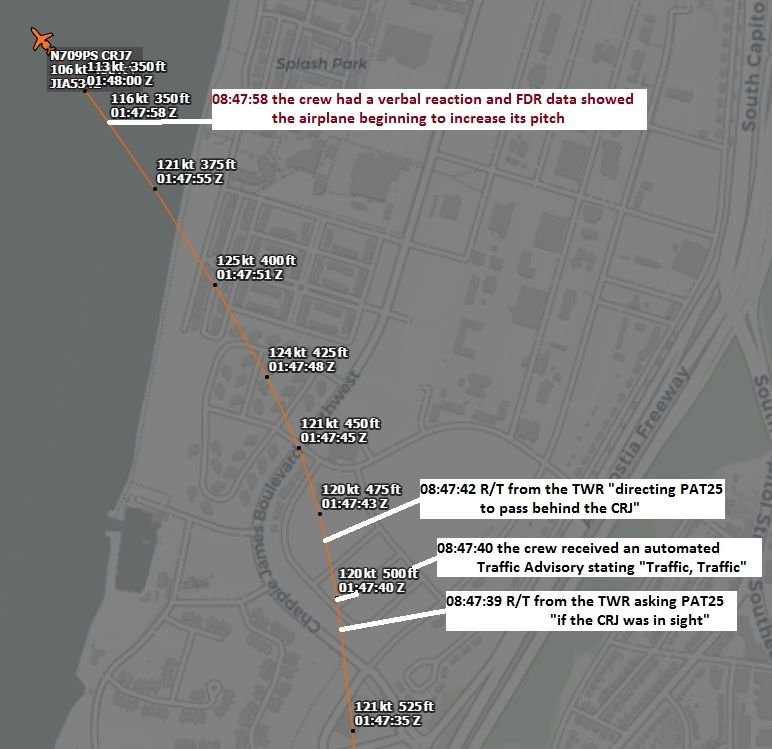
to put "all the way" into context, 18 seconds is what they had
Subjects
ADSB (All)
NTSB
TCAS (All)
Links are to this post in the relevant subject page so that this post can be seen in context.
Reply to this quoting this original post. You need to be logged in. Not available on closed threads.
February 05, 2025, 00:05:00 GMT
permalink Post: 11821822
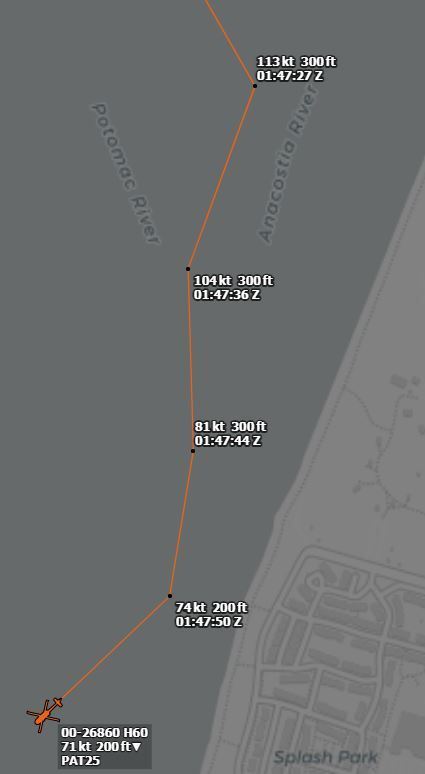
I think the confusion comes from the "amateur MLAT" tracking, which calculates the GS based on the multilaterated position calculations, which have a (relatively) large margin of error:
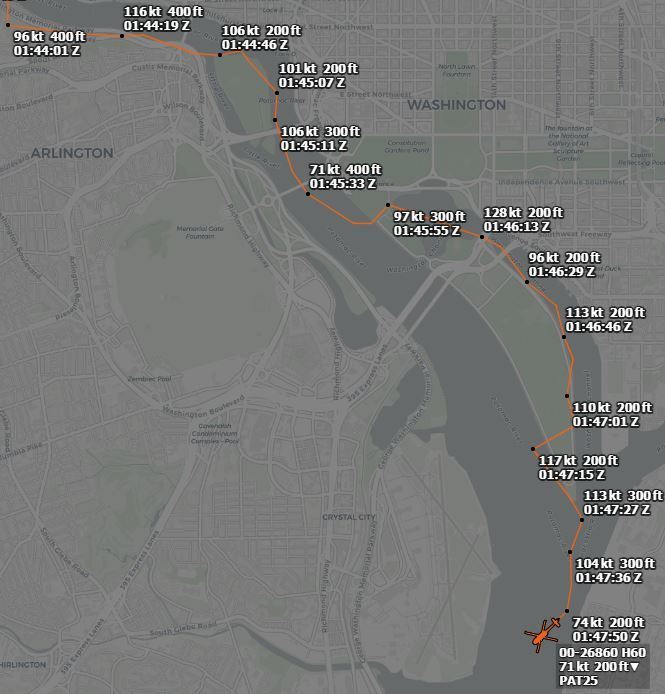
And probably PAT25 was doing initially something in the region of 100kts GS (edit: averaging all but last calculated GS, gives 105kts as average - and over more datapoints, longer trajectory, calculated average GS becomes more reliable)
but at the end it seems there might possibly have been a decreasing GS trend:
Last edited by DIBO; 5th February 2025 at 00:10 . Reason: added calculated average GS
Subjects
ADSB (All)
CRJ
PAT25
Radar
Links are to this post in the relevant subject page so that this post can be seen in context.
Reply to this quoting this original post. You need to be logged in. Not available on closed threads.
February 05, 2025, 03:48:00 GMT
permalink Post: 11821881
We used this quite often when parachute jumpers crossed our approach path to the homebase (from above of course
). We could have done a 360 , but then we would have lost sight of our vertical traffic and a quick stop is more fun.
I my country we widely use a wonderful device called FLARM. It is sort of a pour man's TCAS, using a similar protocol as ADS-B but on a free to use frequency. Shows traffic of other live FLARMS and warns if a Mode-S transponders is approaching (using field strength) . It has another optional feature: a database of low strung cables, power lines and other obstructions our country is infested with. Guess what we had to do in a heli when this alarm went of? Indeed, a quick stop and then a good lookout for cables!
like they say in the industry: “you don’t know what you don’t know”
Trying to quick stop at night as a means of collision avoidance is just dumb anyway.
And fwiw: if you understand VRS training as necessary to recover from mismanaged quick stops, then you need more training.
During a quick stop, your instructor was correct to prepare you for what follows rapidly thereafter with respect to your heading and your need to be ready for some footwork, and to be aware of the torque demand that follows where the wake influences your aircraft. This isn't however vortex ring state, nor is it settling with power, it is a transient related to your wake. The R-22 has adequate but not fantastic tail rotor authority, the UH-60 has an excellent tail rotor befitting a damned fine tactical/combat helicopter.
You can get through a complete aviation career in helicopters without opening up any books beyond your training manuals. Helicopters also bite back hard if you.step out of line, so my suggestion is that you may frame Torquetalk's comment: “you don’t know what you don’t know” , and enjoy reading about your machines physics.
Subjects
ADSB (All)
Blackhawk (H-60)
TCAS (All)
Links are to this post in the relevant subject page so that this post can be seen in context.
Reply to this quoting this original post. You need to be logged in. Not available on closed threads.
February 05, 2025, 19:16:00 GMT
permalink Post: 11822469
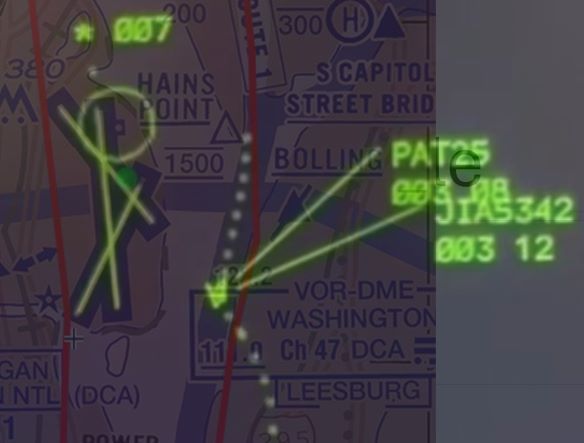
The position of the collision shown in the radar data overlay is consistent with the position of the RJ as shown in ADS-B Exchange at the time of the collision (approximately 01:47:59Z according to the NTSB timeline). See this link from DIBO for the RJ Track with timing AA5342 Down DCA In my experience, times in ADS-B Exchange are generally accurate to within 2 seconds. Given all that, I believe that the Black Hawk was within the horizontal bounds of Route 4 at the time of the collision and that it did not make the right turn we see in the ADS-B Exchange map.
Edit: Corrected route number and helicopter
Last edited by airplanecrazy; 6th February 2025 at 01:24 .
Subjects
AA5342
ADSB (All)
Blackhawk (H-60)
DCA
NTSB
Radar
Route 4
Links are to this post in the relevant subject page so that this post can be seen in context.
Reply to this quoting this original post. You need to be logged in. Not available on closed threads.
February 06, 2025, 21:47:00 GMT
permalink Post: 11823237
Seems to me that the collision altitude is reasonably well established.
Further, seems to me that the helicopter was reporting 200 feet via the IFF (transponder), probably from the AAU-32 Baro altimeter instrument in the cockpit.
I now understand that the H-60 had an ADS-B capable black box upgrade in place of the original basic IFF (APX-100?), and that the extended (ADS-) squitter message was turned off on the subject flight.
I think it is worth a close review of the static line plumbing to the AAU-32 which is the source of the 29.92 altitude report.
If, for example, the static line became disconnected, then cockpit ambient pressure might influence (bias) the AAU-32's reading.
I'd check the records to see if a pitot-static leak set had been performed in the recent past, and I'd inspect the remnants of cockpit plumbing if practical
Second... I'd check the upgraded ADS-B capable IFF/Transponder to see if it used aircraft static altitude sensed values as it reported "altitude" , and not (ever) use any other value such as altitude above geoid.
Long-shot thoughts, but perhaps worth considering.
Last edited by T28B; 6th February 2025 at 23:48 . Reason: formatting both times
Subjects
ADSB (All)
Altimeter (All)
Links are to this post in the relevant subject page so that this post can be seen in context.
Reply to this quoting this original post. You need to be logged in. Not available on closed threads.
February 07, 2025, 02:58:00 GMT
permalink Post: 11823364

Subjects
ADSB (All)
Altimeter (All)
Links are to this post in the relevant subject page so that this post can be seen in context.
Reply to this quoting this original post. You need to be logged in. Not available on closed threads.
February 07, 2025, 04:52:00 GMT
permalink Post: 11823390
Seems to me that the collision altitude is reasonably well established.
Further, seems to me that the helicopter was reporting 200 feet via the IFF (transponder), probably from the AAU-32 Baro altimeter instrument in the cockpit.
I now understand that the H-60 had an ADS-B capable black box upgrade in place of the original basic IFF (APX-100?), and that the extended (ADS-) squitter message was turned off on the subject flight.
I think it is worth a close review of the static line plumbing to the AAU-32 which is the source of the 29.92 altitude report.
If, for example, the static line became disconnected, then cockpit ambient pressure might influence (bias) the AAU-32's reading.
I'd check the records to see if a pitot-static leak set had been performed in the recent past, and I'd inspect the remnants of cockpit plumbing if practical
Second... I'd check the upgraded ADS-B capable IFF/Transponder to see if it used aircraft static altitude sensed values as it reported "altitude" , and not (ever) use any other value such as altitude above geoid.
Long-shot thoughts, but perhaps worth considering.
There is graphic evidence that the fuselage of the 60 went under the nose of the CRJ700, and they hit is probably established beyond reasonable doubt on this forum, if not in the evidence of the wreckage in the Potomac. The flight path of the CRJ is well established, up until the moment that the aircraft struck. That should itself have put to bed the matter of height in the analysis.
It is highly probable that the 60 was on altitude on their instruments, and the causal factor being misidentification of a visual target beyond 5nm at night, landing on RWY01, while the CRJ is not pointing at the helicopter, it is presenting the red navlight on the port wingtip to the helicopter drivers, along with occasional strobes against a night sky. The vector of the CRJ across the visual sector of the helo crews was a slow translation to the right, and then from off around 10 o'clock the CRJ intersects the RWY33 finals and becomes a stationary target well off the main scan of the helicopter crew. When asked to confirm they are passing behind the CRJ traffic, they have the RWY01 traffic off to their right, and they are reasonably expecting that to be their traffic. If they don't have a breadcrumb trace of the traffic on their ND of tac display, while the outcome is unfortunate, I would argue that misidentification of a target in a condition where misidentification is a high probability is not the primary causal factor, it is a consequence of the practice of mixing crossing LL traffic with landing and TO traffic.
My concerns are not future risk from this condition occurring, failure to place spak filler over the cracks in this practice would be naughty. My concern is the system scapegoating a US Army flight crew doing a task that is arguably unreasonable. The fact that some may consider it just normal practice done badly does not answer the fact that physiological limitations and the kinetics of this situation make a mid air a near certainty, the obvious evidence being they did hit, the day before there was a near-miss/loss of separation.
It is time for command to assume responsibilities that go with their post, and not blame those beneath them that travel in harms way on the implicit faith that command is competent and cares for the crews safety, and the national resource that they represent. To do otherwise is conduct unbecoming.
The CRJ crew were having a normal day, until they were killed. The passengers on board could also reasonably expect that our industry cares enough to actually do what we say we are doing, and to MANAGE SAFETY , if that is not too much to ask for. Managing safety does not equate to box ticking, it is the very fact we have devolved into considering safety in a stochastic system to be assured by compliance that we get to this sorry saga.
Last edited by fdr; 7th February 2025 at 20:23 .
Subjects
ADSB (All)
Altimeter (All)
CRJ
Separation (ALL)
Links are to this post in the relevant subject page so that this post can be seen in context.
Reply to this quoting this original post. You need to be logged in. Not available on closed threads.
February 07, 2025, 10:20:00 GMT
permalink Post: 11823511
Quite extraordinary for a supposed 'recertification' flight.
Subjects
AA5342
ADSB (All)
NTSB
PAT25
Situational Awareness
TCAS (All)
Links are to this post in the relevant subject page so that this post can be seen in context.
Reply to this quoting this original post. You need to be logged in. Not available on closed threads.
February 07, 2025, 11:01:00 GMT
permalink Post: 11823555
Quite extraordinary for a supposed 'recertification' flight.
In another midair collision report, that happened in July 2022 at NorthLas Vegas airport, NTSB put out this:
Interviews with personnel at the air traffic control tower indicated that staffing was deficient, and most staff were required to work mandatory overtime shifts, reaching an annual average of 400 to 500 hours of overtime per controller. According to the air traffic manager (ATM), the inadequate staffing had resulted in reduced training discissions, and the management team was unable to appropriately monitor employee performance. The ATM stated that everyone on the team was exhausted, and that work/life balance was non-existent. It is likely that the cumulative effects of continued deficient staffing, excessive overtime, reduced training, and inadequate recovery time between shifts took a considerable toll on the control tower workforce.
I wonder, how this situation is with DCA ATC service.
I am not trying to blame ATC either. He issued clearance to PAT25 to cross behind and asked (and got) confirmation for CRJ in sight twice. It seems quite clear that helicopter crew did not look at the same airplane that ATC was asking about.
What baffles me here is, that it was obvious a routine procedure to let helicopters cross active runway heading less than 2 miles from runway treshold, leaving practically zero margin for error. Backups, designed to catch pilots or ATC errors (TCAS and ATC alarms) cannot catch up in short time left if someone makes a mistake, so this arrangement as based on "see and avoid" concept, in the night, with many lights in the background and a fact, that other aircraft on collision course does not move relatively on the screen, but just grows bigger. Unfortunatelly, that dot on the screen that will kill you starts growing bigger only in the last few seconds.
If I would ask ATC to cross runway heading DAY VFR so close to runway treshold at my airport with incoming commercial traffic, I would be denied 100 times out of 100 attempts. (and probably called nuts).
My guess on this tragedy is, that thru the years, the system was trying to pack more and more aircraft in the same space and same infrastructure, by gradually squeezing margins and safegueards, until one day, Jenga tower collapsed.
Subjects
AA5342
ADSB (All)
ATC
Blackhawk (H-60)
CRJ
DCA
NTSB
PAT25
See and Avoid
Situational Awareness
TCAS (All)
VFR
Links are to this post in the relevant subject page so that this post can be seen in context.
Reply to this quoting this original post. You need to be logged in. Not available on closed threads.
February 07, 2025, 11:52:00 GMT
permalink Post: 11823587
Subjects
AA5342
ADSB (All)
CRJ
NTSB
PAT25
TCAS (All)
Links are to this post in the relevant subject page so that this post can be seen in context.
Reply to this quoting this original post. You need to be logged in. Not available on closed threads.
February 07, 2025, 18:15:00 GMT
permalink Post: 11823828
This page, section "Separation minima based on ATS surveillance systems" quotes ICAO as saying that even in terminal space with good radar, separation should not go below 1,000ft vertically or 3Nm (2.5Nm if established on the same final approach in sequence within 10Nm of the runway). We're already blithely discussing half those standards as being impossible to meet.
Subjects
ADSB (All)
ICAO
Radar
Separation (ALL)
Links are to this post in the relevant subject page so that this post can be seen in context.
Reply to this quoting this original post. You need to be logged in. Not available on closed threads.
February 07, 2025, 18:22:00 GMT
permalink Post: 11823829
This page, section "Separation minima based on ATS surveillance systems" quotes ICAO as saying that even in terminal space with good radar, separation should not go below 1,000ft vertically or 3Nm (2.5Nm if established on the same final approach in sequence within 10Nm of the runway). We're already blithely discussing half those standards as being impossible to meet.
Subjects
ADSB (All)
ICAO
Radar
Separation (ALL)
Vertical Separation
Links are to this post in the relevant subject page so that this post can be seen in context.
Reply to this quoting this original post. You need to be logged in. Not available on closed threads.
February 07, 2025, 22:36:00 GMT
permalink Post: 11823982
Quite extraordinary for a supposed 'recertification' flight.
The recertification flight might specifically need to be at night. It might even specifically require NVG. I also wonder if both pilots would be on NVG or just one of the two.
Last edited by YRP; 7th February 2025 at 22:49 . Reason: Edited to sound 10% less grumpy
Subjects
AA5342
ADSB (All)
NTSB
Night Vision Goggles (NVG)
PAT25
Situational Awareness
TCAS (All)
Links are to this post in the relevant subject page so that this post can be seen in context.
Reply to this quoting this original post. You need to be logged in. Not available on closed threads.