October 16, 2025, 16:07:00 GMT
permalink Post: 11971014
Every pax jet is separated by SIDs and STARs, with either lateral and/or vertical separation. That is what is required here with the choppers. Playing TCAS dodgem-cars below 1000ft when you're trying to land is not the way to go.
Point 3 is the only one that makes any real sense. The rest sound good only to the great-unwashed.
"Directs the Army OIG to initiate a safety coordination audit. The Army Inspector General has declined to voluntarily review the Army's aviation safety practices. The Inspector General would conduct an independent review of the Army's approach to safety."
Why does this not make real sense?
The NTSB will very likely (undoubtedly, I think) include, in its report, quite extensive findings about the Army's operations. It was at least very unusual, if not unprecedented, for the NTSB to issue urgent recommendations to FAA in the immediate aftermath of January 29 with regard to use of the helicopter routes. On these facts, why is it not sensible to require the Army to undergo an IG review?
Although without a service record, I do generally understand the idea that the Army's task and purpose is lethality, at least in the meaning of that term before the assemblage at Quantico earlier this fall. Surely operating in domestic airspace doesn't make safety irrelevant "becasue lethality", does it?
One other aspect of this tragic and from many perspectives senseless midair collision is that very dedicated professional people in the aviation field are going to have their respective actions and failures to act in the events of January 29 scrutinized in the most harshly critical light in a courtroom. Bluntly, their performance will be trashed - the Army pilots, one or more controllers, and as discussed recently on this thread, the airline aviators too. On these facts, and hoping that reasonable minds may differ, I think the IG review isn't just a sensible idea, it's a necessity. It is something owed to those people, who are not going to speak up in their defense, or in their eternal regrets, from the great beyond. The least the United States can do is to find out what to do better. I'll work for the IG project, gratis, .... if they'd take me.
Subjects
ADSB (All)
ADSB In
ATC
FAA
Findings
NTSB
Separation (ALL)
TCAS (All)
Vertical Separation
Links are to this post in the relevant subject page so that this post can be seen in context.
Reply to this quoting this original post. You need to be logged in. Not available on closed threads.
October 17, 2025, 14:29:00 GMT
permalink Post: 11971546
"Directs the Army OIG to initiate a safety coordination audit. The Army Inspector General has declined to voluntarily review the Army's aviation safety practices . The Inspector General would conduct an independent review of the Army's approach to safety." Why does this not make real sense? .................... On these facts, why is it not sensible to require the Army to undergo an IG review? .....................
Here, assuming the original quote is accurate (and nothing suggests it's not!), I suspect my bold highlighting above is key. Given the IG decided not to conduct a review of safety practices himself it looks like someone has just told the IG in no uncertain terms "So you don't want to voluntarily review things? Fine - so now we're ordering you to! Run along now like a good little chap and, by the way, when you report back, we'll be paying very close attention to your conclusions - so don't even think of a white-wash!".
I suspect that this is the unwritten message to the IG given they are even highlighting why they are having to order him to do it!
Last edited by Hot 'n' High; 17th October 2025 at 17:38 .
Subjects
ADSB (All)
Links are to this post in the relevant subject page so that this post can be seen in context.
Reply to this quoting this original post. You need to be logged in. Not available on closed threads.
October 17, 2025, 21:29:00 GMT
permalink Post: 11971770
For one example before ADS-B display, ATC once dumped me in front of CAT that required a 90\xb1\xb0 bank to avoid. There were other interesting encounters with CAT in Class E - no longer.
As we saw here, ATC can fall short and altitudes can be missed. An ADS-B display is a valuable backstop - for a small fraction of the cost of TCAS.
Subjects
ADSB (All)
ADSB In
ATC
TCAS (All)
Links are to this post in the relevant subject page so that this post can be seen in context.
Reply to this quoting this original post. You need to be logged in. Not available on closed threads.
October 17, 2025, 22:03:00 GMT
permalink Post: 11971786
As I recall from the interviews, there was no Army aviation policy about how this technology was to be used during DC area flights. Some crews used it, but most did not.
Subjects
ADSB (All)
ATC
Blackhawk (H-60)
CVR
TCAS (All)
Links are to this post in the relevant subject page so that this post can be seen in context.
Reply to this quoting this original post. You need to be logged in. Not available on closed threads.
October 18, 2025, 02:43:00 GMT
permalink Post: 11971869
There's more to the IG part of the proposed legislation than budgeting, however. My first thought when I read the Sen. Commerce Comm. summary was that the IG and - speaking generally here - various senior-level authorities in the Defense (now "War") Department, the Army, and the White House, realized almost immediately after the accident - certainly once the initial set of facts came to light - that an Army IG investigation would be guaranteed to produce one thing at least: free discovery for the accident victims' families and their attorneys. As time has rolled on, and with the first Complaint now on file in federal district court, this dynamic has become even more persuasive imo.
I'll litter the thread with legal stuff only a little more here. Anyone following the thread has seen posts about the application of part of sovereign immunity to claims against the Army and the FAA/DOT, despite the Federal Tort Claims Act. Specifically, sovereign immunity continues to apply where the alleged negligence resulted from a federal entity exercising "discretion" in making some decision based on weighing competing policy interests and requirements (apologies both for repeating myself from prior posts, and for the legal readers, for oversimplifying). I think this case is going to descend very far down "into the weeds" on this issue; the factual development seems very likely to get highly granular. And the reason for this is that ordinarily, the "discretionary function" refers to a specific decision at a particular time based on development of some sort of administrative record. I've resisted the impulse to post a summary of the Varig Airlines case, in which the discretionary function part of sovereign immunity protected the FAA from liability in an aviation accident matter - the FAA had made a specific decision about how to handle inspections of aircraft (again, apologies for oversimplifying). But in the DCA midair ..... I think there was not one decision to which the discretionary function part of sovereign immunity could attach. This was not a case of discretion being exercised by FAA or by the Army at a specific time for making a decision about a particular thing - no, this was for lack of a recognized term - discretionary inertia. A cousin of normalization of deviance.
What does this have to do with the Army IG and higher-ups (and very very higher-ups) telling the IG to stay in their barracks, I mean offices? In examining the presumably many decisions (or just the intertia of informal practices) the Army made about helicopter flights in DCA airspace, and about altimiters, and about NVGs, and all the rest of the actual flying stuff I don't know, the IG would develop a factual record, and a very official one at that, about how far outside the discretionary function exception this situation really was. How much discretionary inertia was at work, and about how many different parts of the factual record. Which in turn would greatly complicate the Army - and FAA/DOT also in my view - defending in court . . . . if not actually sink the sovereign immunity defense pretty early on.
Caveat: there are probably thousands of published court decisions involving the discretionary function exception; I haven't read them (other than Varig Airlines, and that was in law school for my law review article), and I could have botched the analysis here handsomely.
On politicians and opportunists of other sorts: The Senate Commerce Committee has done heavy lifting in the civil aviation sector not long ago, in the aftermath of the MAX accidents. I'd give the professional staff working for the Committee some credit, not to say that I can take a side about ADS-B, but instead that they (and the Senators, obviously) see the greatly impactful aftermath of the DCA midair collision, and want to try to set the system on a better footing. And that's before NTSB's report lands on desks, whether noticed only for a few news cycles (if those even exist still) or instead lands with a thud. I'm anticipating it will be scatching, but many following the thread watched the hearings (and read the interviews), so . . . .
And don't forget, 12.5 billion bucks have been appropriated for new ATC stuff, with another 18 billion waiting, if not in the wings, then in the cloakrooms. Congress never hesitates to try to get in front of where the money is going, and 12 billion here, 18 billion there, pretty soon you're talking..... we hope not another NextGen sad story. Possibly the Senate Committee is staking out territory from which to try to assure this time, modernization gets done and done right. (I know, there are structural issues too, but one hill to die on at a time.)
QUOTE=Propellerhead;11971298]Suing AA is just corporate greed by the lawyers. Don\x92t see how any of this is the fault of the airline pilots.[/QUOTE]
I entirely agree with the second sentence, and "slapping myself upside of the head" if any of my posts even left the door open to suggesting otherwise. At the same time, the legal process exists to adjudicate claims of injured parties, in this instance, the families of the accident victims. Their lawyers are doing what the system expects them to do, and while lawyers as a group will never, in this society, engender feelings of sweetness and light, I don't think greed is the reason claims against the airline were filed. I'll leave to one side the familiarity (slight though it may be) I happen to have with the lawyers who filed the Complaint - it won't help here to say they've done plenty well, they're consummate professionals, and they are ethically bound to press for significant compensation for their clients. Others will, understandably, scoff and say, "yeah, that's what I meant, lawyers are greedy." (There was, some years ago, a law firm gossip message board known as Greedy Associates, but I digress.)
No, I think the attorneys for the accident victims' families had little choice other than to assert claims against the airline, as wretched as I think those claims are. First, the federal defendants might pull off a Hail Mary of some sort and establish sovereign immunity through the discretionary function exception under the Federal Tort Claims Act. Second, there are no punitive damages awards against the federal defendants, even if they are found liable. Third, including these claims helps to develop a thorough (and might I say, persuasive) factual record to argue to the court and to the jury (leaving aside factors about advisory juries in FTCA matters & etc.). One could just say "deep pockets" but I wanted to highlight what I believe was the lawyers' thought process. Of course they'll vehemently assert the airline actually was negligent, meaning the pilots..... wretched, abhorent.
Maybe I can find an organization which would like to intervene in the case, on behalf of professional piloting - the pilots are victims of the screwed up airspace management too, aren't they? - and then become counsel of record in the case. Don't hold any breaths.
Subjects
ADSB (All)
ATC
Accountability/Liability
DCA
FAA
Night Vision Goggles (NVG)
Normalization of Deviance
Links are to this post in the relevant subject page so that this post can be seen in context.
Reply to this quoting this original post. You need to be logged in. Not available on closed threads.
October 18, 2025, 03:44:00 GMT
permalink Post: 11971880
Every pax jet is separated by SIDs and STARs, with either lateral and/or vertical separation. That is what is required here with the choppers. Playing TCAS dodgem-cars below 1000ft when you're trying to land is not the way to go.
Point 3 is the only one that makes any real sense. The rest sound good only to the great-unwashed.
Subjects
ADSB (All)
ADSB In
ATC
Separation (ALL)
TCAS (All)
Vertical Separation
Links are to this post in the relevant subject page so that this post can be seen in context.
Reply to this quoting this original post. You need to be logged in. Not available on closed threads.
October 18, 2025, 10:20:00 GMT
permalink Post: 11971999
It would not have changed much for the AA CRJ either , the TA would have been more precise and maybe a second or two earlier , but he had already 2 TAs and most certainly so short from landing the PF was focusing on the PAPI not his TA display
It might have changed something if the Heli was equipped with a CDTI ( ADS-B in display) as it is a powerful tool to help identify traffic visually. But not separate yourself from another aircraft . One thing people in offices making such statements forget is that to provide separations maneuvers ATC needs a stable radar picture , with antennas firmly on the ground facing North . Inside an aircraft constantly moving the picture moves with it , (as you can see on your TCAS display ) Extremely complex to separate yourself using that kind of picture when both you and the target are moving. AWACS operators are trained to do this , but not your average pilot .
So I think this ADS-B on the Military Helis is a red herring made by politicians wanting to appear to \x93do something \x93 and perhaps distract the public from the FAA and regulator failures on both the design of the airspace / routes and the lack of action after numerous previous serious incidents reports ,
Subjects
ADSB (All)
ADSB In
ATC
CRJ
FAA
Radar
TCAS (All)
Links are to this post in the relevant subject page so that this post can be seen in context.
Reply to this quoting this original post. You need to be logged in. Not available on closed threads.
October 18, 2025, 12:38:00 GMT
permalink Post: 11972056
It would not have changed much for the AA CRJ either , the TA would have been more precise and maybe a second or two earlier , but he had already 2 TAs and most certainly so short from landing the PF was focusing on the PAPI not his TA display
It might have changed something if the Heli was equipped with a CDTI ( ADS-B in display) as it is a powerful tool to help identify traffic visually. But not separate yourself from another aircraft . One thing people in offices making such statements forget is that to provide separations maneuvers ATC needs a stable radar picture , with antennas firmly on the ground facing North . Inside an aircraft constantly moving the picture moves with it , (as you can see on your TCAS display ) Extremely complex to separate yourself using that kind of picture when both you and the target are moving. AWACS operators are trained to do this , but not your average pilot .
So I think this ADS-B on the Military Helis is a red herring made by politicians wanting to appear to “do something “ and perhaps distract the public from the FAA and regulator failures on both the design of the airspace / routes and the lack of action after numerous previous serious incidents reports ,
Can I add some sympathy for the AA crew - A night over water runway change on final combined with dodging traffic is a LOT to ask of anyone. I can't say for sure what they would have done with ADS-B on the chopper, they said they would miss us, not by how much and we are 30 seconds from landing. The benefit here is the helo crew realizing they are dodging the wrong airplane.
* full disclosure, I have had a close call with the helo traffic there more than once, back in the day they did some crazy stuff. I would have LOVED to have seen them coming on a screen if such a thing had existed.
Last edited by island_airphoto; 18th October 2025 at 13:00 .
Subjects
ADSB (All)
ADSB In
ATC
CRJ
Close Calls
FAA
Radar
TCAS (All)
Links are to this post in the relevant subject page so that this post can be seen in context.
Reply to this quoting this original post. You need to be logged in. Not available on closed threads.
October 18, 2025, 19:27:00 GMT
permalink Post: 11972195
Subjects
ADSB (All)
ATC
IFR
Separation (ALL)
VFR
Links are to this post in the relevant subject page so that this post can be seen in context.
Reply to this quoting this original post. You need to be logged in. Not available on closed threads.
October 18, 2025, 20:47:00 GMT
permalink Post: 11972223
.
ADS-B in, together with a CDTI, is what I said to be L

Subjects
ADSB (All)
ADSB In
ADSB Out
ATC
Blackhawk (H-60)
FAA
Links are to this post in the relevant subject page so that this post can be seen in context.
Reply to this quoting this original post. You need to be logged in. Not available on closed threads.
October 19, 2025, 08:59:00 GMT
permalink Post: 11972330
Subjects
ADSB (All)
IFR
Separation (ALL)
VFR
Links are to this post in the relevant subject page so that this post can be seen in context.
Reply to this quoting this original post. You need to be logged in. Not available on closed threads.
October 20, 2025, 01:09:00 GMT
permalink Post: 11972783
Subjects
ADSB (All)
ADSB In
ADSB Out
ATC
Links are to this post in the relevant subject page so that this post can be seen in context.
Reply to this quoting this original post. You need to be logged in. Not available on closed threads.
October 20, 2025, 10:42:00 GMT
permalink Post: 11972979
Last edited by ATC Watcher; 20th October 2025 at 11:59 . Reason: typos
Subjects
ADSB (All)
ADSB In
TCAS (All)
Links are to this post in the relevant subject page so that this post can be seen in context.
Reply to this quoting this original post. You need to be logged in. Not available on closed threads.
October 20, 2025, 14:28:00 GMT
permalink Post: 11973153
The following video is from NTSB, about 8 years ago concerning the midair collision between Cessna 150M, N3601V and Lockheed Martin F-16CM, 96-0085
From the description:
Subjects
ADSB (All)
ADSB In
ATC
NTSB
Links are to this post in the relevant subject page so that this post can be seen in context.
Reply to this quoting this original post. You need to be logged in. Not available on closed threads.
October 20, 2025, 23:10:00 GMT
permalink Post: 11973389
Subjects
ADSB (All)
ADSB In
ADSB Out
Radar
TCAS (All)
Links are to this post in the relevant subject page so that this post can be seen in context.
Reply to this quoting this original post. You need to be logged in. Not available on closed threads.
October 20, 2025, 23:41:00 GMT
permalink Post: 11973406
(the same thing happens with boat transponders, once you get close enough to throw a beer at the other boat they can be on the opposite side of you as the traffic display shows)
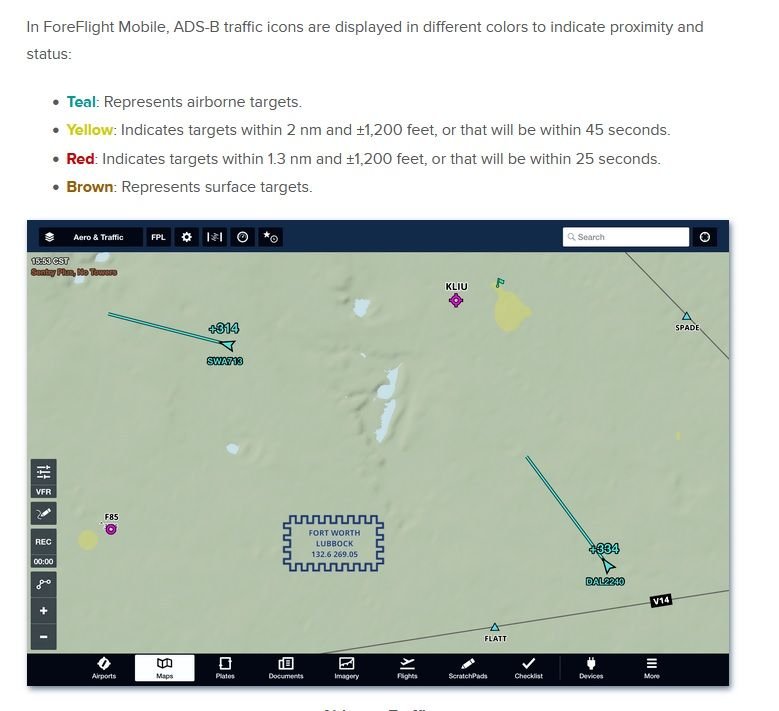
For myself, I get to look at the pretty colors. If I was the AA plane the helo would have been red, but it was close enough to be red even if it was going behind me.
Last edited by island_airphoto; 20th October 2025 at 23:54 .
Subjects
ADSB (All)
ADSB Out
Radar
Separation (ALL)
TCAS (All)
Links are to this post in the relevant subject page so that this post can be seen in context.
Reply to this quoting this original post. You need to be logged in. Not available on closed threads.
October 22, 2025, 14:57:00 GMT
permalink Post: 11974342
Subjects
ADSB (All)
ADSB In
ADSB Out
Links are to this post in the relevant subject page so that this post can be seen in context.
Reply to this quoting this original post. You need to be logged in. Not available on closed threads.
December 13, 2025, 03:58:00 GMT
permalink Post: 12004467
Subjects
ADSB (All)
ADSB Out
ATC
Route 4
Separation (ALL)
Vertical Separation
Links are to this post in the relevant subject page so that this post can be seen in context.
Reply to this quoting this original post. You need to be logged in. Not available on closed threads.
December 13, 2025, 04:41:00 GMT
permalink Post: 12004472
The argument that the NTSB Chair and the Congressional people who are opposed have heard some imperative to "don't just sit there, do something" is a straw man, imo.
But taking it with more credence than it seems to deserve, how do you explain the absence of much, or really any, opposition to the NTSB's recommendation issued shortly after the accident? Too much heat in the aftermath of the tragedy to state the opposition at that time, instead wait until things died down?
Subjects
ADSB (All)
ADSB Out
ATC
NTSB
Route 4
Separation (ALL)
Vertical Separation
Links are to this post in the relevant subject page so that this post can be seen in context.
Reply to this quoting this original post. You need to be logged in. Not available on closed threads.
December 13, 2025, 05:20:00 GMT
permalink Post: 12004479
As a result of this investigation, we issued 2 urgent new recommendations. We issued recommendations to:
To the Federal Aviation Administration:
Prohibit operations on Helicopter Route 4 between Hains Point and the Wilson Bridge when runways 15 and 33 are being used for departures and arrivals, respectively, at Ronald Reagan Washington National Airport (DCA). (Urgent)
Designate an alternative helicopter route that can be used to facilitate travel between Hains Point and the Wilson Bridge when that segment of Route 4 is closed. (Urgent)
The CRJ was equipped with TCAS, which may or may not have been applicable at this low altitude as it is suppressed at 400 ft. The preliminary report does not indicate the helicopter having a TCAS or having an operating one. It did have the ability to produce ADS-B Out. Neither aircraft is reported to have had ADS-B In.
Since many operators seem to loath spending money on ADS-B In, the recommendation from the NTSB was to (1) stop simultaneous flight path use and (2) go elsewhere when the approaches were in use. The FAA agreed.
Per https://data.ntsb.gov/carol-main-pub...tails/A-25-001 the FAA did what was recommended about simultaneous use.
Per https://data.ntsb.gov/carol-main-pub...tails/A-25-002 the FAA made a satisfactory response concerning planning the alternate route(s)
This legislation is the exact opposite of that recommendation.
No doubt the anger isn't just that the NTSB has yet again been ignored, it's that the FAA agreements to safety measures are targeted for destruction in a way that recreates the circumstance of the tragic event.
I said at first, on seeing this collision a few hours after the event, that I felt rage that so many safety measures are available and yet none of them was actually used.
This section, 373, is what I consider an intentional sabotage of the safe operations around DCA.
The FAA literally had advertising videos showing the use of ADS-B In on helicopters for this exact purpose, to give situational awareness to the pilots long before there would be a need to deconflict with other traffic (see end) . No sudden swerves as TCAS attempts to make a last moment save of a terrible situation. TCAS alone cannot be the solution as TCAS gets shut off to avoid nuisance complaints about the terrain the plane is intentionally going to run into or other proximate planes waiting for takeoff.
ADS-B In is for noting where everyone else is in the neighborhood of the aircraft. Had the helicopter been equipped with ADS-B In they would have known the speed and direction of the CRJ and seen it was on a collision course.
As usual it appears there is no name attached nor meeting notes about who submitted what became Section 373. There is certainly no justification paper that will see the light of day.
If those exist, please, someone, prove me wrong.
I cannot find it on YouTube.
An actual user who avoided a mid-air using ADS-B In (Trent Palmer, if anyone wants to avoid him; not everyone is liked):
Subjects
ADSB (All)
ADSB In
ADSB Out
CRJ
DCA
FAA
NTSB
Preliminary Report
Route 4
Section 373 of the FY26 NDAA
Situational Awareness
TCAS (All)
Links are to this post in the relevant subject page so that this post can be seen in context.
Reply to this quoting this original post. You need to be logged in. Not available on closed threads.