May 03, 2025, 01:51:00 GMT
permalink Post: 11877495
I know of three collisions between PowerFLARM equipped aircraft where the PowerFLARM in one aircraft was not operating - in one case fatal to the instructor and student .
Subjects
ADSB (All)
ADSB Out
Links are to this post in the relevant subject page so that this post can be seen in context.
Reply to this quoting this original post. You need to be logged in. Not available on closed threads.
August 08, 2025, 10:02:00 GMT
permalink Post: 11935129
What I learned:
Interestingly the Local controller involved was also a CPL pilot
Pressure to use 33 for landing during high departure rates was there to avoid the queue blocking the taxi ways for arriving aircraft : ( my comment : when you get to that situation traffic should be reduced by departure slots , that what we do in Europe with the Network manager CTOTs..)
No reaction to Conflict alert because visual acquisition was prioritized , i.e if you saw the helicopter passing behind you disregarded the CA. and this was almost always the case so CA with helicopters became disregarded
Advanced training was poor or non existent ( e.g Threat/Error management training).
On the PAT pilots interviews the most flagrant normalization of deviance is requesting visual separation with an aircraft you do not see ( yet) I realize that was declared by pilots other that the one operating that flight , but gives a good indication of the local " best practices " in that area.
Finally on the TCAS issue, one of the screenshots shows other traffic, and we can see that there were 2 TAs one in front -2 and one behind +6 , that could ( emphasis on could) have been one of the reason the CRJ crew missed the urgency of the -2 , but also probably were more focusing on the PAPI so both looking outside instead of at the display .
And to reply to a question earlier by DIBO on the discussion about ADS-B out not avail on the RAT, and its relevance for TCAS, well it would have influenced the degree of accuracy of the Tau calculation ( with Alt returns every 25 ft instead of 100 feet) and could ( again emphasis on could) have changed the alert logic/timing of the TA. Non installation of ADS-B and flying 70 ft too high are probably one of the points the lawyers are going to get into to prove negligence from the military to get more money for their clients , possibly shadowing the real causes. ; which for me are still the design of the procedure and routes, and the failure of the Regulator to act on the alerts. . Love to hear Willow-Run 6-3 comment on this .
.
Subjects
ADSB (All)
ADSB Out
ATC
CRJ
DCA
Normalization of Deviance
Separation (ALL)
TCAS (All)
Visual Separation
Links are to this post in the relevant subject page so that this post can be seen in context.
Reply to this quoting this original post. You need to be logged in. Not available on closed threads.
August 08, 2025, 16:19:00 GMT
permalink Post: 11935293
And to reply to a question earlier by DIBO on the discussion about ADS-B out not avail on the [P]AT, and its relevance for TCAS, well it would have influenced the degree of accuracy of the Tau calculation ( with Alt returns every 25 ft instead of 100 feet) and could ( again emphasis on could) have changed the alert logic/timing of the TA. Non installation of ADS-B and flying 70 ft too high are probably one of the points the lawyers are going to get into to prove negligence from the military to get more money for their clients , possibly shadowing the real causes. ; which for me are still the design of the procedure and routes, and the failure of the Regulator to act on the alerts. . Love to hear Willow-Run 6-3 comment on this .
.
As for the airline, to fault the pilots when they were on short finals and expected to concentrate on flying - as others have expressed here numerous times - seems very ill-founded. Whether the airline company could be alleged to have responsibility for not having spoken up more effectively to cause the airspace design and procedure to be redone also strikes me as far too oblivious to the actual operation of the NAS, and the FAA and Congressional processes, to have any validity as an approach to liability. The airline and even Sikorski could still be named as defendants but, to reiterate, this would be just for leverage and not because there is any real pathway to liability for either one.
That having been set as background, the first context ignores the existence of sovereign immunity issues and looks just at what happened and who was responsible. As a rubric for this, "normalization of deviance" seems very accurate. This includes the fact that over time, ignoring Conflict Alerts came to be routine. It includes the practice of confirming "traffic in sight" or related proper terminology, for visual separation even though no traffic had been sighted yet - because it had become routine that the traffic would come into view and be properly identified as the traffic ATC had called out. The testimony about "just make it work", as I heard it, similarly was very concerning; iirc an overall very credible FAA witness acknowledged that the "just make it work" attitude also resulted in decreased safety margins. As did the medical helicopter operator who also had Army helicopter service background. Add in the lack of advanced training, and though I have not practiced law as legal counsel for accident victims' families, the liability theories here appear strong.
Then factor in the use of 3-3 to allievate congestion from high departure rates, rather than slowing or reducing departure slots. Part of the pressure to use 3-3 (as I understood the testimony) was that the Potomac Tracon wanted to increase in-trail separation but DCA instead increased use of 3-3. This was consistent with the attitude, "just make it work".
As to ADS-B on the helicopters, my understanding is that given the roles and missions of the helicopter operations, ADS-B is not equippage the military and its civilian control (in the sense of oversight) could have approved consistent with those roles and missions generally, and especially the continuing-of-government function.
Putting all the causal factors together into a "theory of the case" is perhaps better left to advocates for the accident victims' families (just as defense theories better left to defense counsel in this matter). But since you've impliedly asked, I would not - in this first context - parse out three of the four factors you noted, the lack of ADS-B being the one left out. That leaves the helicopter operating approximately 70 feet too high, the airspace design and procedures including the helicopter routes, and the inaction following the several safety alerts in databases and other reporting functions prior to the occurence of the accident. And including the forced enlistment of DCA for handling more traffic than the widely accepted airspace utilization and safe operation rules and procedures would allow - but they "just made it work." In other words, all of these three factors combine into the most likely theory of liability.
There is a second context, however. Federal government defendants are protected, despite the broad removal (waiver) of sovereign immunity by federal statute, from liability if the alleged negligence resulted from the exercise of discretion. If the actions or omissions being challenged resulted from decisions in which the federal entity weighed economic, social, political and other factors against each other in a form of "policy" decision-making, sovereign immunity remains in place. You can see where this is leading, of course. At what point does the over-use of DCA move out of the protection of "discretionary functions and decision-making" and into the realm of ... just plain negiligence which needs to be addressed in a court action. And likewise, at what point does the Army's set of decisions about how the routes are flown, and how visual separation and traffic sightings are handled, move out of the protection given by discretionary decisions and into the realm of significant negligence not deserving of such protection? Same question for FAA - surely the presence of safety concerns in databases and reporting systems - as unorganized as they may be and as lacking in systematic review as they may be - are matters within the FAA's discretionary functions and decision-making . . . until they're not. (And not equipping PAT helicopters or other D.C.-based Very Important air transport operations by helicopter with ADS-B would have no chance of being ruled not resulting from a discretionary function and decision - it's not even arguable imo.)
I almost included with this (already lengthy) post the "syllabus" of the U.S. Supreme Court's decision in the United States v. Varig Airlines case, which I think is the most pertinent aviation case in which the discretionary function rule is fundamentally involved....but this isn't a legal forum. Still, the U.S. S. Ct. opinion (467 U.S. 797 1984) gives me uncertainty about how any court of competent jurisdiction will draw the line between what would in a case against a not-federal defendant definitely appear to be negligence, and the actions and omissions of the federal defendants here. (My personal view is that the federal defendants acted with such severe negligence that the discretionary function protection has been lost - but that is a gut reaction to the "this accident never should have happened" idea and not legal analysis.)
Finally and last for a reason, I am not commenting about the motives of legal counsel who are representing or advising clients involved in this matter. I have not practiced law a single day, or a single billable hour, or otherwise, on behalf of the families or representatives of aviation accident victims, or the defendants in such matters. As a result, in participation as a guest on this forum I think it's much wiser to let the members of the bar who do have clients and who do practice in this area let their conduct in their professional capacities speak for itself.
Subjects
ADSB (All)
ADSB Out
ATC
Accountability/Liability
DCA
FAA
Normalization of Deviance
Separation (ALL)
TCAS (All)
Traffic in Sight
Visual Separation
Links are to this post in the relevant subject page so that this post can be seen in context.
Reply to this quoting this original post. You need to be logged in. Not available on closed threads.
August 09, 2025, 23:17:00 GMT
permalink Post: 11935941
DOT inspector launches probe into FAA\x92s Washington DC airspace management
The US Department of Transportation\x92s top inspector has launched an investigation into the Federal Aviation Administration\x92s management of airspace near Washington, DC.
The investigation will focus on the agency\x92s design of the airspace and its process of granting military exemptions to a requirement that aircraft use Automatic Dependent Surveillance-Broadcast (ADS-B) systems.
The review, disclosed by the DOT\x92s Office of Inspector General on 8 August, comes amid scrutiny over the FAA\x92s operations \x96 a response to the 29 January midair collision involving a US Army Sikorsky UH-60L Black Hawk helicopter and a PSA Airlines MHIRJ CRJ700 regional jet.
The helicopter had not been transmitting ASB-B \x93Out\x94 information when, flying higher than permitted, it collided with the CRJ700, which was moments from landing at Ronald Reagan Washington National airport, the National Transportation Safety Board has said.
Both aircraft plummeted into the Potomac River, killing all 65 people on the regional jet and all three on the Black Hawk. The Black Hawk had been operating a pilot training flight.
\x93We are initiating this audit to review FAA\x92s oversight of existing safety gaps in the management of DCA\x92s airspace, including the exemption process for ADS-B Out,\x94 says the DOT inspector\x92s office. \x93Our audit objectives are to assess FAA\x92s oversight and management of the airspace surrounding DCA, and policies and procedures to oversee ADS-B Out exemptions.\x94
The office intends to begin the audit this month.
The investigation comes at the request of two senators who asked the inspector general \x93to review a wide-ranging set of safety issues surrounding the accident\x94, the DOT office adds.
The FAA has since 2020 required aircraft have and use ADS-B Out, a system that transmits an aircraft\x92s position and other information about is flight to air traffic controllers. Aircraft equipped with ADS-B \x93In\x94 \x96 which the FAA does not mandate \x96 also receive the position reports. The ADS-B system is intended to give controllers and pilots more information about air traffic, helping prevent collisions.
Under a compromise with military and government aircraft operators, the FAA permits government aircraft operating \x93sensitive\x94 missions to be exempt from the ADS-B Out requirement. It has allowed those operators to define which missions are sensitive.
The US Army has used that exemption extensively when flying helicopters in the Washington, DC region.
On 29 July, senator Ted Cruz introduced a bill that if passed would prohibit government training flights from qualifying for the exemption. It would also require that all aircraft, within five years, have and use ADS-B In.
Subjects
ADSB (All)
ADSB In
ADSB Out
Blackhawk (H-60)
DCA
FAA
Links are to this post in the relevant subject page so that this post can be seen in context.
Reply to this quoting this original post. You need to be logged in. Not available on closed threads.
October 16, 2025, 04:57:00 GMT
permalink Post: 11970724
___________
Rotor Operations Transparency and Oversight Reform (ROTOR) Act
Upgrading In-Flight Safety Technology and Fixing Helicopter Operations to Eliminate Risk
[Sponsors] Senators Ted Cruz (R-TX), Jerry Moran (R-KS), Marsha Blackburn (R-TN), Ted Budd (R-NC), Shelley Moore Capito (R-WV), Roger Marshall (R-KS), Eric Schmitt (R-MO), Tim Sheehy (R-MT), Todd Young (R-IN)
The Problem : The midair collision between American Airlines Flight 5342 and an Army Black Hawk helicopter on January 29th was preventable. For decades, the airspace around the Ronald Reagan Washington National Airport (DCA) operated without an accident, but with thousands of close calls that should have resulted in preventive action. The Black Hawk was likely operating in congested airspace without transmitting Automatic Dependent Surveillance Broadcast (ADS-B) Out\x97a satellite beacon technology that can transmit location, altitude, and velocity to air traffic control and other nearby aircraft faster than radar or other transponders. The airspace is only as safe as its least equipped aircraft, which is why military aircraft must not play by different rules.
The Solution: The ROTOR Act
The ROTOR Act improves aviation safety, addresses FAA knowledge and oversight of ADS-B, and directs the Army Inspector General (OIG) to reevaluate its aviation safety practices. The bill requires:
1. All aircraft operators to equip with ADS-B In technology and transmit such information. ADS-B In is a technology for aircraft to receive location signals from other nearby aircraft and ground technology, improving safety in the sky and on runways.
2. Closes Federal Aviation Administration (FAA) loophole that permitted the Army Black Hawk to fly without broadcasting ADS-B Out. The ROTOR Act allows the FAA to only grant exceptions for \x93sensitive government missions,\x94 not training flights.
3. Requires the FAA to review helicopter routes near airports. The FAA would comprehensively evaluate the airspace at congested airports\x97where helicopters and airplanes are flying near each other\x97nationwide.
4. Directs the Army OIG to initiate a safety coordination audit. The Army Inspector General has declined to voluntarily review the Army\x92s aviation safety practices. The Inspector General would conduct an independent review of the Army's approach to safety.
5. Initiates FAA study on dynamic restricted area for helicopters near airports. The FAA would review whether audio and visual signals could be deployed to reduce airspace confusion and avoid traffic conflicts.
6. Repeals a Fiscal Year 2019 NDAA provision that exempted the Department of Defense from enacted ADS-B transmission requirements.
Why This Matters: The tragic midair collision earlier this year exposed serious and systemic weaknesses in how civilian and military aircraft share and operate in congested airspace. While the National Transportation Safety Board (NTSB) investigation continues, initial findings show glaring failures in oversight and coordination that must be addressed now, not later. The ROTOR Act was drafted in direct response to the operational shortcomings that led to the midair collision. Deconflicting congested airspace and establishing better communication standards between civilian and military aircraftis not optional\x97it is essential. The ROTOR Act does exactly that, ensuring American skies remain the safest in the world.
Subjects
ADSB (All)
ADSB In
ADSB Out
Blackhawk (H-60)
Close Calls
DCA
FAA
Findings
NDAA
NTSB
Radar
Links are to this post in the relevant subject page so that this post can be seen in context.
Reply to this quoting this original post. You need to be logged in. Not available on closed threads.
October 18, 2025, 20:47:00 GMT
permalink Post: 11972223
.
ADS-B in, together with a CDTI, is what I said to be L

Subjects
ADSB (All)
ADSB In
ADSB Out
ATC
Blackhawk (H-60)
FAA
Links are to this post in the relevant subject page so that this post can be seen in context.
Reply to this quoting this original post. You need to be logged in. Not available on closed threads.
October 20, 2025, 01:09:00 GMT
permalink Post: 11972783
Subjects
ADSB (All)
ADSB In
ADSB Out
ATC
Links are to this post in the relevant subject page so that this post can be seen in context.
Reply to this quoting this original post. You need to be logged in. Not available on closed threads.
October 20, 2025, 23:10:00 GMT
permalink Post: 11973389
Subjects
ADSB (All)
ADSB In
ADSB Out
Radar
TCAS (All)
Links are to this post in the relevant subject page so that this post can be seen in context.
Reply to this quoting this original post. You need to be logged in. Not available on closed threads.
October 20, 2025, 23:41:00 GMT
permalink Post: 11973406
(the same thing happens with boat transponders, once you get close enough to throw a beer at the other boat they can be on the opposite side of you as the traffic display shows)
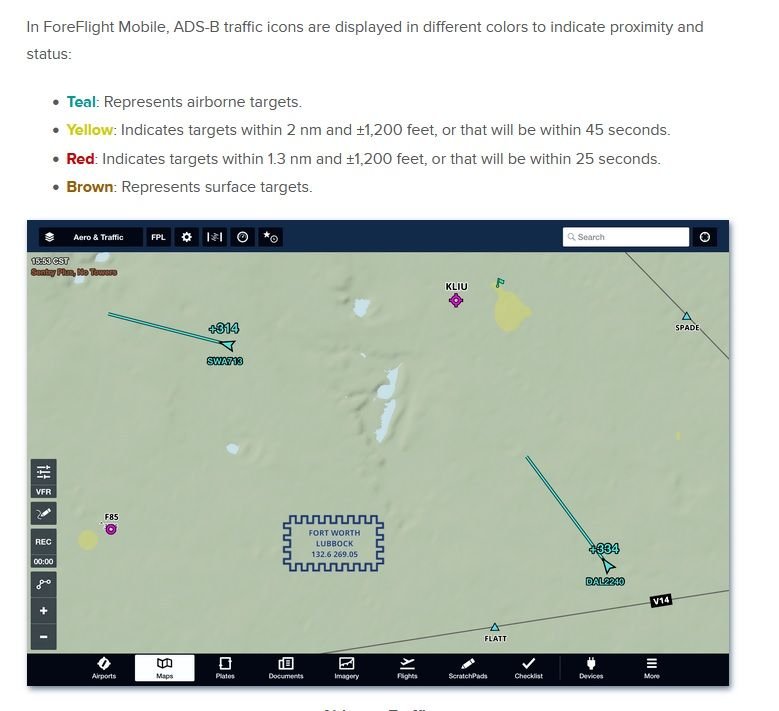
For myself, I get to look at the pretty colors. If I was the AA plane the helo would have been red, but it was close enough to be red even if it was going behind me.
Last edited by island_airphoto; 20th October 2025 at 23:54 .
Subjects
ADSB (All)
ADSB Out
Radar
Separation (ALL)
TCAS (All)
Links are to this post in the relevant subject page so that this post can be seen in context.
Reply to this quoting this original post. You need to be logged in. Not available on closed threads.
October 22, 2025, 14:57:00 GMT
permalink Post: 11974342
Subjects
ADSB (All)
ADSB In
ADSB Out
Links are to this post in the relevant subject page so that this post can be seen in context.
Reply to this quoting this original post. You need to be logged in. Not available on closed threads.
December 13, 2025, 03:58:00 GMT
permalink Post: 12004467
Subjects
ADSB (All)
ADSB Out
ATC
Route 4
Separation (ALL)
Vertical Separation
Links are to this post in the relevant subject page so that this post can be seen in context.
Reply to this quoting this original post. You need to be logged in. Not available on closed threads.
December 13, 2025, 04:41:00 GMT
permalink Post: 12004472
The argument that the NTSB Chair and the Congressional people who are opposed have heard some imperative to "don't just sit there, do something" is a straw man, imo.
But taking it with more credence than it seems to deserve, how do you explain the absence of much, or really any, opposition to the NTSB's recommendation issued shortly after the accident? Too much heat in the aftermath of the tragedy to state the opposition at that time, instead wait until things died down?
Subjects
ADSB (All)
ADSB Out
ATC
NTSB
Route 4
Separation (ALL)
Vertical Separation
Links are to this post in the relevant subject page so that this post can be seen in context.
Reply to this quoting this original post. You need to be logged in. Not available on closed threads.
December 13, 2025, 05:20:00 GMT
permalink Post: 12004479
As a result of this investigation, we issued 2 urgent new recommendations. We issued recommendations to:
To the Federal Aviation Administration:
Prohibit operations on Helicopter Route 4 between Hains Point and the Wilson Bridge when runways 15 and 33 are being used for departures and arrivals, respectively, at Ronald Reagan Washington National Airport (DCA). (Urgent)
Designate an alternative helicopter route that can be used to facilitate travel between Hains Point and the Wilson Bridge when that segment of Route 4 is closed. (Urgent)
The CRJ was equipped with TCAS, which may or may not have been applicable at this low altitude as it is suppressed at 400 ft. The preliminary report does not indicate the helicopter having a TCAS or having an operating one. It did have the ability to produce ADS-B Out. Neither aircraft is reported to have had ADS-B In.
Since many operators seem to loath spending money on ADS-B In, the recommendation from the NTSB was to (1) stop simultaneous flight path use and (2) go elsewhere when the approaches were in use. The FAA agreed.
Per https://data.ntsb.gov/carol-main-pub...tails/A-25-001 the FAA did what was recommended about simultaneous use.
Per https://data.ntsb.gov/carol-main-pub...tails/A-25-002 the FAA made a satisfactory response concerning planning the alternate route(s)
This legislation is the exact opposite of that recommendation.
No doubt the anger isn't just that the NTSB has yet again been ignored, it's that the FAA agreements to safety measures are targeted for destruction in a way that recreates the circumstance of the tragic event.
I said at first, on seeing this collision a few hours after the event, that I felt rage that so many safety measures are available and yet none of them was actually used.
This section, 373, is what I consider an intentional sabotage of the safe operations around DCA.
The FAA literally had advertising videos showing the use of ADS-B In on helicopters for this exact purpose, to give situational awareness to the pilots long before there would be a need to deconflict with other traffic (see end) . No sudden swerves as TCAS attempts to make a last moment save of a terrible situation. TCAS alone cannot be the solution as TCAS gets shut off to avoid nuisance complaints about the terrain the plane is intentionally going to run into or other proximate planes waiting for takeoff.
ADS-B In is for noting where everyone else is in the neighborhood of the aircraft. Had the helicopter been equipped with ADS-B In they would have known the speed and direction of the CRJ and seen it was on a collision course.
As usual it appears there is no name attached nor meeting notes about who submitted what became Section 373. There is certainly no justification paper that will see the light of day.
If those exist, please, someone, prove me wrong.
I cannot find it on YouTube.
An actual user who avoided a mid-air using ADS-B In (Trent Palmer, if anyone wants to avoid him; not everyone is liked):
Subjects
ADSB (All)
ADSB In
ADSB Out
CRJ
DCA
FAA
NTSB
Preliminary Report
Route 4
Section 373 of the FY26 NDAA
Situational Awareness
TCAS (All)
Links are to this post in the relevant subject page so that this post can be seen in context.
Reply to this quoting this original post. You need to be logged in. Not available on closed threads.
December 13, 2025, 05:40:00 GMT
permalink Post: 12004481
It appears I had mistakenly thought NTSB had made a recommendation after the accident about ADS-B. That was incorrect.
It would be interesting to try to unearth the document trail with respect to the agreement reached by FAA and the DoD with regard to ADS-B Out usage, which agreement was reached (per the NTSB Chair letter) after the accident. Of course unearthing documents which relate to controversial subjects could well be a fool's errand. .... ..... ...... oh wait, there's such a thing as pre-trial discovery, and the lawsuits are in federal district court.
Senator Cantwell gave two speeches in recent days on the Senate floor about Section 373. I'm not posting links to them, because "politics". Still, something worth noting from them is that the Senator, previously Chair of the Commerce Committe - the Committee with jurisdiction for civil aviation - and currently Ranking Member, stated she does not know who inserted the highly questionable Section 373 into the NDAA. And whether as prevention or preemption, yes, the families of Flight 5342, including the family of the First Officer, are raising a loud objection to Section 373 - but the concerns over the legislative provision are not based on any effort to serve or to please the trial lawyers suing on the families' behalf. Chairwoman Homendy of the NTSB does indeed operate in a political environment, no kidding, but she is conducting her public advocacy as a safety professional and not a politician. (I'm not lauding any Senator's bona fides as aviation safety advocates because, again "politics.")
Subjects
ADSB (All)
ADSB Out
FAA
NDAA
NTSB
NTSB Chair Jennifer Homendy
Section 373 of the FY26 NDAA
Links are to this post in the relevant subject page so that this post can be seen in context.
Reply to this quoting this original post. You need to be logged in. Not available on closed threads.
December 14, 2025, 14:58:00 GMT
permalink Post: 12005181
- Following the accident, the NTSB recommended that military helo flights not fly that route while 15/33 was in use;
- The FAA concurred, and this was implemented on a temporary basis;
- Section 373 of a bill that has already passed the House would allow military helo flights to resume, as prior to the accident, with 'waivers' to let them fly there as they like;
- The waivers could be granted by many military personnel at different levels of seniority, meaning the waivers would be effectively permanent;
- The NTSB had recommended that military flights in DCA airspace should use ADS-B Out, so that military flights could be detected above 900ft in a busy airspace. The FAA and DoD agreed.
- Section 373 takes away the requirement for ADS-B Out, reducing safety.
- Section 373 gets round the ADS-B Out requirement by specifying that military aircraft should only be required to be able to trigger to TCAS alerts.
- TCAS does not activate at low altitudes, such as when landing, so is useless on the route the helos use to pass DCA.
- Therefore the only reasonable safety measure is not to let military flights onto that route while 15/33 is in use. Section 373 reverses that safety measure.
- 'Someone' sneaked Section 373 into the bill, and nobody knows who or when.
- The bill passed without anybody noticing Section 373.
- So unless the Senate challenges, this legislation will go through
- The legislation would make it harder for families to blame the military/government for the DCA accident, by confirming the correctness of protocols at the time
- Chair Homendy is furious.
If I've got this wrong, can you correct me?
I'm absolutely staggered that something this important could have been 'slipped' into a major piece of legislation, without a final read-through of changes since the last version. Surely there's an audit trail of changes and who submitted or entered them?
Subjects
ADSB (All)
ADSB Out
DCA
FAA
NTSB
NTSB Chair Jennifer Homendy
Section 373 of the FY26 NDAA
TCAS (All)
Links are to this post in the relevant subject page so that this post can be seen in context.
Reply to this quoting this original post. You need to be logged in. Not available on closed threads.
December 14, 2025, 21:41:00 GMT
permalink Post: 12005424
"The NTSB had recommended that military flights in DCA airspace should use ADS-B Out, so that military flights could be detected above 900ft in a busy airspace. The FAA and DoD agreed."
I'm not certain the first sentence above is correct. The letter from the NTSB Chair regarding Section 373 states: "The NTSB has, for decades, advocated for ADS-B In and Out and its substantial contribution to safety, especially near airports."
The NTSB on March 7 issued a pre-preliminary report of sorts, specifically urging immediate action to shut down helicopter route 4 when Runway 33/15 is in use (for landings and departures, respectively). There is no reference to ADS-B in the March 7 urgent recommendation document.
I cannot say how it was that FAA and DoD agreed to start ADS-B Out use by military aircraft in the relevant airspace. But it did not result from the same urgent recommendations, at least insofar as those recommendations were stated in writing on March 7, which led to the closure of helicopter route 4. (I would note that the Preliminary Report by the Board was issued a few days later, on March 11.)
Regarding Section 373's legistative history, to use a term it perhaps does not deserve, there is less mystery than your summation suggests. There certainly are staff of one or both Armed Services Committees, and/or staff of Members serving on one or both of the those Committees, and/or the Representatives and/or Senators who run those Committees, who originated the language, and agreed upon the version that ended up in the legislation (it obviously would have gone through a series of revisions).
So the question is why was their action done without consulting the same people (Committee staff, House/Senate members' staff, and the legislators themselves) whose routine committee work has jurisdiction for civil aviation.
And there's another level also. Where within the defense bureaucracy or some other place in the interagency or executive branch did the impetus for the provision originate? I can see that the post pointing out that the provision, if enacted, would not help the Army in court, is probably correct. What other reason the Army may have had to sponsor the provision (and to do so quietly) I can't say. Which leaves, can it really be that difficult to devise a system for how and when military aircraft with significant emergency or classified operations (as compared to essentially routine operations) need different handling in the airspace?
Subjects
ADSB (All)
ADSB In
ADSB Out
DCA
FAA
NTSB
Preliminary Report
Route 4
Section 373 of the FY26 NDAA
Links are to this post in the relevant subject page so that this post can be seen in context.
Reply to this quoting this original post. You need to be logged in. Not available on closed threads.
December 17, 2025, 03:54:00 GMT
permalink Post: 12006687
Washington, D.C. \x96 Aviation Subcommittee Chairman Troy E. Nehls (R-TX) announced that the Subcommittee will receive testimony from Bryan Bedford, marking his first appearance in front of Congress as Administrator of the Federal Aviation Administration (FAA). Subcommittee Members will have the opportunity to discuss recent regulatory actions taken by the FAA and current issues in aviation, and seek updates on the continued implementation of the FAA Reauthorization Act of 2024. The hearing, entitled, \x93The State of American Aviation,\x94 will be held at 10:00 a.m. ET on Tuesday, December 16, 2025, in 2167 Rayburn House Office Building.
Witness List:
The Honorable Bryan Bedford, Administrator, Federal Aviation Administration, United States Department of Transportation
The video link I am including in this post is from the Forbes magazine website (and I apologize that it includes adverts). I don't know if the video link presumably available on the Subcommittee webpage (or it could be on the Committee webpage) has the same time-stamps as the Forbes video and since it's the one I watched, I'm using it here.
The families of at least some of the families of people who lost their lives in the DCA midair were present for the hearing.
Rep. Nehls (R.-TX), Chair of the Subcomm., and the other three leaders each gave opening statements (Comm. Chair Sam Graves (R.-MO.), Comm. Ranking Member Rick Larsen (D.-WA.), and Subcomm. Ranking Member Andre Carson (D.-IN)). Representative Nehls's opening statement hinted that ADS-B Out and Sec. 373 were going to see some emphasis (unsurprising, as Rep. Nehls had already issued a statement decrying Sec. 373).
The Administrator's testimony started at around 19:00. When he concluded, the Subcommittee Chair, Rep. Nehls, opened the questioning (at about 23:00). He asked, in a fairly pointed manner, about the controversial Section of the NDAA, Sec. 373. What did the Administrator answer, readers of the thread (who presumably have far better things to do than watch Congressional hearings) may wonder??
Mr. Bedford responded that FAA policy is not to comment on pending legislation. But he added that the section had shown up in the NDAA without any advice having been sought from or given by the FAA. And that both he and Secretary Duffy have "no intention" of going back to the airspace situation as it was on January 29.
At about 29:15 the Administrator referred to "someone in the Senate" having placed Section 373 into the NDAA. At about 29:45, he noted that after the accident the gaps in the safety situation were closed "and will remain closed." He also seemed to refer to "renegotiation" of the FAA Memorandum of Agreement with the Department of Defense (and at least twice during the hearing noted that the DoD had been good partners with FAA with regard to DCA (and Capital Region, I believe) airspace usage).
Congresswoman Norton also questioned the Administrator about Section 373 (1:47:__) although without much follow-up.
At about 2:15:__ (oops, I didn't note who was questioning) Mr. Bedford again used the phrase, "not going back" to the airspace situation as it existed, and that mixed traffic situations (military and civil) were, "not gonna happen". He noted the Memorandum of Agreement between FAA and the DoD - in this instance not referring to any renegotiation process (whether presently or planned) - and added that he is "not aware of any desire to change it" (close to verbatim, but I'm not a court reporter).
The Administrator's testimony was noteworthy for several other reasons (not counting the evidence the hearing provided that not every single Member of the House of Representatives deserves categorization in MechEngr's "critter" status), and here are two I thought most significant - most significant to a pro pilot audience, that is.
The current Administrator is a very smooth operator and this should surprise no one (and this is meant as a compliment to professionalism). Dealing with sometimes ill-founded questions (to be polite) and a few outright stupid questions takes patience. Beyond that, there were no instances, at least to the extent of my knowledge, when the Administrator ran away from the truth of the situation across the FAA. And he still managed to be a good soldier (so to speak) as a member of the current Executive administration. Without getting into politics but strictly in the realm of operating as a professional, not everyone in high places at the moment has the ability as well as willingness to talk detailed "X's and O's" about complicated federal enterprises while still staying within the lanes drawn somewhere on Pennsylvania Avenue (see? - not politics).
Second, the Administrator provided several answers in his testimony about the status of the modernization program. As a possibly interesting even if small point, I don't think I heard "brand new ATC system" or even just "new ATC system" even once; it consistently was Air Traffic Control Modernization. Substantively, he outlined four layers: copper wire to fiber; analog to digital systems (and TDMA to VOIP); analog architecture in general to digital architecture; and a fourth layer of "compute" meaning that now, each facility has its own computing resources and the program intends to move this into one cloud-based layer. He also emphasized work that has already been done and gave a slam-dunk defense of selection of Peraton, and sorry for this disrespect, to an outright stupid question about FAA selecting Peraton as systems integrator.
(I realize the ATC Modernization program isn't exactly about DCA but in two senses it is; the accident greatly motivated the program to be drawn up and to receive the first tranche of appropriations, and the families of the accident victims were present for the hearing today. And a third factor: the facts about the modernization program are important as a counterpoint to Section 373's troubling content, not to mention its illegitimate sourcing. I have not heard one single voice of a legitimate aviation wise-person, not a single legitimate worthy, say it is a good provision. How modern can the NAS become if something like Section 373 -- no wait, if Section 373 itself actually -- becomes law?)
Link: https://youtu.be/UJM4YsV_hmw?si=116yx6W1AnJaIELY
Last edited by WillowRun 6-3; 17th December 2025 at 04:17 .
Subjects
ADSB (All)
ADSB Out
ATC
DCA
FAA
NDAA
NTSB
Section 373 of the FY26 NDAA
Links are to this post in the relevant subject page so that this post can be seen in context.
Reply to this quoting this original post. You need to be logged in. Not available on closed threads.
December 20, 2025, 04:24:00 GMT
permalink Post: 12008323
https://theaircurrent.com/aviation-s...pecial-report/
Subjects
ADSB (All)
ADSB In
ADSB Out
CRJ
DCA
Links are to this post in the relevant subject page so that this post can be seen in context.
Reply to this quoting this original post. You need to be logged in. Not available on closed threads.
January 23, 2026, 23:27:00 GMT
permalink Post: 12026106
Trump\x92s Transportation Secretary Formalizes Permanent Restrictions for Aircraft in Reagan National Airport Airspace
Thursday, January 22, 2026
WASHINGTON, D.C. \x97 U.S. Transportation Secretary Sean P. Duffy today announced that the Federal Aviation Administration (FAA) is formalizing permanent restrictions for helicopters and powered-lift from operating in certain areas near Ronald Reagan Washington National Airport (DCA), unless these aircraft are conducting essential operations. These restrictions were put in place immediately following the American Airlines 5342 crash and supported by the NTSB\x92s preliminary recommendations.
\x93After that horrific night in January, this Administration made a promise to do whatever it takes to secure the skies over our nation\x92s capital and ensure such a tragedy would never happen again. Today\x92s announcement reaffirms that commitment,\x94 said U.S. Transportation Secretary Sean P. Duffy. \x93The safety of the American people will always be our top priority. I look forward to continuing to collaborate with the NTSB on any additional actions.\x94
The FAA published an Interim Final Rule (IFR) that will significantly reduce midair-collision risks and implement a National Transportation Safety Board (NTSB) safety recommendation to prohibit certain helicopter operations when Runways 15 and 33 at DCA are in use.
\x93We took decisive action immediately following the January 2025 midair collision to reduce risk in the airspace,\x94 said FAA Administrator Bryan Bedford. \x93This is a key step toward ensuring these improvements remain permanent and we\x92re continuing to work with the NTSB to ensure an accident like this never happens again.\x94
While the interim final rule goes into effect tomorrow, the public is invited to submit written comments, which the FAA will consider before issuing a final rule.
Additional Information:
The FAA took immediate action to restrict mixed traffic around DCA and made permanent helicopter route changes after the NTSB recommendations. U.S. Transportation Secretary Sean P. Duffy and the FAA didn\x92t stop there \x96 taking additional actions for DCA to address operations, procedures, and personnel, including:
Established procedures to eliminate helicopter and fixed-wing mixed traffic near the airport
Closed Route 4 between Hains Point and the Wilson Bridge
Revised agreements with the military to require ADS-B Out broadcasting
Discontinued take offs from the Pentagon until the FAA and Department of War updated procedures and fixed technical issues at the Pentagon Heliport
Eliminated the use of visual separation within 5 nautical miles of DCA
Published modifications to helicopter zones and routes moving them farther away from DCA flight paths
Increased support, oversight and staffing at DCA
In October 2025, the FAA updated Helicopter routes and zones at DCA, Washington Dulles International Airport (IAD) and Baltimore/ Washington International Airport (BWI).
The FAA previously implemented temporary flight restrictions (TFR) around DCA. To make the restrictions contained in the TFRs permanent, the FAA issued an IFR which is set to publish on January 23, 2026, and will take effect immediately. The public is invited to submit comments on the IFR and the FAA will later publish a Final Rule in response to those comments.
Subjects
ADSB (All)
ADSB Out
DCA
FAA
IFR
NTSB
Route 4
Separation (ALL)
Visual Separation
Links are to this post in the relevant subject page so that this post can be seen in context.
Reply to this quoting this original post. You need to be logged in. Not available on closed threads.