February 08, 2025, 22:30:00 GMT
permalink Post: 11824606
"Correlate an observed radar position symbol with manoeuvres currently
executed by a departing aircraft which acknowledged instructions to that
effect, provided that identification is established within 3 NM of the radar
sensor."
So identified on departure, and the usual transfer of Identification occurs for inbound. So no problems using a radar provided we meet the other requirements (MVA and the like). However the whole point of a tower controller is that we can use less than the radar standard and visually separate aircraft in visual conditions.
Subjects
ATC
Radar
Links are to this post in the relevant subject page so that this post can be seen in context.
Reply to this quoting this original post. You need to be logged in. Not available on closed threads.
February 09, 2025, 01:47:00 GMT
permalink Post: 11824686
"Correlate an observed radar position symbol with manoeuvres currently
executed by a departing aircraft which acknowledged instructions to that
effect, provided that identification is established within 3 NM of the radar
sensor."
So identified on departure, and the usual transfer of Identification occurs for inbound. So no problems using a radar provided we meet the other requirements (MVA and the like). However the whole point of a tower controller is that we can use less than the radar standard and visually separate aircraft in visual conditions.
Subjects
ATC
Radar
Links are to this post in the relevant subject page so that this post can be seen in context.
Reply to this quoting this original post. You need to be logged in. Not available on closed threads.
February 09, 2025, 01:50:00 GMT
permalink Post: 11824687
It is esential basic for radar/ surveilance. How the hell you could give vectors for non identified aircraft?
And the above post of island_photo gives exact link with explanation that is officially valid in USA.
No full radar service if it is not " radar contact"( or identified)
It is so logic and simple to remember and to apply.
BTW, in the US, it’s not “identified” but rather radar contact.
Last edited by West Coast; 9th February 2025 at 02:49 . Reason: Spelling
Subjects
ATC
Radar
Links are to this post in the relevant subject page so that this post can be seen in context.
Reply to this quoting this original post. You need to be logged in. Not available on closed threads.
February 09, 2025, 11:33:00 GMT
permalink Post: 11824877
Subjects
ATC
Radar
Links are to this post in the relevant subject page so that this post can be seen in context.
Reply to this quoting this original post. You need to be logged in. Not available on closed threads.
February 09, 2025, 17:01:00 GMT
permalink Post: 11825026
To discuss what he could or should have done is just playing " Captain hindsight "
The procedure was wrong , the safety case botched , and as I understand, the " book " allowing all this was followed by both the controller and the helicopter pilot .
Let's discuss the procedures and visual separation delegation at night in busy airports instead on focusing on what the controller should have done , implying indirectly some form of responsibility in this accident..
Subjects
ATC
Pass Behind
Pass Behind (All)
Radar
Separation (ALL)
Visual Separation
Links are to this post in the relevant subject page so that this post can be seen in context.
Reply to this quoting this original post. You need to be logged in. Not available on closed threads.
February 09, 2025, 17:11:00 GMT
permalink Post: 11825027
Let's discuss the procedures and visual separation delegation at night in busy airports instead on focusing on what the controller should have done , implying indirectly some form of responsibility in this accident..
Subjects
ATC
Separation (ALL)
Visual Separation
Links are to this post in the relevant subject page so that this post can be seen in context.
Reply to this quoting this original post. You need to be logged in. Not available on closed threads.
February 09, 2025, 18:15:00 GMT
permalink Post: 11825063
To discuss what he could or should have done is just playing " Captain hindsight "
The procedure was wrong , the safety case botched , and as I understand, the " book " allowing all this was followed by both the controller and the helicopter pilot .
Let's discuss the procedures and visual separation delegation at night in busy airports instead on focusing on what the controller should have done , implying indirectly some form of responsibility in this accident..
cf FAA Order JO 7110.65AA 7.2.1.a.2 Pilot-applied visual separation
(e)Advise the pilots if the radar targets appear likely to merge.
Last edited by deltafox44; 9th February 2025 at 19:04 . Reason: adding source
Subjects
ATC
FAA
Pass Behind
Pass Behind (All)
Radar
Separation (ALL)
Visual Separation
Links are to this post in the relevant subject page so that this post can be seen in context.
Reply to this quoting this original post. You need to be logged in. Not available on closed threads.
February 09, 2025, 19:15:00 GMT
permalink Post: 11825080
To discuss what he could or should have done is just playing " Captain hindsight "
The procedure was wrong , the safety case botched , and as I understand, the " book " allowing all this was followed by both the controller and the helicopter pilot .
Let's discuss the procedures and visual separation delegation at night in busy airports instead on focusing on what the controller should have done , implying indirectly some form of responsibility in this accident..
The specific one only applies to DCA, so unless you fly there for your job or want to fill out 1001 forms to get your own airplane in there, no worries, no one else does crazy stuff like that with helos.
The general one for me so far is how easy it is to see the wrong traffic at night and the next "do you see X" I get at night I am going to be triple-redundant sure and then some before saying I do.
Subjects
ATC
DCA
Pass Behind
Pass Behind (All)
Radar
Separation (ALL)
Visual Separation
Links are to this post in the relevant subject page so that this post can be seen in context.
Reply to this quoting this original post. You need to be logged in. Not available on closed threads.
February 09, 2025, 20:32:00 GMT
permalink Post: 11825106
To discuss what he could or should have done is just playing " Captain hindsight "
The procedure was wrong , the safety case botched , and as I understand, the " book " allowing all this was followed by both the controller and the helicopter pilot .
Let's discuss the procedures and visual separation delegation at night in busy airports instead on focusing on what the controller should have done , implying indirectly some form of responsibility in this accident..
A second controller -might- have had more time to observe the conflict. They -might- have twigged and second guessed the helo's separation. But they very well might not have. The spacing might have been close enough to the every day occurances that the controller might not have been able to tell.
Having the helicopters on a separate frequency from the fixed wing would certainly not have helped anyone's situational awareness.
Subjects
ATC
Pass Behind
Pass Behind (All)
Radar
Separation (ALL)
Situational Awareness
Visual Separation
Links are to this post in the relevant subject page so that this post can be seen in context.
Reply to this quoting this original post. You need to be logged in. Not available on closed threads.
February 09, 2025, 21:03:00 GMT
permalink Post: 11825124
cf FAA Order JO 7110.65AA 7.2.1.a.2 Pilot-applied visual separation
Subjects
ATC
FAA
Separation (ALL)
Situational Awareness
Visual Separation
Links are to this post in the relevant subject page so that this post can be seen in context.
Reply to this quoting this original post. You need to be logged in. Not available on closed threads.
February 10, 2025, 23:06:00 GMT
permalink Post: 11825761
Likewise ATC controllers ought to be a bit more sceptical whether they really believe a pilot who calls visual with traffic in amongst a whole bunch of other lights 7miles away at night!
Subjects
ATC
Links are to this post in the relevant subject page so that this post can be seen in context.
Reply to this quoting this original post. You need to be logged in. Not available on closed threads.
February 11, 2025, 07:54:00 GMT
permalink Post: 11825889
And all this on three* separate frequencies, not fully cross coupled, so TWR was receiving on several occasions, simultaneous/parallel incoming R/T calls (* based on info from other posters in both threads here on pprune & NTSB info - but I still have doubts PAT25 was on UHF, although 3 or 2 freq's, doesn't really matter in this accident's context)
And simulations by VASAviation and the likes, are heavily edited (as they correctly indicate in their comments), so they easily give the impression that traffic and R/T comm's were relatively light...
https://www.npr.org/2025/01/30/nx-s1...ntroller-radio
Subjects
ATC
NTSB
PAT25
Links are to this post in the relevant subject page so that this post can be seen in context.
Reply to this quoting this original post. You need to be logged in. Not available on closed threads.
February 11, 2025, 09:56:00 GMT
permalink Post: 11825962
Speculation : The helicopter crews know that if they don't report traffic in sight as soon as it's called, they'll be slowed down and deprioritised by ATC and eventually held back until they either do report the traffic, or there's a substantial gap in arrivals - see the LH A380. That makes them unpopular with their passengers and/or superiors, so they are very flexible with what 'in sight' means.
ATC likewise knows that if they push helicopter crews too hard on altitude busts, report anything involving a helicopter, or hold up either kind of traffic, they might get people breathing down their neck and certainly nothing good comes of it.
Calling traffic immediately and not enforcing separation too strictly allows both parties to 'get on with their jobs' while looking more-or-less by-the-book - until an incident like this happens.
I'm hopeful I'm wrong, but given there seems to be a long history of near misses and altitude busts this seems like the obvious conclusion. No-one high-up wanted to hear about it or change anything , because no-one had died yet.
On a slightly different note, I'm curious whether anyone is familiar with the Hierarchy of Controls by NIOSH? It doesn't map 1:1 to aviation, but it codifies some things that are 'obvious' in hindsight:
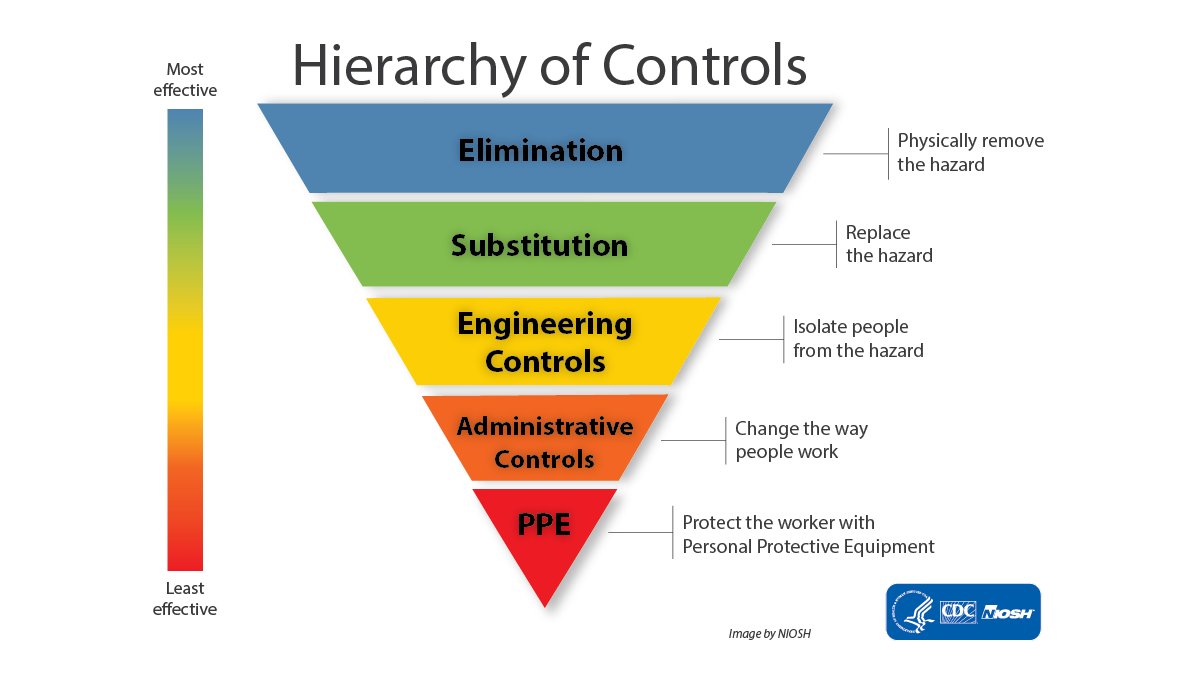
Broadly speaking, some controls are more effective than others. Wherever possible, you should attempt to use more effective controls in place of less effective ones. More effective means not just that it reduces the risk the most, but also the most reliable over time and most resistant to having rules bent, being left broken, being ignored due to alarm fatigue, or 'normalisation of deviation'. Procedures that assume everything is working perfectly and everyone is 100% competent will fail; see MCAS and a great number of other accidents.
Elimination is rarely possible but substitution (radar vs visual) and isolation (separate helicopters from other traffic) amongst other engineering controls are potentially more feasible, and much higher up the hierarchy than a glorified instruction not to crash (the very bottom of administrative). Engineering a problem out of existence is far superior to having a procedure to fix it in the QRH.
I list things like TCAS, GPWS, RSAs, and crash-proof seating as broadly being under PPE: they're nice to have and certainly worth pursuing, but unless there is no other alternative, they should never be your primary protection. Something has gone wrong if they get used.
Subjects
ATC
Close Calls
Normalization of Deviance
Radar
Separation (ALL)
TCAS (All)
Traffic in Sight
Links are to this post in the relevant subject page so that this post can be seen in context.
Reply to this quoting this original post. You need to be logged in. Not available on closed threads.
February 11, 2025, 19:12:00 GMT
permalink Post: 11826274
Subjects
ATC
DCA
Traffic in Sight
Links are to this post in the relevant subject page so that this post can be seen in context.
Reply to this quoting this original post. You need to be logged in. Not available on closed threads.
February 11, 2025, 19:30:00 GMT
permalink Post: 11826285
I'm not pointing the finger of blame at anyone - merely asking why the DCA procedure seem so lax to a controller from another part of the world.
Meanwhile how am I supposed to understand the DCA way of doing things if I can't ask a question about the procedures in place and then read the answers to learn about them?
When it comes to flight safety I was always told there is no such thing as a a stupid question.
Subjects
ATC
DCA
Links are to this post in the relevant subject page so that this post can be seen in context.
Reply to this quoting this original post. You need to be logged in. Not available on closed threads.
February 11, 2025, 19:46:00 GMT
permalink Post: 11826293
Subjects
ATC
DCA
ICAO
Phraseology (ATC)
Links are to this post in the relevant subject page so that this post can be seen in context.
Reply to this quoting this original post. You need to be logged in. Not available on closed threads.
February 12, 2025, 12:15:00 GMT
permalink Post: 11826676
I am sorry you see a witch hunt in my post. It was supposed to be an idea for a future improvement, rather than a criticism of the very hard worked man who was on the job. On the flying end, there is quite a rigid procedure to follow if a TCAS RA goes off. From posts since I see, that there seems to be one for for STCA triggers too. It seems to me that the gravity of the situation is brought faster to a pilot's attention if the Conflict warning is announced on the RT.
That is just one factor in this sad affair of course. Both TCAS and STCA are last ditch saviours but only if full attention can be paid to them.
Subjects
ATC
DCA
TCAS (All)
TCAS RA
Links are to this post in the relevant subject page so that this post can be seen in context.
Reply to this quoting this original post. You need to be logged in. Not available on closed threads.
February 12, 2025, 16:42:00 GMT
permalink Post: 11826805
I am sorry you see a witch hunt in my post. It was supposed to be an idea for a future improvement, rather than a criticism of the very hard worked man who was on the job. On the flying end, there is quite a rigid procedure to follow if a TCAS RA goes off. From posts since I see, that there seems to be one for for STCA triggers too. It seems to me that the gravity of the situation is brought faster to a pilot's attention if the Conflict warning is announced on the RT.
That is just one factor in this sad affair of course. Both TCAS and STCA are last ditch saviours but only if full attention can be paid to them.
Now on the Conflict alert on the BRITE display . I have no first hand info on the SOPs in DCA on how a TWR controller uses the BRITE and if STCA are even displayed . `, but if they are, seen the charts and the routes , I guess STCA alerts are very common .especially when you delegate separation and you then play with a couple of hundred feet, vertical separation Too many unnecessary alerts equals normalization of deviance, . Look at the Haneda preliminary report , same ..
Finally since you mention TCAS RAs , there is a major difference with STCA , it is not the same as a TCAS RA . With an RA , as a pilot you have to react and follow , it is mandatory , for a controller a STCA is just an alert , just like a TCAS TA , if in your judgement it will pass you will not do anything , and if you have already issued a correcting instruction ( heading, level , etc,,) or here delegate visual separation , the STCA just becomes a nuisance. .
I sincerely hope the DC Controller will not be made the scapegoat of this accident . Not so sure it will not.
Subjects
ATC
DCA
FAA
NTSB
Normalization of Deviance
Preliminary Report
Separation (ALL)
TCAS (All)
TCAS RA
Vertical Separation
Visual Separation
Links are to this post in the relevant subject page so that this post can be seen in context.
Reply to this quoting this original post. You need to be logged in. Not available on closed threads.
February 12, 2025, 19:32:00 GMT
permalink Post: 11826913
One ATCO, worked , at three separate frequency, three runways, 6 aircraft for arrival 01, one a/c 33, plus three helicopter, plus how many departures ( both active and approaching/crossing active runways) ?
Plus active estimate for a few aircraft more?
Ground vehicles, any?

Subjects
ATC
ATCO
Links are to this post in the relevant subject page so that this post can be seen in context.
Reply to this quoting this original post. You need to be logged in. Not available on closed threads.
February 12, 2025, 19:46:00 GMT
permalink Post: 11826918
Now on the Conflict alert on the BRITE display . I have no first hand info on the SOPs in DCA on how a TWR controller uses the BRITE and if STCA are even displayed . `, but if they are, seen the charts and the routes , I guess STCA alerts are very common .especially when you delegate separation and you then play with a couple of hundred feet, vertical separation Too many unnecessary alerts equals normalization of deviance, . Look at the Haneda preliminary report , same ..
Finally since you mention TCAS RAs , there is a major difference with STCA , it is not the same as a TCAS RA . With an RA , as a pilot you have to react and follow , it is mandatory , for a controller a STCA is just an alert , just like a TCAS TA , if in your judgement it will pass you will not do anything , and if you have already issued a correcting instruction ( heading, level , etc,,) or here delegate visual separation , the STCA just becomes a nuisance. .
I sincerely hope the DC Controller will not be made the scapegoat of this accident . Not so sure it will not.
Rarely does the "bad apple" theory of accident causation survive the scrutiny of a robust, honest investigation.
Last edited by Senior Pilot; 12th February 2025 at 23:14 . Reason: Quote was unreadable
Subjects
ATC
DCA
FAA
NTSB
Normalization of Deviance
Preliminary Report
Separation (ALL)
TCAS (All)
TCAS RA
Vertical Separation
Visual Separation
Links are to this post in the relevant subject page so that this post can be seen in context.
Reply to this quoting this original post. You need to be logged in. Not available on closed threads.