January 30, 2025, 13:48:00 GMT
permalink Post: 11817257
Subjects
ATC
CRJ
Links are to this post in the relevant subject page so that this post can be seen in context.
Reply to this quoting this original post. You need to be logged in. Not available on closed threads.
January 30, 2025, 13:54:00 GMT
permalink Post: 11817261
Subjects
ATC
DCA
Links are to this post in the relevant subject page so that this post can be seen in context.
Reply to this quoting this original post. You need to be logged in. Not available on closed threads.
January 30, 2025, 13:57:00 GMT
permalink Post: 11817266
Same as using "side step " , a procedure made for parallel runways , here they do with with runways 30 degrees apart . etc..etc..
Subjects
ATC
CRJ
Phraseology (ATC)
Separation (ALL)
Links are to this post in the relevant subject page so that this post can be seen in context.
Reply to this quoting this original post. You need to be logged in. Not available on closed threads.
January 30, 2025, 13:59:00 GMT
permalink Post: 11817269
Subjects
ATC
DCA
Links are to this post in the relevant subject page so that this post can be seen in context.
Reply to this quoting this original post. You need to be logged in. Not available on closed threads.
January 30, 2025, 14:10:00 GMT
permalink Post: 11817272
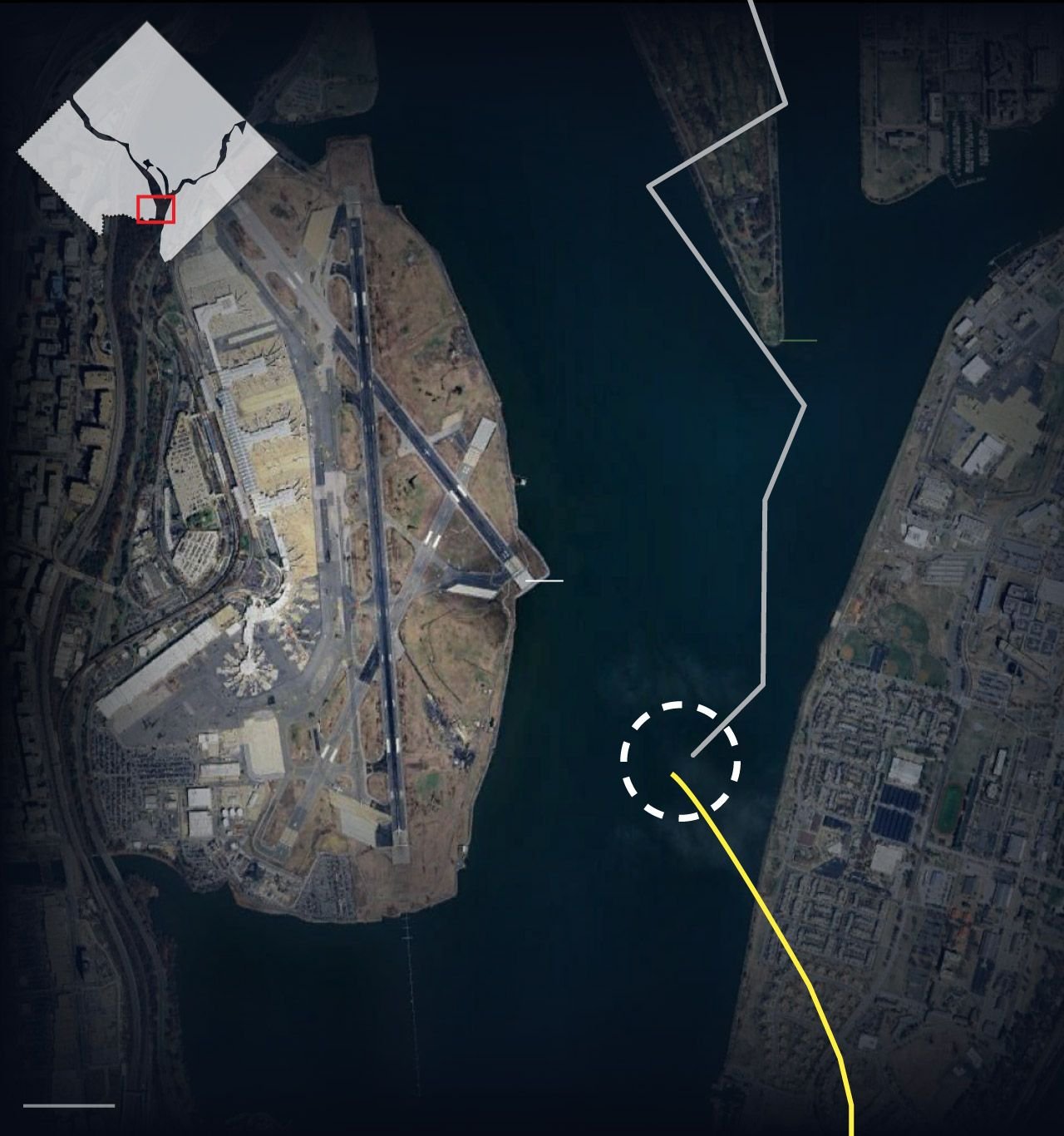
The golf course is on a peninsula in the river, so the helicopter was flying over water before and after it made the two turns.
Subjects
ATC
DCA
Radar
Route 4
Links are to this post in the relevant subject page so that this post can be seen in context.
Reply to this quoting this original post. You need to be logged in. Not available on closed threads.
January 30, 2025, 14:32:00 GMT
permalink Post: 11817282
You could contact them if you want and tell them it\x92s wrong. No offense intended.
Even if it wasn\x92t a sharp turn, it was done over a golf course and their flight path was probably dictated by noise abatement reasons, as are those flown by jets flying into DCA.
Subjects
ATC
DCA
Radar
Route 4
Links are to this post in the relevant subject page so that this post can be seen in context.
Reply to this quoting this original post. You need to be logged in. Not available on closed threads.
January 30, 2025, 14:36:00 GMT
permalink Post: 11817284
It\x92s easy to look now and be like - who would allow a helicopter highway 300 feet below a final approach path????
but this has been completely routine in that area for years and years. Helicopter Pilots who have flown the route have felt wake turbulence when scooting under/behind.
also - the use of 33, especially by CRJ size jets is completely normal and should of been expected by any helicopter crew as a possible traffic issue. In the VAS channel ATC video linked above. There are other jets using 33.
Subjects
ATC
Blackhawk (H-60)
CRJ
Traffic in Sight
Links are to this post in the relevant subject page so that this post can be seen in context.
Reply to this quoting this original post. You need to be logged in. Not available on closed threads.
January 30, 2025, 14:37:00 GMT
permalink Post: 11817285
my earlier point related to responsibility for separation\x85. and that the helo would be VFR (if following the low-level transit Route 4) and the airliner IFR. I was unsure if there was a special category for VFR at night\x85
apologies for sowing any confusion\x85\x85
Subjects
ATC
IFR
Route 4
VFR
Links are to this post in the relevant subject page so that this post can be seen in context.
Reply to this quoting this original post. You need to be logged in. Not available on closed threads.
January 30, 2025, 14:44:00 GMT
permalink Post: 11817292
Subjects
ATC
CRJ
Pass Behind
Pass Behind (All)
Phraseology (ATC)
Separation (ALL)
Traffic in Sight
Visual Separation
Links are to this post in the relevant subject page so that this post can be seen in context.
Reply to this quoting this original post. You need to be logged in. Not available on closed threads.
January 30, 2025, 14:55:00 GMT
permalink Post: 11817305
Subjects
ATC
Pass Behind
Pass Behind (All)
Links are to this post in the relevant subject page so that this post can be seen in context.
Reply to this quoting this original post. You need to be logged in. Not available on closed threads.
January 30, 2025, 14:56:00 GMT
permalink Post: 11817306
Subjects
ATC
Close Calls
FAA
Links are to this post in the relevant subject page so that this post can be seen in context.
Reply to this quoting this original post. You need to be logged in. Not available on closed threads.
January 30, 2025, 15:00:00 GMT
permalink Post: 11817307
Subjects
ATC
Separation (ALL)
Links are to this post in the relevant subject page so that this post can be seen in context.
Reply to this quoting this original post. You need to be logged in. Not available on closed threads.
January 30, 2025, 15:04:00 GMT
permalink Post: 11817309
As the approach to R33 crosses IDTEK (over the East bank of the river) at about 490 feet MSL, there is no way another aircraft can safely pass underneath at 200 feet MSL.
Thus, I think, the helicopter route RT 4 must be closed whenever an approach (visual or RNAV) to R33 is underway.
If a southbound traffic request a clearance for RT 4 in such a circumstance, they should be ordered to hold at Hains Point or North of it, or be redirected via routes RT 2 and RT 3 to Wilson Bridge.
And the helicopter route chart precedes the route descriptions with the comment "ALL ROUTES MAY BE ALTERED AT PILOT'S REQUEST OR AS DIRECTED BY ATC".
Last edited by Luc Lion; 30th January 2025 at 15:12 . Reason: more info
Subjects
ATC
Separation (ALL)
Links are to this post in the relevant subject page so that this post can be seen in context.
Reply to this quoting this original post. You need to be logged in. Not available on closed threads.
January 30, 2025, 15:04:00 GMT
permalink Post: 11817310
Honestly, at night? A light is a light. Which CRJ, where?
ATC have had a large input into a lot of past accidents. Briefed as one of our biggest threats, especially in the US and the 3rd world. Curiously, never in the UK.
Subjects
ATC
CRJ
Links are to this post in the relevant subject page so that this post can be seen in context.
Reply to this quoting this original post. You need to be logged in. Not available on closed threads.
January 30, 2025, 15:10:00 GMT
permalink Post: 11817312
Subjects
ATC
CRJ
Links are to this post in the relevant subject page so that this post can be seen in context.
Reply to this quoting this original post. You need to be logged in. Not available on closed threads.
January 30, 2025, 15:12:00 GMT
permalink Post: 11817313
The majority of people inside the system don\x92t realise how bad it is because it\x92s all they\x92ve ever known. We have American contributors here who routinely tell us it\x92s ok to switch to TA only to avoid \x93nuisance\x94 RA\x92s, who will not follow an RA as they have the traffic in sight, who will accept visual separation at night (day is bad enough) or very late visual switches, who think LAHSO is a good idea. USA ATC think it\x92s acceptable to \x93slam dunk\x94 a heavy jet, get shirty when foreign operators refuse a questionable clearance, literally forget about an aircraft once it has accepted visual separation. The system allows uncontrolled VFR traffic within 500ft of commercial operations which is madness.
I operated the 747-400 around the planet for over a decade, the USA was one of the most threat laden environments we went to. Lovely people, just insane procedures. In that time I experienced a TCAS RA on vectors to JFK, was sent around and put in the hold as punishment on short final in Miami for refusing LAHSO, had multiple super high workload approaches to SFO combined with the crazy policy of pairing aircraft on approach. I witnessed a Singapore aircraft being refused a diversion to Boston from JFK fifteen minutes after they stated what time they would be leaving the hold and where they would be going resulting in a fuel mayday and an unplanned diversion to a regional airport. I lost count of the times I was chastised for refusing a visual approach and visual separation in congested airspace or a very late visual switch.
On most of the planet the human is the last line of defence in a multi layered safety environment. In the USA the human is often the only line of defence, while the environment they are in is super high workload significantly reducing their capacity to trap safety issues.
Unless there is a marked attitude shift in all parties involved in aviation in the USA this will happen again, potentially quite soon.
Stay safe out there
LD
Couldn\x92t agree more with everything you say. I\x92m sure we have probably shared a flightdeck in years gone by judging by your experiences. It\x92s this kind of chaos that I have to say I miss very little!!
Subjects
ATC
Close Calls
Land and Hold Short
Separation (ALL)
TCAS (All)
TCAS RA
Traffic in Sight
VFR
Visual Separation
Links are to this post in the relevant subject page so that this post can be seen in context.
Reply to this quoting this original post. You need to be logged in. Not available on closed threads.
January 30, 2025, 15:23:00 GMT
permalink Post: 11817324
Approach traffic seems to be approx 400-500ft at this point.
Which turnip decided it would be OK to allow vertical separation of 300ft on a busy approach path? And allow it VFR at night?
This accident was baked in. Bound to happen at some point.
In this case, the aircraft was flying an approach to one runway with a circle-to-land on RW-33. Ask any pilot; a circle to land in itself ups the work load. The margin for error of any kind at DCA is small and the 5200 foot runway isn't all that long. Even on a simple landing where none of these considerations are an issue, at some point the pilots reduce their "see and avoid" efforts and concentrate their efforts on achieving the proper line up and glide slope, rate of descent, aircraft configuration, flap setting, etc. etc. etc. In other words, the complicated routine required to safely land an airliner these days is already close to task overload even when things are going well. Add in the fact that it's night time at a very busy airport and looking out the window gets shoved pretty far down the "to do" list. But generally speaking, the system works because big busy airports pretty much operate using IFR rules and nearly all the aircraft are under close control. I other words, even on a crystal clear day under VFR flight conditions, someone is keeping a very close eye on the airliners coming and going from major airports. If a pilot makes a mistake and levels off at the wrong altitude, for example, there is a very good chance a controller will catch that error immediately even on a sunny VFR day. And that's a good thing because truth-be-told, when an airliner is seconds from touch down these days, there isn't much "see and avoid" going on. That's just the way it is.
But apparently DCA routinely has all sorts of helo traffic buzzing around under modified VFR flight rules. The pilots are talking to a controller but without being under the same sort of close control which is usually associated with how airliners operate. And they do that night and day, trusting the helo pilots to not make a mistake. But it looks like someone DID make a mistake last night and nobody caught it in time.
Subjects
ATC
Circle to Land (Deviate to RWY 33)
DCA
FAA
IFR
Route 4
See and Avoid
Separation (ALL)
VFR
Vertical Separation
Links are to this post in the relevant subject page so that this post can be seen in context.
Reply to this quoting this original post. You need to be logged in. Not available on closed threads.
January 30, 2025, 15:39:00 GMT
permalink Post: 11817332
BTW.... I have used NVGs. How the hell can you operate in downtown Washington, with so much that is either lit... or floodlit? The NVG image will be flared out every time you turn your head towards a light.
Subjects
ATC
Night Vision Goggles (NVG)
Links are to this post in the relevant subject page so that this post can be seen in context.
Reply to this quoting this original post. You need to be logged in. Not available on closed threads.
January 30, 2025, 15:41:00 GMT
permalink Post: 11817334
It seems to be a US speciality that ATC can delegate the separation to aircrews (visually) and this at night! And how the hell can ATC separate vertically near the ground when mode S transponders report pressure altitude in steps of 100 feet only?
I dont know the rules of vertical separation by heart but its certainly not less than 500 feet for crossing paths. Is one last digit more or less a separation? This heli crew should have been told by ATC to hold until the aircraft(s) on final have safely passed. It's one of the benefits of a helicopter that it can hover.
Subjects
ATC
DCA
Hover
IFR
Separation (ALL)
VFR
Vertical Separation
Links are to this post in the relevant subject page so that this post can be seen in context.
Reply to this quoting this original post. You need to be logged in. Not available on closed threads.
January 30, 2025, 15:44:00 GMT
permalink Post: 11817336
Providing a conflict-free path for them to do that is the most consistent solution.
However the ultimate issue is traffic density, and the control workarounds (that have been discussed at great length upthread) that the US has normalised to shoehorn huge movement numbers into tiny spaces.
This is probably one of those situations where there should be a military/very limited commercial use airport in the current location and the 'real' airport should be hanging off the end of a high-speed rail line about 50 miles away q.v. Hong Kong.
Subjects
ATC
Links are to this post in the relevant subject page so that this post can be seen in context.
Reply to this quoting this original post. You need to be logged in. Not available on closed threads.