February 18, 2025, 12:39:00 GMT
permalink Post: 11830705
I've asked a question over on Rotorheads to see if anyone knows the actual clearance and service given to helicopters entering the DCA Class Bravo on the 'routes', and I'm happy to repeat it here. In London it's Radar Control ie. separation provided by ATC supported by radar. That's one part of the picture. The other is this startling revelation from Jennifer Homendy that there are no lateral limits to the 'routes', so in one sense they are not really 'routes' at all just guidelines with defined altitude limits. I can't find even altitude limits on the NY and Boston charts.
In other words, the way the 'routes' are used is quite possibly defined locally by custom and practice rather than designed with safety baked in by the authority, and that may be the way the authority intended things to be. In the UK every towered field has its own safety management system, as does the CAA. If these exist here at DCA and the FAA it would be instructive to have those examined as part of the investigation, because either they are not being used, or they're being ignored. Nobody could maintain that the risks on this 'route' were As Low As Reasonably Practicable (ALARP).
Last edited by Wide Mouth Frog; 18th February 2025 at 13:16 .
Subjects
ATC
DCA
FAA
NTSB Chair Jennifer Homendy
Radar
Separation (ALL)
Links are to this post in the relevant subject page so that this post can be seen in context.
Reply to this quoting this original post. You need to be logged in. Not available on closed threads.
February 18, 2025, 22:45:00 GMT
permalink Post: 11831083
Subjects
ATC
FAA
NTSB
Links are to this post in the relevant subject page so that this post can be seen in context.
Reply to this quoting this original post. You need to be logged in. Not available on closed threads.
February 19, 2025, 22:00:00 GMT
permalink Post: 11831783
Added note: The chart shows only crossings collected with ADS-B. I threw out all MLAT collected crossing because of inherent inaccuracy.
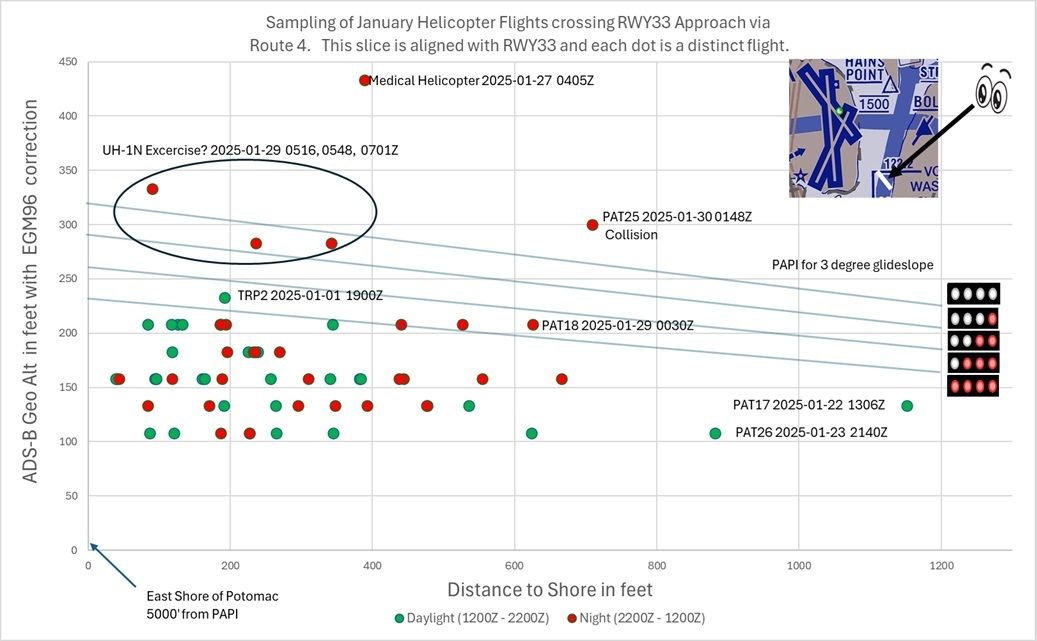
Helicopters crossing RWY 33 approach via Route 4 for January
Last edited by airplanecrazy; 19th February 2025 at 22:26 .
Subjects
ADSB (All)
ATC
Route 4
Links are to this post in the relevant subject page so that this post can be seen in context.
Reply to this quoting this original post. You need to be logged in. Not available on closed threads.
February 19, 2025, 23:16:00 GMT
permalink Post: 11831829
Added note: The chart shows only crossings collected with ADS-B. I threw out all MLAT collected crossing because of inherent inaccuracy.
Helicopters crossing RWY 33 approach via Route 4 for January
Interesting to note that, had PAT25 been at 200 ft and the CRJ just slightly below nominal glideslope, they would have collided too.
And that, had the CRJ been on the glide slope, it would have been way below PAT25 and would not have collided
Last edited by Senior Pilot; 20th February 2025 at 04:17 . Reason: Tidy up
Subjects
ADSB (All)
ATC
CRJ
PAT25
QNH
Route 4
Links are to this post in the relevant subject page so that this post can be seen in context.
Reply to this quoting this original post. You need to be logged in. Not available on closed threads.
February 22, 2025, 07:49:00 GMT
permalink Post: 11833471
Subjects
ATC
IFR
Separation (ALL)
VFR
Links are to this post in the relevant subject page so that this post can be seen in context.
Reply to this quoting this original post. You need to be logged in. Not available on closed threads.
February 22, 2025, 09:48:00 GMT
permalink Post: 11833528
- Class B : Operations may be conducted under IFR, SVFR, or VFR. All aircraft are subject to ATC clearance. All flights are separated from each other by ATC.
Subjects
ATC
DCA
FAA
ICAO
IFR
Separation (ALL)
VFR
Links are to this post in the relevant subject page so that this post can be seen in context.
Reply to this quoting this original post. You need to be logged in. Not available on closed threads.
February 22, 2025, 11:12:00 GMT
permalink Post: 11833584
However, from a US point of view, this is arguably the solution which was in place on the night. It's just that the means of actively keeping the traffic apart, ie visual separation, failed. I am prepared to accept that FAA-style "visual separation" is slightly more robust than "see and avoid" in that it requires ATC to confirm that the pilot has the specific traffic in sight before relaxing separation minima, but the question for the FAA is whether "slightly more robust" is good enough when airliners are involved, particularly at night given the increased potential for misidentification.
I am not sure the subsequent line of discussion over how Class B requires ATC (not pilots) to separate all traffic is a very productive one. Any separation instruction given by ATC relies upon the pilot executing it, for instance by maintaining the cleared altitude. Here, it relied on the pilot not colliding with the specific traffic he had confirmed visual contact with. So far as the FAA is concerned, that's a sufficient degree of control and differs from the "see and avoid" principle applicable to VFR/VFR in Class C, and VFR/Any in Class D. Again, the question is whether that's appropriate.
That last point gives me an opportunity to make an observation I've been pondering for a while. Many European airport control zones are Class D, where on a strict reading of ICAO, VFR traffic is not required to be separated from IFR. But how many of us know a Class D zone where the controller gives traffic information and lets VFR traffic merge with IFR under see and avoid? In practice, European and especially UK ATC exercise a greater degree of control than is strictly required by the ICAO classification. At least in my experience, US airspace is operated closer to ICAO specifications ("visual separation" nothwithstanding).
Last edited by Easy Street; 22nd February 2025 at 11:31 .
Subjects
ATC
DCA
FAA
ICAO
IFR
See and Avoid
Separation (ALL)
Traffic in Sight
VFR
Visual Separation
Links are to this post in the relevant subject page so that this post can be seen in context.
Reply to this quoting this original post. You need to be logged in. Not available on closed threads.
February 22, 2025, 11:14:00 GMT
permalink Post: 11833589
I personally don't think there's anything to be gained from going down the ICAO route. The NTSB has it's own charter and that's what dictates what happens in the USA.
I can see several ways the NTSB could take this, first the obvious one. The helicopter assumed responsibility for separation when it was not able to do so, and then found itself on track for collision. That's what I would define as true proximate cause. Then there's a step back from there which says nobody should be allowed to request and receive visual separation responsibilities in Class B airspace. That would be a good result as far as I'm concerned.
And the final step, which I think is more contentious and really hard for the US to accept, is that the culture at the FAA and within the industry is to balance safety and boosterism for the industry, and I think that is a recipe for irreconcilable conflicts. I'm not holding my breath on that one.
Last edited by Wide Mouth Frog; 22nd February 2025 at 11:49 . Reason: Adding response to Easy Street
Subjects
ATC
FAA
ICAO
NTSB
See and Avoid
Separation (ALL)
Visual Separation
Links are to this post in the relevant subject page so that this post can be seen in context.
Reply to this quoting this original post. You need to be logged in. Not available on closed threads.
February 22, 2025, 11:57:00 GMT
permalink Post: 11833610
Subjects
ATC
FAA
Separation (ALL)
Visual Separation
Links are to this post in the relevant subject page so that this post can be seen in context.
Reply to this quoting this original post. You need to be logged in. Not available on closed threads.
February 22, 2025, 12:07:00 GMT
permalink Post: 11833616
Subjects
ATC
Separation (ALL)
Visual Separation
Links are to this post in the relevant subject page so that this post can be seen in context.
Reply to this quoting this original post. You need to be logged in. Not available on closed threads.
February 22, 2025, 17:10:00 GMT
permalink Post: 11833773
I am not sure the subsequent line of discussion over how Class B requires ATC (not pilots) to separate all traffic is a very productive one. Any separation instruction given by ATC relies upon the pilot executing it, for instance by maintaining the cleared altitude. Here, it relied on the pilot not colliding with the specific traffic he had confirmed visual contact with. So far as the FAA is concerned, that's a sufficient degree of control and differs from the "see and avoid" principle applicable to VFR/VFR in Class C, and VFR/Any in Class D. Again, the question is whether that's appropriate.
.
Listening to the NTSB , the only ATC instruction given : to " pass behind " was not received , and therefore not acknowledged by the crew , so we are here 100% in the good old "see and avoid" scenario I would say
Subjects
ATC
FAA
ICAO
NTSB
Pass Behind
Pass Behind (All)
See and Avoid
Separation (ALL)
Links are to this post in the relevant subject page so that this post can be seen in context.
Reply to this quoting this original post. You need to be logged in. Not available on closed threads.
February 22, 2025, 18:56:00 GMT
permalink Post: 11833817
When genuine "see and avoid" applies (Class C VFR/VFR, Class D VFR/Any) the controller does not need to confirm that VFR pilots have visual contact before allowing separation to reduce, because there *are no* separation minima. At least, not according to ICAO.
As I mentioned earlier, European and especially UK ATC tends to apply more stringent separation than ICAO requires. The 'ATC duty of care' argument in the UK results in its Class D being operated in a similar way to US Class B, in my experience.
Last edited by Easy Street; 22nd February 2025 at 19:10 .
Subjects
ATC
FAA
ICAO
See and Avoid
Separation (ALL)
Traffic in Sight
VFR
Visual Separation
Links are to this post in the relevant subject page so that this post can be seen in context.
Reply to this quoting this original post. You need to be logged in. Not available on closed threads.
February 23, 2025, 11:43:00 GMT
permalink Post: 11834188
If everybody denied visual contact with the other traffic in IFR conditions then ATC will be really pissed, but will have to provide you separation. Isn't that still the case? You can never be completely sure that what you can actually see is the traffic ATC want you to see.
Subjects
ATC
IFR
Separation (ALL)
Links are to this post in the relevant subject page so that this post can be seen in context.
Reply to this quoting this original post. You need to be logged in. Not available on closed threads.
February 23, 2025, 12:09:00 GMT
permalink Post: 11834211
If everybody denied visual contact with the other traffic in IFR conditions then ATC will be really pissed, but will have to provide you separation. Isn't that still the case? You can never be completely sure that what you can actually see is the traffic ATC want you to see.

Lufty at SFO
ATC will still have to provide you with separation, yes. But some US airports have too much traffic to operate without pilots accepting visual separation, so you may have to land elsewhere. Hence the discussion upthread about the inseparability of regulation from policy, economics and (ultimately) politics.
Post #10 on that thread...


Subjects
ATC
IFR
Separation (ALL)
Visual Separation
Links are to this post in the relevant subject page so that this post can be seen in context.
Reply to this quoting this original post. You need to be logged in. Not available on closed threads.
February 23, 2025, 12:20:00 GMT
permalink Post: 11834217
- Traffic density.
- Routing configurations.
In my experience at UK regionals, there is usually just not the taffic density we see here (tho it can be busy at times at certain "rush hours"!) and, also, the ergonomics of the flightpaths were such that you weren't looking back up a busy approach path with many aircraft "in stream" thus making "picking the one" almost impossible. If I had to join a stream I was either changed to IFR for the ILS to "avoid an excessive delay" (which was ATC basically saying to me "we can't do this safely under VFR" which got my vote each time) or, if a smaller stream, I'd be extended downwind by App who effectively then handed Twr a workable solution which App had "engineered". At no time was I given anything more than a simple "pick 1 out of 1"-type or, very rarely, a "1 out of 2" scenario and never where the Twr were "trying to wallpaper a room, tile a bathroom and re-wire the main fuse box" at the same time. In the odd "1 out of 2" situations I was always asked "Do you see the 2 aircraft on Final?" and, unless I saw both, it was "Negative, only 1 in sight!".
The takeaway is that what's "legally allowed" is sometimes "not practically wise" and that seems to have been the undoing here.
Subjects
ATC
IFR
VFR
Links are to this post in the relevant subject page so that this post can be seen in context.
Reply to this quoting this original post. You need to be logged in. Not available on closed threads.
February 23, 2025, 13:03:00 GMT
permalink Post: 11834248
At what distance and light conditions should any average (heli) pilot be able to identify specifically a \x93CRJ\x94 ?
That stand alone, or after having been told what other traffic was in range and view. For example another being a biz jet or A320.
And this question for both daytime and at night.
Would that performance improve when ATC would supply them with say \x93at your 11 o\x92clock and 1,500 ft and 150 kt and intent (visual to rwy33)?
And would that performance improve at say 3 o\x92clock?
Amazed that visual separation responsibility ended up in the lap of the \x91least able\x92 party involved that some here describe as being \x91clinically\x92 blind !
On the NTSB - as far as I have understood it, they can study and recommend on anything. They could for example start an SS parallel to this investigation addressing this wider issue.
Subjects
ATC
NTSB
Separation (ALL)
Visual Separation
Links are to this post in the relevant subject page so that this post can be seen in context.
Reply to this quoting this original post. You need to be logged in. Not available on closed threads.
February 23, 2025, 17:37:00 GMT
permalink Post: 11834396
Last time I operated into LAX there was a cloud layer from 7,000\x92 down to ~2,500\x92, really thick and solid, bit of drizzle, no breaks until you suddenly came out of the bottom of it into a different airmass. A few people were calling visual from 10-15 miles out which raised eyebrows as it was highly unlikely to be the case. Yes, they were going to be visual at some point but not right then.
Would be interested in opinions from FAA-land as to whether this is isolated and/or very abnormal or they\x92ve noticed it as well...
Subjects
ATC
Normalization of Deviance
Links are to this post in the relevant subject page so that this post can be seen in context.
Reply to this quoting this original post. You need to be logged in. Not available on closed threads.
February 24, 2025, 14:43:00 GMT
permalink Post: 11834921
Last time I operated into LAX there was a cloud layer from 7,000’ down to ~2,500’, really thick and solid, bit of drizzle, no breaks until you suddenly came out of the bottom of it into a different airmass. A few people were calling visual from 10-15 miles out which raised eyebrows as it was highly unlikely to be the case. Yes, they were going to be visual at some point but not right then.
Would be interested in opinions from FAA-land as to whether this is isolated and/or very abnormal or they’ve noticed it as well...
Subjects
ATC
DCA
IFR
Normalization of Deviance
VFR
Links are to this post in the relevant subject page so that this post can be seen in context.
Reply to this quoting this original post. You need to be logged in. Not available on closed threads.
February 26, 2025, 13:21:00 GMT
permalink Post: 11836384
The second point of interest for me is the discussion on the previous incident with the RA the day before ( min 34 ) where the Helo crew only learned of this when it was raised on the media a few days after the accident ,as the Heli crew was on a different frequency and did not heard the RA and the go around as a consequences., raising the issue that there might have been far more such incidents as they were all not reported to the helicopters operators.
Subjects
ATC
Blackhawk (H-60)
CRJ
Links are to this post in the relevant subject page so that this post can be seen in context.
Reply to this quoting this original post. You need to be logged in. Not available on closed threads.
February 26, 2025, 16:29:00 GMT
permalink Post: 11836475
eg. If you don’t catch all of a radio call meant for you, just reply with what you think the controller wants to hear you say and then comply with that — not, ‘Say again…’ and confirm your clearance. Also (implicitly while discussing LED lights) confirmed that the helicopter crew would not have been able to visually identify the correct conflicting traffic, yet made the habitual call, ‘Traffic’s visual, request visual separation’ and ok to proceed, with ATC complicit in the arrangement. Also don’t beat yourself up too much if you bust your altitude restriction right under where your route intersects with landing jets, while confirming this as the most safety critical part of the route.
Last edited by Stagformation; 26th February 2025 at 22:13 .
Subjects
ATC
Blackhawk (H-60)
Normalization of Deviance
Links are to this post in the relevant subject page so that this post can be seen in context.
Reply to this quoting this original post. You need to be logged in. Not available on closed threads.