April 21, 2025, 20:06:00 GMT
permalink Post: 11871163

Subjects
ATC
FAA
NTSB
Links are to this post in the relevant subject page so that this post can be seen in context.
Reply to this quoting this original post. You need to be logged in. Not available on closed threads.
April 22, 2025, 03:15:00 GMT
permalink Post: 11871332
Subjects
ATC
FAA
KDCA
Links are to this post in the relevant subject page so that this post can be seen in context.
Reply to this quoting this original post. You need to be logged in. Not available on closed threads.
April 27, 2025, 17:19:00 GMT
permalink Post: 11874462
This type of reporting does not serve aviation safety well. Apparently the editors at the NYT decided that, since nothing new had been reported about the DCA accident, it would be a good time to sweep together some of the facts currently known, add some informed speculation by \x93experts,\x94 and than \x93humanize\x94 the accident by adding photos and personal information about the people involved in the accident. Add in a bit of fact twisting and you have an article that will generate lots of clicks.
One example:
The article states, \x93the controller made a request that was permissible but atypical, according to the N.T.S.B. [5342 change from 1 to 33]. That last phrase \x93according to the NTSB\x94 is hyperlinked, with the linked document being the NTSB\x92s AIR-25-01 report.
Does the NTSB report describe anything \x93atypical\x94 about changing to land on 33? No. In fact, the report makes this contrary statement:
\x93Conducting northbound operations with simultaneous operations to runways 1 and 33 is a routine ATC procedure in compliance with FAA Order 7110.65BB.\x94
Even changing from 1 to 33 relatively late in the approach (which the NYT calls a \x93divert\x94), is routine for DCA. The evening of the accident, several aircraft operating both before and after 5342 were presented with this decision. One declined the switch to 33 and another specifically requeste d a change to 33. These decisions occurred after the aircraft had been handed off from PCT to the DCA LC and the aircraft were established inbound to runway 1.
Subjects
ATC
DCA
FAA
NTSB
New York Times
Links are to this post in the relevant subject page so that this post can be seen in context.
Reply to this quoting this original post. You need to be logged in. Not available on closed threads.
April 27, 2025, 20:22:00 GMT
permalink Post: 11874540
I\x92ll make an assumption that this is the paragraph in the NYT article that you find compelling:
This is the danger of this type of sloppy media reporting.
Subjects
ATC
Blackhawk (H-60)
NTSB
New York Times
Preliminary Report
Links are to this post in the relevant subject page so that this post can be seen in context.
Reply to this quoting this original post. You need to be logged in. Not available on closed threads.
April 28, 2025, 17:01:00 GMT
permalink Post: 11874923
Somehow I doubt that all those responsible for those lapses in oversight were female - quite possibly they were all male.
Subjects
ADSB (All)
ADSB In
ADSB Out
ATC
DCA
FAA
Separation (ALL)
Vertical Separation
Links are to this post in the relevant subject page so that this post can be seen in context.
Reply to this quoting this original post. You need to be logged in. Not available on closed threads.
April 29, 2025, 03:55:00 GMT
permalink Post: 11875184
Somehow I doubt that all those responsible for those lapses in oversight were female - quite possibly they were all male.
The CRJ didn't have ADS-B IN, and the ATC Surveillance system (radar) doesn't process the data.
DM as required to convince me otherwise.
Subjects
ADSB (All)
ADSB In
ADSB Out
ATC
CRJ
DCA
FAA
Radar
Separation (ALL)
Vertical Separation
Links are to this post in the relevant subject page so that this post can be seen in context.
Reply to this quoting this original post. You need to be logged in. Not available on closed threads.
July 30, 2025, 16:41:00 GMT
permalink Post: 11930785
So may 'what ifs' could change the outcome. A "caution - VFR helicopter traffic below - southbound along river" call out to the CRJ crew by ATC could of made the difference. The helciopter crew staying at or below 200 could of made the difference.
Its amazing that this was considered "the norm" in that area.
Subjects
ATC
CRJ
NTSB
Separation (ALL)
VFR
Links are to this post in the relevant subject page so that this post can be seen in context.
Reply to this quoting this original post. You need to be logged in. Not available on closed threads.
July 31, 2025, 08:41:00 GMT
permalink Post: 11931111
What is likely to make a media deal is the wrongly calibrated ( or QNH setting) of the PAT altimeters which might open discussion on the real issue : the initial 100 feet procedural separation
Subjects
ATC
QNH
Separation (ALL)
Links are to this post in the relevant subject page so that this post can be seen in context.
Reply to this quoting this original post. You need to be logged in. Not available on closed threads.
July 31, 2025, 17:48:00 GMT
permalink Post: 11931466
https://www.aviationnewstalknetwork....ntsb-news-talk
just a few :
-UH60-L Heli altimeters accuracy .80 -130 ft systemic error due position of the static sensors affected by rotor blades in cruise
-80 ft error deemed within acceptable tolerance by Army pilots
-flying at 300ft targeting 200ft is "acceptable" by the Army
-200ft restriction on the chart is a only a "recommended target" in VFR not a hard restriction i unless instructed by ATC ..
-Lack of regulatory oversight by FAA despite many previous incidents .
-FAA (bureaucratic) refusal to put a 'Hot spot" symbol on routes crossings.
-Lack of ADS-B compliance on Army helis, due maintenance documentation errors during installation
-lack of experience of heli pilots on specific areas due frequent rotation of staff and lack of training hours in general.
-Lack of continuity in of DCA ATC operations supervision , 10 managers in 12 years and 5 in last 5 years.
In fact on some of the Reason's layers there were more holes than cheese.
Subjects
ADSB (All)
ATC
DCA
FAA
NTSB
VFR
Links are to this post in the relevant subject page so that this post can be seen in context.
Reply to this quoting this original post. You need to be logged in. Not available on closed threads.
July 31, 2025, 19:00:00 GMT
permalink Post: 11931499
(I need to see a bit more of the documentation on the difference between the hard altitude (200') that I was under the impression was on that route, as opposed to the "recommended altitude" statement made there...maybe it will make more sense to me then).
As to altimeter errors.
The UH-60L has a radalt.
Are you trying to tell me that the alleged acceptable error for a rad alt is 80'-130'?
I think not.
I doubt that the rules have changed that much since I was last flying a Blackhawk. (yes, it has been a while).
Will do a bit more reading, thanks.
Subjects
ATC
Altimeter (All)
Blackhawk (H-60)
Radio Altimeter
VFR
Links are to this post in the relevant subject page so that this post can be seen in context.
Reply to this quoting this original post. You need to be logged in. Not available on closed threads.
July 31, 2025, 22:18:00 GMT
permalink Post: 11931562
(Same is true in the Seahawk).
As to your point on the cause of the accident, yes, they were not aware of the traffic coming into 33 (for reasons beaten to death already).
I'm going to offer a contributing cause that I think merits consideration: there was mention made early on of there being 1, not 2, tower controllers on duty at the time when apparently 2 is the normal number.
Had there been two, the helicopter might have been handled differently, but we'll never know.
In regards to your other comment about them not seeing the CRJ, I have believed from the time that the radio traffic was public that the controller was not specific enough when he asked PAT 25 "do you have the CRJ in sight?" Something along the lines of "PAT 25, CRJ on final for RWY 33 is at your 10 o'clock less than a mile, pass behind that traffic" should have drawn the helo crews eyes to the left to hopefully see the traffic. Even better would have been to have the helo do a left 360 over Hains Point.
Subjects
ATC
Blackhawk (H-60)
CRJ
Pass Behind
Pass Behind (All)
Radio Altimeter
Links are to this post in the relevant subject page so that this post can be seen in context.
Reply to this quoting this original post. You need to be logged in. Not available on closed threads.
July 31, 2025, 22:41:00 GMT
permalink Post: 11931566
Subjects
ATC
QNH
Separation (ALL)
Links are to this post in the relevant subject page so that this post can be seen in context.
Reply to this quoting this original post. You need to be logged in. Not available on closed threads.
August 01, 2025, 10:05:00 GMT
permalink Post: 11931748
I'm going to offer a contributing cause that I think merits consideration: there was mention made early on of there being 1, not 2, tower controllers on duty at the time when apparently 2 is the normal number.
Had there been two, the helicopter might have been handled differently, but we'll never know.
For me the key point of this accident is the 100 ft procedural separation planned between a Heli route and a non precision ( e.g visual) approach path . The rest are just more holes in the cheese.
Subjects
ATC
CRJ
Separation (ALL)
Links are to this post in the relevant subject page so that this post can be seen in context.
Reply to this quoting this original post. You need to be logged in. Not available on closed threads.
August 01, 2025, 15:56:00 GMT
permalink Post: 11931914
There's a reason for the normal 500' or 1000' separation between traffic, eg enroute cruising altitudes. Someone once worked out the tolerances and margins.
Subjects
ATC
Altimeter (All)
Separation (ALL)
Links are to this post in the relevant subject page so that this post can be seen in context.
Reply to this quoting this original post. You need to be logged in. Not available on closed threads.
August 01, 2025, 22:40:00 GMT
permalink Post: 11932083
And they acknowledged it, although in a very short reply (understandable to keep R/T's as short as possible).
But replying with " traffic circling 33 in sight " just might have improved their own SA, helping to build the mental picture that mentioned traffic was going to move slightly to their left and was at some point going to cross their route from left to right. And if they didn't have that mental picture of what "circling 33" meant for their routing, then a lot was wrong long before the impact.
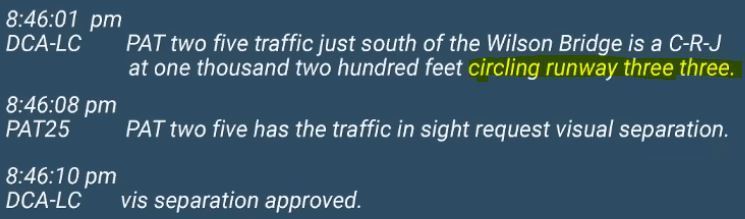
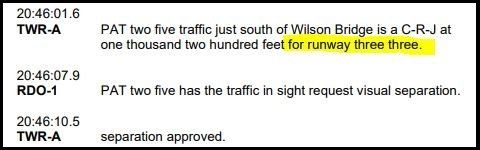
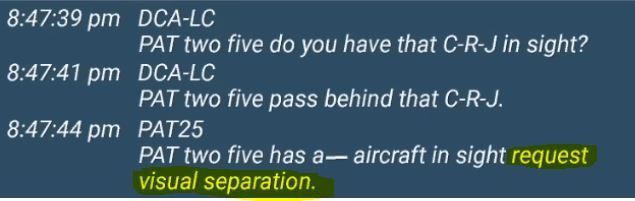
And what strikes me over and over again, is this mutual 'pavlovian' "request visual separation"-"approved" thing, as if proclaiming these words, absolves all involved from any rules/restriction that might hinder the smooth flow of things (which it does - kind of).
Even at the last chance of averting disaster by the controller (by clearly indicating the target), the pavlovian reaction was there again (totally meaningless as it was already requested and approved 96 second earlier)...
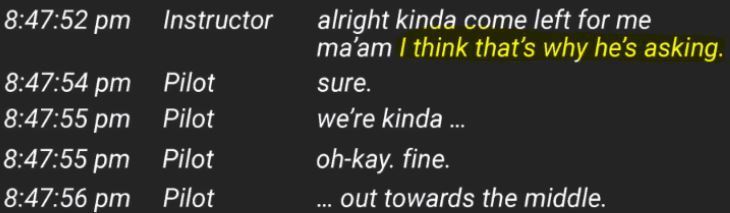
Last edited by DIBO; 2nd August 2025 at 22:03 . Reason: add extract from UH60 CVR transcript (not available/included in NTSB debrief animation)
Subjects
ATC
CVR
Night Vision Goggles (NVG)
Separation (ALL)
Situational Awareness
Visual Separation
Links are to this post in the relevant subject page so that this post can be seen in context.
Reply to this quoting this original post. You need to be logged in. Not available on closed threads.
August 01, 2025, 23:15:00 GMT
permalink Post: 11932095
Normalisation of deviance doesn\x92t even come close.
- Airspace design. The heli route stepping down to 200ft max lead some army pilots to believe it gave clearance from DCA traffic. Spoiler. It did not.
- Controller workload \x93Just make it work\x94 was a common attitude at DCA
- FAA not actively tracking TCAS RA \x93incidents\x94 as it could skew data.. maybe it was correctly applied visual separation etc. Need to look at the background etc. Yeah. But it generated an RA 🤬
- FAA refusing requests for traffic \x93hot spots\x94 on low level VFR charts as \x93hot spots\x94 are on ground charts only.
- PAT25 wanted visual separation from the CRJ. ATC was required to inform the CRJ crew another aircraft was applying visual separation to them. They didn\x92t.
Honestly from a European perspective. It\x92s quite bone chilling.
I feel this was a systemic failure. Airspace design and Risk Normalisation.
And my heartfelt condolences for the pilots, of both aircraft, and everyone else involved including the ATCOs. Not that there weren\x92t issues\x85 but in the Swiss cheese model, the FAA bought the cheese, drilled holes in it, and invited everyone to take a look inside.
Slightly surprised by some NTSB comments as well\x85 they were presented that the heli was straight ahead on the CRJ TCAS simulation presentation. But in actual fact the CRJ was circling in a left turn for runway 33. It was stable at 500ft but in a left turn to line up with the runway\x85 wings level at 300ft. It was challenged by the airline/ALPA but I would hope the NTSB would have picked up on that.
Low point of the whole hearing was Jennifer Homendy halting proceedings and moving witnesses to different seats, as one of the FAA managers elbowed a colleague while she was giving testimony - at which point she went quiet. Infernce being she was being reminded to stop talking.
Subjects
ATC
CRJ
DCA
FAA
NTSB
NTSB Chair Jennifer Homendy
Normalization of Deviance
PAT25
Separation (ALL)
TCAS (All)
TCAS RA
VFR
Visual Separation
Links are to this post in the relevant subject page so that this post can be seen in context.
Reply to this quoting this original post. You need to be logged in. Not available on closed threads.
August 03, 2025, 14:05:00 GMT
permalink Post: 11932790
Twelve billion dollars here, eighteen billion dollars additional there, pretty soon you're talking real money (with apologies to anyone who recalls the originator, Illinois Senator Everett McKinley Dirksen). With all that federal largesse provided by the American taxpayer destined to be spent on the so-called "new ATC system", I have a question. Isn't it necessary to know what conclusions the Board reaches in this investigatory process before committing to - and I'm going to use my own phrase - the "new National Airspace Architecture"?
The United States needs a new FAA organization, on two fronts at least. One, separate the ANSP from the regulator (as probably hundreds of real-life aviation industry worthies have long advocated). Second, a new organizational structure, ethos, culture, set of career pathways, and everything else that is not fit for purpose for the immient and dramatic changes dead-ahead (such as automation, Advanced Air Mobility, environmental pressures, and oh yeah, increased traffic correlated with increased demands from the traveling public for the precise kind of bag of peanuts to which they believe they're entitled). Is it not the case that FAA has failed in its fundamental mission, because under no ConOps should it have been possible for this accident to take place? (Of course, there will never be a guarantee against one or more persons conducting relevant activities with gross negligence - but if that harsh judgment is levied against the Black Hawk, nonetheless the system should have provided stronger procedural separation.)
And all this is before decisions are made about what technologies to build into the new Nat'l Airspace Arch., what vendors, what geographic arrangement, and what connectivity the entire system will have with ATM in Europe and globally (and European ATM especially is moving rapidly into the future).
But the Board final report is what, 12 months away? 18 months perhaps?
And as the new National Airspace Architecture is supposed to be undergoing definition and development, what assurance is there that the upcoming 42nd Triennial Assembly of ICAO in Montreal will not take action which will seriously impact the U.S. process? Or set ICAO on further intitiatives which would constrain U.S. plans, and not necessarily for the better? Recall that the United States has not had a designated Permanent Representative to ICAO since Capt. Sully abruptly resigned (July 2022), and while the career Foreign Service officials heading up the U.S. Mission undoubtedly are fine and excellent public servants, they are not ( afaik ) aviation industry professionals.
None of this is to say that the NTSB should speed up its process and deliberations. But at the same time, if during this Assembly the Secretary of Transportation shows up - as happened during the previous Assembly - to speak on behalf of the United States, I hope the Secretary has very, very good speechwriters because it will be hard to say anything meaningful when the state of affairs is in such disarray.
Edit:
On July 17 the White House nominated former Delta Airlines Capt. and U.S. Navy aviator Jeffrey Anderson to the position of Permanent Representative to ICAO with the rank of Ambassador. Timing of Senate confirmation hearing is presently unknown.
Last edited by WillowRun 6-3; 3rd August 2025 at 22:34 .
Subjects
ATC
Blackhawk (H-60)
FAA
Final Report
ICAO
NTSB
Separation (ALL)
Links are to this post in the relevant subject page so that this post can be seen in context.
Reply to this quoting this original post. You need to be logged in. Not available on closed threads.
August 04, 2025, 07:41:00 GMT
permalink Post: 11933006
Subjects
ATC
Phraseology (ATC)
Links are to this post in the relevant subject page so that this post can be seen in context.
Reply to this quoting this original post. You need to be logged in. Not available on closed threads.
August 04, 2025, 12:51:00 GMT
permalink Post: 11933130
Subjects
ATC
NTSB
Phraseology (ATC)
Links are to this post in the relevant subject page so that this post can be seen in context.
Reply to this quoting this original post. You need to be logged in. Not available on closed threads.
August 05, 2025, 00:21:00 GMT
permalink Post: 11933392
And that is they key , that must come first in my view, first the new structure then the road map to your "new" airspace infrastructure and governance , with new guys and fresh ideas, and yes, some can be copied on what Europe is trying to do .
Good news that the chair will not be empty but I am not sure an airline guy is the best choice for the job , I do not know the guy but as an airline Capt he might be OPS orientated so he will, just like Sully did , become extremely frustrated on discovering how ICAO works. It is by consensus , the best ideas can be rejected by a few States and then discussions and negotiations must start again , even obvious solutions will; take years to be implemented , not weeks. In ICAO the USA has the same voice as a small State with no airline.
A diplomat with civilian airline background fits better the post. A Military's background is of absolute zero use in ICAO.
But, that having been said, the Board's investigation appears primed to result in recommendations, supported by factual findings and analysis, for arguably significant changes in certain basic aspects of the ATM architecture. I'm relying here on the fact that the Board issued, very soon after January 29, an emergency directive to FAA with regard to the design of the DCA airspace and specifically the use of the helicopter routes. While I would not wish to assert familiarity with the actual world of ATC, the tenor and content of the Board's actions to date as well as of the three days of hearings strongly suggest that the Board will make recommendations for significant change in at least certain areas. Among these are the structure of airspace in which helicopters (civil, law enforcement, and military) interact with commerical traffic - it should be noted that a review of these airspace structures was ordered after the accident. Also, the way in which military aviation is conducted in Class B airspace especially adjacent to airports (of a certain size, presumably) appears likely to be covered by recommendations. None of this is to say that the new ATC system cannot be undertaken unless and until the Board report is issued (again, "necessary" was imprecise) but to the degree that recommendations for particular substantial reconfigurations of the NAS design are coming, the architects of the new ATC system certainly will not want to have to backtrack and redo their work.
On the drive to bring "FAA 2.0" into being, I would not associate myself with any claim that the United States ATM should "copy" European activities. I think the Memorandum of Cooperation between the SESAR authorities on one hand, and the FAA on the other, is the correct framework. And under that framework, "harmonization" appears to be the principal objective. It happens to be the case that although three formal joint reports on the status of harmonization have been completed and published over the past couple of decades, the most recent one was published several years ago. It is not as if nothing much has changed or advanced in the intervening years, but no further report is anywhere to be found.
When one takes into account the many and varied data-gathering and reporting functions of EUROCONTROL, the activities of the FABs, the ATM Master Plan, and informed expert groups such as the Wise Persons Group, at least from the cheap seats from which I see these it appears clear that European ATM is advancing quickly into the future. Whereas, in the United States, despite good people in certain technical roles in agencies and supporting organizations, the sorry state of the overall system speaks for itself. So to learn from our European allies and partners (and I do continue to view those States as allies and partners despite the view being out of vague in certain ignoramus precincts here) is not just wise, but necessary. But not to copy, rather to learn and adapt what will work best on this side of the transatlantic air-bridge.
On ICAO and the nomination of Mr. Anderson - and I do not know the gent either. Perhaps frustration with ICAO's immutable process of seeking consensus is what drove Sullenberger from Montreal, but I have my doubts. An experienced and by-then famous airline captain would be expected to have enough sophistication to realize, in advance, the unsurprising fact that ICAO is part of the UN. It should not have been any surprise, and that is without wondering whether the lucrative guest-speaker circuit was also a major factor.
I don't agree (respectfully) that each and every Member State, even small States lacking an airline, have equal voice. In Assembly votes, yes, they do. But not in the Council, given its three levels of membership and the process by which States gain membership on Council. And, though I am not an ATC professional (as you know), my understanding is that in the Air Navigation Commission, there are States with the experience and credibility to understand evolving state-of-the-art, even though they may disagree on how to proceed with it. And not every Member State has that level of experience and credibility. It's impolitic perhaps to say this out loud but that does not negate its validity or truth.
As for Mr. Anderson, the profile he has up on LinkedIn indicates that he has had quite significant labor relations experience. And governement relations responsibilities for the pilots' labor organization as well. His military career was, it appears, where he learned to aviate, and is not the approach the White House expects him to apply at ICAO. (In my view, sovereignty of every Member State's airspace is so fundamental, not only as reality of international flying but also under the Chicago Convention that a military career actually is fabulously relevant background for ICAO Permenent Rep, but reasonable minds can differ.) The labor relations experience could well turn out to be just what the doctor ordered for dealing with - as you say - the sometimes infintesimal pace of ICAO efforts to actually do something.
Of course, with ALPA having promptly denounced the nomination, because Mr. Anderson split from the labor organization over raising the age limit, perhaps the Senate confirmation process will not be accelerated before the Assembly convenes in third week of September. Whether the U.S. will be represented by a proper Permanent Representative, even one without Senate confirmation as Ambassador, is just not clear on the scope yet.
[...apologies for thread drift, but right now the NTSB DCA midair investigation is "the only game in town" in U.S. aviation policy - town as in Washington that is, not Montreal, QC, CA. ]
Subjects
ATC
DCA
FAA
Findings
ICAO
NTSB
Links are to this post in the relevant subject page so that this post can be seen in context.
Reply to this quoting this original post. You need to be logged in. Not available on closed threads.