August 05, 2025, 13:13:00 GMT
permalink Post: 11933607
(I am sure that you are aware of that, but some of our participants need to have that spelled out).
Subjects
ATC
FAA
NTSB
Links are to this post in the relevant subject page so that this post can be seen in context.
Reply to this quoting this original post. You need to be logged in. Not available on closed threads.
August 06, 2025, 12:31:00 GMT
permalink Post: 11934105
Not that the NTSB are going to apportion blame in their report, that isn\x92t their function. But it\x92s quite clear there were (and are) unsafe practices going on among controllers and operators in FAA/DOD land. Read the docket testimony here from page 463 onwards to about 468 or until you get bored.
https://data.ntsb.gov/Docket/Documen...dacted-Rel.pdf
Clearly Army pilots are calling visual on very distant traffic which they haven\x92t actually identified and can\x92t see, and controllers are believing them and contracting responsibility for collision avoidance to them. The Standards pilot being interviewed here (the most experienced Army pilot NTSB spoke to) even says \x91..I know it\x92s bad\x85\x92 but condones the practice because otherwise the PAT helos would have to hold!
The logic displayed here is totally crazy.
If ATC have taken the trouble to issue a traffic advisory to a helo, why does the helo pilot think it\x92s reasonable to assume the traffic (which they haven\x92t seen!) will be no factor. The Controller has called out that particular traffic to the helo pilot for a reason he\x92s become aware of, like the traffic\x92s intended flight path will shortly become a collision risk to the helo.
Last edited by Stagformation; 6th August 2025 at 15:33 .
Subjects
ATC
NTSB
NTSB Docket
Links are to this post in the relevant subject page so that this post can be seen in context.
Reply to this quoting this original post. You need to be logged in. Not available on closed threads.
August 06, 2025, 15:09:00 GMT
permalink Post: 11934187
Subjects
ATC
Route 4
Separation (ALL)
Visual Separation
Links are to this post in the relevant subject page so that this post can be seen in context.
Reply to this quoting this original post. You need to be logged in. Not available on closed threads.
August 06, 2025, 17:53:00 GMT
permalink Post: 11934280
Subjects
ATC
DCA
Links are to this post in the relevant subject page so that this post can be seen in context.
Reply to this quoting this original post. You need to be logged in. Not available on closed threads.
August 06, 2025, 18:07:00 GMT
permalink Post: 11934290
https://data.ntsb.gov/Docket/Documen...dacted-Rel.pdf
Last edited by Stagformation; 7th August 2025 at 08:57 .
Subjects
ATC
Route 4
Separation (ALL)
Visual Separation
Links are to this post in the relevant subject page so that this post can be seen in context.
Reply to this quoting this original post. You need to be logged in. Not available on closed threads.
August 06, 2025, 19:35:00 GMT
permalink Post: 11934332
Subjects
ATC
Normalization of Deviance
Separation (ALL)
Traffic in Sight
Visual Separation
Links are to this post in the relevant subject page so that this post can be seen in context.
Reply to this quoting this original post. You need to be logged in. Not available on closed threads.
August 08, 2025, 10:02:00 GMT
permalink Post: 11935129
What I learned:
Interestingly the Local controller involved was also a CPL pilot
Pressure to use 33 for landing during high departure rates was there to avoid the queue blocking the taxi ways for arriving aircraft : ( my comment : when you get to that situation traffic should be reduced by departure slots , that what we do in Europe with the Network manager CTOTs..)
No reaction to Conflict alert because visual acquisition was prioritized , i.e if you saw the helicopter passing behind you disregarded the CA. and this was almost always the case so CA with helicopters became disregarded
Advanced training was poor or non existent ( e.g Threat/Error management training).
On the PAT pilots interviews the most flagrant normalization of deviance is requesting visual separation with an aircraft you do not see ( yet) I realize that was declared by pilots other that the one operating that flight , but gives a good indication of the local " best practices " in that area.
Finally on the TCAS issue, one of the screenshots shows other traffic, and we can see that there were 2 TAs one in front -2 and one behind +6 , that could ( emphasis on could) have been one of the reason the CRJ crew missed the urgency of the -2 , but also probably were more focusing on the PAPI so both looking outside instead of at the display .
And to reply to a question earlier by DIBO on the discussion about ADS-B out not avail on the RAT, and its relevance for TCAS, well it would have influenced the degree of accuracy of the Tau calculation ( with Alt returns every 25 ft instead of 100 feet) and could ( again emphasis on could) have changed the alert logic/timing of the TA. Non installation of ADS-B and flying 70 ft too high are probably one of the points the lawyers are going to get into to prove negligence from the military to get more money for their clients , possibly shadowing the real causes. ; which for me are still the design of the procedure and routes, and the failure of the Regulator to act on the alerts. . Love to hear Willow-Run 6-3 comment on this .
.
Subjects
ADSB (All)
ADSB Out
ATC
CRJ
DCA
Normalization of Deviance
Separation (ALL)
TCAS (All)
Visual Separation
Links are to this post in the relevant subject page so that this post can be seen in context.
Reply to this quoting this original post. You need to be logged in. Not available on closed threads.
August 08, 2025, 10:54:00 GMT
permalink Post: 11935166
Subjects
ATC
Normalization of Deviance
Separation (ALL)
Visual Separation
Links are to this post in the relevant subject page so that this post can be seen in context.
Reply to this quoting this original post. You need to be logged in. Not available on closed threads.
August 08, 2025, 16:19:00 GMT
permalink Post: 11935293
And to reply to a question earlier by DIBO on the discussion about ADS-B out not avail on the [P]AT, and its relevance for TCAS, well it would have influenced the degree of accuracy of the Tau calculation ( with Alt returns every 25 ft instead of 100 feet) and could ( again emphasis on could) have changed the alert logic/timing of the TA. Non installation of ADS-B and flying 70 ft too high are probably one of the points the lawyers are going to get into to prove negligence from the military to get more money for their clients , possibly shadowing the real causes. ; which for me are still the design of the procedure and routes, and the failure of the Regulator to act on the alerts. . Love to hear Willow-Run 6-3 comment on this .
.
As for the airline, to fault the pilots when they were on short finals and expected to concentrate on flying - as others have expressed here numerous times - seems very ill-founded. Whether the airline company could be alleged to have responsibility for not having spoken up more effectively to cause the airspace design and procedure to be redone also strikes me as far too oblivious to the actual operation of the NAS, and the FAA and Congressional processes, to have any validity as an approach to liability. The airline and even Sikorski could still be named as defendants but, to reiterate, this would be just for leverage and not because there is any real pathway to liability for either one.
That having been set as background, the first context ignores the existence of sovereign immunity issues and looks just at what happened and who was responsible. As a rubric for this, "normalization of deviance" seems very accurate. This includes the fact that over time, ignoring Conflict Alerts came to be routine. It includes the practice of confirming "traffic in sight" or related proper terminology, for visual separation even though no traffic had been sighted yet - because it had become routine that the traffic would come into view and be properly identified as the traffic ATC had called out. The testimony about "just make it work", as I heard it, similarly was very concerning; iirc an overall very credible FAA witness acknowledged that the "just make it work" attitude also resulted in decreased safety margins. As did the medical helicopter operator who also had Army helicopter service background. Add in the lack of advanced training, and though I have not practiced law as legal counsel for accident victims' families, the liability theories here appear strong.
Then factor in the use of 3-3 to allievate congestion from high departure rates, rather than slowing or reducing departure slots. Part of the pressure to use 3-3 (as I understood the testimony) was that the Potomac Tracon wanted to increase in-trail separation but DCA instead increased use of 3-3. This was consistent with the attitude, "just make it work".
As to ADS-B on the helicopters, my understanding is that given the roles and missions of the helicopter operations, ADS-B is not equippage the military and its civilian control (in the sense of oversight) could have approved consistent with those roles and missions generally, and especially the continuing-of-government function.
Putting all the causal factors together into a "theory of the case" is perhaps better left to advocates for the accident victims' families (just as defense theories better left to defense counsel in this matter). But since you've impliedly asked, I would not - in this first context - parse out three of the four factors you noted, the lack of ADS-B being the one left out. That leaves the helicopter operating approximately 70 feet too high, the airspace design and procedures including the helicopter routes, and the inaction following the several safety alerts in databases and other reporting functions prior to the occurence of the accident. And including the forced enlistment of DCA for handling more traffic than the widely accepted airspace utilization and safe operation rules and procedures would allow - but they "just made it work." In other words, all of these three factors combine into the most likely theory of liability.
There is a second context, however. Federal government defendants are protected, despite the broad removal (waiver) of sovereign immunity by federal statute, from liability if the alleged negligence resulted from the exercise of discretion. If the actions or omissions being challenged resulted from decisions in which the federal entity weighed economic, social, political and other factors against each other in a form of "policy" decision-making, sovereign immunity remains in place. You can see where this is leading, of course. At what point does the over-use of DCA move out of the protection of "discretionary functions and decision-making" and into the realm of ... just plain negiligence which needs to be addressed in a court action. And likewise, at what point does the Army's set of decisions about how the routes are flown, and how visual separation and traffic sightings are handled, move out of the protection given by discretionary decisions and into the realm of significant negligence not deserving of such protection? Same question for FAA - surely the presence of safety concerns in databases and reporting systems - as unorganized as they may be and as lacking in systematic review as they may be - are matters within the FAA's discretionary functions and decision-making . . . until they're not. (And not equipping PAT helicopters or other D.C.-based Very Important air transport operations by helicopter with ADS-B would have no chance of being ruled not resulting from a discretionary function and decision - it's not even arguable imo.)
I almost included with this (already lengthy) post the "syllabus" of the U.S. Supreme Court's decision in the United States v. Varig Airlines case, which I think is the most pertinent aviation case in which the discretionary function rule is fundamentally involved....but this isn't a legal forum. Still, the U.S. S. Ct. opinion (467 U.S. 797 1984) gives me uncertainty about how any court of competent jurisdiction will draw the line between what would in a case against a not-federal defendant definitely appear to be negligence, and the actions and omissions of the federal defendants here. (My personal view is that the federal defendants acted with such severe negligence that the discretionary function protection has been lost - but that is a gut reaction to the "this accident never should have happened" idea and not legal analysis.)
Finally and last for a reason, I am not commenting about the motives of legal counsel who are representing or advising clients involved in this matter. I have not practiced law a single day, or a single billable hour, or otherwise, on behalf of the families or representatives of aviation accident victims, or the defendants in such matters. As a result, in participation as a guest on this forum I think it's much wiser to let the members of the bar who do have clients and who do practice in this area let their conduct in their professional capacities speak for itself.
Subjects
ADSB (All)
ADSB Out
ATC
Accountability/Liability
DCA
FAA
Normalization of Deviance
Separation (ALL)
TCAS (All)
Traffic in Sight
Visual Separation
Links are to this post in the relevant subject page so that this post can be seen in context.
Reply to this quoting this original post. You need to be logged in. Not available on closed threads.
August 10, 2025, 05:00:00 GMT
permalink Post: 11936009
I strikes me that, from my layman’s point of view, that this is the primary and gaping hole (among numerous others) in the Swiss cheese here.
At the same time, I get the sense that no controller was ever going to intentionally permit a helicopter to pass directly under an approaching aircraft and challenge that limited clearance.
My question is, should this have been (or was it?) formalized as an ATC procedure? Because if this had been proceduralized, I find it hard to believe that just nighttime VFR separation would have been found acceptable in that environment. Rather I would think that lateral separation should have been actively managed by ATC.
For one thing, with the CRJ (or whatever aircraft) pilots making a late switch to 33, turning to line up with the runway, etc., they may not have had the bandwidth to scan for a possibly conflicting helicopter, if they could even have seen it from their cockpit. (IIRC from the inquiry, the NTSB will be investigating that last point.)
I don’t know how difficult it may have been for the helicopter to see the CRJ, but the simple fact is that they did not.
On another subject, one thing that struck me from the inquiry was that the helicopter pilot apparently had very limited recent flight time, yet was assigned a challenging check ride.
This contrasted with the testimony of the leader (?) of one of the local Medivac groups, who discussed how much more experience he and his pilots had flying in that challenging environment (and often single-pilot ops at that).
Is the Army not providing adequate training and flight time to ensure their pilots can operate safely in those conditions?
Last edited by andihce; 10th August 2025 at 06:44 . Reason: clarification
Subjects
ATC
Altimeter (All)
CRJ
NTSB
Route 4
Separation (ALL)
VFR
Vertical Separation
Links are to this post in the relevant subject page so that this post can be seen in context.
Reply to this quoting this original post. You need to be logged in. Not available on closed threads.
August 10, 2025, 06:10:00 GMT
permalink Post: 11936017
I strikes me that, from my layman\x92s point of view, that this is the primary and gaping hole (among numerous others) in the Swiss cheese here.
At the same time, I get the sense that no controller was ever going to allow a helicopter to pass directly under an approaching aircraft and challenge that limited clearance.
My question is, should this have been (or was it?) formalized as an ATC procedure? Because if this had been proceduralized, I find it hard to believe that just nighttime VFR separation would have been found acceptable in that environment. Rather I would think that lateral separation should have been actively managed by ATC.
For one thing, with the CRJ (or whatever aircraft) pilots making a late switch to 33, turning to line up with the runway, etc., they may not have had the bandwidth to scan for a possibly conflicting helicopter, if they could even have seen it from their cockpit. (IIRC from the inquiry, the NTSB will be investigating that last point.)
I don\x92t know how difficult it may have been for the helicopter to see the CRJ, but the simple fact is that they did not.
And to stick with motoring analogies, some of us are used to considering that at a junction another vehicle can be partly obscured by a pillar for one eye, and in the blind spot of our other eye, so we might move our head sideways to help check better. Some aircraft have more windscreen pillars (this helicopter has four) so the aircraft in a constant relative position - which is the one that is the collision risk - may stay behind a pillar unless we move our head.
Subjects
ATC
Altimeter (All)
CRJ
NTSB
Route 4
Separation (ALL)
VFR
Vertical Separation
Links are to this post in the relevant subject page so that this post can be seen in context.
Reply to this quoting this original post. You need to be logged in. Not available on closed threads.
August 10, 2025, 06:48:00 GMT
permalink Post: 11936029
I strikes me that, from my layman\x92s point of view, that this is the primary and gaping hole (among numerous others) in the Swiss cheese here.
At the same time, I get the sense that no controller was ever going to allow a helicopter to pass directly under an approaching aircraft and challenge that limited clearance.
My question is, should this have been (or was it?) formalized as an ATC procedure? Because if this had been proceduralized, I find it hard to believe that just nighttime VFR separation would have been found acceptable in that environment. Rather I would think that lateral separation should have been actively managed by ATC.
Subjects
ATC
Altimeter (All)
Blackhawk (H-60)
CRJ
IFR
NTSB
Route 4
Separation (ALL)
Traffic in Sight
VFR
Vertical Separation
Visual Separation
Links are to this post in the relevant subject page so that this post can be seen in context.
Reply to this quoting this original post. You need to be logged in. Not available on closed threads.
August 10, 2025, 07:27:00 GMT
permalink Post: 11936037
Yet was not the controller required to inform the CRJ of the helicopter, which (as the inquiry noted) he failed to do? Thus a possible cross-check was lost.
Last edited by andihce; 10th August 2025 at 07:28 . Reason: Fixed quoting
Subjects
ATC
Blackhawk (H-60)
CRJ
IFR
Separation (ALL)
Traffic in Sight
Visual Separation
Links are to this post in the relevant subject page so that this post can be seen in context.
Reply to this quoting this original post. You need to be logged in. Not available on closed threads.
August 10, 2025, 09:11:00 GMT
permalink Post: 11936070
Are you sure about that? My understanding of Class B airspace is that all aircraft proceed only on the basis of an ATC clearance. So to re-parse your statement\x85When a pilot says \x93Traffic in sight\x94 it just means he can see it, nothing more. It\x92s when he then says, \x93Request visual separation\x94 that he\x92s suggesting to the Local Controller he doesn\x92t need help with separation. And then it\x92s only when the Local Controller says, \x93Visual separation approved\x94 that the pilot takes on the responsibility for separation.
Subjects
ATC
Separation (ALL)
Traffic in Sight
Visual Separation
Links are to this post in the relevant subject page so that this post can be seen in context.
Reply to this quoting this original post. You need to be logged in. Not available on closed threads.
August 10, 2025, 12:55:00 GMT
permalink Post: 11936208
Subjects
ATC
CRJ
TCAS (All)
Links are to this post in the relevant subject page so that this post can be seen in context.
Reply to this quoting this original post. You need to be logged in. Not available on closed threads.
August 10, 2025, 18:08:00 GMT
permalink Post: 11936308
"Request visual separation" is non-standard.
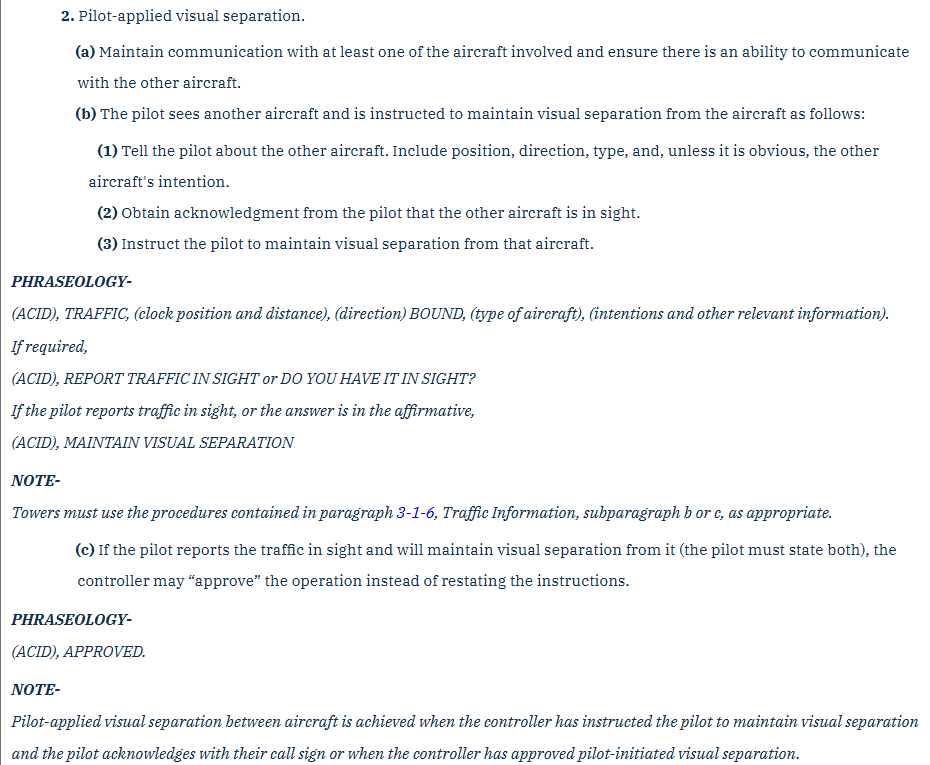
https://www.faa.gov/air_traffic/publ...section_2.html
Subjects
ATC
Separation (ALL)
Traffic in Sight
Visual Separation
Links are to this post in the relevant subject page so that this post can be seen in context.
Reply to this quoting this original post. You need to be logged in. Not available on closed threads.
August 10, 2025, 22:26:00 GMT
permalink Post: 11936398
Two interesting events noted on the recordings:
At about 20:00L, PCT calls helicopter traffic to PAT25. I count at least 12 statements between the two pilots regarding the called traffic in addition to radio transmissions to PCT regarding the traffic. Contrast this to the CRJ called traffic which generates zero discussion between the PAT25 flight crew.
At about 20:37L, there’s a traffic interaction between MUSL13 and BLJK1 (two helicopters) that generates a conflict alert. The DCA LC provides multiple traffic alerts to both aircraft, including direction, range, and altitude of the conflicting aircraft, even after visual separation is approved for BLJK1. Contrast this with the accident sequence where PAT25 is provided with a single traffic alert and the CRJ gets bupkis.
Subjects
ATC
CRJ
DCA
PAT25
Route 4
Separation (ALL)
Visual Separation
Links are to this post in the relevant subject page so that this post can be seen in context.
Reply to this quoting this original post. You need to be logged in. Not available on closed threads.
August 10, 2025, 22:35:00 GMT
permalink Post: 11936401
My understanding is that TCAS RA's are inhibited below some specified altitude, in order to reduce or minimize nuisance alerts. Is it a correct statement to say that when the CRJ received the TCAS TA's referenced by Sailvi767's comment, it already was below the altitude at which RA's were inhibited?
If that is correct, then doesn't it follow that the CRJ crew - intently focused on the approach to and landing on 33 - were following procedure that has long been acknowledged for DCA Rnwy 33 - the LC will keep helicopter traffic from becoming conflicting traffic? It is (I think, but only as a non-pilot and non-ATCO) obviously true that in this instance, there were a number of inputs (and lackof inputs) by ATC, and likewise several acts and omissions by PAT25 which led to the procedure failing badly, with the tragic result. In other words, the clearest root cause is the fact that the acknowledged procedure over a period of years was that the LC (and sometimes a helicopter position in the tower) would keep the helicopters from becoming conflicting traffic - and through normalizationi of deviance, when this procedure eventually failed, it failed all the way.
In a previous post I mentioned that one of the attorneys representing the families of accident vicitims has said that claims against the airline would be investigated and possibly included in the forthcoming lawsuits. I suppose it is not talking like a stark raving lunatic to point to the many reports filed about overly close encounters in the airspace, especially in light of information found and then released by NTSB soon after January 29 which detailed many close encounters (as a non-frivolous basis to assert claims against the airline). But wait. They are going to argue that, during the last few hundred feet on final approach to Runway 33 at night, after having been more or less directed by ATC to switch from Runway 1, running through all the steps outlined (by Capn Bloggs) to look for the possibly conflicting traffic took priority over flying the approach - especially in light of the long-acknowledged procedure at DCA? I'm admittedly shouting from down in the cheap seats but this attack by plaintiffs on the CRJ pilots, as an means to advance claims against the airline, strikes me as a legal obscenity.
Subjects
ATC
CRJ
DCA
NTSB
PAT25
TCAS (All)
TCAS RA
Links are to this post in the relevant subject page so that this post can be seen in context.
Reply to this quoting this original post. You need to be logged in. Not available on closed threads.
August 10, 2025, 22:36:00 GMT
permalink Post: 11936403
In class B , controllers will provide separation between IFR and VFR however they can delegate separation to an aircrfat visually following a strict procedure and phraseology .and issuing an ATC Instruction : " maintain visual separation "
Subjects
ATC
CRJ
IFR
NTSB
NTSB Docket
Phraseology (ATC)
Separation (ALL)
TCAS (All)
VFR
Visual Separation
Links are to this post in the relevant subject page so that this post can be seen in context.
Reply to this quoting this original post. You need to be logged in. Not available on closed threads.
August 11, 2025, 17:19:00 GMT
permalink Post: 11936840
If I am correct can you stop this discussion Remember journalists and possibly families members of those 2 pilots are watching too.
To close that bit just read the CRJ CVR transcript (*)
47:29 : eGPWS : 500 hundred
47:35 : I got 2 whites and 2 red
47:37 : cool ( my note : so they were looking at the PAPI )
47::40 : "Traffic traffic " ( my note : TA audio)
47:47 : TWR :" PAT 25 pass behind the CRJ "
47:55 : eGPWS : ...hundred ..
47:58 " Oh Sh!!!!!
47:59 : sound of impact .
Subjects
ATC
CRJ
CVR
DCA
Pass Behind
Pass Behind (All)
Pass Behind (PAT25)
TCAS (All)
Traffic in Sight
Links are to this post in the relevant subject page so that this post can be seen in context.
Reply to this quoting this original post. You need to be logged in. Not available on closed threads.