August 12, 2025, 00:21:00 GMT
permalink Post: 11936996
"Request visual separation" is non-standard.
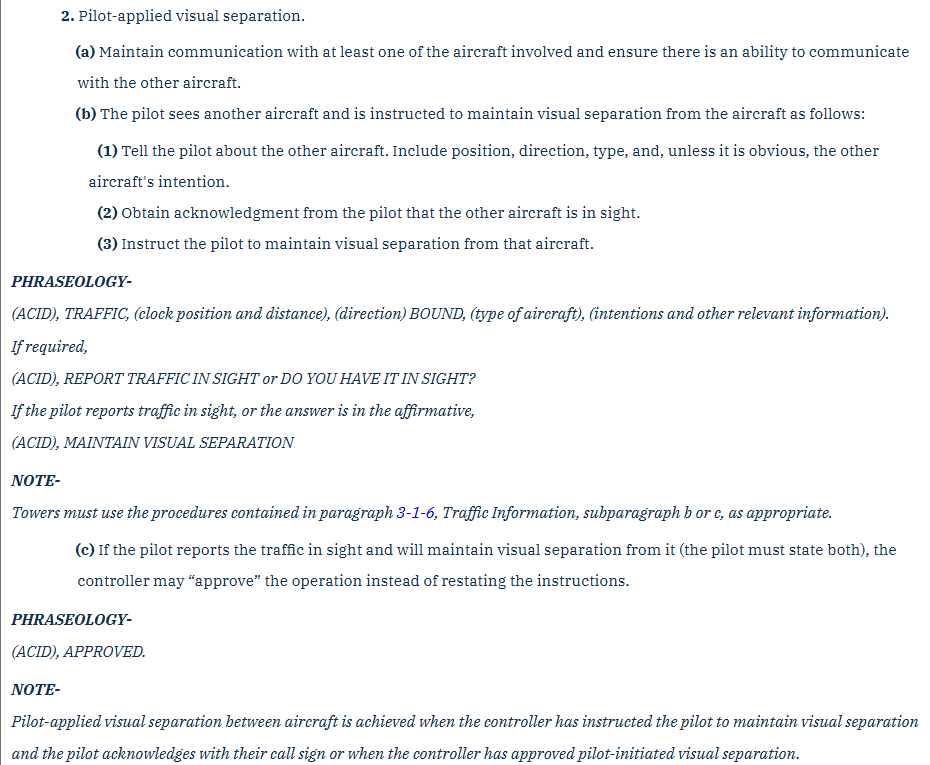
https://www.faa.gov/air_traffic/publ...section_2.html
Absolutely, it was a non-standard discourse. But however you look at what was said, PAT 25 requested the change to visual separation. Meaning PAT25 correctly believed he was under standard 1.5nm/500ft separation at the time and that he needed LC approval for Visual separation to be applied. The change in the separation standard being applied did not happen until the LC accepted PAT 25\x92s traffic visual report and authorised the change. It\x92s not an automatic change made just on the pilot\x92s say so, ie by reporting visual, which I think is what you may be implying (happy if you correct me). Both pilot and LC are necessary (and both made errors here).
Subjects
ATC
PAT25
Separation (ALL)
Traffic in Sight
Visual Separation
Links are to this post in the relevant subject page so that this post can be seen in context.
Reply to this quoting this original post. You need to be logged in. Not available on closed threads.
August 12, 2025, 01:18:00 GMT
permalink Post: 11937016
Subjects
ATC
PAT25
Separation (ALL)
Visual Separation
Links are to this post in the relevant subject page so that this post can be seen in context.
Reply to this quoting this original post. You need to be logged in. Not available on closed threads.
August 12, 2025, 10:13:00 GMT
permalink Post: 11937144
 . I'd often get from Twr on joining the circuit at my various destinations, and having confirmed I'd got traffic XYZ in sight, a clearance "Roger, C/S, keeping that traffic in sight, report Final XX. You are No 2 to the XYZ.". From that point on, my positioning was determined by me based on visual separation with the other traffic - so not totally identical to the DCA accident but the principle was the same - I was responsible for remaining clear of XYZ and positioning appropriately behind them (including accounting for wake/runway occupancy effects etc). Occasionally I'd then get "C/S, new clearance - report
ready
for L/R base." usually with a reason if there was time - often it was App not leaving TWR a big enough gap to sneak me in between 2 IFR arrivals.
. I'd often get from Twr on joining the circuit at my various destinations, and having confirmed I'd got traffic XYZ in sight, a clearance "Roger, C/S, keeping that traffic in sight, report Final XX. You are No 2 to the XYZ.". From that point on, my positioning was determined by me based on visual separation with the other traffic - so not totally identical to the DCA accident but the principle was the same - I was responsible for remaining clear of XYZ and positioning appropriately behind them (including accounting for wake/runway occupancy effects etc). Occasionally I'd then get "C/S, new clearance - report
ready
for L/R base." usually with a reason if there was time - often it was App not leaving TWR a big enough gap to sneak me in between 2 IFR arrivals.
In other words, Twr would delegate separation to me with the initial clearance but, if for whatever reason, they became unhappy - I got issued with a revised, more restrictive, clearance. Similarly, if I lost sight of the traffic at any point after the initial "Report Final" clearance, it was my responsibility to advise ATC that I was no longer visual with XYZ (ie I could no longer comply with the clearance ATC had given me) and ATC would then update my clearance on that basis - "..... report ready for base" or similar until they could visually assure themselves of separation. Indeed, on those occasions, it was not unknown for ATC to say "C/S, I have you both in sight - that traffic is well ahead of you, report Final XX, No 2". I was thus relieved of my responsibility to self-position.
What ATC giveth away in their airspace ATC can taketh back again in their airspace!
Now, "normalised deviation" may skew such a way of working such as PAT routinely expecting to get what they ask for and ATC routinely giving them what they want......... Not saying that happened at DCA but............ Also, I've lost track in the Thread if PAT were visual but with another a/c or the intended one but simply "lost it" at some point........... And whether visual separation at night in such busy airspace was wise ............
Last edited by Hot 'n' High; 12th August 2025 at 10:23 .
Subjects
ATC
DCA
IFR
Separation (ALL)
Traffic in Sight
Visual Separation
Links are to this post in the relevant subject page so that this post can be seen in context.
Reply to this quoting this original post. You need to be logged in. Not available on closed threads.
August 12, 2025, 10:55:00 GMT
permalink Post: 11937179
Re "normalised deviation", I'm not sure this applies here. Normalised deviation means deviating from published (perportedly safe) procedures, with no adverse consequences, so the deviations continue. In this case, it's pretty obvious that the "published procedures" were flawed in the first place.
Subjects
ATC
IFR
Separation (ALL)
TCAS (All)
Links are to this post in the relevant subject page so that this post can be seen in context.
Reply to this quoting this original post. You need to be logged in. Not available on closed threads.
August 12, 2025, 11:11:00 GMT
permalink Post: 11937189
Last edited by Stagformation; 12th August 2025 at 19:11 .
Subjects
ATC
CRJ
DCA
Night Vision Goggles (NVG)
Separation (ALL)
Links are to this post in the relevant subject page so that this post can be seen in context.
Reply to this quoting this original post. You need to be logged in. Not available on closed threads.
August 12, 2025, 12:19:00 GMT
permalink Post: 11937225
If the airspace design had been used with positive control (ie holding traffic off R4 while 33 was in use or even holding R4 traffic at bridges or somewhere clear of 33 while it was in use) that would work.
Using that same airspace design with "see and avoid" was far less safe and, as reported, led to quite a few incidents of TA's before this fateful day.
But, as the "see and avoid" system was seen by the users at the coal face at least to work, despite the TA's, the operational use of the design became "normalised" to use "see and avoid".
Sadly, no-one (such as DCA management) seems to have studied the extra issues so this more dangerous way of using the design has became "normalised", particularly where ATC is busy.
That's just my take on it.
Subjects
ATC
DCA
See and Avoid
Links are to this post in the relevant subject page so that this post can be seen in context.
Reply to this quoting this original post. You need to be logged in. Not available on closed threads.
August 12, 2025, 13:02:00 GMT
permalink Post: 11937250
17 seconds before the collision , sadly he did not receive a clear readback on that instruction .
Yes he did, you\x92re right\x97 but it wasn\x92t proactive enough. Clearly the LC was conflicted, his eyes telling him PAT might not be visual, but the pilot saying he was. What an awful situation to be in. One which really needed a decisive move, not the easiest one, eg order a direct turn for PAT and/or a go around for the CRJ.
Subjects
ATC
CRJ
Pass Behind
Pass Behind (All)
Links are to this post in the relevant subject page so that this post can be seen in context.
Reply to this quoting this original post. You need to be logged in. Not available on closed threads.
August 12, 2025, 15:40:00 GMT
permalink Post: 11937327
Here, the helicopter pilots had obviously routinely been lying to LC (and getting away with it!), so the system broke down.
Subjects
ATC
Separation (ALL)
Visual Separation
Links are to this post in the relevant subject page so that this post can be seen in context.
Reply to this quoting this original post. You need to be logged in. Not available on closed threads.
August 14, 2025, 14:00:00 GMT
permalink Post: 11938382
Yes but that is only the visual separation procedure .
When we talk about un safe " procedures" (plural) it is mostly the airspace design and the actions written and put in place which have to be performed to keep that design safe . That part : "conflicting paths used simultaneously with only 100 or 200ft separation " is the basic " unsafe " part of the procedures. For me at least .
"Visual separation" is the procedure that's supposed to make this safe, i.e. ensure that the actual separation is never that low.
Did DCA actually schedule conflicting flights without visual separation procedures?
Subjects
ATC
DCA
Preliminary Report
Separation (ALL)
Visual Separation
Links are to this post in the relevant subject page so that this post can be seen in context.
Reply to this quoting this original post. You need to be logged in. Not available on closed threads.
August 14, 2025, 16:25:00 GMT
permalink Post: 11938451
Note that the apparently informal procedure of holding helicopters at Hains Pt or golf balls was an effective method of deconflicting Route 4 and 15/33 traffic. However it appears that the use of this \x93procedure\x94 was left to the discretion of the individual controller.
Subjects
ATC
CRJ
DCA
Route 4
Separation (ALL)
VFR
Visual Separation
Links are to this post in the relevant subject page so that this post can be seen in context.
Reply to this quoting this original post. You need to be logged in. Not available on closed threads.
August 14, 2025, 20:50:00 GMT
permalink Post: 11938600
Note that the apparently informal procedure of holding helicopters at Hains Pt or golf balls was an effective method of deconflicting Route 4 and 15/33 traffic. However it appears that the use of this \x93procedure\x94 was left to the discretion of the individual controller.
If I understand the way the q&a progressed, and especially the definition provided by the examiner during the q&a of the Army pilot, "procedurally separate" means the airspace design is such that if both aircraft adhere to their assigned routes, the Route 4 helicopter operation can safely cross the approach path to 3-3 (and, though it should be obvious, please correct this if I've said it incorrectly or without enough precision). But as the Army pilot as well as the med evacuation group chief testified, they took steps to avoid operating across the approach path if there was DCA traffic - which the examiner referred to as "mitigations".
(The wash machine of my mind is cycling through some further thoughts on how the facts emerging from the hearings and certain items in the (voluminous) docket are likely to interact with the relevant legal issues and, in turn, how that appears likely to impact the looming NAS, FAA, and "new ATC system" reforms.)
Subjects
ATC
CRJ
DCA
FAA
NTSB Docket
Route 4
VFR
Links are to this post in the relevant subject page so that this post can be seen in context.
Reply to this quoting this original post. You need to be logged in. Not available on closed threads.
August 14, 2025, 22:06:00 GMT
permalink Post: 11938639
Subjects
ATC
Separation (ALL)
Links are to this post in the relevant subject page so that this post can be seen in context.
Reply to this quoting this original post. You need to be logged in. Not available on closed threads.
August 15, 2025, 02:11:00 GMT
permalink Post: 11938729
Note that the apparently informal procedure of holding helicopters at Hains Pt or golf balls was an effective method of deconflicting Route 4 and 15/33 traffic. However it appears that the use of this \x93procedure\x94 was left to the discretion of the individual controller.
One of the Army pilots at the NTSB hearing said he'd always been instructed to hold when there was traffic on approach to 33. I'd be willing to bet that he never called "traffic in sight" in those instances. That's the crucial difference.
Subjects
ATC
CRJ
NTSB
Route 4
Separation (ALL)
Traffic in Sight
VFR
Links are to this post in the relevant subject page so that this post can be seen in context.
Reply to this quoting this original post. You need to be logged in. Not available on closed threads.
August 15, 2025, 06:32:00 GMT
permalink Post: 11938787
He's quite clear that he thinks that ATC alerting the CRJ about the presence of the helo (using visual flight separation) probably wouldn't have changed the outcome.
But he does pick up on the cockpit dynamics on PAT25. He says
"Now, the most important facts to emerge from the hearings this week center on the cockpit exchange between Warrant Officer Eves and Captain Robach that happened just about a minute before the midair. He says to her, " All right, kind of come left for me, ma'am. I think that's why he's asking ." And she replies, " Sure ." He says, " We're kinda.. ." And she cuts him off by saying, " Oh-kay, fine ." And he finishes his statement “… out toward the middle ”, meaning the middle of the river and west of helicopter route 4. So PAT 25 is above and west of where they should have been as the CRJ is properly on final approach for runway 33. Using maritime rules of the road terms, the CRJ was the burden vessel and the Blackhawk was the giveway vessel." He quotes someone (David Cherbonnier) posting:
"In military protocol, referring to a fellow officer as sir or ma'am is the role of a subordinate. It’s use in the cockpit indicated ‘privilege of rank’ as opposed to the typical instructor student relationship. The instructor was a Chief Warrant Officer with over 10 years service as an enlisted person prior to selection as a Chief Warrant Officer and as well as met all criteria to be a check pilot and as such was the person in charge during the entire training/examination exercise. In any other capacity, a Captain represents a person who has been recognized by Congress to have the qualifications to become an officer. In my experience, an examinee’s response in a drawn out “ oh-kay fine ” would have signaled check ride over. In this instance, deference was given to rank. Was that a contributing factor?"
Subjects
ATC
Blackhawk (H-60)
CRJ
PAT25
Route 4
Separation (ALL)
Links are to this post in the relevant subject page so that this post can be seen in context.
Reply to this quoting this original post. You need to be logged in. Not available on closed threads.
August 15, 2025, 06:37:00 GMT
permalink Post: 11938789
Taking a road procedure similarity : . at a crossroad you can have a stop sign or a triangle giving priority , or nothing
The written procedures are : at a stop sign you must stop even if there is no traffic.
:Transposing this to DCA route 4 map l the procedure should have been in Europe at least ;
1) hold ay golf balls until you get a clearance to proceed . (so that in case of loss of comms , blocked freq, etc.. you can't proceed ).
2) pilot or controller can request visual separation if all t he following conditions re met : typically VMC, and in daylight and traffic is in sight and maintained in sight and both aircrfat pilots are informed. of each other position
3) lateral deviations by the helicopters to fly over built up areas of the city at 200ft will; not be permitted.
Big differences .
Now a pilot can request visual separation at any time but Controller can refuse at any time to .. To my knowledge requesting visual a night using NVG is not covered in the definition of " visual acquisition " in ICAO, so legally it could be challenged I guess . Same as when a pilot reports "visual" on his TCAS display . It is not valid , and for good reasons .
But KDCA is not in Europe, and ICAO SARPs do not apply to military aircrfat , so the outcome of all this is quite uncertain .In fact i would not be surprised if nothing dramatic changes as far as procedures are concerned, Route 4 will be permanently removed I guess, but other than that ? business a usual with visual separations at night ? .
Subjects
ATC
DCA
ICAO
KDCA
Night Vision Goggles (NVG)
Route 4
Separation (ALL)
TCAS (All)
Traffic in Sight
Visual Separation
Links are to this post in the relevant subject page so that this post can be seen in context.
Reply to this quoting this original post. You need to be logged in. Not available on closed threads.
August 15, 2025, 06:49:00 GMT
permalink Post: 11938790
Subjects
ATC
CRJ
Separation (ALL)
TCAS (All)
Links are to this post in the relevant subject page so that this post can be seen in context.
Reply to this quoting this original post. You need to be logged in. Not available on closed threads.
August 15, 2025, 07:31:00 GMT
permalink Post: 11938800
Subjects
ATC
CRJ
DCA
Route 4
Separation (ALL)
VFR
Links are to this post in the relevant subject page so that this post can be seen in context.
Reply to this quoting this original post. You need to be logged in. Not available on closed threads.
August 15, 2025, 09:39:00 GMT
permalink Post: 11938867
Last edited by Stagformation; 15th August 2025 at 21:48 .
Subjects
ATC
Separation (ALL)
Traffic in Sight
VFR
Links are to this post in the relevant subject page so that this post can be seen in context.
Reply to this quoting this original post. You need to be logged in. Not available on closed threads.
August 16, 2025, 03:15:00 GMT
permalink Post: 11939359
He's quite clear that he thinks that ATC alerting the CRJ about the presence of the helo (using visual flight separation) probably wouldn't have changed the outcome.
But he does pick up on the cockpit dynamics on PAT25. He says
"Now, the most important facts to emerge from the hearings this week center on the cockpit exchange between Warrant Officer Eves and Captain Robach that happened just about a minute before the midair. He says to her, " All right, kind of come left for me, ma'am. I think that's why he's asking ." And she replies, " Sure ." He says, " We're kinda.. ." And she cuts him off by saying, " Oh-kay, fine ." And he finishes his statement \x93\x85 out toward the middle \x94, meaning the middle of the river and west of helicopter route 4. So PAT 25 is above and west of where they should have been as the CRJ is properly on final approach for runway 33. Using maritime rules of the road terms, the CRJ was the burden vessel and the Blackhawk was the giveway vessel." He quotes someone (David Cherbonnier) posting:
Subjects
ATC
Blackhawk (H-60)
CRJ
PAT25
Route 4
Separation (ALL)
Links are to this post in the relevant subject page so that this post can be seen in context.
Reply to this quoting this original post. You need to be logged in. Not available on closed threads.
August 22, 2025, 21:32:00 GMT
permalink Post: 11942707
NTSB Aviation Investigation Preliminary Report - N879RW (RPA), UH-60 (PAT23)
Subjects
ATC
DCA
NTSB
PAT23
Preliminary Report
Links are to this post in the relevant subject page so that this post can be seen in context.
Reply to this quoting this original post. You need to be logged in. Not available on closed threads.