December 17, 2025, 03:54:00 GMT
permalink Post: 12006687
Washington, D.C. \x96 Aviation Subcommittee Chairman Troy E. Nehls (R-TX) announced that the Subcommittee will receive testimony from Bryan Bedford, marking his first appearance in front of Congress as Administrator of the Federal Aviation Administration (FAA). Subcommittee Members will have the opportunity to discuss recent regulatory actions taken by the FAA and current issues in aviation, and seek updates on the continued implementation of the FAA Reauthorization Act of 2024. The hearing, entitled, \x93The State of American Aviation,\x94 will be held at 10:00 a.m. ET on Tuesday, December 16, 2025, in 2167 Rayburn House Office Building.
Witness List:
The Honorable Bryan Bedford, Administrator, Federal Aviation Administration, United States Department of Transportation
The video link I am including in this post is from the Forbes magazine website (and I apologize that it includes adverts). I don't know if the video link presumably available on the Subcommittee webpage (or it could be on the Committee webpage) has the same time-stamps as the Forbes video and since it's the one I watched, I'm using it here.
The families of at least some of the families of people who lost their lives in the DCA midair were present for the hearing.
Rep. Nehls (R.-TX), Chair of the Subcomm., and the other three leaders each gave opening statements (Comm. Chair Sam Graves (R.-MO.), Comm. Ranking Member Rick Larsen (D.-WA.), and Subcomm. Ranking Member Andre Carson (D.-IN)). Representative Nehls's opening statement hinted that ADS-B Out and Sec. 373 were going to see some emphasis (unsurprising, as Rep. Nehls had already issued a statement decrying Sec. 373).
The Administrator's testimony started at around 19:00. When he concluded, the Subcommittee Chair, Rep. Nehls, opened the questioning (at about 23:00). He asked, in a fairly pointed manner, about the controversial Section of the NDAA, Sec. 373. What did the Administrator answer, readers of the thread (who presumably have far better things to do than watch Congressional hearings) may wonder??
Mr. Bedford responded that FAA policy is not to comment on pending legislation. But he added that the section had shown up in the NDAA without any advice having been sought from or given by the FAA. And that both he and Secretary Duffy have "no intention" of going back to the airspace situation as it was on January 29.
At about 29:15 the Administrator referred to "someone in the Senate" having placed Section 373 into the NDAA. At about 29:45, he noted that after the accident the gaps in the safety situation were closed "and will remain closed." He also seemed to refer to "renegotiation" of the FAA Memorandum of Agreement with the Department of Defense (and at least twice during the hearing noted that the DoD had been good partners with FAA with regard to DCA (and Capital Region, I believe) airspace usage).
Congresswoman Norton also questioned the Administrator about Section 373 (1:47:__) although without much follow-up.
At about 2:15:__ (oops, I didn't note who was questioning) Mr. Bedford again used the phrase, "not going back" to the airspace situation as it existed, and that mixed traffic situations (military and civil) were, "not gonna happen". He noted the Memorandum of Agreement between FAA and the DoD - in this instance not referring to any renegotiation process (whether presently or planned) - and added that he is "not aware of any desire to change it" (close to verbatim, but I'm not a court reporter).
The Administrator's testimony was noteworthy for several other reasons (not counting the evidence the hearing provided that not every single Member of the House of Representatives deserves categorization in MechEngr's "critter" status), and here are two I thought most significant - most significant to a pro pilot audience, that is.
The current Administrator is a very smooth operator and this should surprise no one (and this is meant as a compliment to professionalism). Dealing with sometimes ill-founded questions (to be polite) and a few outright stupid questions takes patience. Beyond that, there were no instances, at least to the extent of my knowledge, when the Administrator ran away from the truth of the situation across the FAA. And he still managed to be a good soldier (so to speak) as a member of the current Executive administration. Without getting into politics but strictly in the realm of operating as a professional, not everyone in high places at the moment has the ability as well as willingness to talk detailed "X's and O's" about complicated federal enterprises while still staying within the lanes drawn somewhere on Pennsylvania Avenue (see? - not politics).
Second, the Administrator provided several answers in his testimony about the status of the modernization program. As a possibly interesting even if small point, I don't think I heard "brand new ATC system" or even just "new ATC system" even once; it consistently was Air Traffic Control Modernization. Substantively, he outlined four layers: copper wire to fiber; analog to digital systems (and TDMA to VOIP); analog architecture in general to digital architecture; and a fourth layer of "compute" meaning that now, each facility has its own computing resources and the program intends to move this into one cloud-based layer. He also emphasized work that has already been done and gave a slam-dunk defense of selection of Peraton, and sorry for this disrespect, to an outright stupid question about FAA selecting Peraton as systems integrator.
(I realize the ATC Modernization program isn't exactly about DCA but in two senses it is; the accident greatly motivated the program to be drawn up and to receive the first tranche of appropriations, and the families of the accident victims were present for the hearing today. And a third factor: the facts about the modernization program are important as a counterpoint to Section 373's troubling content, not to mention its illegitimate sourcing. I have not heard one single voice of a legitimate aviation wise-person, not a single legitimate worthy, say it is a good provision. How modern can the NAS become if something like Section 373 -- no wait, if Section 373 itself actually -- becomes law?)
Link: https://youtu.be/UJM4YsV_hmw?si=116yx6W1AnJaIELY
Last edited by WillowRun 6-3; 17th December 2025 at 04:17 .
Subjects
ADSB (All)
ADSB Out
ATC
DCA
FAA
NDAA
NTSB
Section 373 of the FY26 NDAA
Links are to this post in the relevant subject page so that this post can be seen in context.
Reply to this quoting this original post. You need to be logged in. Not available on closed threads.
December 18, 2025, 01:52:00 GMT
permalink Post: 12007222
quoting in full (claiming fair use):
The U.S. government accepted fault for a midair collision earlier this year that killed 67 people near Washington, D.C., saying it is willing to pay damages to the families in connection with the incident.
The Justice Department\x92s filing in federal court Wednesday said the pilots of an Army Black Hawk helicopter \x93failed to maintain vigilance so as to see and avoid\x94 an American Airlines regional jet.
\x93Their failure was a cause-in-fact and proximate cause of the accident,\x94 the department\x92s lawyers wrote.
The filing said that an air-traffic controller didn\x92t comply with a federal order to tell aircraft on converging courses to separate. The government also said the American Airlines pilots should have been alerted to the location of the Black Hawk helicopter by a collision alert system and that the pilots \x93failed to maintain vigilance\x94 to avoid the aircraft.
The American regional jet had been flying from Wichita, Kan., when it collided with the Army helicopter on approach to Ronald Reagan Washington National Airport on Jan. 29. The military helicopter was conducting a training exercise along the Potomac River, one of the most congested airspaces in the U.S.
_________
Edit: The court filing in which liability is admitted is the Answer by the United States to the Complaint. It's 209 pages, not a surprise, as the Complaint includes quite detailed allegations, most all of which needed to be addressed point by point.
Notably, the airline is still a defendant and in fact lead counsel for the plaintiffs already has issued a statement to that effect.
I'm not indulging any further law prof mode for now.
Last edited by WillowRun 6-3; 18th December 2025 at 02:30 .
Subjects
ATC
Accountability/Liability
Blackhawk (H-60)
Wall Street Journal
Links are to this post in the relevant subject page so that this post can be seen in context.
Reply to this quoting this original post. You need to be logged in. Not available on closed threads.
December 18, 2025, 03:41:00 GMT
permalink Post: 12007246
"GENERAL ADMISSION OF LIABILITY The United States admits that it owed a duty of care to Plaintiffs, which it breached, thereby proximately causing the tragic accident on January 29, 2025, as specifically set forth below. The United States admits that it, among other tortfeasors, is liable to a Plaintiff who is legally eligible to recover monetary damages, as permitted by the Federal Tort Claims Act, 28 U.S.C. \xa7\xa7 1346(b), 2671\x9680, in an amount yet to be determined and apportioned among other tortfeasors."
The admission is based on the failure of the helicopter pilots to see and avoid traffic. The US also accepts that the air traffic controller failed to comply with a regulation but denies that this was a proximate cause of the accident and therefore that this incurred legal liability. The US briefly makes reference to the policy and political questions exemption with reference to some of the plaintiff's broader claims. The US also appears to be claiming that the jet pilots also had a duty to see and avoid traffic and so that the US is not solely liable.
Subjects
ATC
Accountability/Liability
See and Avoid
Links are to this post in the relevant subject page so that this post can be seen in context.
Reply to this quoting this original post. You need to be logged in. Not available on closed threads.
December 18, 2025, 08:59:00 GMT
permalink Post: 12007341
If this will be In my country , there will be an immediate call for " work to rules " in that airport .," I know it is illegal in the US to call for that , but it starts to look like we are going back to 1981, building another perfect storm ..
Subjects
ATC
FAA
Links are to this post in the relevant subject page so that this post can be seen in context.
Reply to this quoting this original post. You need to be logged in. Not available on closed threads.
December 18, 2025, 16:29:00 GMT
permalink Post: 12007556
Then :
Subjects
ATC
Blackhawk (H-60)
FAA
Links are to this post in the relevant subject page so that this post can be seen in context.
Reply to this quoting this original post. You need to be logged in. Not available on closed threads.
December 18, 2025, 18:05:00 GMT
permalink Post: 12007605
FAA and ATCOs. Did the Department of Justice's Answer to the Complaint throw the controller(s) "under the bus?" Yes, and no. In brief, the Answer does not state that the controllers' acts or omissions were a cause-in-fact and proximate cause of the accident.
The Complaint alleges a long list of allegedly negligent acts by the controller(s) in Paragraph 250, which starts on page 158 and runs on to 164 (in the Answer). Without having studied the pleadings for hours upon hours (as one might do in actual practice) perhaps I've missed something -- but I think the only admission made by DOJ with regard to the controllers is that a very specifically cited FAA rule or procedure of some sort was not followed: "the DCA local controller did not comply with \xb6 7-2-1(a)(2)(d) of FAA Order JO 7110.65AA, chg. 3, Air Traffic Control (Sept. 5, 2024)." This specific admission is made recurrently in the Answer, amidst many other denials of (again, unless I missed something) everything else in the massive and detailed Paragraph 250 of the Complaint.
Edit [forgot to include]: the Complaint alleges generally the following about FAA and the ATCOs.
"the Federal Aviation Administration\x92s air traffic controllers failed in their two most important priorities, namely to separate aircraft in airspace and issue Safety Alerts when aircraft are in an unsafe proximity to one another; that the air traffic controllers on duty failed to abide by numerous other policies and procedures, including that air traffic control failed to provide traffic advisories to both aircraft and air traffic control failed to resolve an aural and visual Conflict Alert that advised air traffic control that the two aircraft were on an unsafe and converging collision course; and that the air traffic controllers failed in their duties concerning the \x93tower team concept\x94 within an air traffic control facility so that all controllers assist each other to prevent, amongst other things, a mid-air collision. The Defendants\x92 [meaning, both the U.S. and the airlines] collective failures (for which they are jointly and severally liable) caused, and/or contributed to this senseless and entirely avoidable tragedy."
So, "no", because the DOJ does not admit ATC was a cause-in-fact and proximate cause (both needed for liability, if I recall 1-L) but yes, first, specifically with regard to the FAA Order, and second, for all of the reasons ATC Watcher invokes. Whether those several factors would ever be considered for inclusion in an Answer to a big tort case such as this is doubtful . . .BUT especially after the fireworks over Section 373, watch for the NTSB report to lay it all out. (And incidentally, the Complaint now includes several excerpts from NTSB hearing and docket - not sure if these were part of the original Complaint. The Answer is the first pleading in response to the Complaint and it has become the Master Complaint, as I understand it, because it is the pleading on behalf of all the plaintiffs, regardless of whether they are represented by the attorneys who filed the very first Complaint in the case. Further, according to press reports (WSJ print edition today) both the airline companies filed motions to dismiss. Thankfully, or maybe not, my Pacer account is acting up, so, no comment....)
2. The airline and its parent company. The Complaint paints a very negative picture about the acts and omissions of the airline companies and the two pilots of 5342. The Answer was filed only on behalf of the United States (FAA and Army) and so the DOJ does not address the specific allegations forming the claims against the airline - this is standard practice. Still, I found this in the Answer (re: Para. 174): "The United States admits that the AE5342 pilots failied to maintain vigilance and to see and avoid PAT25".
I am refraining from trying to summarize or comment on the many aspects of the story about the airline pilots and airline companies alleged in the Complaint. It is a very detailed story. It probably if not certainly will outrage people in the industry writ large. I've not practiced tort law, either suing or defending, but that won't stop me from saying that it seems pretty clear that the trial lawyers are gunning for the airline company deep pockets, the availability of punitive damages when those are not awardable against the Federal Government, the availability of a jury trial, and insurance policies. To state the obvious.
As for the Army, Para. 253 starts on page 168 and runs to 176; the DOJ admits some but not all of the many specifically alleged negligent acts and omissions by the Army and those pilots.
One other little item caught my attention. In paragraph 106, reference is made to "risk assessment" stuff the Army aviation unit conducted or did not conduct. "Risk Assessment", that wouldn't be the same thing as showed up in Section 373, by chance?
(For information, the case number in federal district court in D.C. is 1:25-cv-03382-ACR.)
Last edited by WillowRun 6-3; 18th December 2025 at 18:58 .
Subjects
ATC
Accountability/Liability
DCA
FAA
NTSB
NTSB Docket
PAT25
Section 373 of the FY26 NDAA
See and Avoid
Links are to this post in the relevant subject page so that this post can be seen in context.
Reply to this quoting this original post. You need to be logged in. Not available on closed threads.
December 18, 2025, 19:07:00 GMT
permalink Post: 12007627
It seems to me as a practical aviator, with little knowledge of the US law, but with an interest in ATM matters, that there was a fundamental flaw in the way the routes were constructed and in the way they were used. To blame the ATCO is only a very small part of the problem, to blame the AA crew, equally so. Also, even though the helicopter crew may have made a mistake in height keeping or in identifying the opposing traffic correctly (the latter understandable under the circumstances), the fundamental issue is the design and the procedures used in that airspace.
This appears to me like another organisational whitewash. What do others think?
The Air Current just published a review of those systemic failures. Well worth the reading time. (And TAC publishes stuff on safety matters freely available, not behind pay wall.)
It won't endear anyone to the people running the show in the federal interagency and who have responsibility for the conceptual design, architecture and implementation of the U.S. "ATC Modernization" programme (European spelling done deliberately here) but it strikes this SLF/attorney as remarkably clear that unless a full accounting of what went horribly and tragically wrong in DCA airspace on the night of 29 January 2025 is done and done tranparently, any hope for a successful rebuilding of the ATM components of the U.S. NAS is about slim, to none. Just one small but illustrative example. ATCOs at DCA wanted "hot spots" of potential traffic conflict noted on charts. FAA HQ denied the request. Why? It didn't have in place a standardized method of marking such notations on charts. This actually was testified to at the Board hearing.
Subjects
ATC
ATCO
DCA
FAA
Hot Spots
Links are to this post in the relevant subject page so that this post can be seen in context.
Reply to this quoting this original post. You need to be logged in. Not available on closed threads.
January 27, 2026, 20:59:00 GMT
permalink Post: 12028217
At the same time, Chair Homendy had strong praise for DoT Sec'y Duffy.
This makes for some interesting "political" tensions, doesn't it? A totally restructured, redesigned and reengineered ATC system - really, an almost entirely new Air Traffic Management architecture and all the facilities and technology by which it will operate - is touted by the White House as a project to be completed before the next presidential inauguration day. I think a person can, at the same time, (i) have some empathy for the Secretary who so very early in his service at DoT was confronted with this (except for its reality) unimaginable accident; (ii) have some admiration for the high-wire act of carrying the administration's water but not diverging too far or too obviously from the reality of what an entirely new or almost entirely new ATM architecture in the U.S. will entail; and (iii) have some, if not sympathy, then at least recognition of the challenge of leading (through the office of FAA Administrator, of course) an agency which has had its failures quite so starkly revealed and documented. This is going to be some Report.
A bit off-topic, but nothing I heard today makes it any less interesting to contemplate the question: in the continuing lawsuit, who speaks for the Bluestreak 5342 pilots? They're blamed by the plaintiffs for what they did and what they didn't do, but they are every bit as much victims of this systemic breakdown as the passengers and flight attendants. I would also ask, who speaks for the Army aviators? who also are victims of the systemic breakdown. It all makes me kind of wish Chair Homendy was in the legal profession, tbh.
Subjects
ATC
FAA
NTSB Chair Jennifer Homendy
Links are to this post in the relevant subject page so that this post can be seen in context.
Reply to this quoting this original post. You need to be logged in. Not available on closed threads.
January 27, 2026, 21:50:00 GMT
permalink Post: 12028235
@Osinttechnical
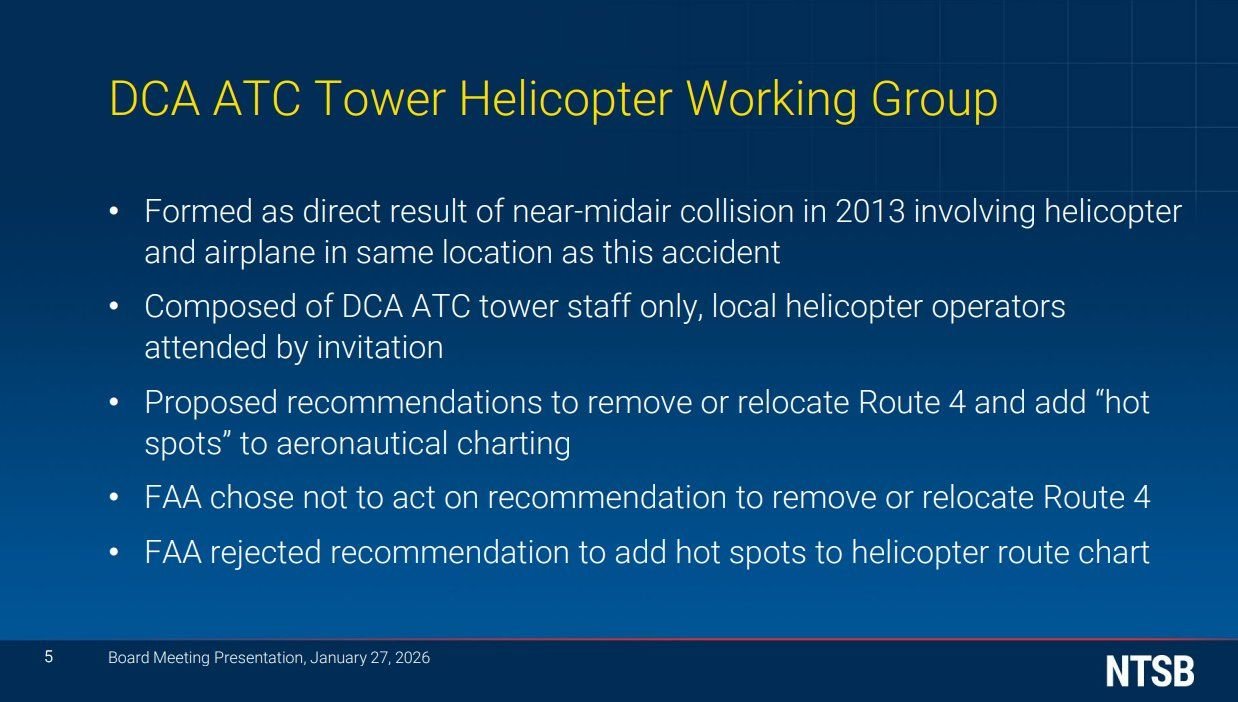
Possibly one of the more damning slides in NTSB history found in the Blackhawk-American Airline
s crash investigation.
In 2013, a group of local ATC and helicopter pilots proposed moving flight paths to avoid aircraft-helicopter collisions on landing at DCA. The FAA ignored them.
Subjects
ATC
DCA
FAA
NTSB
Links are to this post in the relevant subject page so that this post can be seen in context.
Reply to this quoting this original post. You need to be logged in. Not available on closed threads.
January 27, 2026, 22:50:00 GMT
permalink Post: 12028262
Subjects
ATC
FAA
NTSB
Safety Recommendations
Links are to this post in the relevant subject page so that this post can be seen in context.
Reply to this quoting this original post. You need to be logged in. Not available on closed threads.
January 27, 2026, 23:50:00 GMT
permalink Post: 12028296
Subjects
ATC
FAA
NTSB
Probable Cause
Separation (ALL)
Visual Separation
Links are to this post in the relevant subject page so that this post can be seen in context.
Reply to this quoting this original post. You need to be logged in. Not available on closed threads.
January 28, 2026, 01:17:00 GMT
permalink Post: 12028315
Subjects
ATC
DCA
Separation (ALL)
Links are to this post in the relevant subject page so that this post can be seen in context.
Reply to this quoting this original post. You need to be logged in. Not available on closed threads.
January 28, 2026, 03:09:00 GMT
permalink Post: 12028338
The PC statement should be read in its entirety, and at the conscious risk of ripe cliche, context matters. The Board did not assign the probable cause to the intersecting flight routes as such. For one thing, Chair Homendy repeatedly since the early days of the Board investigation has hammered upon the fact that the vertical separation was as little as 75 feet without any procedural separation (such as the helos holding at Haines Point). And also since the start of the investigation, time and again the complexity of the DCA airspace, and the (in my strident opinion) very messed up operation of DCA with regard to - as ATC staff testified - just "making it work", have been emphasized. Plus the refusal of FAA ATO to act upon the input from the helicopter working group several years ago, plus FAA's declining to note "hot spots" on charts. And the staffing issues, and lack of fidelity to SMS on the part of FAA and to some extent the Army as well. And there were, quite obviously, many findings of fact which are necessarily part of the context for reading . . . and understanding, the PC determination.
A person need not be an aeronautical engineer, airspace architect, or civilian or military aviator to understand from the get-go that intersecting flight paths might be found across the NAS. I'll stand to be corrected but I do not think - having watched the entirety of the hearing today - that the criticism of the Probable Cause finding is a valid, fair or accurate assessment of the Board's work in this investigation.
WillowRun 6-3
Subjects
ATC
DCA
FAA
Findings
Helicopter Working Group
Hot Spots
NTSB
NTSB Chair Jennifer Homendy
Probable Cause
Separation (ALL)
Vertical Separation
Links are to this post in the relevant subject page so that this post can be seen in context.
Reply to this quoting this original post. You need to be logged in. Not available on closed threads.
January 28, 2026, 03:16:00 GMT
permalink Post: 12028339
The PC statement should be read in its entirety, and at the conscious risk of ripe cliche, context matters. The Board did not assign the probable cause to the intersecting flight routes as such. For one thing, Chair Homendy repeatedly since the early days of the Board investigation has hammered upon the fact that the vertical separation was as little as 75 feet without any procedural separation (such as the helos holding at Haines Point). And also since the start of the investigation, time and again the complexity of the DCA airspace, and the (in my strident opinion) very messed up operation of DCA with regard to - as ATC staff testified - just "making it work", have been emphasized. Plus the refusal of FAA ATO to act upon the input from the helicopter working group several years ago, plus FAA's declining to note "hot spots" on charts. And the staffing issues, and lack of fidelity to SMS on the part of FAA and to some extent the Army as well. And there were, quite obviously, many findings of fact which are necessarily part of the context for reading . . . and understanding, the PC determination.
A person need not be an aeronautical engineer, airspace architect, or civilian or military aviator to understand from the get-go that intersecting flight paths might be found across the NAS. I'll stand to be corrected but I do not think - having watched the entirety of the hearing today - that the criticism of the Probable Cause finding is a valid, fair or accurate assessment of the Board's work in this investigation.
WillowRun 6-3
Subjects
ATC
DCA
FAA
Findings
Helicopter Working Group
Hot Spots
NTSB
NTSB Chair Jennifer Homendy
Probable Cause
Separation (ALL)
Vertical Separation
Links are to this post in the relevant subject page so that this post can be seen in context.
Reply to this quoting this original post. You need to be logged in. Not available on closed threads.
January 30, 2026, 09:27:00 GMT
permalink Post: 12029574
28. With several other targets located directly in front of the helicopter represented by points of light with no other features by which to identify aircraft type, and without additional position information from the controller, the instructor pilot likely identified the wrong target.
Subjects
ATC
Findings
PAT25
Separation (ALL)
Traffic in Sight
Visual Separation
Links are to this post in the relevant subject page so that this post can be seen in context.
Reply to this quoting this original post. You need to be logged in. Not available on closed threads.
January 30, 2026, 12:48:00 GMT
permalink Post: 12029671
28. With several other targets located directly in front of the helicopter represented by points of light with no other features by which to identify aircraft type, and without additional position information from the controller, the instructor pilot likely identified the wrong target.
The question was why the NTSB chose the right seat of the helicopter, and that was because the instructor assumed responsibility for the visual separation. There is no cockpit communication about the identification, so the PF wasn't involved in that.
One problem the helicopter had was that the CRJ was flying a turn. Flying straight, you know you're going to collide with something (even if it is just a dot of light) if it doesn't move visually. The CRJ's lights were moving left, so that would've looked like it was safely passing the helicopter by. The crew needed the situational awareness that the CRJ was going to turn towards them as it lined up for runway 33, but they didn't have it. ATC did, but didn't share, for reasons also addressed in the findings.
Subjects
ATC
CRJ
Findings
NTSB
Separation (ALL)
Situational Awareness
Visual Separation
Links are to this post in the relevant subject page so that this post can be seen in context.
Reply to this quoting this original post. You need to be logged in. Not available on closed threads.
January 31, 2026, 11:31:00 GMT
permalink Post: 12030150
Current Voice Switching Systems allow multiple frequencies and provide re-transmit options, and as such provide instantaneous splitting of frequencies to separate control positions.
The standard way to couple frequencies in ATC is what was avail in DC , you can transmit on both, listen to both simultaneously but not retransmitting on both . potentially reducing eventual blocked transmissions , or at least improves the detection of blocked transmissions .
in ATC , VHF anti blocking systems are being discussed since Tenerife ( 1977) , CONTRAN was the first one , tested but never really implanted , ,later some copies were made , introduced here and there but with a switch to disable, when traffic got too high ,. not sure what the situation is today but I doubt it changed much. ( waiting to be contradicted)
,
In the air , most new 8,33 VHFs have a "dual" function , where you can listen to 2 frequency simultaneously , but when the master is receiving , the slave is blocked out , some have a replay function but useless in flight , especially when flying manual VFR at 200 ft .. I doubt this would have made any difference in this case . Plus it would not solve UHF/VHF ground coupling issue.
Subjects
ATC
FAA
NTSB
VFR
Links are to this post in the relevant subject page so that this post can be seen in context.
Reply to this quoting this original post. You need to be logged in. Not available on closed threads.
February 06, 2026, 22:36:00 GMT
permalink Post: 12033518
Subjects
ATC
FAA
NTSB
Links are to this post in the relevant subject page so that this post can be seen in context.
Reply to this quoting this original post. You need to be logged in. Not available on closed threads.
February 16, 2026, 15:23:00 GMT
permalink Post: 12038098
I have unfortunately witnessed this almost all the time in the accidents I surveyed.
On the legal front , only in my home country, France , it always has been a disaster for the families , from the 1968 AF Caravelle shot down , the 1973 Iberia mid air collision in Nantes, the 1986 UTA DC10 bombing , the Concorde, or AF447 , every single time , it took well over 10 years to get a trial and every time the judgement was absolving , what the families saw as the real culprits, and the wounds are still open for them , decades later
Justice in the US is much faster , but I am not convinced the result will be better for the families. I hope for them I am wrong . Keep us posted WR 6-3.
.
One of my best school friends was on UTA 772 that was bombed over Niger in 1989, he was 36. We had learnt to fly together, I saw his first solo and he saw mine. We both worked in Africa in the 1980s but for different companies.
I knew his family well and I spent a fair bit of time with them after the accident and here are a few things I learnt:
Firstly, immediately after an accident the friends and relatives are desperate for information, first the What, then the Why. They will look anywhere and everywhere for this information. In this modern world this might well lead them here. When I post on this forum I am always conscious that some of the bereaved are most likely reading. If that is you then I hold you in the light. Getting clear, accurate, timely information to them can be a great comfort. Not everyone can comprehend an accident report or some technical aviation detail but they can if it is explained in a language they can understand so good posts on pprune can help. Consider it a service.
The second lesson for me was dealing with grief. I have been involved in several fatal (non-aviation) accidents and with the families of the victims. As an engineer by training I was taught, reinforced later by experience, that an objective approach is most likely to get to understand the cause and prevention of an accident. However that objective, dispassionate, disinterested approach completely ignores the very powerful emotions that can consume the surviving victims. It is all too easy use the objective facts as some kind of shield for yourself. I think that some recognition that grief can be a great help to the bereaved. The spectrum of grief is enormous and no two people deal with it in the same way.
Motivation: In my experience (and this seems to be the case with Tim and Sheri Lilley) is that some bereaved often have a powerful motivation to prevent this happening again. These people can help you advance your cause if you feel the same way.
A final lesson, and apologies to any lawyers here, is that most legal systems utterly fail to serve the victims or their bereaved. They are glacially slow, bureaucratic, wildly expensive, and polluted with politics. They usually serve the powerful at the expense of the weak (in the UK the NHS is the poster child for this). UTA 772 was one and there are many other aviation ones as ATC Watcher mentions. More examples would be Hillsborough, Grenfell Tower, Pan Am 103, Deepwater Horizon, and Piper Alpha, the list goes on and on.
There is a postscript to my story of UTA 772. My friend's body was never identified so it was nearly seven years later that his affairs could be settled. We then held a memorial service at our flying club (he had left some money in his will to the club). After the memorial his mother reached into her bag and handed me a camera. Apparently the French military would regularly visit the UTA 772 crash site where the shifting sands would often reveal new wreckage. They found some of his belongings, including this camera. Here is what it looked like having survived the bomb, falling from 35,000 feet and spending several years in the desert:

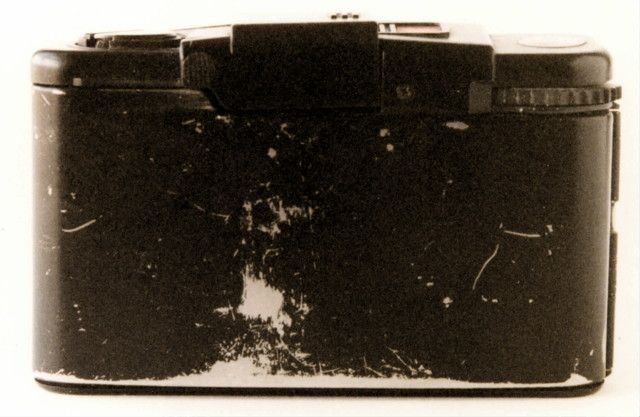
It was pretty beaten up but I could tell it had a film in it. With a specialist photo laboratory in London and help from Kodak's technical department we carefully processed the film. The negatives were pretty thin but there were definitely half a dozen images there. As the lab said "once we heard the story all of our printers wanted to have a go at getting some prints from this."
I remember the joy on his mothers face when she leafed through the prints and right near the end was a picture of her son. It must have been taken a few days before the crash and was certainly the last image of him alive.
Personally, I hate the word 'closure' in these situations as it implies that the grief ends at some point. It never does, all you can hope for is that day by day one manages it a little better. I think that photograph helped his mother to do this, if only a little.
Others weren't so lucky; her other son became obsessed with finding out what had happened to UTA 772, also with Pan Am 103 which had some obvious similarities. That obsession gradually descended into mania.
Subjects
ATC
Grief
Links are to this post in the relevant subject page so that this post can be seen in context.
Reply to this quoting this original post. You need to be logged in. Not available on closed threads.
February 16, 2026, 19:39:00 GMT
permalink Post: 12038200
I was sadly involved in the aftermath of the Uebrlingen collision , and I am still to this day so upset at this ignorant Swiss journalist that printed the nationality, name of the controller on duty and the village where he lived at a time where only wild speculations were around as to what really happened, and that directly led to his murder by the father of one of the victims, in his home in front of his wife and 2 small children. Designating who to blame hours after an accident seem to be the norm on social media today , but at least , here on PPRuNe , let's try to be professionals and not doing that .
Thanks for posting your story Paulross.
Subjects
ATC
Links are to this post in the relevant subject page so that this post can be seen in context.
Reply to this quoting this original post. You need to be logged in. Not available on closed threads.