January 30, 2025, 10:04:00 GMT
permalink Post: 11817076
MPN11, former Mil ATCO
Subjects
ATCO
Blackhawk (H-60)
DCA
PAT25
Radar
Route 4
Links are to this post in the relevant subject page so that this post can be seen in context.
Reply to this quoting this original post. You need to be logged in. Not available on closed threads.
January 30, 2025, 14:10:00 GMT
permalink Post: 11817271
Plus does the Blackhawk have a TCAS screen?? That would have been invaluable to pick out the traffic!
Subjects
ATCO
Blackhawk (H-60)
CRJ
TCAS (All)
Links are to this post in the relevant subject page so that this post can be seen in context.
Reply to this quoting this original post. You need to be logged in. Not available on closed threads.
January 30, 2025, 17:54:00 GMT
permalink Post: 11817466
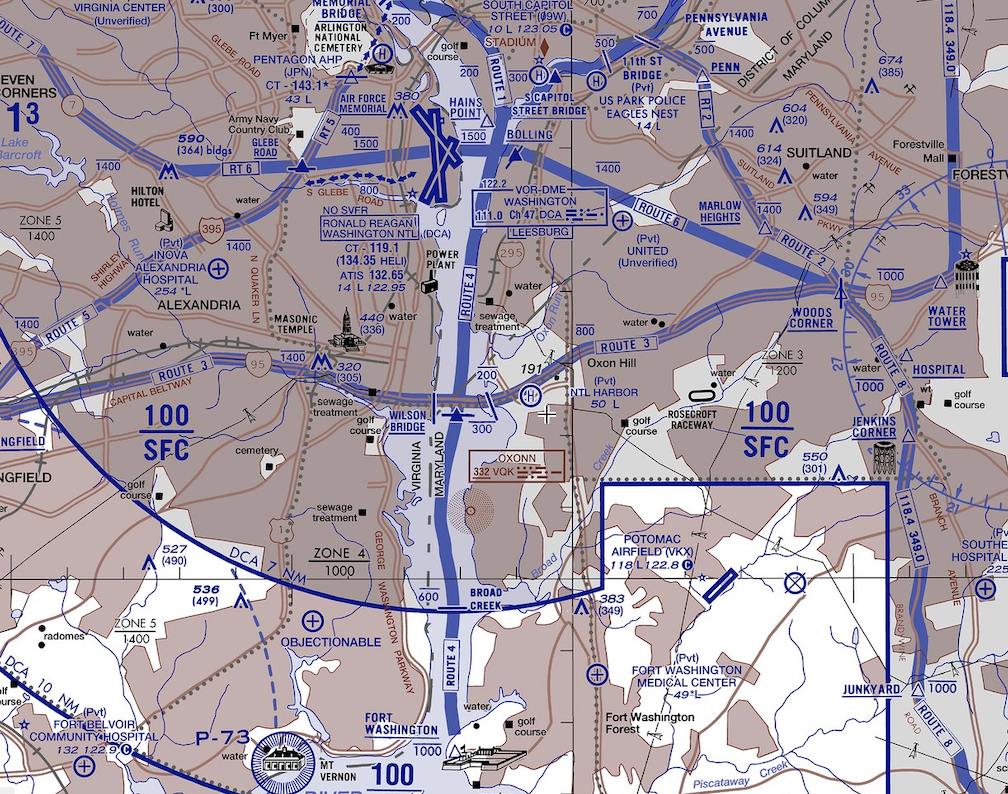
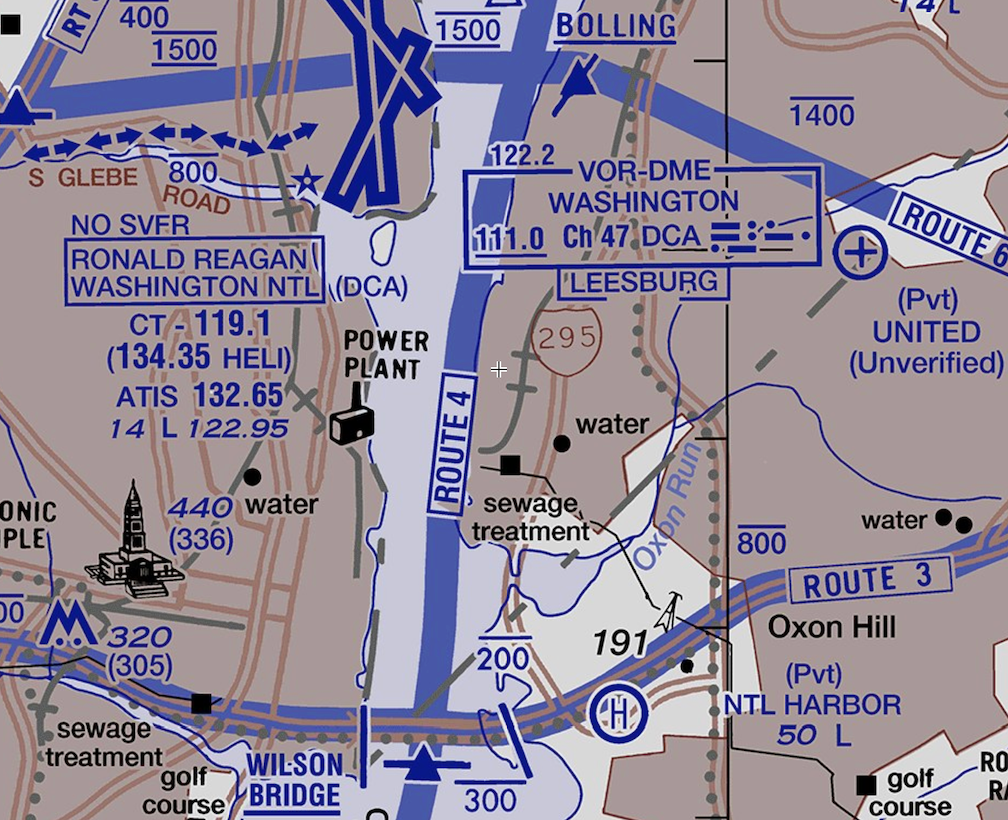
Hanging the ATCO on duty will not bring back the dead, and was not the cause of the problem. Having a civil aircraft flight path immediately overhead a LL RW VFR transit lane that guarantees that there is a loss of separation standards is what set this off, and that has been the case for decades. The crews, pax, ATC officers and families just happened to be the ones that got caught out by the insanity that permitted this track and procedure to exist.
Will Mr T go after the ATC guy? probably, the ATC officer doesn't own a kingdom, a corporation, in fact he is highly unlikely to have a DUI, and certainly won't be a convicted felon. So, I would rate the ATC guy as the convenient fall guy for the US Govt, the FAA who should not have permitted the operation of civil aircraft proximate to military LL traffic, and the US DOD, who will have signed off on the practice of disregarding minimum separation per \xa791.111. As far as right of way, the CRJ was landing, \xa791.113(g) applies, notwithstanding 91.113(d). The CRJ had every reasonable expectation of not sharing a cockpit on short finals to a short runway with crossing helo traffic.
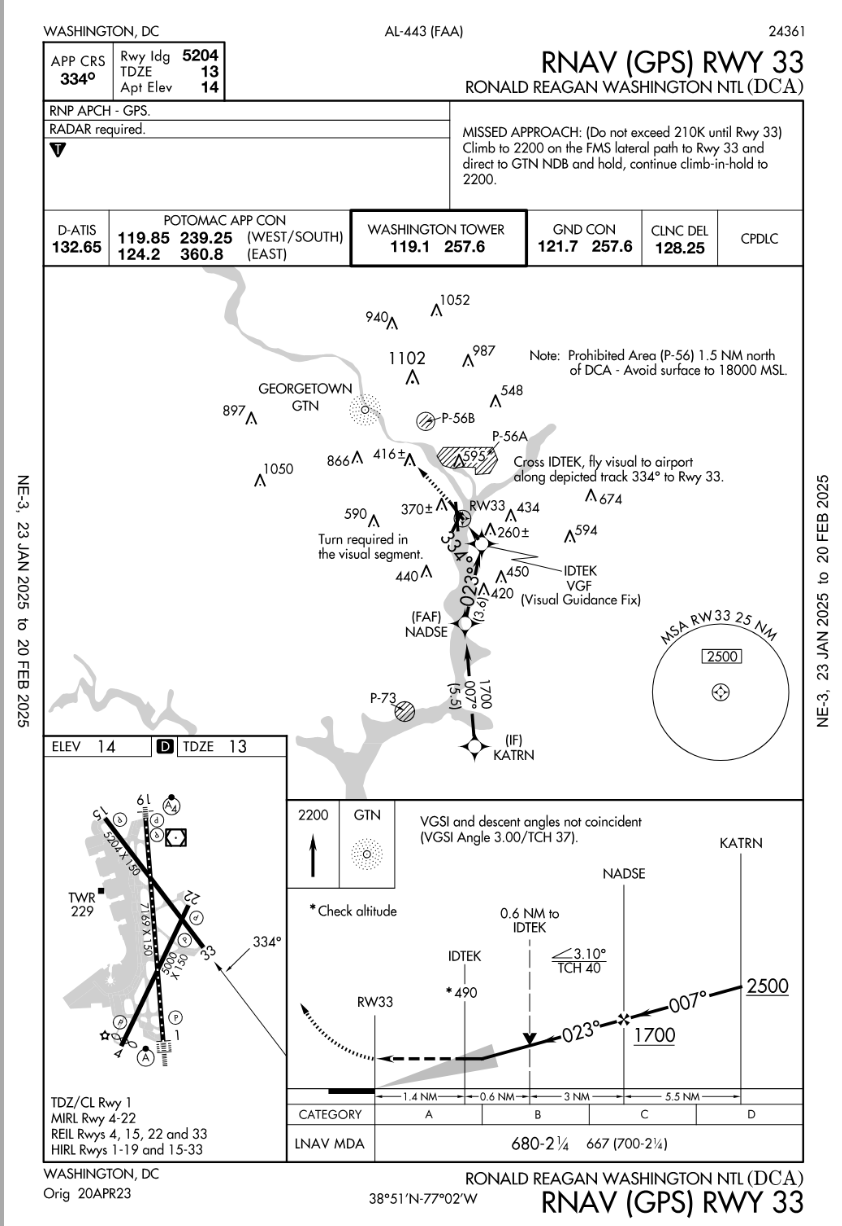
- IDTEK is 1.4nm from touchdown, 490' PA
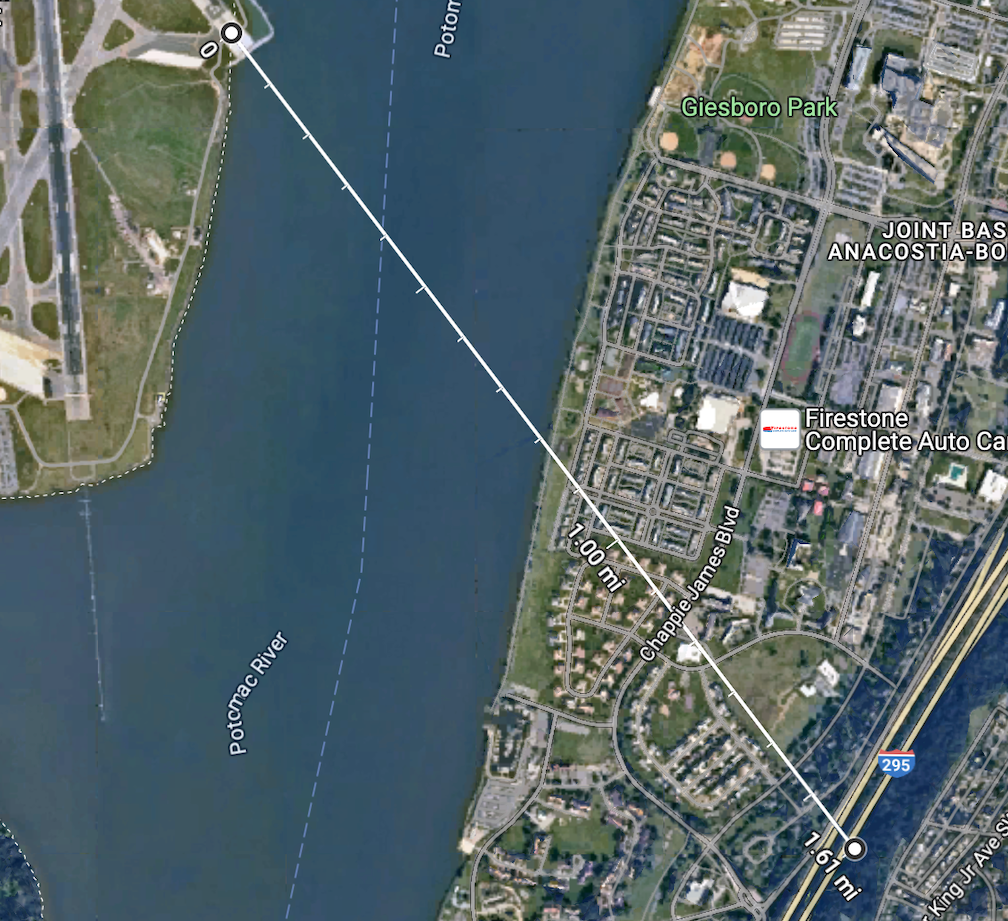
- the east bank of the river is half way to the runway, ~0.7nm, -> 245'+40' = 285'PA
- the collision occurred around mid river, ~0.3-0.4nm from T/D, or 125+40=165'
What is particularly annoying is that the generals and other command staff, and Secretaries of Transport, Defence etc are quite happy to cashier the F-18 pilots who do a slow flypast of an arena, or the T-38 instructors who do the same over some other game, and yet, what is the chance that any general takes responsibility for their part in this sorry state of affairs. responsibility like other stuff, only goes downwards,
Its pretty easy for the guy in charge to defame the ATCO.
Glass houses.

Subjects
ATC
ATCO
CRJ
FAA
Normalization of Deviance
President Donald Trump
Separation (ALL)
VFR
Links are to this post in the relevant subject page so that this post can be seen in context.
Reply to this quoting this original post. You need to be logged in. Not available on closed threads.
January 30, 2025, 19:53:00 GMT
permalink Post: 11817598
Adding an additional slice of cheese in the sandwich is very easy: just state that when 2 tracking routes provide less than 500 ft of separation, then they are mutually exclusive.
A clearance for route RT4 and a clearance for an approach RW33 cannot be active at the same time.
If an approach is underway, the route is closed. And if a clearance for the route has been issued, then the approach to RW33 is not available.
And the FAA would be well inspired to investigate all other similar conflicts across the USA and implement the same principle.
Subjects
ATCO
FAA
Separation (ALL)
Links are to this post in the relevant subject page so that this post can be seen in context.
Reply to this quoting this original post. You need to be logged in. Not available on closed threads.
January 30, 2025, 22:38:00 GMT
permalink Post: 11817719
Subjects
ATC
ATCO
Separation (ALL)
VFR
Links are to this post in the relevant subject page so that this post can be seen in context.
Reply to this quoting this original post. You need to be logged in. Not available on closed threads.
January 30, 2025, 23:07:00 GMT
permalink Post: 11817743
In the US does an agreement to make a visual approach regardless of airspace classification, cancel IFR separation requirements for the ATCO?
Subjects
ATC
ATCO
CRJ
IFR
Separation (ALL)
VFR
Links are to this post in the relevant subject page so that this post can be seen in context.
Reply to this quoting this original post. You need to be logged in. Not available on closed threads.
January 31, 2025, 00:34:00 GMT
permalink Post: 11817798
In the US does an agreement to make a visual approach regardless of airspace classification, cancel IFR separation requirements for the ATCO?
However, note that the airspace class at major US airports is B (rarely used elsewhere). Cancelling IFR in Class B does not relieve ATC of separation responsibility because VFR flights must still be separated from all other flights ( VFR separation standards here ). Separation responsibility only transfers to a pilot when they accept ' visual separation ' and the controller must continue giving separation instructions until that point. Aircraft can be given 'visual separation' against other aircraft, including IFR aircraft as happened here, without the other aircraft needing to have the traffic in sight. The controller must advise the other aircraft that visual separation is being applied if the flight paths are converging .
None of that is necessarily a problem.
The problem is reliance on visual separation at night. The ease with which the eye is drawn to bright lights (which may not be the lights of interest) and inability to perceive depth and distance from a point source of light (made worse by NVG) make it a high risk activity even between combat aircraft. To permit it to be relied upon for protection of airline traffic is madness.
Last edited by Easy Street; 31st January 2025 at 01:14 .
Subjects
ATC
ATCO
IFR
Night Vision Goggles (NVG)
Separation (ALL)
Traffic in Sight
VFR
Visual Separation
Links are to this post in the relevant subject page so that this post can be seen in context.
Reply to this quoting this original post. You need to be logged in. Not available on closed threads.
January 31, 2025, 06:47:00 GMT
permalink Post: 11817956
One runway, one ATCO, one frequency , one language ( not issue here- but there are again number of phraseology deviations)
Yes I know, system is more sensitive to money than to safety.
N.B. what I find interesting, systems that are richer are more prone to safety savings.
You will never find in " small and poor " country one ATCO working on 3 rwys withIin busy CTR .
Subjects
ATCO
Phraseology (ATC)
Links are to this post in the relevant subject page so that this post can be seen in context.
Reply to this quoting this original post. You need to be logged in. Not available on closed threads.
January 31, 2025, 18:45:00 GMT
permalink Post: 11818446
Subjects
ATC
ATCO
ICAO
VFR
Links are to this post in the relevant subject page so that this post can be seen in context.
Reply to this quoting this original post. You need to be logged in. Not available on closed threads.
January 31, 2025, 23:55:00 GMT
permalink Post: 11818633
Aircraft CVR had already been recovered, showed water ingress, was soaked in ionised water, then into oven for getting water out, still checking connectors \x85 but high confidence to get audio out.
Aircraft FDR already recovered, no water ingress, soaked in alcohol, looked good, ref 2,000 datapoints, high confidence to get data out.
NTSB investigation runs parallel to DoD investigation (I assume that will be the usual double), but independent, so NTSB got its own heli on-type licensed pilot in the team.
Investigation has a closely matching config CRJ available to match recovery of items and seating and cockpit config with items being recovered (which are refd on grid coordinates).
Main lift starts tomorrow and may take days. Prio 1 is still recovering all the victims. After that heavy lift of the big chunks starts on Sunday. This will take days.
ATCO interview(s) has already started. The history of the wider ATC team of controllers will look back for 24-72 hrs probably. But also at level of hiring and training.
PoB manifest are, by law, never published by NTSB and are excluded from FOIA.
Last edited by A0283; 1st February 2025 at 00:17 .
Subjects
ATC
ATCO
CRJ
CVR
NTSB
Links are to this post in the relevant subject page so that this post can be seen in context.
Reply to this quoting this original post. You need to be logged in. Not available on closed threads.
February 03, 2025, 15:50:00 GMT
permalink Post: 11820651
On the general subject of the 2nd Twr call to PAT25 and issuing avoidance instructions from BS5342, my take would be that maybe Twr saw it so late and simply didn't have an accurate mental picture of the precise trajectories of the helo and the CRJ to actually formulate a plan to deconflict safely. The only hope was that the helo crew "still" had the aircraft in sight (as they had already stated they had) and were still going to pass behind the CRJ............. Sadly, by then, that was just wishful thinking. At that late stage, all ATC probably knew was that ordering an evasion maneuver was just as likely to turn a near-miss into an accident as it was to turn an accident into a near-miss. A "Rock and a hard place springs" to mind....... One can only feel for the ATCO ...............
Subjects
ATC
ATCO
CRJ
DCA
PAT25
Pass Behind
Pass Behind (All)
Links are to this post in the relevant subject page so that this post can be seen in context.
Reply to this quoting this original post. You need to be logged in. Not available on closed threads.
February 03, 2025, 20:22:00 GMT
permalink Post: 11820868
My earlier questions remain unanswered … does DCA Tower have a slaved radar display ?
And thus could Tower have used that data to direct PAT21 out of the way, regardless of qualification or licensing? Or did Tower have a Radar qualification anyway, but didn’t use it?
Subjects
ATC
ATCO
DCA
Radar
Links are to this post in the relevant subject page so that this post can be seen in context.
Reply to this quoting this original post. You need to be logged in. Not available on closed threads.
February 03, 2025, 21:44:00 GMT
permalink Post: 11820928
My earlier questions remain unanswered \x85 does DCA Tower have a slaved radar display ?
And thus could Tower have used that data to direct PAT21 out of the way, regardless of qualification or licensing? Or did Tower have a Radar qualification anyway, but didn\x92t use it?
Subjects
ATC
ATCO
DCA
Radar
Situational Awareness
Links are to this post in the relevant subject page so that this post can be seen in context.
Reply to this quoting this original post. You need to be logged in. Not available on closed threads.
February 08, 2025, 06:22:00 GMT
permalink Post: 11824114
https://www.faa.gov/documentLibrary/...5-24_READY.pdf
As mentioned upthread, if not visually separated then either 500ft or 1.5mi applies.
Correct if this is all wrong, but in the accident sequence if the helo had responded \x91not visual yet, looking\x92 or words to that effect, then presumably a controller could allow the two to get a bit closer and then advise the conflicting traffic info to the helo again, say at 2.5mi. If helo visual, great \x97maintain visual separation, responsibly passes to helo.
This is what happened, although the very busy controller failed to re-state the position of the CRJ to direct the eyes of the helo crew onto the CRJ in order that they could actually see and avoid it.
However if not visual at say 2.5mi, well it\x92s a bit late, but the controller does still retain responsibility for separation and must apply the 500ft/1.5mi standard. Presumably instant vectors away while simultaneously climb to min vectoring altitude. Or the CRJ has to go around. Can of worms in busy airspace\x97 helos and /or jets being dispersed all over the sky.
Much better to do a rules based system and mutually exclude intersecting IFR app/deps and Helo Visual Routes.
He is not radar qualified- so no headings or radar measurment distances applicable.
Where is prescribed what point is 1,5 Nm away from visual app for rwy 33? ( Note : Atco must achive required separation before that point)
or
At what point should be givem climb instruction for He to be 500' above arriving a/c before compromising 1,5Nm. If rate of climb is 1000 ft/min Helicopet need to climb for 40-50 seconds with the speed 180km/h it is 2 Nm or so - it means that instruction to climb should be given no latter than 4Nm from crossing point.
What is possibikity to spot particular aircraft for visual separation at distances more than 4Nm from crosssing points, duting the night and in bussy traffic enviroment?
Yes , I know it is Burund....
Subjects
ATC
ATCO
CRJ
IFR
Radar
See and Avoid
Separation (ALL)
Visual Separation
Links are to this post in the relevant subject page so that this post can be seen in context.
Reply to this quoting this original post. You need to be logged in. Not available on closed threads.
February 08, 2025, 16:20:00 GMT
permalink Post: 11824433
He is not radar qualified- so no headings or radar measurment distances applicable.
Where is prescribed what point is 1,5 Nm away from visual app for rwy 33? ( Note : Atco must achive required separation before that point)
or
At what point should be givem climb instruction for He to be 500' above arriving a/c before compromising 1,5Nm. If rate of climb is 1000 ft/min Helicopet need to climb for 40-50 seconds with the speed 180km/h it is 2 Nm or so - it means that instruction to climb should be given no latter than 4Nm from crossing point.
What is possibikity to spot particular aircraft for visual separation at distances more than 4Nm from crosssing points, duting the night and in bussy traffic enviroment?
Yes , I know it is Burund....
Subjects
ATC
ATCO
Radar
Separation (ALL)
Visual Separation
Links are to this post in the relevant subject page so that this post can be seen in context.
Reply to this quoting this original post. You need to be logged in. Not available on closed threads.
February 11, 2025, 00:58:00 GMT
permalink Post: 11825797
For the ATCO, there wasn't only the flow of arrivals, but a good number of (no delay) departures, all this on intersecting runways and, not shown on the screenshot, in the seconds (a few dozens of...) prior to the accident, the ATCO was handling at least 3 helicopters (Mussel7 / Medevac / PAT25), even not counting the police helicopter working in the SW corner as depicted in the screenshot.
And all this on three* separate frequencies, not fully cross coupled, so TWR was receiving on several occasions, simultaneous/parallel incoming R/T calls (* based on info from other posters in both threads here on pprune & NTSB info - but I still have doubts PAT25 was on UHF, although 3 or 2 freq's, doesn't really matter in this accident's context)
And simulations by VASAviation and the likes, are heavily edited (as they correctly indicate in their comments), so they easily give the impression that traffic and R/T comm's were relatively light...
Subjects
ATCO
NTSB
PAT25
Links are to this post in the relevant subject page so that this post can be seen in context.
Reply to this quoting this original post. You need to be logged in. Not available on closed threads.
February 12, 2025, 17:30:00 GMT
permalink Post: 11826835
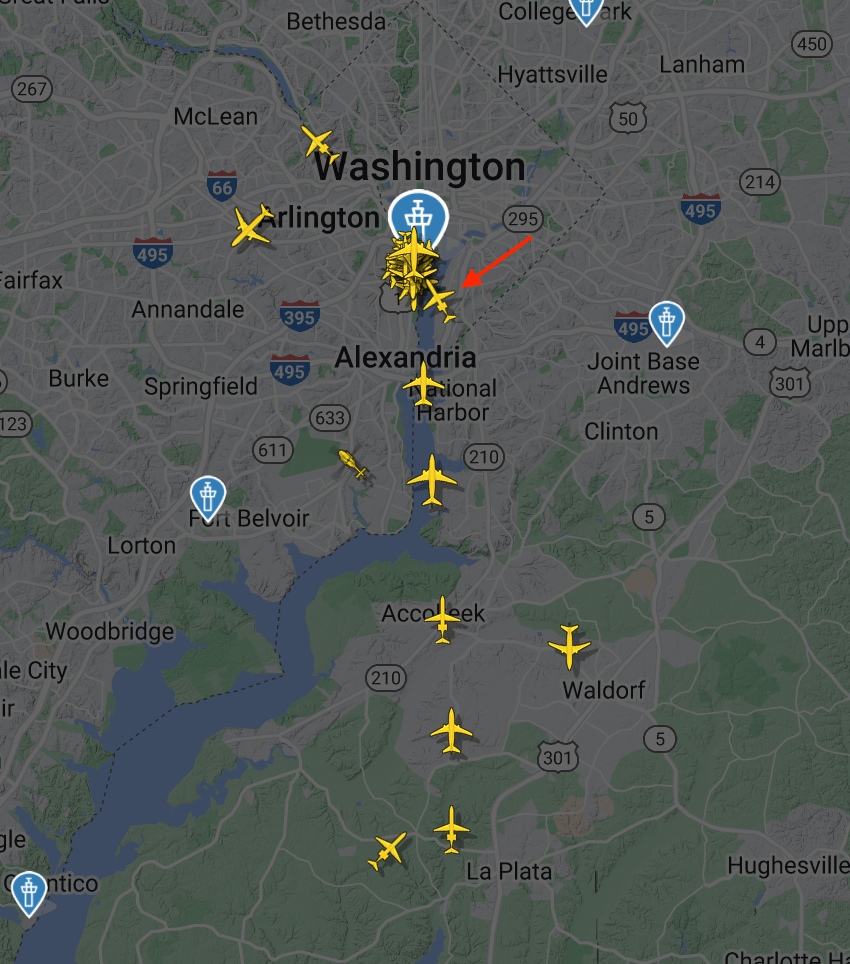
One ATCO, worked , at three separate frequency, three runways, 6 aircraft for arrival 01, one a/c 33, plus three helicopter, plus how many departures ( both active and approaching/crossing active runways) ?
Plus active estimate for a few aircraft more?
Ground vehicles, any?

Subjects
ATCO
PAT25
Links are to this post in the relevant subject page so that this post can be seen in context.
Reply to this quoting this original post. You need to be logged in. Not available on closed threads.
February 12, 2025, 19:32:00 GMT
permalink Post: 11826913
One ATCO, worked , at three separate frequency, three runways, 6 aircraft for arrival 01, one a/c 33, plus three helicopter, plus how many departures ( both active and approaching/crossing active runways) ?
Plus active estimate for a few aircraft more?
Ground vehicles, any?
Subjects
ATC
ATCO
Links are to this post in the relevant subject page so that this post can be seen in context.
Reply to this quoting this original post. You need to be logged in. Not available on closed threads.
February 12, 2025, 22:17:00 GMT
permalink Post: 11827015
One ATCO, worked , at three separate frequency, three runways, 6 aircraft for arrival 01, one a/c 33, plus three helicopter, plus how many departures ( both active and approaching/crossing active runways) ?
Plus active estimate for a few aircraft more?
Ground vehicles, any?
Fixed wing
AAL1630, departed 1, waiting handoff to departure
JIA5305, holding short 1, #2
DAL832, holding short 1 #3
JIA5342, cleared to land 33
AAL3130, cleared to land 1
AAL472, cleared visual 1
JIA5347, cleared visual 1, requested 33
Rotary wing
PAT25
helo, Zone 4
helo, callsign Blackjack 1, freq change approved just prior
helo, callsign Muscle 12, handed off to ADW prior
helo, request Route 3, Zone 6
helo, Zone 7
Medevac AirCare helo, proceeding to Inova Fairfax
Some of the helo\x92s on above list may be duplicates due to poor audio quality.
At the time of the accident, runway 4/22 was not in use.
Subjects
ATC
ATCO
PAT25
Links are to this post in the relevant subject page so that this post can be seen in context.
Reply to this quoting this original post. You need to be logged in. Not available on closed threads.
February 15, 2025, 18:34:00 GMT
permalink Post: 11828759
It was doomed to fail, eventually, but sadly someone [other than those directly impacted] never saw it coming. THEY are the culprits.
MPN11, former Mil ATCO
Subjects
ATC
ATCO
Route 4
Separation (ALL)
Visual Separation
Links are to this post in the relevant subject page so that this post can be seen in context.
Reply to this quoting this original post. You need to be logged in. Not available on closed threads.