February 15, 2025, 20:36:00 GMT
permalink Post: 11828824
It was doomed to fail, eventually, but sadly someone [other than those directly impacted] never saw it coming. THEY are the culprits.
MPN11, former Mil ATCO
Subjects
ATC
ATCO
Altimeter (All)
Route 4
Separation (ALL)
Visual Separation
Links are to this post in the relevant subject page so that this post can be seen in context.
Reply to this quoting this original post. You need to be logged in. Not available on closed threads.
February 19, 2025, 18:09:00 GMT
permalink Post: 11831631
It may sound harsh, but after years of struggle for non-punitive environment, some have deduced this as non-punitive environment for any kind of incident (or even accident).
Back to case in DCA - to expect self separation of night VFR and IFR conducting visual approach agreed hasty and under pressure in the area where none of them is capable of sudden change of trajectory is just pouring gasoline to the fire already raging.
Subjects
ATCO
DCA
IFR
Separation (ALL)
VFR
Links are to this post in the relevant subject page so that this post can be seen in context.
Reply to this quoting this original post. You need to be logged in. Not available on closed threads.
March 21, 2025, 11:20:00 GMT
permalink Post: 11851281
 I always read you input as, while the detailed legal nitty-gritty is generally way beyond me, you always provide a refreshing viewpoint which is good to read! The aim of my Post, based on my interpretation of the above quote, was just to emphasise the existence of ASIAS is just as a tool or, rather, a set of tools but which has no real "proactive function" in itself. Yes, it represents a very small part of the Flight Safety chain - but as a resource in the main. As you say, there were loads of examples of what happened at DCA and my post was an explanation as to who, I believe, should have been looking at it. Maybe they did - and just ignored it? No idea!
In the UK, the airport operator is totally responsible for the safety of operations on or above their field out to 4000 ft on approach and departure - about 12 miles. The CAA who regulates aviation here, along with the Dept of Transport, but in conjunction with other stakeholders such as NATS (our en-route ATC organsiation), airlines and airfield operators etc, designs the airspace and sets the generic rules for it's use. As you said, the main rule is "Don't crash anything into anything else!". However, at the airfield, it is the airport operator who needs to ensure that the generic rules work in their environment. If a particular rule is legal but, if applied in their location, is unsafe, they can't apply that rule! That's what the Safety Case should say.
A relevant example? I used to regularly (for work) transit London S > N and N > S along the red dotted line below - at 2400ft as it kept me just out of the London TMA but as high as possible so, if it had all gone quiet on the engine front, I'd have the best chance to get the plane onto the ground with me alive and no-one else hurt. As part of the transit, I had to cross the final approach into London City (green line). So, say heading N, I'd chat to Thames Radar while over South London and would ask for a London City crossing. They'd chat to City ATC to co-ordinate and take me to the Thames before handing me to City Tower. My route over the Approach has aircraft at 1200 ft descending on the ILS and so I would have crossed anything landing at 1200 ft above that. So, while on first glance, it was fine I never, ever got that clearance with an aircraft landing - and for very good reasons. If the aircraft on the ILS had had to do a go-around, life could have become interesting very quickly. I was always held until the landing aircraft was well clear (ie ATC could see it was almost at the airfield) before they cleared me across. Indeed, legally, they could have given me a "You see the landing? Pass behind that"! But, no - always positive clearances. Got my vote ....... + gave me chance to enjoy the views of Greenwich and the City of London and "delayed" me a couple of minutes. OK, a bit unfair as LCY is "sleepy hollow" compared to DCA but, despite that, they were very friendly ..... but very strict!!!!!
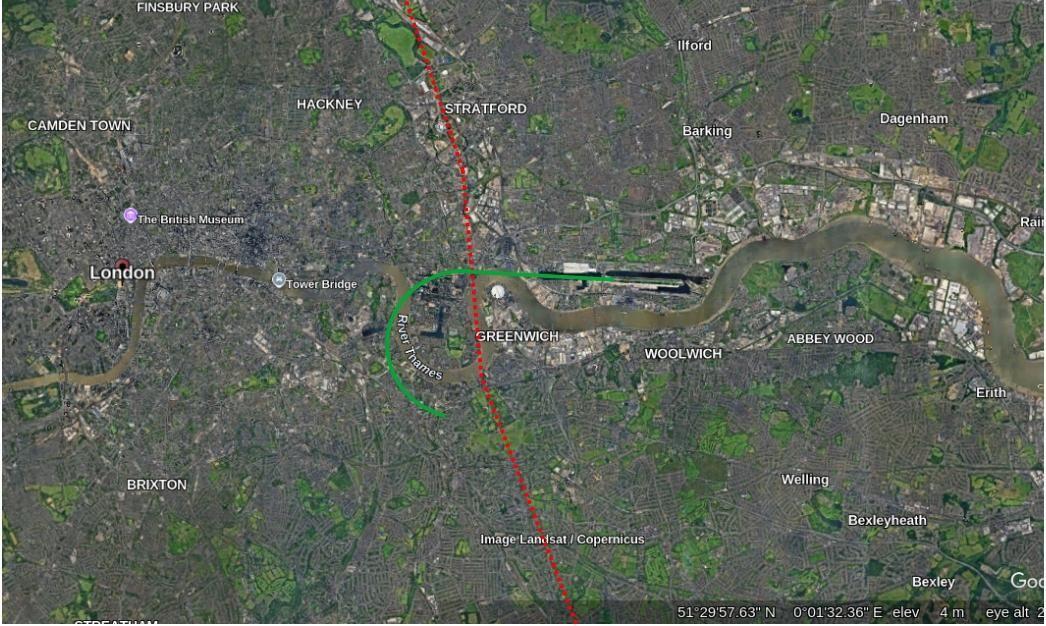
So, when you are discussing (I think!!!) whether ATC elected to give PAT25 a "You visual? Pass behind" or whether it was "ordered" from on-high as it was deemed safe to do, ultimately, it is the ATCOs call on the day. Now, before I get flamed, do I blame the ATCO ? No! Well, why not? After all, he gave PAT permission! And yes, it was a "legal" clearance. But was it a wise clearance? When unpacking that little lot you have to look at a raft of Human Factors which influenced that ATCO on that night. He was on his own so, probably, the only way he could cope with all he had on his plate was to try and shift some responsibility onto PAT25 - one less thing for him to juggle. But even then, he needed to be monitoring which he clearly was - but while very busy with other approaches and departures so he just picked up a concern too late as the audio shows - "Are you sure you see the jet?". Another factor - was the strategy to use Route 4 while 33 was active something ATCers at DCA, over time, started in an effort to cut down radio traffic and speed things up? If so, had it been assessed and then monitored for adverse safety? While anecdotally, it seemed people were aware of "close calls", had any analysis taken place looking at the Databases? In the UK certainly, all the Airport Operator responsibility.
To the final "accountability" part re payments to families, the thing we have here is (and, folks, correct me if I've got this wrong) the FAA set the rules and the operate the Rules. Here, the CAA sets the rules and the Airfield Operator operates the rules. That is important - for eg, huge argument here in the UK about just how independent the UK's Military Flight Safety organisation is ..... as it is part of the Military. IMHO, what we have here are valid generic rules, some of which were simply not suitable in this specific location - just like crossing London City with an aircraft on approach - legal ...... but very unwise. As to who carries the can, well, as you said WR 6-3 , the legal beagles will get to the bottom of that ..... but it will take some time. I'll leave that side to you!!! My main question out of all of this is, why were not these issues flagged up by airport management for further investigation given it was something of an open "secret"? And where else (around the world) is this happening?

And, on that cheerful note...........! H 'n' H
Subjects
ATC
ATCO
Accountability/Liability
Close Calls
DCA
FAA
PAT25
Pass Behind
Pass Behind (All)
Radar
Route 4
Links are to this post in the relevant subject page so that this post can be seen in context.
Reply to this quoting this original post. You need to be logged in. Not available on closed threads.
March 22, 2025, 11:33:00 GMT
permalink Post: 11851982
Now, one could say, "Well, there was a fairly steady flow of (maybe) 10 aircraft landing/taking off. So, 1 extra helicopter is not much more to add in!". True ...... but ...... an example. A mainline train arrives at a major London Station and, at once, all the doors open and several 1000 people all get off together and start heading up the stairs to the ticket barriers. The flow of traffic is heavy but quite ordered as the flow is all in one direction and so, while traffic density up the stairs maybe slows it down a bit, the flow is nicely ordered. Picture now, H 'n' H , being in a rush and so being one of the first off the train arriving at the ticket barrier only to realise - Durrrr - he's left his case back on the train. Being not-too-bright, I decide the quickest way to go back is down the same stairs I came up, and hence back to the train. Of course there's only 1 of me going down and several 1000 coming up. But to an onlooker gazing down, the effect of my single trip back against the several 1000 heading up has had a significant effect. TBH, H 'n' H is causing a fair degree of chaos as he pushes past everyone fighting his way back down the stairs against the flow. A few choice comments are being made by his fellow pax! What we have is a disproportionate effect caused by 1 vs 1000's.
So, while I'm no expert in how the brain works, usually the ATCO is dealing with a steady flow S - N and is sequencing things in their mind to smoothly land and depart traffic, slotting people in and out of the queue to achieve an orderly, safe, flow. All of a sudden, their "mental flow" now has something working in the other direction which all needs a bit more thought to ensure that everything remains safe. OK, 1 helo is not much, but it requires a disproportionate amount of extra "computing" compared to, say, adding another 1 aircraft into the main flow, to ensure safe separation. Was that why the "Own visual separation" offer was taken up? Now, rather than managing the contraflow, the ATCO only has to "monitor" the singleton swimming against the tide - which they were to a degree. Just a thought.
I'm not sure how long such tapes are kept? Usually it is a defined period after which the tape is recycled into the "system". Of course, looking further back, and in a perfect world, you could assess ATC SOPs against the buildup in traffic over the years and see how that's affected things over time. Was it the case of "a death by a 1000 cuts" which
WR 3-6
cited? Sadly, I suspect we'd need a crystal ball to study that. But retired Controllers could give a fairly good insight.
I mean the Airport Operator running the airfield. So, in the UK, that could be a company who then employ the Twr controllers to run that side just as they employ or contract Baggage Handlers, Cleaners, etc, etc. The UK ANSP (NATS) generally pick up everything above 4000 ft tho the actual hand-offs vary tactically and there can be local variations to suit specific airspace. So, for example, from memory, the Channel Islands work up to a higher level before en-route takes over. Below that, its up to the Airport Operator to staff their operation and make sure it's all safe and sound.
Anyway, better dash as already late........! Before yet more chaos is caused by H 'n' H !!!!!!

Subjects
ATC
ATCO
Radar
Separation (ALL)
VFR
Visual Separation
Links are to this post in the relevant subject page so that this post can be seen in context.
Reply to this quoting this original post. You need to be logged in. Not available on closed threads.
March 23, 2025, 18:20:00 GMT
permalink Post: 11852858
My closing thoughts. It seems ATC were simply trying to run a routing system, the layout of which was handed to them, to the best of their ability. As moosepileit said at Post #1176, "These charted routes are Pre 9/11/01. ATC workload and growth of route, ahem, users, too. How do you boil a frog? Just like this. One degree at a time. This is the B-17/P63 crash - dumb orchestration, no one spoke up." . The ATCO involved seems to be a victim of this - a process of "normalisation" over time and pushing rules to, or beyond, their sensible limits - something I said a few Posts back. Similarly, the helo crew were as much victims - again, possibly a process of "normalisation" over time meant they were a bit too happy to say that they had an a/c in sight which they genuinely thought was 5342 but wasn't - "normalised complacency" if such a term exists - I guess it does now!
My own concerns relate more to the "human factors" involved (as per my Safety Engineering experience) and why someone, somewhere, didn't call "Time-out, Folks! We seem to be having a lot of near-misses here! Time to revisit the Safety Case!" - if there was ever one in the first place....... Interestingly, I've already mentioned the Airport Management team in this context - but how come the airlines, where some of their pilots are calling DCA, what was it, "the most dangerous airport in the USA" (it's somewhere back in this Thread!), didn't call a halt? They also have a responsibility to conduct safe operations. OK, they have less exposure to the rate of TCAS warnings at DCA but someone, somewhere would review all TCAS incidents involving their aircraft, where it was and, importantly, why it occurred........
To close - I was involved in one "incident" (actually, it was a complete "non-incident" as you will see!) when crossing the overhead of Luton at 3000ft S - N one day. A jet on the runway went tech so the next aircraft on approach, after some discussion between ATC, the stranded aircraft on the r/w and the aircraft on approach, had only one option - to go around as the runway was blocked ...... certainly for a while. Standard missed approach for LTN is (simplified) "climb to 3000ft" - exactly where I was.
 But
The reason I'd been given that crossing clearance was the ATCO had clearly
pre-planned
for the eventuality of me being overhead at 3000ft
and
a possible go-around to 3000ft. His instruction was quite straight forward, immediate and totally relaxed. "Airline XYZ, go around - stop climb at 2000ft - traffic crossing in my overhead at 3000ft.". Even so, I did pay very close personal attention to the go-around a/c, checking it actually leveled off at 2000ft ...... to see that it all went according to the "Plan"! Oh, in case you wondered, the big difference between my LTN and LCY crossings was that I couldn't get high enough at LCY for ATC to safely slot just this sort of go-around in underneath me! At LCY, the London TMA limited me to 2500 ft max (well, 2400ft with 100ft to allow for height-keeping errors on my part!).
But
The reason I'd been given that crossing clearance was the ATCO had clearly
pre-planned
for the eventuality of me being overhead at 3000ft
and
a possible go-around to 3000ft. His instruction was quite straight forward, immediate and totally relaxed. "Airline XYZ, go around - stop climb at 2000ft - traffic crossing in my overhead at 3000ft.". Even so, I did pay very close personal attention to the go-around a/c, checking it actually leveled off at 2000ft ...... to see that it all went according to the "Plan"! Oh, in case you wondered, the big difference between my LTN and LCY crossings was that I couldn't get high enough at LCY for ATC to safely slot just this sort of go-around in underneath me! At LCY, the London TMA limited me to 2500 ft max (well, 2400ft with 100ft to allow for height-keeping errors on my part!).
But at LTN, I did have a great view of a 737 climbing towards me, leveling off and then passing safely below! If only the outcome on that fateful night at DCA had been the same for 5342 and PAT25.........

Last edited by Hot 'n' High; 23rd March 2025 at 19:07 .
Subjects
ATC
ATCO
DCA
Findings
Normalization of Deviance
PAT25
TCAS (All)
Links are to this post in the relevant subject page so that this post can be seen in context.
Reply to this quoting this original post. You need to be logged in. Not available on closed threads.
March 25, 2025, 11:53:00 GMT
permalink Post: 11853844
Agreed 100%! After all, many air accidents are because pilots are in the wrong place - a good example is the current sister Thread to this one covering a plane which started to take-off from a taxiway - sadly a regular occurrence. Lots of people are asking "How on earth......." - but they did, just as others have done before them! I'll not comment further as the discussion is on that Thread anyway which you can read and the Investigation is early days so far.
However, one of the reasons aviation is so safe today is because the aviation community realised a big driver to improving safety, based on the premise that humans are both ingenious in devising new ways to screw things up - as well as being quite capable of repeating the old ways too - was to understand if additional issues were contributing to those accidents. In particular, anonymous self-reporting of "near misses" provides much valuable information enhancing the understanding of issues before anyone dies. There were many "near miss" reports relating to this route/runway as has been mentioned. But no-one joined the dots........
By understanding how those additional factors contributed to the near miss/accident means further mitigation could be put in place. Maybe one of the most significant - Flight Time limitations - have come about as, after a number of accidents, people realised just how a lack of proper rest significantly degrades human performance and so contributed to poor decision-making, particularly when under pressure. I just use that as an example of "contributory factors" - possibly not relevant here - the full Report is not out yet.
In this case, the helo crew ended up flying into a jet. But why did they do that? Well, when the NTSB recommended that Route 4 be closed, it described it as being "an intolerable risk to aviation safety by increasing the chance of a midair collision.". If the helo crew mistook another aircraft to one they should have been avoiding (a likely mistake) there was little effective mitigation to prevent that mistake leading to catastrophe - hence the recommendation from the NTSB. What there was in terms of mitigation - such as the ATCO - failed. The ATCO suddenly realised all was not quite right but he didn't have the time to come up with a solution to save the day and a collision happened on "his watch". I can't even imagine what he is going through right now every single day.....
Yes, by all means decide liability for recompense to those who lost loved ones on that fateful day - (top tip, go where the money is!). The legal people like our esteemed fellow PPRuNer, WillowRun 6-3 , will do that. What the aviation community itself wants to ensure is that such a mistake (which will happen again - as I said, whilst humans are extremely inventive in finding out new ways to screw up they are also prone to be quite capable of repeating mistakes ad infinitum) - never leads to such deaths in the future. That's why people look, in great depth, behind the obvious cause for the crash to see what more can be done. That's why it's so safe for you to step aboard an aircraft today.
To reiterate, in the words of the NTSB, the aviation world was running a route which provided "an intolerable risk to aviation safety by increasing the chance of a midair collision.". So, one question, who approved that ..... and where is the Safety Case to support that decision? Cue tumbleweed rolling slowly down the road......................
I hope this helps explain why it's wayyyyyy more than "The crew screwed up. End of story!". Cheers, H 'n' H
Subjects
ATCO
Accountability/Liability
Close Calls
NTSB
Route 4
Links are to this post in the relevant subject page so that this post can be seen in context.
Reply to this quoting this original post. You need to be logged in. Not available on closed threads.
March 26, 2025, 08:10:00 GMT
permalink Post: 11854380
Here is the NTSB report/transcript and another transcript here . I couldn't locate the one on Prune way, way back but these 2 will do!). ATC specifically call the a/c sidestepping to 33 as the a/c PAT needs to identify. The ATCO even tells PAT what type it is. PAT then say they have "it" visual. Sadly, "it" wasn't the sidestepping a/c, it was another one. But no-one figured that out ...... till seconds before the crash. This initial exchange, according to the transcript, was about 2 min before the collision. It's only then, on the basis that PAT says they have seen "it" and, by implication, will visually avoid it, that ATC issue the clearance on down Route 4.
There was a lot of discussion earlier on in this Thread about how on earth PAT could be reliably expected to pick out the subject a/c from the rest of the stream of arrivals and at that distance (6 miles rings a bell).
It's only seconds before the crash that it appears that the poor ATCO suddenly starts to suspect the PAT crew are actually looking at a different a/c to the one he had asked them to identify and pass behind. But, by then, it was too late for him to figure out a solution to give to PAT.
As I said, this was all discussed many posts ago so it's easy to forget the details. Hope the links help!
Cheers, H 'n' H
Last edited by Hot 'n' High; 26th March 2025 at 08:44 .
Subjects
ATC
ATCO
NTSB
Pass Behind
Pass Behind (All)
Route 4
Links are to this post in the relevant subject page so that this post can be seen in context.
Reply to this quoting this original post. You need to be logged in. Not available on closed threads.
April 22, 2025, 22:03:00 GMT
permalink Post: 11871844
I guess that dampens the urge to figure out what's going on with a TA, especially when on a relatively short Final where workload is high/time is in short supply/city lighting makes it very difficult. We don't know re this specific crew but it seems the Company regularly used 33 so that could be a factor - "Here we go again...... another TA........". As someone said, the "boiled frog" scenario.
I still think that, while it's a valid thought of "what if they did......", I think it masks the more important aspect in that the overall design of that bit of airspace was rubbish - as was so eloquently put by the NTSB.
Basically, the design stitched up the CRJ crew, the helo crew, the ATCO and the poor pax. Where else are there similarly wilting frogs? Thats the big question.
Subjects
ATCO
CRJ
DCA
NTSB
Links are to this post in the relevant subject page so that this post can be seen in context.
Reply to this quoting this original post. You need to be logged in. Not available on closed threads.
April 28, 2025, 09:40:00 GMT
permalink Post: 11874750
Subjects
ATCO
Links are to this post in the relevant subject page so that this post can be seen in context.
Reply to this quoting this original post. You need to be logged in. Not available on closed threads.
October 22, 2025, 03:19:00 GMT
permalink Post: 11973998
Bit of historical background : when designing this route decades ago they must have followed basic ICAO/ FAA principles . separation IFR-VFR is 500 feet . allowed deviation then was 100 ft either way , so even if one a/c is 100ft above and the other 100ft too low , there would still be 300 ft separation preventing a collision ,
When that was introduced decades ago I bet you a bottle of (real) Champagne that the procedure was use of that route 4 was restricted during RWY 33 arrivals and RWY 15 departures. It was one or the other but not both simultaneously .
How , when and why , over time , did it degraded to the point that this restriction could be disregarded would be interested to investigate and unveil . The why I think we know, i.e. enabling to move more and more traffic, but when and by who we don't. How and on who's pressure did the numerous previous incidents got disregarded is another question worth asking . Not why the Heli pilot was flying 78 ft too high .
Throwing the Heli pilot (and perhaps also the controller on duty) "under the bus" as you say in your country, would be so wrong as it would prevent getting to the truth and learn the real lessons of this accident .
Unless all the possible plaintiffs intend to proceed with the same lawyers who already have filed a Complaint in federal court, other complaints with perhaps different approaches to the facts and the law are to be expected. But at this time, I think there's pretty strong reason to understand the Complaint which was filed as pitching the ATCO and one or more of the helicopter pilots directly toward a large Greyhound. If, after finding time (and attitude) sufficient to read every single word on every single page of the Complaint very closely, I realize that plaintiffs' counsel have not done so in the current Complaint, I'll frame some correcting post.
As a somewhat related point, and without intending to be a flame-thrower, what about the airline pilots in this matter? Imagine being one of their immediate family. The passengers and cabin crew will be part of the overall group of plaintiffs. With the allegations in the current Complaint, the pilots are being alleged to have operated the flight negligently - is this not a fair and accurate reading of the Complaint? But if this accident was caused - in the sense of the actual realities of flight operations and airspace and all the other actual aviating facts - by the airspace design and operation, and the wrong time and place flight of the helicopter - why aren't the families of the pilots entitled to their day in court as well? And I don't mean day in court just to defend their actions against allegations as in the Complaint, I mean in claims against the FAA and possibly the Army....... oh sure, sue the United States? I'm guessing the airline corporate entities which are defendants probably would not think that would be a good idea. And neither would airline industry trade groups - but maybe this is something for former New Hampshire Governor Chris Sununu to tackle in his new role as CEO of Airlines4America. Something that seems to be part of this is that the airline corporate entities are well-insured. But what good does that do for the families of the two pilots? - answer, it doesn't do any good for them, other than a probable off-ramp for the entire case at some point down the litigation timeline. And still without the families of the two pilots having their day in court to claim rights and remedies against the real causal agents of the accident. End of rant. For now anyway. (See perhaps Rule 24 of the Federal Rules of Civil Procedure, re: permissive intervention)
Subjects
ATC
ATCO
FAA
ICAO
NTSB
Route 4
Separation (ALL)
Links are to this post in the relevant subject page so that this post can be seen in context.
Reply to this quoting this original post. You need to be logged in. Not available on closed threads.
December 12, 2025, 18:16:00 GMT
permalink Post: 12004310
What makes it strange is that if someone in the House is going Bad Boy Scout and saving the taxpayer, the ultimate source of the potential payout, that Congress critter would ordinarily be boasting about those savings, like the way that an Executive critter (Rubio) is boasting about going back from Calibri to Times New Roman (because the Biden administration said Calibri was a help to those with damaged eyesight). But no Congress critter is going to be able to take credit for this change if it becomes clear it results in further hurt to the surviving families of the victims of the collision. They won't say "Look at how I saved the US government from the consequences of their carelessness" on the campaign trail.
It's a rare Congress critter who does a thing which, if discovered, would bring hellfire down upon them, and for which they can never take public credit, but for which they also not being paid. If one is to sell out the good of the people, it normally requires a fat bribe. If that can of worms is opened - the DoD paying cash bribes to Congress for political favors - that will be a very difficult can to seal up again. If not the DoD, who would benefit from paying off a Rep to do this?
But regardless, I'm just trying to "noodle" (as a higher-seniority level lawyer in the same firm once used the term) how such a provision was inserted into the NDAA. I might have been taken in too much by press releases and watching hearings, but the current leadership of the House T&I (Transportation and Infrastructure) Committee has not given - to at least this one observer - any reason to think they would move in a direction contrary to the urgent safety recommendations made by NTSB soon after the accident (which were in fact implemented by DOT soon thereafter). So where is this coming from, this provision?
I won't try to argue leverage against any of the links in the reasoning in the quoted post. For one thing, the cynicism - not saying it isn't valid or warranted - on which the reasoning is based is sharper and more basic than the cynicism I usually experience. But this avoidance still doesn't address the question, where did the provision originate, and why?
Perhaps it is coming from the Executive branch and the Congress people involved feel pressure, for all sorts of Jet-Blasty reasons. The Pentagon might not want the adverse publicity of a trial which casts very unfavorable light. And with the recently announced systems integrator contract for the new ATC system, likewise, trial developments showing governmental incompetence would be seen as impeding the rest of the required appropriations. Not least, the public hype for the new ATC system has frequently referred to the work being completed in three or four years. Reliable sources (including a long time senior ATCO in a major European country with current involvement in a major ATCOs organization) scoff at the idea that all the necessary steps could possibly be completed in less than 8 to 10 years (including but not limited to site acquisition, construction, training on new equipment, not to mention sufficient rosters of ATCOs and then doing the relocations necessary if main facilities are actually consolidated). A really negative trial in Washington would not be helpful with regard to continuing to tout the expected so-very-rapid arrival of the new ATC system which will - it is said - make up for many years of lost time in the NAS.
I'm not arguing that this is what happened - just, what is the root of the provision? I mean, unless one believes it's a good idea, then I guess the "what if" is answered by saying, "good idea". Or even....
"That's good thinking there, Cool Breeze." (Couldn't resist the Boomer aside.)
Subjects
ATC
ATCO
NDAA
NTSB
Safety Recommendations
Links are to this post in the relevant subject page so that this post can be seen in context.
Reply to this quoting this original post. You need to be logged in. Not available on closed threads.
December 18, 2025, 18:31:00 GMT
permalink Post: 12007614
It seems to me as a practical aviator, with little knowledge of the US law, but with an interest in ATM matters, that there was a fundamental flaw in the way the routes were constructed and in the way they were used. To blame the ATCO is only a very small part of the problem, to blame the AA crew, equally so. Also, even though the helicopter crew may have made a mistake in height keeping or in identifying the opposing traffic correctly (the latter understandable under the circumstances), the fundamental issue is the design and the procedures used in that airspace.
This appears to me like another organisational whitewash. What do others think?
Last edited by Bergerie1; 18th December 2025 at 18:42 .
Subjects
ATCO
Links are to this post in the relevant subject page so that this post can be seen in context.
Reply to this quoting this original post. You need to be logged in. Not available on closed threads.
December 18, 2025, 19:07:00 GMT
permalink Post: 12007627
It seems to me as a practical aviator, with little knowledge of the US law, but with an interest in ATM matters, that there was a fundamental flaw in the way the routes were constructed and in the way they were used. To blame the ATCO is only a very small part of the problem, to blame the AA crew, equally so. Also, even though the helicopter crew may have made a mistake in height keeping or in identifying the opposing traffic correctly (the latter understandable under the circumstances), the fundamental issue is the design and the procedures used in that airspace.
This appears to me like another organisational whitewash. What do others think?
The Air Current just published a review of those systemic failures. Well worth the reading time. (And TAC publishes stuff on safety matters freely available, not behind pay wall.)
It won't endear anyone to the people running the show in the federal interagency and who have responsibility for the conceptual design, architecture and implementation of the U.S. "ATC Modernization" programme (European spelling done deliberately here) but it strikes this SLF/attorney as remarkably clear that unless a full accounting of what went horribly and tragically wrong in DCA airspace on the night of 29 January 2025 is done and done tranparently, any hope for a successful rebuilding of the ATM components of the U.S. NAS is about slim, to none. Just one small but illustrative example. ATCOs at DCA wanted "hot spots" of potential traffic conflict noted on charts. FAA HQ denied the request. Why? It didn't have in place a standardized method of marking such notations on charts. This actually was testified to at the Board hearing.
Subjects
ATC
ATCO
DCA
FAA
Hot Spots
Links are to this post in the relevant subject page so that this post can be seen in context.
Reply to this quoting this original post. You need to be logged in. Not available on closed threads.