February 07, 2025, 02:58:00 GMT
permalink Post: 11823364

Subjects
ADSB (All)
Altimeter (All)
Links are to this post in the relevant subject page so that this post can be seen in context.
Reply to this quoting this original post. You need to be logged in. Not available on closed threads.
February 07, 2025, 04:21:00 GMT
permalink Post: 11823381
Further, seems to me that the helicopter was reporting 200 feet via the IFF (transponder), probably from the AAU-32 Baro altimeter instrument in the cockpit.
.
https://www.reddit.com/r/aircrashinv...radar_sources/
Of course, I think the whole altitude issue is a red herring and the concentration of attention on this "discrepancy" reduces the attention on other issues that aren't as easily "corrected".
Subjects
ATC
Altimeter (All)
PAT25
Links are to this post in the relevant subject page so that this post can be seen in context.
Reply to this quoting this original post. You need to be logged in. Not available on closed threads.
February 07, 2025, 04:52:00 GMT
permalink Post: 11823390
Seems to me that the collision altitude is reasonably well established.
Further, seems to me that the helicopter was reporting 200 feet via the IFF (transponder), probably from the AAU-32 Baro altimeter instrument in the cockpit.
I now understand that the H-60 had an ADS-B capable black box upgrade in place of the original basic IFF (APX-100?), and that the extended (ADS-) squitter message was turned off on the subject flight.
I think it is worth a close review of the static line plumbing to the AAU-32 which is the source of the 29.92 altitude report.
If, for example, the static line became disconnected, then cockpit ambient pressure might influence (bias) the AAU-32's reading.
I'd check the records to see if a pitot-static leak set had been performed in the recent past, and I'd inspect the remnants of cockpit plumbing if practical
Second... I'd check the upgraded ADS-B capable IFF/Transponder to see if it used aircraft static altitude sensed values as it reported "altitude" , and not (ever) use any other value such as altitude above geoid.
Long-shot thoughts, but perhaps worth considering.
There is graphic evidence that the fuselage of the 60 went under the nose of the CRJ700, and they hit is probably established beyond reasonable doubt on this forum, if not in the evidence of the wreckage in the Potomac. The flight path of the CRJ is well established, up until the moment that the aircraft struck. That should itself have put to bed the matter of height in the analysis.
It is highly probable that the 60 was on altitude on their instruments, and the causal factor being misidentification of a visual target beyond 5nm at night, landing on RWY01, while the CRJ is not pointing at the helicopter, it is presenting the red navlight on the port wingtip to the helicopter drivers, along with occasional strobes against a night sky. The vector of the CRJ across the visual sector of the helo crews was a slow translation to the right, and then from off around 10 o'clock the CRJ intersects the RWY33 finals and becomes a stationary target well off the main scan of the helicopter crew. When asked to confirm they are passing behind the CRJ traffic, they have the RWY01 traffic off to their right, and they are reasonably expecting that to be their traffic. If they don't have a breadcrumb trace of the traffic on their ND of tac display, while the outcome is unfortunate, I would argue that misidentification of a target in a condition where misidentification is a high probability is not the primary causal factor, it is a consequence of the practice of mixing crossing LL traffic with landing and TO traffic.
My concerns are not future risk from this condition occurring, failure to place spak filler over the cracks in this practice would be naughty. My concern is the system scapegoating a US Army flight crew doing a task that is arguably unreasonable. The fact that some may consider it just normal practice done badly does not answer the fact that physiological limitations and the kinetics of this situation make a mid air a near certainty, the obvious evidence being they did hit, the day before there was a near-miss/loss of separation.
It is time for command to assume responsibilities that go with their post, and not blame those beneath them that travel in harms way on the implicit faith that command is competent and cares for the crews safety, and the national resource that they represent. To do otherwise is conduct unbecoming.
The CRJ crew were having a normal day, until they were killed. The passengers on board could also reasonably expect that our industry cares enough to actually do what we say we are doing, and to MANAGE SAFETY , if that is not too much to ask for. Managing safety does not equate to box ticking, it is the very fact we have devolved into considering safety in a stochastic system to be assured by compliance that we get to this sorry saga.
Last edited by fdr; 7th February 2025 at 20:23 .
Subjects
ADSB (All)
Altimeter (All)
CRJ
Separation (ALL)
Links are to this post in the relevant subject page so that this post can be seen in context.
Reply to this quoting this original post. You need to be logged in. Not available on closed threads.
February 14, 2025, 19:54:00 GMT
permalink Post: 11828159

Subjects
Altimeter (All)
Blackhawk (H-60)
NTSB
Pass Behind
Pass Behind (All)
Links are to this post in the relevant subject page so that this post can be seen in context.
Reply to this quoting this original post. You need to be logged in. Not available on closed threads.
February 14, 2025, 20:29:00 GMT
permalink Post: 11828183
Not at all. The briefing indicated there may be a possibility that the altimeter in the BlackHawk displayed an inaccurate altitude reading and that the discrepency was in the order of approx 100' given the height at which the collision is known to have occurred.
Briefing the RT comms, NTSB stated that a portion of the ATC instruction to the BlackHawk to 'pass behind the CRJ' was received in the Blackhawk (according to the CVR), truncated due to the BlackHawk keying the mic at the same time. Apparently, the words 'pass behind the' were missing from the BlackHawk CVR.
Last edited by parabatix; 14th February 2025 at 20:35 . Reason: 'in rely to'
Subjects
ATC
Altimeter (All)
Blackhawk (H-60)
CRJ
CVR
NTSB
Pass Behind
Pass Behind (All)
Links are to this post in the relevant subject page so that this post can be seen in context.
Reply to this quoting this original post. You need to be logged in. Not available on closed threads.
February 14, 2025, 21:03:00 GMT
permalink Post: 11828208
For a couple of days now, was thinking about posting something on an "extra noise" I keep hearing in the R/T comms, when TWR gives the ' pass behind ' instruction. Was wondering whether TWR's Tx wasn't stepped over by someone.
My first impression was that the extra noise came from an radio call from a turbine helicopter (given the typical background noise often heard in radio calls from turbine helicopters). And was wondering if it wasn't PAT25 that started replying to TWR's first ' in sight? ' call, effectively blocking part of TWR's second call, the ' pass behind ' part of the instruction.
In attached mp3 (in .zip per forum attachment requirements) around 00:05 I hear this 'extra noise'.
Edit:
well, this seems to confirm my initial impression:
Last edited by DIBO; 14th February 2025 at 21:07 . Reason: last posts with NTSB info seem to confirm my suspicion
Subjects
ATC
Altimeter (All)
Blackhawk (H-60)
CRJ
CVR
NTSB
PAT25
Pass Behind
Pass Behind (All)
Links are to this post in the relevant subject page so that this post can be seen in context.
Reply to this quoting this original post. You need to be logged in. Not available on closed threads.
February 14, 2025, 21:30:00 GMT
permalink Post: 11828220
Not at all. The briefing indicated there may be a possibility that the altimeter in the BlackHawk displayed an inaccurate altitude reading and that the discrepency was in the order of approx 100' given the height at which the collision is known to have occurred.
Briefing the RT comms, NTSB stated that a portion of the ATC instruction to the BlackHawk to 'pass behind the CRJ' was received in the Blackhawk (according to the CVR), truncated due to the BlackHawk keying the mic at the same time. Apparently, the words 'pass behind the' were missing from the BlackHawk CVR.
Subjects
ATC
Altimeter (All)
Blackhawk (H-60)
CRJ
CVR
NTSB
Pass Behind
Pass Behind (All)
Radio Altimeter
Links are to this post in the relevant subject page so that this post can be seen in context.
Reply to this quoting this original post. You need to be logged in. Not available on closed threads.
February 14, 2025, 21:38:00 GMT
permalink Post: 11828226
8:43:48, pilot stated the Black Hawk was at 300 feet, the instructor pilot stated 400 feet, there is no discussion of the discrepancy; the investigation will probe this.
True, this is some minutes before the collision. But it is a discrepancy of 100 feet as referred to in the prior post.
Subjects
Altimeter (All)
Blackhawk (H-60)
Radio Altimeter
Links are to this post in the relevant subject page so that this post can be seen in context.
Reply to this quoting this original post. You need to be logged in. Not available on closed threads.
February 14, 2025, 22:00:00 GMT
permalink Post: 11828241
Subjects
Altimeter (All)
Radio Altimeter
Links are to this post in the relevant subject page so that this post can be seen in context.
Reply to this quoting this original post. You need to be logged in. Not available on closed threads.
February 14, 2025, 23:34:00 GMT
permalink Post: 11828293
 ) if there had been any discussion in the black hawk cockpit about the CRJ (where it was, whether the PF did see it or not) when PM requested visual separation
Subjects
Altimeter (All)
Blackhawk (H-60)
CRJ
NTSB
Separation (ALL)
Situational Awareness
Visual Separation
Links are to this post in the relevant subject page so that this post can be seen in context.
Reply to this quoting this original post. You need to be logged in. Not available on closed threads.
February 15, 2025, 09:19:00 GMT
permalink Post: 11828441
In any case the procedure us currently withdrawn until end of March and I sincerely doubt they will re-install it before the final report is out. ..
A couple of new info points the NTSB clarified : Both aircraft were on VHF , so we can drop this UHF discussion , the Blackhawk had ADS-B equipped but was not transmitting , it was check ride with NVG, and they most probably all had them on .and there was a last second evasive action attempt by the CRJ crew, which go a TA previously . On the TWR, the CAs are displayed in the BRITE even with audio on ..
For the rest we have to wait until the next NTSB briefing
Subjects
ADSB (All)
Altimeter (All)
Blackhawk (H-60)
CRJ
Final Report
NTSB
Night Vision Goggles (NVG)
Links are to this post in the relevant subject page so that this post can be seen in context.
Reply to this quoting this original post. You need to be logged in. Not available on closed threads.
February 15, 2025, 10:10:00 GMT
permalink Post: 11828480
Disconcerting that the PAT 25 crew, about to descend and fly less than 200 feet AGL , would not have investigate the discrepancy of 100 feet between their respective altimeters...
Subjects
Altimeter (All)
Radar
Links are to this post in the relevant subject page so that this post can be seen in context.
Reply to this quoting this original post. You need to be logged in. Not available on closed threads.
February 15, 2025, 10:24:00 GMT
permalink Post: 11828489
I sincerely hope the NTSB can avoid being distracted by the distractions of altimetry and the missing ATC words on the Blackhawk CVR.
Upthread, Luca Lion calculated the 3 degree PAPI approach path as crossing the eastern riverbank at 270ft. If that's correct, then the CRJ's 313ft radar height 2 seconds before collision puts it at least 43ft above the approach path, so the Blackhawk's radio height deviation of 78ft would have contributed only about 35ft to the erosion of any intended "procedural separation" (*) between the aircraft. Or, to put it another way, the same outcome would have resulted if the Blackhawk had been at 235ft radio and the CRJ on the glide. Height keeping of plus or minus 35ft can only be achieved by instrument flying, which is obviously not compatible with visual separation (or indeed VFR) so cannot be reasonably cited as part of a safety case for the procedure. And of course a landing aircraft could easily be below the glide. Altimetry and height keeping are not the cause of this accident.
Missing the word "circling" wouldn't have influenced the helo crew getting visual with the CRJ at the time of the trasnmission. At best, it would have given them an extra nudge that "runway 33" (which was audible) meant the CRJ would be taking an easterly flight path. Missing "pass behind" with only a few seconds to collision was irrelevant if, as seems likely, the helo crew did not see the CRJ at that point.
(*) The quotes around "procedural separation" are intended to convey a tone of disgust and sarcasm.
Last edited by Easy Street; 15th February 2025 at 10:47 .
Subjects
ATC
Altimeter (All)
Blackhawk (H-60)
CRJ
CVR
Final Report
NTSB
Pass Behind
Pass Behind (All)
Radar
Separation (ALL)
VFR
Visual Separation
Links are to this post in the relevant subject page so that this post can be seen in context.
Reply to this quoting this original post. You need to be logged in. Not available on closed threads.
February 15, 2025, 17:25:00 GMT
permalink Post: 11828732
Likely the Kollsman settings will be recoverable. Barometric altimeters used in VFR can be way off, but transponder calibration depends on a calibrated altimeter. The NTSB will be looking at maintenance records.
Subjects
Altimeter (All)
Blackhawk (H-60)
NTSB
VFR
Links are to this post in the relevant subject page so that this post can be seen in context.
Reply to this quoting this original post. You need to be logged in. Not available on closed threads.
February 15, 2025, 20:36:00 GMT
permalink Post: 11828824
It was doomed to fail, eventually, but sadly someone [other than those directly impacted] never saw it coming. THEY are the culprits.
MPN11, former Mil ATCO
Subjects
ATC
ATCO
Altimeter (All)
Route 4
Separation (ALL)
Visual Separation
Links are to this post in the relevant subject page so that this post can be seen in context.
Reply to this quoting this original post. You need to be logged in. Not available on closed threads.
February 15, 2025, 21:35:00 GMT
permalink Post: 11828846
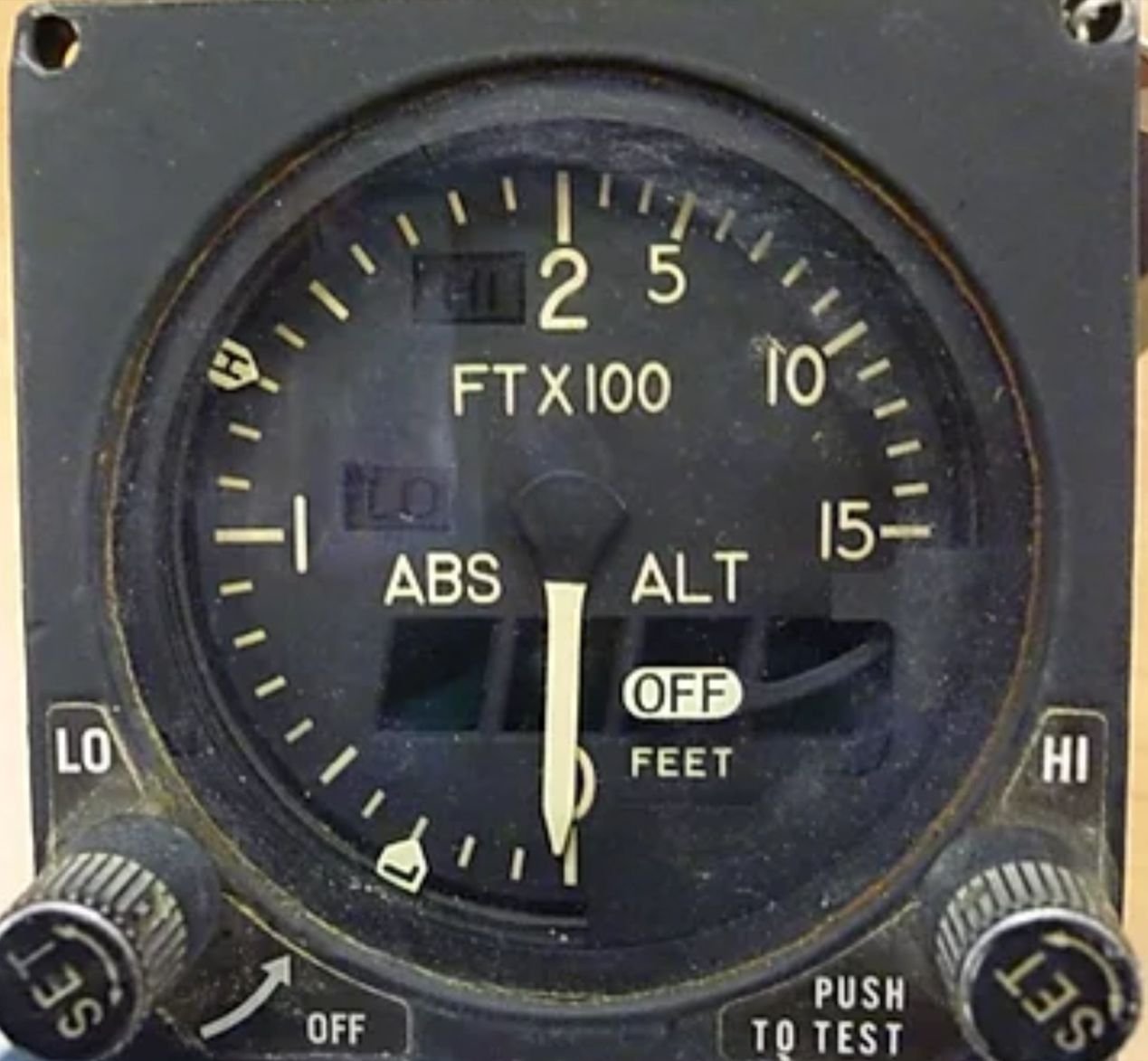
Disconcerting that the PAT 25 crew, about to descend and fly less than 200 feet AGL , would not have investigate the discrepancy of 100 feet between their respective altimeters...
Details of instrumentation here:
https://apps.dtic.mil/sti/tr/pdf/ADA409934.pdf
Not completely obvious in the photo is the digital display of radar altitude just underneath the annotation ABS ALT. The technical manual also mentions a three digit radar altitude displayed on the HUD.
Last edited by Stagformation; 15th February 2025 at 23:01 .
Subjects
Altimeter (All)
HUD
Radar
Links are to this post in the relevant subject page so that this post can be seen in context.
Reply to this quoting this original post. You need to be logged in. Not available on closed threads.
February 16, 2025, 23:07:00 GMT
permalink Post: 11829527
So maybe the handling pilot misread 300ft radio and set an indicated 210ft on her baro-altimeter, while the pilot monitoring correctly set 300ft on his baro-altimeter, but without a crosscheck being performed. Subsequently if they adjusted flightpath to fly 200ft on the handling pilots baro alt then that would explain quite a lot\x85.
eg The helicopter flying at 290ft radio (actually 278ft at impact); the pilot monitoring\x92s nudge to the pilot handling to descend a bit; the transponder mode C reporting 300ft from the pressure altitude capsule in the handling pilots baro altimeter (which we\x92ve seen on the various ATC traffic videos).
Subjects
ATC
Altimeter (All)
Radio Altimeter
Links are to this post in the relevant subject page so that this post can be seen in context.
Reply to this quoting this original post. You need to be logged in. Not available on closed threads.
February 16, 2025, 23:34:00 GMT
permalink Post: 11829539

Subjects
Altimeter (All)
Radio Altimeter
Links are to this post in the relevant subject page so that this post can be seen in context.
Reply to this quoting this original post. You need to be logged in. Not available on closed threads.
February 17, 2025, 03:42:00 GMT
permalink Post: 11829612
While the PAT 25 pilots, prior to take off, would set the barometric pressure each gauge must have no more than a +/- 75 foot error (FAA). One gauge may have read + 50 feet high while the other one read - 50 feet low which would account for the 100 foot difference in flight between the two barometric altimeters. Many mechanical and pilot input errors would be potential factors. Not common but sometimes a pilot will read back the correct setting while at the same time setting a different value by mistake. IF the 100 foot discrepancy was discussed initially on the ground it may account for the lack of discussion , later in the flight, while at 400 feet PM and 300 feet PF. It begs the question was radar altimeter planned to be used and if so when?
Even though there are some transmissions stepped on for various reasons, the words runway thirty three were mentioned a number of times. As crossing the threshold to runway 33 posed a significant risk to PAT 25 I would have thought the PAT 25 crew, to know from experience, that in 3 to 4 minutes from the time ATC reported the CRJ crossing the bridge the CRJ would pass directly in front of them at or near the same altitude. It's not clear to me why PAT 25 would not have reduced airspeed and or held at HAINS point.
I belive the simultaneous helicopter and runway 33 operations should never have been permitted. Clearance limits and expected further clearance times mirroring the ETA for rwy 33 given to helicopters to arrive at or hold at HAINS point would have be helpful in preventing conflicts.
Subjects
ATC
Altimeter (All)
CRJ
FAA
Night Vision Goggles (NVG)
Radar
Links are to this post in the relevant subject page so that this post can be seen in context.
Reply to this quoting this original post. You need to be logged in. Not available on closed threads.
February 17, 2025, 09:45:00 GMT
permalink Post: 11829754
So I wouldn\x92t call the altimeter discussion a distraction per se - not yet, anyway. It\x92s just one tiny fact in a complex picture, but still an important fact nevertheless. It is a concrete example of one (or more) of those, by itself insignificant, real-life deviations from perfection occurring. I expect (hope) that the NTSB will use this issue just to illustrate the point that relevant traffic procedures at KDCA were largely based on wishful thinking.
Subjects
Altimeter (All)
KDCA
NTSB
QNH
Links are to this post in the relevant subject page so that this post can be seen in context.
Reply to this quoting this original post. You need to be logged in. Not available on closed threads.