February 04, 2025, 10:52:00 GMT
permalink Post: 11821295
Radar orders also need to be given and actions taken sooner than if the crews are doing it of their own initiative. So a radar CA needs to be visible say 15 second pre-collision so ATC can wait for the radio to be clear then order pilots to manoeuvre. Pilots can aim to cross visually at more like 5 seconds.
I'm not saying that this is overall a good idea, but the fundamental reason you fit more planes in with visual separation is that you can put them closer together with (given good visibility) not too dissimilar safety.
[Edit: too late... Fullwings got this.]
TCAS 8 is getting closer and sooner after this horrific accident.
Subjects
ATC
Blackhawk (H-60)
CRJ
DCA
Radar
Separation (ALL)
TCAS (All)
TCAS RA
Visual Separation
Links are to this post in the relevant subject page so that this post can be seen in context.
Reply to this quoting this original post. You need to be logged in. Not available on closed threads.
February 04, 2025, 10:57:00 GMT
permalink Post: 11821301
Thanks
Issue a safety alert to an aircraft if you are aware the aircraft is in a position/altitude that, in your judgment, places it in unsafe proximity to terrain, obstructions, or other aircraft. Once the pilot informs you action is being taken to resolve the situation, you may discontinue the issuance of further alerts. Do not assume that because someone else has responsibility for the aircraft that the unsafe situation has been observed and the safety alert issued; inform the appropriate controller.
NOTE-
1. The issuance of a safety alert is a first priority (see paragraph 2-1-2, Duty Priority) once the controller observes and recognizes a situation of unsafe aircraft proximity to terrain, obstacles, or other aircraft. Conditions, such as workload, traffic volume, the quality/limitations of the radar system, and the available lead time to react are factors in determining whether it is reasonable for the controller to observe and recognize such situations. While a controller cannot see immediately the development of every situation where a safety alert must be issued, the controller must remain vigilant for such situations and issue a safety alert when the situation is recognized.
Recognition of situations of unsafe proximity may result from MSAW/E-MSAW, automatic altitude readouts, Conflict/Mode C Intruder Alert, observations on a PAR scope, or pilot reports.
Once the alert is issued, it is solely the pilot's prerogative to determine what course of action, if any, will be taken.
...
b. Aircraft Conflict/Mode C Intruder Alert. Immediately issue/initiate an alert to an aircraft if you are aware of another aircraft at an altitude that you believe places them in unsafe proximity. If feasible, offer the pilot an alternate course of action. When an alternate course of action is given, end the transmission with the word \x93immediately.\x94
PHRASEOLOGY-
TRAFFIC ALERT (call sign) (position of aircraft) ADVISE YOU TURN LEFT/RIGHT (heading),
and/or
CLIMB/DESCEND (specific altitude if appropriate) IMMEDIATELY.
EXAMPLE-
\x93Traffic Alert, Cessna Three Four Juliett, 12'o clock, 1 mile advise you turn left immediately.\x94
or
\x93Traffic Alert, Cessna Three-Four Juliett, 12'o clock, 1 mile advise you turn left and climb immediately.\x94
Subjects
ALERT Act of 2026
ATC
Blackhawk (H-60)
Radar
Links are to this post in the relevant subject page so that this post can be seen in context.
Reply to this quoting this original post. You need to be logged in. Not available on closed threads.
February 04, 2025, 18:49:00 GMT
permalink Post: 11821628
Subjects
Blackhawk (H-60)
Links are to this post in the relevant subject page so that this post can be seen in context.
Reply to this quoting this original post. You need to be logged in. Not available on closed threads.
February 05, 2025, 03:48:00 GMT
permalink Post: 11821881
We used this quite often when parachute jumpers crossed our approach path to the homebase (from above of course
 ). We could have done a 360 , but then we would have lost sight of our vertical traffic and a quick stop is more fun.
I my country we widely use a wonderful device called FLARM. It is sort of a pour man's TCAS, using a similar protocol as ADS-B but on a free to use frequency. Shows traffic of other live FLARMS and warns if a Mode-S transponders is approaching (using field strength) . It has another optional feature: a database of low strung cables, power lines and other obstructions our country is infested with. Guess what we had to do in a heli when this alarm went of? Indeed, a quick stop and then a good lookout for cables!
like they say in the industry: “you don’t know what you don’t know”
Trying to quick stop at night as a means of collision avoidance is just dumb anyway.
And fwiw: if you understand VRS training as necessary to recover from mismanaged quick stops, then you need more training.
During a quick stop, your instructor was correct to prepare you for what follows rapidly thereafter with respect to your heading and your need to be ready for some footwork, and to be aware of the torque demand that follows where the wake influences your aircraft. This isn't however vortex ring state, nor is it settling with power, it is a transient related to your wake. The R-22 has adequate but not fantastic tail rotor authority, the UH-60 has an excellent tail rotor befitting a damned fine tactical/combat helicopter.
You can get through a complete aviation career in helicopters without opening up any books beyond your training manuals. Helicopters also bite back hard if you.step out of line, so my suggestion is that you may frame Torquetalk's comment: “you don’t know what you don’t know” , and enjoy reading about your machines physics.
Subjects
ADSB (All)
Blackhawk (H-60)
TCAS (All)
Links are to this post in the relevant subject page so that this post can be seen in context.
Reply to this quoting this original post. You need to be logged in. Not available on closed threads.
February 05, 2025, 12:26:00 GMT
permalink Post: 11822168
Wouldn't they have their arse handed to them?
Subjects
Blackhawk (H-60)
Links are to this post in the relevant subject page so that this post can be seen in context.
Reply to this quoting this original post. You need to be logged in. Not available on closed threads.
February 05, 2025, 14:41:00 GMT
permalink Post: 11822257
So it wasn't just me.
Last edited by Lonewolf_50; 6th February 2025 at 13:20 .
Subjects
Blackhawk (H-60)
Radio Altimeter
Route Altitude
Links are to this post in the relevant subject page so that this post can be seen in context.
Reply to this quoting this original post. You need to be logged in. Not available on closed threads.
February 05, 2025, 19:16:00 GMT
permalink Post: 11822469
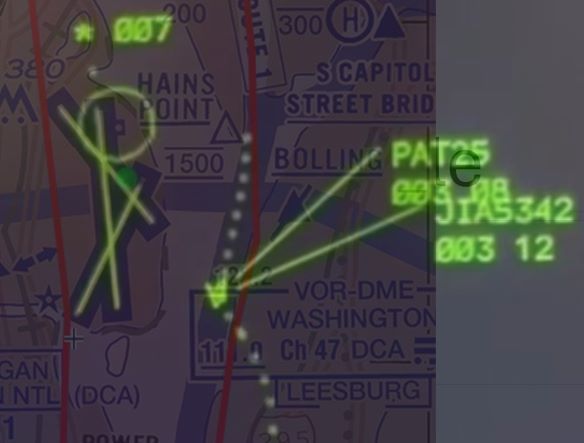
The position of the collision shown in the radar data overlay is consistent with the position of the RJ as shown in ADS-B Exchange at the time of the collision (approximately 01:47:59Z according to the NTSB timeline). See this link from DIBO for the RJ Track with timing AA5342 Down DCA In my experience, times in ADS-B Exchange are generally accurate to within 2 seconds. Given all that, I believe that the Black Hawk was within the horizontal bounds of Route 4 at the time of the collision and that it did not make the right turn we see in the ADS-B Exchange map.
Edit: Corrected route number and helicopter
Last edited by airplanecrazy; 6th February 2025 at 01:24 .
Subjects
AA5342
ADSB (All)
Blackhawk (H-60)
DCA
NTSB
Radar
Route 4
Links are to this post in the relevant subject page so that this post can be seen in context.
Reply to this quoting this original post. You need to be logged in. Not available on closed threads.
February 06, 2025, 14:36:00 GMT
permalink Post: 11823021
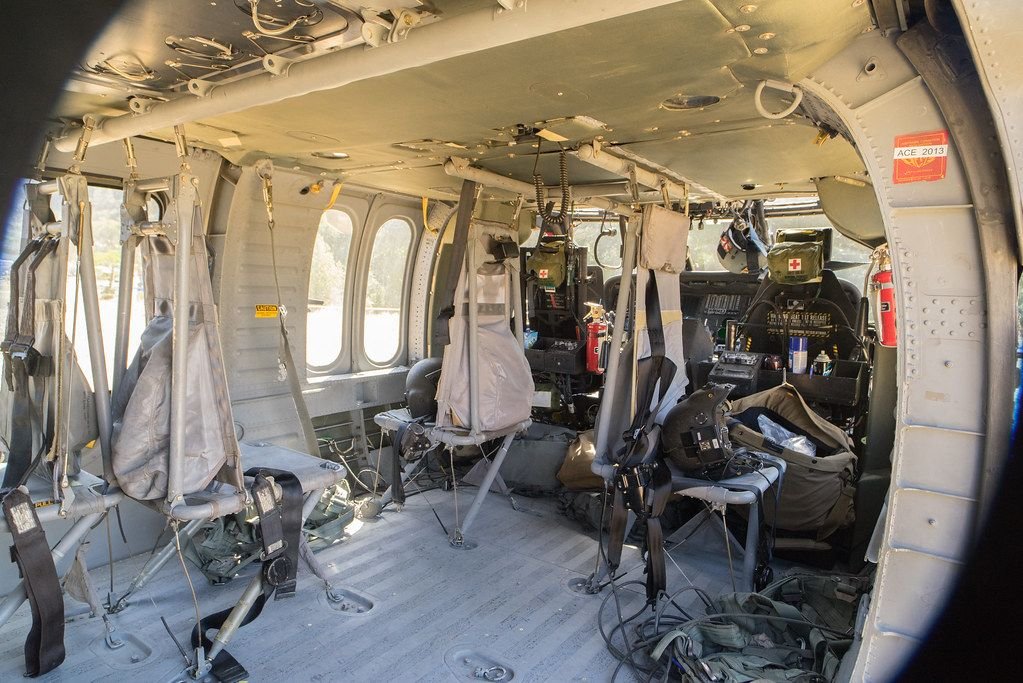
Owing to the vision limitations caused by use of NVG's it is not out of the realm of consideration Army policy would require for two crew members in the rear of the aircraft to enhance conflict resolution.
We routinely flew Chinooks with three crew in the rear with two designated to watch for traffic on either side of the aircraft. The third crew member was the Flight Engineer who controlled activities in the rear and performed safety checks. That simple concept saved my Bacon more than a few times.
Subjects
Blackhawk (H-60)
CRJ
Night Vision Goggles (NVG)
Links are to this post in the relevant subject page so that this post can be seen in context.
Reply to this quoting this original post. You need to be logged in. Not available on closed threads.
February 06, 2025, 20:50:00 GMT
permalink Post: 11823205
They could only later identify the correct light spot by following its trajectory according to their mental image of the approach to 33.

Subjects
Blackhawk (H-60)
CRJ
New York Times
Links are to this post in the relevant subject page so that this post can be seen in context.
Reply to this quoting this original post. You need to be logged in. Not available on closed threads.
February 07, 2025, 10:27:00 GMT
permalink Post: 11823522
They could only later identify the correct light spot by following its trajectory according to their mental image of the approach to 33.
Subjects
Blackhawk (H-60)
CRJ
New York Times
Links are to this post in the relevant subject page so that this post can be seen in context.
Reply to this quoting this original post. You need to be logged in. Not available on closed threads.
February 07, 2025, 11:01:00 GMT
permalink Post: 11823555
Quite extraordinary for a supposed 'recertification' flight.
In another midair collision report, that happened in July 2022 at NorthLas Vegas airport, NTSB put out this:
Interviews with personnel at the air traffic control tower indicated that staffing was deficient, and most staff were required to work mandatory overtime shifts, reaching an annual average of 400 to 500 hours of overtime per controller. According to the air traffic manager (ATM), the inadequate staffing had resulted in reduced training discissions, and the management team was unable to appropriately monitor employee performance. The ATM stated that everyone on the team was exhausted, and that work/life balance was non-existent. It is likely that the cumulative effects of continued deficient staffing, excessive overtime, reduced training, and inadequate recovery time between shifts took a considerable toll on the control tower workforce.
I wonder, how this situation is with DCA ATC service.
I am not trying to blame ATC either. He issued clearance to PAT25 to cross behind and asked (and got) confirmation for CRJ in sight twice. It seems quite clear that helicopter crew did not look at the same airplane that ATC was asking about.
What baffles me here is, that it was obvious a routine procedure to let helicopters cross active runway heading less than 2 miles from runway treshold, leaving practically zero margin for error. Backups, designed to catch pilots or ATC errors (TCAS and ATC alarms) cannot catch up in short time left if someone makes a mistake, so this arrangement as based on "see and avoid" concept, in the night, with many lights in the background and a fact, that other aircraft on collision course does not move relatively on the screen, but just grows bigger. Unfortunatelly, that dot on the screen that will kill you starts growing bigger only in the last few seconds.
If I would ask ATC to cross runway heading DAY VFR so close to runway treshold at my airport with incoming commercial traffic, I would be denied 100 times out of 100 attempts. (and probably called nuts).
My guess on this tragedy is, that thru the years, the system was trying to pack more and more aircraft in the same space and same infrastructure, by gradually squeezing margins and safegueards, until one day, Jenga tower collapsed.
Subjects
AA5342
ADSB (All)
ATC
Blackhawk (H-60)
CRJ
DCA
NTSB
PAT25
See and Avoid
Situational Awareness
TCAS (All)
VFR
Links are to this post in the relevant subject page so that this post can be seen in context.
Reply to this quoting this original post. You need to be logged in. Not available on closed threads.
February 07, 2025, 11:55:00 GMT
permalink Post: 11823592
Regarding to the Pavlovian - if PAL25 wouldnt have requested 'visual separation', what "punishment" would they expect from the Tower? Orbit(s)? Vectors? Or somethin wild, considering 200/300' altitude limits along the river and buildings/infrastructure left and right (what diameter would an orbit cost with a Blackhawk, is it feasible over black water at 200')? Therefore I am asking - would a non-request of a 'visual separation' mean major complications to such a helicopter at night? That as well would then be a significant flaw in the design.
Subjects
AA5342
Blackhawk (H-60)
CRJ
New York Times
Separation (ALL)
Visual Separation
Links are to this post in the relevant subject page so that this post can be seen in context.
Reply to this quoting this original post. You need to be logged in. Not available on closed threads.
February 07, 2025, 12:05:00 GMT
permalink Post: 11823605
Regarding to the Pavlovian - if PAL25 wouldnt have requested 'visual separation', what "punishment" would they expect from the Tower? Orbit(s)? Vectors? Or somethin wild, considering 200/300' altitude limits along the river and buildings/infrastructure left and right (what diameter would an orbit cost with a Blackhawk, is it feasible over black water at 200')? Therefore I am asking - would a non-request of a 'visual separation' mean major complications to such a helicopter at night? That as well would then be a significant flaw in the design.
Waiting for the tower to have no aircraft below ~700ft in the approach area, if we're assuming a 1.5Nm separation, could be quite a while.
Subjects
AA5342
Blackhawk (H-60)
CRJ
Separation (ALL)
VFR
Visual Separation
Links are to this post in the relevant subject page so that this post can be seen in context.
Reply to this quoting this original post. You need to be logged in. Not available on closed threads.
February 09, 2025, 19:54:00 GMT
permalink Post: 11825090
Done this myself for 50 years, night, single-pilot, high-density airports, single and multiengine, never had an issue identifying the aircraft tower pointed out to me.
Keep looking.
Subjects
Blackhawk (H-60)
Night Vision Goggles (NVG)
Pass Behind
Pass Behind (All)
Links are to this post in the relevant subject page so that this post can be seen in context.
Reply to this quoting this original post. You need to be logged in. Not available on closed threads.
February 10, 2025, 08:22:00 GMT
permalink Post: 11825313
CRJ was possible behind the windsield frames in the first sight but anyway it was not conflicting traffic while it was on the base for rwy 33. Final turn at below 500ft doesn’t make it any easier for the helicopter to realize/react to the changing situation.
One thing came to my mind: was the PAT 25 avoiding the traffic by flying ahead of the CRJ instead behind it in first place? ”Pass behind” was told only 18 seconds before the impact.
Last edited by 21600HRS; 10th February 2025 at 12:44 .
Subjects
Blackhawk (H-60)
CRJ
Pass Behind
Pass Behind (All)
Situational Awareness
Links are to this post in the relevant subject page so that this post can be seen in context.
Reply to this quoting this original post. You need to be logged in. Not available on closed threads.
February 10, 2025, 17:17:00 GMT
permalink Post: 11825626
I think the point may be that in those 50yrs you may actually have made a mistake identifying an aircraft, but we don’t have the data. Just because you didn’t have a collision or Airmiss you can’t say for certain that everything worked perfectly.
If you mistakenly identify the wrong aircraft, but don’t realise and don’t actually hit anything and the other party also don’t notice/report, then the error is never recognised, nor recorded. Are we suggesting that this scenario has never happened in the history of aviation?
A flight that doesn’t end in a crash does not mean it was perfect.
I think many pilots would have made a mistake indentifying : seen from the helo, there are 3 aircraft in final, plus 1 on take-off, at the same bearing, how can you tell for sure which is the one "just south of Wilson Bridge" ?
They could only later identify the correct light spot by following its trajectory according to their mental image of the approach to 33.
Last edited by Senior Pilot; 10th February 2025 at 21:20 . Reason: Image source
Subjects
Blackhawk (H-60)
CRJ
New York Times
Links are to this post in the relevant subject page so that this post can be seen in context.
Reply to this quoting this original post. You need to be logged in. Not available on closed threads.
February 10, 2025, 18:56:00 GMT
permalink Post: 11825666
I think many pilots would have made a mistake indentifying : seen from the helo, there are 3 aircraft in final, plus 1 on take-off, at the same bearing, how can you tell for sure which is the one "just south of Wilson Bridge" ?
They could only later identify the correct light spot by following its trajectory according to their mental image of the approach to 33.
At the same time the accident aircraft peels off to the right to swing around and line up to 33, thus taking his (smaller) lights out of the helicopter's direct line of vision and leaving 3130's (brighter) lights still heading to 01 to decoy the pilot. The reflexive nature of the helicopter's responses suggest to me that the full implication of 'circling to 33' in the tower's first call was missed, and also sort of implies that the helicopter could not conceive that following (nearly) the published heliroute could lead him into conflict with an aircraft on final. Me neither.
Last edited by Senior Pilot; 10th February 2025 at 21:22 . Reason: Quote
Subjects
Blackhawk (H-60)
CRJ
DCA
New York Times
PAT25
Separation (ALL)
Visual Separation
Links are to this post in the relevant subject page so that this post can be seen in context.
Reply to this quoting this original post. You need to be logged in. Not available on closed threads.
February 11, 2025, 06:13:00 GMT
permalink Post: 11825867
On the other hand the collision will have somewhat altered trajectory of both aircraft, so maybe the collision had still occured over land and due to the lateral energy transfer the Helicopter was thrown off its original course towards the West and into the river. We will get this information finally.
And in the end it doesn't really make that much of a difference wrt the level of lunacy of this whole setup.
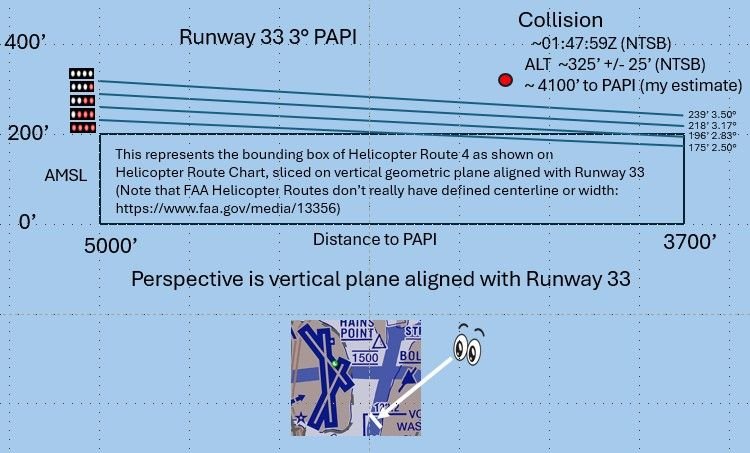
Collision Altitude vs PAPI
Last edited by airplanecrazy; 11th February 2025 at 06:30 . Reason: Problem with picture. Awkward phrasing
Subjects
ADSB (All)
Blackhawk (H-60)
FAA
NTSB
Links are to this post in the relevant subject page so that this post can be seen in context.
Reply to this quoting this original post. You need to be logged in. Not available on closed threads.
February 13, 2025, 00:47:00 GMT
permalink Post: 11827075
__________
Federal air-safety officials want to permanently keep helicopters away from commercial jets taking off and landing at a busy Washington, D.C., airport after the deadliest U.S. aviation accident in more than two decades.
The move, under consideration by senior Federal Aviation Administration officials, would be part of a long-term plan to improve safety at Ronald Reagan Washington National Airport, according to people familiar with the discussions.
Helicopters have been temporarily barred from flying in a corridor used by the U.S. Army Black Hawk that collided on Jan. 29 with an American Airlines regional jet, killing 67 people. The chopper routes have been used to ferry senior military officials around the region and to train for a \x93continuity of government\x94 mission in the event American political leaders need rapid evacuation from Washington. Other government agencies have also used the routes.
Federal officials have said they would revisit the helicopter restrictions once the National Transportation Safety Board issues a preliminary report on the accident in the coming weeks. Preliminary indications from the probe point to multiple factors potentially contributing to the crash, including the design of the airspace, as well as actions by the helicopter pilot and air-traffic controller, according to people familiar with the investigation.
The NTSB said it would examine how far apart planes and helicopters are supposed to be while flying in the airspace.
Transportation Secretary Sean Duffy has criticized the Pentagon\x92s operation of helicopters near the airport. \x93If we have generals who are flying in helicopters for convenience through this airspace, that\x92s unacceptable,\x94 he said last week. \x93Get in a damn Suburban and drive. You don\x92t need to take a helicopter.\x94
The Army said it would continue to comply with FAA requirements and restrictions to enhance flight safety. The service said it was reassessing its aircraft operations near the airport and that it gave priority to the safety of the public and military personnel. The current restrictions allow certain critical flights.
Duffy also suggested certain military missions can be done at a different time of night. The Jan. 29 crash occurred around 9 p.m. Eastern time.
Defense officials have assumed that the helicopter routes would be closed in the coming months amid several ongoing investigations, but have privately said that the routes should be reopened. Adjustments under consideration if routes are reopened include limiting hours for training and test missions.
Reagan\x92s convenient location, a few miles from Capitol Hill, has made the nearly 84-year-old airport a favorite among politicians, business executives and tourists.
Space is tight at the airport. Reagan\x92s longest runway, Runway 1, is the nation\x92s busiest, airport officials have said, and it has two smaller runways. Routes into and out of the airport are constrained by no-fly zones around sensitive government buildings.
The FAA has said it is also reviewing airspace around airports aside from Reagan that also have high volumes of helicopter and airplane traffic.
Discussions about Reagan airport have also focused on a small runway known as Runway 33, people familiar with the matter said. The American Airlines regional jet was attempting to land there when it collided with the Army helicopter. Some government and industry aviation officials believe that there isn\x92t a problem with planes using the runway if helicopters aren\x92t near the traffic lanes.
Warning signs existed for years about risks facing commercial passengers, with planes sharing the skies closely with helicopters zipping up and down the Potomac River.
The path the American Airlines regional jet took toward Runway 33 required it to turn toward the right and then bank left to line up for its landing. That route crosses over a lane for helicopters at a relatively low altitude.
There have been at least 35 events involving conflicts between helicopters and flights into and out of the airport that have been flagged since the 1980s, according to a Wall Street Journal analysis of anonymous reports to a system overseen by the National Aeronautics and Space Administration.
In one instance, in July 2018, a helicopter and small plane came within roughly 580 feet of each other while the plane was approaching Runway 33. The helicopter pilot had to maneuver to avoid the plane and questioned the air-traffic controller about it after, according to an internal FAA report on the incident viewed by the Journal.
Neither aircraft had received traffic advisories or safety alerts, the report said. The helicopter pilot reported the incident as a near midair collision. \x93I\x92m sorry for the confusion,\x94 the controller told the helicopter pilot, according to an audio recording of air-traffic-control communications following the incident.
Nearly two weeks after the deadly crash over the Potomac, the FAA has lifted some of the constraints put on Reagan airport in the wake of the accident.
The FAA on Tuesday boosted the airport\x92s arrival rate from 26 to 28 aircraft an hour, after temporarily reducing it to ease the strain on controllers still dealing with the aftermath of the crash, according to an email viewed by the Journal and earlier reported by other news outlets. The current rate is still lower than the airport\x92s typical maximum of 32 arrivals an hour.
Reagan\x92s two smaller runways, which had been closed due to search and recovery efforts, have been reopened.
________
Subjects
ATC
Blackhawk (H-60)
DCA
FAA
NTSB
Preliminary Report
Wall Street Journal
Links are to this post in the relevant subject page so that this post can be seen in context.
Reply to this quoting this original post. You need to be logged in. Not available on closed threads.
February 14, 2025, 19:54:00 GMT
permalink Post: 11828159

Subjects
Altimeter (All)
Blackhawk (H-60)
NTSB
Pass Behind
Pass Behind (All)
Links are to this post in the relevant subject page so that this post can be seen in context.
Reply to this quoting this original post. You need to be logged in. Not available on closed threads.