February 14, 2025, 20:29:00 GMT
permalink Post: 11828183
Not at all. The briefing indicated there may be a possibility that the altimeter in the BlackHawk displayed an inaccurate altitude reading and that the discrepency was in the order of approx 100' given the height at which the collision is known to have occurred.
Briefing the RT comms, NTSB stated that a portion of the ATC instruction to the BlackHawk to 'pass behind the CRJ' was received in the Blackhawk (according to the CVR), truncated due to the BlackHawk keying the mic at the same time. Apparently, the words 'pass behind the' were missing from the BlackHawk CVR.
Last edited by parabatix; 14th February 2025 at 20:35 . Reason: 'in rely to'
Subjects
ATC
Altimeter (All)
Blackhawk (H-60)
CRJ
CVR
NTSB
Pass Behind
Pass Behind (All)
Links are to this post in the relevant subject page so that this post can be seen in context.
Reply to this quoting this original post. You need to be logged in. Not available on closed threads.
February 14, 2025, 21:03:00 GMT
permalink Post: 11828208

For a couple of days now, was thinking about posting something on an "extra noise" I keep hearing in the R/T comms, when TWR gives the ' pass behind ' instruction. Was wondering whether TWR's Tx wasn't stepped over by someone.
My first impression was that the extra noise came from an radio call from a turbine helicopter (given the typical background noise often heard in radio calls from turbine helicopters). And was wondering if it wasn't PAT25 that started replying to TWR's first ' in sight? ' call, effectively blocking part of TWR's second call, the ' pass behind ' part of the instruction.
In attached mp3 (in .zip per forum attachment requirements) around 00:05 I hear this 'extra noise'.
Edit:
well, this seems to confirm my initial impression:
Last edited by DIBO; 14th February 2025 at 21:07 . Reason: last posts with NTSB info seem to confirm my suspicion
Subjects
ATC
Altimeter (All)
Blackhawk (H-60)
CRJ
CVR
NTSB
PAT25
Pass Behind
Pass Behind (All)
Links are to this post in the relevant subject page so that this post can be seen in context.
Reply to this quoting this original post. You need to be logged in. Not available on closed threads.
February 14, 2025, 21:10:00 GMT
permalink Post: 11828211
The subtext for me is that the Blackhawk crew never saw them...but there's more for the NTSB to sort out, as the lady was VERY CLEAR about.
Subjects
Blackhawk (H-60)
NTSB
Pass Behind
Pass Behind (All)
Separation (ALL)
Vertical Separation
Links are to this post in the relevant subject page so that this post can be seen in context.
Reply to this quoting this original post. You need to be logged in. Not available on closed threads.
February 14, 2025, 21:30:00 GMT
permalink Post: 11828220
Not at all. The briefing indicated there may be a possibility that the altimeter in the BlackHawk displayed an inaccurate altitude reading and that the discrepency was in the order of approx 100' given the height at which the collision is known to have occurred.
Briefing the RT comms, NTSB stated that a portion of the ATC instruction to the BlackHawk to 'pass behind the CRJ' was received in the Blackhawk (according to the CVR), truncated due to the BlackHawk keying the mic at the same time. Apparently, the words 'pass behind the' were missing from the BlackHawk CVR.
Subjects
ATC
Altimeter (All)
Blackhawk (H-60)
CRJ
CVR
NTSB
Pass Behind
Pass Behind (All)
Radio Altimeter
Links are to this post in the relevant subject page so that this post can be seen in context.
Reply to this quoting this original post. You need to be logged in. Not available on closed threads.
February 14, 2025, 21:38:00 GMT
permalink Post: 11828226
8:43:48, pilot stated the Black Hawk was at 300 feet, the instructor pilot stated 400 feet, there is no discussion of the discrepancy; the investigation will probe this.
True, this is some minutes before the collision. But it is a discrepancy of 100 feet as referred to in the prior post.
Subjects
Altimeter (All)
Blackhawk (H-60)
Radio Altimeter
Links are to this post in the relevant subject page so that this post can be seen in context.
Reply to this quoting this original post. You need to be logged in. Not available on closed threads.
February 14, 2025, 22:44:00 GMT
permalink Post: 11828270
Seems to me like a reaction to seeing the Blackhawk right before impact and a reflex/reaction with intent to avoid.
The subtext for me is that the Blackhawk crew never saw them...but there's more for the NTSB to sort out, as the lady was VERY CLEAR about.
 ) if there had been any discussion in the black hawk cockpit about the CRJ (where it was, whether the PF did see it or not) when PM requested visual separation
Last edited by deltafox44; 14th February 2025 at 23:19 .
Subjects
Blackhawk (H-60)
CRJ
NTSB
Pass Behind
Pass Behind (All)
Separation (ALL)
Visual Separation
Links are to this post in the relevant subject page so that this post can be seen in context.
Reply to this quoting this original post. You need to be logged in. Not available on closed threads.
February 14, 2025, 23:34:00 GMT
permalink Post: 11828293
Subjects
Altimeter (All)
Blackhawk (H-60)
CRJ
NTSB
Separation (ALL)
Situational Awareness
Visual Separation
Links are to this post in the relevant subject page so that this post can be seen in context.
Reply to this quoting this original post. You need to be logged in. Not available on closed threads.
February 14, 2025, 23:56:00 GMT
permalink Post: 11828303
relating to seeing the CRJ in the last seconds before impact. The crew didn't see it coming.
Subjects
Blackhawk (H-60)
CRJ
CVR
NTSB
NTSB Chair Jennifer Homendy
Links are to this post in the relevant subject page so that this post can be seen in context.
Reply to this quoting this original post. You need to be logged in. Not available on closed threads.
February 15, 2025, 00:27:00 GMT
permalink Post: 11828318
Subjects
Blackhawk (H-60)
CRJ
CVR
NTSB
NTSB Chair Jennifer Homendy
Night Vision Goggles (NVG)
Links are to this post in the relevant subject page so that this post can be seen in context.
Reply to this quoting this original post. You need to be logged in. Not available on closed threads.
February 15, 2025, 02:01:00 GMT
permalink Post: 11828336
Subjects
Blackhawk (H-60)
CVR
Links are to this post in the relevant subject page so that this post can be seen in context.
Reply to this quoting this original post. You need to be logged in. Not available on closed threads.
February 15, 2025, 03:04:00 GMT
permalink Post: 11828347
Subjects
Blackhawk (H-60)
CVR
Links are to this post in the relevant subject page so that this post can be seen in context.
Reply to this quoting this original post. You need to be logged in. Not available on closed threads.
February 15, 2025, 09:19:00 GMT
permalink Post: 11828441
In any case the procedure us currently withdrawn until end of March and I sincerely doubt they will re-install it before the final report is out. ..
A couple of new info points the NTSB clarified : Both aircraft were on VHF , so we can drop this UHF discussion , the Blackhawk had ADS-B equipped but was not transmitting , it was check ride with NVG, and they most probably all had them on .and there was a last second evasive action attempt by the CRJ crew, which go a TA previously . On the TWR, the CAs are displayed in the BRITE even with audio on ..
For the rest we have to wait until the next NTSB briefing
Subjects
ADSB (All)
Altimeter (All)
Blackhawk (H-60)
CRJ
Final Report
NTSB
Night Vision Goggles (NVG)
Links are to this post in the relevant subject page so that this post can be seen in context.
Reply to this quoting this original post. You need to be logged in. Not available on closed threads.
February 15, 2025, 10:24:00 GMT
permalink Post: 11828489
I sincerely hope the NTSB can avoid being distracted by the distractions of altimetry and the missing ATC words on the Blackhawk CVR.
Upthread, Luca Lion calculated the 3 degree PAPI approach path as crossing the eastern riverbank at 270ft. If that's correct, then the CRJ's 313ft radar height 2 seconds before collision puts it at least 43ft above the approach path, so the Blackhawk's radio height deviation of 78ft would have contributed only about 35ft to the erosion of any intended "procedural separation" (*) between the aircraft. Or, to put it another way, the same outcome would have resulted if the Blackhawk had been at 235ft radio and the CRJ on the glide. Height keeping of plus or minus 35ft can only be achieved by instrument flying, which is obviously not compatible with visual separation (or indeed VFR) so cannot be reasonably cited as part of a safety case for the procedure. And of course a landing aircraft could easily be below the glide. Altimetry and height keeping are not the cause of this accident.
Missing the word "circling" wouldn't have influenced the helo crew getting visual with the CRJ at the time of the trasnmission. At best, it would have given them an extra nudge that "runway 33" (which was audible) meant the CRJ would be taking an easterly flight path. Missing "pass behind" with only a few seconds to collision was irrelevant if, as seems likely, the helo crew did not see the CRJ at that point.
(*) The quotes around "procedural separation" are intended to convey a tone of disgust and sarcasm.
Last edited by Easy Street; 15th February 2025 at 10:47 .
Subjects
ATC
Altimeter (All)
Blackhawk (H-60)
CRJ
CVR
Final Report
NTSB
Pass Behind
Pass Behind (All)
Radar
Separation (ALL)
VFR
Visual Separation
Links are to this post in the relevant subject page so that this post can be seen in context.
Reply to this quoting this original post. You need to be logged in. Not available on closed threads.
February 15, 2025, 10:55:00 GMT
permalink Post: 11828510
I sincerely hope the NTSB can avoid being distracted by the distractions of altimetry and the missing ATC words on the Blackhawk CVR.
Upthread, Luca Lion calculated the 3 degree PAPI approach path as crossing the eastern riverbank at 270ft. If that's correct, then the CRJ's 313ft radar height 2 seconds before collision puts it at least 43ft above the approach path, so the Blackhawk's radio height deviation of 78ft would have contributed only about 35ft to the erosion of any intended "procedural separation" (*) between the aircraft. Or, to put it another way, the same outcome would have resulted if the Blackhawk had been at 235ft radio and the CRJ on the glide. Height keeping of plus or minus 35ft can only be achieved by instrument flying, which is obviously not compatible with visual separation (or indeed VFR) so cannot be reasonably cited as part of a safety case for the procedure. And of course a landing aircraft could easily be below the glide. Altimetry and height keeping are not the cause of this accident.
Missing the word "circling" wouldn't have influenced the helo crew getting visual with the CRJ at the time of the trasnmission. At best, it would have given them an extra nudge that "runway 33" (which was audible) meant the CRJ would be taking an easterly flight path. Missing "pass behind" with only a few seconds to collision was irrelevant if, as seems likely, the helo crew did not see the CRJ at that point.
(*) The quotes around "procedural separation" are intended to convey a tone of disgust and sarcasm.
Following "5*why", keep asking...
Why did the did miss part of the message
Why was the incomplete read back missed
Why does missing a few words lead to this disaster within seconds.
Does this lead an answer like: helicopter in a very busy airspace, busy controllers (insufficient time to be fully focused on full read backs) being by default too close to (and even needing to cross) the glideslope.
Subjects
ATC
Blackhawk (H-60)
CRJ
CVR
NTSB
Pass Behind
Pass Behind (All)
Radar
Separation (ALL)
VFR
Visual Separation
Links are to this post in the relevant subject page so that this post can be seen in context.
Reply to this quoting this original post. You need to be logged in. Not available on closed threads.
February 15, 2025, 17:25:00 GMT
permalink Post: 11828732
Likely the Kollsman settings will be recoverable. Barometric altimeters used in VFR can be way off, but transponder calibration depends on a calibrated altimeter. The NTSB will be looking at maintenance records.
Subjects
Altimeter (All)
Blackhawk (H-60)
NTSB
VFR
Links are to this post in the relevant subject page so that this post can be seen in context.
Reply to this quoting this original post. You need to be logged in. Not available on closed threads.
February 16, 2025, 04:46:00 GMT
permalink Post: 11828977
• At 8:47:58, or 1 second before impact, the CRJ began to increase its pitch, reaching about 9 degrees nose up at the time of collision. FDR data showed the CRJ elevators were deflected near their maximum nose up travel .
• The last radio altitude recorded for the CRJ was 313 ft and was recorded two seconds prior to the collision. The CRJ pitch at this time was, again, 9 degrees nose up, and roll was 11 degrees left wing down. The CRJ was descending at 448 feet per minute.
• The radio altitude of the Blackhawk at the time of the collision was 278 feet and had been steady for the previous 5 seconds. The Blackhawk pitch at the time of the collision was about a half degree nose up with a left roll of 1.6 degrees. Examination of wreckage will assist in determination of the exact angle of the collision.
I was once stopped at a red light, began rolling when the light turned green - and suddenly found myself on the brakes before I was conscious of the car running the red light. Possibly a CRJ pilot similarly caught the helo in peripheral vision and reacted subconsciously.
Last edited by RatherBeFlying; 16th February 2025 at 04:50 . Reason: Formatting
Subjects
Blackhawk (H-60)
CRJ
CVR
DCA
NTSB
Links are to this post in the relevant subject page so that this post can be seen in context.
Reply to this quoting this original post. You need to be logged in. Not available on closed threads.
February 17, 2025, 02:39:00 GMT
permalink Post: 11829597
So if the Blackhawk pilots either flew this low altitude route regularly, or it was an operational norm for that pilot group/operation, pilots would begin to relax with it - it's "normal" I opine that it is never normal to fly at 200 feet AGL in a built up area, nor close to the approach path for a busy airport. So if the training and operational norms of this routing lead pilots to think it is normal, they treat it that way, and vigilance goes down. This was an accident waiting to happen, because of normalization of deviance form established norms of flying.
I've learned the hard way that when ATC asks if you have X aircraft in sight, once you think you do, mentally map the path of that aircraft, then start looking for the one you have not seen yet - particularly with two pilots! You get a clearance to pass at 200 AGL under the approach path of a busy airport at night - that's unusual, and spidy senses should be tingling lots! This hyper awareness should be being trained into the operation - a preflight briefing from the lead "On this flight, we could expect this routing and clearance. This will be unusual, and we're going to be extra aware by doing the following....".
So it's easy to blame the Blackhawk pilots, and yes, they wear some of this, but the military let the pilots down by not categorizing this flight as "high risk", and ATC let the pilots down by clearing a routing which had the potential to provide only a hundreds of feet vertical separation, rather than insisting on both vertical, lateral, and projected path separation, and thereafter, telling the Blackhawk pilots all of the airplanes they should be seeing, not just the one, which seems to have been misunderstood.
I have been instructed to orbit to allow for a passing aircraft to clear in front of me, why not this time? Maybe that low altitude air route is too small for a normal orbit? Another red lag about that route not being a good idea!
Subjects
ATC
Accident Waiting to Happen
Blackhawk (H-60)
Normalization of Deviance
Separation (ALL)
VFR
Vertical Separation
Links are to this post in the relevant subject page so that this post can be seen in context.
Reply to this quoting this original post. You need to be logged in. Not available on closed threads.
February 17, 2025, 12:54:00 GMT
permalink Post: 11829882
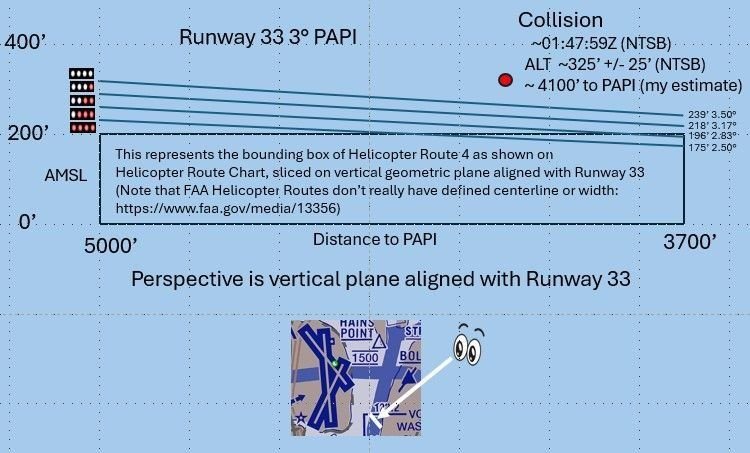
If everyone had been flying at the prescribed altitudes, the CRJ should have passed 40ft over the Blackhawk, I can't believe that would have been OK.
I was very surprised also to hear Jennifer tell us that the heliroutes have no lateral boundaries, which is a bit bizarre given that the Route 4 in the notes on the chart is described as following the East bank of the Potomac which is about on the left end of the diagram. Doesn't matter though, same problem there. Routes shouldn't be designed so that aircraft can infringe on landing (or any other kind) of passenger jet traffic.
Subjects
Blackhawk (H-60)
CRJ
Route 4
Links are to this post in the relevant subject page so that this post can be seen in context.
Reply to this quoting this original post. You need to be logged in. Not available on closed threads.
February 17, 2025, 22:45:00 GMT
permalink Post: 11830289
Subjects
Blackhawk (H-60)
CRJ
Links are to this post in the relevant subject page so that this post can be seen in context.
Reply to this quoting this original post. You need to be logged in. Not available on closed threads.
February 17, 2025, 22:56:00 GMT
permalink Post: 11830297
Subjects
Blackhawk (H-60)
CRJ
Links are to this post in the relevant subject page so that this post can be seen in context.
Reply to this quoting this original post. You need to be logged in. Not available on closed threads.