February 04, 2025, 00:35:00 GMT
permalink Post: 11821049
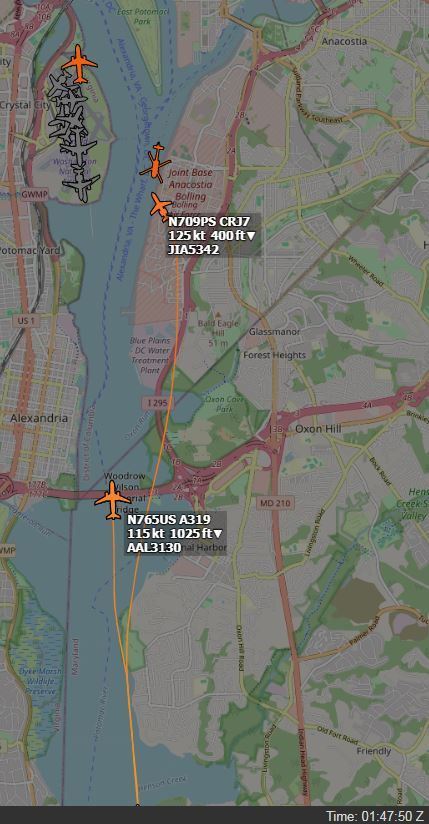
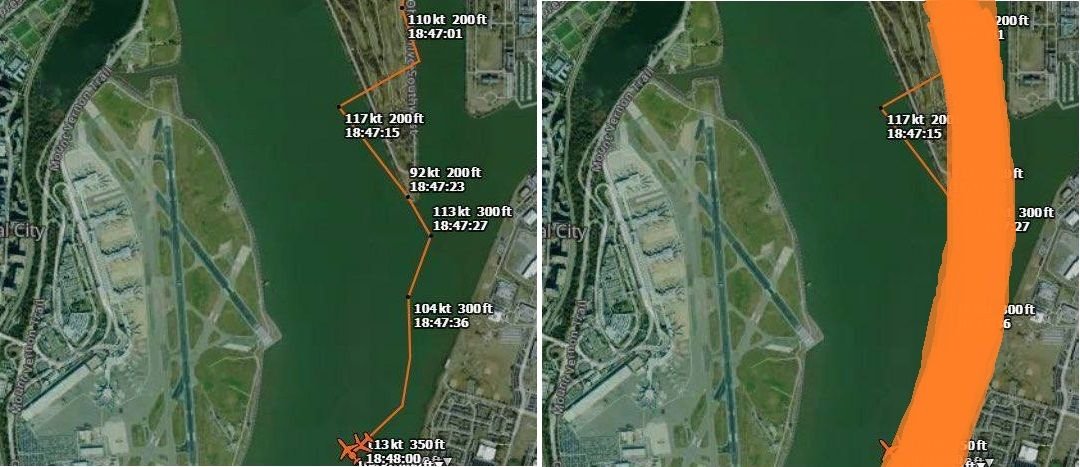
And the "amateur MLAT" tracking of the helo, is only a rough indication of the trajectory with a wide margin of position error and should be interpreted more like the right side hereunder:
Subjects
CRJ
KDCA
Radar
Route 4
Links are to this post in the relevant subject page so that this post can be seen in context.
Reply to this quoting this original post. You need to be logged in. Not available on closed threads.
February 04, 2025, 00:36:00 GMT
permalink Post: 11821050
https://www.youtube.com/shorts/bHBKptJWXtU
I agree that these are just guesses, but the alternative seems to be that the helo just drifted to the right randomly, for no specific reason, which seems unlikely.
Subjects
CRJ
Radar
Route 4
Separation (ALL)
Links are to this post in the relevant subject page so that this post can be seen in context.
Reply to this quoting this original post. You need to be logged in. Not available on closed threads.
February 04, 2025, 09:13:00 GMT
permalink Post: 11821217
All i am really saying is that:
(1) TCAS II can still be improved
(2) Other systems (like ADS-B) can, as can their adoption
(3) Interoperability between them can be enhanced
(4) Procedures can be improved (like mindset and division of tasks with TCAS TA on approach, especially in IMC and at night)
)
1) TCAS II can still be improved : No end of the story by now , no version 8 in the pipeline . We spent millions and years on getting 7.1 accepted .. and even not everyone mandates it .
2) ADS-B gets already saturated , add TCAS type system and it will be .But developing a new Anti-collision system based on ADS-B is in the pipeline however it will; mean ASD-S be out mandated for every flying aircraft , including military . Here is your problem . Some military aircraft cannot be retrofitted , no space ..
3) interoperability .? No , 2 completely different systems , TCAS is analog 1970 technology ,
4) TCAS RAs on approach? you mean below 1000 ft ? No , in our scenario here , with the Blackhawk climbing , the logical RA would be a descent RA for the CRJ ,, you want a Descent RA at 300 ft ?
The only solution I personally see is airspace segregation based on equipment . Class A, B and C restricted to aircraft carrying ADS-B out and TCAS equipped , and both Working and on the MEL as no go item s ( not the case today ) Waiting for AOPA and ATA remarks
Subjects
ADSB (All)
ADSB In
ADSB Out
Blackhawk (H-60)
CRJ
TCAS (All)
TCAS RA
Links are to this post in the relevant subject page so that this post can be seen in context.
Reply to this quoting this original post. You need to be logged in. Not available on closed threads.
February 04, 2025, 09:36:00 GMT
permalink Post: 11821226
I think there is no problem for RA below 1000ft, it would only be like \x94TRAFFIC AHEAD, PULL UP\x94 in Airbus World. Horizontal separation might be smaller and system takes into account whether the traffic is between you and touch down. This DCA case is problematic because you join the final below 500ft, that is not acceptable in any case with an airliner.
TCAS 8 is getting closer and sooner after this horrific accident.
Subjects
Blackhawk (H-60)
CRJ
DCA
Separation (ALL)
TCAS (All)
TCAS RA
Links are to this post in the relevant subject page so that this post can be seen in context.
Reply to this quoting this original post. You need to be logged in. Not available on closed threads.
February 04, 2025, 10:43:00 GMT
permalink Post: 11821285
This means the automated tools (which don\x92t know the aircraft are using visual means to deconflict) will go off based on a predicted or actual loss of the separation criteria that they\x92ve been programmed with. If the helicopter in this instance had passed 1/4m behind and below the CRJ, a CA may still have been generated although the conflict had been resolved visually. The controller actually picks up on the apparent proximity and queries the heli that they are still visual, to which they reply in the affirmative - there is no minimum separation for visual avoidance, just sometimes it\x92s too dang close. Which is an Airprox.
Subjects
ATC
CRJ
IFR
Separation (ALL)
TCAS (All)
Visual Separation
Links are to this post in the relevant subject page so that this post can be seen in context.
Reply to this quoting this original post. You need to be logged in. Not available on closed threads.
February 04, 2025, 10:52:00 GMT
permalink Post: 11821295
Radar orders also need to be given and actions taken sooner than if the crews are doing it of their own initiative. So a radar CA needs to be visible say 15 second pre-collision so ATC can wait for the radio to be clear then order pilots to manoeuvre. Pilots can aim to cross visually at more like 5 seconds.
I'm not saying that this is overall a good idea, but the fundamental reason you fit more planes in with visual separation is that you can put them closer together with (given good visibility) not too dissimilar safety.
[Edit: too late... Fullwings got this.]
TCAS 8 is getting closer and sooner after this horrific accident.
Subjects
ATC
Blackhawk (H-60)
CRJ
DCA
Radar
Separation (ALL)
TCAS (All)
TCAS RA
Visual Separation
Links are to this post in the relevant subject page so that this post can be seen in context.
Reply to this quoting this original post. You need to be logged in. Not available on closed threads.
February 04, 2025, 11:51:00 GMT
permalink Post: 11821345
Among the many risky things I used to do as a military pilot, including diving towards the ground at 45 degrees in pitch darkness and pulling out on a range cue to miss the ground by 500 feet, one thing which always made the chain of command particularly nervous was closed pattern work on NVG. At home base, only experienced pilots were allowed to wear NVG in the pattern with another aircraft, and even then only one other: their similarly experienced formation wingman. And that was at a remote airfield with only a few military lives at stake and a tower controller monitoring both aircraft like a hawk. In Afghanistan, it was a toss-up whether the most dangerous place to fly fixed wing was over the Taliban or in the closed pattern at Kandahar, with helicopters darting around wearing covert lighting (they of course had an understandably different view of the risks). The idea of flying through the traffic pattern at a busy civilian airport using NVG to avoid airliners simply appals me.
Last edited by Easy Street; 4th February 2025 at 12:25 .
Subjects
ATC
CRJ
Night Vision Goggles (NVG)
Links are to this post in the relevant subject page so that this post can be seen in context.
Reply to this quoting this original post. You need to be logged in. Not available on closed threads.
February 04, 2025, 12:38:00 GMT
permalink Post: 11821386
Subjects
CRJ
Night Vision Goggles (NVG)
Links are to this post in the relevant subject page so that this post can be seen in context.
Reply to this quoting this original post. You need to be logged in. Not available on closed threads.
February 04, 2025, 14:51:00 GMT
permalink Post: 11821483
Among the many risky things I used to do as a military pilot, including diving towards the ground at 45 degrees in pitch darkness and pulling out on a range cue to miss the ground by 500 feet, one thing which always made the chain of command particularly nervous was closed pattern work on NVG. At home base, only experienced pilots were allowed to wear NVG in the pattern with another aircraft, and even then only one other: their similarly experienced formation wingman. And that was at a remote airfield with only a few military lives at stake and a tower controller monitoring both aircraft like a hawk. In Afghanistan, it was a toss-up whether the most dangerous place to fly fixed wing was over the Taliban or in the closed pattern at Kandahar, with helicopters darting around wearing covert lighting (they of course had an understandably different view of the risks). The idea of flying through the traffic pattern at a busy civilian airport using NVG to avoid airliners simply appals me.
Subjects
ATC
CRJ
Night Vision Goggles (NVG)
Links are to this post in the relevant subject page so that this post can be seen in context.
Reply to this quoting this original post. You need to be logged in. Not available on closed threads.
February 04, 2025, 15:02:00 GMT
permalink Post: 11821488
remarkable: begin of pitch up 1 sec before impact (CRJ).
Subjects
CRJ
CVR
NTSB
Links are to this post in the relevant subject page so that this post can be seen in context.
Reply to this quoting this original post. You need to be logged in. Not available on closed threads.
February 04, 2025, 15:21:00 GMT
permalink Post: 11821499
https://www.youtube.com/watch?v=-bD-hK3MsiA
remarkable: begin of pitch up 1 sec before impact (CRJ).
Subjects
CRJ
CVR
NTSB
Links are to this post in the relevant subject page so that this post can be seen in context.
Reply to this quoting this original post. You need to be logged in. Not available on closed threads.
February 04, 2025, 19:05:00 GMT
permalink Post: 11821639
Now here we are having a public debate about whether the helicopter was at 200 or 300 feet. My question is at what point would you consider the CRJ to be impermissibly low at that point? At the point of impact they were less than 5000 feet from the aiming point and, I presume, the PAPI. That's less than 4000 feet from the numbers. It's a short runway, 3 degrees to the numbers is 208 feet, to the aiming point 260 feet. So how low can they be at this point without violating some FAR or other rule? Keep in mind it is a visual approach at this point.
Subjects
CRJ
Separation (ALL)
Links are to this post in the relevant subject page so that this post can be seen in context.
Reply to this quoting this original post. You need to be logged in. Not available on closed threads.
February 04, 2025, 19:20:00 GMT
permalink Post: 11821649
Now here we are having a public debate about whether the helicopter was at 200 or 300 feet. My question is at what point would you consider the CRJ to be impermissibly low at that point? At the point of impact they were less than 5000 feet from the aiming point and, I presume, the PAPI. That's less than 4000 feet from the numbers. It's a short runway, 3 degrees to the numbers is 208 feet, to the aiming point 260 feet. So how low can they be at this point without violating some FAR or other rule? Keep in mind it is a visual approach at this point.
Subjects
CRJ
Separation (ALL)
Vertical Separation
Links are to this post in the relevant subject page so that this post can be seen in context.
Reply to this quoting this original post. You need to be logged in. Not available on closed threads.
February 04, 2025, 22:34:00 GMT
permalink Post: 11821762
"5342, helo traffic on your right 1/4 mile at 300 feet, has you in sight". The CRJ FO might just have taken a closer look out the side window with that. Or, like you, they might have opted to go around.
Subjects
ATC
CRJ
CVR
DCA
IFR
Separation (ALL)
TCAS (All)
Traffic in Sight
Visual Separation
Links are to this post in the relevant subject page so that this post can be seen in context.
Reply to this quoting this original post. You need to be logged in. Not available on closed threads.
February 05, 2025, 00:05:00 GMT
permalink Post: 11821822
I think the confusion comes from the "amateur MLAT" tracking, which calculates the GS based on the multilaterated position calculations, which have a (relatively) large margin of error:
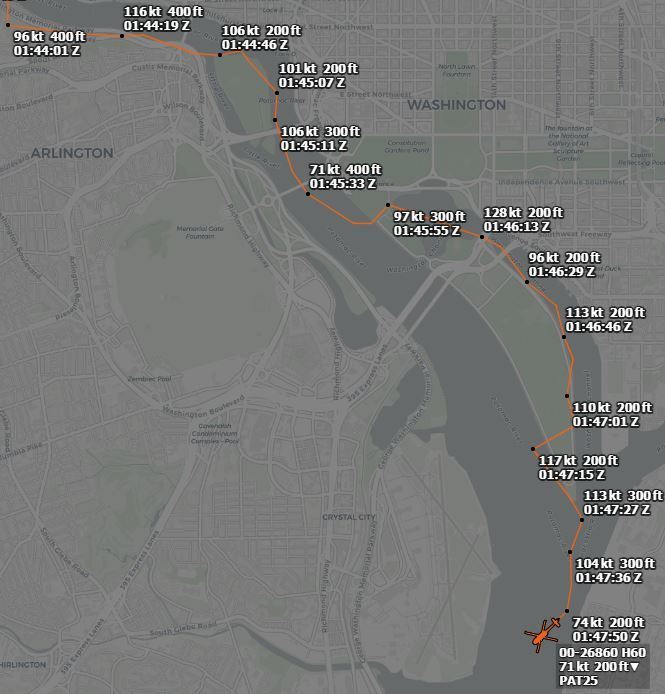
And probably PAT25 was doing initially something in the region of 100kts GS (edit: averaging all but last calculated GS, gives 105kts as average - and over more datapoints, longer trajectory, calculated average GS becomes more reliable)
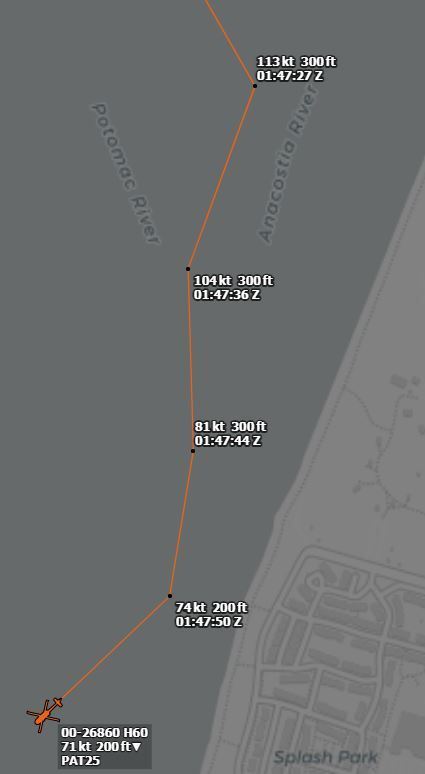
but at the end it seems there might possibly have been a decreasing GS trend:
Last edited by DIBO; 5th February 2025 at 00:10 . Reason: added calculated average GS
Subjects
ADSB (All)
CRJ
PAT25
Radar
Links are to this post in the relevant subject page so that this post can be seen in context.
Reply to this quoting this original post. You need to be logged in. Not available on closed threads.
February 05, 2025, 10:32:00 GMT
permalink Post: 11822080
Additionally, any helicopters flying in such congested airspace should have a display showing other traffic so they know where to look outside.
You cannot actively vector a helo at 200ft over the black hole of a river in the middle of an urban environment or anywhere else. You'd kill helos every month doing that. If the helo were at 100ft or so there would be no need for vectors (you never get them in London, just holding, ie orbits if necessary).
Visual acknowlewgement from the aeroplane is totally unnecessary as he is on finals to land which give total priority over all other traffic. It is up to the give-way traffic to identify and acknowlege.
500ft vertical I agree with, in which case 1,5 miles is totally unnecessary and ridiculously excessive.
This discussion is being considerably bogged down by a really surprising (to me) absence of understanding of helos and helo ops by people who clearly only fly f/w IFR and seem to have no concept of how the rest of the aviation world works. Strangely, there are other ways of aviating safely without staring exclusively at an instrument panel, following a magenta line and doing only what someone miles away in an office tells you. You simply cannot try to apply IFR airline type procedures and mindset to low level VFR traffic. It's like a train driver trying to dictate railway rules to a motorcyclist and being unaware that motorcycles just don't operate like trains... imaginingthat helos can or would come to a free air hover for separation is another example of unrealistic imagnation over reality.
Please, if you don't know anything about helicopter ops, please don't try to apply procedural IFR or Hollywood mindsets/misapprehensions to them as if there is no other waay of flying.
Last edited by meleagertoo; 5th February 2025 at 10:54 .
Subjects
ATC
CRJ
Hover
IFR
Separation (ALL)
VFR
Visual Separation
Links are to this post in the relevant subject page so that this post can be seen in context.
Reply to this quoting this original post. You need to be logged in. Not available on closed threads.
February 05, 2025, 13:39:00 GMT
permalink Post: 11822224
I can imagine a scenario where a helicopter crew, who are regular on this route, report the airliner in sight on first call, knowing that by doing so, they avoid an orbit and subsequent delay.
With regard to other posts asking why the tower controller didn\x92t pass traffic information to the CRJ crew. Bear in mind that this guy was working flat out, working two positions with pretty constant RT. There may well have been additional tasks such as phone coordination going on in the background which we are not aware of. Again I see a scenario of tower using the absolute minimum RT in an attempt to keep on top of the workload. In his mind, the helicopter has reported the inbound in sight and has stated responsibility to pass behind\x85\x85.job done, onto the next task.
I\x92m sure that the investigation will be focusing on why the sectors were combined under these traffic conditions. In my 30+ years of ATC, I have investigated numerous incidents where a significant factor was an overworked controller working combined positions. This can be caused by staff shortages, late reactions to rapidly changing traffic conditions, unit culture or simply a \x93macho\x94 controller who thinks that they can handle everything\x85.until subsequently they find that they cannot!
Subjects
ATC
CRJ
DCA
Separation (ALL)
Vertical Separation
Links are to this post in the relevant subject page so that this post can be seen in context.
Reply to this quoting this original post. You need to be logged in. Not available on closed threads.
February 05, 2025, 15:40:00 GMT
permalink Post: 11822300
Just thinking: they are coming up on the extended centerline of 33, and keep going? Were there any tower or CRJ transmits that indicated the CRJ was on short final?
Last edited by JohnDixson; 5th February 2025 at 15:59 . Reason: Added thought
Subjects
CRJ
Links are to this post in the relevant subject page so that this post can be seen in context.
Reply to this quoting this original post. You need to be logged in. Not available on closed threads.
February 05, 2025, 16:50:00 GMT
permalink Post: 11822344
Subjects
CRJ
Links are to this post in the relevant subject page so that this post can be seen in context.
Reply to this quoting this original post. You need to be logged in. Not available on closed threads.
February 05, 2025, 18:28:00 GMT
permalink Post: 11822429
They were flying Night VFR, not Day VFR.
If I am flying at night over a river at 200' yes, I want to fly smoothly, particularly if my
Maybe, Mech, if you don't know what you are talking about, you keep a sock in it rather than saying something stupid like this:
2. I was sharing (IME means In My Experience) my experience with flying that family of helicopters.
The core problem seems to have been that they never saw the CRJ. Had they seen it, my guess ~ this is speculation ~ is that they'd have turned left and done a 360 degree turn for spacing, particularly since towers instruction was "pass behind" ... and doing that would have, accomplished that. But that isn't how it turned out.
=======
Edited to account for the technical point John Dixson made.
Last edited by Lonewolf_50; 6th February 2025 at 13:10 .
Subjects
CRJ
Pass Behind
Pass Behind (All)
VFR
Links are to this post in the relevant subject page so that this post can be seen in context.
Reply to this quoting this original post. You need to be logged in. Not available on closed threads.