March 30, 2025, 17:43:00 GMT
permalink Post: 11857453
Because , even if the helo had ADSB out and the CRJ an "in " receiver and a CDTI display , what would have happened then ? . The crew would have spotted the Helo, maybe asked ATC what was that , and the reply of the controller would have been something like : " it is a military helicopter on route 4 , has you in sight , passing behind ." and then would you , flying the CRJ , take evasive action or go around after hearing that ? No .
.
The primary cause of this collision is airspace design and normalization of deviance over the years. I hope the judges will see that when the trial comes. We should leave the military crew and their grieving families out of this.
Subjects
ADSB (All)
ADSB Out
ATC
CRJ
Normalization of Deviance
Route 4
Links are to this post in the relevant subject page so that this post can be seen in context.
Reply to this quoting this original post. You need to be logged in. Not available on closed threads.
March 30, 2025, 21:14:00 GMT
permalink Post: 11857551
.
The primary cause of this collision is airspace design and normalization of deviance over the years.
Some people are making out that if the Helicopter had ADSB-out switched on/ activated, then this would never have happened.
Someone correct me if I am wrong but if the Blackhawk has ADSB-out switched on then nothing changes for the CRJ on that night. The TCAS behaves the same, there is no display of the Blackhawk on the CRJ\x92s Nav display\x85..nothing changes. The CRJ crew are still conducting an approach that requires a lot of fast mental processing close to the ground, at night onto a short runway while ensuring checklists/configuration etc is correct. ie they have a high workload. During this high workload phase, \x91the system\x92 has seen fit to allow a single Human ( the helicopter Captain) to be responsible for the separation of the two aircraft visually, at night, in a busy environment while conducting a check, on NVG\x92s.
Is it likey that a single Human, with the sole responsibility, will make a mistake? It\x92s not just likely, it\x92s inevitable, regardless of how sharp and well trained they are, if you run the program long enough their vision, or their SA will fail them and we get what we got here.
The system should never have devolved to the point where one person accepted the responsibility for visual sep 6nm away, at night, in a busy traffic environment while dealing with their own high workload.
The Blackhawk crew had a high workload, the CRJ crew had a high workload, the ATC had a high workload, there was no fat left in the system. Humans make mistakes and any good system will be tolerant of those mistakes.
The system was not tolerant of a mistake, ergo, the system is at fault.
Subjects
ADSB (All)
ADSB Out
ATC
Blackhawk (H-60)
CRJ
Normalization of Deviance
Route 4
Separation (ALL)
Situational Awareness
TCAS (All)
Links are to this post in the relevant subject page so that this post can be seen in context.
Reply to this quoting this original post. You need to be logged in. Not available on closed threads.
March 30, 2025, 23:59:00 GMT
permalink Post: 11857616
ATCWatcher Thank you…It’s like pulling teeth but we will get there eventually ….
No thanks to the NTSB for the selective choice of facts…What should I expect in a country of fake news and alternative facts?
As for your comments re if the CRJ had ADSB_IN; exactly ….welcome to my nightmare!
Shock horror The Holy Grail turned out to be the holy hand grenade!!!
Re all lawyers reading… Put that one in your pipes and smoke it!
Always look on the ….. Now what pizza to order tonight

Subjects
CRJ
NTSB
Links are to this post in the relevant subject page so that this post can be seen in context.
Reply to this quoting this original post. You need to be logged in. Not available on closed threads.
March 31, 2025, 00:41:00 GMT
permalink Post: 11857626
To say so-and-so got it wrong is often obvious ........ but why did they get it wrong? That's often very complex and can involve a lot more people and a raft of other factors and that's where the really valuable lessons are to be found. That's the real reason behind any "bias" - it's so we don't simply stop at that first person (or persons) who got something wrong, but look at what led to them doing what they did and what other factors contributed to the end result . That is the real way Safety is improved. You can then look at appropriate mitigation to try and prevent that same scenario from setting up another crew to fail in the same way at a later date.
So, for example, based on the difficulty in picking out the correct aircraft from the inbound stream, one of the many questions I've been asking myself is "Why were the PAT25 crew so willing to say they had the CRJ in sight (twice they said that) in that environment?". Had that become "normalised" on the Sqdn, or were the risks of miss-IDing a/c not being adequately highlighted in Local Orders, particularly given the geometry of that specific set-up? There may be several reasons - that's for the NTSB to dig out. I used to do a lot of visual separation stuff Commercially and I was nervous as hell - and that was in wayyyyyyyy simpler scenarios in way better conditions usually involving just one other aircraft. ATC were the same - they were very pointed in making sure I'd really seen the a/c in question. Any doubts in my mind or the ATCs mind and it was either an orbit till traffic was well clear or, if busier, it was "Contact Approach ....... lets chat again when they hand you back to me on the ILS.". OK, the ILS bit is not applicable to PAT25 but you get my drift!
There is no one reason why this accident happened - there will be quite a list with each one contributing to the final outcome. Any one of those things, had they been different decisions by those involved on the night, or, for example, by those who designed and approved Route 4 way back when, would have saved the day. So correct not just the 1st issue you find, find out and correct ALL the issues! That's what we really need to do to stop similar things happening again, not just at DCA, but anywhere.
Anyway, hope the above helps with the context of the word "bias". It was not that long ago it was "Hang the crew! Erm, oh no! Someone else has done it now! Hang them too!" Rinse & repeat! Thankfully, we are much better at digging out all the issues these days. But we have to constantly remind ourselves to "Look for everything, not just the 1st thing you find!". Cheers, H 'n' H
Last edited by Hot 'n' High; 31st March 2025 at 00:55 .
Subjects
ATC
CRJ
DCA
NTSB
Night Vision Goggles (NVG)
PAT25
Route 4
See and Avoid
Separation (ALL)
Visual Separation
Links are to this post in the relevant subject page so that this post can be seen in context.
Reply to this quoting this original post. You need to be logged in. Not available on closed threads.
March 31, 2025, 06:45:00 GMT
permalink Post: 11857734
So, for example, based on the difficulty in picking out the correct aircraft from the inbound stream, one of the many questions I've been asking myself is "Why were the PAT25 crew so willing to say they had the CRJ in sight (twice they said that) in that environment?". Had that become "normalised" on the Sqdn, or were the risks of miss-IDing a/c not being adequately highlighted in Local Orders, particularly given the geometry of that specific set-up? ...
...
Subjects
ATC
CRJ
PAT25
Separation (ALL)
Visual Separation
Links are to this post in the relevant subject page so that this post can be seen in context.
Reply to this quoting this original post. You need to be logged in. Not available on closed threads.
April 01, 2025, 22:38:00 GMT
permalink Post: 11858937
BugBear : In your post above you appear to imply that the LC had to work 2 different radar screens. (Memories of Uberlingen?)
Are you sure about that?
And to manage two discrete VHF frequencies. What, two different ?headsets? Is that what you are implying?
And where do you think the ADS-B information from the CRJ was displayed in the TWR Cab, on one or more of the radar screens?
Subjects
ADSB (All)
CRJ
Radar
Links are to this post in the relevant subject page so that this post can be seen in context.
Reply to this quoting this original post. You need to be logged in. Not available on closed threads.
April 04, 2025, 21:49:00 GMT
permalink Post: 11860845
Nope
Yes. LC could hear both Heli and AA. Neither AA Nor helo could hear the other ....."
From ATCDumbo......
"And where do you think the ADS-B information from the CRJ was displayed in the TWR Cab, on one or more of the radar screens?"
One hopes. If not to both pilots, then eyes on by LC ?? How are two conflicted aircraft that close in not aware of each other ?? Doesn't AA get a chance to look for traffic??
Even if traffic is changing orientation from Four 0'clock to12 in ten seconds????
Last edited by BugBear; 4th April 2025 at 22:09 .
Subjects
ADSB (All)
CRJ
Radar
Links are to this post in the relevant subject page so that this post can be seen in context.
Reply to this quoting this original post. You need to be logged in. Not available on closed threads.
April 20, 2025, 21:30:00 GMT
permalink Post: 11870704

The baseline is that a TA on it's own is not enough and can even lead to issues if reacted to without knowing exactly where that contact is and what it is doing. You should, if you have the time (hence my comment re workload for the RJ crew at that point), try and get visual on the traffic but, tbh, it's very difficult to do, especially at low level at night against backlighting. You don't even really have time to "debate" a "shall we react (against SOP) to (yet another?) TCAS alert at DCA?" with all else that is going on at that point of a flight. SOP/Training says "fly on"! You need compelling evidence to go against that. I fact, IIR, the NTSB noted that the CRJ had full "up" elevator at the time of impact - that implies the crew finally saw the helo and reacted ..... but with no time to change their flight path.
If you want to "do" the airline - I feel a much better case could be made based on the fact the evidence of issues for that approach at DCA was sat in the Safety Databases for anyone who went looking, that maybe even crews had raised the issue themselves through internal reporting in the Airline, and/or there was no process in place within the Airline to review operations into DCA - or any other airport. This is promoted by the FAA who state that "The [airline] SMS promotes a defined structure and a \x93learning culture\x94 within an aviation organization that continually seeks and analyzes information, then turns that information into action that eliminates or mitigates safety risks, before they become unwanted events.". The full ref is here. And that also applies equally to the Metropolitan Washington Airports Authority who I believe operate DCA as an independent organisation. How the MWAA fit in to US Government - I'm not sure!
Anyway, hope this helps. Cheers, H 'n' H
Subjects
CRJ
DCA
FAA
NTSB
Situational Awareness
TCAS (All)
TCAS RA
Links are to this post in the relevant subject page so that this post can be seen in context.
Reply to this quoting this original post. You need to be logged in. Not available on closed threads.
April 22, 2025, 22:03:00 GMT
permalink Post: 11871844
I guess that dampens the urge to figure out what's going on with a TA, especially when on a relatively short Final where workload is high/time is in short supply/city lighting makes it very difficult. We don't know re this specific crew but it seems the Company regularly used 33 so that could be a factor - "Here we go again...... another TA........". As someone said, the "boiled frog" scenario.
I still think that, while it's a valid thought of "what if they did......", I think it masks the more important aspect in that the overall design of that bit of airspace was rubbish - as was so eloquently put by the NTSB.
Basically, the design stitched up the CRJ crew, the helo crew, the ATCO and the poor pax. Where else are there similarly wilting frogs? Thats the big question.
Subjects
ATCO
CRJ
DCA
NTSB
Links are to this post in the relevant subject page so that this post can be seen in context.
Reply to this quoting this original post. You need to be logged in. Not available on closed threads.
April 27, 2025, 20:40:00 GMT
permalink Post: 11874550
the pilot flying screwed up in multiple ways but it is all the instructor\x92s fault.
Just like the pilot in the CRJ in YYZ obviously is incompetent when it comes to landing but no fault of her own.
Subjects
CRJ
Links are to this post in the relevant subject page so that this post can be seen in context.
Reply to this quoting this original post. You need to be logged in. Not available on closed threads.
April 29, 2025, 03:55:00 GMT
permalink Post: 11875184
Somehow I doubt that all those responsible for those lapses in oversight were female - quite possibly they were all male.
The CRJ didn't have ADS-B IN, and the ATC Surveillance system (radar) doesn't process the data.
DM as required to convince me otherwise.
Subjects
ADSB (All)
ADSB In
ADSB Out
ATC
CRJ
DCA
FAA
Radar
Separation (ALL)
Vertical Separation
Links are to this post in the relevant subject page so that this post can be seen in context.
Reply to this quoting this original post. You need to be logged in. Not available on closed threads.
July 30, 2025, 16:41:00 GMT
permalink Post: 11930785
So may 'what ifs' could change the outcome. A "caution - VFR helicopter traffic below - southbound along river" call out to the CRJ crew by ATC could of made the difference. The helciopter crew staying at or below 200 could of made the difference.
Its amazing that this was considered "the norm" in that area.
Subjects
ATC
CRJ
NTSB
Separation (ALL)
VFR
Links are to this post in the relevant subject page so that this post can be seen in context.
Reply to this quoting this original post. You need to be logged in. Not available on closed threads.
July 30, 2025, 19:22:00 GMT
permalink Post: 11930888
1. PAT25 PF started to turn right at Cabin John (American Legion Bridge), which would have taken them toward Great Falls; i.e., up the Potomac. IP had to tell PF to turn left, which would start track down Potomac River (helo route 1). Odd. Not the best SA by PF.
2. No discussion in the PAT25 cockpit about the called CRJ traffic.
3. PSA Captain/PF expressed to PM a preference for continuing to runway 1 but accepted runway 33. Media will make a big deal out of this. I don\x92t think it is.
Subjects
CRJ
CVR
NTSB Docket
PAT25
Situational Awareness
Links are to this post in the relevant subject page so that this post can be seen in context.
Reply to this quoting this original post. You need to be logged in. Not available on closed threads.
July 31, 2025, 22:18:00 GMT
permalink Post: 11931562
(Same is true in the Seahawk).
As to your point on the cause of the accident, yes, they were not aware of the traffic coming into 33 (for reasons beaten to death already).
I'm going to offer a contributing cause that I think merits consideration: there was mention made early on of there being 1, not 2, tower controllers on duty at the time when apparently 2 is the normal number.
Had there been two, the helicopter might have been handled differently, but we'll never know.
In regards to your other comment about them not seeing the CRJ, I have believed from the time that the radio traffic was public that the controller was not specific enough when he asked PAT 25 "do you have the CRJ in sight?" Something along the lines of "PAT 25, CRJ on final for RWY 33 is at your 10 o'clock less than a mile, pass behind that traffic" should have drawn the helo crews eyes to the left to hopefully see the traffic. Even better would have been to have the helo do a left 360 over Hains Point.
Subjects
ATC
Blackhawk (H-60)
CRJ
Pass Behind
Pass Behind (All)
Radio Altimeter
Links are to this post in the relevant subject page so that this post can be seen in context.
Reply to this quoting this original post. You need to be logged in. Not available on closed threads.
August 01, 2025, 10:05:00 GMT
permalink Post: 11931748
I'm going to offer a contributing cause that I think merits consideration: there was mention made early on of there being 1, not 2, tower controllers on duty at the time when apparently 2 is the normal number.
Had there been two, the helicopter might have been handled differently, but we'll never know.
For me the key point of this accident is the 100 ft procedural separation planned between a Heli route and a non precision ( e.g visual) approach path . The rest are just more holes in the cheese.
Subjects
ATC
CRJ
Separation (ALL)
Links are to this post in the relevant subject page so that this post can be seen in context.
Reply to this quoting this original post. You need to be logged in. Not available on closed threads.
August 01, 2025, 23:15:00 GMT
permalink Post: 11932095
Normalisation of deviance doesn\x92t even come close.
- Airspace design. The heli route stepping down to 200ft max lead some army pilots to believe it gave clearance from DCA traffic. Spoiler. It did not.
- Controller workload \x93Just make it work\x94 was a common attitude at DCA
- FAA not actively tracking TCAS RA \x93incidents\x94 as it could skew data.. maybe it was correctly applied visual separation etc. Need to look at the background etc. Yeah. But it generated an RA 🤬
- FAA refusing requests for traffic \x93hot spots\x94 on low level VFR charts as \x93hot spots\x94 are on ground charts only.
- PAT25 wanted visual separation from the CRJ. ATC was required to inform the CRJ crew another aircraft was applying visual separation to them. They didn\x92t.
Honestly from a European perspective. It\x92s quite bone chilling.
I feel this was a systemic failure. Airspace design and Risk Normalisation.
And my heartfelt condolences for the pilots, of both aircraft, and everyone else involved including the ATCOs. Not that there weren\x92t issues\x85 but in the Swiss cheese model, the FAA bought the cheese, drilled holes in it, and invited everyone to take a look inside.
Slightly surprised by some NTSB comments as well\x85 they were presented that the heli was straight ahead on the CRJ TCAS simulation presentation. But in actual fact the CRJ was circling in a left turn for runway 33. It was stable at 500ft but in a left turn to line up with the runway\x85 wings level at 300ft. It was challenged by the airline/ALPA but I would hope the NTSB would have picked up on that.
Low point of the whole hearing was Jennifer Homendy halting proceedings and moving witnesses to different seats, as one of the FAA managers elbowed a colleague while she was giving testimony - at which point she went quiet. Infernce being she was being reminded to stop talking.
Subjects
ATC
CRJ
DCA
FAA
NTSB
NTSB Chair Jennifer Homendy
Normalization of Deviance
PAT25
Separation (ALL)
TCAS (All)
TCAS RA
VFR
Visual Separation
Links are to this post in the relevant subject page so that this post can be seen in context.
Reply to this quoting this original post. You need to be logged in. Not available on closed threads.
August 08, 2025, 00:17:00 GMT
permalink Post: 11934969
That's why I don't understand all the fuzz about ADS-B in the UH60. TCAS in the CRJ worked as designed, including RA inhibit down low.
I've wondered a couple of times, what if.... the CRJ crew had failed to spot the UH60 all together. Now a left-banking evasive manoeuver was started, and only the left wing was substantially shredded by the rotor.
If they would has kept wings level, maybe both wings would have narrowly escaped major damage, only MLG and belly at risk of the main rotor.
But it all doesn't matter, really. 'Fate is the hunter' and they got caught.
Subjects
ADSB (All)
ADSB In
CRJ
NTSB Docket
TCAS (All)
Links are to this post in the relevant subject page so that this post can be seen in context.
Reply to this quoting this original post. You need to be logged in. Not available on closed threads.
August 08, 2025, 06:37:00 GMT
permalink Post: 11935035
If they would has kept wings level, maybe both wings would have narrowly escaped major damage, only MLG and belly at risk of the main rotor.
But it all doesn't matter, really. 'Fate is the hunter' and they got caught.
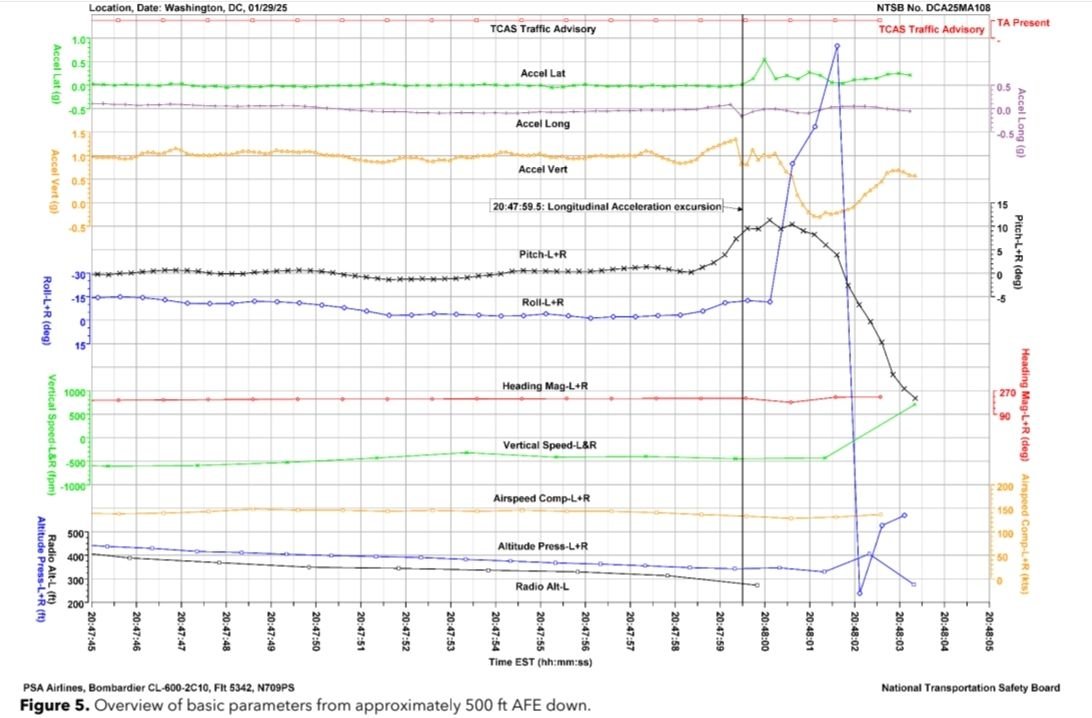
You can see that the pitch-up reduced the airspeed, and the vertical speed was mostly unaffected. This would have had a net effect of making the descent steeper (as the Radio Alt suggests).
If the CRJ crew had remained unaware, we would've learned how the downwash of a helicopter affects the wings of a jet.
The ultimate point is that a situation where a helicopter scrapes by the underside of a jet is not supposed to occur. At this point, all bets are off anyway, and rather than pondering what to do in such a situation, the focus should be on how to prevent it in the first place.
Subjects
CRJ
Links are to this post in the relevant subject page so that this post can be seen in context.
Reply to this quoting this original post. You need to be logged in. Not available on closed threads.
August 08, 2025, 10:02:00 GMT
permalink Post: 11935129
What I learned:
Interestingly the Local controller involved was also a CPL pilot
Pressure to use 33 for landing during high departure rates was there to avoid the queue blocking the taxi ways for arriving aircraft : ( my comment : when you get to that situation traffic should be reduced by departure slots , that what we do in Europe with the Network manager CTOTs..)
No reaction to Conflict alert because visual acquisition was prioritized , i.e if you saw the helicopter passing behind you disregarded the CA. and this was almost always the case so CA with helicopters became disregarded
Advanced training was poor or non existent ( e.g Threat/Error management training).
On the PAT pilots interviews the most flagrant normalization of deviance is requesting visual separation with an aircraft you do not see ( yet) I realize that was declared by pilots other that the one operating that flight , but gives a good indication of the local " best practices " in that area.
Finally on the TCAS issue, one of the screenshots shows other traffic, and we can see that there were 2 TAs one in front -2 and one behind +6 , that could ( emphasis on could) have been one of the reason the CRJ crew missed the urgency of the -2 , but also probably were more focusing on the PAPI so both looking outside instead of at the display .
And to reply to a question earlier by DIBO on the discussion about ADS-B out not avail on the RAT, and its relevance for TCAS, well it would have influenced the degree of accuracy of the Tau calculation ( with Alt returns every 25 ft instead of 100 feet) and could ( again emphasis on could) have changed the alert logic/timing of the TA. Non installation of ADS-B and flying 70 ft too high are probably one of the points the lawyers are going to get into to prove negligence from the military to get more money for their clients , possibly shadowing the real causes. ; which for me are still the design of the procedure and routes, and the failure of the Regulator to act on the alerts. . Love to hear Willow-Run 6-3 comment on this .
.
Subjects
ADSB (All)
ADSB Out
ATC
CRJ
DCA
Normalization of Deviance
Separation (ALL)
TCAS (All)
Visual Separation
Links are to this post in the relevant subject page so that this post can be seen in context.
Reply to this quoting this original post. You need to be logged in. Not available on closed threads.
August 10, 2025, 05:00:00 GMT
permalink Post: 11936009
I strikes me that, from my layman’s point of view, that this is the primary and gaping hole (among numerous others) in the Swiss cheese here.
At the same time, I get the sense that no controller was ever going to intentionally permit a helicopter to pass directly under an approaching aircraft and challenge that limited clearance.
My question is, should this have been (or was it?) formalized as an ATC procedure? Because if this had been proceduralized, I find it hard to believe that just nighttime VFR separation would have been found acceptable in that environment. Rather I would think that lateral separation should have been actively managed by ATC.
For one thing, with the CRJ (or whatever aircraft) pilots making a late switch to 33, turning to line up with the runway, etc., they may not have had the bandwidth to scan for a possibly conflicting helicopter, if they could even have seen it from their cockpit. (IIRC from the inquiry, the NTSB will be investigating that last point.)
I don’t know how difficult it may have been for the helicopter to see the CRJ, but the simple fact is that they did not.
On another subject, one thing that struck me from the inquiry was that the helicopter pilot apparently had very limited recent flight time, yet was assigned a challenging check ride.
This contrasted with the testimony of the leader (?) of one of the local Medivac groups, who discussed how much more experience he and his pilots had flying in that challenging environment (and often single-pilot ops at that).
Is the Army not providing adequate training and flight time to ensure their pilots can operate safely in those conditions?
Last edited by andihce; 10th August 2025 at 06:44 . Reason: clarification
Subjects
ATC
Altimeter (All)
CRJ
NTSB
Route 4
Separation (ALL)
VFR
Vertical Separation
Links are to this post in the relevant subject page so that this post can be seen in context.
Reply to this quoting this original post. You need to be logged in. Not available on closed threads.