January 31, 2025, 14:48:00 GMT
permalink Post: 11818264
30 seconds before the collision, when LC asked if they have traffic in sight, HELO was on track about 200\xb0, because of wind (320/25) HDG was somerhing like 215\xb0. Bearing to CRJ was 10 o’clock and to A319 about 11 o’clock. At this moment CRJ was flying track to North, base for rwy 33, and was not at all conflicting traffic from HELO’s point of view. Few seconds later HELO turned to the South, perhaps to avoid A319, soon after noticed that A319 will pass far ahead and turned back to right… so sad.
Subjects
CRJ
Separation (ALL)
Traffic in Sight
Vertical Separation
Links are to this post in the relevant subject page so that this post can be seen in context.
Reply to this quoting this original post. You need to be logged in. Not available on closed threads.
January 31, 2025, 14:49:00 GMT
permalink Post: 11818266
It is genuinely odd how they flew directly into this thing which must literally have been lighting up the interior of their cockpit. Also, why were they above the 200ft route ceiling?
(Still from the video referenced above by ORAC.)
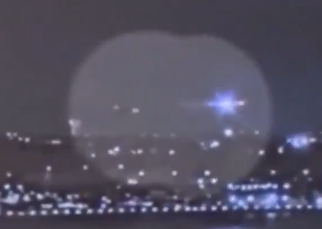
Helo on the left
Subjects
CRJ
Links are to this post in the relevant subject page so that this post can be seen in context.
Reply to this quoting this original post. You need to be logged in. Not available on closed threads.
January 31, 2025, 14:55:00 GMT
permalink Post: 11818269
JFK’s Canarsie in the old days was straight in that wasn’t to get around the rules. There’s a lot of normalization of deviance in FAAland.
As a survivor of an A-10 mid-air with similar geometry and height, it easy to imagine the event.
Last edited by galaxy flyer; 31st January 2025 at 15:00 . Reason: Clean up a mistake
Subjects
ATC
CRJ
DCA
IFR
Normalization of Deviance
Links are to this post in the relevant subject page so that this post can be seen in context.
Reply to this quoting this original post. You need to be logged in. Not available on closed threads.
January 31, 2025, 15:17:00 GMT
permalink Post: 11818285
Blaming the airspace design is also a non starter. Are we really going to say that just because the airspace is poorly designed then I'm just going to fly in to that regional jet over there?
.
I think we can all agree this did not happen on purpose!
They were clearly looking at some other aircraft - and probably spend too much time and focus on it!
They made a very common human mistake - and I challenge any professional pilot here in this forum to say "It never happened to me in my 40 years".
Everybody with any flying experience will have looked at another airborne asset (stupidly) thinking it was his wingman, the traffic that was just called out, the runway in bad weather (when in reality it was the taxiway) etc. etc.
Airspace design and procedures needs to take common human mistakes into account and try to mitigate them.
I think Airspace design failed all the players involved in this tragedy.
Subjects
CRJ
Links are to this post in the relevant subject page so that this post can be seen in context.
Reply to this quoting this original post. You need to be logged in. Not available on closed threads.
January 31, 2025, 15:35:00 GMT
permalink Post: 11818296
It is genuinely odd how they flew directly into this thing which must literally have been lighting up the interior of their cockpit. Also, why were they above the 200ft route ceiling?
(Still from the video referenced above by ORAC.)
Helo on the left
The other lights should have been visible from inside the helicopter, but they were likely looking a different direction to monitor other aircraft.
Subjects
CRJ
Links are to this post in the relevant subject page so that this post can be seen in context.
Reply to this quoting this original post. You need to be logged in. Not available on closed threads.
January 31, 2025, 15:42:00 GMT
permalink Post: 11818302
Subjects
CRJ
Links are to this post in the relevant subject page so that this post can be seen in context.
Reply to this quoting this original post. You need to be logged in. Not available on closed threads.
January 31, 2025, 16:10:00 GMT
permalink Post: 11818323
Arrivals tells PAT25 Heli to keep watch for CRJ. There is no acknowledgment. Arrivals then tells PAT 25 to pass behind CRJ. There is no acknowledgment. Then boom.
Capt Sully responded today. Said dark water gives no indication of height or direction of other aircraft. Put to bed Trumps remarks that it was a clear night so should have seen aircraft but then he now reckons it's the control tower that are the problem.
He acknowledged, the VASaviation stitch-up makes that clear.
But, it is a problem that other commercial traffic (including the CRJ) could only hear the LC's side of the radio traffic.
That will undoubtedly be surfaced in the report.
Subjects
CRJ
PAT25
Pass Behind
Pass Behind (All)
Pass Behind (PAT25)
Links are to this post in the relevant subject page so that this post can be seen in context.
Reply to this quoting this original post. You need to be logged in. Not available on closed threads.
January 31, 2025, 16:38:00 GMT
permalink Post: 11818348
It is genuinely odd how they flew directly into this thing which must literally have been lighting up the interior of their cockpit. Also, why were they above the 200ft route ceiling?
(Still from the video referenced above by ORAC.)
Helo on the left
Here's the more likely issue with NVG. Looking through them is often described as akin to looking through a pair of toilet roll tubes. Field of vision is radically reduced and it takes strong, conscious and fatiguing effort to conduct any kind of visual search.
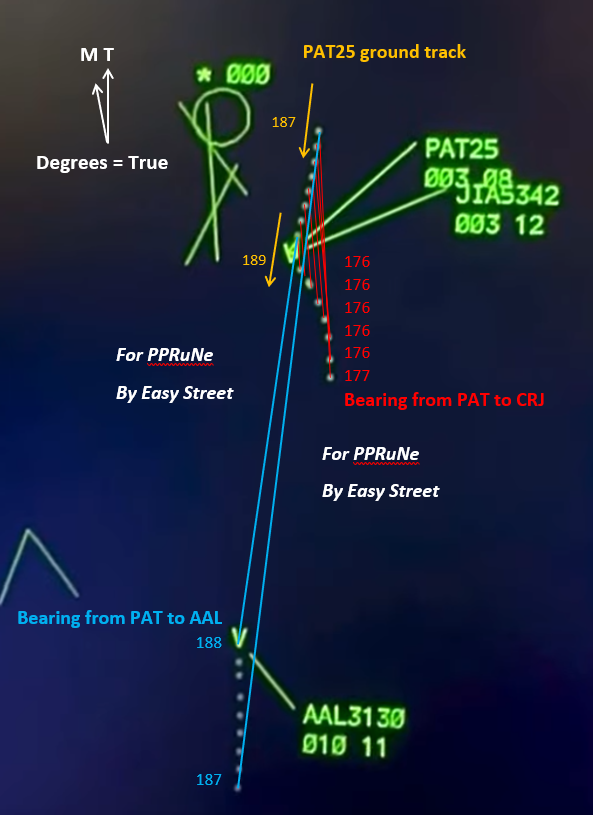
At the start of the radar recording posted to YouTube by AvHerald, AAL3130 is 10 degrees right of the CRJ from PAT25's point of view, and at a similar elevation angle. Its landing lights would be prominent in NVG and if PAT25's pilots were fixated upon it, they would not have seen the CRJ further left unless actively moving their heads to look for it. PAT25 gradually changes heading by 2 degrees right during the course of the radar clip, almost exactly following the bearing to AAL3130, and this makes it even clearer to me that PAT25 was mistakenly holding visual on it.
Last edited by Easy Street; 31st January 2025 at 16:50 .
Subjects
CRJ
Night Vision Goggles (NVG)
PAT25
Radar
Links are to this post in the relevant subject page so that this post can be seen in context.
Reply to this quoting this original post. You need to be logged in. Not available on closed threads.
January 31, 2025, 16:52:00 GMT
permalink Post: 11818357
Here's the more likely issue with NVG. Looking through them is often described as akin to looking through a pair of toilet roll tubes. Field of vision is radically reduced and it takes strong, conscious and fatiguing effort to conduct any kind of visual search.
At the start of the radar recording posted to YouTube by AvHerald, AAL3130 is 10 degrees right of the CRJ from PAT25's point of view, and at a similar elevation angle. Its landing lights would be prominent in NVG and if PAT25's pilots were fixated upon it, they would not have seen the CRJ further left unless actively moving their heads to look for it. PAT25 gradually changes heading by 2 degrees right during the course of the radar clip, almost exactly following the bearing to AAL3130, and this makes it even clearer to me that PAT25 was mistakenly holding visual on it.
Subjects
CRJ
Night Vision Goggles (NVG)
PAT25
Radar
Links are to this post in the relevant subject page so that this post can be seen in context.
Reply to this quoting this original post. You need to be logged in. Not available on closed threads.
January 31, 2025, 17:13:00 GMT
permalink Post: 11818379
Even as they apologize for setting up a near miss, they are, polite and calm.
They are human, and subject to the same frailties as the rest of us.
They are sure polite though.
Heathrow suffers from the problem that their local airspace is.. logical, as are the flight paths, and generally the runway utilisation. They don't have the benefit of the special design skills applied to JFK's terminal procedures which seem to have been designed to give cardio workouts for the controller and the pilots. Masterful airspace design.
JFK, making Abuja look attractive.
I learned that from during my Student Pilot days and it was reaffirmed till I retired from flying.
The Rule is "see and be seen"....which I read as being a two way street kind of situation.
When there is doubt...there is no doubt....remedy the situation as quickly and safely as possible.
If your aircraft is so complex and difficult to fly, or your procedures do not require or allow you to look out when appropriate, and that one of you cannot be spared to take a look out the window now and then....or if you think there is no need for you get your scan outside because you think yourself too busy inside.....there is something close to home that warrants changing.
Bottom line....nothing prevents you from doing a "missed approach" and give it a second try if it eliminates a critical risk of some kind. Even Air Line Pilots do not have to land on every approach and need to kick the mindset every second counts and remind their management that an occasional delay's expense is far cheaper than an accident. It also might make the difference between being retired and enjoying life and just being another statistic or name on a list of those killed In a crash.
This discussion about who is burdened with the responsibility for traffic separation between ATC and Pilots omits one thing.....the PIC of each aircraft is equally responsible for the safety of their own aircraft. More importantly, ATC Controllers might have to live with their mistakes but Pilots die by theirs.
DCA, and others nornalize collision alerts in the background of a significant % of ATC transmssions.
TCAS RA heights show mandatory Day, VMC go arounds the day prior- but how close was the helicopter to the 737 not going around 2 minutes earlier the day prior, so low TCAS TA only height below 900' allows continuing?
You think the CRJ crew, below 500', rolling out of a left turn to 33 sees the helicopter to their right or even notices the TCAS TA display? Maybe it gets a glance IF the short final is wired. Problem is the Traffic aural is already expected in the airspace, same as hearing the ATC collision alarms in their transmission background.
There will be line of sight recreations in the reports. The CRJ will not have but a scant chance to have seen the PAT25, with caveats- the CVR has to be heard.
Pat25 likely had a 500 hour pic getting a checkride in the right, distant seat and the radio PM/1000 hour pilot in left seat, seeing only AAL3130 and trying to figure out how to pass behind, cognitive dissonance with what is seen..
3 seconds later, all ends.
James Reason, Diane Vaughan, NASA, et al...
Subjects
ATC
CRJ
CVR
Close Calls
DCA
PAT25
Pass Behind
Pass Behind (All)
Separation (ALL)
TCAS (All)
TCAS RA
Links are to this post in the relevant subject page so that this post can be seen in context.
Reply to this quoting this original post. You need to be logged in. Not available on closed threads.
January 31, 2025, 17:36:00 GMT
permalink Post: 11818399
Subjects
CRJ
IFR
Pass Behind
Pass Behind (All)
VFR
Links are to this post in the relevant subject page so that this post can be seen in context.
Reply to this quoting this original post. You need to be logged in. Not available on closed threads.
January 31, 2025, 17:45:00 GMT
permalink Post: 11818407
I was also a little surprised at the suggestion that the helicopter crew may have been using NVGs. Perhaps someone with knowledge of this sort of thing might comment? Would that be normal - it seems that on a fine bright night, in a busy tight environment, as well lit as it is NVGs would seriously add risk. Whjy not fly out normally then go to NVGs once out of the high intensity area? It sounds as if NVGs add flare, reduce SA and make scan much harder. I guess that is an acceptable trade of when dealing with typical military operations at night, but it rather surprises me they might be used in this emvironment.
Any comment or enlightenment welcomed !
Subjects
CRJ
IFR
Night Vision Goggles (NVG)
Pass Behind
Pass Behind (All)
Situational Awareness
VFR
Links are to this post in the relevant subject page so that this post can be seen in context.
Reply to this quoting this original post. You need to be logged in. Not available on closed threads.
January 31, 2025, 17:56:00 GMT
permalink Post: 11818418
When the CRJ traffic was first called to the heli, and the heli acknowledged that they were visual, the CRJ looks to have been around 4NM south of the field.
NVGs probably aren't ideal in that environment and I haven't seen any factual statement that they were using them. Even if they were wearing them it doesn't mean they were actively using them (it is usually possible to lift them up out of the way). My only concern would be flying below 200ft, at night, across multiple bridges in an environment where there may be obstructions (not knowing the specifics of that portion of airspace). It may (or may not) have been advantageous to have one person using NVGs for ground collision avoidance, but it's a balancing act that depends on the conditions on the specific night.
Subjects
CRJ
IFR
Night Vision Goggles (NVG)
Pass Behind
Pass Behind (All)
VFR
Links are to this post in the relevant subject page so that this post can be seen in context.
Reply to this quoting this original post. You need to be logged in. Not available on closed threads.
January 31, 2025, 17:58:00 GMT
permalink Post: 11818419
Subjects
ATC
CRJ
IFR
Pass Behind
Pass Behind (All)
Separation (ALL)
VFR
Visual Separation
Links are to this post in the relevant subject page so that this post can be seen in context.
Reply to this quoting this original post. You need to be logged in. Not available on closed threads.
January 31, 2025, 18:52:00 GMT
permalink Post: 11818452
Subjects
CRJ
Links are to this post in the relevant subject page so that this post can be seen in context.
Reply to this quoting this original post. You need to be logged in. Not available on closed threads.
January 31, 2025, 19:00:00 GMT
permalink Post: 11818460
Subjects
CRJ
Links are to this post in the relevant subject page so that this post can be seen in context.
Reply to this quoting this original post. You need to be logged in. Not available on closed threads.
January 31, 2025, 19:41:00 GMT
permalink Post: 11818487
Subjects
CRJ
Separation (ALL)
Visual Separation
Links are to this post in the relevant subject page so that this post can be seen in context.
Reply to this quoting this original post. You need to be logged in. Not available on closed threads.
January 31, 2025, 19:50:00 GMT
permalink Post: 11818495
Formation flying entails one aircraft following another. Definately not the case here. Also the CRJ was not informed...
On a sidenote: It is very convenient that they found an alternative description for the operations at SFO...
Subjects
CRJ
Links are to this post in the relevant subject page so that this post can be seen in context.
Reply to this quoting this original post. You need to be logged in. Not available on closed threads.
January 31, 2025, 19:52:00 GMT
permalink Post: 11818498
It is genuinely odd how they flew directly into this thing which must literally have been lighting up the interior of their cockpit. Also, why were they above the 200ft route ceiling?
The owners of this site have every right to prohibit anything at all that they so choose, I do not dispute that at all and consider it right and proper. This is NOT sarcasm, it is the genuine belief of an extreme freemarketeer.
Last edited by Senior Pilot; 31st January 2025 at 20:25 . Reason: To fix formatting, quote
Subjects
CRJ
Links are to this post in the relevant subject page so that this post can be seen in context.
Reply to this quoting this original post. You need to be logged in. Not available on closed threads.
January 31, 2025, 19:54:00 GMT
permalink Post: 11818499
Subjects
ATC
CRJ
Radar
Separation (ALL)
Links are to this post in the relevant subject page so that this post can be seen in context.
Reply to this quoting this original post. You need to be logged in. Not available on closed threads.