February 15, 2025, 10:55:00 GMT
permalink Post: 11828510
I sincerely hope the NTSB can avoid being distracted by the distractions of altimetry and the missing ATC words on the Blackhawk CVR.
Upthread, Luca Lion calculated the 3 degree PAPI approach path as crossing the eastern riverbank at 270ft. If that's correct, then the CRJ's 313ft radar height 2 seconds before collision puts it at least 43ft above the approach path, so the Blackhawk's radio height deviation of 78ft would have contributed only about 35ft to the erosion of any intended "procedural separation" (*) between the aircraft. Or, to put it another way, the same outcome would have resulted if the Blackhawk had been at 235ft radio and the CRJ on the glide. Height keeping of plus or minus 35ft can only be achieved by instrument flying, which is obviously not compatible with visual separation (or indeed VFR) so cannot be reasonably cited as part of a safety case for the procedure. And of course a landing aircraft could easily be below the glide. Altimetry and height keeping are not the cause of this accident.
Missing the word "circling" wouldn't have influenced the helo crew getting visual with the CRJ at the time of the trasnmission. At best, it would have given them an extra nudge that "runway 33" (which was audible) meant the CRJ would be taking an easterly flight path. Missing "pass behind" with only a few seconds to collision was irrelevant if, as seems likely, the helo crew did not see the CRJ at that point.
(*) The quotes around "procedural separation" are intended to convey a tone of disgust and sarcasm.
Following "5*why", keep asking...
Why did the did miss part of the message
Why was the incomplete read back missed
Why does missing a few words lead to this disaster within seconds.
Does this lead an answer like: helicopter in a very busy airspace, busy controllers (insufficient time to be fully focused on full read backs) being by default too close to (and even needing to cross) the glideslope.
Subjects
ATC
Blackhawk (H-60)
CRJ
CVR
NTSB
Pass Behind
Pass Behind (All)
Radar
Separation (ALL)
VFR
Visual Separation
Links are to this post in the relevant subject page so that this post can be seen in context.
Reply to this quoting this original post. You need to be logged in. Not available on closed threads.
February 16, 2025, 04:46:00 GMT
permalink Post: 11828977
• At 8:47:58, or 1 second before impact, the CRJ began to increase its pitch, reaching about 9 degrees nose up at the time of collision. FDR data showed the CRJ elevators were deflected near their maximum nose up travel .
• The last radio altitude recorded for the CRJ was 313 ft and was recorded two seconds prior to the collision. The CRJ pitch at this time was, again, 9 degrees nose up, and roll was 11 degrees left wing down. The CRJ was descending at 448 feet per minute.
• The radio altitude of the Blackhawk at the time of the collision was 278 feet and had been steady for the previous 5 seconds. The Blackhawk pitch at the time of the collision was about a half degree nose up with a left roll of 1.6 degrees. Examination of wreckage will assist in determination of the exact angle of the collision.
I was once stopped at a red light, began rolling when the light turned green - and suddenly found myself on the brakes before I was conscious of the car running the red light. Possibly a CRJ pilot similarly caught the helo in peripheral vision and reacted subconsciously.
Last edited by RatherBeFlying; 16th February 2025 at 04:50 . Reason: Formatting
Subjects
Blackhawk (H-60)
CRJ
CVR
DCA
NTSB
Links are to this post in the relevant subject page so that this post can be seen in context.
Reply to this quoting this original post. You need to be logged in. Not available on closed threads.
February 16, 2025, 08:38:00 GMT
permalink Post: 11829051
I was once stopped at a red light, began rolling when the light turned green - and suddenly found myself on the brakes before I was conscious of the car running the red light. Possibly a CRJ pilot similarly caught the helo in peripheral vision and reacted subconsciously.
Subjects
CRJ
CVR
NTSB
Links are to this post in the relevant subject page so that this post can be seen in context.
Reply to this quoting this original post. You need to be logged in. Not available on closed threads.
February 16, 2025, 22:11:00 GMT
permalink Post: 11829492
Subjects
CVR
PAT25
Pass Behind
Pass Behind (All)
Separation (ALL)
Visual Separation
Links are to this post in the relevant subject page so that this post can be seen in context.
Reply to this quoting this original post. You need to be logged in. Not available on closed threads.
February 25, 2025, 18:09:00 GMT
permalink Post: 11835787
Thinking about the helicopter route, and the possible errors in the helicopter-borne equipment, the Static ports could be subject to some biases, and could be variable as a function go helicopter airspeed, vertical velocity, side slip.
Add to that a possible error or change in local baro (In-Hg) as one transits from their departure point into another area, the two cockpit baro altimeters' displayed altitudes can contribute to errors, but the altitude reporting to the tower is based on 29.92, so any error in setting AAU-31 or AAU-32 In-Hg applies only to the cockpit displays; the Tower receives Alt value referenced to 29.92 inches and corrects it locally for their displays and conflict alerting algorithms.
For the approach without benefit of a Glide Slope, the VASI or PAPI is visual and thus "probably" more challenging to maintain nominal approach angle to the runway. There should have been some documented analysis, backed up by data that helps to define the worst-case vertical departure from nominal approach angle on the PAPI/VASI approach; that needs to be part of a worst-case combined analysis, and I think needs to be better than "10 to the minus nine". Need to have data from both low-hour and high-hour pilots on a non-coupled approach.
Next quasi- related thought::: when the CVR recorded a verbal disparity of 100 feet between pilot and examiner, shouldn't that have raised questions of "Why"- especially when at low altitudes MSL? As I understand it, there would be 3 or 4 places where Baro Alt was displayed; the two mechanical bar alt indicators, AND the altitude display(s) on the pilot(s) NVG HUDS. If the pilot under evaluation was fully on the ANVIS HUD, and if that pilot failed to set the Bar Alt "correction" in terms go In-Hg, then the pilot could readily be seeing inaccurate Bar Alt digits on the HUD.
I believe there procedurally had to be a separate action to set In-Hg ( or to sync the HUD to the AAU-31 and AAU-32 values). It would not take much of an error in ANVIS HUD In-Hg setting to cause a substantial error in the Altitude digits displayed on the HUD.
Add/multiply these error sources up, and then see if the defined helicopter route met the 10 to the minus nine value.
Subjects
CVR
HUD
Night Vision Goggles (NVG)
Links are to this post in the relevant subject page so that this post can be seen in context.
Reply to this quoting this original post. You need to be logged in. Not available on closed threads.
February 26, 2025, 01:45:00 GMT
permalink Post: 11836058
Thinking about the helicopter route, and the possible errors in the helicopter-borne equipment, the Static ports could be subject to some biases, and could be variable as a function go helicopter airspeed, vertical velocity, side slip.
Add to that a possible error or change in local baro (In-Hg) as one transits from their departure point into another area, the two cockpit baro altimeters' displayed altitudes can contribute to errors, but the altitude reporting to the tower is based on 29.92, so any error in setting AAU-31 or AAU-32 In-Hg applies only to the cockpit displays; the Tower receives Alt value referenced to 29.92 inches and corrects it locally for their displays and conflict alerting algorithms.
For the approach without benefit of a Glide Slope, the VASI or PAPI is visual and thus "probably" more challenging to maintain nominal approach angle to the runway. There should have been some documented analysis, backed up by data that helps to define the worst-case vertical departure from nominal approach angle on the PAPI/VASI approach; that needs to be part of a worst-case combined analysis, and I think needs to be better than "10 to the minus nine". Need to have data from both low-hour and high-hour pilots on a non-coupled approach.
Next quasi- related thought::: when the CVR recorded a verbal disparity of 100 feet between pilot and examiner, shouldn't that have raised questions of "Why"- especially when at low altitudes MSL? As I understand it, there would be 3 or 4 places where Baro Alt was displayed; the two mechanical bar alt indicators, AND the altitude display(s) on the pilot(s) NVG HUDS. If the pilot under evaluation was fully on the ANVIS HUD, and if that pilot failed to set the Bar Alt "correction" in terms go In-Hg, then the pilot could readily be seeing inaccurate Bar Alt digits on the HUD.
I believe there procedurally had to be a separate action to set In-Hg ( or to sync the HUD to the AAU-31 and AAU-32 values). It would not take much of an error in ANVIS HUD In-Hg setting to cause a substantial error in the Altitude digits displayed on the HUD.
Add/multiply these error sources up, and then see if the defined helicopter route met the 10 to the minus nine value.
This is the same deal - anytime a landing airplane is below 1,000 feet (at least!) and doesn't own the airspace from them on down to the surface, you already lost the game right there. Someone will be down there at some point a bit too high and someone at some point will be a bit too low or too close or whatever. It is a narrow 2 lane road in the country with a 150 MPH speed limit. There will be crashes.
Subjects
CVR
HUD
Night Vision Goggles (NVG)
Links are to this post in the relevant subject page so that this post can be seen in context.
Reply to this quoting this original post. You need to be logged in. Not available on closed threads.
February 26, 2025, 12:31:00 GMT
permalink Post: 11836357
Next quasi- related thought::: when the CVR recorded a verbal disparity of 100 feet between pilot and examiner, shouldn't that have raised questions of "Why"- especially when at low altitudes MSL? As I understand it, there would be 3 or 4 places where Baro Alt was displayed; the two mechanical bar alt indicators, AND the altitude display(s) on the pilot(s) NVG HUDS. If the pilot under evaluation was fully on the ANVIS HUD, and if that pilot failed to set the Bar Alt "correction" in terms go In-Hg, then the pilot could readily be seeing inaccurate Bar Alt digits on the HUD.
Helo is going to be using radalt. Everything is radalt when the heights are below ~1000ft because the alternative is often fatal. This has been covered extensively. As to the rest... Wat?
Subjects
CVR
HUD
Night Vision Goggles (NVG)
Radio Altimeter
Links are to this post in the relevant subject page so that this post can be seen in context.
Reply to this quoting this original post. You need to be logged in. Not available on closed threads.
February 26, 2025, 19:10:00 GMT
permalink Post: 11836579
At 8:47:42 the helicopter pilot stepped on the latter part of ATC’s transmission to the Blackhawk which was an instruction to ‘…pass behind the…’ The helicopter crew could not possibly have heard that instruction because they stepped on it themselves. Read back is required to an en-route clearance. Afterwards there was an intercom discussion between the helicopter pilots about whether they were to move further east.
Seems that two consecutive radio calls to the helicopter got corrupted which led to a breakdown in SA onboard the helicopter. Probably they had no idea that they needed to look left over the city lights to see the CRJ and were convinced their traffic was in the line up of jets on 01 extended centreline and therefore no factor.
Subjects
ATC
Blackhawk (H-60)
CRJ
CVR
Situational Awareness
Links are to this post in the relevant subject page so that this post can be seen in context.
Reply to this quoting this original post. You need to be logged in. Not available on closed threads.
April 28, 2025, 11:09:00 GMT
permalink Post: 11874789
1. So if an "intolerable risk" is identified by the NTSB Chair, your view is that nonethless the pilot flying the helicopter necessarily was incompetent when that risk finally reached occurrence? The Swiss Cheese model requires accounting for all the holes in the block first of all existing somewhere, and then enough of them lining up - but not necessarily all of the holes lining up. The pilot might have been fully competent and might not have been - but the intolerable risk present in the airspace design makes it necessary to know a lot more relevant facts in the record to supoort a logical conclusion.
Or perhaps you'll next assert that Chair Homendy is just covering for DEI.
2. Any second-year associate in a firm of more than three lawyers who has done nothing more than watch five depositions would raiload your argument to the extent it is based on the NYT's twisting of the summary of the CVR about turning left. Directive? Among other things, if the pilot flying was being "directed" then to the extent there is responsibility, it has to be mutual.
3. Whenever I read pieces like the one published in the NYT I wonder if one of the reporters has a close friend working on one of the lawsuits and is just trying to shape public opinion. Even if that speculation is merely a cheap shot, I didn't read anything in the piece which changed the level of "complexity" of the accident. Perhaps it was deeply hidden and required more reading between the lines. Regardless, its publication is a sorry excuse to jump far ahead of the investigations.
Subjects
CVR
DEI
NTSB
NTSB Chair Jennifer Homendy
New York Times
Links are to this post in the relevant subject page so that this post can be seen in context.
Reply to this quoting this original post. You need to be logged in. Not available on closed threads.
July 30, 2025, 19:22:00 GMT
permalink Post: 11930888
1. PAT25 PF started to turn right at Cabin John (American Legion Bridge), which would have taken them toward Great Falls; i.e., up the Potomac. IP had to tell PF to turn left, which would start track down Potomac River (helo route 1). Odd. Not the best SA by PF.
2. No discussion in the PAT25 cockpit about the called CRJ traffic.
3. PSA Captain/PF expressed to PM a preference for continuing to runway 1 but accepted runway 33. Media will make a big deal out of this. I don\x92t think it is.
Subjects
CRJ
CVR
NTSB Docket
PAT25
Situational Awareness
Links are to this post in the relevant subject page so that this post can be seen in context.
Reply to this quoting this original post. You need to be logged in. Not available on closed threads.
August 01, 2025, 22:40:00 GMT
permalink Post: 11932083
And they acknowledged it, although in a very short reply (understandable to keep R/T's as short as possible).
But replying with " traffic circling 33 in sight " just might have improved their own SA, helping to build the mental picture that mentioned traffic was going to move slightly to their left and was at some point going to cross their route from left to right. And if they didn't have that mental picture of what "circling 33" meant for their routing, then a lot was wrong long before the impact.
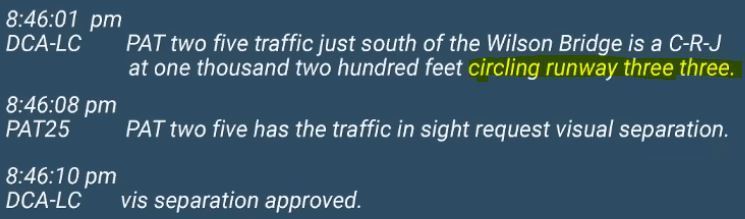
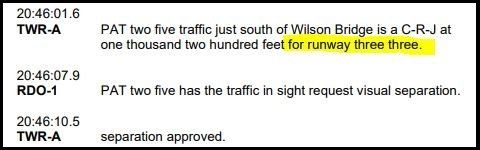
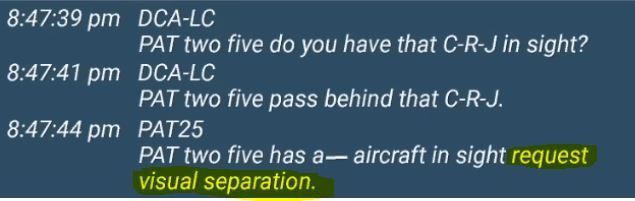
And what strikes me over and over again, is this mutual 'pavlovian' "request visual separation"-"approved" thing, as if proclaiming these words, absolves all involved from any rules/restriction that might hinder the smooth flow of things (which it does - kind of).
Even at the last chance of averting disaster by the controller (by clearly indicating the target), the pavlovian reaction was there again (totally meaningless as it was already requested and approved 96 second earlier)...
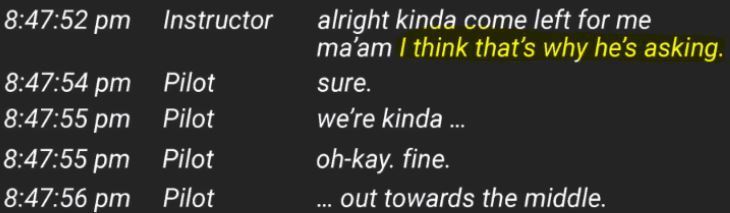
Last edited by DIBO; 2nd August 2025 at 22:03 . Reason: add extract from UH60 CVR transcript (not available/included in NTSB debrief animation)
Subjects
ATC
CVR
Night Vision Goggles (NVG)
Separation (ALL)
Situational Awareness
Visual Separation
Links are to this post in the relevant subject page so that this post can be seen in context.
Reply to this quoting this original post. You need to be logged in. Not available on closed threads.
August 11, 2025, 08:34:00 GMT
permalink Post: 11936560
If I am correct can you stop this discussion Remember journalists and possibly families members of those 2 pilots are watching too.
To close that bit just read the CRJ CVR transcript (*)
47:29 : eGPWS : 500 hundred
47:35 : I got 2 whites and 2 red
47:37 : cool ( my note : so they were looking at the PAPI )
47::40 : "Traffic traffic " ( my note : TA audio)
47:47 : TWR :" PAT 25 pass behind the CRJ "
47:55 : eGPWS : ...hundred ..
47:58 " Oh Sh!!!!!
47:59 : sound of impact .
Subjects
CRJ
CVR
Pass Behind
Pass Behind (All)
Pass Behind (PAT25)
Links are to this post in the relevant subject page so that this post can be seen in context.
Reply to this quoting this original post. You need to be logged in. Not available on closed threads.
August 11, 2025, 17:19:00 GMT
permalink Post: 11936840
If I am correct can you stop this discussion Remember journalists and possibly families members of those 2 pilots are watching too.
To close that bit just read the CRJ CVR transcript (*)
47:29 : eGPWS : 500 hundred
47:35 : I got 2 whites and 2 red
47:37 : cool ( my note : so they were looking at the PAPI )
47::40 : "Traffic traffic " ( my note : TA audio)
47:47 : TWR :" PAT 25 pass behind the CRJ "
47:55 : eGPWS : ...hundred ..
47:58 " Oh Sh!!!!!
47:59 : sound of impact .
Subjects
ATC
CRJ
CVR
DCA
Pass Behind
Pass Behind (All)
Pass Behind (PAT25)
TCAS (All)
Traffic in Sight
Links are to this post in the relevant subject page so that this post can be seen in context.
Reply to this quoting this original post. You need to be logged in. Not available on closed threads.
August 14, 2025, 08:04:00 GMT
permalink Post: 11938210
We don't know if the heli crew thought they had seen that traffic (but picked the wrong one) or not, though the CVR conveys the impression they didn't, because they didn't talk about it (like they did about other traffic earlier in the flight).
It's also difficult to judge distance if all you see is a light, in your night vision goggles.
And it's especially difficult if you fail to predict the other aircraft's maneouver. The CRJ rolled out on final only 7 seconds before the collision. Until then, from a purely visual standpoint, everything would've looked fine. It required the heli crew to be aware of where the runway 33 extended centerline was (and where they were) to avoid being where the CRJ was going.
Subjects
CRJ
CVR
Normalization of Deviance
Separation (ALL)
Traffic in Sight
Visual Separation
Links are to this post in the relevant subject page so that this post can be seen in context.
Reply to this quoting this original post. You need to be logged in. Not available on closed threads.
September 27, 2025, 16:09:00 GMT
permalink Post: 11960626
Reviewing the 5342 CVR, runway 33 was not included in the CA/PF\x92s approach briefing about 35 minutes prior to the expected landing time. The CA/PF did do an abbreviated briefing for 33 after the circle 33 option was accepted.
Subjects
ATC
CVR
PSA Procedures
Links are to this post in the relevant subject page so that this post can be seen in context.
Reply to this quoting this original post. You need to be logged in. Not available on closed threads.
September 29, 2025, 03:56:00 GMT
permalink Post: 11961297
Reviewing the 5342 CVR, runway 33 was not included in the CA/PF\x92s approach briefing about 35 minutes prior to the expected landing time. The CA/PF did do an abbreviated briefing for 33 after the circle 33 option was accepted.
Subjects
ATC
CVR
PSA Procedures
Links are to this post in the relevant subject page so that this post can be seen in context.
Reply to this quoting this original post. You need to be logged in. Not available on closed threads.
September 29, 2025, 22:00:00 GMT
permalink Post: 11961755
Reviewing the 5342 CVR, runway 33 was not included in the CA/PF\x92s approach briefing about 35 minutes prior to the expected landing time. The CA/PF did do an abbreviated briefing for 33 after the circle 33 option was accepted.
We could maybe potentially see something similar here , blaming the PSA captain for accepting without prior briefing a visual Circle 33 to gain time , things he probably had done many times before to the satisfaction of his employer .
@ WillowRun 6-3 : Is normalization of deviance a mitigating circumstances in the US legal system ?
Subjects
ATC
CVR
Normalization of Deviance
PSA Procedures
Links are to this post in the relevant subject page so that this post can be seen in context.
Reply to this quoting this original post. You need to be logged in. Not available on closed threads.
October 17, 2025, 22:03:00 GMT
permalink Post: 11971786
As I recall from the interviews, there was no Army aviation policy about how this technology was to be used during DC area flights. Some crews used it, but most did not.
Subjects
ADSB (All)
ATC
Blackhawk (H-60)
CVR
TCAS (All)
Links are to this post in the relevant subject page so that this post can be seen in context.
Reply to this quoting this original post. You need to be logged in. Not available on closed threads.
February 18, 2026, 19:31:00 GMT
permalink Post: 12039332
We don't know of any gestures, if any pilot pointed at lights, but there is nothing in the CVR transcript that indicates the PF was aware of the traffic, or that the PIC pointed the traffic out to her; the PF certainly did not factor in the decision to request visual separation.
So when the PIC transmitted,
or did the PF know that neither of them could identify the traffic, but accepted it as normal?
Subjects
CVR
Normalization of Deviance
Separation (ALL)
Traffic in Sight
Visual Separation
Links are to this post in the relevant subject page so that this post can be seen in context.
Reply to this quoting this original post. You need to be logged in. Not available on closed threads.
February 19, 2026, 04:20:00 GMT
permalink Post: 12039466
We don't know of any gestures, if any pilot pointed at lights, but there is nothing in the CVR transcript that indicates the PF was aware of the traffic, or that the PIC pointed the traffic out to her; the PF certainly did not factor in the decision to request visual separation.
So when the PIC transmitted,
or did the PF know that neither of them could identify the traffic, but accepted it as normal?
Subjects
CVR
Night Vision Goggles (NVG)
Normalization of Deviance
Separation (ALL)
Traffic in Sight
Visual Separation
Links are to this post in the relevant subject page so that this post can be seen in context.
Reply to this quoting this original post. You need to be logged in. Not available on closed threads.