February 01, 2025, 16:48:00 GMT
permalink Post: 11819158
The helicopter crew is said to have had NVG's but at this point no information has been provided re their use of NVG's.
The height issue is not the primary issue as the intent of the procedures and ATC instructions was to separate the two aircraft.
Had that separation effort worked there would have been no conflict thus no collision.
It is the failure of the separation and the meeting over the river the two aircraft in the same bit of air that height mattered.
No where in the standard procedure was it intended to have helicopter traffic fly below landing aircraft on RWY 33.
Poll the Pilots here folks....ask them if they would routinely fly 100-200 feet below a crossing aircraft? What do you think the answer would be?
I thank 212 Man for his input reminding me why he was the Teacher's Pet. I depend upon his ability to get into the books to keep me straight.
Now a test question for him.....were you flying the incident airplane doing a Visual Approach to RWY33....would you have tuned up the IAP for that RWY as an additional reference for your approach?
SOP's usually instruct Crews to use ILS data when doing Visual Approaches to runways with that kind of IAP so would that kind of thinking apply in this incident? Would that have been of any benefit considering the existing weather and terrain? Or, would that have been a distraction?
This was not a "Circling Approach" but it was very similar.
Subjects
ATC
Circle to Land (Deviate to RWY 33)
DCA
Night Vision Goggles (NVG)
Separation (ALL)
Links are to this post in the relevant subject page so that this post can be seen in context.
Reply to this quoting this original post. You need to be logged in. Not available on closed threads.
February 01, 2025, 18:13:00 GMT
permalink Post: 11819206
Having coffee this morning with my friend (my old CFI) who's a FO for one of the other American Eagle providers based at DCA, his opinion was that since that 5,200 ft on RWY33 is sufficient for an RJ, the primary reason he gets sidestepped to 33 about half the time is that it ends very close to the American's regional jet terminal and that using RWY33 saves wasting a couple hundred bucks to taxi for no reason which adds up with their large amount of activity. I don't fly there but as pax I on an RJ, with those winds in VFR, in my experience we landed 33 maybe 40% of the time.
My friend doesn't speak for all the RJ pilots obviously, but he didn't consider this sidestep to 31 to be at all unexpected or in his mind adding any significant risk and mentioned it was part of his localization checkout (his company has specific ground and line training required for the airfield). Most tellingly, he literally said it was not on his Top Ten gripes about DCA (he likes to complain a bit 😀

Subjects
ATC
CRJ
Circle to Land (Deviate to RWY 33)
DCA
VFR
Links are to this post in the relevant subject page so that this post can be seen in context.
Reply to this quoting this original post. You need to be logged in. Not available on closed threads.
February 01, 2025, 23:39:00 GMT
permalink Post: 11819382
Having coffee this morning with my friend (my old CFI) who's a FO for one of the other American Eagle providers based at DCA, his opinion was that since that 5,200 ft on RWY33 is sufficient for an RJ, the primary reason he gets sidestepped to 33 about half the time is that it ends very close to the American's regional jet terminal and that using RWY33 saves wasting a couple hundred bucks to taxi for no reason which adds up with their large amount of activity. I don't fly there but as pax I on an RJ, with those winds in VFR, in my experience we landed 33 maybe 40% of the time.
My friend doesn't speak for all the RJ pilots obviously, but he didn't consider this sidestep to 31 to be at all unexpected or in his mind adding any significant risk and mentioned it was part of his localization checkout (his company has specific ground and line training required for the airfield). Most tellingly, he literally said it was not on his Top Ten gripes about DCA (he likes to complain a bit 😀
The problem with systemic failures is the come along looking like excellent alternatives until the wheels fall off the wagon and it ends in tears. You have to be lucky 100% of the time, the grim reaper only needs one win.
Subjects
ATC
Circle to Land (Deviate to RWY 33)
DCA
Route 4
VFR
Links are to this post in the relevant subject page so that this post can be seen in context.
Reply to this quoting this original post. You need to be logged in. Not available on closed threads.
February 02, 2025, 15:41:00 GMT
permalink Post: 11819865
Safety reports, if assessed and promulgated correctly, act as another line of defence. They identify any deficiencies in procedures which may have been overlooked (or underestimated) in the original procedure safety assessment.
Hopefully the crash investigation will delve into these aspects to identify what action was taken on receipt of the reports below by the respective organisations.
I found it chilling to read how many factors associated with this accident had repeatedly occurred and been reported over the previous 20+ years. I’ve condensed the reports [see spoiler- mods] and highlighted in bold many of these deficiencies, identified by pilots.
Common Themes
- Collision Avoidance taken on helicopters supposedly visually separating from the traffic.
- Helicopters deviating from their cleared tracks or levels.
- Helicopters on different frequencies
- Lack of traffic information on conflicting traffic.
- “Normalisation” of these incidents.
Last edited by Saab Dastard; 2nd February 2025 at 17:15 . Reason: Make it legible
Subjects
ATC
Accident Waiting to Happen
Circle to Land (Deviate to RWY 33)
DCA
FAA
Frequency 119.1
Separation (ALL)
TCAS (All)
TCAS RA
Visual Separation
Links are to this post in the relevant subject page so that this post can be seen in context.
Reply to this quoting this original post. You need to be logged in. Not available on closed threads.
February 03, 2025, 21:26:00 GMT
permalink Post: 11820910
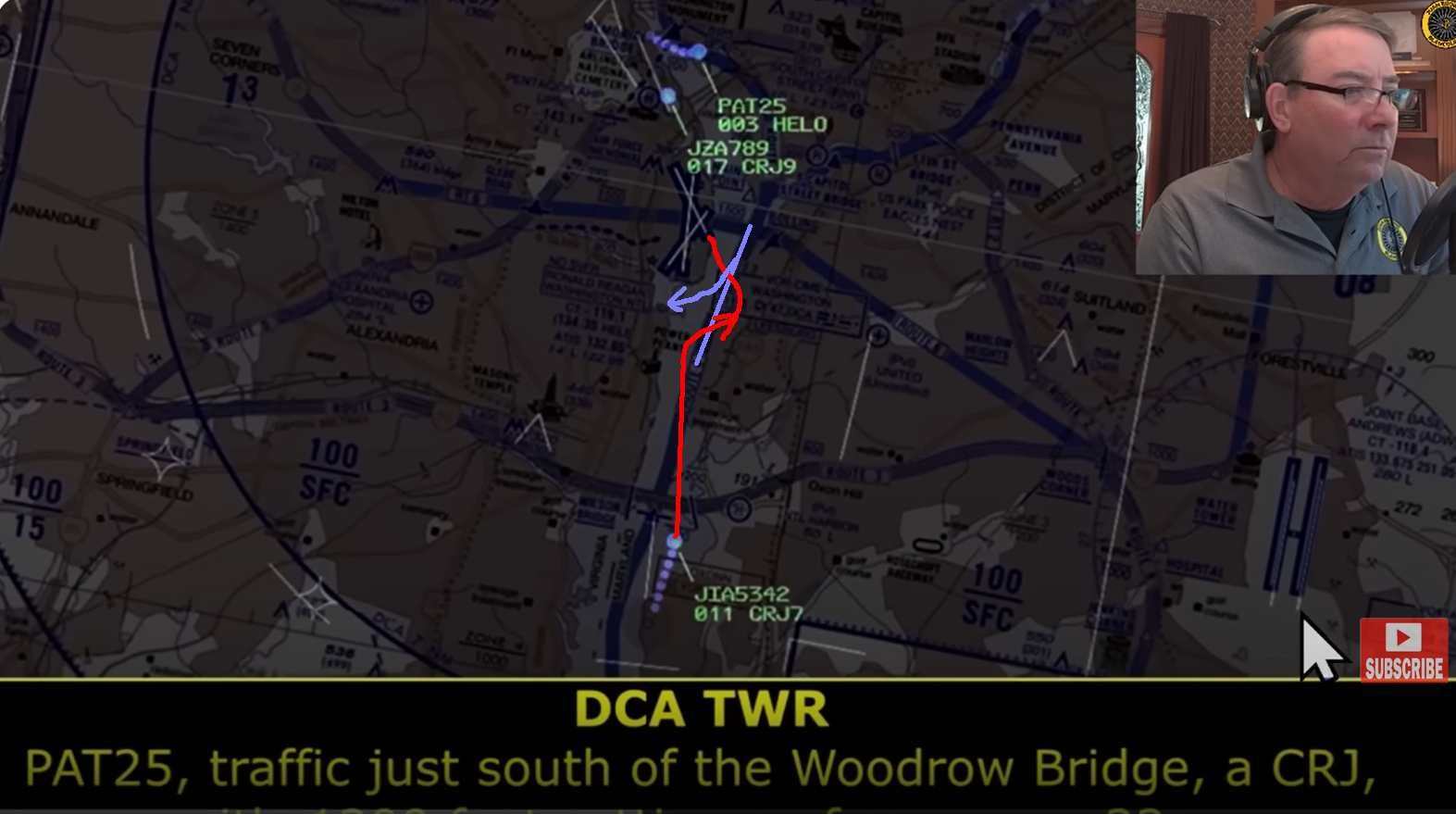
Last edited by spornrad; 3rd February 2025 at 23:06 .
Subjects
CRJ
Circle to Land (Deviate to RWY 33)
Pass Behind
Pass Behind (All)
Links are to this post in the relevant subject page so that this post can be seen in context.
Reply to this quoting this original post. You need to be logged in. Not available on closed threads.
February 03, 2025, 22:46:00 GMT
permalink Post: 11820975
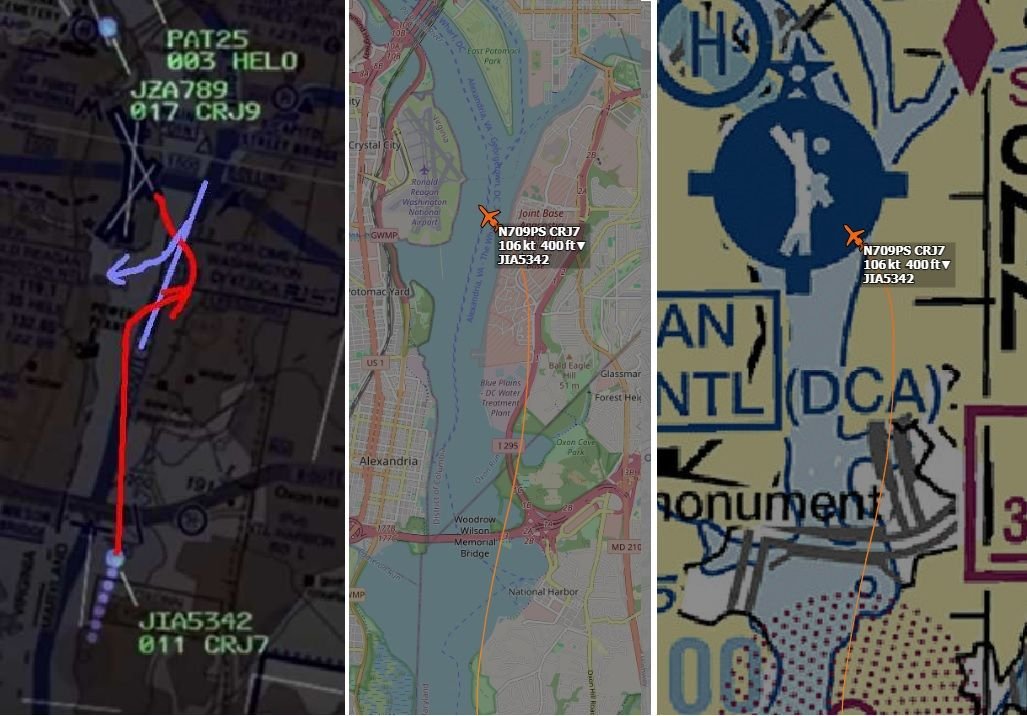
No crossing of 'Route 4' prior to ...
Subjects
CRJ
Circle to Land (Deviate to RWY 33)
Pass Behind
Pass Behind (All)
Route 4
Links are to this post in the relevant subject page so that this post can be seen in context.
Reply to this quoting this original post. You need to be logged in. Not available on closed threads.
February 04, 2025, 17:22:00 GMT
permalink Post: 11821576
Subjects
Circle to Land (Deviate to RWY 33)
Links are to this post in the relevant subject page so that this post can be seen in context.
Reply to this quoting this original post. You need to be logged in. Not available on closed threads.
February 04, 2025, 19:00:00 GMT
permalink Post: 11821636
Circling is a visual maneuver to align with the landing runway but, as opposed to a visual approach” there’s specific airspace to circle within. Circling approaches, by definition, are where the final segment is more than 30 degrees from the runway heading OR a descent gradient greater the 400 feet per nautical mile from the FAF to the MAPpoint.
Last edited by galaxy flyer; 4th February 2025 at 19:16 .
Subjects
Circle to Land (Deviate to RWY 33)
Links are to this post in the relevant subject page so that this post can be seen in context.
Reply to this quoting this original post. You need to be logged in. Not available on closed threads.
February 04, 2025, 19:40:00 GMT
permalink Post: 11821661
Circling is a visual maneuver to align with the landing runway but, as opposed to a visual approach\x94 there\x92s specific airspace to circle within. Circling approaches, be definition, are where the final segment is more than 30 degrees from the runway heading OR a descent gradient greater the 400 feet per nautical mile from the FAF to the MAPpoint.
Subjects
Circle to Land (Deviate to RWY 33)
Links are to this post in the relevant subject page so that this post can be seen in context.
Reply to this quoting this original post. You need to be logged in. Not available on closed threads.
February 06, 2025, 14:28:00 GMT
permalink Post: 11823014
The accident aircraft was making a sidestep curving manoeuvre, a late change from a straight in to 01. The only message passed about this was it was landing on 33. No comment that it was going to break off the 01 approach. No questioning that the heli crew even understood how an aircraft now approached 33, making this unusual and last-minute change, nor that it would compromise them routing along the river.
.
Subjects
CRJ
Circle to Land (Deviate to RWY 33)
PAT25
Separation (ALL)
Traffic in Sight
Visual Separation
Links are to this post in the relevant subject page so that this post can be seen in context.
Reply to this quoting this original post. You need to be logged in. Not available on closed threads.
February 06, 2025, 14:35:00 GMT
permalink Post: 11823020
The accident aircraft was making a sidestep curving manoeuvre, a late change from a straight in to 01. The only message passed about this was it was landing on 33. No comment that it was going to break off the 01 approach. No questioning that the heli crew even understood how an aircraft now approached 33, making this unusual and last-minute change, nor that it would compromise them routing along the river.
.
Subjects
CRJ
Circle to Land (Deviate to RWY 33)
DCA
Separation (ALL)
Visual Separation
Links are to this post in the relevant subject page so that this post can be seen in context.
Reply to this quoting this original post. You need to be logged in. Not available on closed threads.
March 06, 2025, 13:29:00 GMT
permalink Post: 11841979
Because without that information, they could IMHO quite happily look at the A319 approaching runway 1, intend to pass behind it to head south down-river until the A319 was no longer over the river, and loiter around the runway 33 approach until that happens.
Shift the times by ten seconds and the same accident could have still occurred.
Visual simply doesn't work at the required level of safety if there are multiple aircraft to be visual with.
Reading this thread since the night of the accident, many have noted the "wrong-thinking" (for lack of a better term) underpinning the way traffic was managed by FAA and ATC.
I'm not enthused about the litigation that almost certainly will be intense once it commences. But reading the thread I've started to wonder.....
What would a chronological reconstruction of each incremental decision by FAA about the operation of DCA look like, a chronology that would (of course) include each Congressional enactment requiring or allowing further intensity of operations? The airport did not go from a nominal operational environment, with typically safe procedures and airspace usage rules very similar to or the same as any other major urban airport in the country, to the situation which obtained on January 29, overnight - or so it would seem.
(Yes, reconstructing the facts to build such a chronology would involve quite a lot of discovery activities in the presumably forthcoming lawsuits, but I'm not veering off into any further comment about why that would matter or which party or parties it would help or hurt..... other than to say, very often, cases are won and lost in discovery.)
Some years ago, on a trip to Capitol Hill hoping to find gainful employment on a Congressional staff somewhere, on the return flight from what then was Washington National, the aircraft's cockpit door was open as the boarding process was being completed (it was 1987). I recall being seated close enough to the flight deck - leaning a little into the aisle (a Midway Airlines DC-9 iirc) - to be able to see the pilot in the LHS and part of the D.C. skyline through the cockpit's front windows. Maybe that is why my mind somehow can't quite comprehend the recollections from kidhood of reading about the midair collision over New York City which is featured prominently in the book Collision Course , together with the events of the night of January 29.
Added: Wall Street Journal, March 6: "Air-Traffic Staff Rules Tightened After Crash." Also reports previous "close call" incident. Highly recommended reading (and I didn't see anything to contradict the above post, WR 6-3).
Last edited by WillowRun 6-3; 6th March 2025 at 13:46 .
Subjects
ATC
Circle to Land (Deviate to RWY 33)
Close Calls
DCA
FAA
Pass Behind
Pass Behind (All)
Separation (ALL)
Visual Separation
Wall Street Journal
Links are to this post in the relevant subject page so that this post can be seen in context.
Reply to this quoting this original post. You need to be logged in. Not available on closed threads.
March 31, 2025, 14:27:00 GMT
permalink Post: 11858000
 Bit academic anyway as there was no AA ban and the AA flight accepted it when offered it and the next AA asked for it on initial contact ..... not realising what had just happened! That's why I had a $ sign in my earlier post! The cynic that I am........
Last edited by Hot 'n' High; 31st March 2025 at 14:38 .
Subjects
Circle to Land (Deviate to RWY 33)
DCA
Separation (ALL)
TCAS (All)
Visual Separation
Links are to this post in the relevant subject page so that this post can be seen in context.
Reply to this quoting this original post. You need to be logged in. Not available on closed threads.
March 31, 2025, 17:31:00 GMT
permalink Post: 11858092
Bit academic anyway as there was no AA ban and the AA flight accepted it when offered it and the next AA asked for it on initial contact ..... not realising what had just happened! That's why I had a $ sign in my earlier post! The cynic that I am........
Or maybe such a review will, regrettably, require an Act of Congress (it should not require this, but, you know, K Street, campaign donors, the seniority system, and the generally stellar academic and career experience required prior to election to the Congress . . . . too bad elected represenatives are not required to build hours first).
Subjects
Circle to Land (Deviate to RWY 33)
DCA
FAA
NTSB
TCAS (All)
Links are to this post in the relevant subject page so that this post can be seen in context.
Reply to this quoting this original post. You need to be logged in. Not available on closed threads.
March 31, 2025, 22:25:00 GMT
permalink Post: 11858234
Would it have been like the Lufthansa who received no end of grief over the airways while trying to adhere to company policy?
If a CP had put their foot down and implemented policy like that would they be thought of as troublesome within their own Airline?
On that note\x85.. did any Airline have policy refusing the side-step in certain conditions? ie at night?
I\x92m enjoying the conversation and appreciating the thought that people are putting into their contributions so thank you.
Framer
Subjects
Circle to Land (Deviate to RWY 33)
DCA
Grief
Links are to this post in the relevant subject page so that this post can be seen in context.
Reply to this quoting this original post. You need to be logged in. Not available on closed threads.
March 31, 2025, 22:35:00 GMT
permalink Post: 11858238
Would it have been like the Lufthansa who received no end of grief over the airways while trying to adhere to company policy?
If a CP had put their foot down and implemented policy like that would they be thought of as troublesome within their own Airline?
On that note\x85.. did any Airline have policy refusing the side-step in certain conditions? ie at night?
I\x92m enjoying the conversation and appreciating the thought that people are putting into their contributions so thank you.
Framer
"Unable"
Subjects
Circle to Land (Deviate to RWY 33)
DCA
Grief
Links are to this post in the relevant subject page so that this post can be seen in context.
Reply to this quoting this original post. You need to be logged in. Not available on closed threads.
April 01, 2025, 10:51:00 GMT
permalink Post: 11858507
I raised the airline responsibility bit more as "idle thoughts" to illustrate that everyone can play their part in making things safer in cases such as this - including airlines. However, it does need (a) identification of the issue, (b) then good analysis to scope it all and, finally, if there is a "real" potential issue after that analysis, (c) to work out a formal policy (here with AA and DCA) so everyone knows what's what and, importantly, appreciates any knock-on issues that such a policy may generate - such as maybe cutting down on ATC's flexibility on occasion.
So, for eg, it could have been a joint AA/DCA policy that AA would not be placed on the sidestep, or accepted on the sidestep, while something was on Route 4. Irrelevant here now as Route 4 has gone ..... but the above concept can be applied to other potential issues at other airfields.
Anyway, just some thoughts. I'll revert to lurking! Cheers, H 'n' H
Subjects
ATC
Circle to Land (Deviate to RWY 33)
DCA
Route 4
Links are to this post in the relevant subject page so that this post can be seen in context.
Reply to this quoting this original post. You need to be logged in. Not available on closed threads.
April 01, 2025, 13:18:00 GMT
permalink Post: 11858613
I raised the airline responsibility bit more as "idle thoughts" to illustrate that everyone can play their part in making things safer in cases such as this - including airlines. However, it does need (a) identification of the issue, (b) then good analysis to scope it all and, finally, if there is a "real" potential issue after that analysis, (c) to work out a formal policy (here with AA and DCA) so everyone knows what's what and, importantly, appreciates any knock-on issues that such a policy may generate - such as maybe cutting down on ATC's flexibility on occasion.
So, for eg, it could have been a joint AA/DCA policy that AA would not be placed on the sidestep, or accepted on the sidestep, while something was on Route 4. Irrelevant here now as Route 4 has gone ..... but the above concept can be applied to other potential issues at other airfields.
Anyway, just some thoughts. I'll revert to lurking! Cheers, H 'n' H
Subjects
ATC
Circle to Land (Deviate to RWY 33)
DCA
Route 4
Links are to this post in the relevant subject page so that this post can be seen in context.
Reply to this quoting this original post. You need to be logged in. Not available on closed threads.
April 20, 2025, 12:17:00 GMT
permalink Post: 11870505
To briefly reiterate what has been said before, in such a complex airspace environment TA's (which is a step down from an RA, which requires mandatory action on the part of a crew, but RA's are inhibited by TCAS at that low level) can happen fairly frequently due to the proximity of adjacent aircraft which are not necessarily a threat - such as when helo traffic is close but is due to be avoiding you. You could get a TA and yet the helo will pass, say, just behind/below you - and all is well. If you recall, the number of TA's noted in the various Safety Databases has also been discussed and points to issues with 33 and R4 being fairly frequent - the warning bells re the 33/R4 airspace configuration had been ringing in the months/years leading up to this sad event - even if it had always ended OK ......... until this time.
The problem really comes when you regularly get such warnings; they become almost "normal". Normally, if you execute a go-around (not mandatory) against such traffic which ATC has specifically organised to miss you, ATC would rightly ask why plus, if you can't see it, you could go-around into it. Here the RJ crew were involved in the execution of the side-step on to 33 and were fully concentrating on rolling out on quite a short Final and would be expecting ATC to keep traffic away from them. So they would likely have noted the TA (I only use "likely" as I can't recall any facts on that) but now you have a highly split focus; flying the last bit of the approach where you have to monitor the PF/aircraft on the approach, ensure you remain stable to touchdown, keep a check that the a/c on 01 was not moving...... etc, etc and trying to see TA traffic - at low-level against a sea of lights. High workload, a belief/trust that ATC has you covered, and a rubbish environment to pick up the helo which is also not an uncommon event at DCA.................... Not a good hand of cards to hold at all.................. That's a polite way to put it!
So, this was definitely not a case of "Well, they had the traffic info so they should have avoided it!" - it's wayyyyyy more subtle and complex than that. That last bit of the cheese, if not having an actual hole in it, was so thin as to effectively be useless......... On your "legal culpability" point (where I have absolutely no quals!!!) I did mention, during discussions of the reports on the Safety Databases, that airlines and airports have a duty of care and so they could (should?) have been conducting Safety Audits which may have highlighted this Risk. Maybe they did and people picked the Risk up but continued to assess it as being "safe". Who knows..........................
Last edited by Hot 'n' High; 20th April 2025 at 12:35 .
Subjects
ATC
Circle to Land (Deviate to RWY 33)
DCA
TCAS (All)
TCAS RA
Links are to this post in the relevant subject page so that this post can be seen in context.
Reply to this quoting this original post. You need to be logged in. Not available on closed threads.
September 30, 2025, 16:30:00 GMT
permalink Post: 11962103
@ WillowRun 6-3 : Is normalization of deviance a mitigating circumstances in the US legal system ?
Second, and without diving into way too much legal stuff, it's important to remember that the substantive content of the law that will be applied to claims such as in the Complaint can be different in one state within the U.S. compared to another state. As I write this I haven't yet read the Complaint in total and although "jurisidiction" and "venue" certainly are covered, "choice of law" might not be. What specifically the tort (negligence) law of the District of Columbia, as a separate legal jurisdiction even though it is not a state within the U.S. might be, I would have to guess. Whether the plaintiffs will have some legal theory for the District of Columbia federal district court to apply the tort law of, say, some other state where the crash victims lived, ..... I don't know.
......
By "mitigating circumstance", I'm inferring that you're asking whether the continous acceptance of deviations from the airline's policy could lessen the force of arguments that the airline has legal responsibility for the accident as (i) one of the causes of the accident, or (ii), under the argument that if the PSA flight had not accepted the approach to 33, then the entire accident sequence would have been broken and would not have occurred. I find (ii) a very difficult proposition to accept, but not because of logic. After all, and even though it is a counter-factual, if the PSA flight had not been where in the space in the sky where the collision occurred....... then none of the other glaring problems about the airspace would be the focus of so much attention.
But so much else was fundamentally wrong with how the airspace in question was structured, how it was operated (for lack of a better term) by FAA, and how it was operated in by the Army, that moving the PSA flight out of the approach corridor to 33 instead of where the collision occurred strikes me as not sensible. First, it is severely simplistic given the other systemic and operational failures. Second, I see it as insulting to the many serious issues about safety in the NAS which are squarely and directly presented by the facts of this accident. But whether the law to be applied, whether it's the substantive law of negligence in the District of Columbia or some other state within the U.S., allows the analysis of legal liability (of the airline) to be determined by such a severe counter-factual which completely ignores the many other serious failures by the other active participants - I cannot say.
But to continue, so the airline has a policy of some sort that the circling approach to 33 should not be accepted if it was not briefed as part of the initial approach briefing for the usual arrival runway. So the pilots are supposed to interpose the company's policy rather than agree to an ATC request - let's say that's the case. But is it really? I'm going to wait for PSA to defend its pilots and the company policies. Does it actually require the pilots not to accept the approach if the initial approach briefing didn't also include 33? - was it really that level of an absolute prohibition? The Complaint contains allegations, not facts. (I have my doubts, but then SLF guys often do.)
As for the specific question about normalization of devicance, .... it is an interesting question! not least because I think it cuts both ways.
In the standard formulation, as rules get broken over and over, the fact that such breaking of such rules creates a cumulative deviation from the legally required standard of care receives less and less attention. In other words, negligence is gradually accepted as okay. So this certainly would not "mitigate" against the legal arguments for finding the airline to have some legal responsibility.
But on the other hand.... do you recall the scene in which the courtroom attorney, famously portrayed by Tom Cruise, confronts the Git-mo Commanding Officer, portrayed also famously by Jack Nicholson, in the Hollywood film, "A Few Good Men."? Attorney Caffee is trying to get Colonel Jessup to reveal that the Colonel had given an illegal order (which had resulted in severe hazing of a servicemember leading, in conjunction with his medical conditon, to that soldier's death). Counsel cannot ask the Colonel directly. So Counsel asks the Colonel if sometimes, when he gives the soldiers under his command an order, they might shrug it off, saying things like "the Old Man doesn't really mean it" or "he is just giving the order for show, we don't have to do anything about it". And the Colonel slams the question down hard, testifying emphatically that his orders are always, unfailingly, taken as direct orders that must be obeyed. (Anyone who recalls the film knows the rest.)
Was the PSA policy really that strident of an order? I have my doubts, and as I said, I'm anticipating - with more than just lawyerly interest, after all, this accident seems to me to be a watershed event in the evolution of the NAS with severe consequences for years to come - PSA's able and motivated legal counsel will have much to say.
I'm pretty frequently amazed, even after a dozen years, at the knowledge many forum community people have about particular aviation accidents stretching back decades. I wonder, are there examples where the legal system tried to blame pilots, but not for making any error as such, and also amid such a wealth of almost incomprehensibly negligent factors in the structure and operation of the airspace, and the operation of military aircraft in that airspace? (If this is too strong for some readers, my reason is this is a pilot's forum, and so when I see that someone is parking a big bus with a banner reading "throw 'em under here" I think it's okay to sound off.)
Subjects
ATC
Accountability/Liability
Circle to Land (Deviate to RWY 33)
FAA
Normalization of Deviance
Links are to this post in the relevant subject page so that this post can be seen in context.
Reply to this quoting this original post. You need to be logged in. Not available on closed threads.