February 01, 2025, 22:36:00 GMT
permalink Post: 11819353
No the airspace does not take the blame. Apparently the hello pilots missed the lookout. And the controller could have been clearer, instead of “still in sight?” perhaps “the RJ is now 1/2 mile 10 o’clock, confirm you have him?”.
(not criticizing him, guessing that he saw them closer than expected, was concerned, and made a very quick call)
But the airspace & procedure seems to not tolerate mistakes. There ought to be some safety margin. While not the primary fault, it could be improved.
The difficulties of identifying a specific aircraft, at night, in a background of stationary and moving lights, when moving objects on a collision course will always appear stationary to each other, are well known, as are the probabilities of mis-identification. The airspace design 'squeezes' inbound aircraft and transiting helicopters to practicality the same altitude, when instrument and other tolerances are taken into consideration.
I'm guessing that those focusing on the helo pilot's lookout and aircraft identification responsibilities haven't done much flying, at night, over a busy city. Maybe the procedure and airspace designers haven't either, though I get the distinct whiff of political and bureaucratic expediency in the helicopter lane design. I'm also guessing that earlier near misses in similar circumstances will be identified, where the ball on the Roulette Wheel fortunately didn't land on 00.
Last edited by Lead Balloon; 1st February 2025 at 23:06 .
Subjects
ATC
Close Calls
Separation (ALL)
Links are to this post in the relevant subject page so that this post can be seen in context.
Reply to this quoting this original post. You need to be logged in. Not available on closed threads.
February 02, 2025, 07:50:00 GMT
permalink Post: 11819571
Subjects
Close Calls
Links are to this post in the relevant subject page so that this post can be seen in context.
Reply to this quoting this original post. You need to be logged in. Not available on closed threads.
February 02, 2025, 08:03:00 GMT
permalink Post: 11819579
Alternatively, you impose (IATA) slot constraints to your congested airports, just like the rest of the world does.
Subjects
Close Calls
Links are to this post in the relevant subject page so that this post can be seen in context.
Reply to this quoting this original post. You need to be logged in. Not available on closed threads.
February 02, 2025, 10:30:00 GMT
permalink Post: 11819666
... The politics of DCA are going to drive a band-aid fix is my prediction. Visual separation won\x92t go away. FAA will get crucified over manning. DCA may lose some significant service, if we closed 33 permanently.
[I think of the Austin investigation, which did not even mention, let alone question the practice of issuing runway clearances to multiple aircraft at the same time, which IMHO is the root cause of most of the recent near misses.]
Last edited by Easy Street; 2nd February 2025 at 10:50 .
Subjects
ATC
Close Calls
DCA
FAA
Separation (ALL)
Visual Separation
Links are to this post in the relevant subject page so that this post can be seen in context.
Reply to this quoting this original post. You need to be logged in. Not available on closed threads.
February 02, 2025, 11:38:00 GMT
permalink Post: 11819710
I accept the point regarding the likely economic impact. However I think its worth making the point that in the context of that '16 years without a fatality' record. there have been a number of potentially serious near-misses on the ground (JBU at BOS, AAL/DAL at JFK, SWA/FDX at AUS, etc etc) that are indicative of a system operating beyond its capacity and implementing procedures that are deemed to be of an acceptable risk profile in order to stretch that capacity. It was fortunate that those previous incidents were narrowly avoided. Wednesday night was where that luck, sadly, ran out.
Despite what's said almost universally by politicians and aviation authorities worldwide, the answers are driven and determined by politics, not the laws of physics and probabilities. "Safety is always our highest priority" is a meaningless but comforting sop for the public.
Ponder this question: If the POB the CRJ were senior politicians and important bureaucrats instead of the actual POB killed in this tragedy, would the investigation be carried out any differently, and its outcomes be any different, than if the POB were us nobodies?
I earnestly (perhaps naively) hope that the NTSB has and continues to have the corporate competence and the corporate integrity to investigate the circumstances of this tragedy, comprehensively, and to make frank and fearless findings and recommendations based on the objective facts and objective risks.
Subjects
ATC
CRJ
Close Calls
Findings
NTSB
Links are to this post in the relevant subject page so that this post can be seen in context.
Reply to this quoting this original post. You need to be logged in. Not available on closed threads.
February 02, 2025, 17:30:00 GMT
permalink Post: 11819947
That there is adequate data of American airlines running into military helicopters in the terminal area? We have one data point. That is an exception event. The near misses, there is more data, but apparently not enough to get anyone's attention before a bad day out occurred (whether DEI dependent or not)
The intent of a safety system is to tend towards improved safety. To do so, it needs data to make rational assessments, and we have a system today that is based on responses to exceptions, and often responses to exceptions that arose due to responses to other exceptions, etc. We have a stack of bandaids that are our rules and regs, and they act as soporifics, great if you are suffering from insomnia.
As a system, it sucks.
Subjects
ATC
Close Calls
DEI
Links are to this post in the relevant subject page so that this post can be seen in context.
Reply to this quoting this original post. You need to be logged in. Not available on closed threads.
February 02, 2025, 19:28:00 GMT
permalink Post: 11820031
We've been fortunate and simultaneously unfortunate that 1000+ runway incursions per year and an increasing number of near misses has resulted in zero passenger deaths until now.
Last edited by remi; 2nd February 2025 at 19:38 .
Subjects
ATC
CVR
Close Calls
Links are to this post in the relevant subject page so that this post can be seen in context.
Reply to this quoting this original post. You need to be logged in. Not available on closed threads.
February 03, 2025, 08:36:00 GMT
permalink Post: 11820320
These were 5 aviation professionals who had gotten their roles through hard work and perseverance (like all aviation professionals) and fell victim to the circumstances they found themselves in that night.
Speaking to some of my colleagues who have used NVGs operationally, they say they do reduce your field-of-view and flatten depth perception - one said he had mistaken a star for another aircraft for a while; it was only further away than he thought by a factor of ten trillion...
Subjects
ATC
CRJ
Close Calls
DCA
Night Vision Goggles (NVG)
Links are to this post in the relevant subject page so that this post can be seen in context.
Reply to this quoting this original post. You need to be logged in. Not available on closed threads.
February 03, 2025, 10:04:00 GMT
permalink Post: 11820374
Speaking to some of my colleagues who have used NVGs operationally, they say they do reduce your field-of-view and flatten depth perception - one said he had mistaken a star for another aircraft for a while; it was only further away than he thought by a factor of ten trillion...
What's wrong with this picture?
Last edited by artee; 3rd February 2025 at 10:37 . Reason: Corrected wording.
Subjects
Close Calls
DCA
Night Vision Goggles (NVG)
Links are to this post in the relevant subject page so that this post can be seen in context.
Reply to this quoting this original post. You need to be logged in. Not available on closed threads.
February 03, 2025, 14:07:00 GMT
permalink Post: 11820561
This was discussed earlier, with several posts being based on listening to an incomplete ATC recording which failed to pick up the (UHF) frequency on which the helicopter crew were responding.
As far as I can see, the helicopter crew when asked twice if they had the CRJ in sight responded in the affirmative both times. I think it's a tad unfair to criticise the controller for not being able to divine that they were actually looking at a different aircraft in the approach sequence.
Subjects
ATC
CRJ
Close Calls
Pass Behind
Pass Behind (All)
Radar
Links are to this post in the relevant subject page so that this post can be seen in context.
Reply to this quoting this original post. You need to be logged in. Not available on closed threads.
February 03, 2025, 14:45:00 GMT
permalink Post: 11820598
But the controller doesn\x92t know they have the wrong plane. Guess: he\x92s just checking they didn\x92t think they\x92d passed it already.
Either way, the controller does not have enough information to use a heading \x97 neither to know one is needed nor what it should be . The radar & display is just not as accurate as a Mark I eyeball in one cockpit seeing the other plane out the window.
When would he? \x93Tower, PAT25 has lost that traffic\x94. Until then a vector might bring them *into* a collision.
Subjects
ATC
CRJ
Close Calls
PAT25
Pass Behind
Pass Behind (All)
Radar
Links are to this post in the relevant subject page so that this post can be seen in context.
Reply to this quoting this original post. You need to be logged in. Not available on closed threads.
February 05, 2025, 23:51:00 GMT
permalink Post: 11822641
Questions:
Why was PAT 25 search light in the stowed position and not motored to a more forward position?
Why are PAT helicopters not M models with FD's so PAT 25 could have been coupled on route 4 while at 200' giving the PF more time to look for traffic?
Was there pressure to use NVG along route 4 to meet the hourly requirements for currency?
Why did PAT 25 not slow down or hold at Hains in order to pass behind the CRJ as per their clearance?
Why was it ops normal after a near miss the previous day and then only one crew chief instead of two for PAT 25?
Why was the controller task saturated?
Why over the years, as the airport got busier, someone didn't suggest, for night operations, only one aircraft on route 4 or only one aircraft on the approach to 33 at a time and prohibit simultaneous operations?
IMO while the CRJ was turning final to rwy 33 PAT 25 may have experienced the CRJ landing lights in the cockpit and may have chosen up and right rather than left and down. Note worthy, PAT 25 RAD ALT gauge scale changes dramatically at 200'.
Maybe an upgrade to Dulles with a high speed train connection...
Subjects
ATC
CRJ
Close Calls
Night Vision Goggles (NVG)
Pass Behind
Pass Behind (All)
Route 4
Links are to this post in the relevant subject page so that this post can be seen in context.
Reply to this quoting this original post. You need to be logged in. Not available on closed threads.
February 06, 2025, 01:54:00 GMT
permalink Post: 11822687
Questions:
Why was PAT 25 search light in the stowed position and not motored to a more forward position?
Why are PAT helicopters not M models with FD's so PAT 25 could have been coupled on route 4 while at 200' giving the PF more time to look for traffic?
Was there pressure to use NVG along route 4 to meet the hourly requirements for currency?
Why did PAT 25 not slow down or hold at Hains in order to pass behind the CRJ as per their clearance?
Why was it ops normal after a near miss the previous day and then only one crew chief instead of two for PAT 25?
Why was the controller task saturated?
Why over the years, as the airport got busier, someone didn't suggest, for night operations, only one aircraft on route 4 or only one aircraft on the approach to 33 at a time and prohibit simultaneous operations?
IMO while the CRJ was turning final to rwy 33 PAT 25 may have experienced the CRJ landing lights in the cockpit and may have chosen up and right rather than left and down. Note worthy, PAT 25 RAD ALT gauge scale changes dramatically at 200'.
Maybe an upgrade to Dulles with a high speed train connection...
Not the latest model? Guess what, combat units get the latest models. These missions are transport, not combat roles. Budgets and priorities rule. There are VH-60s in the battalion, they\x92re probably not scheduled for check rides or training flights.
One RA does not rewrite the schedule, likely not even unusual in DCA. The previous crew may not have passed the event on. I\x92ve had numerous RAs, never a report. The NTSB has stopped asking for reports for events involving VFR traffic.
While nice to have, there\x92s no place for a second crew chief to have a forward view. And the CC may or may not be \x93in the loop\x94. They\x92re crew chiefs, not pilots. We had them on C-5 and they mostly slept in flight as they too much to do on the ground.
Subjects
ATC
CRJ
Close Calls
DCA
NTSB
Night Vision Goggles (NVG)
Pass Behind
Pass Behind (All)
Route 4
TCAS RA
VFR
Links are to this post in the relevant subject page so that this post can be seen in context.
Reply to this quoting this original post. You need to be logged in. Not available on closed threads.
February 06, 2025, 03:55:00 GMT
permalink Post: 11822721
I wouldn't be surprised if the same applied to helos flying above the 200' ceiling, but that's more of an incidental factor. It would still have been unacceptably close had they been at the correct altitude, and could have been a collision if the CRJ was a little low on approach.
Subjects
CRJ
Close Calls
Normalization of Deviance
Links are to this post in the relevant subject page so that this post can be seen in context.
Reply to this quoting this original post. You need to be logged in. Not available on closed threads.
February 06, 2025, 21:27:00 GMT
permalink Post: 11823226
The accident investigators will probably be asking questions similar to yours, and a great many more.
As to Dulles and rail: I am happy to inform you that the metro now goes out that far .

I had heard some years ago that the Metro was eventually going to get out that far into Northern Virginia, and it seems that "eventually" has arrived.
[stuff]
But as it was a blatantly political article that did not focus at all on the key things that are pretty much obvious as causal from this discussion, then it is surely just a distraction to serious discussion in this thread.
The controller does not appear to have done anything wrong, so what have DEI policies to do with the ATC side of this accident?
The passenger aircraft followed a procedure and got hit, so what bit of the federal bloat caused that?
The 2-crew helicopter apparently never properly identified the aircraft they were supposed to avoid visually. You going to really argue that the DEI or the government caused that?
Unsafe procedures caused this. SASess, please take the ridiculous politics to Jet Blast.
We all know there are issues with American ATC. But primarily, they are ordinary problems that don't need radical solutions. The solutions are generally more resources and more rigorous enforcement.
* One of my go-to complaints: Pilots not disciplined for erasing or overwriting CVRs following runway incursions and near misses. No blowback for aircrews refusing to meet with NTSB following incursions/near misses. I mentioned this earlier; hopefully 25 hr recorders will fix the overwrite part of this. Ideally the "erase" button would be removed in all cockpits where it still remains. I understand aircrews wanting to erase their CVRs and avoid meetings with investigators after doing something careless (or straight up idiotic) with a plane full of people, but, folks, how can coming to Jesus *not* be part of the job? We are blessed to live in a country where fatal transportation accidents are not presumed to be criminal (unlike most every other non-Commonwealth nation), and aircrews hardly ever have personal liability for damages. Yes a career might take a hit. That's careers for ya.
* Runway incursions in general: Over 1k per year for many years ... we have systems to manage this but they need to be continually funded, resourced, and improved ... HNL, MDW, LAX need to be sorted out aggressively (LAX is no longer the poster child for incursions, good work there, it's HNL now)
* See-and-avoid: It works as well as it does because of the very high standard of air"person"ship prevalent in the US, but it is absolutely guaranteed that see-and-avoid is insufficient to avoid midair collisions, as it is impossible to see all potential collision aircraft even in broad daylight
* Manufacturer quality: Until MCAS I'd have never thought that US manufacturing processes would (once again) become a significant safety risk, but, here we are, with no indication that the trend has been reversed (it's fair to say that there is some promise that there has been a reversal at the top of Boeing management, but effects haven't appeared at this early date)
* ATC hiring: Pay more, hire more, create alternative career structures that allow qualified "old" people in their 30s to start jobs at ATC while giving them a fair framework for retirement
None of this needs "AI" or "satellites" or "complete rework" or "woodchipper" to fix. It just needs money and constant re-commitment to safety, and commitment to compromising in favor of safety when a decision of "revenue vs safety" arises. Honestly I think it's mostly about money. Perhaps 99% about money. Perhaps 100%.
Last edited by remi; 6th February 2025 at 22:31 .
Subjects
ATC
Accountability/Liability
Close Calls
DEI
NTSB
See and Avoid
Links are to this post in the relevant subject page so that this post can be seen in context.
Reply to this quoting this original post. You need to be logged in. Not available on closed threads.
February 11, 2025, 09:56:00 GMT
permalink Post: 11825962
Speculation : The helicopter crews know that if they don't report traffic in sight as soon as it's called, they'll be slowed down and deprioritised by ATC and eventually held back until they either do report the traffic, or there's a substantial gap in arrivals - see the LH A380. That makes them unpopular with their passengers and/or superiors, so they are very flexible with what 'in sight' means.
ATC likewise knows that if they push helicopter crews too hard on altitude busts, report anything involving a helicopter, or hold up either kind of traffic, they might get people breathing down their neck and certainly nothing good comes of it.
Calling traffic immediately and not enforcing separation too strictly allows both parties to 'get on with their jobs' while looking more-or-less by-the-book - until an incident like this happens.
I'm hopeful I'm wrong, but given there seems to be a long history of near misses and altitude busts this seems like the obvious conclusion. No-one high-up wanted to hear about it or change anything , because no-one had died yet.
On a slightly different note, I'm curious whether anyone is familiar with the Hierarchy of Controls by NIOSH? It doesn't map 1:1 to aviation, but it codifies some things that are 'obvious' in hindsight:
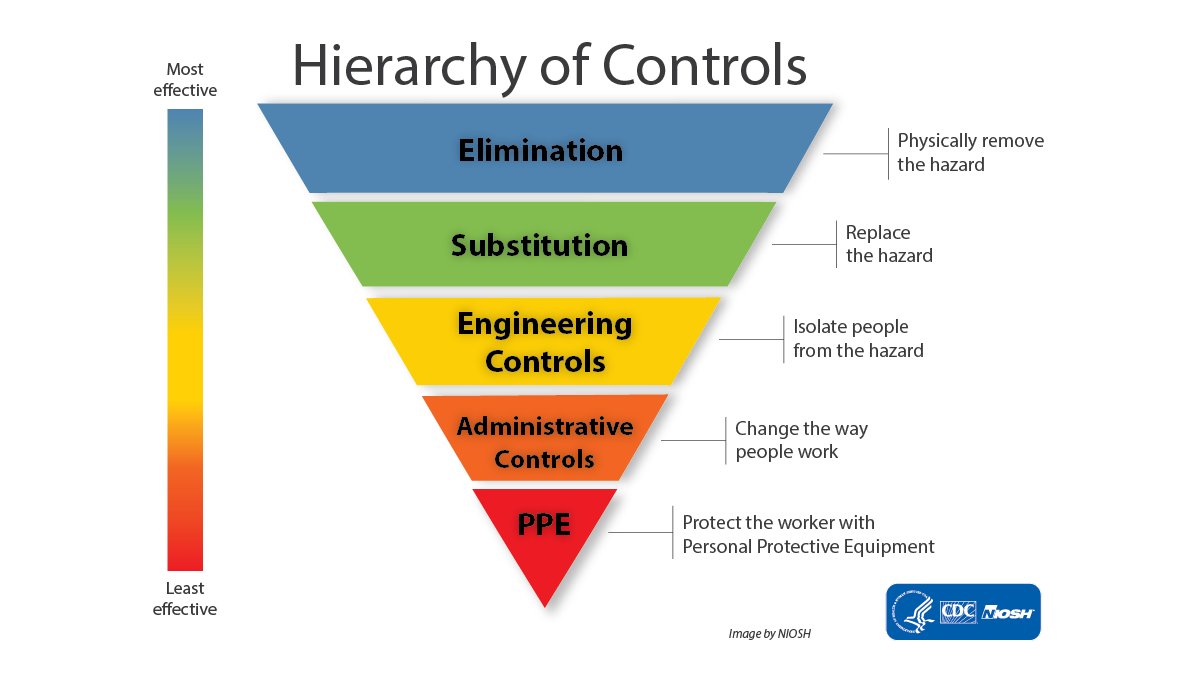
Broadly speaking, some controls are more effective than others. Wherever possible, you should attempt to use more effective controls in place of less effective ones. More effective means not just that it reduces the risk the most, but also the most reliable over time and most resistant to having rules bent, being left broken, being ignored due to alarm fatigue, or 'normalisation of deviation'. Procedures that assume everything is working perfectly and everyone is 100% competent will fail; see MCAS and a great number of other accidents.
Elimination is rarely possible but substitution (radar vs visual) and isolation (separate helicopters from other traffic) amongst other engineering controls are potentially more feasible, and much higher up the hierarchy than a glorified instruction not to crash (the very bottom of administrative). Engineering a problem out of existence is far superior to having a procedure to fix it in the QRH.
I list things like TCAS, GPWS, RSAs, and crash-proof seating as broadly being under PPE: they're nice to have and certainly worth pursuing, but unless there is no other alternative, they should never be your primary protection. Something has gone wrong if they get used.
Subjects
ATC
Close Calls
Normalization of Deviance
Radar
Separation (ALL)
TCAS (All)
Traffic in Sight
Links are to this post in the relevant subject page so that this post can be seen in context.
Reply to this quoting this original post. You need to be logged in. Not available on closed threads.
February 15, 2025, 09:00:00 GMT
permalink Post: 11828431
The most reliable information from the helicopter indicates they were at 278ft above the water. Likewise we're told that the CRJ was at 313ft 2 seconds before impact. The CRJ is 20ft tall, more with landing gear extended. The UH60 is 16ft tall. There is no more information to be gleaned from this.
The CRJ was a passenger jet on finals to land and there is no way on earth anything else should be on a collision track. The helicopter should never have been allowed to be that close to landing traffic, no matter what the legal and procedural niceties of ATC communication were.
And the fact that there were numerous reports of similar close calls of this kind over the previous decade or so is a damning (some might say criminal) indictment of the safety management systems of the authorities involved.
Subjects
ATC
CRJ
Close Calls
Links are to this post in the relevant subject page so that this post can be seen in context.
Reply to this quoting this original post. You need to be logged in. Not available on closed threads.
February 15, 2025, 12:41:00 GMT
permalink Post: 11828596
Why did the did miss part of the message
Why was the incomplete read back missed
Why does missing a few words lead to this disaster within seconds.
Does this lead an answer like: helicopter in a very busy airspace, busy controllers (insufficient time to be fully focused on full read backs) being by default too close to (and even needing to cross) the glideslope.
Helicopters in busy airspace are not a problem if a safe system exists for separating them from airline traffic.
There is no evidence yet of the controller having made a mistake. He was undoubtedly busy, but that was not his fault. What could be done about it? The answers to that question take us another step along the causal chain:
- The FAA could have provided more controllers. We know the helicopter controller position was unoccupied, and it's likely that closer monitoring and earlier intervention could have changed the outcome (notwithstanding point 3).
- Controller workload could have been reduced by implementing effective procedural separation . If the DCA ATC rulebook allowed this segment of Route 4 to be in simultaneous use with Runway 33 landings, then procedural separation did not exist , however much anyone thought it did. At least 1.5nm or 500ft between flight paths would be needed to meet the least restrictive FAA separation standards, and this would have forced constraints to be applied to Route 4 or Runway 33 utilisation.
- Regulations allowed the helo pilots to assume responsibility for separation. This is what happened, with the consequences which flow from the inherent difficulty of identifying and separating visually at night (especially while wearing NVG).
The authorities (by which I mean FAA and DoD) have questions to answer on all three points. Why was the helicopter controller position vacant? Did the ATC rulebook or staffing requirements rely on a false assumption that procedural separation existed? How did any such assumption remain in place after previous near misses? Is visual separation between helicopters and airline traffic a reasonable thing for regulations to permit, at night and using NVG? Ultimately it seems to have routinely been used as a release valve for the pressure building in the system due to the failure to address points 1 and 2.
Hopefully the investigation will be bold enough to ask these questions, which expand the potential scope of responsibility well beyond the individual controller and pilots.
Last edited by Easy Street; 15th February 2025 at 13:36 .
Subjects
ATC
Close Calls
DCA
FAA
Night Vision Goggles (NVG)
Route 4
Separation (ALL)
Visual Separation
Links are to this post in the relevant subject page so that this post can be seen in context.
Reply to this quoting this original post. You need to be logged in. Not available on closed threads.
February 16, 2025, 11:15:00 GMT
permalink Post: 11829163
Subjects
Close Calls
NTSB
PAT25
Route 4
Links are to this post in the relevant subject page so that this post can be seen in context.
Reply to this quoting this original post. You need to be logged in. Not available on closed threads.
February 19, 2025, 04:53:00 GMT
permalink Post: 11831215
Subjects
Close Calls
FAA
Links are to this post in the relevant subject page so that this post can be seen in context.
Reply to this quoting this original post. You need to be logged in. Not available on closed threads.