March 06, 2025, 13:29:00 GMT
permalink Post: 11841979
Because without that information, they could IMHO quite happily look at the A319 approaching runway 1, intend to pass behind it to head south down-river until the A319 was no longer over the river, and loiter around the runway 33 approach until that happens.
Shift the times by ten seconds and the same accident could have still occurred.
Visual simply doesn't work at the required level of safety if there are multiple aircraft to be visual with.
Reading this thread since the night of the accident, many have noted the "wrong-thinking" (for lack of a better term) underpinning the way traffic was managed by FAA and ATC.
I'm not enthused about the litigation that almost certainly will be intense once it commences. But reading the thread I've started to wonder.....
What would a chronological reconstruction of each incremental decision by FAA about the operation of DCA look like, a chronology that would (of course) include each Congressional enactment requiring or allowing further intensity of operations? The airport did not go from a nominal operational environment, with typically safe procedures and airspace usage rules very similar to or the same as any other major urban airport in the country, to the situation which obtained on January 29, overnight - or so it would seem.
(Yes, reconstructing the facts to build such a chronology would involve quite a lot of discovery activities in the presumably forthcoming lawsuits, but I'm not veering off into any further comment about why that would matter or which party or parties it would help or hurt..... other than to say, very often, cases are won and lost in discovery.)
Some years ago, on a trip to Capitol Hill hoping to find gainful employment on a Congressional staff somewhere, on the return flight from what then was Washington National, the aircraft's cockpit door was open as the boarding process was being completed (it was 1987). I recall being seated close enough to the flight deck - leaning a little into the aisle (a Midway Airlines DC-9 iirc) - to be able to see the pilot in the LHS and part of the D.C. skyline through the cockpit's front windows. Maybe that is why my mind somehow can't quite comprehend the recollections from kidhood of reading about the midair collision over New York City which is featured prominently in the book Collision Course , together with the events of the night of January 29.
Added: Wall Street Journal, March 6: "Air-Traffic Staff Rules Tightened After Crash." Also reports previous "close call" incident. Highly recommended reading (and I didn't see anything to contradict the above post, WR 6-3).
Last edited by WillowRun 6-3; 6th March 2025 at 13:46 .
Subjects
ATC
Circle to Land (Deviate to RWY 33)
Close Calls
DCA
FAA
Pass Behind
Pass Behind (All)
Separation (ALL)
Visual Separation
Wall Street Journal
Links are to this post in the relevant subject page so that this post can be seen in context.
Reply to this quoting this original post. You need to be logged in. Not available on closed threads.
March 14, 2025, 03:12:00 GMT
permalink Post: 11847144
One example, after the KBED G IV accident, the NTSB went to the NBAA asking for help in better use of FOQA data increase compliance with flight control checks. Remember, this the G IV crew who tried to take-off with locked controls. ASIAS has tens of thousands of flight control checks and compliance data. Focused on that, measure it, problem mostly solved.
GE Digital’s FOQA programs also have a tremendous data bank. For example, KTEB has an easily the highest rate of TCAS encounters for corporate operators. How it compares to KDCA, I again cannot say. The airlines have the KDCA data for their operations. They know how many and where TCAS events occur. More evidence of normalization, I suppose.
Subjects
Close Calls
FAA
KDCA
NTSB
Normalization of Deviance
TCAS (All)
Links are to this post in the relevant subject page so that this post can be seen in context.
Reply to this quoting this original post. You need to be logged in. Not available on closed threads.
March 20, 2025, 15:18:00 GMT
permalink Post: 11850721
Personally, the reference to ASIAS and it forming a key player here is, IMHO, a bit of a "red herring". It's not how Flight Safety should work in my experience of over some 40 years. Flight Safety ethos comes from the top and works down. Flight Safety activity starts at the bottom works up. In other words, it is the guys and gals on the Line, in the Tower, in the Hangar, in the Cockpit day-to-day who should actively spot and flag up issues relevant to where they are working - encouraged and supported all the way by the ethos from on high. After all, they (and only they) know exactly what is happening in their airspace, on their flight deck, in their hangar.
So the \x93DCA Flight Safety Organisation\x94 (we had Flight Safety Committees as Sqdn and Stn level to manage this \x96 similar in Industry \x96 so does DCA have a similar group? Please tell me it does!) should have been alerted to, possibly, initially unquantified issues with near misses along Route 4 by ATC staff. Local DCA Safety Management and ATC staff would then quantify the issue using the data available directly from such sources as the FAA AIDS and the NASA ASRS databases, all freely available via the ASIAS site. A good overview of ASIAS can be found here and an example of a search screen is the AIDS search form. This is all driven \x93bottom up\x94 . I personally used AIDS and ASRS during my MSc when writing a research paper many years ago \x96 sat at my PC in the UK so it\x92s really easy to use if I could master it! Juan probably got his stuff from there too.
Once the \x93DCA Flight Safety Organisation\x94 has looked at the data sources, either you have no issue or it needs wider investigation. In this case, clearly it was an issue, so (a) Route 4 should have had temporary mitigation put in place by DCA and (b) the "corporate" FAA (for want of a way to describe it) should have been requested to carry out a full "independent" Safety Review. Finally, (c), the ASIAS organisation could have been asked to flag this up to other Airfield Safety Organisations in their \x93Communication\x94 role in case they had similar issues to DCA. Again, local Safety Management at those fields would then investigate.
The FAA Safety Review should decide, with justification , what the next steps are - the justification being called the revised Safety Case (\x93revised\x94 as there should already be an initial \x93Safety Case\x94 supporting the operation of Route 4! Mmmm, an initial Safety Case? Was that a pig I\x92ve just seen fly past here???????!!!!!!!!). The outcome could be (as in this case) to close Route 4 down. If it were to be kept open, the revised Safety Case must support that by adding further mitigation and, vitally, the situation should be then be formally reviewed at defined intervals to ensure such mitigation is actually working before it becomes \x93normal business\x94. The FAA could also order a much wider formal review to see if other airfields are similarly affected and, if so, similar Safety Case reviews should be conducted at such locations if required.
So, from my point of view, I think that ASIAS (and as per the ASIAS overview link earlier) is not in itself responsible for initially identifying issues - it is simply (a) a conduit across users once issues have been identified by a user and (b) it manages some tools for users to use. I managed the RN\x92s Fleet Air Arm Engineering Database with a staff of 3. What we would do is, for example, at the request of Equipment Desk Officers , run additional reports requested by them if they thought, say, there was an increase in issues with a particular type of hydraulic pump or whatever it was. It was not my role in that Post to look for problems - my role was to ensure such data was accessible and ensure the database remained accurate and up to date. As I said earlier, the activity to raise problems and initially scope them is bottom-up as only the worker-bees (in my example, the Desk Officer) see the specific issues where they happen to work. The ethos to ensure that the organisation is in place at each airfield (and the wider FAA) to support the Safety activity should be top-down.
Clearly, it requires suitably qualified/experienced people on the coal face with a mind to safety to actively recognise and flag up such issues, encouraged from the very top by the ethos . That is an important point. If the ethos \x93encourages\x94 the watching of a \x93near miss\x94, sucking one\x92s teeth and saying \x93Sheesh! That was bleep-bleep close!!!!\x94 and moving swiftly on, that is NOT a safety management ethos !!! That is a recipe for disaster! If the ethos exists only in name and the worker-bees are not positively encouraged to raise issues which are then transparently acted on, but is an ethos which is totally subservient to commercial or political pressures then you'll get little or no Safety activity which will lead to\x85\x85\x85.... I\x92m sure you can all fill that ending in\x85\x85\x85!
Just my thoughts FWIW\x85\x85.. and sorry it\x92s so long!
 Cheers
H 'n' H
Cheers
H 'n' H

Last edited by Hot 'n' High; 20th March 2025 at 15:35 .
Subjects
ATC
Close Calls
DCA
FAA
NTSB Chair Jennifer Homendy
Route 4
Links are to this post in the relevant subject page so that this post can be seen in context.
Reply to this quoting this original post. You need to be logged in. Not available on closed threads.
March 21, 2025, 11:20:00 GMT
permalink Post: 11851281
I always read you input as, while the detailed legal nitty-gritty is generally way beyond me, you always provide a refreshing viewpoint which is good to read! The aim of my Post, based on my interpretation of the above quote, was just to emphasise the existence of ASIAS is just as a tool or, rather, a set of tools but which has no real "proactive function" in itself. Yes, it represents a very small part of the Flight Safety chain - but as a resource in the main. As you say, there were loads of examples of what happened at DCA and my post was an explanation as to who, I believe, should have been looking at it. Maybe they did - and just ignored it? No idea!
In the UK, the airport operator is totally responsible for the safety of operations on or above their field out to 4000 ft on approach and departure - about 12 miles. The CAA who regulates aviation here, along with the Dept of Transport, but in conjunction with other stakeholders such as NATS (our en-route ATC organsiation), airlines and airfield operators etc, designs the airspace and sets the generic rules for it's use. As you said, the main rule is "Don't crash anything into anything else!". However, at the airfield, it is the airport operator who needs to ensure that the generic rules work in their environment. If a particular rule is legal but, if applied in their location, is unsafe, they can't apply that rule! That's what the Safety Case should say.
A relevant example? I used to regularly (for work) transit London S > N and N > S along the red dotted line below - at 2400ft as it kept me just out of the London TMA but as high as possible so, if it had all gone quiet on the engine front, I'd have the best chance to get the plane onto the ground with me alive and no-one else hurt. As part of the transit, I had to cross the final approach into London City (green line). So, say heading N, I'd chat to Thames Radar while over South London and would ask for a London City crossing. They'd chat to City ATC to co-ordinate and take me to the Thames before handing me to City Tower. My route over the Approach has aircraft at 1200 ft descending on the ILS and so I would have crossed anything landing at 1200 ft above that. So, while on first glance, it was fine I never, ever got that clearance with an aircraft landing - and for very good reasons. If the aircraft on the ILS had had to do a go-around, life could have become interesting very quickly. I was always held until the landing aircraft was well clear (ie ATC could see it was almost at the airfield) before they cleared me across. Indeed, legally, they could have given me a "You see the landing? Pass behind that"! But, no - always positive clearances. Got my vote ....... + gave me chance to enjoy the views of Greenwich and the City of London and "delayed" me a couple of minutes. OK, a bit unfair as LCY is "sleepy hollow" compared to DCA but, despite that, they were very friendly ..... but very strict!!!!!
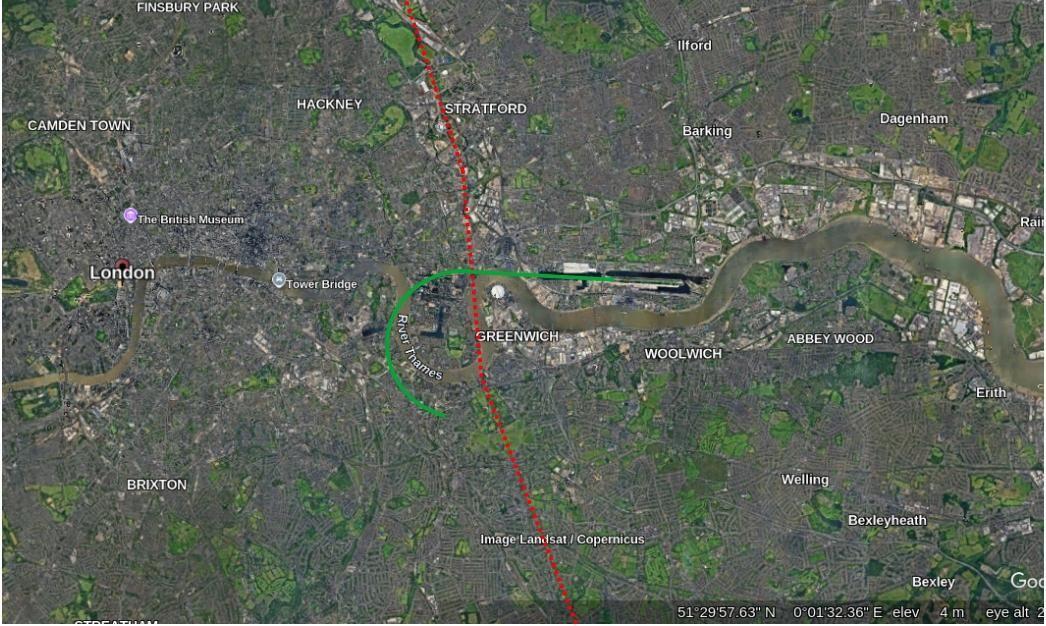
So, when you are discussing (I think!!!) whether ATC elected to give PAT25 a "You visual? Pass behind" or whether it was "ordered" from on-high as it was deemed safe to do, ultimately, it is the ATCOs call on the day. Now, before I get flamed, do I blame the ATCO ? No! Well, why not? After all, he gave PAT permission! And yes, it was a "legal" clearance. But was it a wise clearance? When unpacking that little lot you have to look at a raft of Human Factors which influenced that ATCO on that night. He was on his own so, probably, the only way he could cope with all he had on his plate was to try and shift some responsibility onto PAT25 - one less thing for him to juggle. But even then, he needed to be monitoring which he clearly was - but while very busy with other approaches and departures so he just picked up a concern too late as the audio shows - "Are you sure you see the jet?". Another factor - was the strategy to use Route 4 while 33 was active something ATCers at DCA, over time, started in an effort to cut down radio traffic and speed things up? If so, had it been assessed and then monitored for adverse safety? While anecdotally, it seemed people were aware of "close calls", had any analysis taken place looking at the Databases? In the UK certainly, all the Airport Operator responsibility.
To the final "accountability" part re payments to families, the thing we have here is (and, folks, correct me if I've got this wrong) the FAA set the rules and the operate the Rules. Here, the CAA sets the rules and the Airfield Operator operates the rules. That is important - for eg, huge argument here in the UK about just how independent the UK's Military Flight Safety organisation is ..... as it is part of the Military. IMHO, what we have here are valid generic rules, some of which were simply not suitable in this specific location - just like crossing London City with an aircraft on approach - legal ...... but very unwise. As to who carries the can, well, as you said WR 6-3 , the legal beagles will get to the bottom of that ..... but it will take some time. I'll leave that side to you!!! My main question out of all of this is, why were not these issues flagged up by airport management for further investigation given it was something of an open "secret"? And where else (around the world) is this happening?

And, on that cheerful note...........! H 'n' H
Subjects
ATC
ATCO
Accountability/Liability
Close Calls
DCA
FAA
PAT25
Pass Behind
Pass Behind (All)
Radar
Route 4
Links are to this post in the relevant subject page so that this post can be seen in context.
Reply to this quoting this original post. You need to be logged in. Not available on closed threads.
March 22, 2025, 01:07:00 GMT
permalink Post: 11851803
". . . was the strategy to use Route 4 while 33 was active something ATCers at DCA, over time, started in an effort to cut down radio traffic and speed things up? If so, had it been assessed and then monitored for adverse safety? While anecdotally, it seemed people were aware of "close calls", had any analysis taken place looking at the Databases?"
To start, no apology whatsoever needed with regard to this dialogue. I try to respect the decorum required on this forum generally (meaning as SLF/attorney something has to be pretty severe or awful to warrant apologizing to me). And although I might not explain my sense of this with enough clarity - the FAA is conducting a review (according to Secretary Duffy) of airspace management and usage rules at other airports. The explanations in your posts, including very particularly the procedures when crossing approach corridors for London City, should be read and studied by the presumably well-informed professional ATO (Air Traffic Organization) staff assigned to conduct the review. (If it seems way presumptuous for an SLF/attorney to assert what resources ATO should be considering for the review noted by Sec. Duffy, I would suggest that ATO's reputation at the moment for upholding the much-touted "gold standard" set by FAA and United States aviation in general for the rest of the world ... well, like we used to say in trial practice, it takes the other side only about three minutes in court to stain the draperies, but it will take us all afternoon even to try to clean them. Reputation lost, same deal getting it back.)
On ASIAS, actually I entirely agree with your description of where it fits into the so-called "aviation safety ecosystem" (there simply has got to be a better term). The point I'm stuck on is one that (apologies, once more) comes from litigating in U.S. courts (especially federal District Courts around the country) employment law cases. Specifically, at the start, the main task for defense counsel is to construct the "chronology". Who did and said what to whom, when, and for what reason(s). I've asserted in an earlier post that in what I see as the inevitable litigation arising from this accident, there will be teams of significant lawyers constructing, or attempting to construct, such a chronology, although it won't be about an individual employee's hiring, performance reviews, promotion grants or denials and so on. It will be how it happened that the situation which obtained in the DCA airspace, in the cockpits of the Blackhawk helicopter and the CRJ, and ATC, came to exist.
(And I say "significant lawyers" because the attorneys who handle the big and significant aviation crash lawsuits for the families of victims are kind of the polar opposite of the stereotype ambulance chaser; to the contrary, their work is opposed by big-time big-law firm skyhigh hourly rate legally privileged sharks. The lawyers suing on behalf of these crash victims - if they are the same as the legal specialists I have met and discussed stuff with in various settings - are vindicating the need to bring the truth to light. "Aviation is the safest form of transportation": it is incanted over and over to the point of making anyone who utters it now sound quite seriously performative. Yet if it is so safe, how and why did those 67 people die over and in the Potomac? So with a kind of intense ruthlessness, the lawyers who will represent the families and other loved ones of the crash victims will unearth every little sequential act and omission which led to the situation which obtained on the fateful night of Wednesday, 29 January 2025. Exactly as the quoted language above from your post asks, what indeed was the strategy, if there even was one, as opposed to little incremental changes, accelerated of course by increasing airline flight lengths under the perimeter rule.)
On this basis, I would not concur with the idea that whether immunity is available for the defendants (both the Army and FAA/DoT) depends on whether the ATCO's specific conduct on Jan. 29 was "ordered" from on-high. The "on-high" is the development, over time, of the situation that obtained that night at DCA, despite safety imperatives in the NAS and aviation sector in general - and not a specific order or instruction given on that night.
The question behind the discretionary function exception is whether the act or omission by the defendant either (1) was negligent because it failed to follow a specific rule or statutory provision (if so, no immunity), or (2) was negligent in the usual sense of the word but will nevertheless still be protected by immunity because the act or omission was based on a decision about a policy matter or question. The decision on the policy matter or question is "discretionary" on the part of the government and hence the name of the exception protecting it. The courts are reluctant, and sometimes loath, to second-guess policy decisions made by the Executive Branch (I know, irony neither intended or not intended, given certain prominent flight- and aircraft-related matters in federal court at the moment). Under the first variety of negligence, there was no policy matter being decided, just failure to do something there was a legal duty to do (basic definition of negligence). Under the second variety, there would be a valid case to be made that there was negligence - but the immunity provided by the exception for discretionary functions prevents the case going forward.
So back to January 29, the assertion I've been making here is that no, there was not a specific rule or procedure that said to do things much like you describe the procedure - de facto (unwritten, informal) though it was - for transiting across the approach path. But there certainly were higher-order rules by which FAA and its ATC functions were required to observe in consistent performance, and not merely in repeated incantation that "aviation is the safest form of transportation." In fact, I wonder if clever lawyers might take that slogan and deploy it as a bludgeon. "You're at greater risk driving your car to the airport", they always say. Oh, really? Then let's talk about the equivalent scenario on the streets of Chicago with intersecting traffic lanes (obviously not at different altitudes), similarly difficult visibility conditions at night, compounded by NVGs. possibly compounded by a training or check ride in the vehicle, and then make the case that the Chicago PD cop directing traffic, and the motorist without the right-of-way, were acting on the basis of interpreting policies about driving on public roadways. No, there is no policy matter involved - there are strict rules of the road and over-riding principles for safe driving, and the failure to observe these is negligence.
It's simplistic but it might be sufficiently illustrative. Is "see and avoid" a procedure which involves making decisions on matters of policy? or is it a higher-order safety rule which must be observed at all times?
(Not meaning to slight the point about ANSP and regulatory functions needing to be separate - entirely agree, and yet, this will be an extraordinarily heavy lift to get done in the United States. That being said, I might know some lawyer-types who are fired up about efforts to make it happen this time around.)
WillowRun 6-3
Subjects
ATC
Blackhawk (H-60)
CRJ
Close Calls
DCA
FAA
Night Vision Goggles (NVG)
Route 4
See and Avoid
Links are to this post in the relevant subject page so that this post can be seen in context.
Reply to this quoting this original post. You need to be logged in. Not available on closed threads.
March 22, 2025, 05:51:00 GMT
permalink Post: 11851870
The local controller had an Assistant ATC and a Supervisor to coordinate, monitor and regulate the traffic.
Class B airspace "ATC Clearances and Separation. An ATC clearance is required to enter and operate within Class B airspace. VFR pilots are provided sequencing and separation from other aircraft while operating within Class B airspace." source FAA Class B
One way to determine how the application of sequencing and separation to VFR pilots in this airspace was being applied would be to listen to the audio and watch radar replays over the weeks and months prior.
Subjects
ATC
Close Calls
DCA
FAA
PAT25
Radar
Route 4
Separation (ALL)
VFR
Links are to this post in the relevant subject page so that this post can be seen in context.
Reply to this quoting this original post. You need to be logged in. Not available on closed threads.
March 22, 2025, 22:11:00 GMT
permalink Post: 11852334
Probably five dozen lawyers have added, or will add, to their work-in-progress plans for their fact investigation and discovery activities locating, interviewing, and taking the depositions of retired ATCOs - with pertinent knowledge and appropriate credibility and experience, of course.
1. The actively used heli routes near landing traffic with merely hundreds of feet or less of "separation ".
2. The CA system being unreliable , it goes off all the time.. very high % of CA alarms in towers are useless. They do not have the effect outsiders or higher management think they do. We get so used to them going off that they don't carry the weight some wish they did. I have seen close calls where the CA goes off after the planes are a mile already past each other.
3. Visual separation with helicopters that normally use airspace, how often do they actually have traffic in sight and can maintain it? Are they just saying they do to get their job done? Should visual separation be allowed under NVGs ?
4. Many TCAS-RA problems under similar conditions, but nothing solid done about it? Where was management before? LSC? I honestly wonder if some controllers hated that operation but felt pressured into doing it to keep rate high and let the helis do their mission at the same time ?
Subjects
ATC
Close Calls
Night Vision Goggles (NVG)
Separation (ALL)
Traffic in Sight
Visual Separation
Links are to this post in the relevant subject page so that this post can be seen in context.
Reply to this quoting this original post. You need to be logged in. Not available on closed threads.
March 24, 2025, 08:53:00 GMT
permalink Post: 11853136
Subjects
Close Calls
Links are to this post in the relevant subject page so that this post can be seen in context.
Reply to this quoting this original post. You need to be logged in. Not available on closed threads.
March 25, 2025, 11:53:00 GMT
permalink Post: 11853844
Agreed 100%! After all, many air accidents are because pilots are in the wrong place - a good example is the current sister Thread to this one covering a plane which started to take-off from a taxiway - sadly a regular occurrence. Lots of people are asking "How on earth......." - but they did, just as others have done before them! I'll not comment further as the discussion is on that Thread anyway which you can read and the Investigation is early days so far.
However, one of the reasons aviation is so safe today is because the aviation community realised a big driver to improving safety, based on the premise that humans are both ingenious in devising new ways to screw things up - as well as being quite capable of repeating the old ways too - was to understand if additional issues were contributing to those accidents. In particular, anonymous self-reporting of "near misses" provides much valuable information enhancing the understanding of issues before anyone dies. There were many "near miss" reports relating to this route/runway as has been mentioned. But no-one joined the dots........
By understanding how those additional factors contributed to the near miss/accident means further mitigation could be put in place. Maybe one of the most significant - Flight Time limitations - have come about as, after a number of accidents, people realised just how a lack of proper rest significantly degrades human performance and so contributed to poor decision-making, particularly when under pressure. I just use that as an example of "contributory factors" - possibly not relevant here - the full Report is not out yet.
In this case, the helo crew ended up flying into a jet. But why did they do that? Well, when the NTSB recommended that Route 4 be closed, it described it as being "an intolerable risk to aviation safety by increasing the chance of a midair collision.". If the helo crew mistook another aircraft to one they should have been avoiding (a likely mistake) there was little effective mitigation to prevent that mistake leading to catastrophe - hence the recommendation from the NTSB. What there was in terms of mitigation - such as the ATCO - failed. The ATCO suddenly realised all was not quite right but he didn't have the time to come up with a solution to save the day and a collision happened on "his watch". I can't even imagine what he is going through right now every single day.....
Yes, by all means decide liability for recompense to those who lost loved ones on that fateful day - (top tip, go where the money is!). The legal people like our esteemed fellow PPRuNer, WillowRun 6-3 , will do that. What the aviation community itself wants to ensure is that such a mistake (which will happen again - as I said, whilst humans are extremely inventive in finding out new ways to screw up they are also prone to be quite capable of repeating mistakes ad infinitum) - never leads to such deaths in the future. That's why people look, in great depth, behind the obvious cause for the crash to see what more can be done. That's why it's so safe for you to step aboard an aircraft today.
To reiterate, in the words of the NTSB, the aviation world was running a route which provided "an intolerable risk to aviation safety by increasing the chance of a midair collision.". So, one question, who approved that ..... and where is the Safety Case to support that decision? Cue tumbleweed rolling slowly down the road......................
I hope this helps explain why it's wayyyyyy more than "The crew screwed up. End of story!". Cheers, H 'n' H
Subjects
ATCO
Accountability/Liability
Close Calls
NTSB
Route 4
Links are to this post in the relevant subject page so that this post can be seen in context.
Reply to this quoting this original post. You need to be logged in. Not available on closed threads.
March 30, 2025, 19:13:00 GMT
permalink Post: 11857494
According to post 1346 the accident helicopter was higher and to the west of the position of the typical helicopter flying that route. Was this a slight error that in this case was fatal?
Subjects
Close Calls
Links are to this post in the relevant subject page so that this post can be seen in context.
Reply to this quoting this original post. You need to be logged in. Not available on closed threads.
March 30, 2025, 21:14:00 GMT
permalink Post: 11857550
The altitude is still uncertain because of difference between jet and heli values and destruction of the heli altimeter. So work on that is continuing with a focus on other sources.
But note the 75 ft separation is a maximum. So if the heli was at 200ft then it was on the glide slope.
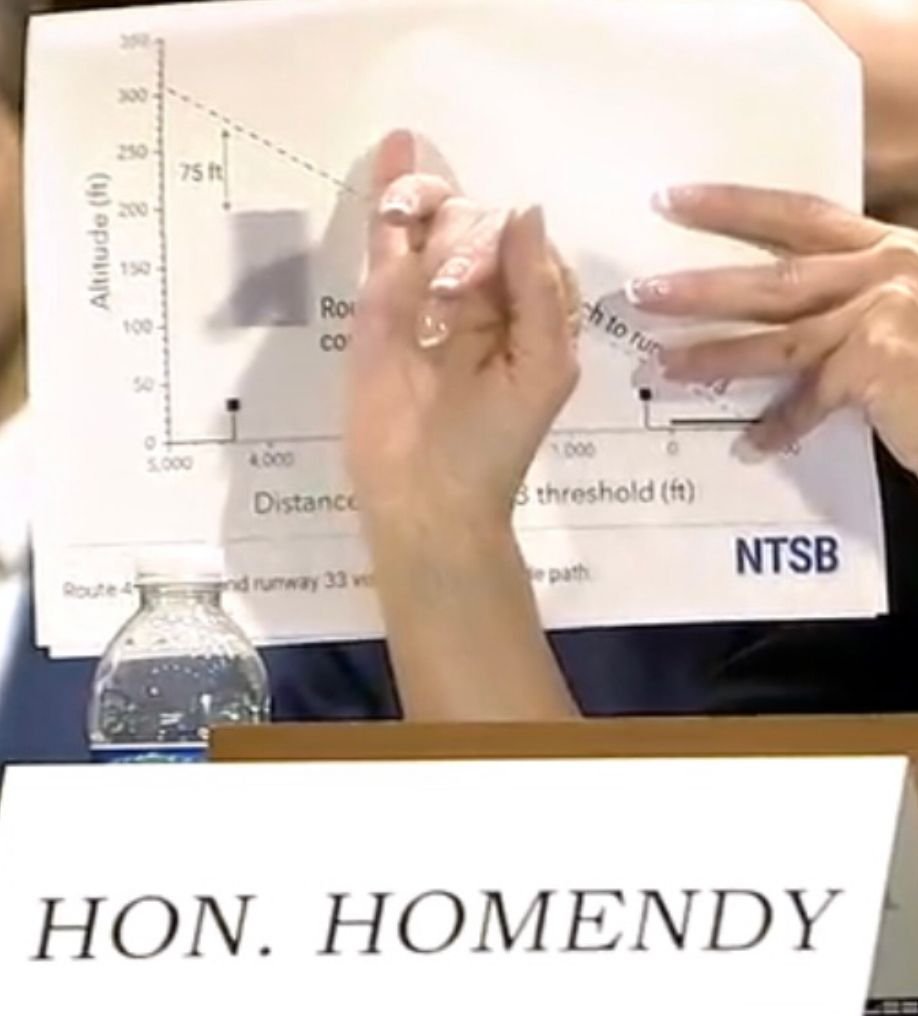
Another interesting point is that mixed heli and fixed wing is forbidden in the yellow zone (permanently), and ADSB mandatory in the red zone. With routes 4 and 6 cut.
See post below
Last edited by A0283; 30th March 2025 at 21:25 .
Subjects
ADSB (All)
Altimeter (All)
Close Calls
NTSB
Separation (ALL)
Links are to this post in the relevant subject page so that this post can be seen in context.
Reply to this quoting this original post. You need to be logged in. Not available on closed threads.
March 30, 2025, 23:23:00 GMT
permalink Post: 11857597
According to post 1346 the accident helicopter was higher and to the west of the position of the typical helicopter flying that route. Was this a slight error that in this case was fatal?
But I crash this party every time I post, and so I'll let the professionals in the aviation community direct the painful vector of responsibility to aviators, where they must. As SLF/attorney I have determined it appropriate to respect the fact that the average professional pilot has already forgotten more about understanding accident causes and reasons than I will ever know. As I said, in a professional capacity, I would be working with such pro's and would "try to keep up."
Subjects
Close Calls
Links are to this post in the relevant subject page so that this post can be seen in context.
Reply to this quoting this original post. You need to be logged in. Not available on closed threads.
April 01, 2025, 00:54:00 GMT
permalink Post: 11858292
Howdy. Are you aware of any interviews the AC pilot did?
The video is damning. Besides thinking Charlie was the runway, he missed a direct hit on the tail of a holding aircraft by less than 100 feet.
Enjoy your thoughts, and objectivity....bb
Not sure of what video you've referred to about the Air Canada incident. But yes, without a doubt, it was a very close call. Only a slight difference in the height above the taxiway for the Air Canada flight, or slight delay in initiating the go-around . . . and many factors which play into those parameters (reaction time, etc.).
I don't recall any interviews of the aviators being published (but I haven't run off to go looking through sources available online). Somewhat more in the direction of drift, the thread on the incident was useful background for trying to follow and understand the Lufthansa diversion occurrence.
Edit and slight correction: NTSB Incident Report, NTSB/AIR 18/01, PB2018-101561 (Sept. 25, 2018) does include information from the incident investigation interviews of the pilots (including several quotations) but to my knowledge the transcripts of interviews were not disclosed to the public.
Last edited by WillowRun 6-3; 1st April 2025 at 01:12 .
Subjects
Close Calls
FAA
NTSB
Links are to this post in the relevant subject page so that this post can be seen in context.
Reply to this quoting this original post. You need to be logged in. Not available on closed threads.
July 31, 2025, 20:06:00 GMT
permalink Post: 11931519
That is \x93nuts\x94.
Even if they had maintained 100 feet over the river that would still be classified as a very near miss.
A terrible case of Swiss Cheese holes lining up for a multitude of reasons.
An error of 100\x92 ft from field elevation during preflight would be out of limits and snagged in my civilian experience. Shouldn\x92t military aircraft that operate at very low altitudes at night have even tighter restrictions?
Subjects
Close Calls
Links are to this post in the relevant subject page so that this post can be seen in context.
Reply to this quoting this original post. You need to be logged in. Not available on closed threads.
August 13, 2025, 22:32:00 GMT
permalink Post: 11938086
If Yes, no normalisation of deviance. The procedures themselves were/are flawed, not the execution of them.
If No, then there's normalisation of deviance. The users are not following the procedures and if those procedures have been in place for some time, the users have been "getting away with it" ie NoD until now.
Each time someone gets away with a close call, the "normalization" sweeps the issue under the rug, instead of the procedure being questioned. The longer the procedure is in use, the more confidence there may be that it is acceptable, when in fact it may just be a matter of time until some unlikely and disastrous event occurs "by chance".
Having worked in a non-aviation area that became heavily proceduralized after all too many mistakes had been made, I have seen more than a few flawed procedures that continued to be employed despite warning signs, typically because of time, management, cost, etc. pressures. Modifying and reviewing a procedure can be a time consuming process as many individuals and management structures can be involved in a complicated system.
In the present case (without knowing exactly what procedures were in effect), I could argue that permitting visual separation at night in this particular environment was a key procedural flaw. But it was accepted as there had been no accidents as a result, even as perhaps traffic density, etc. increased risk over time.
Last edited by andihce; 13th August 2025 at 23:53 . Reason: addition
Subjects
Close Calls
Normalization of Deviance
Separation (ALL)
Visual Separation
Links are to this post in the relevant subject page so that this post can be seen in context.
Reply to this quoting this original post. You need to be logged in. Not available on closed threads.
September 27, 2025, 16:33:00 GMT
permalink Post: 11960646
The plaintiff lawyers would have a better argument against the airline if they had deviated from the approach.
Subjects
ATC
Accident Waiting to Happen
Close Calls
PSA Procedures
Links are to this post in the relevant subject page so that this post can be seen in context.
Reply to this quoting this original post. You need to be logged in. Not available on closed threads.
September 27, 2025, 17:25:00 GMT
permalink Post: 11960678
The plaintiff lawyers would have a better argument against the airline if they had deviated from the approach.
Subjects
Accident Waiting to Happen
Close Calls
Links are to this post in the relevant subject page so that this post can be seen in context.
Reply to this quoting this original post. You need to be logged in. Not available on closed threads.
September 28, 2025, 03:33:00 GMT
permalink Post: 11960849
It's more difficult to argue that the airlines should have been doing FAA's job for them.
Subjects
Accident Waiting to Happen
Close Calls
FAA
Links are to this post in the relevant subject page so that this post can be seen in context.
Reply to this quoting this original post. You need to be logged in. Not available on closed threads.
September 28, 2025, 06:33:00 GMT
permalink Post: 11960869
It's more difficult to argue that the airlines should have been doing FAA's job for them.
Subjects
Accident Waiting to Happen
Close Calls
FAA
Links are to this post in the relevant subject page so that this post can be seen in context.
Reply to this quoting this original post. You need to be logged in. Not available on closed threads.
September 28, 2025, 10:39:00 GMT
permalink Post: 11960950
It's more difficult to argue that the airlines should have been doing FAA's job for them.
Sure, the FAA have that same responsibility in ensuring their airspace is safe and operates safely. However, that does not absolve the airline of their own Safety responsibilities. Just to say "Well, the FAA say it's OK so it's fine!" is not enough. Aviation is littered by 1000's of cases where the National rules say one thing but an airline will be even more restrictive. For eg, the ILS minima for an approach to R/W 24 at ABC may be, let's say, 100ft, but Airline XYZ itself says only Captains may fly down to that on this particular approach - their 1st Officers can't even fly the approach at all (for whatever reason)! Obviously, you can't go less restrictive than the Regs but you can go more restrictive.
The data in the various databases is freely available (I've used them myself for research back in the day) so the airline should be doing it's own "due diligence" around their operation rather than blindly accepting what the FAA say. However, and there always is one of these, the "downside" is that it may well be more expensive to operate within the more restrictive case which will upset the Finance Department who will cite the regs.....
And so it goes on......... The only certainty is that the lawyers will do well out of this (appols to Willow-Run !).......
Subjects
Accident Waiting to Happen
Close Calls
FAA
Links are to this post in the relevant subject page so that this post can be seen in context.
Reply to this quoting this original post. You need to be logged in. Not available on closed threads.