May 03, 2025, 12:55:00 GMT
permalink Post: 11877718
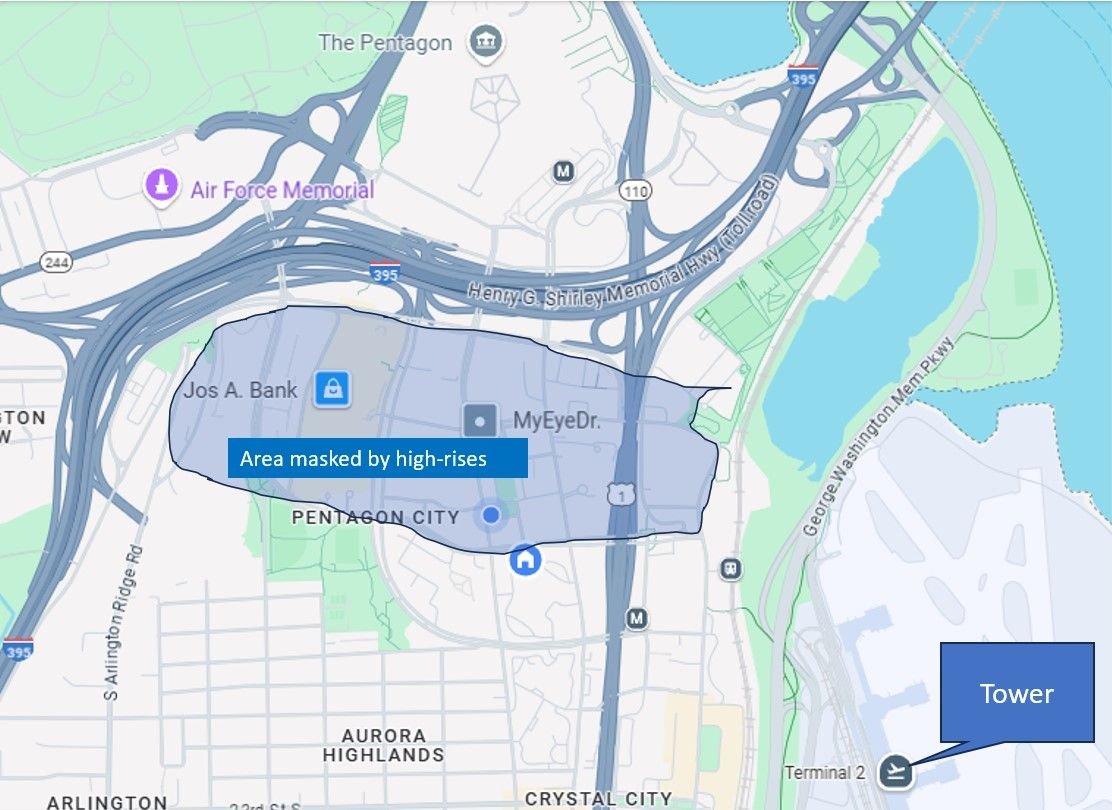
Unclear why PAT23 (and apparently other helicopters) fly counter-clockwise; i.e., continue to follow 395 S of Pentagon (past south parking), then turn N to follow 110 (past the Metro entrance) to the JPN landing pad. Why not use the charted transition route along 27/Washington Blvd?
Not a clue, but someone should ask - and, after Thursday, someone should be relieved of command. Because the helo didn't do one pass east of the Pentagon but two, making a circuit after causing the first go-around, and triggering a second. All the while in the ground clutter - hence the jump in data - and apparently, per BFSGrad, unresponsive to control.
The video is in a Twitter post by @STATter911. Cannot link here.
Subjects
DCA
PAT23
Links are to this post in the relevant subject page so that this post can be seen in context.
Reply to this quoting this original post. You need to be logged in. Not available on closed threads.
May 03, 2025, 13:20:00 GMT
permalink Post: 11877725
"NTSB investigating Thursday's incidents at Reagan Washington National Airport (DCA) in which a Delta Air Lines Airbus A319 and a Republic Airways Embraer E170 were instructed by air traffic control to perform go-arounds due to a U.S. Army Black Hawk helicopter inbound to the Pentagon."
[Credit: post on X by NTSB Newsroom, seen as reply to post by @STATter911 (cited by LowObs); verified from NTSB webpage]
Subjects
Blackhawk (H-60)
DCA
NTSB
Links are to this post in the relevant subject page so that this post can be seen in context.
Reply to this quoting this original post. You need to be logged in. Not available on closed threads.
May 24, 2025, 15:13:00 GMT
permalink Post: 11889642
It would also be good to know who was on board that helicopter and why it was Pete Hairgelseth.
Subjects
DCA
Route 5
Links are to this post in the relevant subject page so that this post can be seen in context.
Reply to this quoting this original post. You need to be logged in. Not available on closed threads.
July 22, 2025, 18:51:00 GMT
permalink Post: 11926908
U.S. Army Brigadier General Matthew Braman has rotated out of his role as Director of Army Aviation, leaving the branch\x92s central aviation office without clear leadership in the wake of January\x92s fatal midair collision between an Army Black Hawk helicopter and a PSA Airlines CRJ700 near Washington, D.C.\x92s Reagan National Airport (DCA).
An Army official told The Air Current that the move was made as a part of the Department of Defense\x92s broader effort to streamline its general officer workforce. Going forward, the role will be filled by a lower ranking Army Colonel (O-6), the official said, though the Army declined to comment on who is currently serving in Braman\x92s former role or who is expected to fill it.
Army personnel \x97 and others involved in the DCA investigation \x97 are due to appear starting on July 30 at the U.S. National Transportation Safety Board\x92s three-day hearing on the crash to submit sworn testimony and answer investigators\x92 questions. Braman is expected to testify during the hearing, TAC has learned.
Subjects
Blackhawk (H-60)
DCA
Links are to this post in the relevant subject page so that this post can be seen in context.
Reply to this quoting this original post. You need to be logged in. Not available on closed threads.
July 31, 2025, 04:34:00 GMT
permalink Post: 11931045
Aviation community and espeically professionals (and others in cheap seats like mine) owe TAC a big Kudos! for the live updates.
I'm not going to restate in depth one of the fundamental legal issues looming in the litigation in which this accident will be dissected; just a cursory summary, for context.
The main defendants, from a liability standpoint, are the two federal government entities and not the airline - quite obviously because as someone upthread observed, the Bluestreak 5342 pilots "owned" the last segment of airspace to be traversed to the runway. Pulling the airline in for deep pockets and insurers is not the issue for liability analysis.
But the federal government in all its actors and agents is protected by sovereign immunity. But -- it also has waived, in other words legally discontinued, its sovereign immunity (by the Federal Tort Claims Act) for many types of alleged wrongful acts. BUT -- there is an exception to its opening itself up to lawsuits - if the action or omission being challenged is a matter of "discretionary functions", in other words the making of policy, immunity is still in place. Only if the act or omission is a "ministerial function" is Uncle open to suit (Uncle Sam, that is). Generally, alleged failure to follow established rules and policies.
Well, if I were in this case, I first would have hit the 7-11 for a six-pack of Giant Size energy drinks, because I would be awake for a week gathering cases and writing preliminary briefs about the glaring nature of the FAA's action - actually an omission - in not adding something on the order of "hot spot" or its equivalent to the pertinent charts. I mean, "policy factors" in that slippery bit of bureaucratic box-checking? (I wasn't tuned in for the exchange in which the FAA witness indicated - according to the TAC live update, that LAX had requested a similar notation relative to helicopter traffic, which FAA did add, but FAA did not suggest anything for DCA because DCA had only requested "hot spot" which, of course, is for surface congestion points not airspace. But FAA let the situation continue unabated, unaddressed? No wonder the cool-as-ice Chair is said to have lost it, her cool that is, over this FAA testimony.)
Forecasting how legal issues will run and play out can be foolish indeed. Perhaps watching the NTSB "animation" - including actual video footage of the two aircraft colliding in mid-air - has wrenched my senses so as to yield a sense of blood in the water. Lawyer, sharks, their similiarities, all that trip.
WillowRun 6-3
And Salute! to the Officer of the United States Army who expressed condolences to the families in attendance, before he started to answer a question that had been addressed to him. A class act, sir.
Last edited by WillowRun 6-3; 31st July 2025 at 04:41 . Reason: Counsel prefer neatness, because it counts.
Subjects
Accountability/Liability
DCA
FAA
NTSB
Links are to this post in the relevant subject page so that this post can be seen in context.
Reply to this quoting this original post. You need to be logged in. Not available on closed threads.
July 31, 2025, 17:48:00 GMT
permalink Post: 11931466
https://www.aviationnewstalknetwork....ntsb-news-talk
just a few :
-UH60-L Heli altimeters accuracy .80 -130 ft systemic error due position of the static sensors affected by rotor blades in cruise
-80 ft error deemed within acceptable tolerance by Army pilots
-flying at 300ft targeting 200ft is "acceptable" by the Army
-200ft restriction on the chart is a only a "recommended target" in VFR not a hard restriction i unless instructed by ATC ..
-Lack of regulatory oversight by FAA despite many previous incidents .
-FAA (bureaucratic) refusal to put a 'Hot spot" symbol on routes crossings.
-Lack of ADS-B compliance on Army helis, due maintenance documentation errors during installation
-lack of experience of heli pilots on specific areas due frequent rotation of staff and lack of training hours in general.
-Lack of continuity in of DCA ATC operations supervision , 10 managers in 12 years and 5 in last 5 years.
In fact on some of the Reason's layers there were more holes than cheese.
Subjects
ADSB (All)
ATC
DCA
FAA
NTSB
VFR
Links are to this post in the relevant subject page so that this post can be seen in context.
Reply to this quoting this original post. You need to be logged in. Not available on closed threads.
July 31, 2025, 19:52:00 GMT
permalink Post: 11931513
Law enforcement and med-evac helicopter flights also are involved in the DCA airspace problem. Further, besides the Army unit, reference was made - if I understood correctly - to a unit of USAF. Perhaps this was a reference to the helicopter unit assigned specifically to the White House and was left unclear on purpose.
Subjects
ADSB (All)
DCA
Links are to this post in the relevant subject page so that this post can be seen in context.
Reply to this quoting this original post. You need to be logged in. Not available on closed threads.
August 01, 2025, 23:15:00 GMT
permalink Post: 11932095
Normalisation of deviance doesn\x92t even come close.
- Airspace design. The heli route stepping down to 200ft max lead some army pilots to believe it gave clearance from DCA traffic. Spoiler. It did not.
- Controller workload \x93Just make it work\x94 was a common attitude at DCA
- FAA not actively tracking TCAS RA \x93incidents\x94 as it could skew data.. maybe it was correctly applied visual separation etc. Need to look at the background etc. Yeah. But it generated an RA 🤬
- FAA refusing requests for traffic \x93hot spots\x94 on low level VFR charts as \x93hot spots\x94 are on ground charts only.
- PAT25 wanted visual separation from the CRJ. ATC was required to inform the CRJ crew another aircraft was applying visual separation to them. They didn\x92t.
Honestly from a European perspective. It\x92s quite bone chilling.
I feel this was a systemic failure. Airspace design and Risk Normalisation.
And my heartfelt condolences for the pilots, of both aircraft, and everyone else involved including the ATCOs. Not that there weren\x92t issues\x85 but in the Swiss cheese model, the FAA bought the cheese, drilled holes in it, and invited everyone to take a look inside.
Slightly surprised by some NTSB comments as well\x85 they were presented that the heli was straight ahead on the CRJ TCAS simulation presentation. But in actual fact the CRJ was circling in a left turn for runway 33. It was stable at 500ft but in a left turn to line up with the runway\x85 wings level at 300ft. It was challenged by the airline/ALPA but I would hope the NTSB would have picked up on that.
Low point of the whole hearing was Jennifer Homendy halting proceedings and moving witnesses to different seats, as one of the FAA managers elbowed a colleague while she was giving testimony - at which point she went quiet. Infernce being she was being reminded to stop talking.
Subjects
ATC
CRJ
DCA
FAA
NTSB
NTSB Chair Jennifer Homendy
Normalization of Deviance
PAT25
Separation (ALL)
TCAS (All)
TCAS RA
VFR
Visual Separation
Links are to this post in the relevant subject page so that this post can be seen in context.
Reply to this quoting this original post. You need to be logged in. Not available on closed threads.
August 02, 2025, 01:38:00 GMT
permalink Post: 11932142
Also a high point - let me explain. ..... First, it was one of a goodly number of instances when Chairwoman Homendy proved all over again why she is an outstanding servant of the public interest.
But most observers of how the Board has operated over the past several years already would have agreed with that (imo).
Personally I didn't observe the elbowing on livestream but when the Chair noted it and that witnesses would be moved, it made sense. Together with the now widely derided rationale (on Wednesday) for not adding a notation on the helicopter route charts - in some terminology or nomenclature if "hot spots" was unavailable - the FAA witnesses in question, as I assessed their statements until that point, had been working mightily to give this accident an air of "excused inevitably." I need to point out this slam on their apparently questionable sincerity-plus-candor explicitly does not include the ATCT supervisor who testified at length and, in my view, honorably.
I don't want to comment yet on whether the accident victims' families will have a valid legal argument about the issue of "in trail" spacing, with regard to which one of the FAA witnesses in question described the matter in quite divergent terms from the way in which the Potomac Tracon official described it. But even reserving further comment, still it appears that if the answer for why the "in trail" memo was not acted upon favorably is that Runway 3-3 was going to be used more frequently, doesn't that answer: (a) mean that the pace of approaching and landing aircraft, in and of itself and also when combined with departures, would remain intense for DCA, and (b) the continued high tempo would also continue to complicate the proper - which is to say safe - control of helicopter flights most especially in the glaring light of the fact that Route 4 intersects the approach path to 3-3? As raw material for the legal argumentation that the FAA's actions and omissions were ministerial, and not matters of policy, this could be another call of, blood in the water.
(Of course all concerned know that the "unwritten policy" choice was to move traffic and hope for safe outcomes only. Maybe that often-criticized approach taken in the United States would prove out in an actual courtroom battle as a regrettable but nevertheless sufficient "policy decision" so as to allow sovereign immunity. But does the United States FAA really want to litigate this issue? Against some of the strongest and most experienced advocates ever to enunciate "Approach" in a courtroom? My understanding is the families, or some of them at least, are rep'd by attorneys and counselors who .... aren't finding time to sit in Starbux and post here.)
There were two other, at least, pieces of FAA testimony that, in my deposition-taking days, would have gone on for some hours more. No one could say what the Assistant LC was doing at the critical times. How could this not have been nailed down in the interviews? Also, what in the world is "debriefing" after training? How and why was that more important than keeping the helicopter position staffed?
I wish not to cast aspersions on any DCA ATCOs whatsoever. The testimony about why FAA did not get both alcohol and drug testing done in accordance with established rules was just another piece of shattered credibility - but as Board Member Inman stated, there is no basis to believe or think those kinds of problems were factors, and so that's not the point here. I mean, it wasn't clear fatalities had occurred very, very soon after the event? Good grief.
Perhaps the contretemps afoot in the investigations - and surrounding public relations affairs - in Korea and India have led me to some misunderstandings, but has it become time to think about whether the U.S. should have an AAIB? and not combine aviation into the general category of Transportation? For now, Member Inman said it well and succinctly: "Do better."
Subjects
DCA
FAA
Grief
Hot Spots
NTSB Chair Jennifer Homendy
Route 4
Links are to this post in the relevant subject page so that this post can be seen in context.
Reply to this quoting this original post. You need to be logged in. Not available on closed threads.
August 02, 2025, 02:59:00 GMT
permalink Post: 11932153
They managed to sink lower when questioned about SMS and just culture. They said they\x92d heard of it. But struggled to describe it\x85 especially when the NTSB questioned why so many people were reassigned to new jobs straight after the accident. Many questioned said, \x93I\x92ve only been in this job a month, so I can\x92t comment\x94.
Again the formidable Jennifer called it out. The NTSB has seen this before\x85Radom job replacement, deniability etc
As Panel 5 was getting set, there were follow-up questions about the post-accident testing. At least two witnesses weren't familiar with previous revisions of the relevant FAA written rules (iirc they're referred to as "orders" but I wouldn't swear to that). FAA testified that the agency is revising that order, in light of things not having been done properly at DCA on the night ofJanuary 29 into January 30. Member Inman hit a towering home run, I thought. He noted that he was with DoT when FAA set to work on revising a previous iteration of the pertinent order ..... many years ago. Deja vu, all over again.
Subjects
DCA
FAA
NTSB
Links are to this post in the relevant subject page so that this post can be seen in context.
Reply to this quoting this original post. You need to be logged in. Not available on closed threads.
August 05, 2025, 00:21:00 GMT
permalink Post: 11933392
And that is they key , that must come first in my view, first the new structure then the road map to your "new" airspace infrastructure and governance , with new guys and fresh ideas, and yes, some can be copied on what Europe is trying to do .
Good news that the chair will not be empty but I am not sure an airline guy is the best choice for the job , I do not know the guy but as an airline Capt he might be OPS orientated so he will, just like Sully did , become extremely frustrated on discovering how ICAO works. It is by consensus , the best ideas can be rejected by a few States and then discussions and negotiations must start again , even obvious solutions will; take years to be implemented , not weeks. In ICAO the USA has the same voice as a small State with no airline.
A diplomat with civilian airline background fits better the post. A Military's background is of absolute zero use in ICAO.
But, that having been said, the Board's investigation appears primed to result in recommendations, supported by factual findings and analysis, for arguably significant changes in certain basic aspects of the ATM architecture. I'm relying here on the fact that the Board issued, very soon after January 29, an emergency directive to FAA with regard to the design of the DCA airspace and specifically the use of the helicopter routes. While I would not wish to assert familiarity with the actual world of ATC, the tenor and content of the Board's actions to date as well as of the three days of hearings strongly suggest that the Board will make recommendations for significant change in at least certain areas. Among these are the structure of airspace in which helicopters (civil, law enforcement, and military) interact with commerical traffic - it should be noted that a review of these airspace structures was ordered after the accident. Also, the way in which military aviation is conducted in Class B airspace especially adjacent to airports (of a certain size, presumably) appears likely to be covered by recommendations. None of this is to say that the new ATC system cannot be undertaken unless and until the Board report is issued (again, "necessary" was imprecise) but to the degree that recommendations for particular substantial reconfigurations of the NAS design are coming, the architects of the new ATC system certainly will not want to have to backtrack and redo their work.
On the drive to bring "FAA 2.0" into being, I would not associate myself with any claim that the United States ATM should "copy" European activities. I think the Memorandum of Cooperation between the SESAR authorities on one hand, and the FAA on the other, is the correct framework. And under that framework, "harmonization" appears to be the principal objective. It happens to be the case that although three formal joint reports on the status of harmonization have been completed and published over the past couple of decades, the most recent one was published several years ago. It is not as if nothing much has changed or advanced in the intervening years, but no further report is anywhere to be found.
When one takes into account the many and varied data-gathering and reporting functions of EUROCONTROL, the activities of the FABs, the ATM Master Plan, and informed expert groups such as the Wise Persons Group, at least from the cheap seats from which I see these it appears clear that European ATM is advancing quickly into the future. Whereas, in the United States, despite good people in certain technical roles in agencies and supporting organizations, the sorry state of the overall system speaks for itself. So to learn from our European allies and partners (and I do continue to view those States as allies and partners despite the view being out of vague in certain ignoramus precincts here) is not just wise, but necessary. But not to copy, rather to learn and adapt what will work best on this side of the transatlantic air-bridge.
On ICAO and the nomination of Mr. Anderson - and I do not know the gent either. Perhaps frustration with ICAO's immutable process of seeking consensus is what drove Sullenberger from Montreal, but I have my doubts. An experienced and by-then famous airline captain would be expected to have enough sophistication to realize, in advance, the unsurprising fact that ICAO is part of the UN. It should not have been any surprise, and that is without wondering whether the lucrative guest-speaker circuit was also a major factor.
I don't agree (respectfully) that each and every Member State, even small States lacking an airline, have equal voice. In Assembly votes, yes, they do. But not in the Council, given its three levels of membership and the process by which States gain membership on Council. And, though I am not an ATC professional (as you know), my understanding is that in the Air Navigation Commission, there are States with the experience and credibility to understand evolving state-of-the-art, even though they may disagree on how to proceed with it. And not every Member State has that level of experience and credibility. It's impolitic perhaps to say this out loud but that does not negate its validity or truth.
As for Mr. Anderson, the profile he has up on LinkedIn indicates that he has had quite significant labor relations experience. And governement relations responsibilities for the pilots' labor organization as well. His military career was, it appears, where he learned to aviate, and is not the approach the White House expects him to apply at ICAO. (In my view, sovereignty of every Member State's airspace is so fundamental, not only as reality of international flying but also under the Chicago Convention that a military career actually is fabulously relevant background for ICAO Permenent Rep, but reasonable minds can differ.) The labor relations experience could well turn out to be just what the doctor ordered for dealing with - as you say - the sometimes infintesimal pace of ICAO efforts to actually do something.
Of course, with ALPA having promptly denounced the nomination, because Mr. Anderson split from the labor organization over raising the age limit, perhaps the Senate confirmation process will not be accelerated before the Assembly convenes in third week of September. Whether the U.S. will be represented by a proper Permanent Representative, even one without Senate confirmation as Ambassador, is just not clear on the scope yet.
[...apologies for thread drift, but right now the NTSB DCA midair investigation is "the only game in town" in U.S. aviation policy - town as in Washington that is, not Montreal, QC, CA. ]
Subjects
ATC
DCA
FAA
Findings
ICAO
NTSB
Links are to this post in the relevant subject page so that this post can be seen in context.
Reply to this quoting this original post. You need to be logged in. Not available on closed threads.
August 05, 2025, 17:38:00 GMT
permalink Post: 11933716
1. Producing documents just a short time before a scheduled deposition or, in this instance, a scheduled session before an investigatory board at which witnesses from the producing party or entity will testify under oath, is a classic sign of intentional failure to cooperate. Perhaps there were valid reasons for the last-minute production of documents the Board had requested; there is no way I could know whether valid reasons existed or not. But absent an articulable basis in fact, the late disclosure of requested documents means that the FAA officials responsible intended to delay, deflect, or otherwise interfere with the Board's processes. It is not obstruction of justice as such - but having had a litigation practice which involved many instances of needing to produce, or conversely wanting to receive, significant document disclosures with enough time to evaluate them prior to taking (or defending) depositions, if there were legit reasons for FAA's timing....well, they would need to be pretty good ones, given the appearance of intent to delay and so on.
2. As to retaliation, it is understandable that FAA would have moved people from DCA in the aftermath of the accident, and not necessarily for retaliatory motives. Or, not necessarily only for retaliatory motives. That particular set of personnel changes in the immediate aftermath of the accident, however, does not actually address the larger issue of the existence of a retaliatory mindset within the agency, or at least the perception of such a mindset, which also would inhibit or discourage speaking up about changes needed for safety's sake.
3. Is there an investigation process by the Army which will be (or already is) publicly available, in whole or in part?
4. The perhaps unusual or even surprising extent to which the hearings appeared to approach an adversarial context suggested it was time to check on the status of the preliminary litigation activities. (Under the Federal Tort Claims Act, which is pertinent to claims against the FAA and the U.S. Army, a preliminary type of claim must first be filed with the federal entities, who have some defined time period in which to respond, or not. This was filed in mid-February.) One of the prominent attorneys specializing in representing families of accident victims, in a video segment on the firm's website, described the status of the matter. What I had not (perhaps inexcusably) anticipated was a description of likely, or at least possible, claims against the airline, and Sikorsky. About the airline, the attorney asserted that it appears the airline knew that flight operations into DCA were especially risky, that there had been several instances of cause for heightened alarm or concern, and that in the past what he called special training had been required for flying into DCA but which had been discontinued - all in the context of proximity of helicopter flight operations.
I get it. Under the FTCA, claims against the federal entities may well be challenged on the basis of the exception to waiver of sovereign immunity for (so-called) discretionary functions (a case involving Varig Airlines is a well-known example). And even if the claims go forward, there are no punitive damages allowed by the FTCA. And FTCA claims are tried to the court (judge) only, not to a jury. But claims against the airline and manufacturer, as implausible as they may appear, would allow recovery of punitive damages, and would be tried to a jury. So it isn't just a case of deeper pockets and insurers, it's also leverage given the different avenues of legal redress.
It will get . . . intense. And if the Board report ultimately follows suit to the main take-aways from the hearings, well.
Subjects
DCA
FAA
ICAO
Links are to this post in the relevant subject page so that this post can be seen in context.
Reply to this quoting this original post. You need to be logged in. Not available on closed threads.
August 05, 2025, 21:37:00 GMT
permalink Post: 11933815
on the NTSB powers :
as to how ICAO works :
I have been attending ICAO meetings . part of Panels and various working group ( still do it today ) The ANC is where the decisions are voted but not when the work is done and proposals are made. . There is not like in the UN , no State has a priority seat there, all equals , big and small.. And that causes difficulties My example was correct , for instance in Europe there are 2 large non-EU States both with very large international airlines and a dozen smaller ones , also both aircrfat manufacturers which are constantly blocked by very small countries with no airline but members of the EU. ( PM me if you want the names)
Military background, no use for me because we do not discuss Military matters in ICAO ( the "C" in ICAO is sacred ) and over-playing the sovereignty card is creating opposition , not consensus . Some States think it is is a nice retirement present to send a former Air Force General to ICAO : big mistake . You lose influence, not gain any, in my experience at least , but I will give Mr Anderson my full attention and will judge him on his actions , not his past .He might prove to be excellent in that role , who knows,
now about retaliation :
Here from what we know so far, the controllers and their supervisors were trained to work on local procedures made long before they came to the facility . Those procedures were or became unsafe but if this is how they were trained to work , you can't blame the operators for faulty procedures . OK but what about supervision ? 10 managers in 10 years, 5 in the last 5 years , show that some possibly felt vey uncomfortable with what they were seeing. But for me they also were kind of victims of the system
Subjects
DCA
FAA
ICAO
NTSB
Links are to this post in the relevant subject page so that this post can be seen in context.
Reply to this quoting this original post. You need to be logged in. Not available on closed threads.
August 06, 2025, 17:53:00 GMT
permalink Post: 11934280
Subjects
ATC
DCA
Links are to this post in the relevant subject page so that this post can be seen in context.
Reply to this quoting this original post. You need to be logged in. Not available on closed threads.
August 07, 2025, 03:43:00 GMT
permalink Post: 11934457
Those replies are appreciated. As the questions I asked probably reveal, I cannot claim any familiarity or experience with U.S. military aviation accident or incident investigations. But I think the course of events following this accident, especially the lawsuits, could lead to more activities becoming public than is usually the case.
Starting with the Army's response to the accident, the likely path the litigation will take could lead to some pressure for its internal inquiry - if an inquiry is conducted and in whatever form - to be disclosed. Apart from classified subjects, parts of the inquiry could be disclosed, even if only as a subject of discovery. Even more so if the case involves all-out legal fighting.
The PBFA also could emerge in a somewhat more public role. As the three days of hearings progressed, at least twice, a former Army helicopter pilot who also later served as an officer in the Air Force, and who works with medical helicopter flights, expressed regret for having to testify about safety concerns about Army and Air Force helicopter operations in the relevant airspace. (He supervises 10 pilots who "frequently fly within DCA airspace as we transport critically ill patients".) Together with several other pieces of testimonial evidence, this testimony showed there are a set of problems in the way the airspace is designed and used.
But the military aviation operations generally involve quite high priority roles and missions, as the letters PAT themselves indicate, even without trying to say anything intellilgent about another helicopter unit which (I read someplace) conducts training flights on a certain grassed-in, lawn area.
So there will be some level of intensity in the litigation. There will be keen Congressional interest, among other reasons because although Senators and Representatives (and their staffs and the cadres of K-Street et cetera) will not say so out loud, the current service level of DCA is something they want to maintain, not reduce. Of course FAA will be the immediate respondent to the investigation result, but in this situation FAA (imo) will not be able to act on its own. Some unit, office, group, or ad hoc assemblage of authorities someplace also will have to pick up the result of the NTSB investigation and do so within the context of intensified public attention.
It should not be assumed that the lawsuit will have proceeded very far in the time it takes for NTSB to reach its conclusions and complete its report. Worse, the discovery process in federal district court can very easily lead to additional pressure for more public involvement (yes, NTSB is thorough, but adversarial litigators do have a way of developing and presenting additional layers of information). None of this is meant as predictions, but there are a lot of unuusal pressures in this situation.
Edit: this post was written before I saw Galaxy Flyer's post. As a guest on this forum, I believe it is expected that I not try to revise content (as opposed to correcting typos) and so I'm leaving this post as written, despite now seeing some gaps in information or understanding.
Last edited by WillowRun 6-3; 7th August 2025 at 03:54 .
Subjects
DCA
FAA
NTSB
Links are to this post in the relevant subject page so that this post can be seen in context.
Reply to this quoting this original post. You need to be logged in. Not available on closed threads.
August 08, 2025, 10:02:00 GMT
permalink Post: 11935129
What I learned:
Interestingly the Local controller involved was also a CPL pilot
Pressure to use 33 for landing during high departure rates was there to avoid the queue blocking the taxi ways for arriving aircraft : ( my comment : when you get to that situation traffic should be reduced by departure slots , that what we do in Europe with the Network manager CTOTs..)
No reaction to Conflict alert because visual acquisition was prioritized , i.e if you saw the helicopter passing behind you disregarded the CA. and this was almost always the case so CA with helicopters became disregarded
Advanced training was poor or non existent ( e.g Threat/Error management training).
On the PAT pilots interviews the most flagrant normalization of deviance is requesting visual separation with an aircraft you do not see ( yet) I realize that was declared by pilots other that the one operating that flight , but gives a good indication of the local " best practices " in that area.
Finally on the TCAS issue, one of the screenshots shows other traffic, and we can see that there were 2 TAs one in front -2 and one behind +6 , that could ( emphasis on could) have been one of the reason the CRJ crew missed the urgency of the -2 , but also probably were more focusing on the PAPI so both looking outside instead of at the display .
And to reply to a question earlier by DIBO on the discussion about ADS-B out not avail on the RAT, and its relevance for TCAS, well it would have influenced the degree of accuracy of the Tau calculation ( with Alt returns every 25 ft instead of 100 feet) and could ( again emphasis on could) have changed the alert logic/timing of the TA. Non installation of ADS-B and flying 70 ft too high are probably one of the points the lawyers are going to get into to prove negligence from the military to get more money for their clients , possibly shadowing the real causes. ; which for me are still the design of the procedure and routes, and the failure of the Regulator to act on the alerts. . Love to hear Willow-Run 6-3 comment on this .
.
Subjects
ADSB (All)
ADSB Out
ATC
CRJ
DCA
Normalization of Deviance
Separation (ALL)
TCAS (All)
Visual Separation
Links are to this post in the relevant subject page so that this post can be seen in context.
Reply to this quoting this original post. You need to be logged in. Not available on closed threads.
August 08, 2025, 16:19:00 GMT
permalink Post: 11935293
And to reply to a question earlier by DIBO on the discussion about ADS-B out not avail on the [P]AT, and its relevance for TCAS, well it would have influenced the degree of accuracy of the Tau calculation ( with Alt returns every 25 ft instead of 100 feet) and could ( again emphasis on could) have changed the alert logic/timing of the TA. Non installation of ADS-B and flying 70 ft too high are probably one of the points the lawyers are going to get into to prove negligence from the military to get more money for their clients , possibly shadowing the real causes. ; which for me are still the design of the procedure and routes, and the failure of the Regulator to act on the alerts. . Love to hear Willow-Run 6-3 comment on this .
.
As for the airline, to fault the pilots when they were on short finals and expected to concentrate on flying - as others have expressed here numerous times - seems very ill-founded. Whether the airline company could be alleged to have responsibility for not having spoken up more effectively to cause the airspace design and procedure to be redone also strikes me as far too oblivious to the actual operation of the NAS, and the FAA and Congressional processes, to have any validity as an approach to liability. The airline and even Sikorski could still be named as defendants but, to reiterate, this would be just for leverage and not because there is any real pathway to liability for either one.
That having been set as background, the first context ignores the existence of sovereign immunity issues and looks just at what happened and who was responsible. As a rubric for this, "normalization of deviance" seems very accurate. This includes the fact that over time, ignoring Conflict Alerts came to be routine. It includes the practice of confirming "traffic in sight" or related proper terminology, for visual separation even though no traffic had been sighted yet - because it had become routine that the traffic would come into view and be properly identified as the traffic ATC had called out. The testimony about "just make it work", as I heard it, similarly was very concerning; iirc an overall very credible FAA witness acknowledged that the "just make it work" attitude also resulted in decreased safety margins. As did the medical helicopter operator who also had Army helicopter service background. Add in the lack of advanced training, and though I have not practiced law as legal counsel for accident victims' families, the liability theories here appear strong.
Then factor in the use of 3-3 to allievate congestion from high departure rates, rather than slowing or reducing departure slots. Part of the pressure to use 3-3 (as I understood the testimony) was that the Potomac Tracon wanted to increase in-trail separation but DCA instead increased use of 3-3. This was consistent with the attitude, "just make it work".
As to ADS-B on the helicopters, my understanding is that given the roles and missions of the helicopter operations, ADS-B is not equippage the military and its civilian control (in the sense of oversight) could have approved consistent with those roles and missions generally, and especially the continuing-of-government function.
Putting all the causal factors together into a "theory of the case" is perhaps better left to advocates for the accident victims' families (just as defense theories better left to defense counsel in this matter). But since you've impliedly asked, I would not - in this first context - parse out three of the four factors you noted, the lack of ADS-B being the one left out. That leaves the helicopter operating approximately 70 feet too high, the airspace design and procedures including the helicopter routes, and the inaction following the several safety alerts in databases and other reporting functions prior to the occurence of the accident. And including the forced enlistment of DCA for handling more traffic than the widely accepted airspace utilization and safe operation rules and procedures would allow - but they "just made it work." In other words, all of these three factors combine into the most likely theory of liability.
There is a second context, however. Federal government defendants are protected, despite the broad removal (waiver) of sovereign immunity by federal statute, from liability if the alleged negligence resulted from the exercise of discretion. If the actions or omissions being challenged resulted from decisions in which the federal entity weighed economic, social, political and other factors against each other in a form of "policy" decision-making, sovereign immunity remains in place. You can see where this is leading, of course. At what point does the over-use of DCA move out of the protection of "discretionary functions and decision-making" and into the realm of ... just plain negiligence which needs to be addressed in a court action. And likewise, at what point does the Army's set of decisions about how the routes are flown, and how visual separation and traffic sightings are handled, move out of the protection given by discretionary decisions and into the realm of significant negligence not deserving of such protection? Same question for FAA - surely the presence of safety concerns in databases and reporting systems - as unorganized as they may be and as lacking in systematic review as they may be - are matters within the FAA's discretionary functions and decision-making . . . until they're not. (And not equipping PAT helicopters or other D.C.-based Very Important air transport operations by helicopter with ADS-B would have no chance of being ruled not resulting from a discretionary function and decision - it's not even arguable imo.)
I almost included with this (already lengthy) post the "syllabus" of the U.S. Supreme Court's decision in the United States v. Varig Airlines case, which I think is the most pertinent aviation case in which the discretionary function rule is fundamentally involved....but this isn't a legal forum. Still, the U.S. S. Ct. opinion (467 U.S. 797 1984) gives me uncertainty about how any court of competent jurisdiction will draw the line between what would in a case against a not-federal defendant definitely appear to be negligence, and the actions and omissions of the federal defendants here. (My personal view is that the federal defendants acted with such severe negligence that the discretionary function protection has been lost - but that is a gut reaction to the "this accident never should have happened" idea and not legal analysis.)
Finally and last for a reason, I am not commenting about the motives of legal counsel who are representing or advising clients involved in this matter. I have not practiced law a single day, or a single billable hour, or otherwise, on behalf of the families or representatives of aviation accident victims, or the defendants in such matters. As a result, in participation as a guest on this forum I think it's much wiser to let the members of the bar who do have clients and who do practice in this area let their conduct in their professional capacities speak for itself.
Subjects
ADSB (All)
ADSB Out
ATC
Accountability/Liability
DCA
FAA
Normalization of Deviance
Separation (ALL)
TCAS (All)
Traffic in Sight
Visual Separation
Links are to this post in the relevant subject page so that this post can be seen in context.
Reply to this quoting this original post. You need to be logged in. Not available on closed threads.
August 09, 2025, 23:17:00 GMT
permalink Post: 11935941
DOT inspector launches probe into FAA\x92s Washington DC airspace management
The US Department of Transportation\x92s top inspector has launched an investigation into the Federal Aviation Administration\x92s management of airspace near Washington, DC.
The investigation will focus on the agency\x92s design of the airspace and its process of granting military exemptions to a requirement that aircraft use Automatic Dependent Surveillance-Broadcast (ADS-B) systems.
The review, disclosed by the DOT\x92s Office of Inspector General on 8 August, comes amid scrutiny over the FAA\x92s operations \x96 a response to the 29 January midair collision involving a US Army Sikorsky UH-60L Black Hawk helicopter and a PSA Airlines MHIRJ CRJ700 regional jet.
The helicopter had not been transmitting ASB-B \x93Out\x94 information when, flying higher than permitted, it collided with the CRJ700, which was moments from landing at Ronald Reagan Washington National airport, the National Transportation Safety Board has said.
Both aircraft plummeted into the Potomac River, killing all 65 people on the regional jet and all three on the Black Hawk. The Black Hawk had been operating a pilot training flight.
\x93We are initiating this audit to review FAA\x92s oversight of existing safety gaps in the management of DCA\x92s airspace, including the exemption process for ADS-B Out,\x94 says the DOT inspector\x92s office. \x93Our audit objectives are to assess FAA\x92s oversight and management of the airspace surrounding DCA, and policies and procedures to oversee ADS-B Out exemptions.\x94
The office intends to begin the audit this month.
The investigation comes at the request of two senators who asked the inspector general \x93to review a wide-ranging set of safety issues surrounding the accident\x94, the DOT office adds.
The FAA has since 2020 required aircraft have and use ADS-B Out, a system that transmits an aircraft\x92s position and other information about is flight to air traffic controllers. Aircraft equipped with ADS-B \x93In\x94 \x96 which the FAA does not mandate \x96 also receive the position reports. The ADS-B system is intended to give controllers and pilots more information about air traffic, helping prevent collisions.
Under a compromise with military and government aircraft operators, the FAA permits government aircraft operating \x93sensitive\x94 missions to be exempt from the ADS-B Out requirement. It has allowed those operators to define which missions are sensitive.
The US Army has used that exemption extensively when flying helicopters in the Washington, DC region.
On 29 July, senator Ted Cruz introduced a bill that if passed would prohibit government training flights from qualifying for the exemption. It would also require that all aircraft, within five years, have and use ADS-B In.
Subjects
ADSB (All)
ADSB In
ADSB Out
Blackhawk (H-60)
DCA
FAA
Links are to this post in the relevant subject page so that this post can be seen in context.
Reply to this quoting this original post. You need to be logged in. Not available on closed threads.
August 10, 2025, 22:26:00 GMT
permalink Post: 11936398
Two interesting events noted on the recordings:
At about 20:00L, PCT calls helicopter traffic to PAT25. I count at least 12 statements between the two pilots regarding the called traffic in addition to radio transmissions to PCT regarding the traffic. Contrast this to the CRJ called traffic which generates zero discussion between the PAT25 flight crew.
At about 20:37L, there’s a traffic interaction between MUSL13 and BLJK1 (two helicopters) that generates a conflict alert. The DCA LC provides multiple traffic alerts to both aircraft, including direction, range, and altitude of the conflicting aircraft, even after visual separation is approved for BLJK1. Contrast this with the accident sequence where PAT25 is provided with a single traffic alert and the CRJ gets bupkis.
Subjects
ATC
CRJ
DCA
PAT25
Route 4
Separation (ALL)
Visual Separation
Links are to this post in the relevant subject page so that this post can be seen in context.
Reply to this quoting this original post. You need to be logged in. Not available on closed threads.
August 10, 2025, 22:35:00 GMT
permalink Post: 11936401
My understanding is that TCAS RA's are inhibited below some specified altitude, in order to reduce or minimize nuisance alerts. Is it a correct statement to say that when the CRJ received the TCAS TA's referenced by Sailvi767's comment, it already was below the altitude at which RA's were inhibited?
If that is correct, then doesn't it follow that the CRJ crew - intently focused on the approach to and landing on 33 - were following procedure that has long been acknowledged for DCA Rnwy 33 - the LC will keep helicopter traffic from becoming conflicting traffic? It is (I think, but only as a non-pilot and non-ATCO) obviously true that in this instance, there were a number of inputs (and lackof inputs) by ATC, and likewise several acts and omissions by PAT25 which led to the procedure failing badly, with the tragic result. In other words, the clearest root cause is the fact that the acknowledged procedure over a period of years was that the LC (and sometimes a helicopter position in the tower) would keep the helicopters from becoming conflicting traffic - and through normalizationi of deviance, when this procedure eventually failed, it failed all the way.
In a previous post I mentioned that one of the attorneys representing the families of accident vicitims has said that claims against the airline would be investigated and possibly included in the forthcoming lawsuits. I suppose it is not talking like a stark raving lunatic to point to the many reports filed about overly close encounters in the airspace, especially in light of information found and then released by NTSB soon after January 29 which detailed many close encounters (as a non-frivolous basis to assert claims against the airline). But wait. They are going to argue that, during the last few hundred feet on final approach to Runway 33 at night, after having been more or less directed by ATC to switch from Runway 1, running through all the steps outlined (by Capn Bloggs) to look for the possibly conflicting traffic took priority over flying the approach - especially in light of the long-acknowledged procedure at DCA? I'm admittedly shouting from down in the cheap seats but this attack by plaintiffs on the CRJ pilots, as an means to advance claims against the airline, strikes me as a legal obscenity.
Subjects
ATC
CRJ
DCA
NTSB
PAT25
TCAS (All)
TCAS RA
Links are to this post in the relevant subject page so that this post can be seen in context.
Reply to this quoting this original post. You need to be logged in. Not available on closed threads.