August 11, 2025, 17:19:00 GMT
permalink Post: 11936840
If I am correct can you stop this discussion Remember journalists and possibly families members of those 2 pilots are watching too.
To close that bit just read the CRJ CVR transcript (*)
47:29 : eGPWS : 500 hundred
47:35 : I got 2 whites and 2 red
47:37 : cool ( my note : so they were looking at the PAPI )
47::40 : "Traffic traffic " ( my note : TA audio)
47:47 : TWR :" PAT 25 pass behind the CRJ "
47:55 : eGPWS : ...hundred ..
47:58 " Oh Sh!!!!!
47:59 : sound of impact .
Subjects
ATC
CRJ
CVR
DCA
Pass Behind
Pass Behind (All)
Pass Behind (PAT25)
TCAS (All)
Traffic in Sight
Links are to this post in the relevant subject page so that this post can be seen in context.
Reply to this quoting this original post. You need to be logged in. Not available on closed threads.
August 11, 2025, 23:34:00 GMT
permalink Post: 11936975
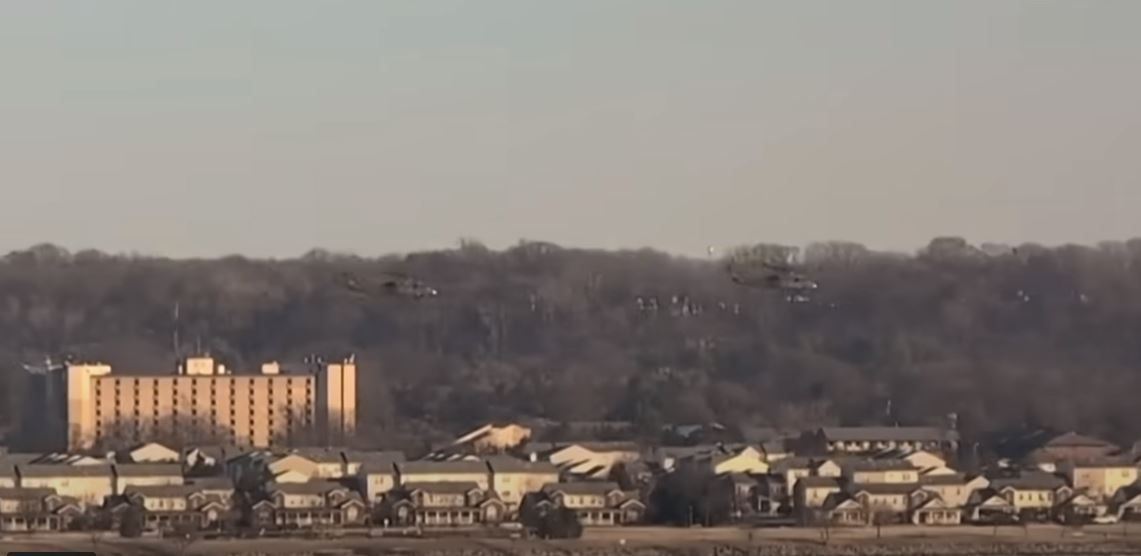
I wonder how many pilots on rwy 01/19 really perceived this section of the routing as unsafe (when flown correctly = hugging the shoreline at max 200ft).
A nuisance, undoubtedly. And the whole helicopter traffic surrounding DCA, pretty unsafe, I can understand.
And then we have nighttime...
A helicopter may be operated at less than the minimums prescribed in paragraph (b) or (c) of this section, provided each person operating the helicopter complies with any routes or altitudes specifically prescribed for helicopters by the FAA
Subjects
DCA
FAA
Route 4
Links are to this post in the relevant subject page so that this post can be seen in context.
Reply to this quoting this original post. You need to be logged in. Not available on closed threads.
August 12, 2025, 04:41:00 GMT
permalink Post: 11937043
In the case you quote, Tower reported the traffic had you in sight. In the case in question, AA5342 was not provided traffic by the DCA LC.
In the case you quote, did Tower say that the traffic was going to maintain own separation? Did Tower provide a bearing/direction and distance to this traffic? Did Tower provide the height of the traffic?
Subjects
AA5342
DCA
Separation (ALL)
TCAS (All)
Traffic in Sight
Links are to this post in the relevant subject page so that this post can be seen in context.
Reply to this quoting this original post. You need to be logged in. Not available on closed threads.
August 12, 2025, 10:13:00 GMT
permalink Post: 11937144
 . I'd often get from Twr on joining the circuit at my various destinations, and having confirmed I'd got traffic XYZ in sight, a clearance "Roger, C/S, keeping that traffic in sight, report Final XX. You are No 2 to the XYZ.". From that point on, my positioning was determined by me based on visual separation with the other traffic - so not totally identical to the DCA accident but the principle was the same - I was responsible for remaining clear of XYZ and positioning appropriately behind them (including accounting for wake/runway occupancy effects etc). Occasionally I'd then get "C/S, new clearance - report
ready
for L/R base." usually with a reason if there was time - often it was App not leaving TWR a big enough gap to sneak me in between 2 IFR arrivals.
. I'd often get from Twr on joining the circuit at my various destinations, and having confirmed I'd got traffic XYZ in sight, a clearance "Roger, C/S, keeping that traffic in sight, report Final XX. You are No 2 to the XYZ.". From that point on, my positioning was determined by me based on visual separation with the other traffic - so not totally identical to the DCA accident but the principle was the same - I was responsible for remaining clear of XYZ and positioning appropriately behind them (including accounting for wake/runway occupancy effects etc). Occasionally I'd then get "C/S, new clearance - report
ready
for L/R base." usually with a reason if there was time - often it was App not leaving TWR a big enough gap to sneak me in between 2 IFR arrivals.
In other words, Twr would delegate separation to me with the initial clearance but, if for whatever reason, they became unhappy - I got issued with a revised, more restrictive, clearance. Similarly, if I lost sight of the traffic at any point after the initial "Report Final" clearance, it was my responsibility to advise ATC that I was no longer visual with XYZ (ie I could no longer comply with the clearance ATC had given me) and ATC would then update my clearance on that basis - "..... report ready for base" or similar until they could visually assure themselves of separation. Indeed, on those occasions, it was not unknown for ATC to say "C/S, I have you both in sight - that traffic is well ahead of you, report Final XX, No 2". I was thus relieved of my responsibility to self-position.
What ATC giveth away in their airspace ATC can taketh back again in their airspace!
Now, "normalised deviation" may skew such a way of working such as PAT routinely expecting to get what they ask for and ATC routinely giving them what they want......... Not saying that happened at DCA but............ Also, I've lost track in the Thread if PAT were visual but with another a/c or the intended one but simply "lost it" at some point........... And whether visual separation at night in such busy airspace was wise ............
Last edited by Hot 'n' High; 12th August 2025 at 10:23 .
Subjects
ATC
DCA
IFR
Separation (ALL)
Traffic in Sight
Visual Separation
Links are to this post in the relevant subject page so that this post can be seen in context.
Reply to this quoting this original post. You need to be logged in. Not available on closed threads.
August 12, 2025, 11:11:00 GMT
permalink Post: 11937189
Last edited by Stagformation; 12th August 2025 at 19:11 .
Subjects
ATC
CRJ
DCA
Night Vision Goggles (NVG)
Separation (ALL)
Links are to this post in the relevant subject page so that this post can be seen in context.
Reply to this quoting this original post. You need to be logged in. Not available on closed threads.
August 12, 2025, 12:19:00 GMT
permalink Post: 11937225
If the airspace design had been used with positive control (ie holding traffic off R4 while 33 was in use or even holding R4 traffic at bridges or somewhere clear of 33 while it was in use) that would work.
Using that same airspace design with "see and avoid" was far less safe and, as reported, led to quite a few incidents of TA's before this fateful day.
But, as the "see and avoid" system was seen by the users at the coal face at least to work, despite the TA's, the operational use of the design became "normalised" to use "see and avoid".
Sadly, no-one (such as DCA management) seems to have studied the extra issues so this more dangerous way of using the design has became "normalised", particularly where ATC is busy.
That's just my take on it.
Subjects
ATC
DCA
See and Avoid
Links are to this post in the relevant subject page so that this post can be seen in context.
Reply to this quoting this original post. You need to be logged in. Not available on closed threads.
August 12, 2025, 21:33:00 GMT
permalink Post: 11937477
Then 3rd , if you have to be designing a conflicting route system , it would be procedurally clear that the 2 could not be used simultaneously . In other word , here in DCA, when runway 33 is in use for landing . Route 4 would be closed, and vice versa, when you have an Heli on route 4 you can't use runway 33 for landing.
But it is not only DCA, I have been flying regularly VFR in Vegas a few years back , and what the tourist helicopters companies were allowed to do there was. let's say " amazing " compared to what we are allowed to do in Europe.
Subjects
DCA
Normalization of Deviance
Route 4
VFR
Links are to this post in the relevant subject page so that this post can be seen in context.
Reply to this quoting this original post. You need to be logged in. Not available on closed threads.
August 14, 2025, 14:00:00 GMT
permalink Post: 11938382
Yes but that is only the visual separation procedure .
When we talk about un safe " procedures" (plural) it is mostly the airspace design and the actions written and put in place which have to be performed to keep that design safe . That part : "conflicting paths used simultaneously with only 100 or 200ft separation " is the basic " unsafe " part of the procedures. For me at least .
"Visual separation" is the procedure that's supposed to make this safe, i.e. ensure that the actual separation is never that low.
Did DCA actually schedule conflicting flights without visual separation procedures?
Subjects
ATC
DCA
Preliminary Report
Separation (ALL)
Visual Separation
Links are to this post in the relevant subject page so that this post can be seen in context.
Reply to this quoting this original post. You need to be logged in. Not available on closed threads.
August 14, 2025, 14:53:00 GMT
permalink Post: 11938401
"Visual separation" is the procedure that's supposed to make this safe, i.e. ensure that the actual separation is never that low.
Did DCA actually schedule conflicting flights without visual separation procedures?
I don't know how to answer your question. FAA said that there was no "procedural separation" plan in place. Army stated that when 33/15 was in use, the protocol/procedure was for Army to automatically hold at one of two points (depending on direction of travel) to await clearance past the extended runway center-line, or to request clearance past the same. So the 75-foot topic in theory maybe is relevant if considering wake/rotor-related turbulence, but not for physical separation of aircraft.
I cannot imagine that airlines take military helo flights into account while scheduling flights. What is important is the maximum commercial operations/flight density that can be accommodated (e.g. per hour). So when FAA allows commercial traffic to really get dense, this makes conflicts with random helo traffic more likely.
Subjects
DCA
FAA
Preliminary Report
Separation (ALL)
Visual Separation
Links are to this post in the relevant subject page so that this post can be seen in context.
Reply to this quoting this original post. You need to be logged in. Not available on closed threads.
August 14, 2025, 16:25:00 GMT
permalink Post: 11938451
Note that the apparently informal procedure of holding helicopters at Hains Pt or golf balls was an effective method of deconflicting Route 4 and 15/33 traffic. However it appears that the use of this \x93procedure\x94 was left to the discretion of the individual controller.
Subjects
ATC
CRJ
DCA
Route 4
Separation (ALL)
VFR
Visual Separation
Links are to this post in the relevant subject page so that this post can be seen in context.
Reply to this quoting this original post. You need to be logged in. Not available on closed threads.
August 14, 2025, 20:50:00 GMT
permalink Post: 11938600
Note that the apparently informal procedure of holding helicopters at Hains Pt or golf balls was an effective method of deconflicting Route 4 and 15/33 traffic. However it appears that the use of this \x93procedure\x94 was left to the discretion of the individual controller.
If I understand the way the q&a progressed, and especially the definition provided by the examiner during the q&a of the Army pilot, "procedurally separate" means the airspace design is such that if both aircraft adhere to their assigned routes, the Route 4 helicopter operation can safely cross the approach path to 3-3 (and, though it should be obvious, please correct this if I've said it incorrectly or without enough precision). But as the Army pilot as well as the med evacuation group chief testified, they took steps to avoid operating across the approach path if there was DCA traffic - which the examiner referred to as "mitigations".
(The wash machine of my mind is cycling through some further thoughts on how the facts emerging from the hearings and certain items in the (voluminous) docket are likely to interact with the relevant legal issues and, in turn, how that appears likely to impact the looming NAS, FAA, and "new ATC system" reforms.)
Subjects
ATC
CRJ
DCA
FAA
NTSB Docket
Route 4
VFR
Links are to this post in the relevant subject page so that this post can be seen in context.
Reply to this quoting this original post. You need to be logged in. Not available on closed threads.
August 15, 2025, 06:37:00 GMT
permalink Post: 11938789
Taking a road procedure similarity : . at a crossroad you can have a stop sign or a triangle giving priority , or nothing
The written procedures are : at a stop sign you must stop even if there is no traffic.
:Transposing this to DCA route 4 map l the procedure should have been in Europe at least ;
1) hold ay golf balls until you get a clearance to proceed . (so that in case of loss of comms , blocked freq, etc.. you can't proceed ).
2) pilot or controller can request visual separation if all t he following conditions re met : typically VMC, and in daylight and traffic is in sight and maintained in sight and both aircrfat pilots are informed. of each other position
3) lateral deviations by the helicopters to fly over built up areas of the city at 200ft will; not be permitted.
Big differences .
Now a pilot can request visual separation at any time but Controller can refuse at any time to .. To my knowledge requesting visual a night using NVG is not covered in the definition of " visual acquisition " in ICAO, so legally it could be challenged I guess . Same as when a pilot reports "visual" on his TCAS display . It is not valid , and for good reasons .
But KDCA is not in Europe, and ICAO SARPs do not apply to military aircrfat , so the outcome of all this is quite uncertain .In fact i would not be surprised if nothing dramatic changes as far as procedures are concerned, Route 4 will be permanently removed I guess, but other than that ? business a usual with visual separations at night ? .
Subjects
ATC
DCA
ICAO
KDCA
Night Vision Goggles (NVG)
Route 4
Separation (ALL)
TCAS (All)
Traffic in Sight
Visual Separation
Links are to this post in the relevant subject page so that this post can be seen in context.
Reply to this quoting this original post. You need to be logged in. Not available on closed threads.
August 15, 2025, 07:31:00 GMT
permalink Post: 11938800
Subjects
ATC
CRJ
DCA
Route 4
Separation (ALL)
VFR
Links are to this post in the relevant subject page so that this post can be seen in context.
Reply to this quoting this original post. You need to be logged in. Not available on closed threads.
August 22, 2025, 21:32:00 GMT
permalink Post: 11942707
NTSB Aviation Investigation Preliminary Report - N879RW (RPA), UH-60 (PAT23)
Subjects
ATC
DCA
NTSB
PAT23
Preliminary Report
Links are to this post in the relevant subject page so that this post can be seen in context.
Reply to this quoting this original post. You need to be logged in. Not available on closed threads.
August 23, 2025, 02:15:00 GMT
permalink Post: 11942779
In the case you quote, Tower reported the traffic had you in sight. In the case in question, AA5342 was not provided traffic by the DCA LC.
In the case you quote, did Tower say that the traffic was going to maintain own separation? Did Tower provide a bearing/direction and distance to this traffic? Did Tower provide the height of the traffic?
Subjects
AA5342
DCA
Separation (ALL)
TCAS (All)
Traffic in Sight
Links are to this post in the relevant subject page so that this post can be seen in context.
Reply to this quoting this original post. You need to be logged in. Not available on closed threads.
September 25, 2025, 00:46:00 GMT
permalink Post: 11959243
American Airlines
- Knowingly operated and expanded operations into an airport (DCA) with \x93massive congestion\x94
- Operated in airspace subject to numerous near-miss reports
AA/PSA Pilots
- Failed to respond to traffic alert 19 sec before collision
- Accepted visual approach to runway 33
Subjects
Accountability/Liability
DCA
Links are to this post in the relevant subject page so that this post can be seen in context.
Reply to this quoting this original post. You need to be logged in. Not available on closed threads.
September 25, 2025, 03:30:00 GMT
permalink Post: 11959265
American Airlines
- Knowingly operated and expanded operations into an airport (DCA) with \x93massive congestion\x94
- Operated in airspace subject to numerous near-miss reports
AA/PSA Pilots
- Failed to respond to traffic alert 19 sec before collision
- Accepted visual approach to runway 33
Perhaps this SLF/attorney should "do the reading" ...... I am quite curious whether, and if so how, these preeminent aviation accident litigators have dealt with the discretionary function exception to the statutory waiver of federal government sovereign immunity.
Edit: case number is 1:25 -cv-03382 (United States District Court for the District of Columbia)
Last edited by WillowRun 6-3; 25th September 2025 at 03:49 .
Subjects
Accountability/Liability
DCA
Links are to this post in the relevant subject page so that this post can be seen in context.
Reply to this quoting this original post. You need to be logged in. Not available on closed threads.
September 28, 2025, 11:58:00 GMT
permalink Post: 11960983
Subjects
DCA
FAA
Links are to this post in the relevant subject page so that this post can be seen in context.
Reply to this quoting this original post. You need to be logged in. Not available on closed threads.
September 28, 2025, 13:57:00 GMT
permalink Post: 11961025
Ordinarily I have no objection to lawyer bashing (and I've been known (in non-anonymous mode) to tell one or more good lawyer jokes).
Before stating why I object to the aspersion you've cast on legal types in the context of the DCA mid-air collision and the litigation arising from it, I'll suggest that probably most all forum posters (and readers), if not literally all, have heard either an ex-husband or ex-wife relate their unrequited frustration and anger at how the other spouse "got everything", "ripped me off", "took me to the cleaners" and so on. And then someone else will say, "yeah, and the lawyers are the only ones who profit in a divorce." The contradiction is rarely called out, but it is no less a contradiction.
But as to this case. The passenger manifest of the PSA flight isn't necessary to make this point, but I'm sure the estimable Mr. Clifford would consume hours of argument and pages of supporting documents making it clear that 64 lives were cut short, and many were people in the prime of their adult lives - not that one life should be worth more than any other life in compensation in court proceedings, but taking for example the relatively early career attorneys who perished in the accident, their earnings potential over the course of their careers is less speculative than, say, projections about one of the youthful skaters (although I'm pretty sure there are standards which have been worked out in the mine run of personal injury and wrongful death cases). My point is, this case will yield quite significant damage awards in the end. Yes, I realize that issues of immunity of federal agencies will have to be surmounted; having posted a lot about theses issues I realize they exist. Yet the citations of FAA orders, procedures, and rules in the Complaint does suggest that plaintiffs are ready to overcome the immunity argument. And I'm leaving for another day and place the consideration, how do you think it would affect the FAA in the long run to argue that "na na you can't get me" because of "legal technicalities" when it is pretty predictable at this point that NTSB in its final report will be, shall we say, either unkind or unsparing to FAA, or both, in assessing causes and effects.
So the case is likely, if not certain, to pay out big. The lawyers will get - unless legal counsel are using very different formulas than are typical in cases of this type - about one-third.
How is it then that only the lawyers do well? The argument is not about whether big-ticket damage awards can replace a lost loved one. The argument is about whether only the lawyers do well. "Grief" begins with the same four letters as "Grievance" and the crash victims' families certainly are individuals aggrieved by the negligence of some or all of the defendants. Maybe we can split semantic fibers over whether having their grievance abated by significant financial compensation is within the meaning of "doing well" - but under the facts of this case and their tragic losses, I think they will be at least "doing better". And so not only the lawyers.
This all having been said, apologies accepted, naturally.
WR 6-3
Subjects
DCA
FAA
Final Report
Grief
NTSB
Links are to this post in the relevant subject page so that this post can be seen in context.
Reply to this quoting this original post. You need to be logged in. Not available on closed threads.
September 28, 2025, 14:16:00 GMT
permalink Post: 11961033
This is where a SMS needs to look again at things and then decide what else, if anything, needs to be done. Part of my background is from Safety Engineering (where I was put through a SE MSc in the 1990's by my then employer) and processes such as Hazard Analysis takes into account both material failure as well as operational failure - and here we have "airspace design" and then the "operation of that airspace". When designing a bit of kit you apply the Regs as part of the design hazard analysis. But that is the minimum (tick VG) - after that we then ask "And is it actually safe?". Regs generally provide for a "minimum safe standard" which, all being well, will see us through - 100%. If not, we'd have aircraft falling out the sky with regular abandon! But that's assuming that those who write the Regs have got it right (or, in this case "designed the airspace" and then created the "operational rules" for that design). They can make mistakes as much as anyone else. One would hope for rigorous QA checks and so on ......... but this is where even organisations such as the FAA can, over time, become institutionalized with poor practices/cost cutting/etc/etc.
On an operational side of things, I've often, as an Engineer, reduced servicing intervals to less than those recommended where I've had issues with a bit of kit on a particular airframe*. I've released the aircraft back into service with an Engineering Limitation which has called for more frequent inspections than the Rules ask for while we try and ascertain what the issue is and if there really is a trend starting. If as an operator you believe something to be unsafe, you must address it. How did I know to reduce the servicing intervals? Sometimes it was a Maintenance Engineer calling me over and saying "Hey, Boss, have you seen this? What do you think?". Other times it's because trawling through Stats, a trend has started to show which, in the noise of day-to-day operations, was invisible - but look back over 6 months in a Spreadsheet and, hey, what have we here? We used to get regular print-outs from our Maintenance databases for just this reason - in the 1980's!
The FAA, in the wake of this accident I suspect, has issued this on the considerable extension of SMS's - but only in Apr 2024. But this is not new stuff - SMS's have been around for years. My first brush with it all was way back in 1980 - we called it something different then but that's what it was! Here in the UK, the CAA published CAP 795 - Safety Management Systems - Guidance to Organizations back in 2015, the purpose of which " .......... is to provide guidance on the implementation of Safety Management Systems (SMS). It has been developed to give sufficient understanding of SMS concepts and the development of management policies and processes to implement and maintain an effective SMS. It applies to Air Operator\x92s Certificate (AOC) holders, continuing airworthiness management organisations, maintenance organisations, air navigation service providers, aerodromes and approved training organisations. ".
Anyway, that's my take FWIW and hopefully it explains why I said what I did! Cheers, H 'n' H
Ordinarily I have no objection to lawyer bashing (and I've been known (in non-anonymous mode) to tell one or more good lawyer jokes)........... How is it then that only the lawyers do well? The argument is not about whether big-ticket damage awards can replace a lost loved one. The argument is about whether only the lawyers do well. "Grief" begins with the same four letters as "Grievance" and the crash victims' families certainly are individuals aggrieved by the negligence of some or all of the defendants. Maybe we can split semantic fibers over whether having their grievance abated by significant financial compensation is within the meaning of "doing well" - but under the facts of this case and their tragic losses, I think they will be at least "doing better". And so not only the lawyers.
This all having been said, apologies accepted, naturally.
WR 6-3
* Re increased servicing, even that has to be approached with care. In the late 1970's, we lost a helo when someone applied more grease then they should have as "....... well, a bit more will be even better!". Murphy's Law can be a right bu&&er!
Subjects
DCA
FAA
Grief
Links are to this post in the relevant subject page so that this post can be seen in context.
Reply to this quoting this original post. You need to be logged in. Not available on closed threads.