December 19, 2025, 09:00:00 GMT
permalink Post: 12007870
The core issue remains that of air safety;
An independent US view focussed on safety:- "The night everything at DCA finally went wrong"
https://theaircurrent.com/aviation-s...pecial-report/
Lessons that aviation can learn now, without waiting for a trial or raking though the embers of investigation.
Note the heat map of reported incidents - the data existed, but not acted on.
"\x85 only one pilot out of four interviewed by the NTSB had an accurate and complete understanding of the structure of the D.C. helicopter routes \x97 an individual who happened to have seven years of prior experience as a military pilot in the area. Two pilots had no awareness that published routes for helicopters even existed." And other telling quotes.
Knowledge, information sharing, published approach charts, normalisation of deviance (Dekker); a systemic accident (Reason).
'Safety' is easy with hindsight, but there are many people who's job is to have foresight - to review and act on reports, at least ask 'what if', to think about, and seek an understanding of every day work (Hollnagel).
Subjects
DCA
NTSB
Normalization of Deviance
Links are to this post in the relevant subject page so that this post can be seen in context.
Reply to this quoting this original post. You need to be logged in. Not available on closed threads.
December 20, 2025, 04:24:00 GMT
permalink Post: 12008323
https://theaircurrent.com/aviation-s...pecial-report/
Subjects
ADSB (All)
ADSB In
ADSB Out
CRJ
DCA
Links are to this post in the relevant subject page so that this post can be seen in context.
Reply to this quoting this original post. You need to be logged in. Not available on closed threads.
January 23, 2026, 23:27:00 GMT
permalink Post: 12026106
Trump\x92s Transportation Secretary Formalizes Permanent Restrictions for Aircraft in Reagan National Airport Airspace
Thursday, January 22, 2026
WASHINGTON, D.C. \x97 U.S. Transportation Secretary Sean P. Duffy today announced that the Federal Aviation Administration (FAA) is formalizing permanent restrictions for helicopters and powered-lift from operating in certain areas near Ronald Reagan Washington National Airport (DCA), unless these aircraft are conducting essential operations. These restrictions were put in place immediately following the American Airlines 5342 crash and supported by the NTSB\x92s preliminary recommendations.
\x93After that horrific night in January, this Administration made a promise to do whatever it takes to secure the skies over our nation\x92s capital and ensure such a tragedy would never happen again. Today\x92s announcement reaffirms that commitment,\x94 said U.S. Transportation Secretary Sean P. Duffy. \x93The safety of the American people will always be our top priority. I look forward to continuing to collaborate with the NTSB on any additional actions.\x94
The FAA published an Interim Final Rule (IFR) that will significantly reduce midair-collision risks and implement a National Transportation Safety Board (NTSB) safety recommendation to prohibit certain helicopter operations when Runways 15 and 33 at DCA are in use.
\x93We took decisive action immediately following the January 2025 midair collision to reduce risk in the airspace,\x94 said FAA Administrator Bryan Bedford. \x93This is a key step toward ensuring these improvements remain permanent and we\x92re continuing to work with the NTSB to ensure an accident like this never happens again.\x94
While the interim final rule goes into effect tomorrow, the public is invited to submit written comments, which the FAA will consider before issuing a final rule.
Additional Information:
The FAA took immediate action to restrict mixed traffic around DCA and made permanent helicopter route changes after the NTSB recommendations. U.S. Transportation Secretary Sean P. Duffy and the FAA didn\x92t stop there \x96 taking additional actions for DCA to address operations, procedures, and personnel, including:
Established procedures to eliminate helicopter and fixed-wing mixed traffic near the airport
Closed Route 4 between Hains Point and the Wilson Bridge
Revised agreements with the military to require ADS-B Out broadcasting
Discontinued take offs from the Pentagon until the FAA and Department of War updated procedures and fixed technical issues at the Pentagon Heliport
Eliminated the use of visual separation within 5 nautical miles of DCA
Published modifications to helicopter zones and routes moving them farther away from DCA flight paths
Increased support, oversight and staffing at DCA
In October 2025, the FAA updated Helicopter routes and zones at DCA, Washington Dulles International Airport (IAD) and Baltimore/ Washington International Airport (BWI).
The FAA previously implemented temporary flight restrictions (TFR) around DCA. To make the restrictions contained in the TFRs permanent, the FAA issued an IFR which is set to publish on January 23, 2026, and will take effect immediately. The public is invited to submit comments on the IFR and the FAA will later publish a Final Rule in response to those comments.
Subjects
ADSB (All)
ADSB Out
DCA
FAA
IFR
NTSB
Route 4
Separation (ALL)
Visual Separation
Links are to this post in the relevant subject page so that this post can be seen in context.
Reply to this quoting this original post. You need to be logged in. Not available on closed threads.
January 26, 2026, 20:56:00 GMT
permalink Post: 12027659
The reporting indicates that the Board's final report is expected within two weeks.
Various safety recommendations also are anticipated to be on the agenda for the NTSB's January 27 meeting.
Of particular interest, among many other factors involved in this horrifically senseless accident (my characterization, not found in TAC reporting as such), is whether the NTSB's meeting which will mark the end of its official investigatory process will touch upon the controversial section of the NDAA, Section 373 (subject of previous posts at the time of passage, upthread).
Subjects
DCA
Final Report
NDAA
NTSB
Probable Cause
Safety Recommendations
Section 373 of the FY26 NDAA
Links are to this post in the relevant subject page so that this post can be seen in context.
Reply to this quoting this original post. You need to be logged in. Not available on closed threads.
January 27, 2026, 16:38:00 GMT
permalink Post: 12028081
While "an accident waiting to happen" is an old cliche, there can't have been many accidents where it was more apt, with reference being made to a precursor at DCA a dozen or so years ago where only luck avoided a similar outcome, and sod-all having been done in the meantime to mitigate the possibility of a recurrence.
Subjects
Accident Waiting to Happen
DCA
FAA
Links are to this post in the relevant subject page so that this post can be seen in context.
Reply to this quoting this original post. You need to be logged in. Not available on closed threads.
January 27, 2026, 21:50:00 GMT
permalink Post: 12028235
@Osinttechnical
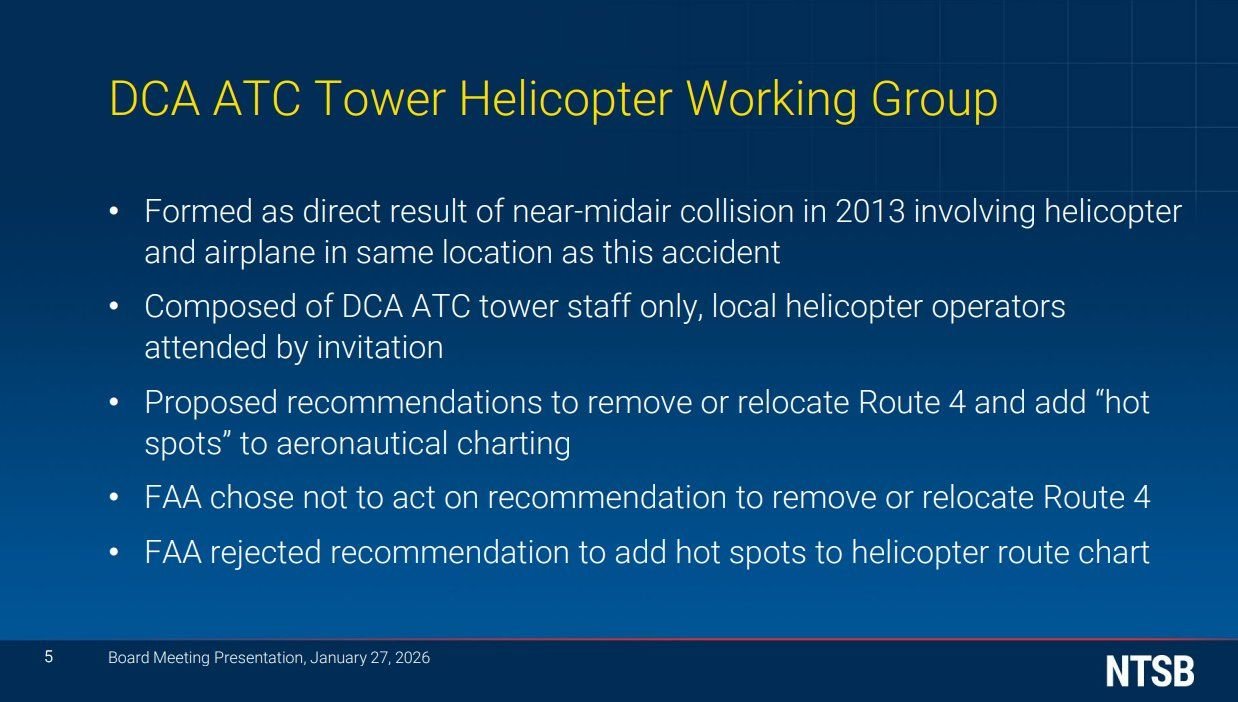
Possibly one of the more damning slides in NTSB history found in the Blackhawk-American Airline
s crash investigation.
In 2013, a group of local ATC and helicopter pilots proposed moving flight paths to avoid aircraft-helicopter collisions on landing at DCA. The FAA ignored them.
Subjects
ATC
DCA
FAA
NTSB
Links are to this post in the relevant subject page so that this post can be seen in context.
Reply to this quoting this original post. You need to be logged in. Not available on closed threads.
January 27, 2026, 22:48:00 GMT
permalink Post: 12028261
It responds to them, with either acceptance or rejection, and in the latter case provides its reasons for doing so. It may also suggest alternative means of compliance with the Board's wishes, and in some cases this leads to quite a bit of to-and-froing between the two organisations until a final position is reached.
But the discussion was about a working group organized, convened and conducted by people from the FAA DCA staff and other concerned parties. The output of that group is what got "ignored"
Subjects
DCA
FAA
NTSB
Safety Recommendations
Links are to this post in the relevant subject page so that this post can be seen in context.
Reply to this quoting this original post. You need to be logged in. Not available on closed threads.
January 27, 2026, 23:09:00 GMT
permalink Post: 12028272
Their failure to regularly review and evaluate helicopter routes and available data, and their failure to act on recommendations to mitigate the risk of a mid-air collision near Ronald Reagan Washington National Airport, as well as the air traffic system's overreliance on visual separation.
In order to promote efficient traffic flow without consideration for the limitations of the see and avoid concept.
Also causal was the lack of effective pilot applied visual separation by the helicopter crew, which resulted in a mid-air collision.
Additional causal factors were were the tower team's loss of situational awareness and degraded performance due to a high workload of the combined helicopter and local control positions, and the absence of a risk assessment process to identify and mitigate real time operational risk factors, which resulted in miss prioritization of duties, inadequate traffic advisory advisories, and the lack of safety alerts to both flight crews.
Also causal was the Army's failure to ensure pilots were aware of the effects of air tolerances on barometric altimeter in their helicopters, which resulted in the crew flying above the maximum published helicopter route altitude.
Contributing factors include the limitations of the traffic awareness and collision alerting systems on both aircraft, which precluded effective alerting of the impending collision to the flight crew's.
An unsustainable airport arrival rate, increasing traffic volume with a changing fleet mix and airline scheduling practices at DCA, which regularly strain the DCA Atct workforce and degraded safety over time.
The Army's lack of a fully implemented safety management system, which should have identified and addressed hazards associated with altitude exceedances on the Washington, D.C. Helicopter routes.
The FAA's failure across multiple organizations to implement previous NTSB recommendations, including Ads-b in and to follow and fully integrate its established safety management system, which should have led to several organizational and operational changes based on previously identified risk that were known to management and the absence of effective data sharing and analysis among the FAA aircraft operators and other relevant organizations.
Subjects
Altimeter (All)
Barometric Altimeter
DCA
FAA
NTSB
Probable Cause
Route Altitude
See and Avoid
Separation (ALL)
Situational Awareness
Visual Separation
Links are to this post in the relevant subject page so that this post can be seen in context.
Reply to this quoting this original post. You need to be logged in. Not available on closed threads.
January 28, 2026, 01:17:00 GMT
permalink Post: 12028315
Subjects
ATC
DCA
Separation (ALL)
Links are to this post in the relevant subject page so that this post can be seen in context.
Reply to this quoting this original post. You need to be logged in. Not available on closed threads.
January 28, 2026, 03:09:00 GMT
permalink Post: 12028338
The PC statement should be read in its entirety, and at the conscious risk of ripe cliche, context matters. The Board did not assign the probable cause to the intersecting flight routes as such. For one thing, Chair Homendy repeatedly since the early days of the Board investigation has hammered upon the fact that the vertical separation was as little as 75 feet without any procedural separation (such as the helos holding at Haines Point). And also since the start of the investigation, time and again the complexity of the DCA airspace, and the (in my strident opinion) very messed up operation of DCA with regard to - as ATC staff testified - just "making it work", have been emphasized. Plus the refusal of FAA ATO to act upon the input from the helicopter working group several years ago, plus FAA's declining to note "hot spots" on charts. And the staffing issues, and lack of fidelity to SMS on the part of FAA and to some extent the Army as well. And there were, quite obviously, many findings of fact which are necessarily part of the context for reading . . . and understanding, the PC determination.
A person need not be an aeronautical engineer, airspace architect, or civilian or military aviator to understand from the get-go that intersecting flight paths might be found across the NAS. I'll stand to be corrected but I do not think - having watched the entirety of the hearing today - that the criticism of the Probable Cause finding is a valid, fair or accurate assessment of the Board's work in this investigation.
WillowRun 6-3
Subjects
ATC
DCA
FAA
Findings
Helicopter Working Group
Hot Spots
NTSB
NTSB Chair Jennifer Homendy
Probable Cause
Separation (ALL)
Vertical Separation
Links are to this post in the relevant subject page so that this post can be seen in context.
Reply to this quoting this original post. You need to be logged in. Not available on closed threads.
January 28, 2026, 03:16:00 GMT
permalink Post: 12028339
The PC statement should be read in its entirety, and at the conscious risk of ripe cliche, context matters. The Board did not assign the probable cause to the intersecting flight routes as such. For one thing, Chair Homendy repeatedly since the early days of the Board investigation has hammered upon the fact that the vertical separation was as little as 75 feet without any procedural separation (such as the helos holding at Haines Point). And also since the start of the investigation, time and again the complexity of the DCA airspace, and the (in my strident opinion) very messed up operation of DCA with regard to - as ATC staff testified - just "making it work", have been emphasized. Plus the refusal of FAA ATO to act upon the input from the helicopter working group several years ago, plus FAA's declining to note "hot spots" on charts. And the staffing issues, and lack of fidelity to SMS on the part of FAA and to some extent the Army as well. And there were, quite obviously, many findings of fact which are necessarily part of the context for reading . . . and understanding, the PC determination.
A person need not be an aeronautical engineer, airspace architect, or civilian or military aviator to understand from the get-go that intersecting flight paths might be found across the NAS. I'll stand to be corrected but I do not think - having watched the entirety of the hearing today - that the criticism of the Probable Cause finding is a valid, fair or accurate assessment of the Board's work in this investigation.
WillowRun 6-3
Subjects
ATC
DCA
FAA
Findings
Helicopter Working Group
Hot Spots
NTSB
NTSB Chair Jennifer Homendy
Probable Cause
Separation (ALL)
Vertical Separation
Links are to this post in the relevant subject page so that this post can be seen in context.
Reply to this quoting this original post. You need to be logged in. Not available on closed threads.
January 29, 2026, 00:17:00 GMT
permalink Post: 12028883
Subjects
DCA
FAA
Route 5
Links are to this post in the relevant subject page so that this post can be seen in context.
Reply to this quoting this original post. You need to be logged in. Not available on closed threads.
February 06, 2026, 17:52:00 GMT
permalink Post: 12033392
_________________________
Joint Statement of House Transportation and Infrastructure Committee and House Armed Services Committee Bipartisan Leaders on NTSB\x92s Recommendations to Address DCA Crash
For Immediate Release: February 06, 2026
[Committee contacts omitted]
Washington, DC \x96 The bipartisan leaders of the House Transportation and Infrastructure Committee and the House Armed Services Committee today issued a joint statement regarding the National Transportation Safety Board\x92s (NTSB) recently approved recommendations to address the January 29, 2025, midair collision at Ronald Reagan Washington National Airport (DCA).
Joint statement from House Transportation and Infrastructure Committee Chairman Sam Graves (R-MO), House Transportation and Infrastructure Committee Ranking Member Rick Larsen (D-WA), House Armed Services Committee Chairman Mike Rogers (R-AL), and House Armed Services Committee Ranking Member Adam Smith (D-WA):
\x93Now that we have received the approved recommendations and probable cause from the NTSB on the tragic DCA midair collision that claimed 67 lives, and with the NTSB\x92s final report expected in a matter of days, we are working on a comprehensive legislative solution to address what we\x92ve learned. It is our firm belief that meaningful improvements to the safety of our airspace require the full and fair consideration of all of the NTSB\x92s recommendations. We are continuing to evaluate the information and analysis gathered and put forward by the NTSB, and we will work together expeditiously on legislation to ensure a crash like this can never happen again.\x94
Subjects
DCA
Final Report
NDAA
NTSB
Probable Cause
Section 373 of the FY26 NDAA
Links are to this post in the relevant subject page so that this post can be seen in context.
Reply to this quoting this original post. You need to be logged in. Not available on closed threads.
February 07, 2026, 07:49:00 GMT
permalink Post: 12033661
https://www.politico.com/live-update...-bill-00764270
The journalists asked Homendy about it on the day of the board meeting, and she diplomatically said she'd been busy with the DCA midair documents since the board meeting and final report were coming up, but she also reiterated she wants ADS-B IN on every aircraft, so...
The NTSB has the enviable role of being able to champion safety absent any other consideration. The FAA and politics in general need to balance that with economic, business and other interests, so the outcomes are pretty much guaranteed to be compromises falling short of what we would want.
Subjects
ADSB (All)
DCA
FAA
Final Report
NTSB
NTSB Chair Jennifer Homendy
Links are to this post in the relevant subject page so that this post can be seen in context.
Reply to this quoting this original post. You need to be logged in. Not available on closed threads.
February 17, 2026, 06:03:00 GMT
permalink Post: 12038394
Once happened, DCA crash had the same potential to change things- at least in USA. It seems that it wont happen- due many reasons- as we have already discussed here.
Subjects
Accountability/Liability
DCA
Links are to this post in the relevant subject page so that this post can be seen in context.
Reply to this quoting this original post. You need to be logged in. Not available on closed threads.
February 17, 2026, 11:23:00 GMT
permalink Post: 12038569
Lawyers represent both sides so sometimes it is shocking for us professionals who know the truth , confirmed by the official accident report to hear their arguments . .
In Uberlingen there were 13 holes in the cheese layer , any one of them closed and there would likely not have been an accident .For the judges to select only a few of them and concentrate on the person responsible for that hole is not what we, professionals would do , but this is how their system works. ,
Some of the holes were plain bad luck , but many others were man made. The BFU investigated and (tried to) explain all the holes, , the judges only a couple.
The similarities with DCA : on the accident itself , , for the controllers : normalization of deviance , being trained to do things which are not in the book .The judge will look at the book and say the controller did not follow the procedures . . Lawyers from the other side will be exploiting this loophole .
On the pilots : both the Russians and the Bluestreak did things not in their book either , for instance on reactions to TCAS alerts , or on accepting a procedure not briefed.. Lawyers are likely to exploits that as well.
But the cover ups keep coming
Still today , 50 years later , the French Government and especially the Armeee de l'Air , still refuse the judgement conclusion ( saying that they are responsible for the collision ) , saying it was false , and still refuse to acknowledge the evidence . For the victim's families , mostly British and Spanish, the wound is still wide open as no-one was held responsible in the end , only "the State " in all its anonymity .
Subjects
ATC
DCA
Grief
Normalization of Deviance
TCAS (All)
Links are to this post in the relevant subject page so that this post can be seen in context.
Reply to this quoting this original post. You need to be logged in. Not available on closed threads.
February 17, 2026, 16:22:00 GMT
permalink Post: 12038698
Last edited by BFSGrad; 17th February 2026 at 20:59 . Reason: Replaced erroneous "TCAS RA" with correct "TCAS TA"
Subjects
DCA
TCAS (All)
Links are to this post in the relevant subject page so that this post can be seen in context.
Reply to this quoting this original post. You need to be logged in. Not available on closed threads.
February 17, 2026, 19:24:00 GMT
permalink Post: 12038796
Subjects
DCA
TCAS (All)
TCAS RA
Links are to this post in the relevant subject page so that this post can be seen in context.
Reply to this quoting this original post. You need to be logged in. Not available on closed threads.
February 19, 2026, 23:09:00 GMT
permalink Post: 12039941
From House Transportation and Infrastructure Committee website 19 February 2026
Washington, DC \x96 The comprehensive legislative response to the various aviation safety issues raised by the tragic 2025 midair collision between American Airlines Flight 5342 and a UH-60 Army Black Hawk helicopter at Ronald Reagan Washington National Airport (DCA) was released today by the bipartisan leaders of the House Transportation and Infrastructure Committee and the House Armed Services Committee.
The Airspace Location and Enhanced Risk Transparency (ALERT) Act of 2026 addresses all 50 safety related recommendations issued by the National Transportation Safety Board (NTSB), which concluded its thorough investigation and issued its final report on February 17, 2026.
The ALERT Act considers all of the NTSB\x92s findings of probable cause that contributed to the accident and responds to each of the NTSB\x92s 50 safety recommendations to provide a thorough and holistic legislative solution to improve U.S. aviation safety. Critical safety issues the bill addresses include:
Establishing requirements for equipping collision mitigation, avoidance, and alerting technologies and systems for civil fixed-wing and rotorcraft;
Improving helicopter route design, guidance, and separation;
Preventing loss of separation (near-miss) incidents;
Addressing deficiencies in the FAA\x92s safety culture;
Enhancing air traffic control training and procedures, particularly during high traffic;
Strengthening the safety of the DCA airspace \x96 one of the nation\x92s busiest and most congested airspaces;
Repealing section 373(a) of the last National Defense Authorization Act; and more.
The ALERT Act is led by Transportation and Infrastructure Committee Chairman Sam Graves (R-MO), Transportation and Infrastructure Committee Ranking Member Rick Larsen (D-WA), Armed Services Committee Chairman Mike Rogers (R-AL), and Armed Services Committee Ranking Member Adam Smith (D-WA).
[Quotes from Congressmen omitted]
Link to the text of the ALERT Act: https://transportation.house.gov/components/redirect/r.aspx?ID=486957-71714618
Link to a section by section summary of the ALERT Act:
https://transportation.house.gov/news/email/show.aspx?ID=RFS3V7AWS4PPNV2MA2XZXHULM4
Subjects
ALERT Act of 2026
Blackhawk (H-60)
DCA
Final Report
Findings
NTSB
Probable Cause
Safety Recommendations
Separation (ALL)
Links are to this post in the relevant subject page so that this post can be seen in context.
Reply to this quoting this original post. You need to be logged in. Not available on closed threads.
February 20, 2026, 03:43:00 GMT
permalink Post: 12039997
Subjects
DCA
Links are to this post in the relevant subject page so that this post can be seen in context.
Reply to this quoting this original post. You need to be logged in. Not available on closed threads.