February 04, 2025, 10:52:00 GMT
permalink Post: 11821295
Radar orders also need to be given and actions taken sooner than if the crews are doing it of their own initiative. So a radar CA needs to be visible say 15 second pre-collision so ATC can wait for the radio to be clear then order pilots to manoeuvre. Pilots can aim to cross visually at more like 5 seconds.
I'm not saying that this is overall a good idea, but the fundamental reason you fit more planes in with visual separation is that you can put them closer together with (given good visibility) not too dissimilar safety.
[Edit: too late... Fullwings got this.]
TCAS 8 is getting closer and sooner after this horrific accident.
Subjects
ATC
Blackhawk (H-60)
CRJ
DCA
Radar
Separation (ALL)
TCAS (All)
TCAS RA
Visual Separation
Links are to this post in the relevant subject page so that this post can be seen in context.
Reply to this quoting this original post. You need to be logged in. Not available on closed threads.
February 04, 2025, 11:56:00 GMT
permalink Post: 11821350
The only solution I personally see is airspace segregation based on equipment . Class A, B and C restricted to aircraft carrying ADS-B out and TCAS equipped , and both Working and on the MEL as no go item s ( not the case today ) Waiting for AOPA and ATA remarks
Subjects
ADSB (All)
ADSB Out
ATC
DCA
TCAS (All)
Links are to this post in the relevant subject page so that this post can be seen in context.
Reply to this quoting this original post. You need to be logged in. Not available on closed threads.
February 04, 2025, 12:52:00 GMT
permalink Post: 11821404
Then there is the question of the C150s, you raised , of course no TCAS, we are talking ADS-B out, but even then, do you really want to have them anywhere near the approach path of a major busy airport airspace to start with ?
Subjects
ADSB (All)
ADSB Out
DCA
TCAS (All)
Links are to this post in the relevant subject page so that this post can be seen in context.
Reply to this quoting this original post. You need to be logged in. Not available on closed threads.
February 04, 2025, 13:17:00 GMT
permalink Post: 11821423
Then there is the question of the C150s, you raised , of course no TCAS, we are talking ADS-B out, but even then, do you really want to have them anywhere near the approach path of a major busy airport airspace to start with ?
I was a frequent visitor to DCA in C-150s and C-172s pre 9-11, it was a nice way to get to the city for dinner from the island I live on. Unless the airlines start buying their own private airports there is no sorting out of airplanes like that, public airports are for everyone with an airplane (9-11 bullcrap excepted). They would do "river tours" back then too, you got a trip up and down the Potomac with some great sightseeing. Back then airplane ramp fees were less than you could end up paying to park a car

Subjects
ADSB (All)
ADSB Out
ATC
DCA
TCAS (All)
Links are to this post in the relevant subject page so that this post can be seen in context.
Reply to this quoting this original post. You need to be logged in. Not available on closed threads.
February 04, 2025, 13:36:00 GMT
permalink Post: 11821443
I was a frequent visitor to DCA in C-150s and C-172s pre 9-11, it was a nice way to get to the city for dinner from the island I live on. Unless the airlines start buying their own private airports there is no sorting out of airplanes like that, public airports are for everyone with an airplane (9-11 bullcrap excepted). They would do "river tours" back then too, you got a trip up and down the Potomac with some great sightseeing. Back then airplane ramp fees were less than you could end up paying to park a car
Subjects
DCA
TCAS (All)
Links are to this post in the relevant subject page so that this post can be seen in context.
Reply to this quoting this original post. You need to be logged in. Not available on closed threads.
February 04, 2025, 18:54:00 GMT
permalink Post: 11821633
Subjects
DCA
Links are to this post in the relevant subject page so that this post can be seen in context.
Reply to this quoting this original post. You need to be logged in. Not available on closed threads.
February 04, 2025, 21:57:00 GMT
permalink Post: 11821736
I have flown into DCA at least a hundred times and took my own go-around once even though tower said the traffic had us in sight. If I can\x92t see a TCAS target on a collision course I am going around.
Subjects
DCA
TCAS (All)
Traffic in Sight
Links are to this post in the relevant subject page so that this post can be seen in context.
Reply to this quoting this original post. You need to be logged in. Not available on closed threads.
February 04, 2025, 22:34:00 GMT
permalink Post: 11821762
"5342, helo traffic on your right 1/4 mile at 300 feet, has you in sight". The CRJ FO might just have taken a closer look out the side window with that. Or, like you, they might have opted to go around.
Subjects
ATC
CRJ
CVR
DCA
IFR
Separation (ALL)
TCAS (All)
Traffic in Sight
Visual Separation
Links are to this post in the relevant subject page so that this post can be seen in context.
Reply to this quoting this original post. You need to be logged in. Not available on closed threads.
February 05, 2025, 13:39:00 GMT
permalink Post: 11822224
I can imagine a scenario where a helicopter crew, who are regular on this route, report the airliner in sight on first call, knowing that by doing so, they avoid an orbit and subsequent delay.
With regard to other posts asking why the tower controller didn\x92t pass traffic information to the CRJ crew. Bear in mind that this guy was working flat out, working two positions with pretty constant RT. There may well have been additional tasks such as phone coordination going on in the background which we are not aware of. Again I see a scenario of tower using the absolute minimum RT in an attempt to keep on top of the workload. In his mind, the helicopter has reported the inbound in sight and has stated responsibility to pass behind\x85\x85.job done, onto the next task.
I\x92m sure that the investigation will be focusing on why the sectors were combined under these traffic conditions. In my 30+ years of ATC, I have investigated numerous incidents where a significant factor was an overworked controller working combined positions. This can be caused by staff shortages, late reactions to rapidly changing traffic conditions, unit culture or simply a \x93macho\x94 controller who thinks that they can handle everything\x85.until subsequently they find that they cannot!
Subjects
ATC
CRJ
DCA
Separation (ALL)
Vertical Separation
Links are to this post in the relevant subject page so that this post can be seen in context.
Reply to this quoting this original post. You need to be logged in. Not available on closed threads.
February 05, 2025, 19:16:00 GMT
permalink Post: 11822469
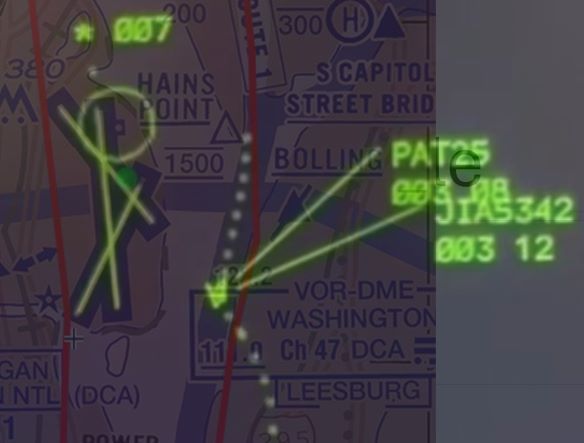
The position of the collision shown in the radar data overlay is consistent with the position of the RJ as shown in ADS-B Exchange at the time of the collision (approximately 01:47:59Z according to the NTSB timeline). See this link from DIBO for the RJ Track with timing AA5342 Down DCA In my experience, times in ADS-B Exchange are generally accurate to within 2 seconds. Given all that, I believe that the Black Hawk was within the horizontal bounds of Route 4 at the time of the collision and that it did not make the right turn we see in the ADS-B Exchange map.
Edit: Corrected route number and helicopter
Last edited by airplanecrazy; 6th February 2025 at 01:24 .
Subjects
AA5342
ADSB (All)
Blackhawk (H-60)
DCA
NTSB
Radar
Route 4
Links are to this post in the relevant subject page so that this post can be seen in context.
Reply to this quoting this original post. You need to be logged in. Not available on closed threads.
February 05, 2025, 20:24:00 GMT
permalink Post: 11822518
Subjects
ATC
DCA
PAT25
Pass Behind
Pass Behind (All)
Links are to this post in the relevant subject page so that this post can be seen in context.
Reply to this quoting this original post. You need to be logged in. Not available on closed threads.
February 06, 2025, 01:07:00 GMT
permalink Post: 11822673
This was a check ride wearing NVGs while runway 33 was open. Do PAT night flights with passengers operate with NVGs all the time, or was this an attempt to check multiple boxes (e.g. NVG currency, route currency, night flight currency) in a single flight?
if the answer to the question above is \x93NVGs are generally worn if the Washington area is under some sort of security situation which reduces lit points of reference, but not otherwise\x94 would DCA civil flight ops be continuing in such conditions?
What I\x92m driving at is - wouldn\x92t it have been a good idea to reduce the degree of difficulty by squaring in advance with DCA ATC a pause of 33 ops when PAT25 came by, even if an aircraft or two had to hold/delay departure?
Subjects
ATC
DCA
Night Vision Goggles (NVG)
PAT25
Links are to this post in the relevant subject page so that this post can be seen in context.
Reply to this quoting this original post. You need to be logged in. Not available on closed threads.
February 06, 2025, 01:54:00 GMT
permalink Post: 11822687
Questions:
Why was PAT 25 search light in the stowed position and not motored to a more forward position?
Why are PAT helicopters not M models with FD's so PAT 25 could have been coupled on route 4 while at 200' giving the PF more time to look for traffic?
Was there pressure to use NVG along route 4 to meet the hourly requirements for currency?
Why did PAT 25 not slow down or hold at Hains in order to pass behind the CRJ as per their clearance?
Why was it ops normal after a near miss the previous day and then only one crew chief instead of two for PAT 25?
Why was the controller task saturated?
Why over the years, as the airport got busier, someone didn't suggest, for night operations, only one aircraft on route 4 or only one aircraft on the approach to 33 at a time and prohibit simultaneous operations?
IMO while the CRJ was turning final to rwy 33 PAT 25 may have experienced the CRJ landing lights in the cockpit and may have chosen up and right rather than left and down. Note worthy, PAT 25 RAD ALT gauge scale changes dramatically at 200'.
Maybe an upgrade to Dulles with a high speed train connection...
Not the latest model? Guess what, combat units get the latest models. These missions are transport, not combat roles. Budgets and priorities rule. There are VH-60s in the battalion, they\x92re probably not scheduled for check rides or training flights.
One RA does not rewrite the schedule, likely not even unusual in DCA. The previous crew may not have passed the event on. I\x92ve had numerous RAs, never a report. The NTSB has stopped asking for reports for events involving VFR traffic.
While nice to have, there\x92s no place for a second crew chief to have a forward view. And the CC may or may not be \x93in the loop\x94. They\x92re crew chiefs, not pilots. We had them on C-5 and they mostly slept in flight as they too much to do on the ground.
Subjects
ATC
CRJ
Close Calls
DCA
NTSB
Night Vision Goggles (NVG)
Pass Behind
Pass Behind (All)
Route 4
TCAS RA
VFR
Links are to this post in the relevant subject page so that this post can be seen in context.
Reply to this quoting this original post. You need to be logged in. Not available on closed threads.
February 06, 2025, 03:31:00 GMT
permalink Post: 11822714
How can you make that statement without realising how many red flags are in it?
LD
Subjects
DCA
NTSB
TCAS RA
VFR
Links are to this post in the relevant subject page so that this post can be seen in context.
Reply to this quoting this original post. You need to be logged in. Not available on closed threads.
February 06, 2025, 14:35:00 GMT
permalink Post: 11823020
The accident aircraft was making a sidestep curving manoeuvre, a late change from a straight in to 01. The only message passed about this was it was landing on 33. No comment that it was going to break off the 01 approach. No questioning that the heli crew even understood how an aircraft now approached 33, making this unusual and last-minute change, nor that it would compromise them routing along the river.
.
Subjects
CRJ
Circle to Land (Deviate to RWY 33)
DCA
Separation (ALL)
Visual Separation
Links are to this post in the relevant subject page so that this post can be seen in context.
Reply to this quoting this original post. You need to be logged in. Not available on closed threads.
February 06, 2025, 15:05:00 GMT
permalink Post: 11823040
What an enlightened approach to discussing aviation safety you have.
You attack the source and ignore the content.
Others have already made note of their perception that the UK and EU have better ATC systems than does the United States..
That is raised in the article.
What say you discuss issues rather than sources as that might allow you to be seen in a far better light than you are with the quality of your post.
People that have flown the London and Paris helicopter lanes as well as the DC routes see the DC method lacking in the level of safety the other two provide.
Efforts to change the US ATC system to similar to that of the UK and the EU have been tried and failed....the article get that wrong?
Why not just discuss the issues raised in the article and prove your comment has some basis in fact.
NO ONE is arguing that what goes on at DCA is a good idea and NO ONE thinks it is a good idea to do it without the helo controller on duty.
"A poor plan poorly executed"
Subjects
ATC
DCA
Links are to this post in the relevant subject page so that this post can be seen in context.
Reply to this quoting this original post. You need to be logged in. Not available on closed threads.
February 07, 2025, 00:07:00 GMT
permalink Post: 11823327
On a 300'/mile 3 degree vertical path, landing 33 traffic is FAR below 700', or 500' vertically above the 200' Route 1/4 top. Vertical separartion does not exist. Lateral failed.
Route construction error, if 33 landings were mathed. Route restriction error if the "rules" in the letter of agreement of ATC/FAA and DoD users nailed the brass tacks.
Tragic that the helo was high, but the foul is being there with traffic crossing. South flow DCA departures might be allowed, but a V1 cut and it's low screen height/TERPS/reduced climb gradient would deem consideration.
RWY 1 gives far more clearance, in all conditions.
Subjects
DCA
Links are to this post in the relevant subject page so that this post can be seen in context.
Reply to this quoting this original post. You need to be logged in. Not available on closed threads.
February 07, 2025, 11:01:00 GMT
permalink Post: 11823555
Quite extraordinary for a supposed 'recertification' flight.
In another midair collision report, that happened in July 2022 at NorthLas Vegas airport, NTSB put out this:
Interviews with personnel at the air traffic control tower indicated that staffing was deficient, and most staff were required to work mandatory overtime shifts, reaching an annual average of 400 to 500 hours of overtime per controller. According to the air traffic manager (ATM), the inadequate staffing had resulted in reduced training discissions, and the management team was unable to appropriately monitor employee performance. The ATM stated that everyone on the team was exhausted, and that work/life balance was non-existent. It is likely that the cumulative effects of continued deficient staffing, excessive overtime, reduced training, and inadequate recovery time between shifts took a considerable toll on the control tower workforce.
I wonder, how this situation is with DCA ATC service.
I am not trying to blame ATC either. He issued clearance to PAT25 to cross behind and asked (and got) confirmation for CRJ in sight twice. It seems quite clear that helicopter crew did not look at the same airplane that ATC was asking about.
What baffles me here is, that it was obvious a routine procedure to let helicopters cross active runway heading less than 2 miles from runway treshold, leaving practically zero margin for error. Backups, designed to catch pilots or ATC errors (TCAS and ATC alarms) cannot catch up in short time left if someone makes a mistake, so this arrangement as based on "see and avoid" concept, in the night, with many lights in the background and a fact, that other aircraft on collision course does not move relatively on the screen, but just grows bigger. Unfortunatelly, that dot on the screen that will kill you starts growing bigger only in the last few seconds.
If I would ask ATC to cross runway heading DAY VFR so close to runway treshold at my airport with incoming commercial traffic, I would be denied 100 times out of 100 attempts. (and probably called nuts).
My guess on this tragedy is, that thru the years, the system was trying to pack more and more aircraft in the same space and same infrastructure, by gradually squeezing margins and safegueards, until one day, Jenga tower collapsed.
Subjects
AA5342
ADSB (All)
ATC
Blackhawk (H-60)
CRJ
DCA
NTSB
PAT25
See and Avoid
Situational Awareness
TCAS (All)
VFR
Links are to this post in the relevant subject page so that this post can be seen in context.
Reply to this quoting this original post. You need to be logged in. Not available on closed threads.
February 07, 2025, 17:07:00 GMT
permalink Post: 11823784
I don't suggest a hard 1.5NM, but anywhere standard fixed wing ops cannot assure 500' vertical separation, Rotary wing traffic must be gated and controlled.
If rotary wing mission dictates, then fixed wing traffic will have to wait/go missed/discontinue approach. Visual Sep, ATC and a Pavlovian environment killed an airliner.
I'm still going to argue that a helicopter on Route 4 from DCA to the Wilson Bridge or across Route 6 is unacceptable while there's an approaching aircraft below 700ft.
Subjects
ATC
DCA
Route 4
Separation (ALL)
Vertical Separation
Links are to this post in the relevant subject page so that this post can be seen in context.
Reply to this quoting this original post. You need to be logged in. Not available on closed threads.
February 08, 2025, 16:30:00 GMT
permalink Post: 11824439
Subjects
ATC
DCA
Links are to this post in the relevant subject page so that this post can be seen in context.
Reply to this quoting this original post. You need to be logged in. Not available on closed threads.