January 31, 2025, 00:34:00 GMT
permalink Post: 11817798
In the US does an agreement to make a visual approach regardless of airspace classification, cancel IFR separation requirements for the ATCO?
However, note that the airspace class at major US airports is B (rarely used elsewhere). Cancelling IFR in Class B does not relieve ATC of separation responsibility because VFR flights must still be separated from all other flights ( VFR separation standards here ). Separation responsibility only transfers to a pilot when they accept ' visual separation ' and the controller must continue giving separation instructions until that point. Aircraft can be given 'visual separation' against other aircraft, including IFR aircraft as happened here, without the other aircraft needing to have the traffic in sight. The controller must advise the other aircraft that visual separation is being applied if the flight paths are converging .
None of that is necessarily a problem.
The problem is reliance on visual separation at night. The ease with which the eye is drawn to bright lights (which may not be the lights of interest) and inability to perceive depth and distance from a point source of light (made worse by NVG) make it a high risk activity even between combat aircraft. To permit it to be relied upon for protection of airline traffic is madness.
Last edited by Easy Street; 31st January 2025 at 01:14 .
Subjects
ATC
ATCO
IFR
Night Vision Goggles (NVG)
Separation (ALL)
Traffic in Sight
VFR
Visual Separation
Links are to this post in the relevant subject page so that this post can be seen in context.
Reply to this quoting this original post. You need to be logged in. Not available on closed threads.
January 31, 2025, 14:20:00 GMT
permalink Post: 11818247
https://aeronav.faa.gov/visual/09-05...-Wash_Heli.pdf
Subjects: None
1 recorded likes for this post.Reply to this quoting this original post. You need to be logged in. Not available on closed threads.
January 31, 2025, 16:45:00 GMT
permalink Post: 11818351
Because it's clearly the same controller voice. What's the published UHF frequency for the civ traffic controller to use?
His first video had responses from the helo, just not all of them... The civ ATC is sending to the helo on VHF and receiving on UHF? Is that mentioned anywhere on the VAS Aviation channel? Because the LiveATC recordings page has clips which include all the audio with no mention of splices being made.
Please read the helicopter route chart.
https://aeronav.faa.gov/visual/09-05...-Wash_Heli.pdf
There is a DCA tower frequency dedicated to helicopters: "134.35 (HELI)".
And it looks VHF to me.
Edit: Sorry, didn't see that skwdenyer had already answered
Subjects
ATC
DCA
Frequency 134.35
Links are to this post in the relevant subject page so that this post can be seen in context.
Reply to this quoting this original post. You need to be logged in. Not available on closed threads.
January 31, 2025, 17:33:00 GMT
permalink Post: 11818396
https://aeronav.faa.gov/visual/09-05...-Wash_Heli.pdf
Subjects: None
No recorded likes for this post (could be before pprune supported 'likes').Reply to this quoting this original post. You need to be logged in. Not available on closed threads.
January 31, 2025, 22:11:00 GMT
permalink Post: 11818566
Comments appreciated of course. Indeed, I was referring to the second LC comms with the helo (coinciding with CA alerts). Class B mandates ATC to ensure separation , no matter VFR (indeed twice requested and twice accepted) or IFR (on the question whether AA by/when accepting 33 canceled IFR or not). This IMO implies much more on ATC than re-requesting whether A/C in sight, in particular in case of CA alert, less than one good/bad minute apart.
VFR aircraft must be separated from VFR/IFR aircraft/ helicopter/rotorcraft that weigh more than 19,000 pounds and turbojets by no less than:
- 1 \xbd miles separation, or
- 500 feet vertical separation, or
- Visual separation, as specified in paragraph 7-2-1 , Visual Separation, paragraph 7-4-2 , Vectors for Visual Approach, and paragraph 7-6-7 , Sequencing.
The rules for pilot-applied visual separation state:
- If the aircraft are on converging courses, inform the other aircraft of the traffic and that visual separation is being applied.
- Advise the pilots if the radar targets appear likely to merge.
Subjects
ATC
IFR
Radar
Separation (ALL)
VFR
Vertical Separation
Visual Separation
Links are to this post in the relevant subject page so that this post can be seen in context.
Reply to this quoting this original post. You need to be logged in. Not available on closed threads.
January 31, 2025, 23:31:00 GMT
permalink Post: 11818616
VFR aircraft must be separated from VFR/IFR aircraft/ helicopter/rotorcraft that weigh more than 19,000 pounds and turbojets by no less than:
- 1 \xbd miles separation, or
- 500 feet vertical separation, or
- Visual separation, as specified in paragraph 7-2-1 , Visual Separation, paragraph 7-4-2 , Vectors for Visual Approach, and paragraph 7-6-7 , Sequencing.
The rules for pilot-applied visual separation state:
- If the aircraft are on converging courses, inform the other aircraft of the traffic and that visual separation is being applied.
- Advise the pilots if the radar targets appear likely to merge.
- If aircraft are on converging courses, inform the other aircraft of the traffic and that visual separation is being applied.
(ACID), TRAFFIC, (clock position and distance), (direction) BOUND, (type of aircraft), HAS YOU IN SIGHT AND WILL MAINTAIN VISUAL SEPARATION.
- Advise the pilots if the targets appear likely to merge.
Issue this advisory in conjunction with the instruction to maintain visual separation, the advisory to the other aircraft of the converging course, or thereafter if the controller subsequently becomes aware that the targets are merging.\x94
Subjects
ATC
CRJ
Radar
Separation (ALL)
VFR
Vertical Separation
Visual Separation
Links are to this post in the relevant subject page so that this post can be seen in context.
Reply to this quoting this original post. You need to be logged in. Not available on closed threads.
February 01, 2025, 03:58:00 GMT
permalink Post: 11818753
Please read the helicopter route chart.
https://aeronav.faa.gov/visual/09-05...-Wash_Heli.pdf
There is a DCA tower frequency dedicated to helicopters: "134.35 (HELI)".
And it looks VHF to me.
Edit: Sorry, didn't see that skwdenyer had already answered
Ugh, for the umpteenth time, and put it to bed, helo frequency to DCA CT is 257.6. Take another look at the chart, please. Army helicopters in that area communicate with DCA on UHF.
FYI, the PP in PPRUNE stands for Professional Pilots, stick with playing X-Plane in moms basement.
Subjects
DCA
Frequency 134.35
Links are to this post in the relevant subject page so that this post can be seen in context.
Reply to this quoting this original post. You need to be logged in. Not available on closed threads.
February 01, 2025, 14:44:00 GMT
permalink Post: 11819064
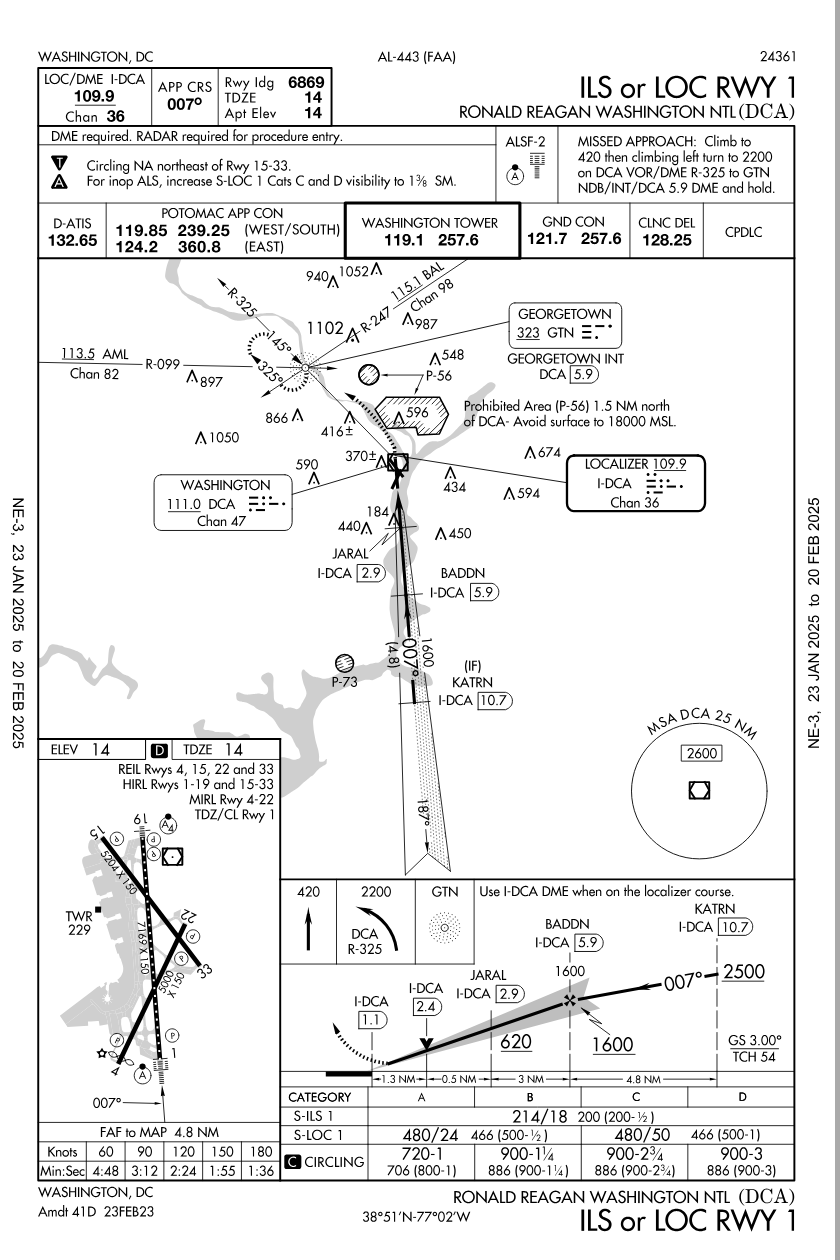
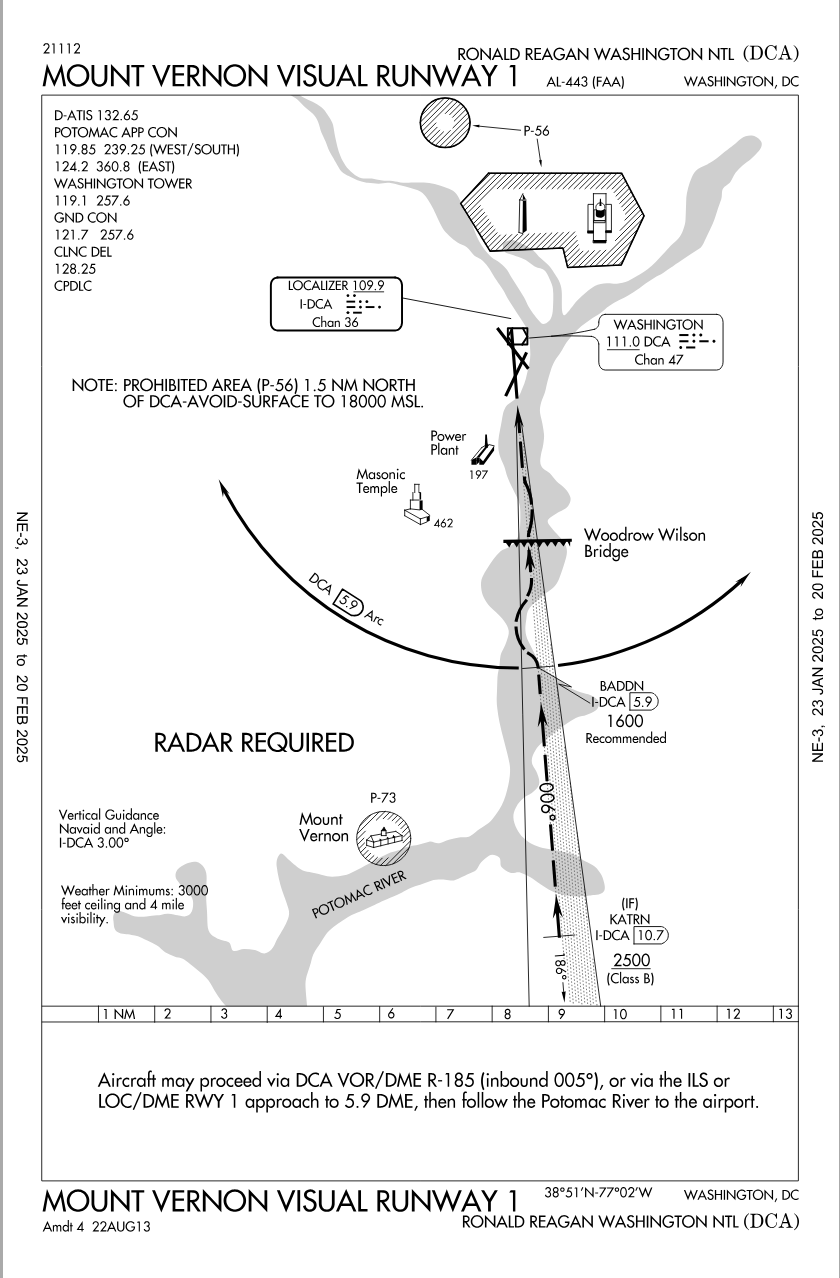
SOP's usually instruct Crews to use ILS data when doing Visual Approaches to runways with that kind of IAP so would that kind of thinking apply in this incident? Would that have been of any benefit considering the existing weather and terrain? Or, would that have been a distraction?
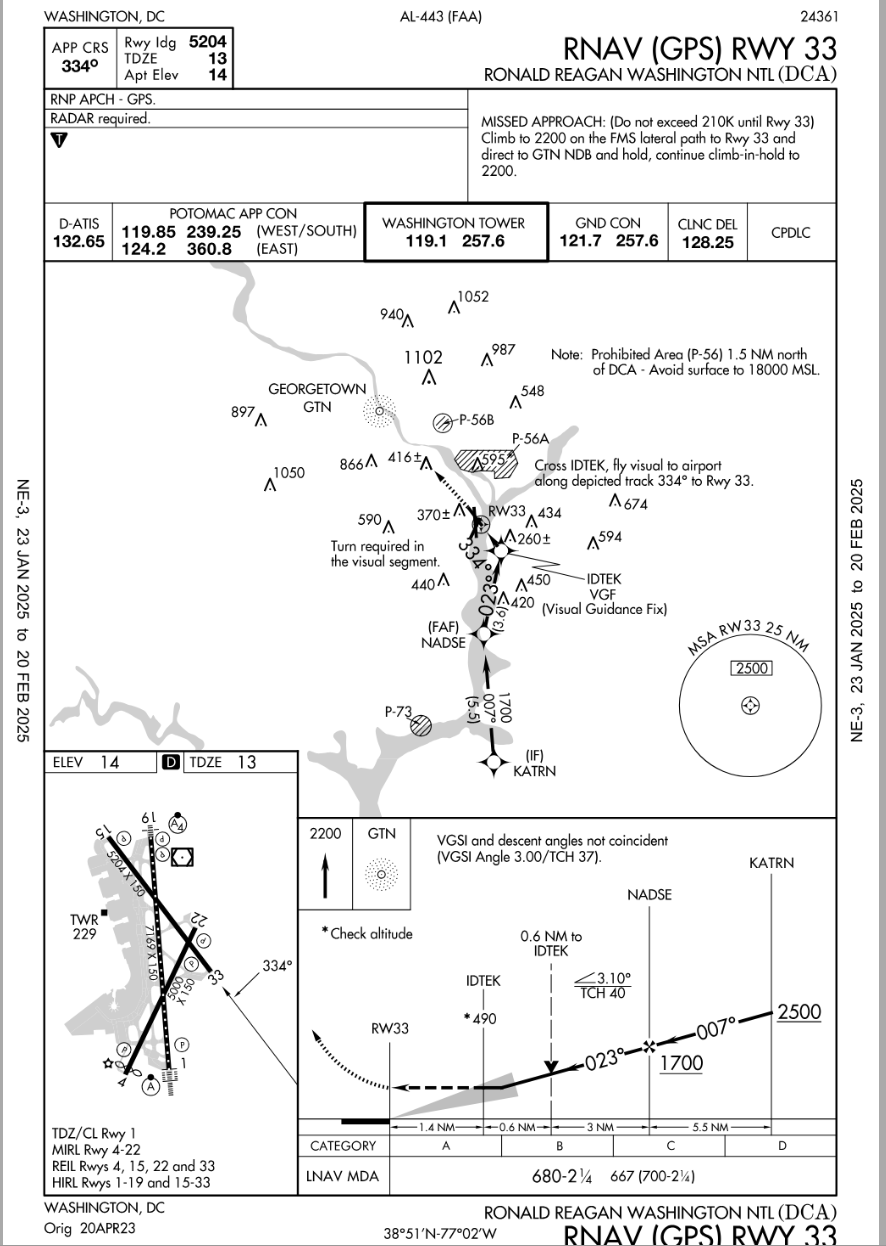
There is a curving RNAV approach, that is not in line with the runway until 490 feet/1.4nm, where one makes the last-minute ~50\xb0 left turn for visual runway alignment.
In light of that fact, maybe you can reframe your question.
AirNav: KDCA - Ronald Reagan Washington National Airport
https://aeronav.faa.gov/d-tpp/2501/00443R33.PDF
Subjects
KDCA
Links are to this post in the relevant subject page so that this post can be seen in context.
Reply to this quoting this original post. You need to be logged in. Not available on closed threads.
February 01, 2025, 17:18:00 GMT
permalink Post: 11819178
There is a curving RNAV approach, that is not in line with the runway until 490 feet/1.4nm, where one makes the last-minute ~50\xb0 left turn for visual runway alignment.
In light of that fact, maybe you can reframe your question.
AirNav: KDCA - Ronald Reagan Washington National Airport
https://aeronav.faa.gov/d-tpp/2501/00443R33.PDF
Now a test question for him.... . were you flying the incident airplane doing a Visual Approach to RWY33....would you have tuned up the IAP for that RWY as an additional reference for your approach ?
SOP's usually instruct Crews to use ILS data when doing Visual Approaches to runways with that kind of IAP so would that kind of thinking apply in this incident? Would that have been of any benefit considering the existing weather and terrain? Or, would that have been a distraction?
Pattern, perhaps you might review your comment.
It really is not a difficult concept or question.
Seems easy enough to understand if the post is actually read for comprehension sakes.
About 80% of all IATA operators would be discomforted by such changes, outside of the USA visual approaches at night have a litany of requirements to adhere to for the purposes of terrain separation, vs Texas big sky rules that do work in the US. In the end, taht didn't cause the accident, it is one of those things that goes with the freedom of flight in the USA.
...
Subjects
ATC
CRJ
KDCA
Separation (ALL)
Links are to this post in the relevant subject page so that this post can be seen in context.
Reply to this quoting this original post. You need to be logged in. Not available on closed threads.
February 02, 2025, 03:18:00 GMT
permalink Post: 11819485
FAA Order JO 7110.65AA - Air Traffic Control
7.9.4 SEPARATIONa. Standard IFR services to IFR aircraft.
b. VFR aircraft must be separated from VFR/IFR aircraft/ helicopter/rotorcraft that weigh more than 19,000 pounds and turbojets by no less than:
1. 1 \xbd miles separation, or
2. 500 feet vertical separation, or
3. Visual separation, as specified in paragraph 7-2-1 , Visual Separation, paragraph 7-4-2 , Vectors for Visual Approach, and paragraph 7-6-7 , Sequencing.
7.2.1 VISUAL SEPARATION
a.2. Pilot-applied visual separation.
(a) Maintain communication with at least one of the aircraft involved and ensure there is an ability to communicate with the other aircraft.
(b) The pilot sees another aircraft and is instructed to maintain visual separation from the aircraft as follows
(1) Tell the pilot about the other aircraft. Include position, direction, type, and, unless it is obvious, the other aircraft's intention.
(2) Obtain acknowledgment from the pilot that the other aircraft is in sight.
(3) Instruct the pilot to maintain visual separation from that aircraft.
Subjects
FAA
IFR
Separation (ALL)
VFR
Vertical Separation
Visual Separation
Links are to this post in the relevant subject page so that this post can be seen in context.
Reply to this quoting this original post. You need to be logged in. Not available on closed threads.
February 03, 2025, 12:44:00 GMT
permalink Post: 11820506
https://www.washingtonpost.com/dc-md...ues-point-dei/
Crews are set to begin lifting a catastrophically damaged American Airlines regional jet from the bottom of the Potomac River in Washington on Monday, five days after the plane and an Army helicopter collided in a fiery crash that left no survivors .
What’s left of the plane will be carefully brought to the surface with the help of Navy salvage experts and specialized dive teams who have been rehearsing the effort, according to Col. Francis Pera, the Baltimore district commander for the U.S. Army Corps of Engineers, which is helping oversee the work.
The Army Corps said the process could take three days to complete. The aircraft will be hoisted out of the water with a crane and onto a barge, then covered by a large tent, providing “full discretion” for human remains that may still be on board, Pera said.
Last edited by visibility3miles; 3rd February 2025 at 13:00 . Reason: Adding quote about NOTAM
Subjects
Blackhawk (H-60)
DCA
FAA
NTSB
Links are to this post in the relevant subject page so that this post can be seen in context.
Reply to this quoting this original post. You need to be logged in. Not available on closed threads.
February 03, 2025, 23:26:00 GMT
permalink Post: 11821010
Thanks
Subjects
ATC
Blackhawk (H-60)
IFR
Radar
VFR
Links are to this post in the relevant subject page so that this post can be seen in context.
Reply to this quoting this original post. You need to be logged in. Not available on closed threads.
February 04, 2025, 10:57:00 GMT
permalink Post: 11821301
Thanks
Issue a safety alert to an aircraft if you are aware the aircraft is in a position/altitude that, in your judgment, places it in unsafe proximity to terrain, obstructions, or other aircraft. Once the pilot informs you action is being taken to resolve the situation, you may discontinue the issuance of further alerts. Do not assume that because someone else has responsibility for the aircraft that the unsafe situation has been observed and the safety alert issued; inform the appropriate controller.
NOTE-
1. The issuance of a safety alert is a first priority (see paragraph 2-1-2, Duty Priority) once the controller observes and recognizes a situation of unsafe aircraft proximity to terrain, obstacles, or other aircraft. Conditions, such as workload, traffic volume, the quality/limitations of the radar system, and the available lead time to react are factors in determining whether it is reasonable for the controller to observe and recognize such situations. While a controller cannot see immediately the development of every situation where a safety alert must be issued, the controller must remain vigilant for such situations and issue a safety alert when the situation is recognized.
Recognition of situations of unsafe proximity may result from MSAW/E-MSAW, automatic altitude readouts, Conflict/Mode C Intruder Alert, observations on a PAR scope, or pilot reports.
Once the alert is issued, it is solely the pilot's prerogative to determine what course of action, if any, will be taken.
...
b. Aircraft Conflict/Mode C Intruder Alert. Immediately issue/initiate an alert to an aircraft if you are aware of another aircraft at an altitude that you believe places them in unsafe proximity. If feasible, offer the pilot an alternate course of action. When an alternate course of action is given, end the transmission with the word \x93immediately.\x94
PHRASEOLOGY-
TRAFFIC ALERT (call sign) (position of aircraft) ADVISE YOU TURN LEFT/RIGHT (heading),
and/or
CLIMB/DESCEND (specific altitude if appropriate) IMMEDIATELY.
EXAMPLE-
\x93Traffic Alert, Cessna Three Four Juliett, 12'o clock, 1 mile advise you turn left immediately.\x94
or
\x93Traffic Alert, Cessna Three-Four Juliett, 12'o clock, 1 mile advise you turn left and climb immediately.\x94
Subjects
ALERT Act of 2026
ATC
Blackhawk (H-60)
Radar
Links are to this post in the relevant subject page so that this post can be seen in context.
Reply to this quoting this original post. You need to be logged in. Not available on closed threads.
February 06, 2025, 16:55:00 GMT
permalink Post: 11823104
Ref para 3.2.3. e. 2 here https://www.faa.gov/air_traffic/publ...l%20separation .
Subjects
ATC
Separation (ALL)
Traffic in Sight
Visual Separation
Links are to this post in the relevant subject page so that this post can be seen in context.
Reply to this quoting this original post. You need to be logged in. Not available on closed threads.
February 06, 2025, 18:20:00 GMT
permalink Post: 11823141
Ref para 3.2.3. e. 2 here https://www.faa.gov/air_traffic/publ...l%20separation .
I have watched these comments in two threads with interest. Helo routes under busy approach lanes was (and I believe, still is) the norm at Boscombe Down when I arrived there in th eearly 90s. When the civvy incumbants left and the military took over we had to learn from scratch and one of the first things was to sort out the procedure for helicopters routing from Middle Wallop, along the railway line towards Boscombe Down before making a sharp right to go under the approach path to 23 before heading of north west into the Salisbury Plain play areas. As far as I remember this was a no-RT route and was a akin to a child crossing the road (look left, look right and when safe, cross). It was not unusal to have a jet on PAR and then a little blip appear about 2 miles finals crossing at 90 degrees. I seem to think this had been going on like this for years. After that it was mandated that a call to ATC must be made, and if traffic was busy, the helos held clear of the appraoch path. I cannot remember the exact details but think there was a150ft cap as well and a conspicuity squawk. Back then Boscombe was incredibly busy.
IMHO the crew on the helo were alerted to traffic, a misident occurs and they press on, maybe relaxing their altitude accuracy as they are not aware of any other threats besides the one they can see in the distance, which they will clearly pass behind as requested. They would have no clue as to aircraft type.
A very sad incident indeed and my heart goes out to all involved.
Subjects
ATC
Pass Behind
Pass Behind (All)
Separation (ALL)
Traffic in Sight
Links are to this post in the relevant subject page so that this post can be seen in context.
Reply to this quoting this original post. You need to be logged in. Not available on closed threads.
February 06, 2025, 19:52:00 GMT
permalink Post: 11823184
Ref para 3.2.3. e. 2 here https://www.faa.gov/air_traffic/publ...l%20separation .
Subjects
ATC
Separation (ALL)
Traffic in Sight
Visual Separation
Links are to this post in the relevant subject page so that this post can be seen in context.
Reply to this quoting this original post. You need to be logged in. Not available on closed threads.
February 07, 2025, 21:23:00 GMT
permalink Post: 11823937
https://www.faa.gov/documentLibrary/...5-24_READY.pdf
As mentioned upthread, if not visually separated then either 500ft or 1.5mi applies.
Correct if this is all wrong, but in the accident sequence if the helo had responded ‘not visual yet, looking’ or words to that effect, then presumably a controller could allow the two to get a bit closer and then advise the conflicting traffic info to the helo again, say at 2.5mi. If helo visual, great —maintain visual separation, responsibly passes to helo.
This is what happened, although the very busy controller failed to re-state the position of the CRJ to direct the eyes of the helo crew onto the CRJ in order that they could actually see and avoid it.
However if not visual at say 2.5mi, well it’s a bit late, but the controller does still retain responsibility for separation and must apply the 500ft/1.5mi standard. Presumably instant vectors away while simultaneously climb to min vectoring altitude. Or the CRJ has to go around. Can of worms in busy airspace— helos and /or jets being dispersed all over the sky.
Much better to do a rules based system and mutually exclude intersecting IFR app/deps and Helo Visual Routes.
Last edited by Stagformation; 7th February 2025 at 22:06 .
Subjects
ATC
CRJ
FAA
IFR
See and Avoid
Separation (ALL)
Visual Separation
Links are to this post in the relevant subject page so that this post can be seen in context.
Reply to this quoting this original post. You need to be logged in. Not available on closed threads.
February 07, 2025, 22:59:00 GMT
permalink Post: 11824002
https://www.faa.gov/documentLibrary/...5-24_READY.pdf
As mentioned upthread, if not visually separated then either 500ft or 1.5mi applies.
Correct if this is all wrong, but in the accident sequence if the helo had responded \x91not visual yet, looking\x92 or words to that effect, then presumably a controller could allow the two to get a bit closer and then advise the conflicting traffic info to the helo again, say at 2.5mi. If helo visual, great \x97maintain visual separation, responsibly passes to helo.
This is what happened, although the very busy controller failed to re-state the position of the CRJ to direct the eyes of the helo crew onto the CRJ in order that they could actually see and avoid it.
However if not visual at say 2.5mi, well it\x92s a bit late, but the controller does still retain responsibility for separation and must apply the 500ft/1.5mi standard. Presumably instant vectors away while simultaneously climb to min vectoring altitude. Or the CRJ has to go around. Can of worms in busy airspace\x97 helos and /or jets being dispersed all over the sky.
Much better to do a rules based system and mutually exclude intersecting IFR app/deps and Helo Visual Routes.
Subjects
ATC
CRJ
IFR
Radar
See and Avoid
Separation (ALL)
Visual Separation
Links are to this post in the relevant subject page so that this post can be seen in context.
Reply to this quoting this original post. You need to be logged in. Not available on closed threads.
February 08, 2025, 06:22:00 GMT
permalink Post: 11824114
https://www.faa.gov/documentLibrary/...5-24_READY.pdf
As mentioned upthread, if not visually separated then either 500ft or 1.5mi applies.
Correct if this is all wrong, but in the accident sequence if the helo had responded \x91not visual yet, looking\x92 or words to that effect, then presumably a controller could allow the two to get a bit closer and then advise the conflicting traffic info to the helo again, say at 2.5mi. If helo visual, great \x97maintain visual separation, responsibly passes to helo.
This is what happened, although the very busy controller failed to re-state the position of the CRJ to direct the eyes of the helo crew onto the CRJ in order that they could actually see and avoid it.
However if not visual at say 2.5mi, well it\x92s a bit late, but the controller does still retain responsibility for separation and must apply the 500ft/1.5mi standard. Presumably instant vectors away while simultaneously climb to min vectoring altitude. Or the CRJ has to go around. Can of worms in busy airspace\x97 helos and /or jets being dispersed all over the sky.
Much better to do a rules based system and mutually exclude intersecting IFR app/deps and Helo Visual Routes.
He is not radar qualified- so no headings or radar measurment distances applicable.
Where is prescribed what point is 1,5 Nm away from visual app for rwy 33? ( Note : Atco must achive required separation before that point)
or
At what point should be givem climb instruction for He to be 500' above arriving a/c before compromising 1,5Nm. If rate of climb is 1000 ft/min Helicopet need to climb for 40-50 seconds with the speed 180km/h it is 2 Nm or so - it means that instruction to climb should be given no latter than 4Nm from crossing point.
What is possibikity to spot particular aircraft for visual separation at distances more than 4Nm from crosssing points, duting the night and in bussy traffic enviroment?
Yes , I know it is Burund....
Subjects
ATC
ATCO
CRJ
IFR
Radar
See and Avoid
Separation (ALL)
Visual Separation
Links are to this post in the relevant subject page so that this post can be seen in context.
Reply to this quoting this original post. You need to be logged in. Not available on closed threads.
February 09, 2025, 18:15:00 GMT
permalink Post: 11825063
To discuss what he could or should have done is just playing " Captain hindsight "
The procedure was wrong , the safety case botched , and as I understand, the " book " allowing all this was followed by both the controller and the helicopter pilot .
Let's discuss the procedures and visual separation delegation at night in busy airports instead on focusing on what the controller should have done , implying indirectly some form of responsibility in this accident..
cf FAA Order JO 7110.65AA 7.2.1.a.2 Pilot-applied visual separation
(e)Advise the pilots if the radar targets appear likely to merge.
Last edited by deltafox44; 9th February 2025 at 19:04 . Reason: adding source
Subjects
ATC
FAA
Pass Behind
Pass Behind (All)
Radar
Separation (ALL)
Visual Separation
Links are to this post in the relevant subject page so that this post can be seen in context.
Reply to this quoting this original post. You need to be logged in. Not available on closed threads.