January 31, 2025, 16:45:00 GMT
permalink Post: 11818352
"Staffing at the air traffic control tower at Ronald Reagan National Airport was \x93not normal for the time of day and volume of traffic,\x94 according to an internal preliminary Federal Aviation Administration safety report about the collision that was reviewed by The New York Times.
The controller who was handling helicopters in the airport\x92s vicinity Wednesday night was also instructing planes that were landing and departing from its runways. Those jobs typically are assigned to two controllers, rather than one.
This increases the workload for the air traffic controller and can complicate the job. One reason is that the controllers can use different radio frequencies to communicate with pilots flying planes and pilots flying helicopters. While the controller is communicating with pilots of the helicopter and the jet, the two sets of pilots may not be able to hear each other.Like most of the country\x92s air traffic control facilities, the tower at Reagan airport has been understaffed for years. The tower there was nearly a third below targeted staff levels, with 19 fully certified controllers as of September 2023, according to the most recent Air Traffic Controller Workforce Plan, an annual report to Congress that contains target and actual staffing levels. The targets set by the F.A.A. and the controllers\x92 union call for 30.
The shortage \x97 caused by years of employee turnover and tight budgets, among other factors \x97 has forced many controllers to work up to six days a week and 10 hours a day."
Subjects
ATC
FAA
New York Times
Links are to this post in the relevant subject page so that this post can be seen in context.
Reply to this quoting this original post. You need to be logged in. Not available on closed threads.
January 31, 2025, 17:26:00 GMT
permalink Post: 11818392
FAA Near Midair Collision System (NMACS)
BackgroundA NMAC is an incident associated with the operation of an aircraft in which a possibility of a collision occurs as a result of proximity of less than 500 feet to another aircraft, or a report is received from a pilot or flight crew member stating that a collision hazard existed between two or more aircraft. A report does not necessarily involve the violation of regulations or error by the air traffic control system, nor does it necessarily represent an unsafe condition.
You are allowed to do formation, that's in the rules, it just requres all participants to be have agreed to be part of the formation and a few other pesky things, like...
\xa7 91.111 Operating near other aircraft.
(a) No person may operate an aircraft so close to another aircraft as to create a collision hazard.(b) No person may operate an aircraft in formation flight except by arrangement with the pilot in command of each aircraft in the formation.
(c) No person may operate an aircraft, carrying passengers for hire, in formation flight.
Given how unusual the airspace is around DC, at least there would be good guidance and x'lent safety priorities related to that, which would come up in 14CFRPart 93, SATR.
Subpart T—Ronald Reagan Washington National Airport Traffic Rules
Source ocket No. 25143,
51 FR 43587
, Dec. 3, 1986; Amdt. 93-82,
68 FR 9795
, Feb. 28, 2003, unless otherwise noted.
ocket No. 25143,
51 FR 43587
, Dec. 3, 1986; Amdt. 93-82,
68 FR 9795
, Feb. 28, 2003, unless otherwise noted.
\xa7 93.251 Applicability.
This subpart prescribes rules applicable to the operation of aircraft to or from Ronald Reagan Washington National Airport.\xa7 93.253 Nonstop operations.
No person may operate an aircraft nonstop in air transportation between Ronald Reagan Washington National Airport and another airport that is more than 1,250 miles away from Ronald Reagan Washington National Airport.hmmm,
Noise abatement. MACs are quite noisy.
Last edited by Saab Dastard; 31st January 2025 at 18:02 . Reason: reference to deleted posts removed
Subjects
FAA
Links are to this post in the relevant subject page so that this post can be seen in context.
Reply to this quoting this original post. You need to be logged in. Not available on closed threads.
January 31, 2025, 17:45:00 GMT
permalink Post: 11818406
https://www.cnn.com/us/live-news/pla...-25/index.html
Subjects
CNN
FAA
Links are to this post in the relevant subject page so that this post can be seen in context.
Reply to this quoting this original post. You need to be logged in. Not available on closed threads.
January 31, 2025, 17:54:00 GMT
permalink Post: 11818415
https://www.cnn.com/us/live-news/pla...-25/index.html
Subjects
CNN
FAA
Links are to this post in the relevant subject page so that this post can be seen in context.
Reply to this quoting this original post. You need to be logged in. Not available on closed threads.
January 31, 2025, 18:52:00 GMT
permalink Post: 11818453
HEAR, HEAR.
In the hands of bureaucrats, SMS has drifted far from its purpose, and become another unwieldy, overly complex, set of box-ticking processes. There are some civil aviation service providers -- i.e. airports, airlines, and ANSPs -- that have functional, effective SMS's. Somewhat ironically, those are usually the smaller, more efficient organizations. The larger and more bureaucratic the entity (the FAA for example) the more likely that any collected data is not adequately assessed for risk, and acted upon.
It's SO damned sad and frustrating that, as you said, this accident was as predictable as a sunrise.
Subjects
FAA
ICAO
Links are to this post in the relevant subject page so that this post can be seen in context.
Reply to this quoting this original post. You need to be logged in. Not available on closed threads.
January 31, 2025, 19:00:00 GMT
permalink Post: 11818459
Subjects
FAA
ICAO
Links are to this post in the relevant subject page so that this post can be seen in context.
Reply to this quoting this original post. You need to be logged in. Not available on closed threads.
January 31, 2025, 19:13:00 GMT
permalink Post: 11818466
https://www.cnn.com/us/live-news/pla...-25/index.html
The most important function of an aviation Safety Management System (SMS) is to prevent accidents by identifying hazards, assess them for associated risk, and then act to mitigate those risks, before the known hazard or incident becomes an accident. Looking at the list posted above by NIBEX2A, it is crystal clear that the hazards were well known, and reported, but no appropriate mitigations were implemented -- until 67 lives were lost.
Sadly, this accident will no doubt be used as an example in the future, of how Reason's famous cheese holes can, and will, line up -- and what can happen if those holes aren't closed.
Subjects
CNN
FAA
Links are to this post in the relevant subject page so that this post can be seen in context.
Reply to this quoting this original post. You need to be logged in. Not available on closed threads.
February 01, 2025, 03:09:00 GMT
permalink Post: 11818724
1. The CRJ was on approach to 1 and then was asked to divert to 33. They complied, which added to their workload. From what I understand, that runway is rarely used for commercial aircraft. So, ATC added to the CRJ's workload while introducing and "unusual event." The CRJ crew appears to have acted professionally in changing their approach.
2. ATC didn't hold the helo short of the runway path, instead relied on them to correctly identify an aircraft, at night, over an urban area. That introduced a "single point of failure" to an already complex situation.
3. There was no way for the helo to pass safely under the CRJ at the altitude of impact.
3. I don't recall hearing ATC asking the CRJ if they could see the helo, though they already overtasked them. At that point, I don't think they could do anything at that point to prevent the collision.
Other factors may come into play, such as if ATC was properly staffed that night. I've read that DCA had two incidents that week where an aircraft had to perform a "go around" because of helo traffic. Also, was the CRJ's TCAS system operational?
This was completely preventable if things work they way they're supposed to.
Subjects
ATC
CRJ
DCA
FAA
TCAS (All)
Links are to this post in the relevant subject page so that this post can be seen in context.
Reply to this quoting this original post. You need to be logged in. Not available on closed threads.
February 01, 2025, 03:14:00 GMT
permalink Post: 11818731
If you can't post professionally on the aviation matters to hand, then don't post.
Whether or not the FAA has, or has not, fulfilled it's role is a functional, not political, matter if you can be bothered to constrain yourselves to the functional aspects of regulation.
You will not be warned again.
EDITED this post due to a link problem:
AA5342 Down DCA
Posts referencing actual facts, reported from authoritative sources, and primarily on the topic of the accident, the investigation, and associated safety are welcomed here. If in doubt, just leave out the political part of what you're thinking to write, we all know that you have an opinion, we don't need to read it here. If your post touches to role of a government official as a factor of the event, without inflaming discussion, the moderation team will do it's best to find a favourable interpretation.
Thanks for working with the moderation team on this...
Pilot DAR
Last edited by T28B; 2nd February 2025 at 19:01 . Reason: link problem required an edit
Subjects
AA5342
DCA
FAA
Thread Moderation
Links are to this post in the relevant subject page so that this post can be seen in context.
Reply to this quoting this original post. You need to be logged in. Not available on closed threads.
February 01, 2025, 03:34:00 GMT
permalink Post: 11818738
1. The CRJ was on approach to 1 and then was asked to divert to 33. They complied, which added to their workload. From what I understand, that runway is rarely used for commercial aircraft. So, ATC added to the CRJ's workload while introducing and "unusual event." The CRJ crew appears to have acted professionally in changing their approach.
2. ATC didn't hold the helo short of the runway path, instead relied on them to correctly identify an aircraft, at night, over an urban area. That introduced a "single point of failure" to an already complex situation.
3. There was no way for the helo to pass safely under the CRJ at the altitude of impact.
3. I don't recall hearing ATC asking the CRJ if they could see the helo, though they already overtasked them. At that point, I don't think they could do anything at that point to prevent the collision.
Other factors may come into play, such as if ATC was properly staffed that night. I've read that DCA had two incidents that week where an aircraft had to perform a "go around" because of helo traffic. Also, was the CRJ's TCAS system operational?
This was completely preventable if things work they way they're supposed to.
Everything else is moot, really...
Subjects
ATC
CRJ
DCA
FAA
Separation (ALL)
TCAS (All)
Visual Separation
Links are to this post in the relevant subject page so that this post can be seen in context.
Reply to this quoting this original post. You need to be logged in. Not available on closed threads.
February 01, 2025, 03:57:00 GMT
permalink Post: 11818752
Would suspending all operations of the cross runways not simplify the flow control and traffic management, while achieving the needs of the DOD and the unique needs of DC, without setting up new risks over densely populated areas? The primary runway is fit for purpose, the cross runways do not meaningfully increase operational capacity any more than a well set up series of taxiways at either end of the main runway.
The FAA's response is laudable as an immediate response, but it may not be the best risk mitigation in this case.
Subjects
CNN
FAA
Route 4
Links are to this post in the relevant subject page so that this post can be seen in context.
Reply to this quoting this original post. You need to be logged in. Not available on closed threads.
February 01, 2025, 13:18:00 GMT
permalink Post: 11819019
If you can't post professionally on the aviation matters to hand, then don't post.
Whether or not the FAA has, or has not, fulfilled it's role is a functional, not political, matter if you can be bothered to constrain yourselves to the functional aspects of regulation.
You will not be warned again.
Carry on.
Subjects
FAA
Links are to this post in the relevant subject page so that this post can be seen in context.
Reply to this quoting this original post. You need to be logged in. Not available on closed threads.
February 01, 2025, 18:07:00 GMT
permalink Post: 11819203
My thoughts:
I continue to see this as:
- a failure of imagination by command;
- a system failure by command to monitor performance against expected system behaviour;
- an information system failure, the evidence has been in front of those that are charged with having safe systems such as the govt, regulator, DOD, airlines;
- The crew and the the ATC controller, and certainly the passengers are not high in the systemic failures that occur here, I would contend that the crew and the ATC officer are victims of the systemic failures.
Criss-Crossing Routes in D.C. Airspace Leave Little Room for Error
By Elena Shao , Leanne Abraham , Eli Murray and Lazaro GamioThe pictures are out of order, the tracks are for "1-Week" of data. The latest NOTAM is a good start, the helo fleet operators may want to revisit the concept of the flyways.
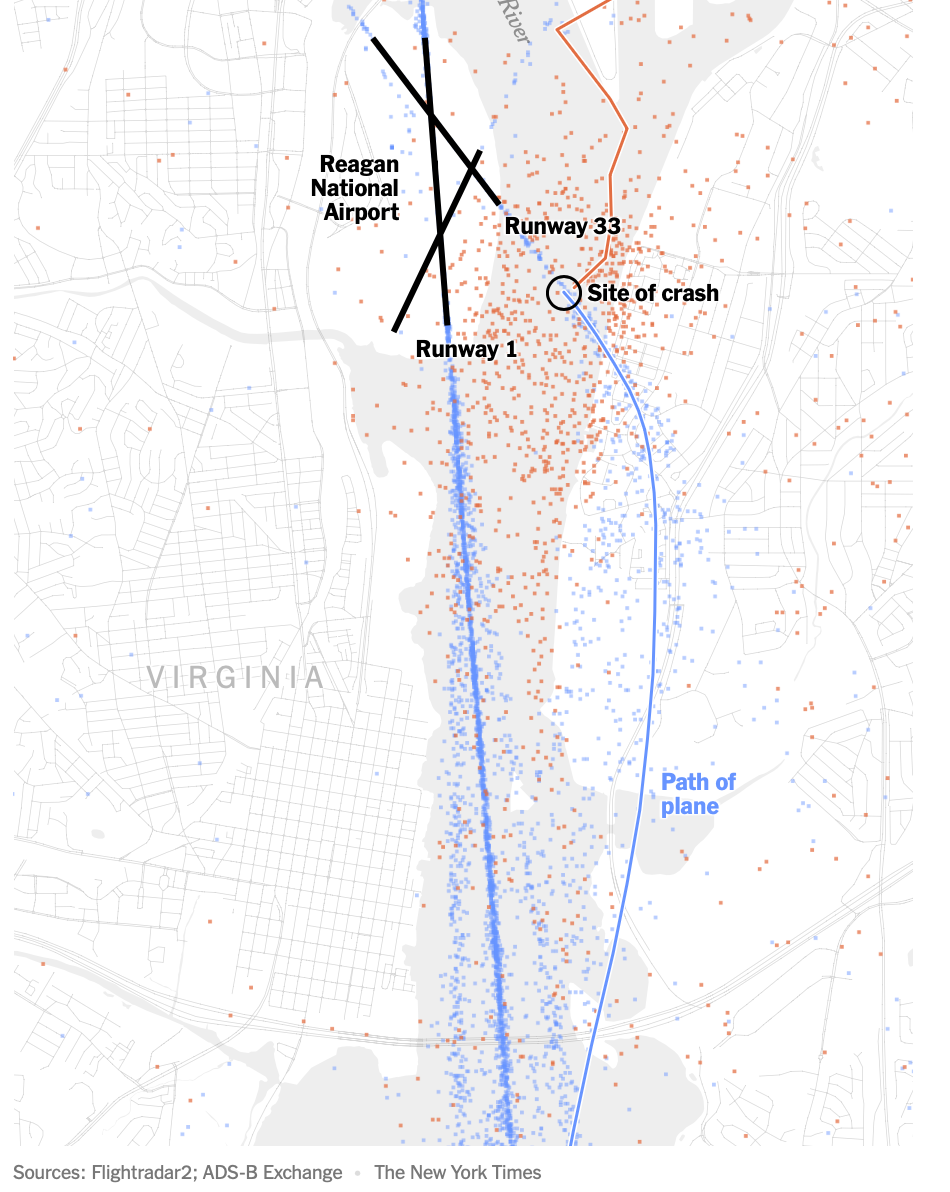
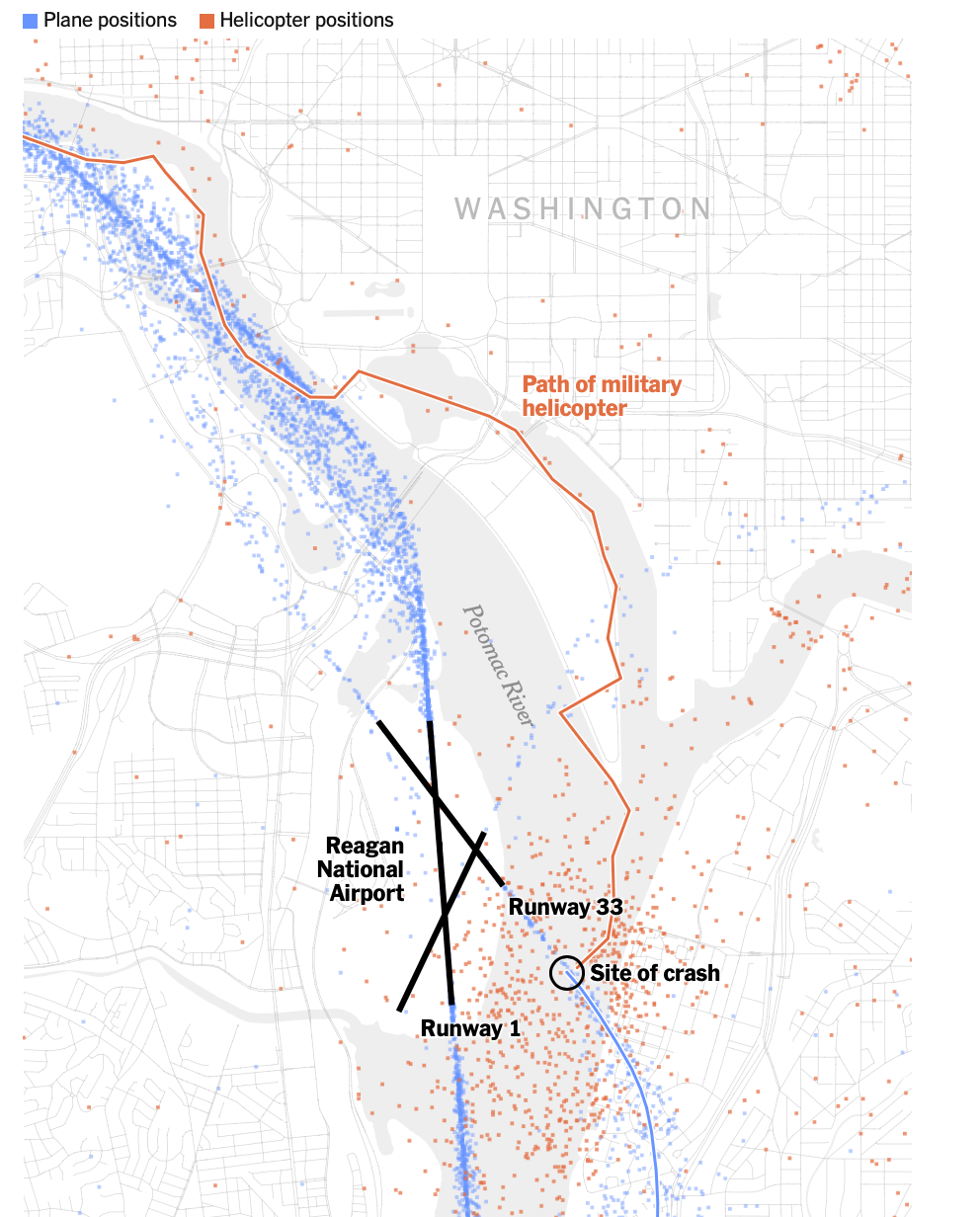
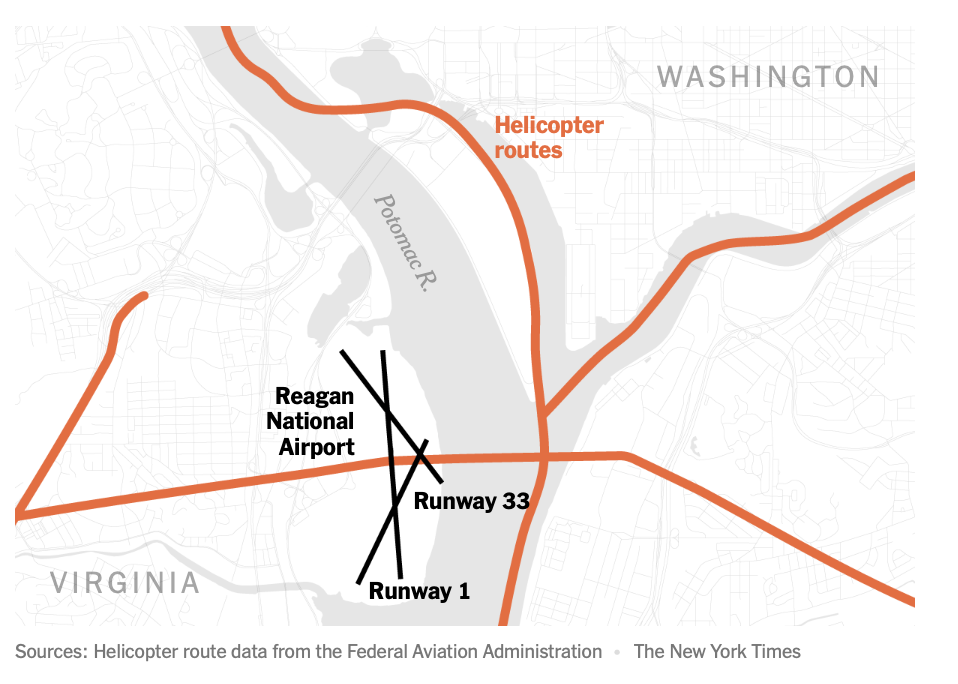
A deadly midair collision between an American Airlines passenger jet and a U.S. Army helicopter near Ronald Reagan National Airport in Washington highlights the complexity of navigating an airspace with many civilian and military aircraft.
The airport has three runways that intersect, but only one is used for nearly all of its hundreds of daily flights. With the routes of aircraft routinely criss-crossing one another, there is little room for error as planes descend onto the runways. To stay out of the way of commercial jets, helicopters in this area are supposed to fly along a route designated by the Federal Aviation Administration at an altitude no higher than 200 feet.
Air traffic data from the past week shows that helicopters flying along the Potomac River must navigate amid the takeoffs and landings of hundreds of planes daily. While they are advised by the F.A.A. to stick to a tight air corridor above the eastern bank of the river, data shows that in reality, helicopters can be spotted across the width of the river.
One week of air traffic at Reagan National
Dots show positions of planes during their takeoffs and landings at Reagan National Airport, as well as the positions of helicopters as they traversed the area from Jan. 23 to Jan. 30.The American Airlines flight was cleared to land on Runway 1 before being instructed by an air traffic controller shortly before the collision to pivot its landing route to the intersecting Runway 33.
The last-minute request to switch runways at Reagan National is “very common,” said Shawn Pruchnicki, a former airline pilot and an assistant professor at the Center for Aviation Studies at Ohio State University, who said he has piloted aircraft into the airport more than a hundred times.
Skies were clear on Wednesday night when the two aircraft collided. But, in case of low visibility, like in poor weather, the F.A.A. has designed “instrument approaches,” or descents that involve a series of steps pilots must follow to maneuver down to the runway safely.
The instrument approach for Runway 1 calls for a descending plane to cross over the helicopter corridor while the plane is at a much higher altitude, somewhere from 620 to 1,700 feet and more than a minute from landing. The approach for Runway 33, however, calls for a plane to cross over the helicopter corridor at a much lower altitude, because a plane is seconds from landing. The clearance between a helicopter in the corridor and a descending plane may be from 100 to 300 feet, which can result in close calls if there are severe fluctuations in the altitude of either aircraft.
Sources: Helicopter route and instrument approach data from the Federal Aviation Administration
Note: An instrument approach is a descent that involves a series of scripted flight maneuvers, with pilots using navigation aids and instruments to reach the runway safely when visibility is low, such as in poor weather.
The [failing] New York Times
Given the clear nighttime weather, the plane’s pilots would not have been expected to initiate an instrument approach to aid their landing, Mr. Pruchnicki said, and instead could have used their vision to guide their descent to the runway. Data on the aircraft’s positions indicates that the pilots’ route was very similar to the one outlined in an instrument approach. For example, the plane maintained roughly the recommended altitude when it made a leftward turn toward Runway 33.
In this case, the Army Black Hawk requested permission to use the route designated for helicopters, meaning that it would keep to the eastern bank of the Potomac and stay under 200 feet in altitude. But the helicopter was at least a half-mile off of the approved route when it collided with the jet, according to four people briefed on the matter but not authorized to speak publicly. The helicopter was also flying above 300 feet, not below 200, the people said.
The crash also renewed questions about the safety of intersecting runways, which the F.A.A. has sought to eliminate or close in recent years in places like Chicago and Dallas because of concerns over congestion on the ground. The setup can increase the workload of the air traffic controller, especially if the two runways are getting used simultaneously for takeoff and landing, said Cyriel Kronenburg, a former air traffic controller and pilot.
An internal preliminary report from the F.A.A., which was reviewed by The New York Times , said that a supervisor allowed an air traffic controller to leave early, sometime before the crash. This left one air traffic controller to manage the dual roles of handling helicopters in the airport’s vicinity and also instructing planes that were landing and departing from runways, according to a person briefed on the matter. While it is within the supervisor’s discretion to combine the duties, that staffing configuration “was not normal for the time of day and volume of traffic,” the F.A.A. report said.
A Times investigation in 2023 found that the nation’s air traffic control facilities are chronically understaffed , contributing to an alarming number of close calls in the skies and on the runways across the country. Before the plane crash on Wednesday night, there were at least 10 close calls at Reagan National in the last three years that were documented in government records reviewed by The Times.
Additional research by Riley Mellen.
See more on: Federal Aviation Administration (F.A.A.)
https://www.nytimes.com/interactive/...smid=url-share
Subjects
ATC
Blackhawk (H-60)
Close Calls
FAA
Preliminary Report
Links are to this post in the relevant subject page so that this post can be seen in context.
Reply to this quoting this original post. You need to be logged in. Not available on closed threads.
February 01, 2025, 20:30:00 GMT
permalink Post: 11819276
In finding ‘probable cause’, do the NTSB’s terms of reference provide any guidance on the proximity (in time) of that cause to the accident?
Not in any way wishing to prejudge the outcome of the enquiry, I’ll pick a couple of hypothetical examples.
Could the NTSB for example say, “it all goes back to 1991 and the firing of the striking Controllers”.
Or closer to the accident in the timeline, “the number of movements at the airport was excessive and the procedures in use were unsafe and we see that as root cause”.
Or are they limited to something completely specific and timely along the lines of, “the altimeter was out of calibration and that put the two aircraft in conflict”.
thanks.
Subjects
Altimeter (All)
FAA
NTSB
Links are to this post in the relevant subject page so that this post can be seen in context.
Reply to this quoting this original post. You need to be logged in. Not available on closed threads.
February 02, 2025, 00:48:00 GMT
permalink Post: 11819416
Assuming the CRJ was at an expected/typical altitude at that point in it's approach, if the helicopter was at 200 feet, or lets say for their benefit 175 feet, then they would have avoided collision by a mere 150 feet of vertical separation if everything else about the position of the two aircraft remained the same.
Is 125 feet of vertical separation (with no horizontal separation) considered acceptable?
If the CRJ movement is controlled by ATC, and the helicopter is responsible for avoiding all other aircraft, then there is no question the helicopter was at fault here as the primary cause, and ATC as the secondary.
Given the collision course these aircraft were clearly on, why wouldn't ATC have diverted one of them prior to impact? Does ATC have any reason to believe that the helicopter sees everything with the same degree of detail and accuracy as ATC? This is not a sarcastic question. I'm genuinely curious. Would ATC, hearing the helicopter twice affirming visual separation, have had any plausible reason to doubt that the helicopter was unaware of the impending collision?
What's the point of having Air Traffic "Control"...if they're not actually in control?
The helo should have been told to hold some half mile away and wait for crossing traffic to clear.
The NTSB is going to have a field day with the FAA on this.
Subjects
ATC
CRJ
FAA
NTSB
Separation (ALL)
Vertical Separation
Visual Separation
Links are to this post in the relevant subject page so that this post can be seen in context.
Reply to this quoting this original post. You need to be logged in. Not available on closed threads.
February 02, 2025, 03:16:00 GMT
permalink Post: 11819484
It almost seems backwards to me. Late runway changes should only be applied in quiet environments, allowing plenty of room for manoeuvring without separation issues. The same for visual separation, where only one or two aircraft in the area make misidentification of traffic an improbability. Unfortunately the reverse is true. The busier and more congested the airspace, the more likely these procedures are to be used. From a risk identification and management perspective, I just don't see how operating like this can ever have been deemed acceptable.
Again though, it's used because it's the only way to squeeze an extra 1% out of an over burdened system. And worse of all, everyone involved, from pilots to ATC, think they're the worlds best for making it "work".
All that said, the plan for DCA, particularly the helicopter ops, were hazardous in the extreme. The Route 4/33 operations is just plain dangerous, nothing less. The politics of DCA are going to drive a band-aid fix is my prediction. Visual separation won\x92t go away. FAA will get crucified over manning. DCA may lose some significant service, if we closed 33 permanently. If I read the NOTAM correctly, closing 4 and 33, the pain will become known, interestingly, I read elsewhere that the helicopter altitudes were raised to 200\x92 in 2023 due to noise complaints.
Subjects
ATC
DCA
FAA
Separation (ALL)
Visual Separation
Links are to this post in the relevant subject page so that this post can be seen in context.
Reply to this quoting this original post. You need to be logged in. Not available on closed threads.
February 02, 2025, 03:18:00 GMT
permalink Post: 11819485
FAA Order JO 7110.65AA - Air Traffic Control
7.9.4 SEPARATIONa. Standard IFR services to IFR aircraft.
b. VFR aircraft must be separated from VFR/IFR aircraft/ helicopter/rotorcraft that weigh more than 19,000 pounds and turbojets by no less than:
1. 1 \xbd miles separation, or
2. 500 feet vertical separation, or
3. Visual separation, as specified in paragraph 7-2-1 , Visual Separation, paragraph 7-4-2 , Vectors for Visual Approach, and paragraph 7-6-7 , Sequencing.
7.2.1 VISUAL SEPARATION
a.2. Pilot-applied visual separation.
(a) Maintain communication with at least one of the aircraft involved and ensure there is an ability to communicate with the other aircraft.
(b) The pilot sees another aircraft and is instructed to maintain visual separation from the aircraft as follows
(1) Tell the pilot about the other aircraft. Include position, direction, type, and, unless it is obvious, the other aircraft's intention.
(2) Obtain acknowledgment from the pilot that the other aircraft is in sight.
(3) Instruct the pilot to maintain visual separation from that aircraft.
Subjects
FAA
IFR
Separation (ALL)
VFR
Vertical Separation
Visual Separation
Links are to this post in the relevant subject page so that this post can be seen in context.
Reply to this quoting this original post. You need to be logged in. Not available on closed threads.
February 02, 2025, 03:33:00 GMT
permalink Post: 11819493
All that said, the plan for DCA, particularly the helicopter ops, were hazardous in the extreme. The Route 4/33 operations is just plain dangerous, nothing less. The politics of DCA are going to drive a band-aid fix is my prediction. Visual separation won’t go away. FAA will get crucified over manning. DCA may lose some significant service, if we closed 33 permanently. If I read the NOTAM correctly, closing 4 and 33, the pain will become known, interestingly, I read elsewhere that the helicopter altitudes were raised to 200’ in 2023 due to noise complaints.
And yes, trying to do EU IFR for everything all the time would create some epic traffic jams.
* IMHO they need the dedicated helicopter controller on at ALL times the helicopters are flying and they need to be held for crossing traffic. They also all need ADS-B, no private pilot that wasn't totally skint would be running around with the lack of situational awareness the helos seem to have in an area like that.
Subjects
ADSB (All)
ATC
DCA
FAA
IFR
Separation (ALL)
Situational Awareness
Visual Separation
Links are to this post in the relevant subject page so that this post can be seen in context.
Reply to this quoting this original post. You need to be logged in. Not available on closed threads.
February 02, 2025, 06:20:00 GMT
permalink Post: 11819535
The difficulties of identifying a specific aircraft, at night, in a background of stationary and moving lights, when moving objects on a collision course will always appear stationary to each other, are well known, as are the probabilities of mis-identification. The airspace design 'squeezes' inbound aircraft and transiting helicopters to practicality the same altitude, when instrument and other tolerances are taken into consideration.
Subjects
FAA
NTSB
Separation (ALL)
Visual Separation
Links are to this post in the relevant subject page so that this post can be seen in context.
Reply to this quoting this original post. You need to be logged in. Not available on closed threads.
February 02, 2025, 09:27:00 GMT
permalink Post: 11819621
Now , is delegating visual separation to an Helicopter ,at night ,( with pilots wearing NGV ) on an aircraft cleared off the ILS doing a circle visual NPA at 500 ft with 4 eyes most probably locked on the PAPI something safe ? with a 150- Ft margin of error designed on the chart ? But it is how the system was built and local controllers trained on doing this , since years. Normalization of Deviance.
I wish good luck to the NTSB and the FAA is trying to reverse this .
Subjects
FAA
IFR
Land and Hold Short
NTSB
Normalization of Deviance
Separation (ALL)
Visual Separation
Links are to this post in the relevant subject page so that this post can be seen in context.
Reply to this quoting this original post. You need to be logged in. Not available on closed threads.