February 15, 2025, 21:35:00 GMT
permalink Post: 11828846
Disconcerting that the PAT 25 crew, about to descend and fly less than 200 feet AGL , would not have investigate the discrepancy of 100 feet between their respective altimeters...
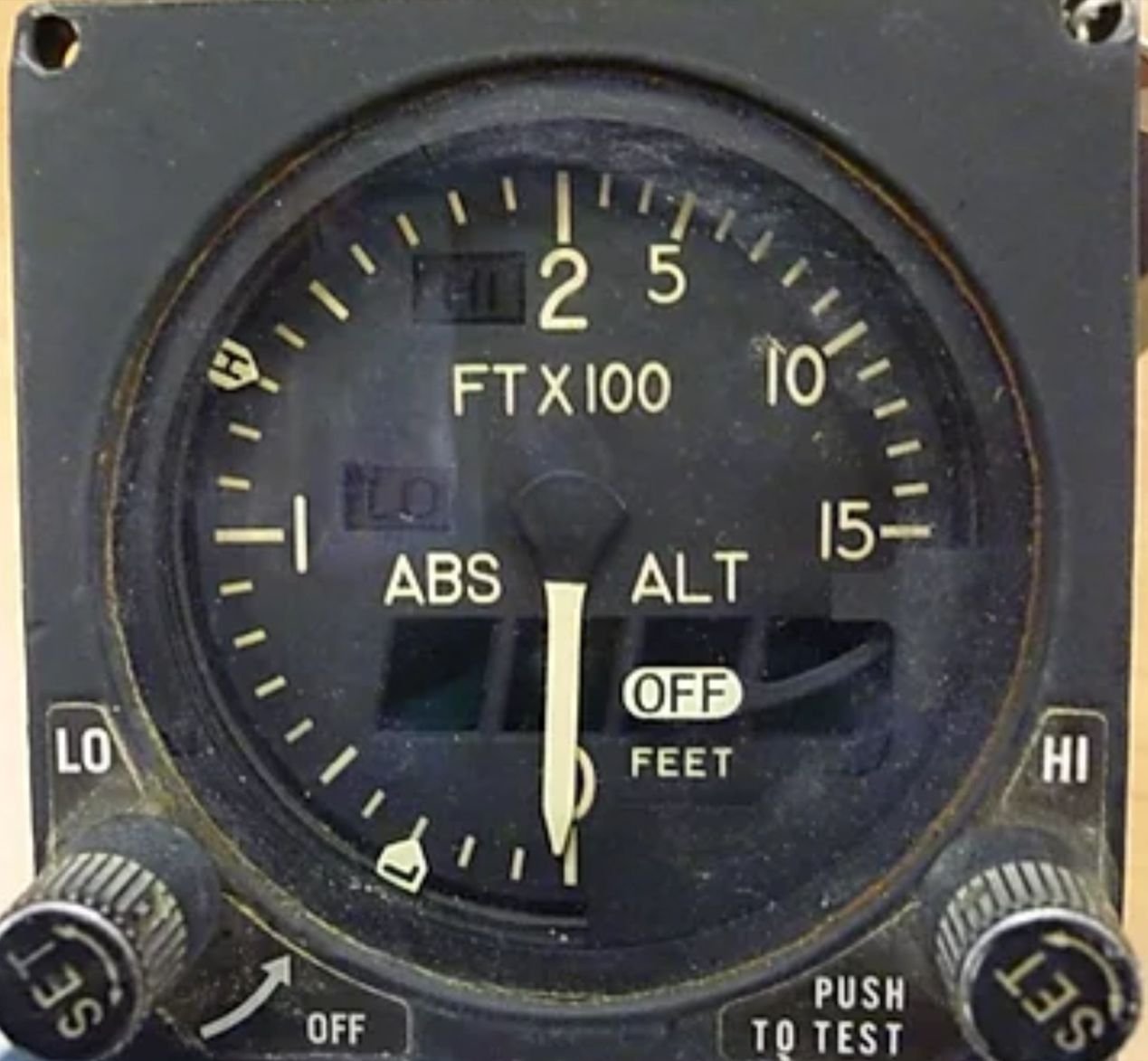
Details of instrumentation here:
https://apps.dtic.mil/sti/tr/pdf/ADA409934.pdf
Not completely obvious in the photo is the digital display of radar altitude just underneath the annotation ABS ALT. The technical manual also mentions a three digit radar altitude displayed on the HUD.
Last edited by Stagformation; 15th February 2025 at 23:01 .
Subjects
Altimeter (All)
HUD
Radar
Links are to this post in the relevant subject page so that this post can be seen in context.
Reply to this quoting this original post. You need to be logged in. Not available on closed threads.
February 25, 2025, 18:09:00 GMT
permalink Post: 11835787
Thinking about the helicopter route, and the possible errors in the helicopter-borne equipment, the Static ports could be subject to some biases, and could be variable as a function go helicopter airspeed, vertical velocity, side slip.
Add to that a possible error or change in local baro (In-Hg) as one transits from their departure point into another area, the two cockpit baro altimeters' displayed altitudes can contribute to errors, but the altitude reporting to the tower is based on 29.92, so any error in setting AAU-31 or AAU-32 In-Hg applies only to the cockpit displays; the Tower receives Alt value referenced to 29.92 inches and corrects it locally for their displays and conflict alerting algorithms.
For the approach without benefit of a Glide Slope, the VASI or PAPI is visual and thus "probably" more challenging to maintain nominal approach angle to the runway. There should have been some documented analysis, backed up by data that helps to define the worst-case vertical departure from nominal approach angle on the PAPI/VASI approach; that needs to be part of a worst-case combined analysis, and I think needs to be better than "10 to the minus nine". Need to have data from both low-hour and high-hour pilots on a non-coupled approach.
Next quasi- related thought::: when the CVR recorded a verbal disparity of 100 feet between pilot and examiner, shouldn't that have raised questions of "Why"- especially when at low altitudes MSL? As I understand it, there would be 3 or 4 places where Baro Alt was displayed; the two mechanical bar alt indicators, AND the altitude display(s) on the pilot(s) NVG HUDS. If the pilot under evaluation was fully on the ANVIS HUD, and if that pilot failed to set the Bar Alt "correction" in terms go In-Hg, then the pilot could readily be seeing inaccurate Bar Alt digits on the HUD.
I believe there procedurally had to be a separate action to set In-Hg ( or to sync the HUD to the AAU-31 and AAU-32 values). It would not take much of an error in ANVIS HUD In-Hg setting to cause a substantial error in the Altitude digits displayed on the HUD.
Add/multiply these error sources up, and then see if the defined helicopter route met the 10 to the minus nine value.
Subjects
CVR
HUD
Night Vision Goggles (NVG)
Links are to this post in the relevant subject page so that this post can be seen in context.
Reply to this quoting this original post. You need to be logged in. Not available on closed threads.
February 26, 2025, 01:45:00 GMT
permalink Post: 11836058
Thinking about the helicopter route, and the possible errors in the helicopter-borne equipment, the Static ports could be subject to some biases, and could be variable as a function go helicopter airspeed, vertical velocity, side slip.
Add to that a possible error or change in local baro (In-Hg) as one transits from their departure point into another area, the two cockpit baro altimeters' displayed altitudes can contribute to errors, but the altitude reporting to the tower is based on 29.92, so any error in setting AAU-31 or AAU-32 In-Hg applies only to the cockpit displays; the Tower receives Alt value referenced to 29.92 inches and corrects it locally for their displays and conflict alerting algorithms.
For the approach without benefit of a Glide Slope, the VASI or PAPI is visual and thus "probably" more challenging to maintain nominal approach angle to the runway. There should have been some documented analysis, backed up by data that helps to define the worst-case vertical departure from nominal approach angle on the PAPI/VASI approach; that needs to be part of a worst-case combined analysis, and I think needs to be better than "10 to the minus nine". Need to have data from both low-hour and high-hour pilots on a non-coupled approach.
Next quasi- related thought::: when the CVR recorded a verbal disparity of 100 feet between pilot and examiner, shouldn't that have raised questions of "Why"- especially when at low altitudes MSL? As I understand it, there would be 3 or 4 places where Baro Alt was displayed; the two mechanical bar alt indicators, AND the altitude display(s) on the pilot(s) NVG HUDS. If the pilot under evaluation was fully on the ANVIS HUD, and if that pilot failed to set the Bar Alt "correction" in terms go In-Hg, then the pilot could readily be seeing inaccurate Bar Alt digits on the HUD.
I believe there procedurally had to be a separate action to set In-Hg ( or to sync the HUD to the AAU-31 and AAU-32 values). It would not take much of an error in ANVIS HUD In-Hg setting to cause a substantial error in the Altitude digits displayed on the HUD.
Add/multiply these error sources up, and then see if the defined helicopter route met the 10 to the minus nine value.
This is the same deal - anytime a landing airplane is below 1,000 feet (at least!) and doesn't own the airspace from them on down to the surface, you already lost the game right there. Someone will be down there at some point a bit too high and someone at some point will be a bit too low or too close or whatever. It is a narrow 2 lane road in the country with a 150 MPH speed limit. There will be crashes.
Subjects
CVR
HUD
Night Vision Goggles (NVG)
Links are to this post in the relevant subject page so that this post can be seen in context.
Reply to this quoting this original post. You need to be logged in. Not available on closed threads.
February 26, 2025, 12:31:00 GMT
permalink Post: 11836357
Next quasi- related thought::: when the CVR recorded a verbal disparity of 100 feet between pilot and examiner, shouldn't that have raised questions of "Why"- especially when at low altitudes MSL? As I understand it, there would be 3 or 4 places where Baro Alt was displayed; the two mechanical bar alt indicators, AND the altitude display(s) on the pilot(s) NVG HUDS. If the pilot under evaluation was fully on the ANVIS HUD, and if that pilot failed to set the Bar Alt "correction" in terms go In-Hg, then the pilot could readily be seeing inaccurate Bar Alt digits on the HUD.
Helo is going to be using radalt. Everything is radalt when the heights are below ~1000ft because the alternative is often fatal. This has been covered extensively. As to the rest... Wat?
Subjects
CVR
HUD
Night Vision Goggles (NVG)
Radio Altimeter
Links are to this post in the relevant subject page so that this post can be seen in context.
Reply to this quoting this original post. You need to be logged in. Not available on closed threads.
March 26, 2025, 03:33:00 GMT
permalink Post: 11854333
Also, AA5342 received a TA and continued the approach for 18 seconds until the collision occurred. I realize an RA would not occur there, but would their SOP's suggest a G/A on receiving a TA at that position on the approach?
Apologize if these have been answered.
Regards,
OBD
Last edited by Old Boeing Driver; 26th March 2025 at 03:35 . Reason: Grammar
Subjects
AA5342
HUD
Night Vision Goggles (NVG)
Links are to this post in the relevant subject page so that this post can be seen in context.
Reply to this quoting this original post. You need to be logged in. Not available on closed threads.
January 31, 2026, 21:00:00 GMT
permalink Post: 12030376
The UH-60 Maintenance Test Flight Manual includes a barometric altimeter accuracy check, which is accomplished by calling the tower for the local altimeter setting, set the altimeter accordingly and comparing the altimeter readout to the elevation of that heliport/airport. THE ACCEPTED MAXIMUM ERROR IS 70 FEET. So, the baro altimeter readout can be 70 ft off and you are OK to fly: VFR or IFR.
The radar altimeter ( APN-171 or later APN-209 ) accuracy is similar at +/- 3 ft then 3% of indicated altitude, so, for the H-4 Route Maximum altitude of 200 ft. The Rad Alt could be as much as 9 ft off.
The NVGs do show Rad Alt.
Haven\x92t seen any submittal indicating the Rad Alt was inoperative or unusable.
The Helicopter Operations presentation included a slide stating that pilots are "Trained to use barometric altimeter to navigate helicopter route ceilings".
Subjects
Altimeter (All)
Barometric Altimeter
HUD
IFR
Night Vision Goggles (NVG)
Radar
Radio Altimeter
VFR
Links are to this post in the relevant subject page so that this post can be seen in context.
Reply to this quoting this original post. You need to be logged in. Not available on closed threads.