February 02, 2025, 03:33:00 GMT
permalink Post: 11819493
All that said, the plan for DCA, particularly the helicopter ops, were hazardous in the extreme. The Route 4/33 operations is just plain dangerous, nothing less. The politics of DCA are going to drive a band-aid fix is my prediction. Visual separation won’t go away. FAA will get crucified over manning. DCA may lose some significant service, if we closed 33 permanently. If I read the NOTAM correctly, closing 4 and 33, the pain will become known, interestingly, I read elsewhere that the helicopter altitudes were raised to 200’ in 2023 due to noise complaints.
And yes, trying to do EU IFR for everything all the time would create some epic traffic jams.
* IMHO they need the dedicated helicopter controller on at ALL times the helicopters are flying and they need to be held for crossing traffic. They also all need ADS-B, no private pilot that wasn't totally skint would be running around with the lack of situational awareness the helos seem to have in an area like that.
Subjects
ADSB (All)
ATC
DCA
FAA
IFR
Separation (ALL)
Situational Awareness
Visual Separation
Links are to this post in the relevant subject page so that this post can be seen in context.
Reply to this quoting this original post. You need to be logged in. Not available on closed threads.
February 02, 2025, 03:43:00 GMT
permalink Post: 11819495
Subjects
ATC
Altimeter (All)
Barometric Altimeter
Blackhawk (H-60)
CRJ
IFR
Links are to this post in the relevant subject page so that this post can be seen in context.
Reply to this quoting this original post. You need to be logged in. Not available on closed threads.
February 02, 2025, 04:02:00 GMT
permalink Post: 11819500
And yes, trying to do EU IFR for everything all the time would create some epic traffic jams.
* IMHO they need the dedicated helicopter controller on at ALL times the helicopters are flying and they need to be held for crossing traffic. They also all need ADS-B, no private pilot that wasn't totally skint would be running around with the lack of situational awareness the helos seem to have in an area like that.
Subjects
ADSB (All)
ATC
DCA
IFR
Situational Awareness
Links are to this post in the relevant subject page so that this post can be seen in context.
Reply to this quoting this original post. You need to be logged in. Not available on closed threads.
February 02, 2025, 04:47:00 GMT
permalink Post: 11819512
The Blackhawk air data system would not be RVSM certified as it could not fly high enough to need it, but the CRJ definitely would be. The CRJ has independent dual digital air data computers, and I assume the Blackhawk does as well.
The \x9375 foot\x94 requirement does not come from a specific FAR, but from the Airman\x92s Information Manual (AIM), which states that if the current barometric pressure is set on the ground, that the altimeter should read within 75 feet of the known field elevation at the aircraft\x92s location or the \x93altimeter accuracy should be suspect\x94.
In the US, the altimeters of all civil aircraft that fly under IFR must be tested for required accuracy every 24 months. I assume military aircraft have to meet the same requirement.
FAR 43 Appendix \x91E\x92 is the basic standard for accuracy, but in the case of something like the CRJ, the AMM (Aircraft Maintenance Manual) Chapter 34 will have additional tests to perform which have much more stringent accuracy requirements set forth than FAR 43.
Last edited by JRBarrett; 2nd February 2025 at 04:59 .
Subjects
Altimeter (All)
Blackhawk (H-60)
CRJ
IFR
Links are to this post in the relevant subject page so that this post can be seen in context.
Reply to this quoting this original post. You need to be logged in. Not available on closed threads.
February 02, 2025, 09:27:00 GMT
permalink Post: 11819621
Now , is delegating visual separation to an Helicopter ,at night ,( with pilots wearing NGV ) on an aircraft cleared off the ILS doing a circle visual NPA at 500 ft with 4 eyes most probably locked on the PAPI something safe ? with a 150- Ft margin of error designed on the chart ? But it is how the system was built and local controllers trained on doing this , since years. Normalization of Deviance.
I wish good luck to the NTSB and the FAA is trying to reverse this .
Subjects
FAA
IFR
Land and Hold Short
NTSB
Normalization of Deviance
Separation (ALL)
Visual Separation
Links are to this post in the relevant subject page so that this post can be seen in context.
Reply to this quoting this original post. You need to be logged in. Not available on closed threads.
February 02, 2025, 13:57:00 GMT
permalink Post: 11819813
Spot on, but there is no EU or EASA IFR there are IFR rules and agreed global aviation standards ,Period What is ( or should I say was ) done in DC , or in SFO or with LAHSO, etc are all deviations to allow more traffic outside of the rules. Expedition taking over our good old "safety first" mantra .
Now , is delegating visual separation to an Helicopter ,at night ,( with pilots wearing NGV ) on an aircraft cleared off the ILS doing a circle visual NPA at 500 ft with 4 eyes most probably locked on the PAPI something safe ? with a 150- Ft margin of error designed on the chart ? But it is how the system was built and local controllers trained on doing this , since years. Normalization of Deviance.
I wish good luck to the NTSB and the FAA is trying to reverse this .
1.The bat-s### crazy way they run helicopters around DCA.
2. The usual practice of visual approaches and spacing in good weather. It has been that way for as long as I have been flying and I am having a hard time even visualizing all IFR spacing to the pavement on a clear day. Maybe asking an American about this is like asking a fish if water is wet?
The OTHER unrelated (?) issue of sorting out ground traffic. I was one on the same trip cleared to take off with an aircraft on short final and then cleared to land with an airplane just pulling out onto the active. To make that one better, I knew the person flying that plane and couldn't resist being snarky: "Ah XYZ tower, we'll be going around, Bob says not to wreck his airplane by landing on it".
Subjects
ATC
DCA
FAA
IFR
Land and Hold Short
NTSB
Normalization of Deviance
Separation (ALL)
Visual Separation
Links are to this post in the relevant subject page so that this post can be seen in context.
Reply to this quoting this original post. You need to be logged in. Not available on closed threads.
February 03, 2025, 01:06:00 GMT
permalink Post: 11820211
Spot on, but there is no EU or EASA IFR there are IFR rules and agreed global aviation standards ,Period What is ( or should I say was ) done in DC , or in SFO or with LAHSO, etc are all deviations to allow more traffic outside of the rules. Expedition taking over our good old "safety first" mantra .
Now , is delegating visual separation to an Helicopter ,at night ,( with pilots wearing NGV ) on an aircraft cleared off the ILS doing a circle visual NPA at 500 ft with 4 eyes most probably locked on the PAPI something safe ? with a 150- Ft margin of error designed on the chart ? But it is how the system was built and local controllers trained on doing this , since years. Normalization of Deviance.
I wish good luck to the NTSB and the FAA is trying to reverse this .
The \x93single point of failure\x94 thing has been around forever. Reminds me of when ATC decided it was OK to start using land and hold short procedures at major air carrier airports. My airline immediately put out ALL CAPS memo that we were not to accept LAHSO clearance under any circumstances. It wasn\x92t long after that I was operating into BOS landing 27, when controller says \x93______ 123 you are cleared to land 27, ________ XYZ will be landing 22L and holding short of your runway.\x94 I politely said we can\x92t accept that clearance. Controller got PO\x92ed a bit and wanted to debate it, but in the end he removed the LAHSO clearance from the other aircraft/cancelled our landing clearance/told us to continue then subsequently cleared us to land after the other aircraft landed. The gist of all that is that ATC was miffed because everybody else was going along with their questionable tactics until I came along. In my mind it was clear: technically we would not have been accepting a land and hold short clearance, but we would all be cemetery dead if the other guy screwed up. We would be \x93dead right.\x94
Over the course of the next few weeks/months I queried every check airman/chief pilot I came across and got differing opinions from nearly every one. The majority of them leaned towards the \x93 it\x92s ok you are not landing/holding short,\x94 idea. When I would point out the \x93dead right\x94 concept they would just look at me like I was speaking Mandarin Chinese.
It seems like most pilots (myself included) have a can do attitude and are willing to help ATC out whenever they can so long as it\x92s \x93legal.\x94
There was an old captain I flew with years ago that said \x93We get paid the big bucks to say no.\x94
Subjects
ATC
FAA
IFR
Land and Hold Short
NTSB
Normalization of Deviance
Separation (ALL)
Visual Separation
Links are to this post in the relevant subject page so that this post can be seen in context.
Reply to this quoting this original post. You need to be logged in. Not available on closed threads.
February 03, 2025, 10:18:00 GMT
permalink Post: 11820382
Can we please get away from the idea that there is a direct equivalence between the hours flown by military pilots and those flown in commercial air transport types?
Subjects
Blackhawk (H-60)
IFR
Links are to this post in the relevant subject page so that this post can be seen in context.
Reply to this quoting this original post. You need to be logged in. Not available on closed threads.
February 03, 2025, 16:46:00 GMT
permalink Post: 11820702
1) There seems to be a big push, especially in the US, to get traffic to go visual and do visual approaches, in order to squeeze in more traffic. I know of several European carriers that prohibit visual approaches at night. Is this really a sensible trend?

One night over at BWI the controller hinted he could tighten things up if everyone reported the airport in sight, so the incoming push played along and I guess they lost track of the real ceiling and vectored me right into IMC going past and then if I complained it would mess up the whole thing.
Underfunded Understafffed Overloaded and In a Hurry has been a thing for ages, maybe since the strike.
Subjects
ATC
DCA
IFR
Links are to this post in the relevant subject page so that this post can be seen in context.
Reply to this quoting this original post. You need to be logged in. Not available on closed threads.
February 03, 2025, 23:26:00 GMT
permalink Post: 11821010
Thanks
Subjects
ATC
Blackhawk (H-60)
IFR
Radar
VFR
Links are to this post in the relevant subject page so that this post can be seen in context.
Reply to this quoting this original post. You need to be logged in. Not available on closed threads.
February 03, 2025, 23:29:00 GMT
permalink Post: 11821012
But for those rebuking any mentioning of a VHF Heli frequency, please provide some proof as any reference I find on VFR sectionals, is a VHF Heli-frequency.
IFR charts only have the regular VHF+UHF TWR freq.
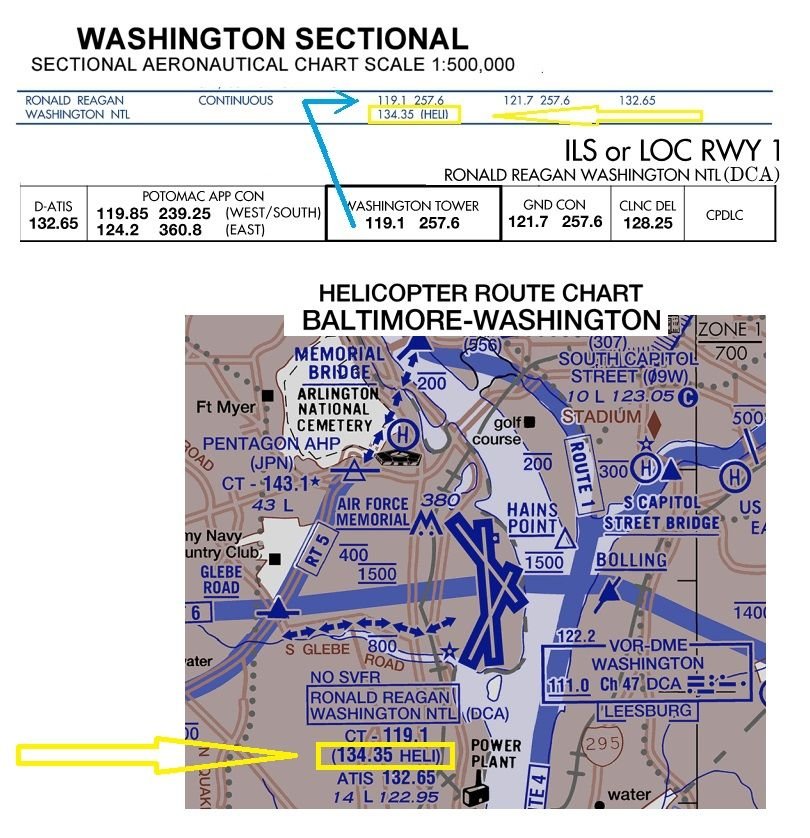
Subjects
IFR
VFR
Links are to this post in the relevant subject page so that this post can be seen in context.
Reply to this quoting this original post. You need to be logged in. Not available on closed threads.
February 04, 2025, 10:43:00 GMT
permalink Post: 11821285
This means the automated tools (which don\x92t know the aircraft are using visual means to deconflict) will go off based on a predicted or actual loss of the separation criteria that they\x92ve been programmed with. If the helicopter in this instance had passed 1/4m behind and below the CRJ, a CA may still have been generated although the conflict had been resolved visually. The controller actually picks up on the apparent proximity and queries the heli that they are still visual, to which they reply in the affirmative - there is no minimum separation for visual avoidance, just sometimes it\x92s too dang close. Which is an Airprox.
Subjects
ATC
CRJ
IFR
Separation (ALL)
TCAS (All)
Visual Separation
Links are to this post in the relevant subject page so that this post can be seen in context.
Reply to this quoting this original post. You need to be logged in. Not available on closed threads.
February 04, 2025, 11:44:00 GMT
permalink Post: 11821332
CA will activate whenever certain separation minima are going to be lost (600\x92 and 2 miles for example).
Visual separation is a perfectly legal tool that allows separation to reduce below radar minima.
CA will (almost) always activate when applying visual separation. That doesn\x92t mean the aircraft are on a collision course or are definitely going to crash, it just means they will be in confliction and separated by less than the IFR radar minima.
Its activation in this scenario (and countless others in the days before) was totally normal. Anyone who thinks it should have been reacted to differently or that it was a last line of defence really doesn\x92t understand the role of Conflict Alert.
And it\x92s not the role of the radar centre to phone tower and warn them of a conflict alert between two aircraft they would expect to be visually separated - that\x92s a scenario that probably happens several times a day.
Subjects
IFR
Radar
Separation (ALL)
Visual Separation
Links are to this post in the relevant subject page so that this post can be seen in context.
Reply to this quoting this original post. You need to be logged in. Not available on closed threads.
February 04, 2025, 22:34:00 GMT
permalink Post: 11821762
"5342, helo traffic on your right 1/4 mile at 300 feet, has you in sight". The CRJ FO might just have taken a closer look out the side window with that. Or, like you, they might have opted to go around.
Subjects
ATC
CRJ
CVR
DCA
IFR
Separation (ALL)
TCAS (All)
Traffic in Sight
Visual Separation
Links are to this post in the relevant subject page so that this post can be seen in context.
Reply to this quoting this original post. You need to be logged in. Not available on closed threads.
February 05, 2025, 07:14:00 GMT
permalink Post: 11821938
As a previous poster has said, they are using third world procedures at what is a very busy and high-density traffic area. I doubt if this collision would have occurred in many other countries as positive separation and/or significant restrictions are provided to ALL aircraft, be they IFR or VFR, and certainly not at night.
I suspect however that the DoD would not be too happy with not being able to operate VFR. Whatever the outcome, an independent risk analysis would need to tick all the boxes and the procedures changed to match.
Subjects
FAA
IFR
Separation (ALL)
VFR
Links are to this post in the relevant subject page so that this post can be seen in context.
Reply to this quoting this original post. You need to be logged in. Not available on closed threads.
February 05, 2025, 08:11:00 GMT
permalink Post: 11821971
As a previous poster has said, they are using third world procedures at what is a very busy and high-density traffic area. I doubt if this collision would have occurred in many other countries as positive separation and/or significant restrictions are provided to ALL aircraft, be they IFR or VFR, and certainly not at night.
I suspect however that the DoD would not be too happy with not being able to operate VFR. h.
Subjects
FAA
IFR
Separation (ALL)
VFR
Links are to this post in the relevant subject page so that this post can be seen in context.
Reply to this quoting this original post. You need to be logged in. Not available on closed threads.
February 05, 2025, 09:41:00 GMT
permalink Post: 11822038
Additionally, any helicopters flying in such congested airspace should have a display showing other traffic so they know where to look outside.
Subjects
ATC
IFR
Separation (ALL)
VFR
Visual Separation
Links are to this post in the relevant subject page so that this post can be seen in context.
Reply to this quoting this original post. You need to be logged in. Not available on closed threads.
February 05, 2025, 10:12:00 GMT
permalink Post: 11822066
Imho the altitude sectored restrictions were never suitable and safe to deconflict helicopter traffic from traffic to finals 01 and 33, but were meant to deconflict takeoffs from 15 and 19. Could it be that someday some clever soul thought to solve increasing traffic demands by using 33 and 01 for landing despite traffic in the helicopter routes under visual separation rules, ignoring thereby that now all layers of safety had been removed bare the eyes of an helicopter crew?
Subjects
ATC
IFR
Separation (ALL)
VFR
Visual Separation
Links are to this post in the relevant subject page so that this post can be seen in context.
Reply to this quoting this original post. You need to be logged in. Not available on closed threads.
February 05, 2025, 10:32:00 GMT
permalink Post: 11822080
Additionally, any helicopters flying in such congested airspace should have a display showing other traffic so they know where to look outside.
You cannot actively vector a helo at 200ft over the black hole of a river in the middle of an urban environment or anywhere else. You'd kill helos every month doing that. If the helo were at 100ft or so there would be no need for vectors (you never get them in London, just holding, ie orbits if necessary).
Visual acknowlewgement from the aeroplane is totally unnecessary as he is on finals to land which give total priority over all other traffic. It is up to the give-way traffic to identify and acknowlege.
500ft vertical I agree with, in which case 1,5 miles is totally unnecessary and ridiculously excessive.
This discussion is being considerably bogged down by a really surprising (to me) absence of understanding of helos and helo ops by people who clearly only fly f/w IFR and seem to have no concept of how the rest of the aviation world works. Strangely, there are other ways of aviating safely without staring exclusively at an instrument panel, following a magenta line and doing only what someone miles away in an office tells you. You simply cannot try to apply IFR airline type procedures and mindset to low level VFR traffic. It's like a train driver trying to dictate railway rules to a motorcyclist and being unaware that motorcycles just don't operate like trains... imaginingthat helos can or would come to a free air hover for separation is another example of unrealistic imagnation over reality.
Please, if you don't know anything about helicopter ops, please don't try to apply procedural IFR or Hollywood mindsets/misapprehensions to them as if there is no other waay of flying.
Last edited by meleagertoo; 5th February 2025 at 10:54 .
Subjects
ATC
CRJ
Hover
IFR
Separation (ALL)
VFR
Visual Separation
Links are to this post in the relevant subject page so that this post can be seen in context.
Reply to this quoting this original post. You need to be logged in. Not available on closed threads.
February 05, 2025, 10:45:00 GMT
permalink Post: 11822093
Perhaps you mean that DoD would not be too happy with not being able to take visual separation, at night, using NVG? I think they might have to suck that up - especially the second and third aspects.
Subjects
IFR
Night Vision Goggles (NVG)
Separation (ALL)
VFR
Visual Separation
Links are to this post in the relevant subject page so that this post can be seen in context.
Reply to this quoting this original post. You need to be logged in. Not available on closed threads.