February 05, 2025, 11:21:00 GMT
permalink Post: 11822123
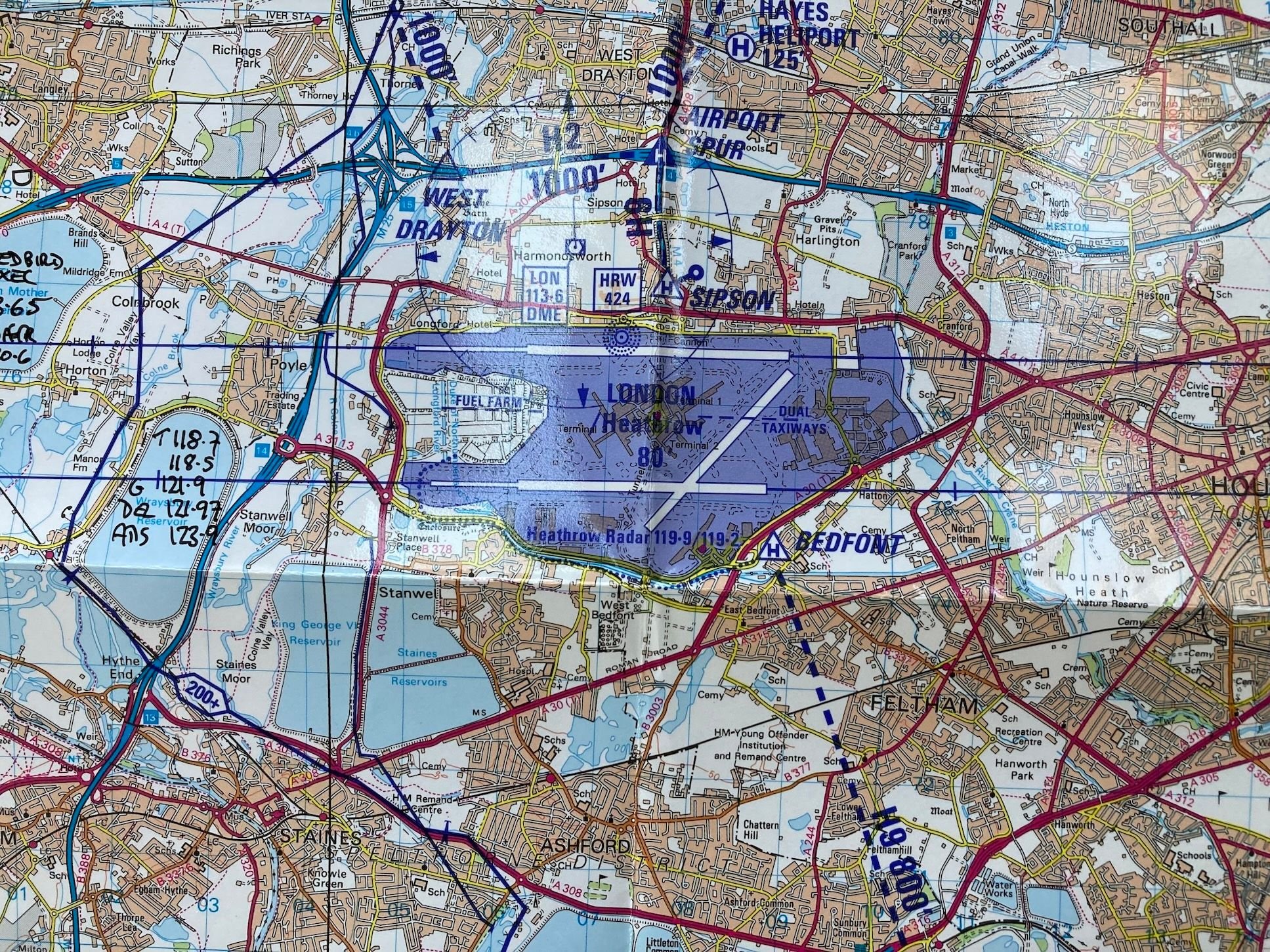
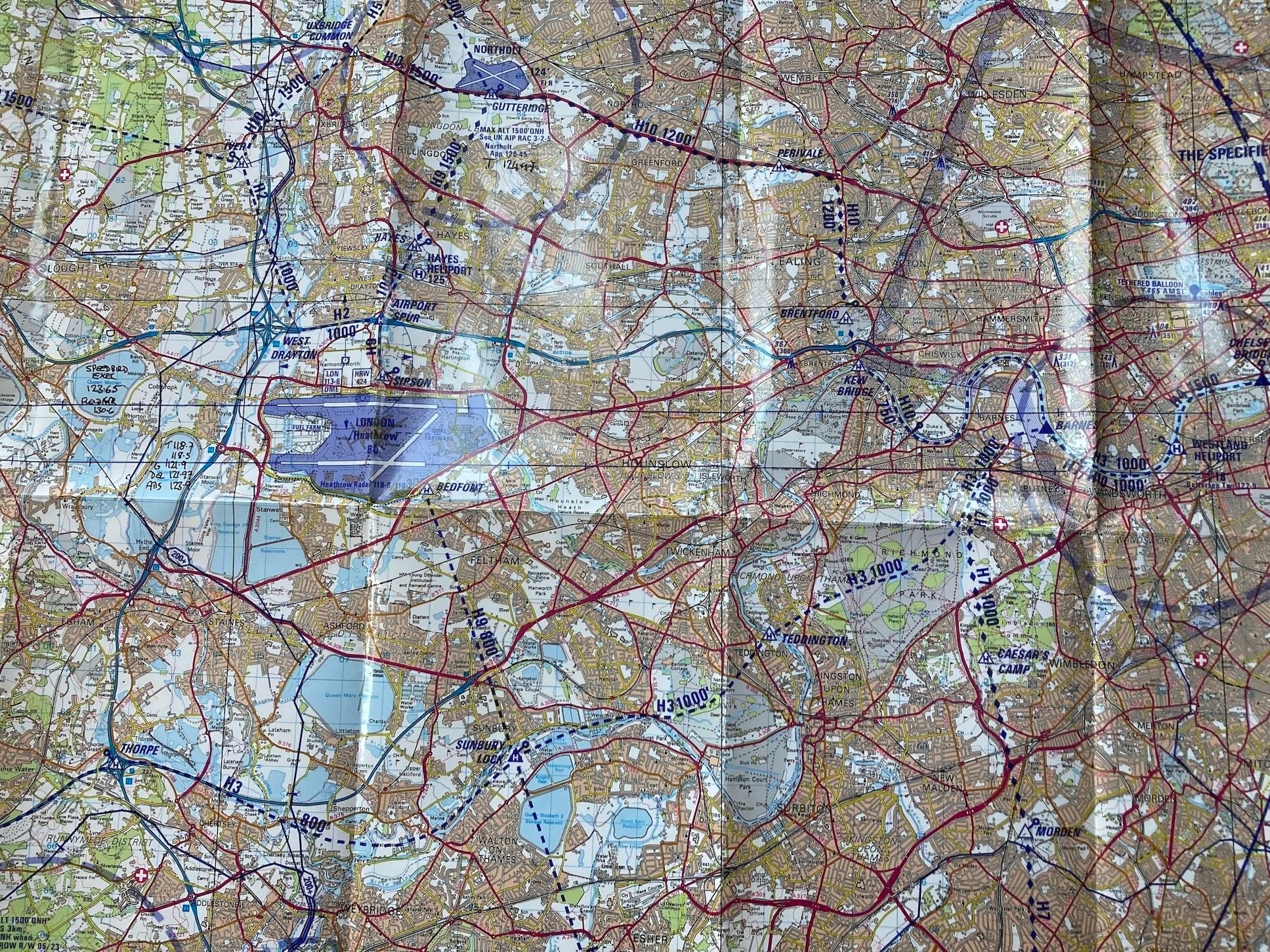
Usually, only if crossing LHR you'd be cleared to enter via requested route with limit Bedfont/Sipson, sometimes Airport Spur to hold (orbit) and change from Heathrow Special to Tower for the crossing itself. There's a further hold at Twin Taxiways between the runways. Altitudes are shown. Note there is usually unrestricted passage on routes H3 and H10 along the river directly under the approach. This system works seamlessly and with - to date - total safety.
Accepted the aairport we are discussing has more varied runway directions than Heathrow so the situation would be a bit more complex but I can't see why a similar system couldn't be devised - with defined clearance limits, sensible vertical separation and, critically, coherent and specific controller voice procedure.
There's no reason not to make landing traffic aware of helos holding close in if appropriate and indeed that happens, but no way is their visual contact required.
The entire system operates on visual 'separation'. Helos cross visually behind traffic as cleared, but with vertical separation. It's as safe as the system can be made. How else could it work? It requires no controller vectoring and the time and space margins that would be required if radar separation was used would render the slick, efficient visual system cumbrous, unacceptably high end unnecessary workload and probably unworkable.
Please, once again let's stop applying this insular f/w procedural IFR mindset to VFR helo traffic. There seems to be a procedural IFR mental blockage that can't see that 'visual separation' occurs in three dimensions, not just two. Helos are perfectly capable of ensuring visual separation as long as the traffic has been correctly identified and with vertical separation as here even if a mistake is made there is 800ft clear vertically. Also, VFR does NOT mean, as many seem to imagine, blundering about randomly at will, it is often every bit as disciplined and controlled as IFR as Shackman reiterates below, these routes are rigidly enforced to within a hundred metres or so and woe betide the transgressor.
The elephant in the room here is a combintion of a ridiculously hazardous two-dimensional crossing procedure combined with culpably sloppy & imprecise r/t which offers no second slice of cheese, not matters of visual separation. I'm well aware that our transatlantic cousins are sensitive to criticism of their relaxed, easygoing and informal ways in the air but in this case they self-evidently were the direct cause of 70 odd deaths. While they may regard European style as excessively pedantic there's no doubt whatsoever that had European standards applied here this event would have resulted in nothing more serious than a MOR and an Airmiss report.
For those unfamiliar the light grid squares are 1Km so the Sipson and Bedfont reporting/holding points is ony about 500m from the runways.
Last edited by meleagertoo; 5th February 2025 at 12:23 .
Subjects
ATC
IFR
Radar
Separation (ALL)
VFR
Vertical Separation
Visual Separation
Links are to this post in the relevant subject page so that this post can be seen in context.
Reply to this quoting this original post. You need to be logged in. Not available on closed threads.
February 05, 2025, 12:57:00 GMT
permalink Post: 11822202
...change from Heathrow Special to Tower for the crossing itself. There's a further hold at Twin Taxiways between the runways. Altitudes are shown. Note there is usually unrestricted passage on routes H3 and H10 along the river directly under the approach...
...defined clearance limits, sensible vertical separation and, critically, coherent and specific controller voice procedure.
I agree with your underlying point that blanket application of IFR separation criteria would be inappropriate. But there are modes of separation besides the false binary of 'visual' and 'IFR' which can be applied to VFR traffic.
Last edited by Easy Street; 5th February 2025 at 14:01 .
Subjects
ATC
IFR
Radar
Separation (ALL)
VFR
Vertical Separation
Visual Separation
Links are to this post in the relevant subject page so that this post can be seen in context.
Reply to this quoting this original post. You need to be logged in. Not available on closed threads.
February 06, 2025, 01:45:00 GMT
permalink Post: 11822684

Long answer? No.
Short Answer? "__"
The NW wind results in their CAS being lower if maintaining a desired ground speed, and as LW50 and John Dixson would attest to, the crew would be aiming at generally maintaining speed above ETL, to improve ride and economy, noise, pretty much everything. Civil helos will normally specify a minimum IFR speed to keep tracking tasks of the pilot to a manageable level. The crew in this case are night, VFR, but without SAS or ALTHOLD, helos are a bit more demanding than fixed wing. Flying these helos down in the weeds is why Pilots like Lonewolf and John D got paid the big money and have such extravagant retirement life as of course their Government respects their service that much.

Subjects
IFR
VFR
Links are to this post in the relevant subject page so that this post can be seen in context.
Reply to this quoting this original post. You need to be logged in. Not available on closed threads.
February 06, 2025, 11:55:00 GMT
permalink Post: 11822926
PAT25: "PAT25 has the traffic in sight, request visual separation"
Tower: "Visual separation approved"
0:26 here:
https://youtu.be/r90Xw3tQC0I?feature=shared
Perhaps, and this is big perhaps, it's a pavlovian response to whenever PAT is advised of other traffic. I listened to the TCAS RA missed approach from the previous day, and once again the response from PAT is "request visual separation". It's highly likely that the pilot requests for visual separation is the only way that this Class B airspace can operate with the mix of IFR vs VFR, and aerodrome traffic vs transits.
I fail to understand why PAT is using UHF, surely this is another slice of cheese.
The use of RWY 33 for arrival makes it easier for the ATC and the aircrew with one less runway crossing after they have landed. To emphasis the point, the following PSA actually requests RWY 33.
Subjects
ATC
CRJ
IFR
PAT25
Separation (ALL)
TCAS (All)
TCAS RA
Traffic in Sight
VFR
Visual Separation
Links are to this post in the relevant subject page so that this post can be seen in context.
Reply to this quoting this original post. You need to be logged in. Not available on closed threads.
February 06, 2025, 12:07:00 GMT
permalink Post: 11822935
Using visual separation as the only line of defence at night (and even during daylight) is utter madness. As is having aircraft circle to multiple runways, mixing high density military and civilian traffic, and a multitude of other issues.
Had full IFR separation been applied this accident wouldn\x92t have happened.
Subjects
IFR
Separation (ALL)
Visual Separation
Links are to this post in the relevant subject page so that this post can be seen in context.
Reply to this quoting this original post. You need to be logged in. Not available on closed threads.
February 07, 2025, 00:09:00 GMT
permalink Post: 11823328
Did the FAA or the Army assume they would always be able to apply visual (NOT VFR) separation. Visual separation does not necessarily mean 500\x92 vertically and 1.5 nm or radar target separation; it means \x93I see you, I miss you\x94. Did the operating plan always direct crews to use visual separation as the default plan? I hope not, but it is only I see it being written.
Subjects
FAA
IFR
Radar
Route 4
Separation (ALL)
VFR
Visual Separation
Links are to this post in the relevant subject page so that this post can be seen in context.
Reply to this quoting this original post. You need to be logged in. Not available on closed threads.
February 07, 2025, 02:15:00 GMT
permalink Post: 11823361
You can be VFR in the Class B and treated exactly like an IFR flight. The clearance requirement from clouds VFR is just "clear of" clouds. You can have clouds three inches over you and five inches under you with each wingtip 3 inches away from them and still be VFR. This is much reduced from C, D, and E because you are under positive control. The helo was let loose to provide their own visual separation, which is a totally separate thing.
Subjects
IFR
Separation (ALL)
VFR
Visual Separation
Links are to this post in the relevant subject page so that this post can be seen in context.
Reply to this quoting this original post. You need to be logged in. Not available on closed threads.
February 07, 2025, 21:23:00 GMT
permalink Post: 11823937
https://www.faa.gov/documentLibrary/...5-24_READY.pdf
As mentioned upthread, if not visually separated then either 500ft or 1.5mi applies.
Correct if this is all wrong, but in the accident sequence if the helo had responded ‘not visual yet, looking’ or words to that effect, then presumably a controller could allow the two to get a bit closer and then advise the conflicting traffic info to the helo again, say at 2.5mi. If helo visual, great —maintain visual separation, responsibly passes to helo.
This is what happened, although the very busy controller failed to re-state the position of the CRJ to direct the eyes of the helo crew onto the CRJ in order that they could actually see and avoid it.
However if not visual at say 2.5mi, well it’s a bit late, but the controller does still retain responsibility for separation and must apply the 500ft/1.5mi standard. Presumably instant vectors away while simultaneously climb to min vectoring altitude. Or the CRJ has to go around. Can of worms in busy airspace— helos and /or jets being dispersed all over the sky.
Much better to do a rules based system and mutually exclude intersecting IFR app/deps and Helo Visual Routes.
Last edited by Stagformation; 7th February 2025 at 22:06 .
Subjects
ATC
CRJ
FAA
IFR
See and Avoid
Separation (ALL)
Visual Separation
Links are to this post in the relevant subject page so that this post can be seen in context.
Reply to this quoting this original post. You need to be logged in. Not available on closed threads.
February 07, 2025, 22:59:00 GMT
permalink Post: 11824002
https://www.faa.gov/documentLibrary/...5-24_READY.pdf
As mentioned upthread, if not visually separated then either 500ft or 1.5mi applies.
Correct if this is all wrong, but in the accident sequence if the helo had responded \x91not visual yet, looking\x92 or words to that effect, then presumably a controller could allow the two to get a bit closer and then advise the conflicting traffic info to the helo again, say at 2.5mi. If helo visual, great \x97maintain visual separation, responsibly passes to helo.
This is what happened, although the very busy controller failed to re-state the position of the CRJ to direct the eyes of the helo crew onto the CRJ in order that they could actually see and avoid it.
However if not visual at say 2.5mi, well it\x92s a bit late, but the controller does still retain responsibility for separation and must apply the 500ft/1.5mi standard. Presumably instant vectors away while simultaneously climb to min vectoring altitude. Or the CRJ has to go around. Can of worms in busy airspace\x97 helos and /or jets being dispersed all over the sky.
Much better to do a rules based system and mutually exclude intersecting IFR app/deps and Helo Visual Routes.
Subjects
ATC
CRJ
IFR
Radar
See and Avoid
Separation (ALL)
Visual Separation
Links are to this post in the relevant subject page so that this post can be seen in context.
Reply to this quoting this original post. You need to be logged in. Not available on closed threads.
February 08, 2025, 06:22:00 GMT
permalink Post: 11824114
https://www.faa.gov/documentLibrary/...5-24_READY.pdf
As mentioned upthread, if not visually separated then either 500ft or 1.5mi applies.
Correct if this is all wrong, but in the accident sequence if the helo had responded \x91not visual yet, looking\x92 or words to that effect, then presumably a controller could allow the two to get a bit closer and then advise the conflicting traffic info to the helo again, say at 2.5mi. If helo visual, great \x97maintain visual separation, responsibly passes to helo.
This is what happened, although the very busy controller failed to re-state the position of the CRJ to direct the eyes of the helo crew onto the CRJ in order that they could actually see and avoid it.
However if not visual at say 2.5mi, well it\x92s a bit late, but the controller does still retain responsibility for separation and must apply the 500ft/1.5mi standard. Presumably instant vectors away while simultaneously climb to min vectoring altitude. Or the CRJ has to go around. Can of worms in busy airspace\x97 helos and /or jets being dispersed all over the sky.
Much better to do a rules based system and mutually exclude intersecting IFR app/deps and Helo Visual Routes.
He is not radar qualified- so no headings or radar measurment distances applicable.
Where is prescribed what point is 1,5 Nm away from visual app for rwy 33? ( Note : Atco must achive required separation before that point)
or
At what point should be givem climb instruction for He to be 500' above arriving a/c before compromising 1,5Nm. If rate of climb is 1000 ft/min Helicopet need to climb for 40-50 seconds with the speed 180km/h it is 2 Nm or so - it means that instruction to climb should be given no latter than 4Nm from crossing point.
What is possibikity to spot particular aircraft for visual separation at distances more than 4Nm from crosssing points, duting the night and in bussy traffic enviroment?
Yes , I know it is Burund....
Subjects
ATC
ATCO
CRJ
IFR
Radar
See and Avoid
Separation (ALL)
Visual Separation
Links are to this post in the relevant subject page so that this post can be seen in context.
Reply to this quoting this original post. You need to be logged in. Not available on closed threads.
February 08, 2025, 16:47:00 GMT
permalink Post: 11824451
https://www.avweb.com/flight-safety/tower-brites/
This explains the different phraseology between a tower using a BRITE to help out vs. the phraseology of tower certified and equipped for full radar separation. It also explains LOAs for airspace. Where I learned to fly at KMLB the tower only owned up to about 1800 feet IIRC and approach had above that. In those pre-BRITE days it helped a lot for handling IFR traffic.
( I sometimes flew a Bell 47 helicopter there and the tower managed to organize it such that I never came close to any airplanes)
Subjects
IFR
Phraseology (ATC)
Radar
Separation (ALL)
Links are to this post in the relevant subject page so that this post can be seen in context.
Reply to this quoting this original post. You need to be logged in. Not available on closed threads.
February 08, 2025, 20:56:00 GMT
permalink Post: 11824572

Subjects
IFR
Traffic in Sight
Links are to this post in the relevant subject page so that this post can be seen in context.
Reply to this quoting this original post. You need to be logged in. Not available on closed threads.
February 10, 2025, 13:56:00 GMT
permalink Post: 11825521
https://www.avweb.com/flight-safety/tower-brites/
This explains the different phraseology between a tower using a BRITE to help out vs. the phraseology of tower certified and equipped for full radar separation. It also explains LOAs for airspace. Where I learned to fly at KMLB the tower only owned up to about 1800 feet IIRC and approach had above that. In those pre-BRITE days it helped a lot for handling IFR traffic.
( I sometimes flew a Bell 47 helicopter there and the tower managed to organize it such that I never came close to any airplanes)
Subjects
IFR
Phraseology (ATC)
Radar
Separation (ALL)
Links are to this post in the relevant subject page so that this post can be seen in context.
Reply to this quoting this original post. You need to be logged in. Not available on closed threads.
February 19, 2025, 18:09:00 GMT
permalink Post: 11831631
It may sound harsh, but after years of struggle for non-punitive environment, some have deduced this as non-punitive environment for any kind of incident (or even accident).
Back to case in DCA - to expect self separation of night VFR and IFR conducting visual approach agreed hasty and under pressure in the area where none of them is capable of sudden change of trajectory is just pouring gasoline to the fire already raging.
Subjects
ATCO
DCA
IFR
Separation (ALL)
VFR
Links are to this post in the relevant subject page so that this post can be seen in context.
Reply to this quoting this original post. You need to be logged in. Not available on closed threads.
February 21, 2025, 23:22:00 GMT
permalink Post: 11833322
If two aircraft are converging on the same runway or look like they are going to occupy it simultaneously, then one of them has to give way. Why should it be any different for a small volume of sky?
Subjects
DCA
IFR
Separation (ALL)
Links are to this post in the relevant subject page so that this post can be seen in context.
Reply to this quoting this original post. You need to be logged in. Not available on closed threads.
February 22, 2025, 01:15:00 GMT
permalink Post: 11833379
If two aircraft are converging on the same runway or look like they are going to occupy it simultaneously, then one of them has to give way. Why should it be any different for a small volume of sky?
Subjects
DCA
IFR
Separation (ALL)
Visual Separation
Links are to this post in the relevant subject page so that this post can be seen in context.
Reply to this quoting this original post. You need to be logged in. Not available on closed threads.
February 22, 2025, 01:37:00 GMT
permalink Post: 11833388
If two aircraft are converging on the same runway or look like they are going to occupy it simultaneously, then one of them has to give way. Why should it be any different for a small volume of sky?
Subjects
DCA
IFR
Separation (ALL)
VFR
Links are to this post in the relevant subject page so that this post can be seen in context.
Reply to this quoting this original post. You need to be logged in. Not available on closed threads.
February 22, 2025, 07:49:00 GMT
permalink Post: 11833471
Subjects
ATC
IFR
Separation (ALL)
VFR
Links are to this post in the relevant subject page so that this post can be seen in context.
Reply to this quoting this original post. You need to be logged in. Not available on closed threads.
February 22, 2025, 09:48:00 GMT
permalink Post: 11833528
- Class B : Operations may be conducted under IFR, SVFR, or VFR. All aircraft are subject to ATC clearance. All flights are separated from each other by ATC.
Subjects
ATC
DCA
FAA
ICAO
IFR
Separation (ALL)
VFR
Links are to this post in the relevant subject page so that this post can be seen in context.
Reply to this quoting this original post. You need to be logged in. Not available on closed threads.
February 22, 2025, 11:12:00 GMT
permalink Post: 11833584
However, from a US point of view, this is arguably the solution which was in place on the night. It's just that the means of actively keeping the traffic apart, ie visual separation, failed. I am prepared to accept that FAA-style "visual separation" is slightly more robust than "see and avoid" in that it requires ATC to confirm that the pilot has the specific traffic in sight before relaxing separation minima, but the question for the FAA is whether "slightly more robust" is good enough when airliners are involved, particularly at night given the increased potential for misidentification.
I am not sure the subsequent line of discussion over how Class B requires ATC (not pilots) to separate all traffic is a very productive one. Any separation instruction given by ATC relies upon the pilot executing it, for instance by maintaining the cleared altitude. Here, it relied on the pilot not colliding with the specific traffic he had confirmed visual contact with. So far as the FAA is concerned, that's a sufficient degree of control and differs from the "see and avoid" principle applicable to VFR/VFR in Class C, and VFR/Any in Class D. Again, the question is whether that's appropriate.
That last point gives me an opportunity to make an observation I've been pondering for a while. Many European airport control zones are Class D, where on a strict reading of ICAO, VFR traffic is not required to be separated from IFR. But how many of us know a Class D zone where the controller gives traffic information and lets VFR traffic merge with IFR under see and avoid? In practice, European and especially UK ATC exercise a greater degree of control than is strictly required by the ICAO classification. At least in my experience, US airspace is operated closer to ICAO specifications ("visual separation" nothwithstanding).
Last edited by Easy Street; 22nd February 2025 at 11:31 .
Subjects
ATC
DCA
FAA
ICAO
IFR
See and Avoid
Separation (ALL)
Traffic in Sight
VFR
Visual Separation
Links are to this post in the relevant subject page so that this post can be seen in context.
Reply to this quoting this original post. You need to be logged in. Not available on closed threads.