February 15, 2025, 17:25:00 GMT
permalink Post: 11828732
Likely the Kollsman settings will be recoverable. Barometric altimeters used in VFR can be way off, but transponder calibration depends on a calibrated altimeter. The NTSB will be looking at maintenance records.
Subjects
Altimeter (All)
Blackhawk (H-60)
NTSB
VFR
Links are to this post in the relevant subject page so that this post can be seen in context.
Reply to this quoting this original post. You need to be logged in. Not available on closed threads.
February 16, 2025, 04:46:00 GMT
permalink Post: 11828977
• At 8:47:58, or 1 second before impact, the CRJ began to increase its pitch, reaching about 9 degrees nose up at the time of collision. FDR data showed the CRJ elevators were deflected near their maximum nose up travel .
• The last radio altitude recorded for the CRJ was 313 ft and was recorded two seconds prior to the collision. The CRJ pitch at this time was, again, 9 degrees nose up, and roll was 11 degrees left wing down. The CRJ was descending at 448 feet per minute.
• The radio altitude of the Blackhawk at the time of the collision was 278 feet and had been steady for the previous 5 seconds. The Blackhawk pitch at the time of the collision was about a half degree nose up with a left roll of 1.6 degrees. Examination of wreckage will assist in determination of the exact angle of the collision.
I was once stopped at a red light, began rolling when the light turned green - and suddenly found myself on the brakes before I was conscious of the car running the red light. Possibly a CRJ pilot similarly caught the helo in peripheral vision and reacted subconsciously.
Last edited by RatherBeFlying; 16th February 2025 at 04:50 . Reason: Formatting
Subjects
Blackhawk (H-60)
CRJ
CVR
DCA
NTSB
Links are to this post in the relevant subject page so that this post can be seen in context.
Reply to this quoting this original post. You need to be logged in. Not available on closed threads.
February 16, 2025, 04:57:00 GMT
permalink Post: 11828979
Now on the Conflict alert on the BRITE display . I have no first hand info on the SOPs in DCA on how a TWR controller uses the BRITE and if STCA are even displayed . `, but if they are, seen the charts and the routes , I guess STCA alerts are very common .especially when you delegate separation and you then play with a couple of hundred feet, vertical separation Too many unnecessary alerts equals normalization of deviance, . Look at the Haneda preliminary report , same ..
Finally since you mention TCAS RAs , there is a major difference with STCA , it is not the same as a TCAS RA . With an RA , as a pilot you have to react and follow , it is mandatory , for a controller a STCA is just an alert , just like a TCAS TA , if in your judgement it will pass you will not do anything , and if you have already issued a correcting instruction ( heading, level , etc,,) or here delegate visual separation , the STCA just becomes a nuisance. .
I sincerely hope the DC Controller will not be made the scapegoat of this accident . Not so sure it will not.
In the US, physicians who work for "Health Maintenance Organizations" are asked to practice medicine, at times, in a "basically unsafe" manner...to keep patients moving. On occasion, such practices will bite a patient (and sometimes the physician). As a whole, HMO physicians do not enjoy the best reputation.
From my perspective, there is practically no difference between the plight of an American air traffic controller and an American HMO physician. Both are expected to "squeeze one more in." Both fields are staffed by above-average capable individuals who thrive on challenges. Both are managed in such a manner that they cannot say "no" and also keep their job. In this regard, at least physicians have job portability.
But the take home point is that one cannot admit to knowing a practice is fundamentally unsafe, yet do it anyway. The public, rightfully, should not accept this. I have no solution except more staff and/or more airports (and not some next-gen whizzbang computer system).
Subjects
ATC
DCA
FAA
NTSB
Normalization of Deviance
Preliminary Report
Separation (ALL)
TCAS (All)
TCAS RA
Vertical Separation
Visual Separation
Links are to this post in the relevant subject page so that this post can be seen in context.
Reply to this quoting this original post. You need to be logged in. Not available on closed threads.
February 16, 2025, 08:38:00 GMT
permalink Post: 11829051
I was once stopped at a red light, began rolling when the light turned green - and suddenly found myself on the brakes before I was conscious of the car running the red light. Possibly a CRJ pilot similarly caught the helo in peripheral vision and reacted subconsciously.
Subjects
CRJ
CVR
NTSB
Links are to this post in the relevant subject page so that this post can be seen in context.
Reply to this quoting this original post. You need to be logged in. Not available on closed threads.
February 16, 2025, 10:44:00 GMT
permalink Post: 11829142
Subjects
NTSB
PAT25
Route 4
Links are to this post in the relevant subject page so that this post can be seen in context.
Reply to this quoting this original post. You need to be logged in. Not available on closed threads.
February 16, 2025, 11:15:00 GMT
permalink Post: 11829163
Subjects
Close Calls
NTSB
PAT25
Route 4
Links are to this post in the relevant subject page so that this post can be seen in context.
Reply to this quoting this original post. You need to be logged in. Not available on closed threads.
February 16, 2025, 22:52:00 GMT
permalink Post: 11829513
Is the construction and operation of the airspace around DCA a matter of policy judgment? I can almost hear the lawyers planning to file suit arguing that airspace rules which make simple, obvious sense are not derived from policy judgments. I can almost hear them issuing subpoenas (through the necessary international process) of Network Manager or MUAC senior managers to gain testimony that in European airspace, as others have observed about Heathrow, the airspace rules are more like "plug-and-chug" than the sometimes esoteric, and usually vague and/or ambiguous, factors which inform the choices made in - offensive phrase coming - "the policy world."
If we took the FAA to be undertaking "plug and chug" regulatory and procedural activities, unburdened by political considerations and at risk of having EASA or UK CAA regulations and procedures held up as comparators in negligence cases against it, then I think it is highly unlikely that FAA regulations would be as permissive as they are in respect of visual separation and runway occupancy (the two most obvious and frequently cited points of difference, at least where airline operations are concerned), or that DCA\x92s helicopter routes would have existed. So why such a difference in approach? Economic factors are usually held up as the reason, and I fear this takes us away from "plug and chug" regulation into policy territory where immunity would seemingly apply.
I very much doubt that any politician, corporate lobbyist or general would explicitly advance the argument that occasional accidents are a tolerable price for the traffic capacity enhancements enabled by visual separation. It'll be interesting to see whether the NTSB forces that argument into the open, or enables it to be avoided by distracting itself with altimetry and other such matters.
Last edited by Easy Street; 16th February 2025 at 23:35 .
Subjects
DCA
FAA
NTSB
Separation (ALL)
Visual Separation
Links are to this post in the relevant subject page so that this post can be seen in context.
Reply to this quoting this original post. You need to be logged in. Not available on closed threads.
February 17, 2025, 02:01:00 GMT
permalink Post: 11829593
When the NTSB has more to share it will be interesting (to me) to see what a balanced mitigation strategy is.
Subjects
NTSB
Pass Behind
Pass Behind (All)
Links are to this post in the relevant subject page so that this post can be seen in context.
Reply to this quoting this original post. You need to be logged in. Not available on closed threads.
February 17, 2025, 06:24:00 GMT
permalink Post: 11829650
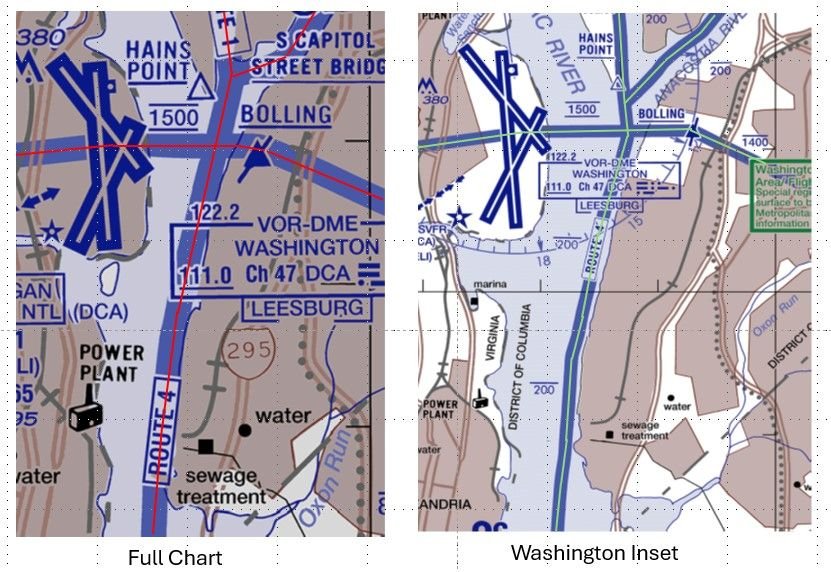
You could reasonably define the bank as the water's edge, and therefore expect crews to fly along an infinitesimally narrow path. Or as the space between the water's edge and the [edge of the flood plain | first flat area | something else], which would imply that the western boundary changes with the water level. Both imply the route is substantially above land.
Neither are useful for precise navigation, but the map and the description are probably 'close enough' if they are only needed for general route guidance and knowing that structures on the east bank need to be NOTAMed for helicopters, but probably not the west bank.
A good reminder that measurements/specifications without tolerance are often worse than useless.
If it quacks like a duck... this kind of "It can't be an X because we can't do it, so we'll call it a Y" leads to a culture that gets used to massaging the truth for convenience. Did we hear more on the Alaska door plug that was an 'opening' not a 'removal'?
Subjects
ATC
CRJ
DCA
FAA
KDCA
NTSB
Night Vision Goggles (NVG)
Pass Behind
Pass Behind (All)
Separation (ALL)
Links are to this post in the relevant subject page so that this post can be seen in context.
Reply to this quoting this original post. You need to be logged in. Not available on closed threads.
February 17, 2025, 09:45:00 GMT
permalink Post: 11829754
So I wouldn\x92t call the altimeter discussion a distraction per se - not yet, anyway. It\x92s just one tiny fact in a complex picture, but still an important fact nevertheless. It is a concrete example of one (or more) of those, by itself insignificant, real-life deviations from perfection occurring. I expect (hope) that the NTSB will use this issue just to illustrate the point that relevant traffic procedures at KDCA were largely based on wishful thinking.
Subjects
Altimeter (All)
KDCA
NTSB
QNH
Links are to this post in the relevant subject page so that this post can be seen in context.
Reply to this quoting this original post. You need to be logged in. Not available on closed threads.
February 17, 2025, 15:50:00 GMT
permalink Post: 11829979
As many and I said before, discussion about Altimeters or width of VFR routes are just distractions to deflect from the real cause , which for me can be resumed into the lack of a safety assessment and safety case of existing procedures. We all had to do this when SMS was widely introduced in the late 90s It was not that easy , but we discovered a few holes that were closed.
Here in DCA we see a couple of procedures that would not have passed a safety case : e.g Route 4, Circling to RWY 33 with that route active, visual separation at night , use of NVG on that route ..etc,,
Flying in itself always bares a risk,, our job is to minimize the risk , not to eliminate it , but here the Regulatory ( i.e FAA) failed to minimize the risks.
As in the US the FAA is both the service provider and the Regulator , and is in addition dependent of political will and pressure for its funding , the willingness to implement unpopular measures, may be limited. A Judge might look into this differently but for those part of the discussion I hand over the floor to .Willow run 6-3 .
This is an excerpt from a website of an actually well-known, very accomplished, and respected group of lawyers who specialize in (among other things) aviation matters. I'm not using their name and I don't have any approval, express or implied, to use information from their website - but if justice is to be sought for the victims' families, public discussion is - or should be - encouraged.
"A discretionary function is an action of a governmental nature exercised by a federal employee, but in order for that action to be considered a discretionary function, it must pass a two-part test:
There must be an element of judgment or choice. That is, if a federal statute or regulation prescribes a course of action for an employee to follow, there is no discretion.
That judgment or choice must be susceptible to policy analysis.
The Federal Tort Claims Act contains a discretionary function exception that says the U.S. cannot be held liable for any employee\x92s failure to exercise or perform a discretionary duty.
Within the legal field of aviation accidents, discretionary duties for which the U.S. is not liable include the following:
Aircraft \x93spot check\x94 certifications
Weather forecasting
Failure to install equipment
The FAA\x92s design of flight procedures
The types of actions that are considered not discretionary, and therefore, open the U.S. government to litigation are:
The failure to issue air traffic control manual warnings
If air traffic control fails to warn of weather dangers
The failure to maintain equipment
Relaying incorrect instructions to pilots."
END OF EXCERPT [not intended as legal advice here or on its original internet page]
So to return to ATC Watcher's point...... the more posts I read about this midair collision (plus other information such as NTSB briefings) the more I am anticipating that it will require an act of Congress to provide for compensation for the families of the victims. Isn't it the obvious fact that convenience for people who work in Washington and travel "back home" generally speaking on weekends and when Congress isn't convened, is a prime and central reason for the way DCA airspace has been constructed and managed? Is it really going to be the case that because the lawsuits will - in all likelihood - fail to overcome the "discretionary function" exception, that the 67 families will be without a remedy? Is that how it works, then?
In case anyone thinks my sense of being horrified at this accident is clouding reason or logic, consider this - the book Collision Course discusses the PATCO union's genesis, the strike, and so on. PATCO's earliest stirrings resulted in large part from the 1960 midair over New York. Is the United States aviation sector willing to accept an outcome of this accident that in effect travels back over six decades? The point is, given the long-term shortage of ATCOs in this country . . . I don't think a court is capable of ruling that the situation, allowed and in fact enabled by Congress and successive White House presidential administrations, is subject to "negligence" analysis in the currently applicable legal sense. All this being said, this is how I arrive at thinking that in the interests of justice, some other means of providing for the loved ones of 67 souls who were on board needs to be determined and implemented.
Last edited by WillowRun 6-3; 17th February 2025 at 19:11 .
Subjects
ATC
DCA
FAA
NTSB
Night Vision Goggles (NVG)
Route 4
Separation (ALL)
VFR
Visual Separation
Links are to this post in the relevant subject page so that this post can be seen in context.
Reply to this quoting this original post. You need to be logged in. Not available on closed threads.
February 17, 2025, 21:32:00 GMT
permalink Post: 11830196
Here if you want to learn or just refresh your memory ; https://www.latimes.com/archives/la-...%20government.
As an aside , the NTSB conclusions of that collision are interesting compared to our DCA accident : ( exactly 40 years ago !)
Subjects
ATC
DCA
FAA
NTSB
Probable Cause
Route 4
See and Avoid
Separation (ALL)
Links are to this post in the relevant subject page so that this post can be seen in context.
Reply to this quoting this original post. You need to be logged in. Not available on closed threads.
February 18, 2025, 22:45:00 GMT
permalink Post: 11831083
Subjects
ATC
FAA
NTSB
Links are to this post in the relevant subject page so that this post can be seen in context.
Reply to this quoting this original post. You need to be logged in. Not available on closed threads.
February 19, 2025, 23:36:00 GMT
permalink Post: 11831852
Subjects
NTSB
Links are to this post in the relevant subject page so that this post can be seen in context.
Reply to this quoting this original post. You need to be logged in. Not available on closed threads.
February 22, 2025, 08:02:00 GMT
permalink Post: 11833475
"… and yet that is precisely how ICAO stipulates that accident investigation should work. The consequent focus on such things as ‘proximate cause’ and the inherent unwillingness to deal with underlying aetiology work against holistic approaches and generate exactly the outcomes you warn against. "
In part yes, I agree.
However, as you might know, ICAO does not 'stipulate', it provides recommendations and standards of practice (SARPS), e.g. Annex 13, on which nations can base their investigation and reporting.
As such it is the interpretation of by individual nations and their investigators which direct investigation, findings, and recommendations.
Some nations interpret SARPS better than others.
There is an interesting example (amongst many others) of wider investigation and reporting in the Fukushima accident report: Pprune Safety Forum Fukushima Nuclear Accident Investigation
Reforming the regulators
The Commission has concluded that the safety … cannot be assured unless the regulators go through an essential transformation process. The entire organization needs to be transformed, not as a formality but in a substantial way. … regulators need to shed the insular attitude of ignoring international safety standards and transform themselves into a globally trusted entity .
P.S. Re the investigation above, also noting 'Cosmetic Solutions'; if the findings from this DCA investigation warrant it, would the NTSB conclude 'This was a manmade accident, made in the USA'
.ii
Last edited by PEI_3721; 22nd February 2025 at 08:56 . Reason: PS
Subjects
DCA
Findings
ICAO
NTSB
Links are to this post in the relevant subject page so that this post can be seen in context.
Reply to this quoting this original post. You need to be logged in. Not available on closed threads.
February 22, 2025, 09:00:00 GMT
permalink Post: 11833498
"… and yet that is precisely how ICAO stipulates that accident investigation should work. The consequent focus on such things as ‘proximate cause’ and the inherent unwillingness to deal with underlying aetiology work against holistic approaches and generate exactly the outcomes you warn against. "
In part yes, I agree.
However, as you might know, ICAO does not 'stipulate', it provides recommendations and standards of practice (SARPS), e.g. Annex 13, on which nations can base their investigation and reporting.
As such it is the interpretation of by individual nations and their investigators which direct investigation, findings, and recommendations.
Some nations interpret SARPS better than others.
There is an interesting example (amongst many others) of wider investigation and reporting in the Fukushima accident report: Pprune Safety Forum Fukushima Nuclear Accident Investigation
Reforming the regulators
The Commission has concluded that the safety … cannot be assured unless the regulators go through an essential transformation process. The entire organization needs to be transformed, not as a formality but in a substantial way. … regulators need to shed the insular attitude of ignoring international safety standards and transform themselves into a globally trusted entity .
P.S. Re the investigation above, also noting 'Cosmetic Solutions'; if the findings from this DCA investigation warrant it, would the NTSB conclude 'This was a manmade accident, made in the USA'
.ii
Regarding Fukushima, the problem lies not with regulators, but with regulation and its evil twin, compliance. And on your last line, I might add, 'by politics'. The process of sharing draft reports with interested parties is harmful enough to the investigative process, as we have seen with crystal clarity over the Clutha case for example, but is even more damaging in its influence to the jobbing investigator sitting at a word processor, thinking not only of that process, but all the petty politics which are exercised by managers in SIAs. Sometimes the investigator feels charged with writing a benign account of a series of improbable, unfortunate, and unforeseeable coincidences, which aligned with previously unknown holes in otherwise-solid cheese, despite being fully aware that there is much more to it than that.
Subjects
DCA
Findings
ICAO
NTSB
Links are to this post in the relevant subject page so that this post can be seen in context.
Reply to this quoting this original post. You need to be logged in. Not available on closed threads.
February 22, 2025, 11:14:00 GMT
permalink Post: 11833589
I personally don't think there's anything to be gained from going down the ICAO route. The NTSB has it's own charter and that's what dictates what happens in the USA.
I can see several ways the NTSB could take this, first the obvious one. The helicopter assumed responsibility for separation when it was not able to do so, and then found itself on track for collision. That's what I would define as true proximate cause. Then there's a step back from there which says nobody should be allowed to request and receive visual separation responsibilities in Class B airspace. That would be a good result as far as I'm concerned.
And the final step, which I think is more contentious and really hard for the US to accept, is that the culture at the FAA and within the industry is to balance safety and boosterism for the industry, and I think that is a recipe for irreconcilable conflicts. I'm not holding my breath on that one.
Last edited by Wide Mouth Frog; 22nd February 2025 at 11:49 . Reason: Adding response to Easy Street
Subjects
ATC
FAA
ICAO
NTSB
See and Avoid
Separation (ALL)
Visual Separation
Links are to this post in the relevant subject page so that this post can be seen in context.
Reply to this quoting this original post. You need to be logged in. Not available on closed threads.
February 22, 2025, 13:33:00 GMT
permalink Post: 11833670
"… don't think there's anything to be gained from going down the ICAO route. The NTSB has it's own charter and that's what dictates what happens in the USA."
If so then the NTSB (FAA, USA) attitude raises safety concerns.
From systems theory, all systems (i.e. aviation) will change with time, tending towards greater disorder (increasing entropy), often referred to as complexity.
To date, the industry has managed this change and simultaneously improved the level of safety, and with economic benefit.
A contribution to this is the use of world standards (ICAO, UN charter) enabling, aiding, inter-country operations, and refection on one's own, home standards and assumptions
Independent, fixed attitudes may encounter more safety issues as the overall system changes.
Safety minds, thinking, has to change just to keep up with the changes in aviation - what has been done safely before may not apply today or in the future.
Subjects
FAA
ICAO
NTSB
Links are to this post in the relevant subject page so that this post can be seen in context.
Reply to this quoting this original post. You need to be logged in. Not available on closed threads.
February 22, 2025, 14:31:00 GMT
permalink Post: 11833694
Subjects
NTSB
Links are to this post in the relevant subject page so that this post can be seen in context.
Reply to this quoting this original post. You need to be logged in. Not available on closed threads.
February 22, 2025, 16:33:00 GMT
permalink Post: 11833758
… well having searched the usual places and the NTSB, you will have to help with directions and text for reference.
There is a NTSB Charter for data, but nothing which explains the link between ICAO and the USA, and thence to the NTSB and investigation, or the required statement of any USA deviation from the ICAO guidance (Annex 13).
Notwithstanding https://www.ntsb.gov/about/organizat...office_as.aspx
" fulfill U.S. obligations under International Civil Aviation Organization agreements"
"to examine specific aviation safety problems from a broader perspective. "
But back to the thread. Are there any reasons why NTSB might not comment on the wider organisational aspects as indicated in the discussion. Also noting that the NTSB have no powers of enforcement, relying on the FAA; thus if the FAA process were to be identified as deficient, who mandates change.
,,
Last edited by PEI_3721; 22nd February 2025 at 16:44 . Reason: Link
Subjects
FAA
ICAO
NTSB
Links are to this post in the relevant subject page so that this post can be seen in context.
Reply to this quoting this original post. You need to be logged in. Not available on closed threads.