January 30, 2025, 03:21:00 GMT
permalink Post: 11816809
TCAS
ATC
ADS-B
See and Avoid
Filing a flight plan
Not operating in controlled airspace without a transponder
Not operating at a landing altitude for aircraft on final for a well used runway
Announcing an intention to cross a well used approach
Position lights/strobes
Landing lights
Just spitballing, but there's a non-zero chance NVGs were in use in the helicopter.
It sucks that the best part of this is the airplane was a CRJ, not a larger airliner. Most all those passengers would have survived the initial collision and been aware during the fall to the river.
I feel rage.
Subjects
ADSB (All)
ATC
CRJ
Night Vision Goggles (NVG)
See and Avoid
TCAS (All)
Links are to this post in the relevant subject page so that this post can be seen in context.
Reply to this quoting this original post. You need to be logged in. Not available on closed threads.
January 30, 2025, 07:02:00 GMT
permalink Post: 11816927
TCAS
ATC
ADS-B
See and Avoid
Filing a flight plan
Not operating in controlled airspace without a transponder
Not operating at a landing altitude for aircraft on final for a well used runway
Announcing an intention to cross a well used approach
Position lights/strobes
Landing lights
Just spitballing, but there's a non-zero chance NVGs were in use in the helicopter.
It sucks that the best part of this is the airplane was a CRJ, not a larger airliner. Most all those passengers would have survived the initial collision and been aware during the fall to the river.
I feel rage.
Subjects
ADSB (All)
ATC
CRJ
Night Vision Goggles (NVG)
See and Avoid
TCAS (All)
Links are to this post in the relevant subject page so that this post can be seen in context.
Reply to this quoting this original post. You need to be logged in. Not available on closed threads.
January 30, 2025, 08:02:00 GMT
permalink Post: 11816975
Subjects
ATC
CRJ
Night Vision Goggles (NVG)
Links are to this post in the relevant subject page so that this post can be seen in context.
Reply to this quoting this original post. You need to be logged in. Not available on closed threads.
January 30, 2025, 09:01:00 GMT
permalink Post: 11817018
At 300 ft doglegging onto a different runway in an airliner (whaaat??? Who the digamma thought that one up! No wonder Lufthansa refused it!) there's zero lookout for traffic going on.
Having spent much helo time over cities at night even at 800ft (the lowest I ever operated) you don't have too much attention left to scan the skies for traffic, and if something was on a collison course its lights are on a constant bearing ie stationary against the background lighting and would be very difficult indeed to spot. Additionally you would naturally not be looking for traffic against the city lights but above it. Even strobes would easily be misconstrued as some of the numerous flashing lights seen in cities at night. And if the helo was on a training flight both pilots' attention on surroundings is likely to be less than might be expected otherwise.
Compared to the stringent control of the London Helilanes and rigid procedures especially closer to Heathrow this entire airspace setup looks simply beyond belief from a European point of view.
Last edited by meleagertoo; 30th January 2025 at 10:35 .
Subjects
Circle to Land (Deviate to RWY 33)
Night Vision Goggles (NVG)
Links are to this post in the relevant subject page so that this post can be seen in context.
Reply to this quoting this original post. You need to be logged in. Not available on closed threads.
January 30, 2025, 15:24:00 GMT
permalink Post: 11817326
Subjects
Night Vision Goggles (NVG)
Links are to this post in the relevant subject page so that this post can be seen in context.
Reply to this quoting this original post. You need to be logged in. Not available on closed threads.
January 30, 2025, 15:39:00 GMT
permalink Post: 11817332
BTW.... I have used NVGs. How the hell can you operate in downtown Washington, with so much that is either lit... or floodlit? The NVG image will be flared out every time you turn your head towards a light.
Subjects
ATC
Night Vision Goggles (NVG)
Links are to this post in the relevant subject page so that this post can be seen in context.
Reply to this quoting this original post. You need to be logged in. Not available on closed threads.
January 30, 2025, 15:51:00 GMT
permalink Post: 11817349
BTW.... I have used NVGs. How the hell can you operate in downtown Washington, with so much that is either lit... or floodlit? The NVG image will be flared out every time you turn your head towards a light.
Subjects
ATC
Night Vision Goggles (NVG)
Links are to this post in the relevant subject page so that this post can be seen in context.
Reply to this quoting this original post. You need to be logged in. Not available on closed threads.
January 30, 2025, 16:20:00 GMT
permalink Post: 11817366
Subjects
Night Vision Goggles (NVG)
Links are to this post in the relevant subject page so that this post can be seen in context.
Reply to this quoting this original post. You need to be logged in. Not available on closed threads.
January 30, 2025, 16:21:00 GMT
permalink Post: 11817368
Subjects
Night Vision Goggles (NVG)
Links are to this post in the relevant subject page so that this post can be seen in context.
Reply to this quoting this original post. You need to be logged in. Not available on closed threads.
January 30, 2025, 17:22:00 GMT
permalink Post: 11817431
In my opinion, there are way too many issues that contributed to this horrific incident.
An outdated airport that exists primarily for the benefit of the governing class. Seriously, take a few minutes to look at the approach plates - a circle to land approach to rwy 33, 5,200 ft, at night - really??
A video I watched this morning described the government priority parking spaces, special hotline to the airlines to hold planes for last minute departing bureaucrats. As noted above, for several years the destinations from KDCA were tightly controlled to limit the number of operations, yet this has been compromised by bureaucrats utilizing special privileges to lobby airlines to obtain direct flights to their home cities. After all, it\x92s a far longer drive to KIAD.
Apparently there was some talk years ago to utilize KADW, which is also close to the center of government as a replacement to KDCA, but the neighborhood didn\x92t want the noise.
I think the fact the helo was communicating with the KDCA tower on UHF, (SOP in that area) complicates the SA of all involved. Use of the NVG in the helo with a crew of 3 restricted the SA of the crew. An additional crew member on the helo may have helped.
As mentioned, USA ATC hasn\x92t been up to the usual standards but have some empathy for these folks as staffing levels have significantly degraded and they are being asked to do more with less and I think all aircrew operating in the US are aware of this.
Trumps press conference never should have involved the political aspect, it really degrades the message to the victims families. This is an opportunity to fix the problems in the system, invest money in upgrading staffing levels and equipment and changing poor practices that have been accepted into the norm.
Subjects
ATC
Circle to Land (Deviate to RWY 33)
KDCA
Night Vision Goggles (NVG)
Situational Awareness
Links are to this post in the relevant subject page so that this post can be seen in context.
Reply to this quoting this original post. You need to be logged in. Not available on closed threads.
January 30, 2025, 17:31:00 GMT
permalink Post: 11817442

Subjects
CRJ
Night Vision Goggles (NVG)
Pass Behind
Pass Behind (All)
Links are to this post in the relevant subject page so that this post can be seen in context.
Reply to this quoting this original post. You need to be logged in. Not available on closed threads.
January 30, 2025, 18:06:00 GMT
permalink Post: 11817481
Subjects
Night Vision Goggles (NVG)
Links are to this post in the relevant subject page so that this post can be seen in context.
Reply to this quoting this original post. You need to be logged in. Not available on closed threads.
January 30, 2025, 18:10:00 GMT
permalink Post: 11817490
Subjects
ATC
Night Vision Goggles (NVG)
Links are to this post in the relevant subject page so that this post can be seen in context.
Reply to this quoting this original post. You need to be logged in. Not available on closed threads.
January 31, 2025, 00:34:00 GMT
permalink Post: 11817798
In the US does an agreement to make a visual approach regardless of airspace classification, cancel IFR separation requirements for the ATCO?
However, note that the airspace class at major US airports is B (rarely used elsewhere). Cancelling IFR in Class B does not relieve ATC of separation responsibility because VFR flights must still be separated from all other flights ( VFR separation standards here ). Separation responsibility only transfers to a pilot when they accept ' visual separation ' and the controller must continue giving separation instructions until that point. Aircraft can be given 'visual separation' against other aircraft, including IFR aircraft as happened here, without the other aircraft needing to have the traffic in sight. The controller must advise the other aircraft that visual separation is being applied if the flight paths are converging .
None of that is necessarily a problem.
The problem is reliance on visual separation at night. The ease with which the eye is drawn to bright lights (which may not be the lights of interest) and inability to perceive depth and distance from a point source of light (made worse by NVG) make it a high risk activity even between combat aircraft. To permit it to be relied upon for protection of airline traffic is madness.
Last edited by Easy Street; 31st January 2025 at 01:14 .
Subjects
ATC
ATCO
IFR
Night Vision Goggles (NVG)
Separation (ALL)
Traffic in Sight
VFR
Visual Separation
Links are to this post in the relevant subject page so that this post can be seen in context.
Reply to this quoting this original post. You need to be logged in. Not available on closed threads.
January 31, 2025, 03:49:00 GMT
permalink Post: 11817890
Subjects
Night Vision Goggles (NVG)
Links are to this post in the relevant subject page so that this post can be seen in context.
Reply to this quoting this original post. You need to be logged in. Not available on closed threads.
January 31, 2025, 07:45:00 GMT
permalink Post: 11817970
Subjects
Blackhawk (H-60)
Hover
Night Vision Goggles (NVG)
Links are to this post in the relevant subject page so that this post can be seen in context.
Reply to this quoting this original post. You need to be logged in. Not available on closed threads.
January 31, 2025, 14:32:00 GMT
permalink Post: 11818255
Subjects
CNN
Night Vision Goggles (NVG)
Links are to this post in the relevant subject page so that this post can be seen in context.
Reply to this quoting this original post. You need to be logged in. Not available on closed threads.
January 31, 2025, 16:38:00 GMT
permalink Post: 11818348
It is genuinely odd how they flew directly into this thing which must literally have been lighting up the interior of their cockpit. Also, why were they above the 200ft route ceiling?
(Still from the video referenced above by ORAC.)
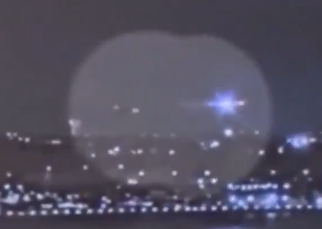
Helo on the left
Here's the more likely issue with NVG. Looking through them is often described as akin to looking through a pair of toilet roll tubes. Field of vision is radically reduced and it takes strong, conscious and fatiguing effort to conduct any kind of visual search.
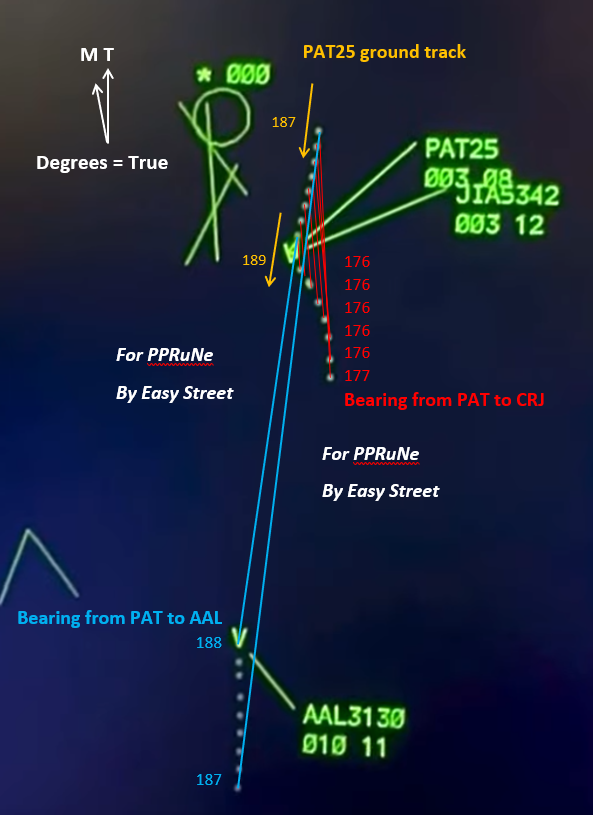
At the start of the radar recording posted to YouTube by AvHerald, AAL3130 is 10 degrees right of the CRJ from PAT25's point of view, and at a similar elevation angle. Its landing lights would be prominent in NVG and if PAT25's pilots were fixated upon it, they would not have seen the CRJ further left unless actively moving their heads to look for it. PAT25 gradually changes heading by 2 degrees right during the course of the radar clip, almost exactly following the bearing to AAL3130, and this makes it even clearer to me that PAT25 was mistakenly holding visual on it.
Last edited by Easy Street; 31st January 2025 at 16:50 .
Subjects
CRJ
Night Vision Goggles (NVG)
PAT25
Radar
Links are to this post in the relevant subject page so that this post can be seen in context.
Reply to this quoting this original post. You need to be logged in. Not available on closed threads.
January 31, 2025, 16:52:00 GMT
permalink Post: 11818357
Here's the more likely issue with NVG. Looking through them is often described as akin to looking through a pair of toilet roll tubes. Field of vision is radically reduced and it takes strong, conscious and fatiguing effort to conduct any kind of visual search.
At the start of the radar recording posted to YouTube by AvHerald, AAL3130 is 10 degrees right of the CRJ from PAT25's point of view, and at a similar elevation angle. Its landing lights would be prominent in NVG and if PAT25's pilots were fixated upon it, they would not have seen the CRJ further left unless actively moving their heads to look for it. PAT25 gradually changes heading by 2 degrees right during the course of the radar clip, almost exactly following the bearing to AAL3130, and this makes it even clearer to me that PAT25 was mistakenly holding visual on it.
Subjects
CRJ
Night Vision Goggles (NVG)
PAT25
Radar
Links are to this post in the relevant subject page so that this post can be seen in context.
Reply to this quoting this original post. You need to be logged in. Not available on closed threads.
January 31, 2025, 17:10:00 GMT
permalink Post: 11818375
Lets break it down based on what we know so far:
See and Avoid We have years and years and years of evidence about the limitations of see and avoid. It is not and never will be effective mitigation to a collision risk on its own. It needs to be backed up with other barriers such as ACAS etc. The human eye is particularly bad at spotting stationary objects, which would have been the case in this instance with another aircraft on a steady bearing. Those who criticise the aircrew for not keeping a good lookout are being disingenuous. The ability to judge distance at night, is difficult. Those who suggest the helicopter was looking up at the night sky, omit to recognise that the cameras on which you are basing that opinion, were at ground level. The crew of the Helo would have been at a similar altitude, looking at a background of many lights, with other aircraft barely above the horizon. The reports state that the aircrew may have been on NVG. This exacerbates the issue as they narrow your field of view, make depth perception even worse and of course, those I know of, do not display different colours, such as navigation lights. So see and avoid needs to be backed up by other measures and one can also see how VFR at night is fraught with danger.
Procedures - There is nothing inherently wrong with helicopter lanes close to aerodromes as long as the procedures that control such traffic are robust. I do not know what the local procedures state for routes 1 and 4 but I would expect them to include a limitation to ensure that you cannot use route 4/1 if an approach is being made to Rwy 33 or vice versa, an approach cannot be made to Rwy 33 if there is traffic on route 1/4. If such a procedure does no t exist then we could argue negligence. Lets assume one does exist. In that case, I would expect some process to block the route or the approach, using an aide memoire such as a flight strip or other electronic means. The recent crash at Haneda, highlights the need for such a safety barrier.
The Controller - Reports suggest that controller numbers were down to 19, which is woefully inadequate for an operation such as this and I hope the NTSB looks at what actions were taken by the airport to close in the face of staff limitations. We assume from reports, that the controller concerned was working in a combined position, with band-boxed frequencies. Looking at FR24 replays, it was quite busy at the time and we also do not know what level of fatigue the individuals were under. If the procedures above were in force, was a blocking strip forgotten? Was the controller overloaded or distracted? I hope they were not combining Radar and tower!
Phraseology - Others on here have mentioned about phraseology used. First of all, I cannot understand this machismo, that US controllers have to speak fast. Stop it! It is dangerous and you only end up having to repeat yourself. Others have mentioned about using the clock code. The Tower controller may not have the endorsement to use radar procedures and may have been forced to use geographical points. From what I have heard and yes lets wait for the report, it seems that the phraseology used was sub optimal.
Duty of Care - Some of here have spoken about the transfer of responsibility onto the helicopter operator. This is a pet hate of mine, of people hiding behind the rules to abrogate responsibility. Everyone in the system has a duty of care and Air Traffic Controllers, regardless of type of service, have an accountability to do what they can to prevent collisions. That is written into the highest levels of ICAO Annex 11
My condolences to all involved and my thoughts are also with those under investigation, who I feel may have been let down by the system.
Subjects
ATC
Accountability/Liability
ICAO
NTSB
Night Vision Goggles (NVG)
Phraseology (ATC)
Radar
See and Avoid
VFR
Links are to this post in the relevant subject page so that this post can be seen in context.
Reply to this quoting this original post. You need to be logged in. Not available on closed threads.