February 02, 2025, 21:03:00 GMT
permalink Post: 11820111
If the aircraft were at a close to 90-degree intersection, then the CRJ700 would have been moving across the field of vision right in front of the helicopter, thus making the collision all the more perplexing, not withstanding night vision goggles (if indeed worn) interfere with depth perception and can reduce field of view to as low as 40\xb0. Of course there also remains the reported disparity in flying height, with the UH-60 100 feet above it's flight ceiling
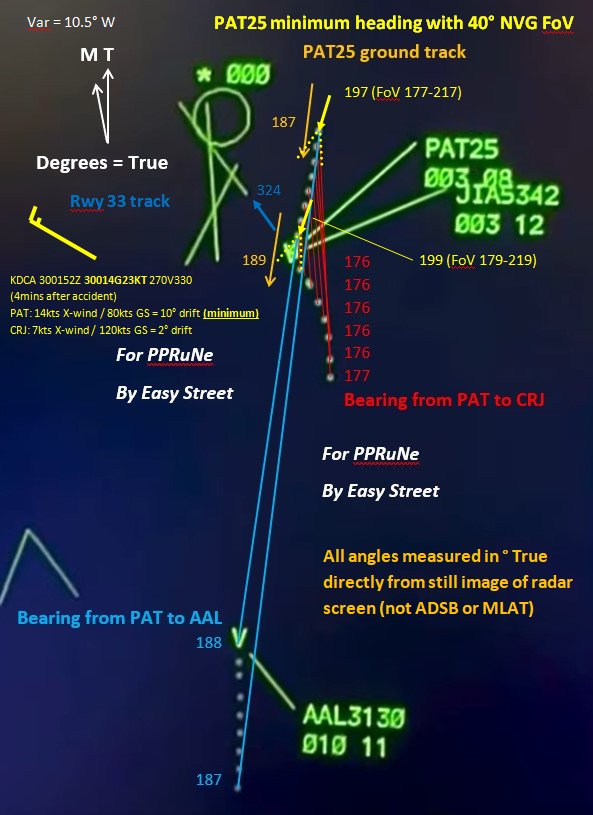
I can't access the METAR history any more, but I think it was 270V330 with gusts above 20kts. With the helo showing a groundspeed of 80kts on the radar trace, a westerly wind of just 12kts would give 9 degrees of drift and therefore a helo heading of 196, putting the CRJ just outside the 20 degree semi-angle of NVG with 40 degree field of view if the pilots were looking straight ahead.
If anyone can supply the METAR info (there was a report just 10mins after the accident), I'll update my radar diagram with the helo heading and a superimposed field of view. (Edit: done at #729 )
Last edited by Easy Street; 3rd February 2025 at 02:04 .
Subjects
Blackhawk (H-60)
CRJ
Night Vision Goggles (NVG)
Radar
Links are to this post in the relevant subject page so that this post can be seen in context.
Reply to this quoting this original post. You need to be logged in. Not available on closed threads.
February 03, 2025, 01:52:00 GMT
permalink Post: 11820222
My marked up version of the radar plot now shows the heading of PAT25 at the first and penultimate sweep, based on the ground track as measured directly from the plot and assuming that the wind is at the non-gust value from the METAR observation taken just 4 minutes later (making this a reasonable minimum drift). It also shows the 40 degree field of view of the AN/AVS-9 NVG, drawn assuming both pilots are looking directly ahead along aircraft centreline.
The take-away is that with these assumptions, the CRJ starts on the extreme left hand edge of the NVG field of view and then moves just out of it. The PAT25 pilots would only see the CRJ in NVG if they turned their heads left of aircraft centreline to search for it. Since they thought they had visual contact, presumably with AAL3130, they would have no reason to do so.
Subjects
CRJ
Night Vision Goggles (NVG)
PAT25
Radar
Links are to this post in the relevant subject page so that this post can be seen in context.
Reply to this quoting this original post. You need to be logged in. Not available on closed threads.
February 03, 2025, 01:54:00 GMT
permalink Post: 11820223
- A Blackhawk can in fact stop on a dime (so whatever you're suggesting Mike Blackstone was wrong about, it certainly wasn't that).
- Obviously that shouldn't be the plan , but it still a legitimate question to ask, in the context of an emergency, and when every other safety precaution has already failed, why couldn't it be done? Other poster's rationalize: at the low altitude, there's nowhere to go. The videos demonstrate otherwise. You can stop a Blackhawk 50 feet above the ground in seconds. If deviating in any direction is a risk, why didn't ATC just say " PAT25 slow to stop and hover!" – as a Very. Last. Resort?
My experience? 15,000 hours rotary with at least 4-5,000 hours below 200', 1,500 night hours, Mil/Civil mix of mediums (21,000lb) down to horrid little clockwork toys.
No further online discussion from me, but it would be interesting to know your pilot qualifications to post here with such assumed authority, please?
Subjects
ATC
Blackhawk (H-60)
Hover
Night Vision Goggles (NVG)
PAT25
Links are to this post in the relevant subject page so that this post can be seen in context.
Reply to this quoting this original post. You need to be logged in. Not available on closed threads.
February 03, 2025, 08:36:00 GMT
permalink Post: 11820320
These were 5 aviation professionals who had gotten their roles through hard work and perseverance (like all aviation professionals) and fell victim to the circumstances they found themselves in that night.
Speaking to some of my colleagues who have used NVGs operationally, they say they do reduce your field-of-view and flatten depth perception - one said he had mistaken a star for another aircraft for a while; it was only further away than he thought by a factor of ten trillion...
Subjects
ATC
CRJ
Close Calls
DCA
Night Vision Goggles (NVG)
Links are to this post in the relevant subject page so that this post can be seen in context.
Reply to this quoting this original post. You need to be logged in. Not available on closed threads.
February 03, 2025, 10:04:00 GMT
permalink Post: 11820374
Speaking to some of my colleagues who have used NVGs operationally, they say they do reduce your field-of-view and flatten depth perception - one said he had mistaken a star for another aircraft for a while; it was only further away than he thought by a factor of ten trillion...
What's wrong with this picture?
Last edited by artee; 3rd February 2025 at 10:37 . Reason: Corrected wording.
Subjects
Close Calls
DCA
Night Vision Goggles (NVG)
Links are to this post in the relevant subject page so that this post can be seen in context.
Reply to this quoting this original post. You need to be logged in. Not available on closed threads.
February 03, 2025, 11:08:00 GMT
permalink Post: 11820420
9. As JIA342 rolls out of its left hand turn to final on RWY 33, completing the deviation they were just handed and had not briefed for, it is now approaching the 9-11 o\x92clock position of PAT25. Since the pilot of PAT25 is on the right-hand side of the Blackhawk, visibility of the CRJ may be limited. Both pilots of PAT25 are now most likely visibly fixated on passing to the rear of AA3130, which is in their 1-3 O\x92clock position, and which is the conflicting aircraft they perceive as the one ATC initially warned them about.
Subjects
ATC
Blackhawk (H-60)
CRJ
DCA
Night Vision Goggles (NVG)
PAT25
Route 4
Links are to this post in the relevant subject page so that this post can be seen in context.
Reply to this quoting this original post. You need to be logged in. Not available on closed threads.
February 03, 2025, 16:21:00 GMT
permalink Post: 11820674
If the guess that PAT25 saw the traffic for 01 (further south,who was #2 for landing, with the CRJ being #1) and not the traffic for 33, they were still advised by ATC to pass behind their traffic .
As you look at the various diagrams of the final geometry, with their initial southerly heading, any right turn would have them pass in front of the traffic approaching 01 (and yes, also it would cause them to cross in front of landing traffic for 33 if they saw that, though it appears that they didn't.).
Why the right turn rather than simply following the east bank (of the declared route) until the traffic that they did see (apparently the aircraft approaching 01) was passing their right side?
It makes no sense to me.
It appears that poster 51bravo has made a similar observation, worded differently.
If what you suggest is true, that neither pilot in the cockpit was familiar with the runway lay out of National(Reagan) Airport, that's an enormous hole in a slice or three of the cheese. I expect that subtle details like this may, or may not, eventually come out as the investigation progresses.
For patrickal:
While I appreciate the effort your put into that extended analysis, you are quite wrong about what a training mission is, the least of which is why one needs to do actual flying in an area to be competent in a given operations area, and why you have to do them in daylight and at night since your mission will call on your unit to undertake that mission, VIP transport, day or night.
The airspace in and around DC, writ large, is one of that unit's required operations area.
Your point 11 has so many things wrong about it that I won't waste further time on it.
In terms you might understand: no sale.
Last edited by Lonewolf_50; 3rd February 2025 at 16:45 .
Subjects
ATC
CRJ
DCA
Night Vision Goggles (NVG)
PAT25
Pass Behind
Pass Behind (All)
Links are to this post in the relevant subject page so that this post can be seen in context.
Reply to this quoting this original post. You need to be logged in. Not available on closed threads.
February 03, 2025, 18:11:00 GMT
permalink Post: 11820767
I fully sign your deduction, but granted your assumptions are true that PAT25 was mentally focused on passing behind AA3130 (which I fully believe too), but they also received the information that it is RWY33 that is to be used for landing of the CRJ. So why for gods sake did they continue into 33 runway extension before AA3130. Was there also a disorientation towards their current position relative to DCA runway systems and they also easily (at night, mental bias) took RWY01 for RWY33 ? It almost looks so. Once more the narrow vision of NVG cheese slice ?!
Subjects
CRJ
DCA
Night Vision Goggles (NVG)
PAT25
Links are to this post in the relevant subject page so that this post can be seen in context.
Reply to this quoting this original post. You need to be logged in. Not available on closed threads.
February 04, 2025, 09:50:00 GMT
permalink Post: 11821238
During NVG flight there are aided (NVGs down or up) and unaided portions depending on which one gives the pilots better situational awarness.
Conclusion is that it\x92s unlikely that the NVGs on board signifitically affeted the crew\x92s ability to spot the conflicting traffic.
Subjects
Night Vision Goggles (NVG)
Links are to this post in the relevant subject page so that this post can be seen in context.
Reply to this quoting this original post. You need to be logged in. Not available on closed threads.
February 04, 2025, 11:51:00 GMT
permalink Post: 11821345
Among the many risky things I used to do as a military pilot, including diving towards the ground at 45 degrees in pitch darkness and pulling out on a range cue to miss the ground by 500 feet, one thing which always made the chain of command particularly nervous was closed pattern work on NVG. At home base, only experienced pilots were allowed to wear NVG in the pattern with another aircraft, and even then only one other: their similarly experienced formation wingman. And that was at a remote airfield with only a few military lives at stake and a tower controller monitoring both aircraft like a hawk. In Afghanistan, it was a toss-up whether the most dangerous place to fly fixed wing was over the Taliban or in the closed pattern at Kandahar, with helicopters darting around wearing covert lighting (they of course had an understandably different view of the risks). The idea of flying through the traffic pattern at a busy civilian airport using NVG to avoid airliners simply appals me.
Last edited by Easy Street; 4th February 2025 at 12:25 .
Subjects
ATC
CRJ
Night Vision Goggles (NVG)
Links are to this post in the relevant subject page so that this post can be seen in context.
Reply to this quoting this original post. You need to be logged in. Not available on closed threads.
February 04, 2025, 12:38:00 GMT
permalink Post: 11821386
Subjects
CRJ
Night Vision Goggles (NVG)
Links are to this post in the relevant subject page so that this post can be seen in context.
Reply to this quoting this original post. You need to be logged in. Not available on closed threads.
February 04, 2025, 13:04:00 GMT
permalink Post: 11821412
The issue outside is that NVG modify and 'flatten' the visual scene markedly. Not all wavelengths are intensified equally: older generation equipment with which I'm familiar amplified red significantly, green not at all (hence green writing in HUDs and green lighting in NVG cockpits), and blue only moderately. The purpose of NVG is to see the ground, so gain control is applied to prevent bright points of light from obscuring the terrain; this means that beyond a certain brightness, all lights look the same. However a particularly bright light can create a dark halo around it, potentially obscuring dim lights nearby. It is possible to see two lights with the naked eye and only one with NVG. There is no ability to discern colour or sharpness, at least in the equipment I'm familiar with, and any twinkle is lost.
Stories abound of pilots chasing after bright stars or planets, wondering why their TACAN range to the tanker keeps increasing. It is really a thing, trust me. I distinctly remember the aviation medical officer giving the NVG introductory briefing telling us that if we were to undergo assessment of visual acuity while wearing them on a perfectly moonlit night, we would be assessed as clinically blind! That message was never lost on me.
Subjects
Night Vision Goggles (NVG)
Links are to this post in the relevant subject page so that this post can be seen in context.
Reply to this quoting this original post. You need to be logged in. Not available on closed threads.
February 04, 2025, 13:28:00 GMT
permalink Post: 11821431
And the "amateur MLAT" tracking of the helo, is only a rough indication of the trajectory with a wide margin of position error and should be interpreted more like the right side hereunder:
Thanks for that insight as well.
It's almost as though wearing the NVG in the vicinity of the airport on that evening would, by itself, create a degraded lookout ability. Seems counterintuitive unless one gets into the details of how NVGs work.
Subjects
KDCA
Night Vision Goggles (NVG)
Route 4
Links are to this post in the relevant subject page so that this post can be seen in context.
Reply to this quoting this original post. You need to be logged in. Not available on closed threads.
February 04, 2025, 14:51:00 GMT
permalink Post: 11821483
Among the many risky things I used to do as a military pilot, including diving towards the ground at 45 degrees in pitch darkness and pulling out on a range cue to miss the ground by 500 feet, one thing which always made the chain of command particularly nervous was closed pattern work on NVG. At home base, only experienced pilots were allowed to wear NVG in the pattern with another aircraft, and even then only one other: their similarly experienced formation wingman. And that was at a remote airfield with only a few military lives at stake and a tower controller monitoring both aircraft like a hawk. In Afghanistan, it was a toss-up whether the most dangerous place to fly fixed wing was over the Taliban or in the closed pattern at Kandahar, with helicopters darting around wearing covert lighting (they of course had an understandably different view of the risks). The idea of flying through the traffic pattern at a busy civilian airport using NVG to avoid airliners simply appals me.
Subjects
ATC
CRJ
Night Vision Goggles (NVG)
Links are to this post in the relevant subject page so that this post can be seen in context.
Reply to this quoting this original post. You need to be logged in. Not available on closed threads.
February 04, 2025, 15:28:00 GMT
permalink Post: 11821504
The issue outside is that NVG modify and 'flatten' the visual scene markedly. Not all wavelengths are intensified equally: older generation equipment with which I'm familiar amplified red significantly, green not at all (hence green writing in HUDs and green lighting in NVG cockpits), and blue only moderately. The purpose of NVG is to see the ground, so gain control is applied to prevent bright points of light from obscuring the terrain; this means that beyond a certain brightness, all lights look the same. However a particularly bright light can create a dark halo around it, potentially obscuring dim lights nearby. It is possible to see two lights with the naked eye and only one with NVG. There is no ability to discern colour or sharpness, at least in the equipment I'm familiar with, and any twinkle is lost.
Stories abound of pilots chasing after bright stars or planets, wondering why their TACAN range to the tanker keeps increasing. It is really a thing, trust me. I distinctly remember the aviation medical officer giving the NVG introductory briefing telling us that if we were to undergo assessment of visual acuity while wearing them on a perfectly moonlit night, we would be assessed as clinically blind! That message was never lost on me.
The new generation NVG are capable of providing clearer images and with this comes the ability to draw some shapes.
My doctor said the same as yours: with NVGs you are close to the blind person experience, next time you will understand how they feel.
Subjects
Night Vision Goggles (NVG)
Links are to this post in the relevant subject page so that this post can be seen in context.
Reply to this quoting this original post. You need to be logged in. Not available on closed threads.
February 05, 2025, 10:45:00 GMT
permalink Post: 11822093
Perhaps you mean that DoD would not be too happy with not being able to take visual separation, at night, using NVG? I think they might have to suck that up - especially the second and third aspects.
Subjects
IFR
Night Vision Goggles (NVG)
Separation (ALL)
VFR
Visual Separation
Links are to this post in the relevant subject page so that this post can be seen in context.
Reply to this quoting this original post. You need to be logged in. Not available on closed threads.
February 05, 2025, 14:07:00 GMT
permalink Post: 11822238
Subjects
ATC
Night Vision Goggles (NVG)
Links are to this post in the relevant subject page so that this post can be seen in context.
Reply to this quoting this original post. You need to be logged in. Not available on closed threads.
February 05, 2025, 23:51:00 GMT
permalink Post: 11822641
Questions:
Why was PAT 25 search light in the stowed position and not motored to a more forward position?
Why are PAT helicopters not M models with FD's so PAT 25 could have been coupled on route 4 while at 200' giving the PF more time to look for traffic?
Was there pressure to use NVG along route 4 to meet the hourly requirements for currency?
Why did PAT 25 not slow down or hold at Hains in order to pass behind the CRJ as per their clearance?
Why was it ops normal after a near miss the previous day and then only one crew chief instead of two for PAT 25?
Why was the controller task saturated?
Why over the years, as the airport got busier, someone didn't suggest, for night operations, only one aircraft on route 4 or only one aircraft on the approach to 33 at a time and prohibit simultaneous operations?
IMO while the CRJ was turning final to rwy 33 PAT 25 may have experienced the CRJ landing lights in the cockpit and may have chosen up and right rather than left and down. Note worthy, PAT 25 RAD ALT gauge scale changes dramatically at 200'.
Maybe an upgrade to Dulles with a high speed train connection...
Subjects
ATC
CRJ
Close Calls
Night Vision Goggles (NVG)
Pass Behind
Pass Behind (All)
Route 4
Links are to this post in the relevant subject page so that this post can be seen in context.
Reply to this quoting this original post. You need to be logged in. Not available on closed threads.
February 06, 2025, 01:07:00 GMT
permalink Post: 11822673
This was a check ride wearing NVGs while runway 33 was open. Do PAT night flights with passengers operate with NVGs all the time, or was this an attempt to check multiple boxes (e.g. NVG currency, route currency, night flight currency) in a single flight?
if the answer to the question above is \x93NVGs are generally worn if the Washington area is under some sort of security situation which reduces lit points of reference, but not otherwise\x94 would DCA civil flight ops be continuing in such conditions?
What I\x92m driving at is - wouldn\x92t it have been a good idea to reduce the degree of difficulty by squaring in advance with DCA ATC a pause of 33 ops when PAT25 came by, even if an aircraft or two had to hold/delay departure?
Subjects
ATC
DCA
Night Vision Goggles (NVG)
PAT25
Links are to this post in the relevant subject page so that this post can be seen in context.
Reply to this quoting this original post. You need to be logged in. Not available on closed threads.
February 06, 2025, 01:54:00 GMT
permalink Post: 11822687
Questions:
Why was PAT 25 search light in the stowed position and not motored to a more forward position?
Why are PAT helicopters not M models with FD's so PAT 25 could have been coupled on route 4 while at 200' giving the PF more time to look for traffic?
Was there pressure to use NVG along route 4 to meet the hourly requirements for currency?
Why did PAT 25 not slow down or hold at Hains in order to pass behind the CRJ as per their clearance?
Why was it ops normal after a near miss the previous day and then only one crew chief instead of two for PAT 25?
Why was the controller task saturated?
Why over the years, as the airport got busier, someone didn't suggest, for night operations, only one aircraft on route 4 or only one aircraft on the approach to 33 at a time and prohibit simultaneous operations?
IMO while the CRJ was turning final to rwy 33 PAT 25 may have experienced the CRJ landing lights in the cockpit and may have chosen up and right rather than left and down. Note worthy, PAT 25 RAD ALT gauge scale changes dramatically at 200'.
Maybe an upgrade to Dulles with a high speed train connection...
Not the latest model? Guess what, combat units get the latest models. These missions are transport, not combat roles. Budgets and priorities rule. There are VH-60s in the battalion, they\x92re probably not scheduled for check rides or training flights.
One RA does not rewrite the schedule, likely not even unusual in DCA. The previous crew may not have passed the event on. I\x92ve had numerous RAs, never a report. The NTSB has stopped asking for reports for events involving VFR traffic.
While nice to have, there\x92s no place for a second crew chief to have a forward view. And the CC may or may not be \x93in the loop\x94. They\x92re crew chiefs, not pilots. We had them on C-5 and they mostly slept in flight as they too much to do on the ground.
Subjects
ATC
CRJ
Close Calls
DCA
NTSB
Night Vision Goggles (NVG)
Pass Behind
Pass Behind (All)
Route 4
TCAS RA
VFR
Links are to this post in the relevant subject page so that this post can be seen in context.
Reply to this quoting this original post. You need to be logged in. Not available on closed threads.