February 06, 2025, 13:35:00 GMT
permalink Post: 11822990
Now the M model is equipped with additional features so you can if wanted have a hands off approach to a hover ( any hover height ) at any preselected destination of your choice etc. M model came after I retired so I\x92m not expert on that operation.
The L model in this accident has the 3400shp gearbox and bigger engines, thus with say full tanks and three crew, and as I recall we increased the tail rotor authority. In any case, coming to a hover OGE or any other maneuver you had in mind doesn\x92t present any problems. HOGE/backwards 45 kts-whatever-have at it. Only other thing that may deserve a note is that I do believe ( subject to correction from current Hawk pilots) that they would be using NVGs which flip up so they may have them on, but can choose whether to use them.
Subjects
Hover
Night Vision Goggles (NVG)
Links are to this post in the relevant subject page so that this post can be seen in context.
Reply to this quoting this original post. You need to be logged in. Not available on closed threads.
February 06, 2025, 14:36:00 GMT
permalink Post: 11823021
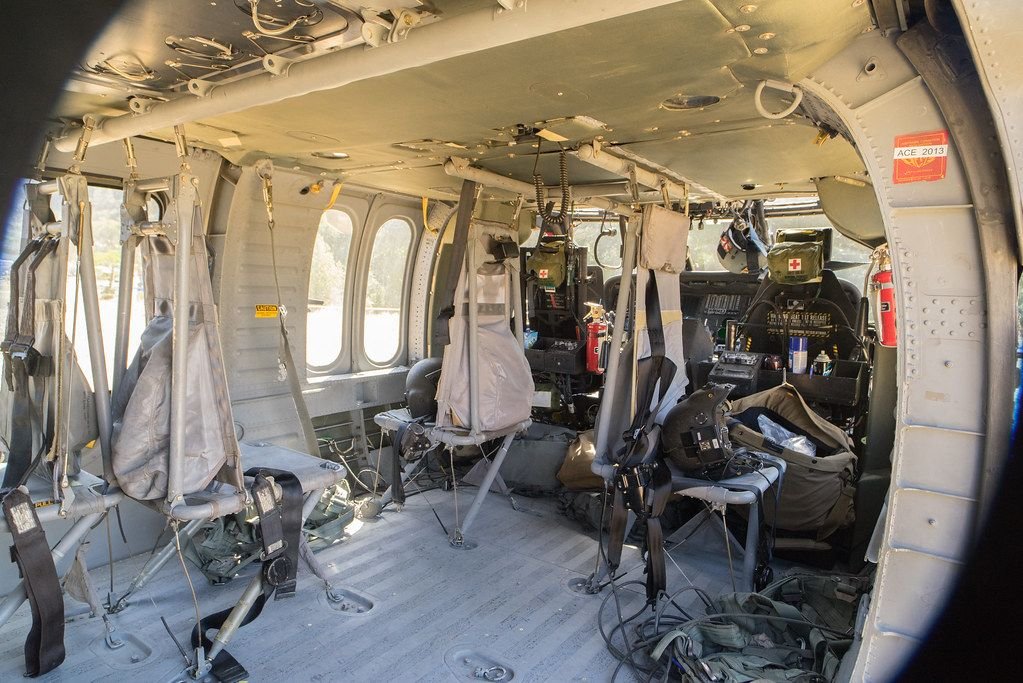
Owing to the vision limitations caused by use of NVG's it is not out of the realm of consideration Army policy would require for two crew members in the rear of the aircraft to enhance conflict resolution.
We routinely flew Chinooks with three crew in the rear with two designated to watch for traffic on either side of the aircraft. The third crew member was the Flight Engineer who controlled activities in the rear and performed safety checks. That simple concept saved my Bacon more than a few times.
Subjects
Blackhawk (H-60)
CRJ
Night Vision Goggles (NVG)
Links are to this post in the relevant subject page so that this post can be seen in context.
Reply to this quoting this original post. You need to be logged in. Not available on closed threads.
February 07, 2025, 10:47:00 GMT
permalink Post: 11823540
Brigadier, the newer NVGs are flip up, so you can have them on your helmet but flip them up if not wanting to use them.
Last edited by JohnDixson; 7th February 2025 at 10:52 . Reason: added note
Subjects
Night Vision Goggles (NVG)
Links are to this post in the relevant subject page so that this post can be seen in context.
Reply to this quoting this original post. You need to be logged in. Not available on closed threads.
February 07, 2025, 16:59:00 GMT
permalink Post: 11823780
* re the NVGs, I found an old video I shot of trying to drive with mine and coming around a corner to a bright street light at first the light bloomed across a good portion of the display and then the thing ramped down gain until the light was a pinpoint surrounded by black. Good thing I had it on one eye! I assume that if you have them on and look at a landing plane with lights on you get the same, either blooming or black with pinpoints.
Last edited by island_airphoto; 7th February 2025 at 17:16 .
Subjects
ATC
Night Vision Goggles (NVG)
Route 4
Links are to this post in the relevant subject page so that this post can be seen in context.
Reply to this quoting this original post. You need to be logged in. Not available on closed threads.
February 07, 2025, 22:36:00 GMT
permalink Post: 11823982
Quite extraordinary for a supposed 'recertification' flight.
The recertification flight might specifically need to be at night. It might even specifically require NVG. I also wonder if both pilots would be on NVG or just one of the two.
Last edited by YRP; 7th February 2025 at 22:49 . Reason: Edited to sound 10% less grumpy
Subjects
AA5342
ADSB (All)
NTSB
Night Vision Goggles (NVG)
PAT25
Situational Awareness
TCAS (All)
Links are to this post in the relevant subject page so that this post can be seen in context.
Reply to this quoting this original post. You need to be logged in. Not available on closed threads.
February 09, 2025, 19:54:00 GMT
permalink Post: 11825090
Done this myself for 50 years, night, single-pilot, high-density airports, single and multiengine, never had an issue identifying the aircraft tower pointed out to me.
Keep looking.
Subjects
Blackhawk (H-60)
Night Vision Goggles (NVG)
Pass Behind
Pass Behind (All)
Links are to this post in the relevant subject page so that this post can be seen in context.
Reply to this quoting this original post. You need to be logged in. Not available on closed threads.
February 15, 2025, 00:27:00 GMT
permalink Post: 11828318
Subjects
Blackhawk (H-60)
CRJ
CVR
NTSB
NTSB Chair Jennifer Homendy
Night Vision Goggles (NVG)
Links are to this post in the relevant subject page so that this post can be seen in context.
Reply to this quoting this original post. You need to be logged in. Not available on closed threads.
February 15, 2025, 00:56:00 GMT
permalink Post: 11828328
Subjects
NTSB
Night Vision Goggles (NVG)
Links are to this post in the relevant subject page so that this post can be seen in context.
Reply to this quoting this original post. You need to be logged in. Not available on closed threads.
February 15, 2025, 09:19:00 GMT
permalink Post: 11828441
In any case the procedure us currently withdrawn until end of March and I sincerely doubt they will re-install it before the final report is out. ..
A couple of new info points the NTSB clarified : Both aircraft were on VHF , so we can drop this UHF discussion , the Blackhawk had ADS-B equipped but was not transmitting , it was check ride with NVG, and they most probably all had them on .and there was a last second evasive action attempt by the CRJ crew, which go a TA previously . On the TWR, the CAs are displayed in the BRITE even with audio on ..
For the rest we have to wait until the next NTSB briefing
Subjects
ADSB (All)
Altimeter (All)
Blackhawk (H-60)
CRJ
Final Report
NTSB
Night Vision Goggles (NVG)
Links are to this post in the relevant subject page so that this post can be seen in context.
Reply to this quoting this original post. You need to be logged in. Not available on closed threads.
February 15, 2025, 12:41:00 GMT
permalink Post: 11828596
Why did the did miss part of the message
Why was the incomplete read back missed
Why does missing a few words lead to this disaster within seconds.
Does this lead an answer like: helicopter in a very busy airspace, busy controllers (insufficient time to be fully focused on full read backs) being by default too close to (and even needing to cross) the glideslope.
Helicopters in busy airspace are not a problem if a safe system exists for separating them from airline traffic.
There is no evidence yet of the controller having made a mistake. He was undoubtedly busy, but that was not his fault. What could be done about it? The answers to that question take us another step along the causal chain:
- The FAA could have provided more controllers. We know the helicopter controller position was unoccupied, and it's likely that closer monitoring and earlier intervention could have changed the outcome (notwithstanding point 3).
- Controller workload could have been reduced by implementing effective procedural separation . If the DCA ATC rulebook allowed this segment of Route 4 to be in simultaneous use with Runway 33 landings, then procedural separation did not exist , however much anyone thought it did. At least 1.5nm or 500ft between flight paths would be needed to meet the least restrictive FAA separation standards, and this would have forced constraints to be applied to Route 4 or Runway 33 utilisation.
- Regulations allowed the helo pilots to assume responsibility for separation. This is what happened, with the consequences which flow from the inherent difficulty of identifying and separating visually at night (especially while wearing NVG).
The authorities (by which I mean FAA and DoD) have questions to answer on all three points. Why was the helicopter controller position vacant? Did the ATC rulebook or staffing requirements rely on a false assumption that procedural separation existed? How did any such assumption remain in place after previous near misses? Is visual separation between helicopters and airline traffic a reasonable thing for regulations to permit, at night and using NVG? Ultimately it seems to have routinely been used as a release valve for the pressure building in the system due to the failure to address points 1 and 2.
Hopefully the investigation will be bold enough to ask these questions, which expand the potential scope of responsibility well beyond the individual controller and pilots.
Last edited by Easy Street; 15th February 2025 at 13:36 .
Subjects
ATC
Close Calls
DCA
FAA
Night Vision Goggles (NVG)
Route 4
Separation (ALL)
Visual Separation
Links are to this post in the relevant subject page so that this post can be seen in context.
Reply to this quoting this original post. You need to be logged in. Not available on closed threads.
February 16, 2025, 09:42:00 GMT
permalink Post: 11829100
Last edited by Easy Street; 16th February 2025 at 10:32 .
Subjects
ATC
Night Vision Goggles (NVG)
Separation (ALL)
Visual Separation
Links are to this post in the relevant subject page so that this post can be seen in context.
Reply to this quoting this original post. You need to be logged in. Not available on closed threads.
February 16, 2025, 22:53:00 GMT
permalink Post: 11829514
Subjects
ATC
CRJ
Night Vision Goggles (NVG)
Pass Behind
Pass Behind (All)
Separation (ALL)
Links are to this post in the relevant subject page so that this post can be seen in context.
Reply to this quoting this original post. You need to be logged in. Not available on closed threads.
February 16, 2025, 23:09:00 GMT
permalink Post: 11829529
He doesn't know his mental model is dead wrong because he latched onto the wrong aircraft in the cluster of 4 visible when the traffic was called to him a couple of minutes ago.
Last edited by Easy Street; 16th February 2025 at 23:38 .
Subjects
CRJ
Night Vision Goggles (NVG)
Links are to this post in the relevant subject page so that this post can be seen in context.
Reply to this quoting this original post. You need to be logged in. Not available on closed threads.
February 17, 2025, 01:03:00 GMT
permalink Post: 11829565
TCAS
ATC
ADS-B
See and Avoid
Filing a flight plan
Not operating in controlled airspace without a transponder
Not operating at a landing altitude for aircraft on final for a well used runway
Announcing an intention to cross a well used approach
Position lights/strobes
Landing lights
Just spitballing, but there's a non-zero chance NVGs were in use in the helicopter.
It sucks that the best part of this is the airplane was a CRJ, not a larger airliner. Most all those passengers would have survived the initial collision and been aware during the fall to the river.
I feel rage.
So the message for everyone is to politely and firmly refuse to do things that are not in your own interest, to make copious reports through safety management systems of events that you see that breach the normal, and to stop trying to work around a broken system where you ultimately will be the scapegoat.
Last edited by Wide Mouth Frog; 17th February 2025 at 01:37 .
Subjects
ADSB (All)
ATC
CRJ
Night Vision Goggles (NVG)
See and Avoid
TCAS (All)
Links are to this post in the relevant subject page so that this post can be seen in context.
Reply to this quoting this original post. You need to be logged in. Not available on closed threads.
February 17, 2025, 01:08:00 GMT
permalink Post: 11829568
Your litany of how the holes in the cheese lined up might be missing a detail or two, but any of those holes not lining up might have avoided this tragedy.
The rad alt is right there.
At night over water at low level, the pilots I flew with did not ignore their rad alt.
It was a part of one's scan.
If I know that field elevation is 14', and my rad alt isn't at 200' or less on a route where max altitude is 200', a correction is needed now, before the error gets larger. (The separate issue of going behind, and that tower guidance apparently being stepped on, is another pair of holes in the cheese).
I am at a loss to understand the apparent magnitude of the altitude error (they were still too close laterally, yes), but as I've been out of the cockpit for a few years I am not aware of what's being taught these days.
On most airlines, they do have a barf bag, still, in the seat pocket in front of you. Suggest you vomit into that and avoid the choke hazard.
Subjects
ATC
CRJ
Night Vision Goggles (NVG)
Pass Behind
Pass Behind (All)
Radio Altimeter
Separation (ALL)
Links are to this post in the relevant subject page so that this post can be seen in context.
Reply to this quoting this original post. You need to be logged in. Not available on closed threads.
February 17, 2025, 03:42:00 GMT
permalink Post: 11829612
While the PAT 25 pilots, prior to take off, would set the barometric pressure each gauge must have no more than a +/- 75 foot error (FAA). One gauge may have read + 50 feet high while the other one read - 50 feet low which would account for the 100 foot difference in flight between the two barometric altimeters. Many mechanical and pilot input errors would be potential factors. Not common but sometimes a pilot will read back the correct setting while at the same time setting a different value by mistake. IF the 100 foot discrepancy was discussed initially on the ground it may account for the lack of discussion , later in the flight, while at 400 feet PM and 300 feet PF. It begs the question was radar altimeter planned to be used and if so when?
Even though there are some transmissions stepped on for various reasons, the words runway thirty three were mentioned a number of times. As crossing the threshold to runway 33 posed a significant risk to PAT 25 I would have thought the PAT 25 crew, to know from experience, that in 3 to 4 minutes from the time ATC reported the CRJ crossing the bridge the CRJ would pass directly in front of them at or near the same altitude. It's not clear to me why PAT 25 would not have reduced airspeed and or held at HAINS point.
I belive the simultaneous helicopter and runway 33 operations should never have been permitted. Clearance limits and expected further clearance times mirroring the ETA for rwy 33 given to helicopters to arrive at or hold at HAINS point would have be helpful in preventing conflicts.
Subjects
ATC
Altimeter (All)
CRJ
FAA
Night Vision Goggles (NVG)
Radar
Links are to this post in the relevant subject page so that this post can be seen in context.
Reply to this quoting this original post. You need to be logged in. Not available on closed threads.
February 17, 2025, 06:24:00 GMT
permalink Post: 11829650
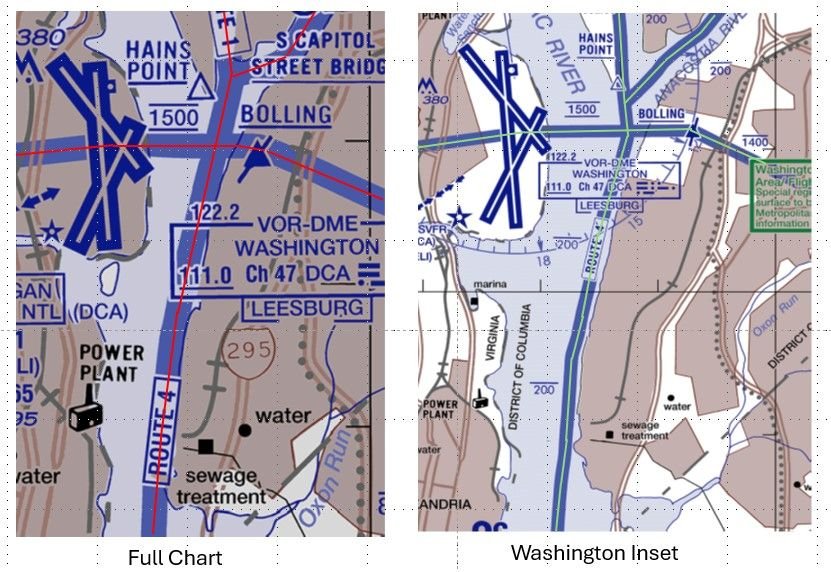
You could reasonably define the bank as the water's edge, and therefore expect crews to fly along an infinitesimally narrow path. Or as the space between the water's edge and the [edge of the flood plain | first flat area | something else], which would imply that the western boundary changes with the water level. Both imply the route is substantially above land.
Neither are useful for precise navigation, but the map and the description are probably 'close enough' if they are only needed for general route guidance and knowing that structures on the east bank need to be NOTAMed for helicopters, but probably not the west bank.
A good reminder that measurements/specifications without tolerance are often worse than useless.
If it quacks like a duck... this kind of "It can't be an X because we can't do it, so we'll call it a Y" leads to a culture that gets used to massaging the truth for convenience. Did we hear more on the Alaska door plug that was an 'opening' not a 'removal'?
Subjects
ATC
CRJ
DCA
FAA
KDCA
NTSB
Night Vision Goggles (NVG)
Pass Behind
Pass Behind (All)
Separation (ALL)
Links are to this post in the relevant subject page so that this post can be seen in context.
Reply to this quoting this original post. You need to be logged in. Not available on closed threads.
February 17, 2025, 08:38:00 GMT
permalink Post: 11829705
As many and I said before, discussion about Altimeters or width of VFR routes are just distractions to deflect from the real cause , which for me can be resumed into the lack of a safety assessment and safety case of existing procedures. We all had to do this when SMS was widely introduced in the late 90s It was not that easy , but we discovered a few holes that were closed.
Here in DCA we see a couple of procedures that would not have passed a safety case : e.g Route 4, Circling to RWY 33 with that route active, visual separation at night , use of NVG on that route ..etc,,
Flying in itself always bares a risk,, our job is to minimize the risk , not to eliminate it , but here the Regulatory ( i.e FAA) failed to minimize the risks.
As in the US the FAA is both the service provider and the Regulator , and is in addition dependent of political will and pressure for its funding , the willingness to implement unpopular measures, may be limited. A Judge might look into this differently but for those part of the discussion I hand over the floor to .Willow run 6-3 .
Subjects
DCA
FAA
Night Vision Goggles (NVG)
Route 4
Separation (ALL)
VFR
Visual Separation
Links are to this post in the relevant subject page so that this post can be seen in context.
Reply to this quoting this original post. You need to be logged in. Not available on closed threads.
February 17, 2025, 09:15:00 GMT
permalink Post: 11829728
Re the height deviation. When flying a helo at 200ft at night over a black hole (the river) you are very conscious indeed of your extremely low height. If told of conflicting traffic that you have to search for over/amongst city lights your attention is considerably diverted from pure flying and the natural tendency would be to squeeze back a little on the cyclic. I imagine that would be even more the case if NVGs were in use, tho I've no experience with them. That is a likely cause of the otherwise surprising altitude deviation tho we'll never know.
Subjects
Night Vision Goggles (NVG)
Route 4
Links are to this post in the relevant subject page so that this post can be seen in context.
Reply to this quoting this original post. You need to be logged in. Not available on closed threads.
February 17, 2025, 15:50:00 GMT
permalink Post: 11829979
As many and I said before, discussion about Altimeters or width of VFR routes are just distractions to deflect from the real cause , which for me can be resumed into the lack of a safety assessment and safety case of existing procedures. We all had to do this when SMS was widely introduced in the late 90s It was not that easy , but we discovered a few holes that were closed.
Here in DCA we see a couple of procedures that would not have passed a safety case : e.g Route 4, Circling to RWY 33 with that route active, visual separation at night , use of NVG on that route ..etc,,
Flying in itself always bares a risk,, our job is to minimize the risk , not to eliminate it , but here the Regulatory ( i.e FAA) failed to minimize the risks.
As in the US the FAA is both the service provider and the Regulator , and is in addition dependent of political will and pressure for its funding , the willingness to implement unpopular measures, may be limited. A Judge might look into this differently but for those part of the discussion I hand over the floor to .Willow run 6-3 .
This is an excerpt from a website of an actually well-known, very accomplished, and respected group of lawyers who specialize in (among other things) aviation matters. I'm not using their name and I don't have any approval, express or implied, to use information from their website - but if justice is to be sought for the victims' families, public discussion is - or should be - encouraged.
"A discretionary function is an action of a governmental nature exercised by a federal employee, but in order for that action to be considered a discretionary function, it must pass a two-part test:
There must be an element of judgment or choice. That is, if a federal statute or regulation prescribes a course of action for an employee to follow, there is no discretion.
That judgment or choice must be susceptible to policy analysis.
The Federal Tort Claims Act contains a discretionary function exception that says the U.S. cannot be held liable for any employee\x92s failure to exercise or perform a discretionary duty.
Within the legal field of aviation accidents, discretionary duties for which the U.S. is not liable include the following:
Aircraft \x93spot check\x94 certifications
Weather forecasting
Failure to install equipment
The FAA\x92s design of flight procedures
The types of actions that are considered not discretionary, and therefore, open the U.S. government to litigation are:
The failure to issue air traffic control manual warnings
If air traffic control fails to warn of weather dangers
The failure to maintain equipment
Relaying incorrect instructions to pilots."
END OF EXCERPT [not intended as legal advice here or on its original internet page]
So to return to ATC Watcher's point...... the more posts I read about this midair collision (plus other information such as NTSB briefings) the more I am anticipating that it will require an act of Congress to provide for compensation for the families of the victims. Isn't it the obvious fact that convenience for people who work in Washington and travel "back home" generally speaking on weekends and when Congress isn't convened, is a prime and central reason for the way DCA airspace has been constructed and managed? Is it really going to be the case that because the lawsuits will - in all likelihood - fail to overcome the "discretionary function" exception, that the 67 families will be without a remedy? Is that how it works, then?
In case anyone thinks my sense of being horrified at this accident is clouding reason or logic, consider this - the book Collision Course discusses the PATCO union's genesis, the strike, and so on. PATCO's earliest stirrings resulted in large part from the 1960 midair over New York. Is the United States aviation sector willing to accept an outcome of this accident that in effect travels back over six decades? The point is, given the long-term shortage of ATCOs in this country . . . I don't think a court is capable of ruling that the situation, allowed and in fact enabled by Congress and successive White House presidential administrations, is subject to "negligence" analysis in the currently applicable legal sense. All this being said, this is how I arrive at thinking that in the interests of justice, some other means of providing for the loved ones of 67 souls who were on board needs to be determined and implemented.
Last edited by WillowRun 6-3; 17th February 2025 at 19:11 .
Subjects
ATC
DCA
FAA
NTSB
Night Vision Goggles (NVG)
Route 4
Separation (ALL)
VFR
Visual Separation
Links are to this post in the relevant subject page so that this post can be seen in context.
Reply to this quoting this original post. You need to be logged in. Not available on closed threads.