February 25, 2025, 18:09:00 GMT
permalink Post: 11835787
Thinking about the helicopter route, and the possible errors in the helicopter-borne equipment, the Static ports could be subject to some biases, and could be variable as a function go helicopter airspeed, vertical velocity, side slip.
Add to that a possible error or change in local baro (In-Hg) as one transits from their departure point into another area, the two cockpit baro altimeters' displayed altitudes can contribute to errors, but the altitude reporting to the tower is based on 29.92, so any error in setting AAU-31 or AAU-32 In-Hg applies only to the cockpit displays; the Tower receives Alt value referenced to 29.92 inches and corrects it locally for their displays and conflict alerting algorithms.
For the approach without benefit of a Glide Slope, the VASI or PAPI is visual and thus "probably" more challenging to maintain nominal approach angle to the runway. There should have been some documented analysis, backed up by data that helps to define the worst-case vertical departure from nominal approach angle on the PAPI/VASI approach; that needs to be part of a worst-case combined analysis, and I think needs to be better than "10 to the minus nine". Need to have data from both low-hour and high-hour pilots on a non-coupled approach.
Next quasi- related thought::: when the CVR recorded a verbal disparity of 100 feet between pilot and examiner, shouldn't that have raised questions of "Why"- especially when at low altitudes MSL? As I understand it, there would be 3 or 4 places where Baro Alt was displayed; the two mechanical bar alt indicators, AND the altitude display(s) on the pilot(s) NVG HUDS. If the pilot under evaluation was fully on the ANVIS HUD, and if that pilot failed to set the Bar Alt "correction" in terms go In-Hg, then the pilot could readily be seeing inaccurate Bar Alt digits on the HUD.
I believe there procedurally had to be a separate action to set In-Hg ( or to sync the HUD to the AAU-31 and AAU-32 values). It would not take much of an error in ANVIS HUD In-Hg setting to cause a substantial error in the Altitude digits displayed on the HUD.
Add/multiply these error sources up, and then see if the defined helicopter route met the 10 to the minus nine value.
Subjects
CVR
HUD
Night Vision Goggles (NVG)
Links are to this post in the relevant subject page so that this post can be seen in context.
Reply to this quoting this original post. You need to be logged in. Not available on closed threads.
February 26, 2025, 01:45:00 GMT
permalink Post: 11836058
Thinking about the helicopter route, and the possible errors in the helicopter-borne equipment, the Static ports could be subject to some biases, and could be variable as a function go helicopter airspeed, vertical velocity, side slip.
Add to that a possible error or change in local baro (In-Hg) as one transits from their departure point into another area, the two cockpit baro altimeters' displayed altitudes can contribute to errors, but the altitude reporting to the tower is based on 29.92, so any error in setting AAU-31 or AAU-32 In-Hg applies only to the cockpit displays; the Tower receives Alt value referenced to 29.92 inches and corrects it locally for their displays and conflict alerting algorithms.
For the approach without benefit of a Glide Slope, the VASI or PAPI is visual and thus "probably" more challenging to maintain nominal approach angle to the runway. There should have been some documented analysis, backed up by data that helps to define the worst-case vertical departure from nominal approach angle on the PAPI/VASI approach; that needs to be part of a worst-case combined analysis, and I think needs to be better than "10 to the minus nine". Need to have data from both low-hour and high-hour pilots on a non-coupled approach.
Next quasi- related thought::: when the CVR recorded a verbal disparity of 100 feet between pilot and examiner, shouldn't that have raised questions of "Why"- especially when at low altitudes MSL? As I understand it, there would be 3 or 4 places where Baro Alt was displayed; the two mechanical bar alt indicators, AND the altitude display(s) on the pilot(s) NVG HUDS. If the pilot under evaluation was fully on the ANVIS HUD, and if that pilot failed to set the Bar Alt "correction" in terms go In-Hg, then the pilot could readily be seeing inaccurate Bar Alt digits on the HUD.
I believe there procedurally had to be a separate action to set In-Hg ( or to sync the HUD to the AAU-31 and AAU-32 values). It would not take much of an error in ANVIS HUD In-Hg setting to cause a substantial error in the Altitude digits displayed on the HUD.
Add/multiply these error sources up, and then see if the defined helicopter route met the 10 to the minus nine value.
This is the same deal - anytime a landing airplane is below 1,000 feet (at least!) and doesn't own the airspace from them on down to the surface, you already lost the game right there. Someone will be down there at some point a bit too high and someone at some point will be a bit too low or too close or whatever. It is a narrow 2 lane road in the country with a 150 MPH speed limit. There will be crashes.
Subjects
CVR
HUD
Night Vision Goggles (NVG)
Links are to this post in the relevant subject page so that this post can be seen in context.
Reply to this quoting this original post. You need to be logged in. Not available on closed threads.
February 26, 2025, 12:31:00 GMT
permalink Post: 11836357
Next quasi- related thought::: when the CVR recorded a verbal disparity of 100 feet between pilot and examiner, shouldn't that have raised questions of "Why"- especially when at low altitudes MSL? As I understand it, there would be 3 or 4 places where Baro Alt was displayed; the two mechanical bar alt indicators, AND the altitude display(s) on the pilot(s) NVG HUDS. If the pilot under evaluation was fully on the ANVIS HUD, and if that pilot failed to set the Bar Alt "correction" in terms go In-Hg, then the pilot could readily be seeing inaccurate Bar Alt digits on the HUD.
Helo is going to be using radalt. Everything is radalt when the heights are below ~1000ft because the alternative is often fatal. This has been covered extensively. As to the rest... Wat?
Subjects
CVR
HUD
Night Vision Goggles (NVG)
Radio Altimeter
Links are to this post in the relevant subject page so that this post can be seen in context.
Reply to this quoting this original post. You need to be logged in. Not available on closed threads.
March 08, 2025, 21:18:00 GMT
permalink Post: 11843640
As for "do not cross final 33 before CRJ"... that'd still have given too much responsibility to the helo crew, in my opinion. They'd have suffered a crushing breakdown of their mental model as it became clear the lights ahead of them weren't going to land on 33 before they crossed the approach. Would that dawning reality have caused then to widen their search and see the CRJ? Possibly. But I doubt it. Human nature in high pressure situations, like NVG flying over a dark river in a city, is to keep pressing on with a flawed mental model.
"Hold at Hains Point", from a second controller with capacity to keep watch over two converging tracks, was what was needed to save the day here - and to cover up the underlying organisational failings for a while longer.
Subjects
ATC
CRJ
FAA
Night Vision Goggles (NVG)
Links are to this post in the relevant subject page so that this post can be seen in context.
Reply to this quoting this original post. You need to be logged in. Not available on closed threads.
March 21, 2025, 13:06:00 GMT
permalink Post: 11851374
I generally do see the raw facts of the accident as pointing to the acts, omissions, decisions and so forth by the pilots of the Army helicopter. But their conduct must be seen - and this must be an absolute hard line - within the context of what acts, omissions, decisions and so forth were taken by the all identifiable elements of the parties involved - the FAA, the Dep't of Transportation, the Army, the DoD. This context includes the night of the accident and many time periods before. At this time as just an observer well outside any actual fact investigation I'm not expressing a view about the manufacturer of the NVGs.
If you would like an example of an overly complicated argument which - on the state of the public record at present - competent (if not also highly motivated and driven) trial counsel would be advised to leave on the cutting room floor . . . What about legal accountability for the Congressional actors who kept overloading the DCA airspace until it broke, or rather two aircraft broke apart upon impact midair and further upon hitting and sinking into the Potomac, along with the shattering of 67 lives and the lives of perhaps countless family members and other loved ones? What about the denizens of K Street and their collections of multiple colors of Gucci loafers, the better to match the liveries of their airline industry clients? I mean, it could get complicated, and not that interesting either. (Disclaimer: there isn't any likelihood, legally speaking, of holding Congress to account for its actions with regard to DCA airspace management and usage. . . . . . you know, other than "voting" and a word that rhymes with "shmolitics.")
Subjects
Accountability/Liability
DCA
FAA
Night Vision Goggles (NVG)
Links are to this post in the relevant subject page so that this post can be seen in context.
Reply to this quoting this original post. You need to be logged in. Not available on closed threads.
March 22, 2025, 01:07:00 GMT
permalink Post: 11851803
". . . was the strategy to use Route 4 while 33 was active something ATCers at DCA, over time, started in an effort to cut down radio traffic and speed things up? If so, had it been assessed and then monitored for adverse safety? While anecdotally, it seemed people were aware of "close calls", had any analysis taken place looking at the Databases?"
To start, no apology whatsoever needed with regard to this dialogue. I try to respect the decorum required on this forum generally (meaning as SLF/attorney something has to be pretty severe or awful to warrant apologizing to me). And although I might not explain my sense of this with enough clarity - the FAA is conducting a review (according to Secretary Duffy) of airspace management and usage rules at other airports. The explanations in your posts, including very particularly the procedures when crossing approach corridors for London City, should be read and studied by the presumably well-informed professional ATO (Air Traffic Organization) staff assigned to conduct the review. (If it seems way presumptuous for an SLF/attorney to assert what resources ATO should be considering for the review noted by Sec. Duffy, I would suggest that ATO's reputation at the moment for upholding the much-touted "gold standard" set by FAA and United States aviation in general for the rest of the world ... well, like we used to say in trial practice, it takes the other side only about three minutes in court to stain the draperies, but it will take us all afternoon even to try to clean them. Reputation lost, same deal getting it back.)
On ASIAS, actually I entirely agree with your description of where it fits into the so-called "aviation safety ecosystem" (there simply has got to be a better term). The point I'm stuck on is one that (apologies, once more) comes from litigating in U.S. courts (especially federal District Courts around the country) employment law cases. Specifically, at the start, the main task for defense counsel is to construct the "chronology". Who did and said what to whom, when, and for what reason(s). I've asserted in an earlier post that in what I see as the inevitable litigation arising from this accident, there will be teams of significant lawyers constructing, or attempting to construct, such a chronology, although it won't be about an individual employee's hiring, performance reviews, promotion grants or denials and so on. It will be how it happened that the situation which obtained in the DCA airspace, in the cockpits of the Blackhawk helicopter and the CRJ, and ATC, came to exist.
(And I say "significant lawyers" because the attorneys who handle the big and significant aviation crash lawsuits for the families of victims are kind of the polar opposite of the stereotype ambulance chaser; to the contrary, their work is opposed by big-time big-law firm skyhigh hourly rate legally privileged sharks. The lawyers suing on behalf of these crash victims - if they are the same as the legal specialists I have met and discussed stuff with in various settings - are vindicating the need to bring the truth to light. "Aviation is the safest form of transportation": it is incanted over and over to the point of making anyone who utters it now sound quite seriously performative. Yet if it is so safe, how and why did those 67 people die over and in the Potomac? So with a kind of intense ruthlessness, the lawyers who will represent the families and other loved ones of the crash victims will unearth every little sequential act and omission which led to the situation which obtained on the fateful night of Wednesday, 29 January 2025. Exactly as the quoted language above from your post asks, what indeed was the strategy, if there even was one, as opposed to little incremental changes, accelerated of course by increasing airline flight lengths under the perimeter rule.)
On this basis, I would not concur with the idea that whether immunity is available for the defendants (both the Army and FAA/DoT) depends on whether the ATCO's specific conduct on Jan. 29 was "ordered" from on-high. The "on-high" is the development, over time, of the situation that obtained that night at DCA, despite safety imperatives in the NAS and aviation sector in general - and not a specific order or instruction given on that night.
The question behind the discretionary function exception is whether the act or omission by the defendant either (1) was negligent because it failed to follow a specific rule or statutory provision (if so, no immunity), or (2) was negligent in the usual sense of the word but will nevertheless still be protected by immunity because the act or omission was based on a decision about a policy matter or question. The decision on the policy matter or question is "discretionary" on the part of the government and hence the name of the exception protecting it. The courts are reluctant, and sometimes loath, to second-guess policy decisions made by the Executive Branch (I know, irony neither intended or not intended, given certain prominent flight- and aircraft-related matters in federal court at the moment). Under the first variety of negligence, there was no policy matter being decided, just failure to do something there was a legal duty to do (basic definition of negligence). Under the second variety, there would be a valid case to be made that there was negligence - but the immunity provided by the exception for discretionary functions prevents the case going forward.
So back to January 29, the assertion I've been making here is that no, there was not a specific rule or procedure that said to do things much like you describe the procedure - de facto (unwritten, informal) though it was - for transiting across the approach path. But there certainly were higher-order rules by which FAA and its ATC functions were required to observe in consistent performance, and not merely in repeated incantation that "aviation is the safest form of transportation." In fact, I wonder if clever lawyers might take that slogan and deploy it as a bludgeon. "You're at greater risk driving your car to the airport", they always say. Oh, really? Then let's talk about the equivalent scenario on the streets of Chicago with intersecting traffic lanes (obviously not at different altitudes), similarly difficult visibility conditions at night, compounded by NVGs. possibly compounded by a training or check ride in the vehicle, and then make the case that the Chicago PD cop directing traffic, and the motorist without the right-of-way, were acting on the basis of interpreting policies about driving on public roadways. No, there is no policy matter involved - there are strict rules of the road and over-riding principles for safe driving, and the failure to observe these is negligence.
It's simplistic but it might be sufficiently illustrative. Is "see and avoid" a procedure which involves making decisions on matters of policy? or is it a higher-order safety rule which must be observed at all times?
(Not meaning to slight the point about ANSP and regulatory functions needing to be separate - entirely agree, and yet, this will be an extraordinarily heavy lift to get done in the United States. That being said, I might know some lawyer-types who are fired up about efforts to make it happen this time around.)
WillowRun 6-3
Subjects
ATC
Blackhawk (H-60)
CRJ
Close Calls
DCA
FAA
Night Vision Goggles (NVG)
Route 4
See and Avoid
Links are to this post in the relevant subject page so that this post can be seen in context.
Reply to this quoting this original post. You need to be logged in. Not available on closed threads.
March 22, 2025, 22:11:00 GMT
permalink Post: 11852334
Probably five dozen lawyers have added, or will add, to their work-in-progress plans for their fact investigation and discovery activities locating, interviewing, and taking the depositions of retired ATCOs - with pertinent knowledge and appropriate credibility and experience, of course.
1. The actively used heli routes near landing traffic with merely hundreds of feet or less of "separation ".
2. The CA system being unreliable , it goes off all the time.. very high % of CA alarms in towers are useless. They do not have the effect outsiders or higher management think they do. We get so used to them going off that they don't carry the weight some wish they did. I have seen close calls where the CA goes off after the planes are a mile already past each other.
3. Visual separation with helicopters that normally use airspace, how often do they actually have traffic in sight and can maintain it? Are they just saying they do to get their job done? Should visual separation be allowed under NVGs ?
4. Many TCAS-RA problems under similar conditions, but nothing solid done about it? Where was management before? LSC? I honestly wonder if some controllers hated that operation but felt pressured into doing it to keep rate high and let the helis do their mission at the same time ?
Subjects
ATC
Close Calls
Night Vision Goggles (NVG)
Separation (ALL)
Traffic in Sight
Visual Separation
Links are to this post in the relevant subject page so that this post can be seen in context.
Reply to this quoting this original post. You need to be logged in. Not available on closed threads.
March 23, 2025, 23:02:00 GMT
permalink Post: 11852983
It seems clear the helicopter crew made mistakes that don't qualify as an exercise of discretion. Under the FTCA the crew is immune from lawsuits but the government is liable for the consequences of any such mistakes they made. As it was the governments responsibility not to assign them missions for which their training was inadequate.
I don't see such a case against the FAA. Perhaps if you find some specific regulation that was violated.
I think there is a reasonable chance the government will concede liability. The FTCA doesn't allow punitive damages and FTCA cases are not tried by juries. So if the government concedes liability I see no reason there will be any evidence presented about the cause, the remaining issues will be the amount of damages.
This all applies to the people on the jet. The helicopter crew can't claim against the military because of the Feres doctrine. Perhaps they have a claim against the FAA but I think their chances are distinctly weaker than those of the people on the jet.
Where I continue to view the legal playing field differently is that essentially all the elements of the authorities responsible for construction and management of the airspace in question set it up so this accident could occur even if - in this case - the Army pilots followed every rule and procedure they had been trained to follow. To make the point with some absurdity, the way the Army crew was negligent was in refusing to fly the helicopter routes around DCA absent significant modifications in procedures and rules. What other meaning can reasonable minds give to the by-now cliche: it was an accident waiting to happen? Within the airspace as constructed and operated by both the Army and FAA (and any other users who, at an agency and/or interagency level, participated in management of DCA airspace), the helicopter crew could be said to have acted non-negligently - it was the airspace management system which was negligently designed and operated. As another poster noted, there was normalization of complacency.
As I've noted above, I've got no claim for expertise about the DCA airspace (or any airspace) but that does not stop me from asserting that it is hard to understand why you do not see deep liability exposure for FAA in this matter (prior to successful invocation of the discretionary function exception, of course).
I had to delve into Feres in some depth for my student law review article many years ago .... though that's not the only reason I hadn't noted its relevance and applicability. In any event, I recall it being pretty largely without exceptions.... probably you're correct about that aspect.
The trial lawyers I have met would not easily give up on devising a way to get this case in front of a jury and litigating all issues, including punitive damages. Perhaps a claim against the manufacturer and designer of the NVGs? . . . but then we'll see more posts about legal matters, especially the "government contractor defense" and the Boyle decision by the Supreme Court in 1988 (with some oversimplification, if the defense contractor follows reasonably precise specifications for the design of the military equipemt, it is protected against tort claims by, in effect, an extension of the government's immunity).
Conceding liability but without allowance for punitive damages or their equivalent will be tough sledding. Fatalities in this country in airline accidents had, thankfully, become rare. This lends brutal poignancy to descriptions of the lives and imminent futures of passengers on the CRJ. And despite the lingering in American law of the Feres Doctrine, of the Army crew too. Perhaps some fund would be established by the sages and scholars of the United States Congress and an eminence grise (such as the inimitable Mr. K. Feinberg) would hear claims and assign value.
Subjects
Accident Waiting to Happen
Accountability/Liability
CRJ
DCA
FAA
Night Vision Goggles (NVG)
Normalization of Deviance
Links are to this post in the relevant subject page so that this post can be seen in context.
Reply to this quoting this original post. You need to be logged in. Not available on closed threads.
March 24, 2025, 18:56:00 GMT
permalink Post: 11853471
The vast majority of flights I was on (even when I was not an instructor) were correctly classified as training missions (the post maintenance check flights were not, and the combat missions were not). (I was a Navy pilot for 25 years. The Army follows a similar documentation scheme).
The word "Training" is utterly irrelevant.
This has been explained multiple times in this very thread. Please keep up.
The use of NVG's might or might not have been a contributing factor. (I am hoping that the NTSB can clarify).
To maintain proficiency and currency with a skill You Have To Use It.
Subjects
NTSB
Night Vision Goggles (NVG)
Links are to this post in the relevant subject page so that this post can be seen in context.
Reply to this quoting this original post. You need to be logged in. Not available on closed threads.
March 24, 2025, 19:51:00 GMT
permalink Post: 11853504
The vast majority of flights I was on (even when I was not an instructor) were correctly classified as training missions (the post maintenance check flights were not, and the combat missions were not). (I was a Navy pilot for 25 years. The Army follows a similar documentation scheme).
The word "Training" is utterly irrelevant.
This has been explained multiple times in this very thread. Please keep up.
The use of NVG's might or might not have been a contributing factor. (I am hoping that the NTSB can clarify).
To maintain proficiency and currency with a skill You Have To Use It.
What I was suggesting was that being on a NVG training exercise required (or very strongly recommended) the pilot to use NVGs regardless of their impact on the pilot's performance at the task in hand.
I totally agree with your last two sentences.
Last edited by Peter H; 24th March 2025 at 20:03 .
Subjects
NTSB
Night Vision Goggles (NVG)
Links are to this post in the relevant subject page so that this post can be seen in context.
Reply to this quoting this original post. You need to be logged in. Not available on closed threads.
March 24, 2025, 20:34:00 GMT
permalink Post: 11853528
What I was suggesting was that being on a NVG training exercise required (or very strongly recommended) the pilot to use NVGs regardless of their impact on the pilot's performance at the task in hand.
I totally agree with your last two sentences.
....
Subjects
Night Vision Goggles (NVG)
Links are to this post in the relevant subject page so that this post can be seen in context.
Reply to this quoting this original post. You need to be logged in. Not available on closed threads.
March 26, 2025, 03:33:00 GMT
permalink Post: 11854333
Also, AA5342 received a TA and continued the approach for 18 seconds until the collision occurred. I realize an RA would not occur there, but would their SOP's suggest a G/A on receiving a TA at that position on the approach?
Apologize if these have been answered.
Regards,
OBD
Last edited by Old Boeing Driver; 26th March 2025 at 03:35 . Reason: Grammar
Subjects
AA5342
HUD
Night Vision Goggles (NVG)
Links are to this post in the relevant subject page so that this post can be seen in context.
Reply to this quoting this original post. You need to be logged in. Not available on closed threads.
March 29, 2025, 18:17:00 GMT
permalink Post: 11856798
1) Regarding ADSB-Out being turned off, what is the reason there was such emphasis placed on this at the recent Congressional hearing (and just scoring media points per usual in Committee hearings doesn't qualify as a "reason" in this context). Is the reason that there are objections to running the kinds of tests in question (per the R&N thread) in or near DCA airspace? Is it valid to say there is no connection to the chain of causes-and-effects which led to the midair collision on Janaury 29 (but if there is, what is that connection, specifically)? Is the reason some connection with the occurence of TA's and RA's on TCAS as documented by NTSB? (although other posts on the R&N thread indicate that ADSB-out isn't connected to TCAS advisories . . . that is, if I understood those other posts). Or something else? I'm dismissing the mere fact that FR24 doesn't provide information to enthusiasts as the reason for such emphasis in the hearing.
2) If the Army operates certain "missions" with ADSB-Out turned off, and it conducts these operations based on national security concerns, my initial thought about this practice is, . . . . . . . hey, isn't there a discretionary function involved in deciding what avionics (or electronics system if this isn't within the technical definition and scope of "avionics") to operate based on national security concerns? So the Senator declaring that there is "no justification" seems to deliberately overlook the existence in the Federal Tort Claims Act of the exception. (I realize there has not been, to my knowledge at least, any lawsuits filed yet. But they're certainly going to happen.)
Of course, this all said, the indictment of the structure and operation of the portion of the NAS in which DCA is situated might (as suggested previosly) itself be adjudged inconsistent and non-compliant with basic standards of aviation safety. The only not-crazy-sounding justification for that state of affairs would seem to be "but we have to move traffic in volume." As a legal wrangle over whether that obvious judgment of a "policy" nature is or is not a proper basis for keeping federal immunity in place in a particular matter . . . I am quite skeptical such a legal wrangle would ever make it as far as an actual courtroom proceeding. But will Congress not try to manuever itself into the issue for all the usual reasons - some people want actually to address the problem constructively, some just want to please their donors, and some just follow the crowd, or so it always appears.
3) Something about discovery in civil litigation was underscored by the exchange in the video clip: there's an Army memo, dated Aug. 9, 2024 as referenced by Sen. Cruz, about operating in the NAS with ADSB-Out turned off. And the Army so far declines to turn it over to the Committee. (Applying the rough equivalent of a pre-snap read by a QB, the manner in which the Army witness replied to Sen. Cruz's questions gave the impression that the Army and DoD will strongly resist the memo in question becoming public.)
[Okay, I'll refrain from speculating how much fun it would be to decide which officer or officers would be presented as the Person(s) Most Knowledgeable about the matters discussed in this memo (on the Army side, receiving the Rule 30(b)(6) deposition notice), or similarly, how much fun would be had by counsel describing the "subject matter(s)" which must be specifically iterated in a Rule 30(b)(6) deposition notice (on the plaintiffs' side).]
4. I'm very determinedly hoping this won't be read or even misinterpreted as an offensive point. In the YT video produced by "Mover" in which he interviewed a former Army helicopter aviator (post 1228), it was possible to draw the impression that Army helicopter pilots operating in the airspace in which DCA is situated have a certain attitude toward FAA ATC. That is, the Army operates - one could get the impression - in its own "airspace system" and deals with FAA ATC only as much and only as quickly as necessary. Listening to the pertient Jan. 29 ATC R/T, and knowing the visual difficulties presented by the basic facts of nighttime in that specific area of the DCA airspace, plus NVGs, an observer could get the impression that the Army aviator handling the R/T was doing so in a perfunctory manner on Jan. 29.
To explain further, upthread (in post 1261) in the context of a Mover/Gonky YT video (post 1228) someone much more knowledgeable than myself observed that the way in which the Army pilot interviewed in the video described communications with FAA ATCOs in DCA airspace was as if Army chopper pilots view FAA ATCOs somewhat as a nuisance. Far be it from me to fault any pilot over any practice or custom in anything, including comms with ATCOs. But faulting any pilot is not the point. The point is that in that YT video, as related that other poster, --
"it was suggested that it\x92s perfectly OK to second guess what ATC might have said to you, reply to that, and then if no correction is forthcoming you can comply with your guess. As others have pointed out implicitly, that works if there\x92s only one error involved, but here there were three: an untrue statement, leading to a wrongly issued clearance, and a missing read back."
It is known that ADSB-Out is not active on the Army and other certain missions in the relevant airspace. Is there also a pattern or practice of operating with a mindset that FAA ATC is a necessary nuisance, to be indulged but not focused upon as closely as other airspace users? If any reader asserts this question accuses the Army pilots or any one of them in the helicopter on January 29 of negligence - that would be incorrect. The way in which the airspace had been designed, managed and operated handed those pilots a pre-determined normalization of complacency - so it appears, does it not?. They operated their flight within the system they had been given, which does not constitute negligence. The designers, managers, and operators of that system . . . well, it will be for the courts to sort out whether the exception to the removal of federal immunity to tort claims applies to those systemic level actions, or not. If it were not for the existence of the discretionary function exception, I personally believe the race to the courthouse would already have been a feeding frenzy worthy of the most biting negative stereotypes about lawyers.
Speaking of immunities, wasn't it generally believed that the airspace within the NAS, and especially airspace in which major airports in the United States are situated, was immune to midair collisions, in general and not only collisions sudden, without actionable warning, and with at most two or three seconds' knowledge of impending death and disaster? Mere SLF/attorney as I am, I had believed that. It follows, but only under that mindset, that what occurred was obviously negligence, and even gross negligence. The point is, expect the lawsuits to be, in a word, consistent with the ugliness one feels seeing the wreckage pulled from the Potomac, or reading about the backgrounds of 67 people. Or both.
Subjects
ADSB (All)
ATC
DCA
FAA
NTSB
Night Vision Goggles (NVG)
Normalization of Deviance
President Donald Trump
TCAS (All)
TCAS RA
Links are to this post in the relevant subject page so that this post can be seen in context.
Reply to this quoting this original post. You need to be logged in. Not available on closed threads.
March 31, 2025, 00:41:00 GMT
permalink Post: 11857626
To say so-and-so got it wrong is often obvious ........ but why did they get it wrong? That's often very complex and can involve a lot more people and a raft of other factors and that's where the really valuable lessons are to be found. That's the real reason behind any "bias" - it's so we don't simply stop at that first person (or persons) who got something wrong, but look at what led to them doing what they did and what other factors contributed to the end result . That is the real way Safety is improved. You can then look at appropriate mitigation to try and prevent that same scenario from setting up another crew to fail in the same way at a later date.
So, for example, based on the difficulty in picking out the correct aircraft from the inbound stream, one of the many questions I've been asking myself is "Why were the PAT25 crew so willing to say they had the CRJ in sight (twice they said that) in that environment?". Had that become "normalised" on the Sqdn, or were the risks of miss-IDing a/c not being adequately highlighted in Local Orders, particularly given the geometry of that specific set-up? There may be several reasons - that's for the NTSB to dig out. I used to do a lot of visual separation stuff Commercially and I was nervous as hell - and that was in wayyyyyyyy simpler scenarios in way better conditions usually involving just one other aircraft. ATC were the same - they were very pointed in making sure I'd really seen the a/c in question. Any doubts in my mind or the ATCs mind and it was either an orbit till traffic was well clear or, if busier, it was "Contact Approach ....... lets chat again when they hand you back to me on the ILS.". OK, the ILS bit is not applicable to PAT25 but you get my drift!
There is no one reason why this accident happened - there will be quite a list with each one contributing to the final outcome. Any one of those things, had they been different decisions by those involved on the night, or, for example, by those who designed and approved Route 4 way back when, would have saved the day. So correct not just the 1st issue you find, find out and correct ALL the issues! That's what we really need to do to stop similar things happening again, not just at DCA, but anywhere.
Anyway, hope the above helps with the context of the word "bias". It was not that long ago it was "Hang the crew! Erm, oh no! Someone else has done it now! Hang them too!" Rinse & repeat! Thankfully, we are much better at digging out all the issues these days. But we have to constantly remind ourselves to "Look for everything, not just the 1st thing you find!". Cheers, H 'n' H
Last edited by Hot 'n' High; 31st March 2025 at 00:55 .
Subjects
ATC
CRJ
DCA
NTSB
Night Vision Goggles (NVG)
PAT25
Route 4
See and Avoid
Separation (ALL)
Visual Separation
Links are to this post in the relevant subject page so that this post can be seen in context.
Reply to this quoting this original post. You need to be logged in. Not available on closed threads.
April 09, 2025, 03:30:00 GMT
permalink Post: 11863094
From your perspective then, could you clarify :
Controlled Airspace, See and Avoid re same, duty of care re ATCre controlled Airspace, specifically short finals, etc?
May as well add split or proportional liability??
I am trying to get even a basic understanding of how a large helicopter flew in visual flight rules into a jetliner on short final, which was on an IMC approach, on slope. Both were \x93legal\x94. The helicopter busted altitude by 125 feet vertically, and just exactly enough horizontally. Que?
There are unknowns at this point about what information the Army PAT25 crew had in front of them about the altitude at which they were operating. There also are unknowns about the Army crew's visual scan (which, as a non-aviator, sounds to me like a complex subset of facts; I do work on maintaining strong visual scan plying limited access highways and even local streets and roads in my car but the instrument panel of my vehicle is, shall we say, somewhat limited in comparison). Add in the relatively fixed attributes of the physical environment, the background lights of the city and surrounding areas, the river, and so forth. Plus, NVGs, plus experience using same by the particular crew.
Then with all those factual matters still subject to fairly significant unknowns (at least as I am able to follow the developments), your question(s) turn to the acts or omissions of ATC. I am fairly strongly inclined to "stay in my lane" - meaning, there is a lot more about how ATC functions are performed that I don't know, compared to what I might actually have picked up from forum threads and other sources. It stands to reason that the visual separation set-up is subject to formal written rules and procedures, but I don't know to what extent these presumed rules and procedures reach down to very specific operational details. Beyond that, the signal-to-noise ratio of what more I might say would not be too especially good.
I'm reminded of the old saw that some one or another fairly well-versed individual has already forgotten more about a given subject than some smart-aleck will ever be able to master about such subject. I don't want to trip over that . . . altitude restriction.
One other perhaps non-trivial item I can add is that the attorney whose office has filed the preliminary claim (as required pursuant to the federal statute) is very accomplished in this field. I've met him at professional (Aviation Law) conferences. I have enough respect for other members of the bar who have amassed vastly larger public records of accomplishment - even those records which prompt lawyer-bashers to decry the profession and all who practice in it - not to try to pass off forum talk as the equivalent, or even merely reflective of, the serious legal thinking going on in that attorney's conference room. And many other law firm conference rooms. The issues in this matter aren't going to be simple, neat, or pleasant. Perhaps the air has been deflated out of the emotional shock-balloon the midair collision visited upon many folks; it is still my view that this was a catastrophe, wrenching in many respects the NAS all the way back to the skies over New York City in 1960 and the midair which ultimately gave rise to the formation of PATCO. And the strike, which led to, with respect to controller staffing . . . . .
Subjects
ATC
Accountability/Liability
Night Vision Goggles (NVG)
PAT25
See and Avoid
Separation (ALL)
Visual Separation
Links are to this post in the relevant subject page so that this post can be seen in context.
Reply to this quoting this original post. You need to be logged in. Not available on closed threads.
August 01, 2025, 22:40:00 GMT
permalink Post: 11932083
And they acknowledged it, although in a very short reply (understandable to keep R/T's as short as possible).
But replying with " traffic circling 33 in sight " just might have improved their own SA, helping to build the mental picture that mentioned traffic was going to move slightly to their left and was at some point going to cross their route from left to right. And if they didn't have that mental picture of what "circling 33" meant for their routing, then a lot was wrong long before the impact.
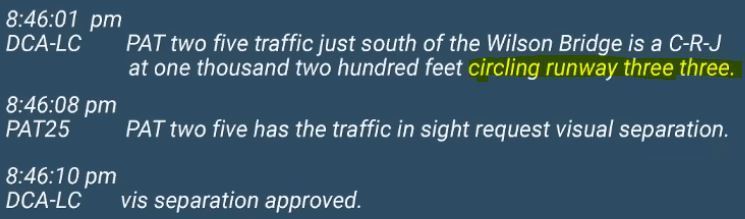
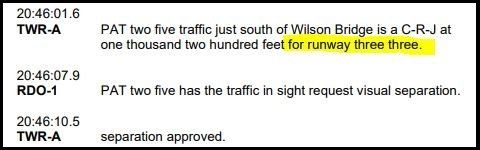
And what strikes me over and over again, is this mutual 'pavlovian' "request visual separation"-"approved" thing, as if proclaiming these words, absolves all involved from any rules/restriction that might hinder the smooth flow of things (which it does - kind of).
Even at the last chance of averting disaster by the controller (by clearly indicating the target), the pavlovian reaction was there again (totally meaningless as it was already requested and approved 96 second earlier)...
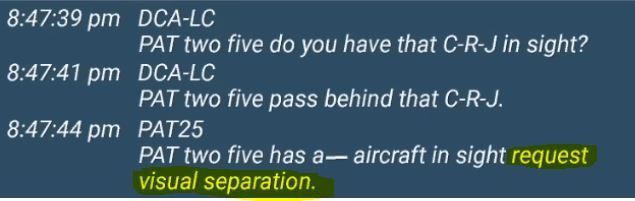
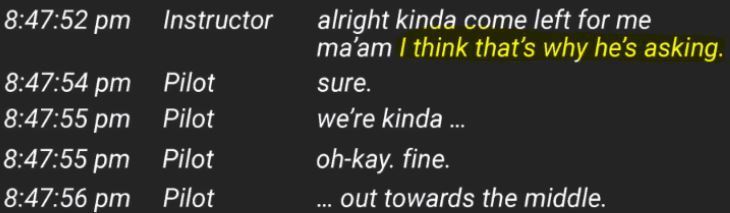
Last edited by DIBO; 2nd August 2025 at 22:03 . Reason: add extract from UH60 CVR transcript (not available/included in NTSB debrief animation)
Subjects
ATC
CVR
Night Vision Goggles (NVG)
Separation (ALL)
Situational Awareness
Visual Separation
Links are to this post in the relevant subject page so that this post can be seen in context.
Reply to this quoting this original post. You need to be logged in. Not available on closed threads.
August 12, 2025, 11:11:00 GMT
permalink Post: 11937189
Last edited by Stagformation; 12th August 2025 at 19:11 .
Subjects
ATC
CRJ
DCA
Night Vision Goggles (NVG)
Separation (ALL)
Links are to this post in the relevant subject page so that this post can be seen in context.
Reply to this quoting this original post. You need to be logged in. Not available on closed threads.
August 15, 2025, 06:37:00 GMT
permalink Post: 11938789
Taking a road procedure similarity : . at a crossroad you can have a stop sign or a triangle giving priority , or nothing
The written procedures are : at a stop sign you must stop even if there is no traffic.
:Transposing this to DCA route 4 map l the procedure should have been in Europe at least ;
1) hold ay golf balls until you get a clearance to proceed . (so that in case of loss of comms , blocked freq, etc.. you can't proceed ).
2) pilot or controller can request visual separation if all t he following conditions re met : typically VMC, and in daylight and traffic is in sight and maintained in sight and both aircrfat pilots are informed. of each other position
3) lateral deviations by the helicopters to fly over built up areas of the city at 200ft will; not be permitted.
Big differences .
Now a pilot can request visual separation at any time but Controller can refuse at any time to .. To my knowledge requesting visual a night using NVG is not covered in the definition of " visual acquisition " in ICAO, so legally it could be challenged I guess . Same as when a pilot reports "visual" on his TCAS display . It is not valid , and for good reasons .
But KDCA is not in Europe, and ICAO SARPs do not apply to military aircrfat , so the outcome of all this is quite uncertain .In fact i would not be surprised if nothing dramatic changes as far as procedures are concerned, Route 4 will be permanently removed I guess, but other than that ? business a usual with visual separations at night ? .
Subjects
ATC
DCA
ICAO
KDCA
Night Vision Goggles (NVG)
Route 4
Separation (ALL)
TCAS (All)
Traffic in Sight
Visual Separation
Links are to this post in the relevant subject page so that this post can be seen in context.
Reply to this quoting this original post. You need to be logged in. Not available on closed threads.
October 18, 2025, 02:43:00 GMT
permalink Post: 11971869
There's more to the IG part of the proposed legislation than budgeting, however. My first thought when I read the Sen. Commerce Comm. summary was that the IG and - speaking generally here - various senior-level authorities in the Defense (now "War") Department, the Army, and the White House, realized almost immediately after the accident - certainly once the initial set of facts came to light - that an Army IG investigation would be guaranteed to produce one thing at least: free discovery for the accident victims' families and their attorneys. As time has rolled on, and with the first Complaint now on file in federal district court, this dynamic has become even more persuasive imo.
I'll litter the thread with legal stuff only a little more here. Anyone following the thread has seen posts about the application of part of sovereign immunity to claims against the Army and the FAA/DOT, despite the Federal Tort Claims Act. Specifically, sovereign immunity continues to apply where the alleged negligence resulted from a federal entity exercising "discretion" in making some decision based on weighing competing policy interests and requirements (apologies both for repeating myself from prior posts, and for the legal readers, for oversimplifying). I think this case is going to descend very far down "into the weeds" on this issue; the factual development seems very likely to get highly granular. And the reason for this is that ordinarily, the "discretionary function" refers to a specific decision at a particular time based on development of some sort of administrative record. I've resisted the impulse to post a summary of the Varig Airlines case, in which the discretionary function part of sovereign immunity protected the FAA from liability in an aviation accident matter - the FAA had made a specific decision about how to handle inspections of aircraft (again, apologies for oversimplifying). But in the DCA midair ..... I think there was not one decision to which the discretionary function part of sovereign immunity could attach. This was not a case of discretion being exercised by FAA or by the Army at a specific time for making a decision about a particular thing - no, this was for lack of a recognized term - discretionary inertia. A cousin of normalization of deviance.
What does this have to do with the Army IG and higher-ups (and very very higher-ups) telling the IG to stay in their barracks, I mean offices? In examining the presumably many decisions (or just the intertia of informal practices) the Army made about helicopter flights in DCA airspace, and about altimiters, and about NVGs, and all the rest of the actual flying stuff I don't know, the IG would develop a factual record, and a very official one at that, about how far outside the discretionary function exception this situation really was. How much discretionary inertia was at work, and about how many different parts of the factual record. Which in turn would greatly complicate the Army - and FAA/DOT also in my view - defending in court . . . . if not actually sink the sovereign immunity defense pretty early on.
Caveat: there are probably thousands of published court decisions involving the discretionary function exception; I haven't read them (other than Varig Airlines, and that was in law school for my law review article), and I could have botched the analysis here handsomely.
On politicians and opportunists of other sorts: The Senate Commerce Committee has done heavy lifting in the civil aviation sector not long ago, in the aftermath of the MAX accidents. I'd give the professional staff working for the Committee some credit, not to say that I can take a side about ADS-B, but instead that they (and the Senators, obviously) see the greatly impactful aftermath of the DCA midair collision, and want to try to set the system on a better footing. And that's before NTSB's report lands on desks, whether noticed only for a few news cycles (if those even exist still) or instead lands with a thud. I'm anticipating it will be scatching, but many following the thread watched the hearings (and read the interviews), so . . . .
And don't forget, 12.5 billion bucks have been appropriated for new ATC stuff, with another 18 billion waiting, if not in the wings, then in the cloakrooms. Congress never hesitates to try to get in front of where the money is going, and 12 billion here, 18 billion there, pretty soon you're talking..... we hope not another NextGen sad story. Possibly the Senate Committee is staking out territory from which to try to assure this time, modernization gets done and done right. (I know, there are structural issues too, but one hill to die on at a time.)
QUOTE=Propellerhead;11971298]Suing AA is just corporate greed by the lawyers. Don\x92t see how any of this is the fault of the airline pilots.[/QUOTE]
I entirely agree with the second sentence, and "slapping myself upside of the head" if any of my posts even left the door open to suggesting otherwise. At the same time, the legal process exists to adjudicate claims of injured parties, in this instance, the families of the accident victims. Their lawyers are doing what the system expects them to do, and while lawyers as a group will never, in this society, engender feelings of sweetness and light, I don't think greed is the reason claims against the airline were filed. I'll leave to one side the familiarity (slight though it may be) I happen to have with the lawyers who filed the Complaint - it won't help here to say they've done plenty well, they're consummate professionals, and they are ethically bound to press for significant compensation for their clients. Others will, understandably, scoff and say, "yeah, that's what I meant, lawyers are greedy." (There was, some years ago, a law firm gossip message board known as Greedy Associates, but I digress.)
No, I think the attorneys for the accident victims' families had little choice other than to assert claims against the airline, as wretched as I think those claims are. First, the federal defendants might pull off a Hail Mary of some sort and establish sovereign immunity through the discretionary function exception under the Federal Tort Claims Act. Second, there are no punitive damages awards against the federal defendants, even if they are found liable. Third, including these claims helps to develop a thorough (and might I say, persuasive) factual record to argue to the court and to the jury (leaving aside factors about advisory juries in FTCA matters & etc.). One could just say "deep pockets" but I wanted to highlight what I believe was the lawyers' thought process. Of course they'll vehemently assert the airline actually was negligent, meaning the pilots..... wretched, abhorent.
Maybe I can find an organization which would like to intervene in the case, on behalf of professional piloting - the pilots are victims of the screwed up airspace management too, aren't they? - and then become counsel of record in the case. Don't hold any breaths.
Subjects
ADSB (All)
ATC
Accountability/Liability
DCA
FAA
Night Vision Goggles (NVG)
Normalization of Deviance
Links are to this post in the relevant subject page so that this post can be seen in context.
Reply to this quoting this original post. You need to be logged in. Not available on closed threads.
October 19, 2025, 21:05:00 GMT
permalink Post: 11972680
I continue to doubt the discretionary exception will be important to this case. In my view the helicopter crew was clearly negligent (in ways that are not covered by the discretionary exception) and that is all that is needed to make the government liable. There is no need (and it would probably be inadvisable) for the plaintiffs to bring in anything that might be covered by the discretionary exception.
If I were the government I would be trying to settle these cases. I expect there are plenty of plaintiffs (and even some plaintiff's lawyers) who would rather have a certain $x now instead of an uncertain $3x in 5 years.
Without an assessment of potential liability and damages, no defense counsel I have ever known would recommend settlement negotiations to start. What you say about some plaintiffs and their counsel potentially wanting to buy certainty of recovery in exchange for waiving possibly larger recovery later on certainly can happen in litigation. However in this case, the attorneys who filed the Complaint are, to state it (or to try to state it) neutrally, about the biggest guns in the business of litigating claims on behalf of air crash victimns' families. Sure, they might take the earlier, lower dollar route, and/or recommend such a choice to clients, but their reputations - and track records - suggest this will be the least likely course, and only much futher down the timeline. On the other hand, I have no role in the case and do not know whether the two firms (one in NYC the other Chicago) actually represent all the passengers on the American Eagle flight. (And do the estates and survivors of the deceased airline pilots have representation? Or the estates and survivors of the decesased soldiers? I don't know - and not getting into why they might have representation in this case or in general. Or whether an organization on behalf of ATCOs, in the U.S., or more globally, might seek to intervene in light of the facts being asserted against one or more controllers.)
Further, the government attorneys as well as the airline attorneys on the defense would be (imo) pretty far outside practice norms to recommend settlement negotiations without joining issue on anything yet. Perhaps one or more defendants will not file their (respective) Answer to the Complaint before broaching settlement, but doubtful this will happen (insurers' counsel lurking off-stage probably would insist upon an Answer being filed). And, the defense applying sovereign immunity through the discretionary function exception to the FTCA waiver is most likely an "affirmative defense" which, under the Federal Rules of Civil Procedure, probably must be included in a defendant's Answer to the Complaint. Even if your continued doubts about its applicability prove correct, it strikes me as quite inconsistent with the current Department of Justice approach to things to skip the pleading stage and jump to settlement. Especially when the opposing attorneys are among the biggest guns in this part of the trial bar, and especially with the political overtones of the litigation looming (as in, funding by Congress of the new ATC system, and legislation which may be lurching ahead of NTSB findings, as in recent posts about 'the ROTOR Act').
As to the discretionary function exception on the merits:
On the current state of the public record, it is pretty straightforward to say that the helicopter crew deviated from the applicable duty of care (i.e., negligence) - as noted, though, I can't imagine the Army component of the Defendant-USA just declining to contest liability at this stage. It must be noted that plenty of acts and/or failures to act by the FAA component of the Defendant-USA also appear to have departed substantially from the applicable duty of care. Maybe it's too cyncial to have this view, but I think FAA is more deeply entrenched in trying to prevent a litigated result that it had mismanaged the DCA airspace - more deeply entrenched than the Army because, as the airline company attorney reportedly said, the helicopter flew into the airliner, pretty simple. I cannot quite verbalize how the FAA would try to shift major responsibility to the Army and off itself, but the discretionary judgments FAA might argue drove its methods and processes for operating the DCA airspace could be the way FAA tries to do so. Of course, ultimately that still leaves Defendant-USA fully liable - just a politically different outcome.
But recall that the defense of sovereign immunity through the discretiionary function exception to the FTCA waiver is an Affirmative Defense. The defendant can rasie it even when the plaintiff has not sought to plead anything which would, by itself, invoke the issue. And in federal court (unless things have drastically changed since I last stepped up to the lectern in a courtroom with the Big Eagle on the wall behind the bench) the standard for pleading is "notice pleading" not "fact pleading". The Complaint just has to give sufficient notice of what the claims are about and what they're based on, and not all the facts necessary to state a particular claim under the specific substantive law. (Certain State courts still follow "fact pleading" though....been a minute.)
I think the point you were making is that nothing the Complaint has alleged factually, and nothing else about the accident that is in the public record at this time, suggests that a defense based on the discretionary function exception would work, or in fact would be worth trying. My view is that the government will take a very close look at trying to assert it. For example, the way the Army operated the proficiency flights in general and in DCA airspace in partiucular, including but not limited to use of NVGs, draws upon (it would be argued) policy judgments about the critical importance of "continuity of government" operations, and even the more routine VIP transport. Will that be enough to overcome the assertedly "clear negiigence" of the helicopter crew in their visual scan for visual separation, and altitude adherence (and possibly other related operational factors)? Maybe not, but I have no clear idea what process the Army went through to devise the rules by which those proficiency flights are conducted, evaluated, and so on. (And which a proper Army Inspector General inquiry and review would delineate, and with clarity.)
And for the FAA, how many times on this forum have posters pointed out that FAA's operating principle has been to move traffic in volume, and not to focus on what FAA eviderntly considers minor details of proper ATC methods and procedures? Sloppy discretion, maybe, but Congress recently expanded the slots at DCA (iirc) and so in a sense the United States did indeed exercise discretion.
I have posted several times that I do not believe the defense should be successful here. But what some non-pilot SLF and attorney writes (hoping not to overstay my guest-on-the-forum status) here might be many levels of altitude below what will actually happen in the litigation and in the courtroom.
Subjects
ATC
Accountability/Liability
DCA
FAA
Findings
NTSB
Night Vision Goggles (NVG)
Separation (ALL)
Visual Separation
Links are to this post in the relevant subject page so that this post can be seen in context.
Reply to this quoting this original post. You need to be logged in. Not available on closed threads.