January 31, 2025, 16:10:00 GMT
permalink Post: 11818323
Arrivals tells PAT25 Heli to keep watch for CRJ. There is no acknowledgment. Arrivals then tells PAT 25 to pass behind CRJ. There is no acknowledgment. Then boom.
Capt Sully responded today. Said dark water gives no indication of height or direction of other aircraft. Put to bed Trumps remarks that it was a clear night so should have seen aircraft but then he now reckons it's the control tower that are the problem.
He acknowledged, the VASaviation stitch-up makes that clear.
But, it is a problem that other commercial traffic (including the CRJ) could only hear the LC's side of the radio traffic.
That will undoubtedly be surfaced in the report.
Subjects
CRJ
PAT25
Pass Behind
Pass Behind (All)
Pass Behind (PAT25)
Links are to this post in the relevant subject page so that this post can be seen in context.
Reply to this quoting this original post. You need to be logged in. Not available on closed threads.
January 31, 2025, 16:38:00 GMT
permalink Post: 11818348
It is genuinely odd how they flew directly into this thing which must literally have been lighting up the interior of their cockpit. Also, why were they above the 200ft route ceiling?
(Still from the video referenced above by ORAC.)
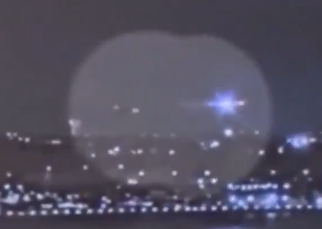
Helo on the left
Here's the more likely issue with NVG. Looking through them is often described as akin to looking through a pair of toilet roll tubes. Field of vision is radically reduced and it takes strong, conscious and fatiguing effort to conduct any kind of visual search.
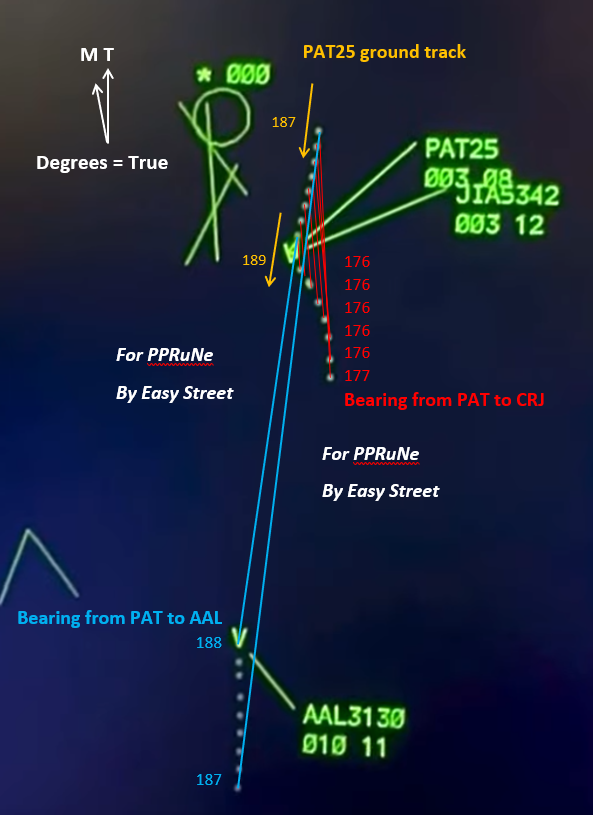
At the start of the radar recording posted to YouTube by AvHerald, AAL3130 is 10 degrees right of the CRJ from PAT25's point of view, and at a similar elevation angle. Its landing lights would be prominent in NVG and if PAT25's pilots were fixated upon it, they would not have seen the CRJ further left unless actively moving their heads to look for it. PAT25 gradually changes heading by 2 degrees right during the course of the radar clip, almost exactly following the bearing to AAL3130, and this makes it even clearer to me that PAT25 was mistakenly holding visual on it.
Last edited by Easy Street; 31st January 2025 at 16:50 .
Subjects
CRJ
Night Vision Goggles (NVG)
PAT25
Radar
Links are to this post in the relevant subject page so that this post can be seen in context.
Reply to this quoting this original post. You need to be logged in. Not available on closed threads.
January 31, 2025, 16:52:00 GMT
permalink Post: 11818357
Here's the more likely issue with NVG. Looking through them is often described as akin to looking through a pair of toilet roll tubes. Field of vision is radically reduced and it takes strong, conscious and fatiguing effort to conduct any kind of visual search.
At the start of the radar recording posted to YouTube by AvHerald, AAL3130 is 10 degrees right of the CRJ from PAT25's point of view, and at a similar elevation angle. Its landing lights would be prominent in NVG and if PAT25's pilots were fixated upon it, they would not have seen the CRJ further left unless actively moving their heads to look for it. PAT25 gradually changes heading by 2 degrees right during the course of the radar clip, almost exactly following the bearing to AAL3130, and this makes it even clearer to me that PAT25 was mistakenly holding visual on it.
Subjects
CRJ
Night Vision Goggles (NVG)
PAT25
Radar
Links are to this post in the relevant subject page so that this post can be seen in context.
Reply to this quoting this original post. You need to be logged in. Not available on closed threads.
January 31, 2025, 17:13:00 GMT
permalink Post: 11818379
Even as they apologize for setting up a near miss, they are, polite and calm.
They are human, and subject to the same frailties as the rest of us.
They are sure polite though.
Heathrow suffers from the problem that their local airspace is.. logical, as are the flight paths, and generally the runway utilisation. They don't have the benefit of the special design skills applied to JFK's terminal procedures which seem to have been designed to give cardio workouts for the controller and the pilots. Masterful airspace design.
JFK, making Abuja look attractive.
I learned that from during my Student Pilot days and it was reaffirmed till I retired from flying.
The Rule is "see and be seen"....which I read as being a two way street kind of situation.
When there is doubt...there is no doubt....remedy the situation as quickly and safely as possible.
If your aircraft is so complex and difficult to fly, or your procedures do not require or allow you to look out when appropriate, and that one of you cannot be spared to take a look out the window now and then....or if you think there is no need for you get your scan outside because you think yourself too busy inside.....there is something close to home that warrants changing.
Bottom line....nothing prevents you from doing a "missed approach" and give it a second try if it eliminates a critical risk of some kind. Even Air Line Pilots do not have to land on every approach and need to kick the mindset every second counts and remind their management that an occasional delay's expense is far cheaper than an accident. It also might make the difference between being retired and enjoying life and just being another statistic or name on a list of those killed In a crash.
This discussion about who is burdened with the responsibility for traffic separation between ATC and Pilots omits one thing.....the PIC of each aircraft is equally responsible for the safety of their own aircraft. More importantly, ATC Controllers might have to live with their mistakes but Pilots die by theirs.
DCA, and others nornalize collision alerts in the background of a significant % of ATC transmssions.
TCAS RA heights show mandatory Day, VMC go arounds the day prior- but how close was the helicopter to the 737 not going around 2 minutes earlier the day prior, so low TCAS TA only height below 900' allows continuing?
You think the CRJ crew, below 500', rolling out of a left turn to 33 sees the helicopter to their right or even notices the TCAS TA display? Maybe it gets a glance IF the short final is wired. Problem is the Traffic aural is already expected in the airspace, same as hearing the ATC collision alarms in their transmission background.
There will be line of sight recreations in the reports. The CRJ will not have but a scant chance to have seen the PAT25, with caveats- the CVR has to be heard.
Pat25 likely had a 500 hour pic getting a checkride in the right, distant seat and the radio PM/1000 hour pilot in left seat, seeing only AAL3130 and trying to figure out how to pass behind, cognitive dissonance with what is seen..
3 seconds later, all ends.
James Reason, Diane Vaughan, NASA, et al...
Subjects
ATC
CRJ
CVR
Close Calls
DCA
PAT25
Pass Behind
Pass Behind (All)
Separation (ALL)
TCAS (All)
TCAS RA
Links are to this post in the relevant subject page so that this post can be seen in context.
Reply to this quoting this original post. You need to be logged in. Not available on closed threads.
January 31, 2025, 23:15:00 GMT
permalink Post: 11818607
Listen to the audio at 1.10 to 1.13
Controller asks PAT25 if CRJ in sight NO ANSWER
Controller asks PAT25 to pass behind. NO ANSWER
Dealt with.
Subjects
ATC
CRJ
PAT25
Pass Behind
Pass Behind (All)
Pass Behind (PAT25)
Links are to this post in the relevant subject page so that this post can be seen in context.
Reply to this quoting this original post. You need to be logged in. Not available on closed threads.
January 31, 2025, 23:21:00 GMT
permalink Post: 11818613
Subjects
ATC
CRJ
PAT25
Pass Behind
Pass Behind (All)
Pass Behind (PAT25)
Links are to this post in the relevant subject page so that this post can be seen in context.
Reply to this quoting this original post. You need to be logged in. Not available on closed threads.
January 31, 2025, 23:42:00 GMT
permalink Post: 11818626
This shows exactly the communications. The heli was told about the CRJ at 1200ft, going for 33. The heli said explicitly they had the plane in sight.
7:20 onwards.
Subjects
ATC
CRJ
PAT25
Pass Behind
Pass Behind (All)
Pass Behind (PAT25)
Links are to this post in the relevant subject page so that this post can be seen in context.
Reply to this quoting this original post. You need to be logged in. Not available on closed threads.
February 01, 2025, 00:18:00 GMT
permalink Post: 11818645
The two traffic items probably didn't hear each other.
Subjects
ATC
CRJ
Frequency 119.1
Frequency 134.35
PAT25
Pass Behind
Pass Behind (All)
Pass Behind (PAT25)
Links are to this post in the relevant subject page so that this post can be seen in context.
Reply to this quoting this original post. You need to be logged in. Not available on closed threads.
February 01, 2025, 00:55:00 GMT
permalink Post: 11818670
The two traffic items probably didn't hear each other.
Edit: here’s vid.
Last edited by joe_bloggs; 1st February 2025 at 04:33 . Reason: Added vid link
Subjects
ATC
CRJ
Frequency 119.1
Frequency 134.35
PAT25
Links are to this post in the relevant subject page so that this post can be seen in context.
Reply to this quoting this original post. You need to be logged in. Not available on closed threads.
February 01, 2025, 02:33:00 GMT
permalink Post: 11818713
Subjects
CRJ
Circle to Land (Deviate to RWY 33)
PAT25
Separation (ALL)
Traffic in Sight
Visual Separation
Links are to this post in the relevant subject page so that this post can be seen in context.
Reply to this quoting this original post. You need to be logged in. Not available on closed threads.
February 01, 2025, 11:39:00 GMT
permalink Post: 11818951
https://edition.cnn.com/2025/01/30/u...nvs/index.html
https://www.youtube.com/watch?v=hfgllf1L9_4
If they were using NVG as speculated, the failure to see the landing lights of the approaching aircraft might be explained by a scenario where :
Crew mistakenly identified the following aircraft, either with NVG on or temporarily off. Happy with the separation, the NGV gear goes back on and with the limited field of view from the goggles, focused ahead and down as visual flight demands, the landing lights, so bright in the videos, were just never seen, but without the goggles the peripheral vision of the crew might have had some warning.
Subjects
CNN
CRJ
Circle to Land (Deviate to RWY 33)
Night Vision Goggles (NVG)
PAT25
Separation (ALL)
Traffic in Sight
Visual Separation
Links are to this post in the relevant subject page so that this post can be seen in context.
Reply to this quoting this original post. You need to be logged in. Not available on closed threads.
February 01, 2025, 17:37:00 GMT
permalink Post: 11819189
I have only once flown into the Washington area, and it was more than a decade ago in a light single. I seem to recall DCA required special training even for airline pilots.
Is that not the case now or not for helicopter pilots? I thought it was a case where you need to be familiar to use those routes.
I fly in the DC FRZ and you hear the helo folks on freq all day, ( a lot of Coast Guard, various DoD, various fed LEO, some medivac and lifeguard) and they all know every inch of the area . Also surprising to listen to is that helo pilots through the FRZ are pretty much self-directed and entrusted with self sufficiency that fixed wing traffic is not . They've all been vetted, fingerprinted, have their own squawks etc and so ATC gives them a lot of respect. They announce intentions to 'fly route X' or 'request direct Andrews', and ATC is able to understand their intentions and clears a path and approves - and then you don't hear a peep from them until they reach the endpoint - then they announce next intention like "Field in sight'" -> "contact Andrews tower on..., Freq change approved" -> "good day" and the whole 20 minutes had a total of three radio calls. .
They seem to all know what they're doing and it's nobody's giving off the vibe that it's any kind of initial training for anything - you don't hear ATC having to telling them to 'say altitude' or 'turn left 10 degrees' or really anything, and you don't hear the pilots giving half arsed requests. [This level of trust might have had consequences, but I'll defer my judgement]
For all helo pilots local knowledge is a survival. Lots of civi helos in DC are based out of KFME, and the ones I know every inch of territory, every local landmark, overpass, bridge, body of water within the DC beltway like the back of their hand - one guy knows off the top of his head if every single road is asphalt or concrete, light or unlight, etc. Similar experience when I met news chopper folks based in the Valley - they knew hundreds of places in greater Los Angeles that I never even heard of.
Landmarks in DC are hard to miss, basically every one knows where the WW bridge, Hanes Point, the route of the Potomac, etc.. DCA is strangely popular for plane watching (there's rec areas to view at each end) so an absurdly large number of non-av people in the area are familiar with how the traffic flow works. I kayak right below the crash area and when wind is out of North, you can see landing lights of 7+ sequenced arrivals coming up the Potomac, it's basically impossible to miss the incoming landing parade and even non-av people get the concept. The WW bridge would seem to me a good point of reference for a callout, everybody knows where to immediately look. It's hard to think that the IP didn't understand local reference of the ATC traffic advisory.
Subjects
ATC
DCA
PAT25
Links are to this post in the relevant subject page so that this post can be seen in context.
Reply to this quoting this original post. You need to be logged in. Not available on closed threads.
February 02, 2025, 19:19:00 GMT
permalink Post: 11820026
1) If PAT25 had said they were unable to identify the inbound CRJ, how would ATC have dealt with it?
2) Why was PAT25 requesting \x93Visual Separation\x94? What advantage did that give to PAT25?
Subjects
ATC
CRJ
DCA
PAT25
Links are to this post in the relevant subject page so that this post can be seen in context.
Reply to this quoting this original post. You need to be logged in. Not available on closed threads.
February 02, 2025, 19:39:00 GMT
permalink Post: 11820037
I have mostly enjoyed my latest years of not sitting at the front end of a jet. During my 40 years of flying people, I never really felt the stresses of being responsible for the well being of so many. Now that I spend most of my days on my boat fishing or growing tomatoes in my garden, life's pressures are minimal. This has opened my eyes to the gravity of the enormous responsibility I held on my shoulders, for the safety and well being of so many.
I have always had the mindset not to "arm-chair" quarterback any aviation mishap, regardless of how tempting it may be. But the aviation mishap that occurred at DCA on the evening of Wednesday, January 29 has compelled me to speak out.
Was it preventable? Sadly, It was entirely preventable.
How did it happen you may ask. After all both aircraft were clearly operating normally up until impact. First lets clear up one detail both the President and our news media has consistently made error.
Elevation refers to the height above sea level of the ground. These two aircraft were flying altitudes, not elevations. Aircraft fly altitudes and above 18,000 feet they are called flight levels. Example, flight level 180 is 18,000 feet. The ill-fated regional jet was at approximately 325 feet when it was impacted by the Army UH-60 helicopter. I have flown into Washington National since the first days Southwest began operations at DCA. I was already a Captain at this point, and I can tell you this airport is one of the most technically challenging of any I have flown.
However, that is not why this disaster happened.
I would be very surprised if the RJ black box revealed either of the two young PSA pilots were aware up until the moment of impact. Why you may ask? Because when you are flying a jet on short final, at 325 feet, you are focused on the flare and touch-down point on the runway. Perhaps the young First Officer may have seen the UH-60 just with enough warning to make a call-out, just prior to impact. From the angle of impact, very unlikely the more seasoned Captain would have even been able to see anything at all. If the First Officer was making the landing, it is most certain that neither of them saw it coming and there was nothing said on the microphone. I have no doubt, the pilots on the regional jet will be completely vindicated. In any aviation mishap, there is a chain of events that lead up to the accident. If any one of the links in the chain are broken, the accident will not happen. In this case, there are two remaining main causal factors.
DCA control tower: Tower controller made a fatal error in communicating with the Army UH-60. Time was clearly critical and was wasted by asking the H-60 if they had jet traffic in site. Clearly, they did not. What should have been said in a very assertive voice, "PAT25 (UH-60's callsign), IMMEDIATE TURN TO XXX HEADING, CLIMB AND MAINTAIN XXX ALTITUDE TO AVOID COLLISION. Tower was no help at all. First they cleared the RJ for a last minute change to 33, and then failed to ensure their approach corridor was clear of traffic. In my view, the tower controller could have easily prevented this fatal collision.
Army UH-60 crew: In military aviation training, we have always have preached the importance for pilots to maintain situational awareness. That philosophy by the way is also a cornerstone to commercial aviation safety. Were the pilots tuned up to tower when the controller gave the RJ clearance to land runway 33? Had they been aware the commuter jet was going to track over the ground through their intended flight direction, something should have been said. Request vector, due to traffic! One H-60 pilot responded, yes we have traffic in site, we will maintain VFR (visual flight rules) which means "see and avoid" yes even at night. Clearly he was looking at the wrong traffic which by the way is a very common occurrence, especially at night. No doubt the Army crew was engaged in training, which may have been a distractor to situational awareness.
In the end, the chain of events were allowed to happen as did this horrible accident that took the lives of sixty-seven beautiful souls. The President is totally correct in that we need to hire pilots and air-traffic controllers based on merit and experience, nothing else! I have witnessed first hand, the failed attempts to ensure diversity while training pilots, at the expense of safety. That practice, both military and commercial aviation, needs to stop! The current administration has their hands full but I have complete confidence they will make significant headway. Clearly we need to train and educate more air traffic controllers! The shortage and perhaps poor training standards are likely the primary cause of this mishap. I have no doubt our new Transportation Secretary is on it with both feet running. We need to maintain pilot standards also. The pilot shortage resulted in the FAA reducing the flight hours required to be hired to fly commercially. Why didn't they allow experienced pilots age 65-67 to work? In this country, we have effectively dumbed down just about everything, in the name of getting everyone through.
Just like on the operating table, you want the most experienced individuals in the most demanding jobs!
Last edited by T28B; 3rd February 2025 at 02:17 . Reason: formatting and paragraph breaks
Subjects
ATC
DCA
FAA
PAT25
President Donald Trump
See and Avoid
Situational Awareness
VFR
Links are to this post in the relevant subject page so that this post can be seen in context.
Reply to this quoting this original post. You need to be logged in. Not available on closed threads.
February 02, 2025, 19:56:00 GMT
permalink Post: 11820054
1) If PAT25 had said they were unable to identify the inbound CRJ, how would ATC have dealt with it?
2) Why was PAT25 requesting \x93Visual Separation\x94? What advantage did that give to PAT25?
Subjects
ATC
CRJ
DCA
PAT25
Separation (ALL)
Visual Separation
Links are to this post in the relevant subject page so that this post can be seen in context.
Reply to this quoting this original post. You need to be logged in. Not available on closed threads.
February 02, 2025, 23:05:00 GMT
permalink Post: 11820185
1. In an effort to maximize commercial air traffic in and out of DCA, the FAA has created the “deviate to RWY 33 procedure” for air traffic in-bound to RWY 01. This requires a right-hand turn from the RWY 01 approach followed by an immediate hard left-hand turn to line up on RWY 33. FAA criteria for a stabilized approach states that you have to be stable at 500 feet AGL on final in VMC or perform an immediate go-around. But on this particular approach, you will be at or below 400 feet AGL as you come out of the left turn to final. So the FAA has granted an exception to the “stabilized requirements” at DCA to allow for this maneuver. This allows ATC to shorten the distance between arriving and departing aircraft that are utilizing conflicting RWYs. The FAA in essence violates its own safety standards on stabilized approaches for the sake of expediency.
2. The FAA creates the Route 1/4 helicopter route through the DCA airspace as a VFR route with constantly changing altitude requirements. The lowest limit is at 200 ft MSL through the area east of DCA. Any pilot will tell you that flying that low over water at night is a best a tense experience. Try not to break that limit flying at night while also trying to communicate with ATC and simultaneously searching for possible conflicting aircraft.
3. The United States Army Aviation Branch deems it acceptable to allow training missions for Army Reserve pilots with limited flying experience to fly these helicopter routes through this complex and extremely active airspace. Compounding this, training flights at night using night-vision goggles are deemed “safe” in spite of the fact that using said goggles severely limits peripheral vision and makes it difficult if not impossible to perceive any color other than green and white. Picking out particular lights against the background of urban lighting is challenging, as is depth perception. Scanning key cockpit instruments is also made more difficult, making it challenging to accurately maintain altitude. Add to that workload the need to be in constant communication with ATC as well as monitoring all other comms traffic not directed to you but necessary in order to maintain good situational awareness. Given the density of commercial air traffic on this route, common sense would dictate that this route be flown by only the most experienced pilots and only when absolutely necessary. Reasonable logic would understand that conducting training missions should not be using final approach areas with heavy commercial traffic.
4. The Army crew on PAT25 are flying a mission they have been ordered to fly, at night and using night vision goggles. Although they may feel it is difficult and may be anxious about it, their command structure has determined that it is an appropriate training procedure and as such must meet minimum safety requirements. They do not have the authority to question the mission or the orders to fly it.
5. JIA342 is on approach for RWY 01, but is asked at the last minute by ATC to deviate to RWY 33, requiring the “circle to land” maneuver. Therefore, they are now on approach different from what they briefed for.
6. Any aircraft following the “circle to land” approach to RWY 33 will most likely have both pilots focused on RWY 33 as they come out of the left turn to final, especially if it was a last-minute request by ATC. In this case they will be looking to make sure that AA1630, which has just been given clearance to depart from RWY 01, is clear of the intersection with RWY 33 as they complete their final approach, and be ready for a go-around if it is not. In addition, this left bank makes it extremely difficult for the first officer to see any conflicting traffic coming towards them from the 1 to 2 o’clock position, as that traffic will probably be below the right window level. For the pilot, who is on the left side of the cockpit, visibility of such conflicting traffic will be nearly impossible.
7. For whatever reason, ATC is working with “split frequencies while controlling this airspace, so that although the controller hears both the aircraft on approach and the helo traffic south-bound on “Route 1”, the pilots of those respective aircraft only hear information directed at them. Thus they are not aware of all that is going on around them, and as such their situational awareness is limited by factors outside of their control.
8. ATC informs PAT25 of the conflicting aircraft on approach for RWY 33 at 1200 feet MSL, but at the time, PAT25 is heading almost due east towards the Jefferson Memorial on Helo Route 4 while JIA342 (the CRJ) is executing its right turn departing from the RWY 01 approach and is now heading in a northeast direction as it prepares to make a hard left onto the RWY 33 short final approach. From their respective positions, PAT25 in all likelihood sees the landing lights of AA3130 which is trailing JIA342 and whose landing lights are pointed almost directly in his direction, and mistakenly identifies it as the aircraft approaching RWY 33. At no time does it appear that ATC notifies JIA342 of the conflicting helo traffic. They are most likely focused on their approach to RWY 33, which was just handed to them.
9. As JIA342 rolls out of its left hand turn to final on RWY 33, completing the deviation they were just handed and had not briefed for, it is now approaching the 9-11 o’clock position of PAT25. Since the pilot of PAT25 is on the right-hand side of the Blackhawk, visibility of the CRJ may be limited. Both pilots of PAT25 are now most likely visibly fixated on passing to the rear of AA3130, which is in their 1-3 O’clock position, and which is the conflicting aircraft they perceive as the one ATC initially warned them about.
10. ATC, now receiving a conflicting aircraft warning, asks PAT25 if they have JIA342 in sight. In the absence of any obvious difference from the first mid-identification of the conflicting traffic, confirmation bias raises its ugly head. The voice response from the training pilot is calm and confident in stating that they do have it in sight and claim visual separation, probably proving once again that he mistakenly has AA3130 in sight slightly to his right directly in front of him and more than a mile away. Both pilots are totally unaware of JIA342 which is now arriving in front of them from their left.
11. The collision occurs.
In my humble opinion, the crews of both aircraft involved were set up by both the FAA and the Army Department of Aviation through a series of poorly based decisions which focused on expediency and departed from any appropriate utilization of a rational use of risk assessment. Consider the following:
1. Approval of the circling to RWY 33 maneuver which violates normal stabilized approach standards.
2. The establishment of a series of complex VFR helicopter track complex and heavily restricted air space as well as through final approach paths.
3. A 200 foot maximum altitude requirement over water and required even at night, which may result in a less than 200 foot vertical separation between aircraft on approach to RWY 33 and those traveling on Helo Route 1/4.
4. The decision to conduct military training missions in this complex and busy airspace with an abundance of commercial passenger traffic either arriving to or departing from DCA.
5. The use of split frequencies by the FAA which negatively impacts the situational awareness of all of the pilots in the airspace.
6. The use of night vision goggles to place even more limitations on the pilots.
Granted, all pilots involved may not have had the thousands of hours senior commercial and military pilot possess. But even the most senior individuals when placed in the task saturated environments these two crews faced would have at the very least felt their “pucker factor” increase through this. And there is probably an equal chance that the lack of common sense and appropriate safety design exhibited by the controlling entities would have resulted in a similar outcome. The odds were significantly stacked against these two flight crews, and unfortunately, against the passengers and flight attendants as well. If ever there were an example of an accident waiting to happen, this is it.
Subjects
ATC
Accident Waiting to Happen
Blackhawk (H-60)
CRJ
DCA
FAA
NTSB
PAT25
Route 4
Separation (ALL)
Situational Awareness
VFR
Vertical Separation
Visual Separation
Links are to this post in the relevant subject page so that this post can be seen in context.
Reply to this quoting this original post. You need to be logged in. Not available on closed threads.
February 03, 2025, 01:03:00 GMT
permalink Post: 11820210
What I can say about Mike is: he puts his name and his face and his reputation out there in public to have open discussions about flight safety, and in the context of this totally preventable collision, it would be beneficial to all if every expert here and elsewhere on the interwebs participated in a similarly open and public debate in relation to this incident. If you disagree with him, message him and invite a public debate.
I've lurked and read this forum for a long time. Decades? I can't even remember how long. Much as I enjoy reading it when a major incident occurs, it frustrates me to no end how it is filled with so many examples of institutional inertia, acquiescence to mind-numbingly antiquated regulations, ridiculous politics, and endless excuses, all of which inhibit the progress of technology and safety...not to segue into a rant but the most obvious example being, and which 99% of the non-flying public would agree with, that there is almost zero reason at this point to not have cameras in the cockpit and perhaps even live transmission of video and/or audio feeds on every commercial aircraft at this point \x96 the power and data/bandwidth requirements being miniscule relative to the benefits, at this point it is simply absurd that such features do not exist; the Jeju incident's loss of CVR data being the best recent example of what a hindrance to technological progress aviation regulations have become, when for a few dollars a consumer can own a tiny little dashcam that records stunning 4K video and broadcast quality audio in near total darkness with 100mph wind noise running on a small and safe lithium batteries trickle charged from a 5 watt power supply for days on end, which can be broadcast via wifi link to Starlink-satellite based internet across the entire planet. We live in the Space Age, but the data storage and recovery procedures for commercial aircraft still hearkens back to WW2...
That rant aside, as the videos posted above by others demonstrate:
- A Blackhawk can in fact stop on a dime (so whatever you're suggesting Mike Blackstone was wrong about, it certainly wasn't that).
- Obviously that shouldn't be the plan , but it still a legitimate question to ask, in the context of an emergency, and when every other safety precaution has already failed, why couldn't it be done? Other poster's rationalize: at the low altitude, there's nowhere to go. The videos demonstrate otherwise. You can stop a Blackhawk 50 feet above the ground in seconds. If deviating in any direction is a risk, why didn't ATC just say " PAT25 slow to stop and hover!" \x96 as a Very. Last. Resort?
- I don't understand how we can have a system of "Air Traffic Control" that defers its control to aircraft at night around a busy airport with intersecting approaches. It's nonsensical. I honestly didn't know it was a thing. I thought all major airports had flight paths that kept inbound and outbound aircraft in separate non-conflicting lanes at all times. Obviously, I'm extremely naive. From my perspective, it seems as though the professionals involved are allowed no intuition to deviate when the procedures clearly compromise safety? Apparently they're all reduced to being bots who can only read checklists? If that's the case, then why not run the whole system on "AI"? I know I'm being spicy by saying that, given all the pilots on this forum who harp on about how stupid AI is (true for the moment, but not for much longer, rest assured), yet many consider it perfectly reasonable for ATC procedures being to read out the type of aircraft to a pilot who is flying in total darkness in order to fulfill delegation of its responsibility to control air traffic, as if that procedure actually helps? Are we through the looking glass? It doesn't take a three year NTSB investigation to infer how stupid that is. Yet some defend it. Why?
Subjects
ATC
Blackhawk (H-60)
CVR
Hover
NTSB
PAT25
Links are to this post in the relevant subject page so that this post can be seen in context.
Reply to this quoting this original post. You need to be logged in. Not available on closed threads.
February 03, 2025, 01:52:00 GMT
permalink Post: 11820222
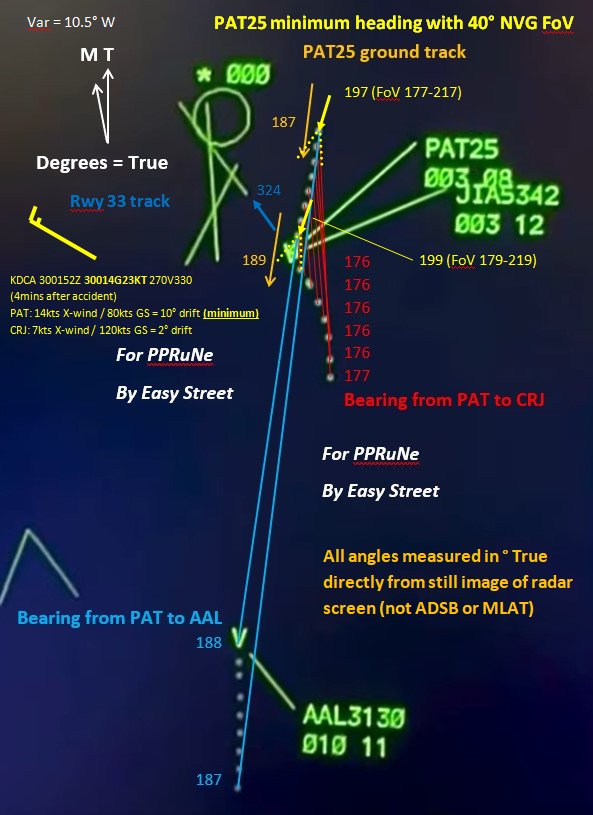
My marked up version of the radar plot now shows the heading of PAT25 at the first and penultimate sweep, based on the ground track as measured directly from the plot and assuming that the wind is at the non-gust value from the METAR observation taken just 4 minutes later (making this a reasonable minimum drift). It also shows the 40 degree field of view of the AN/AVS-9 NVG, drawn assuming both pilots are looking directly ahead along aircraft centreline.
The take-away is that with these assumptions, the CRJ starts on the extreme left hand edge of the NVG field of view and then moves just out of it. The PAT25 pilots would only see the CRJ in NVG if they turned their heads left of aircraft centreline to search for it. Since they thought they had visual contact, presumably with AAL3130, they would have no reason to do so.
Subjects
CRJ
Night Vision Goggles (NVG)
PAT25
Radar
Links are to this post in the relevant subject page so that this post can be seen in context.
Reply to this quoting this original post. You need to be logged in. Not available on closed threads.
February 03, 2025, 01:54:00 GMT
permalink Post: 11820223
- A Blackhawk can in fact stop on a dime (so whatever you're suggesting Mike Blackstone was wrong about, it certainly wasn't that).
- Obviously that shouldn't be the plan , but it still a legitimate question to ask, in the context of an emergency, and when every other safety precaution has already failed, why couldn't it be done? Other poster's rationalize: at the low altitude, there's nowhere to go. The videos demonstrate otherwise. You can stop a Blackhawk 50 feet above the ground in seconds. If deviating in any direction is a risk, why didn't ATC just say " PAT25 slow to stop and hover!" – as a Very. Last. Resort?
My experience? 15,000 hours rotary with at least 4-5,000 hours below 200', 1,500 night hours, Mil/Civil mix of mediums (21,000lb) down to horrid little clockwork toys.
No further online discussion from me, but it would be interesting to know your pilot qualifications to post here with such assumed authority, please?
Subjects
ATC
Blackhawk (H-60)
Hover
Night Vision Goggles (NVG)
PAT25
Links are to this post in the relevant subject page so that this post can be seen in context.
Reply to this quoting this original post. You need to be logged in. Not available on closed threads.
February 03, 2025, 11:08:00 GMT
permalink Post: 11820420
9. As JIA342 rolls out of its left hand turn to final on RWY 33, completing the deviation they were just handed and had not briefed for, it is now approaching the 9-11 o\x92clock position of PAT25. Since the pilot of PAT25 is on the right-hand side of the Blackhawk, visibility of the CRJ may be limited. Both pilots of PAT25 are now most likely visibly fixated on passing to the rear of AA3130, which is in their 1-3 O\x92clock position, and which is the conflicting aircraft they perceive as the one ATC initially warned them about.
Subjects
ATC
Blackhawk (H-60)
CRJ
DCA
Night Vision Goggles (NVG)
PAT25
Route 4
Links are to this post in the relevant subject page so that this post can be seen in context.
Reply to this quoting this original post. You need to be logged in. Not available on closed threads.