February 03, 2025, 12:36:00 GMT
permalink Post: 11820496
I think I first flew that procedure in the mid 1980's. It has been in use for decades.
I expect most pilots operating into DCA, and possibly this PSA crew have done this.
Based on the NTSB briefing yesterday, the PSA was at 325 feet +/-25 feet.
Had PAT25 been on the east coast of the Potomac, and at or below 200 feet, this accident would not have happened.
Just an opinion.....
Subjects
DCA
NTSB
PAT25
Links are to this post in the relevant subject page so that this post can be seen in context.
Reply to this quoting this original post. You need to be logged in. Not available on closed threads.
February 03, 2025, 13:06:00 GMT
permalink Post: 11820522
Just a different opinion.
Subjects
PAT25
Links are to this post in the relevant subject page so that this post can be seen in context.
Reply to this quoting this original post. You need to be logged in. Not available on closed threads.
February 03, 2025, 14:45:00 GMT
permalink Post: 11820598
But the controller doesn\x92t know they have the wrong plane. Guess: he\x92s just checking they didn\x92t think they\x92d passed it already.
Either way, the controller does not have enough information to use a heading \x97 neither to know one is needed nor what it should be . The radar & display is just not as accurate as a Mark I eyeball in one cockpit seeing the other plane out the window.
When would he? \x93Tower, PAT25 has lost that traffic\x94. Until then a vector might bring them *into* a collision.
Subjects
ATC
CRJ
Close Calls
PAT25
Pass Behind
Pass Behind (All)
Radar
Links are to this post in the relevant subject page so that this post can be seen in context.
Reply to this quoting this original post. You need to be logged in. Not available on closed threads.
February 03, 2025, 15:50:00 GMT
permalink Post: 11820651
On the general subject of the 2nd Twr call to PAT25 and issuing avoidance instructions from BS5342, my take would be that maybe Twr saw it so late and simply didn't have an accurate mental picture of the precise trajectories of the helo and the CRJ to actually formulate a plan to deconflict safely. The only hope was that the helo crew "still" had the aircraft in sight (as they had already stated they had) and were still going to pass behind the CRJ............. Sadly, by then, that was just wishful thinking. At that late stage, all ATC probably knew was that ordering an evasion maneuver was just as likely to turn a near-miss into an accident as it was to turn an accident into a near-miss. A "Rock and a hard place springs" to mind....... One can only feel for the ATCO ...............
Subjects
ATC
ATCO
CRJ
DCA
PAT25
Pass Behind
Pass Behind (All)
Links are to this post in the relevant subject page so that this post can be seen in context.
Reply to this quoting this original post. You need to be logged in. Not available on closed threads.
February 03, 2025, 16:21:00 GMT
permalink Post: 11820674
If the guess that PAT25 saw the traffic for 01 (further south,who was #2 for landing, with the CRJ being #1) and not the traffic for 33, they were still advised by ATC to pass behind their traffic .
As you look at the various diagrams of the final geometry, with their initial southerly heading, any right turn would have them pass in front of the traffic approaching 01 (and yes, also it would cause them to cross in front of landing traffic for 33 if they saw that, though it appears that they didn't.).
Why the right turn rather than simply following the east bank (of the declared route) until the traffic that they did see (apparently the aircraft approaching 01) was passing their right side?
It makes no sense to me.
It appears that poster 51bravo has made a similar observation, worded differently.
If what you suggest is true, that neither pilot in the cockpit was familiar with the runway lay out of National(Reagan) Airport, that's an enormous hole in a slice or three of the cheese. I expect that subtle details like this may, or may not, eventually come out as the investigation progresses.
For patrickal:
While I appreciate the effort your put into that extended analysis, you are quite wrong about what a training mission is, the least of which is why one needs to do actual flying in an area to be competent in a given operations area, and why you have to do them in daylight and at night since your mission will call on your unit to undertake that mission, VIP transport, day or night.
The airspace in and around DC, writ large, is one of that unit's required operations area.
Your point 11 has so many things wrong about it that I won't waste further time on it.
In terms you might understand: no sale.
Last edited by Lonewolf_50; 3rd February 2025 at 16:45 .
Subjects
ATC
CRJ
DCA
Night Vision Goggles (NVG)
PAT25
Pass Behind
Pass Behind (All)
Links are to this post in the relevant subject page so that this post can be seen in context.
Reply to this quoting this original post. You need to be logged in. Not available on closed threads.
February 03, 2025, 18:11:00 GMT
permalink Post: 11820767
I fully sign your deduction, but granted your assumptions are true that PAT25 was mentally focused on passing behind AA3130 (which I fully believe too), but they also received the information that it is RWY33 that is to be used for landing of the CRJ. So why for gods sake did they continue into 33 runway extension before AA3130. Was there also a disorientation towards their current position relative to DCA runway systems and they also easily (at night, mental bias) took RWY01 for RWY33 ? It almost looks so. Once more the narrow vision of NVG cheese slice ?!
Subjects
CRJ
DCA
Night Vision Goggles (NVG)
PAT25
Links are to this post in the relevant subject page so that this post can be seen in context.
Reply to this quoting this original post. You need to be logged in. Not available on closed threads.
February 03, 2025, 18:21:00 GMT
permalink Post: 11820772
Subjects
PAT25
Links are to this post in the relevant subject page so that this post can be seen in context.
Reply to this quoting this original post. You need to be logged in. Not available on closed threads.
February 03, 2025, 20:31:00 GMT
permalink Post: 11820870
Subjects
ATC
CRJ
PAT25
Pass Behind
Pass Behind (All)
Links are to this post in the relevant subject page so that this post can be seen in context.
Reply to this quoting this original post. You need to be logged in. Not available on closed threads.
February 04, 2025, 21:02:00 GMT
permalink Post: 11821702
Subjects
ATC
PAT25
Separation (ALL)
Vertical Separation
Visual Separation
Links are to this post in the relevant subject page so that this post can be seen in context.
Reply to this quoting this original post. You need to be logged in. Not available on closed threads.
February 05, 2025, 00:05:00 GMT
permalink Post: 11821822
I think the confusion comes from the "amateur MLAT" tracking, which calculates the GS based on the multilaterated position calculations, which have a (relatively) large margin of error:
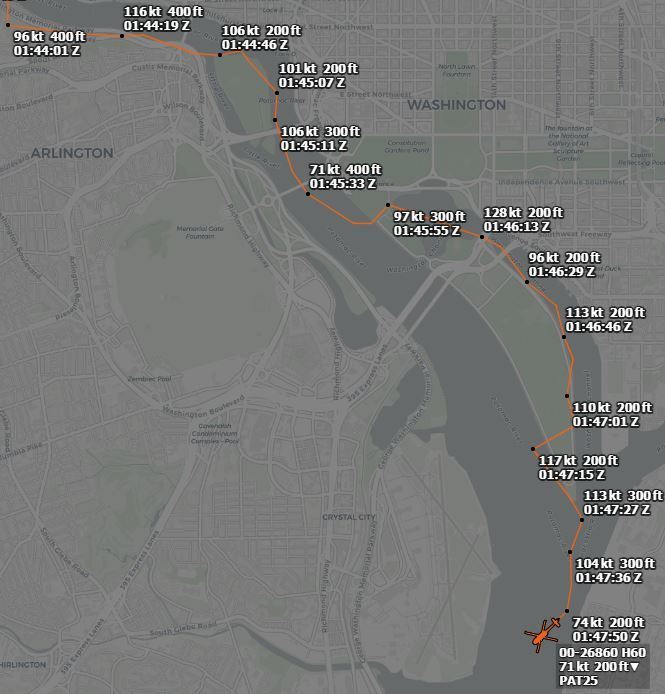
And probably PAT25 was doing initially something in the region of 100kts GS (edit: averaging all but last calculated GS, gives 105kts as average - and over more datapoints, longer trajectory, calculated average GS becomes more reliable)
but at the end it seems there might possibly have been a decreasing GS trend:
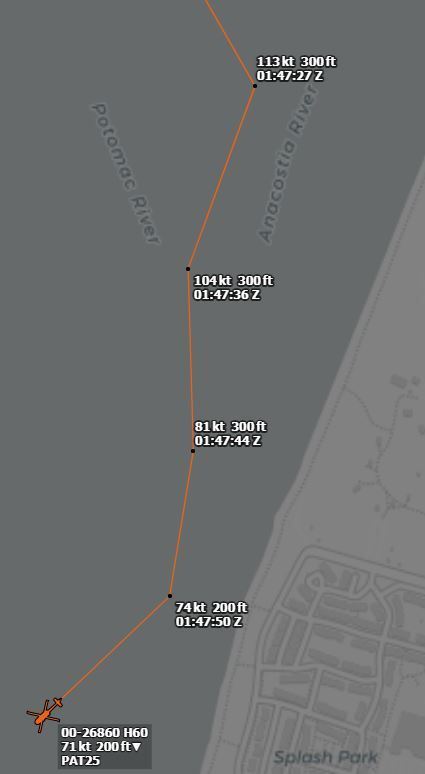
Last edited by DIBO; 5th February 2025 at 00:10 . Reason: added calculated average GS
Subjects
ADSB (All)
CRJ
PAT25
Radar
Links are to this post in the relevant subject page so that this post can be seen in context.
Reply to this quoting this original post. You need to be logged in. Not available on closed threads.
February 05, 2025, 20:06:00 GMT
permalink Post: 11822511
2. I was sharing (IME means In My Experience) my experience with flying that family of helicopters.
Subjects
ATC
PAT25
Links are to this post in the relevant subject page so that this post can be seen in context.
Reply to this quoting this original post. You need to be logged in. Not available on closed threads.
February 05, 2025, 20:20:00 GMT
permalink Post: 11822517
Just thinking: they are coming up on the extended centerline of 33, and keep going? Were there any tower or CRJ transmits that indicated the CRJ was on short final?
Subjects
ATC
CRJ
PAT25
Separation (ALL)
Traffic in Sight
Visual Separation
Links are to this post in the relevant subject page so that this post can be seen in context.
Reply to this quoting this original post. You need to be logged in. Not available on closed threads.
February 05, 2025, 20:24:00 GMT
permalink Post: 11822518
Subjects
ATC
DCA
PAT25
Pass Behind
Pass Behind (All)
Links are to this post in the relevant subject page so that this post can be seen in context.
Reply to this quoting this original post. You need to be logged in. Not available on closed threads.
February 06, 2025, 01:07:00 GMT
permalink Post: 11822673
This was a check ride wearing NVGs while runway 33 was open. Do PAT night flights with passengers operate with NVGs all the time, or was this an attempt to check multiple boxes (e.g. NVG currency, route currency, night flight currency) in a single flight?
if the answer to the question above is \x93NVGs are generally worn if the Washington area is under some sort of security situation which reduces lit points of reference, but not otherwise\x94 would DCA civil flight ops be continuing in such conditions?
What I\x92m driving at is - wouldn\x92t it have been a good idea to reduce the degree of difficulty by squaring in advance with DCA ATC a pause of 33 ops when PAT25 came by, even if an aircraft or two had to hold/delay departure?
Subjects
ATC
DCA
Night Vision Goggles (NVG)
PAT25
Links are to this post in the relevant subject page so that this post can be seen in context.
Reply to this quoting this original post. You need to be logged in. Not available on closed threads.
February 06, 2025, 10:57:00 GMT
permalink Post: 11822897
Controller instructed very firmly: "PAT25, pass behind the CRJ"
There was no such readback, instead:
PAT25: "PAT25 has CRJ in sight, request visual separation"
Controller: "vis sep approved"
Does the "request visual separation" undo the "pass behind"?
(just trying to refresh my phraseology understanding, its long time passed, my PPL is not current a long time since)
Subjects
ATC
CRJ
PAT25
Pass Behind
Pass Behind (All)
Pass Behind (PAT25)
Phraseology (ATC)
Separation (ALL)
Traffic in Sight
Visual Separation
Links are to this post in the relevant subject page so that this post can be seen in context.
Reply to this quoting this original post. You need to be logged in. Not available on closed threads.
February 06, 2025, 11:28:00 GMT
permalink Post: 11822911
Subjects
ATC
CRJ
PAT25
Separation (ALL)
Traffic in Sight
Visual Separation
Links are to this post in the relevant subject page so that this post can be seen in context.
Reply to this quoting this original post. You need to be logged in. Not available on closed threads.
February 06, 2025, 11:35:00 GMT
permalink Post: 11822919
PAT25: "PAT25 has the traffic in sight, request visual separation"
Tower: "Visual separation approved"
0:26 here:
Subjects
CRJ
PAT25
Separation (ALL)
Traffic in Sight
Visual Separation
Links are to this post in the relevant subject page so that this post can be seen in context.
Reply to this quoting this original post. You need to be logged in. Not available on closed threads.
February 06, 2025, 11:55:00 GMT
permalink Post: 11822926
PAT25: "PAT25 has the traffic in sight, request visual separation"
Tower: "Visual separation approved"
0:26 here:
https://youtu.be/r90Xw3tQC0I?feature=shared
Perhaps, and this is big perhaps, it's a pavlovian response to whenever PAT is advised of other traffic. I listened to the TCAS RA missed approach from the previous day, and once again the response from PAT is "request visual separation". It's highly likely that the pilot requests for visual separation is the only way that this Class B airspace can operate with the mix of IFR vs VFR, and aerodrome traffic vs transits.
I fail to understand why PAT is using UHF, surely this is another slice of cheese.
The use of RWY 33 for arrival makes it easier for the ATC and the aircrew with one less runway crossing after they have landed. To emphasis the point, the following PSA actually requests RWY 33.
Subjects
ATC
CRJ
IFR
PAT25
Separation (ALL)
TCAS (All)
TCAS RA
Traffic in Sight
VFR
Visual Separation
Links are to this post in the relevant subject page so that this post can be seen in context.
Reply to this quoting this original post. You need to be logged in. Not available on closed threads.
February 06, 2025, 13:14:00 GMT
permalink Post: 11822970
Subjects
ATC
PAT25
Links are to this post in the relevant subject page so that this post can be seen in context.
Reply to this quoting this original post. You need to be logged in. Not available on closed threads.
February 06, 2025, 14:28:00 GMT
permalink Post: 11823014
The accident aircraft was making a sidestep curving manoeuvre, a late change from a straight in to 01. The only message passed about this was it was landing on 33. No comment that it was going to break off the 01 approach. No questioning that the heli crew even understood how an aircraft now approached 33, making this unusual and last-minute change, nor that it would compromise them routing along the river.
.
Subjects
CRJ
Circle to Land (Deviate to RWY 33)
PAT25
Separation (ALL)
Traffic in Sight
Visual Separation
Links are to this post in the relevant subject page so that this post can be seen in context.
Reply to this quoting this original post. You need to be logged in. Not available on closed threads.