February 16, 2025, 10:44:00 GMT
permalink Post: 11829142
Subjects
NTSB
PAT25
Route 4
Links are to this post in the relevant subject page so that this post can be seen in context.
Reply to this quoting this original post. You need to be logged in. Not available on closed threads.
February 16, 2025, 11:15:00 GMT
permalink Post: 11829163
Subjects
Close Calls
NTSB
PAT25
Route 4
Links are to this post in the relevant subject page so that this post can be seen in context.
Reply to this quoting this original post. You need to be logged in. Not available on closed threads.
February 16, 2025, 18:30:00 GMT
permalink Post: 11829380
200 feet is the maximum and they had to get permission for this route. They\x92re flying past a busy airport. On one hand you\x92re all saying this accident was bound to happen, on the other hand this in and of itself indicates pilots don\x92t fly through these zones without concerns & vigilance. It makes no sense they would play roulette with the height - most pilots would be adhering to rules & a little on edge knowing a VIP or any number of emergency protocols could happen in the capital of America.
It just doesn\x92t add up - the complacency over elevation. Between two pilots it should have been rectified. May they rest in peace & this isn\x92t a slur against their name but in support of it not being their fault and something amiss.
Systems that rely on human perfection are 100% guaranteed to fail. The only question is how often. The system in place at DCA required helo pilots to assume responsibility for visual (*not vertical*) avoidance of collisions in order to fulfil their ordered missions. Given what we know about human visual performance at night, that would eventually end badly, and sure enough it did. There is a strong element of the pilots having been set up to fail, which is why no-one here is going hard on them.
Altimetry and height keeping would be important matters for investigators if the collision had occurred due to a breakdown in vertical separation, which as a minimum would involve 500 feet (and more often 1000 feet) of planned spacing to account for instrument and height keeping errors. FAA instrument rating standards require pilots to be able to maintain altitude plus or minus 100 feet. This helicopter was being flown VFR at very low height, which means that looking outside takes primacy over monitoring instruments. I'm sure helo pilots could fly along at 175ft plus or minus 25ft if they really tried, but you can be certain they wouldn't be looking out for traffic (as is required when holding responsibility for visual separation).
However, as there was no vertical separation built into this procedure, all of this is at best a distraction. The more important questions are why procedural barriers were not in place to stop the route being used during landings on runway 33, and whether visual separation at night is an adequate barrier to collision when airliners and their human cargo are involved.
Last edited by Easy Street; 16th February 2025 at 18:57 .
Subjects
CRJ
DCA
FAA
PAT25
Separation (ALL)
VFR
Vertical Separation
Visual Separation
Links are to this post in the relevant subject page so that this post can be seen in context.
Reply to this quoting this original post. You need to be logged in. Not available on closed threads.
February 16, 2025, 18:49:00 GMT
permalink Post: 11829389
Altimetry and height keeping would be important matters for investigators if the collision had occurred due to a breakdown in vertical separation, which as a minimum would involve 500 feet (and more often 1000 feet) of planned spacing to account for instrument and height keeping errors. FAA instrument rating standards require pilots to be able to maintain altitude plus or minus 100 feet. This helicopter was being flown VFR at very low height, which means that looking outside takes primacy over monitoring instruments. I'm sure helo pilots could fly along at 175ft plus or minus 25ft if they really tried, but you can be certain they wouldn't be looking out for traffic (as required when taking visual separation).
However, as there was no vertical separation built into this procedure, all of this is at best a distraction. The more important questions are why procedural barriers were not in place to stop the route being used during landings on runway 33, and whether visual separation at night is an adequate barrier to collision when airliners and their human cargo are involved.
N123, do you see the closest plane lined up, pass right below and behind him and never mind all the other planes right behind. Ah......NO.
There is night visual and there is night nutty visual. The first example leaves a lot of room for error and time for ATC to see if it is going wrong.
Subjects
ATC
CRJ
FAA
PAT25
Pass Behind
Pass Behind (All)
Separation (ALL)
VFR
Vertical Separation
Visual Separation
Links are to this post in the relevant subject page so that this post can be seen in context.
Reply to this quoting this original post. You need to be logged in. Not available on closed threads.
February 16, 2025, 21:54:00 GMT
permalink Post: 11829484
Subjects
PAT25
Links are to this post in the relevant subject page so that this post can be seen in context.
Reply to this quoting this original post. You need to be logged in. Not available on closed threads.
February 16, 2025, 22:11:00 GMT
permalink Post: 11829492
Subjects
CVR
PAT25
Pass Behind
Pass Behind (All)
Separation (ALL)
Visual Separation
Links are to this post in the relevant subject page so that this post can be seen in context.
Reply to this quoting this original post. You need to be logged in. Not available on closed threads.
February 19, 2025, 23:16:00 GMT
permalink Post: 11831829
Added note: The chart shows only crossings collected with ADS-B. I threw out all MLAT collected crossing because of inherent inaccuracy.
Helicopters crossing RWY 33 approach via Route 4 for January
Interesting to note that, had PAT25 been at 200 ft and the CRJ just slightly below nominal glideslope, they would have collided too.
And that, had the CRJ been on the glide slope, it would have been way below PAT25 and would not have collided
Last edited by Senior Pilot; 20th February 2025 at 04:17 . Reason: Tidy up
Subjects
ADSB (All)
ATC
CRJ
PAT25
QNH
Route 4
Links are to this post in the relevant subject page so that this post can be seen in context.
Reply to this quoting this original post. You need to be logged in. Not available on closed threads.
March 01, 2025, 09:36:00 GMT
permalink Post: 11838415
I think the LC saw what was unfolding and said that because he had concerns that the chopper didn't actually have the CRJ. He was right.
PAT25 says (for the second time), “Traffic visual, request visual separation”,
which is not true, evidently they were not visual at all because they crashed into the CRJ.
LC responds, “Visual separation approved, [pass behind the] CRJ,”
which clearance was issued on the false premise that PAT25 was visual. But PAT 25 only hears, “Visual separation approved…[pause]…CRJ,” because they briefly stepped on the LC’s transmission themselves. No read back is forthcoming; the LC should be expecting one but he fails to chase it up, because he’s too busy.
If PAT 25 realised he’s stepped on the middle part of the LC’s transmission to himself (which likely could have included an instruction) then he ought to be professional enough to say, “Stepped on, say again,” etc and make absolutely sure he knows what the clearance may have been. That was standard practice a long time ago, but no longer, it seems.
My original point was that in the Mover/Gonky video (post #1228) it was suggested that it’s perfectly OK to second guess what ATC might have said to you, reply to that, and then if no correction is forthcoming you can comply with your guess. As others have pointed out implicitly, that works if there’s only one error involved, but here there were three: an untrue statement, leading to a wrongly issued clearance, and a missing read back.
System broken.
Last edited by Stagformation; 2nd March 2025 at 23:42 .
Subjects
ATC
CRJ
PAT25
Pass Behind
Pass Behind (All)
Separation (ALL)
Links are to this post in the relevant subject page so that this post can be seen in context.
Reply to this quoting this original post. You need to be logged in. Not available on closed threads.
March 04, 2025, 14:56:00 GMT
permalink Post: 11840670
Fixed wing
AAL1630, departed 1, waiting handoff to departure
JIA5305, holding short 1, #2
DAL832, holding short 1 #3
JIA5342, cleared to land 33
AAL3130, cleared to land 1
AAL472, cleared visual 1
JIA5347, cleared visual 1, requested 33
Rotary wing
PAT25
helo, Zone 4
helo, callsign Blackjack 1, freq change approved just prior
helo, callsign Muscle 12, handed off to ADW prior
helo, request Route 3, Zone 6
helo, Zone 7
Medevac AirCare helo, proceeding to Inova Fairfax
Some of the helo\x92s on above list may be duplicates due to poor audio quality.
At the time of the accident, runway 4/22 was not in use.
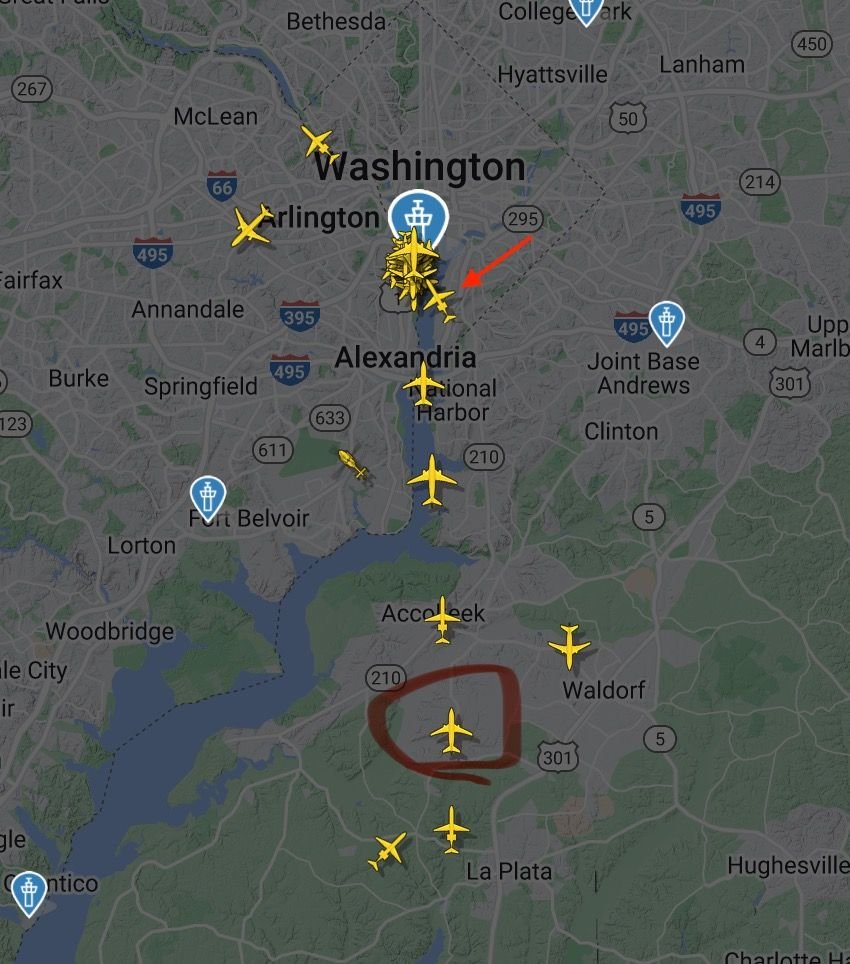
pretty sure I was the circled aircraft that night, AA1855 from CLT. We were just about to be cleared onto the MTV1 when it happened. Did not see it happen but pretty sure we heard JIA5342 being handed off to tower. We were then vectored off the approach and eventually diverted to IAD. Tragic night.
Subjects
ATC
PAT25
Links are to this post in the relevant subject page so that this post can be seen in context.
Reply to this quoting this original post. You need to be logged in. Not available on closed threads.
March 05, 2025, 02:07:00 GMT
permalink Post: 11841017
PAT25 says (for the second time), “Traffic visual, request visual separation”,
which is not true, evidently they were not visual at all because they crashed into the CRJ.
LC responds, “Visual separation approved, [pass behind the] CRJ,”
which clearance was issued on the false premise that PAT25 was visual. But PAT 25 only hears, “Visual separation approved…[pause]…CRJ,” because they briefly stepped on the LC’s transmission themselves. No read back is forthcoming; the LC should be expecting one but he fails to chase it up, because he’s too busy.
If PAT 25 realised he’s stepped on the middle part of the LC’s transmission to himself (which likely could have included an instruction) then he ought to be professional enough to say, “Stepped on, say again,” etc and make absolutely sure he knows what the clearance may have been. That was standard practice a long time ago, but no longer, it seems.
My original point was that in the Mover/Gonky video (post #1228) it was suggested that it’s perfectly OK to second guess what ATC might have said to you, reply to that, and then if no correction is forthcoming you can comply with your guess. As others have pointed out implicitly, that works if there’s only one error involved, but here there were three: an untrue statement, leading to a wrongly issued clearance, and a missing read back.
System broken.
Good points, especially the first, Keep in mind that no readback was required, and that type of instruction doesn't require a readback and according to the AIM is not even a type that "should" be read back, so the controller wouldn't be surprised if he didn't get one. Agree with Capn Bloggs;even if PAT25 didn't get the particular "pass behind" transmission, visual separation, which came up twice, carries the implicit instruction "Don't hit the other aircraft" ( no sarcasm intended), regardless of the method employed.
Last edited by Commando Cody; 5th March 2025 at 02:45 . Reason: Add reference to another post
Subjects
ATC
CRJ
PAT25
Pass Behind
Pass Behind (All)
Separation (ALL)
Visual Separation
Links are to this post in the relevant subject page so that this post can be seen in context.
Reply to this quoting this original post. You need to be logged in. Not available on closed threads.
March 11, 2025, 20:21:00 GMT
permalink Post: 11845619
Subjects
NTSB
PAT25
Preliminary Report
Links are to this post in the relevant subject page so that this post can be seen in context.
Reply to this quoting this original post. You need to be logged in. Not available on closed threads.
March 11, 2025, 20:35:00 GMT
permalink Post: 11845640
"Near Midair Collision Events at DCA
Review of information gathered from voluntary safety reporting programs along with FAA data regarding encounters between helicopters and commercial aircraft near DCA from 2011 through 2024 indicated that a vast majority of the reported events occurred on approach to landing. Initial analysis found that at least one TCAS resolution advisory (RA) was triggered per month due to proximity to a helicopter. In over half of these instances, the helicopter may have been above the route altitude restriction. Two-thirds of the events occurred at night.
A review of commercial operations (instrument flight rules departures or arrivals) at DCA between October 2021 and December 2024 indicated a total of 944,179 operations. During that time, there were 15,214 occurrences between commercial airplanes and helicopters in which there was a lateral separation distance of less than 1 nm and vertical separation of less than 400 ft. There were 85 recorded events that involved a lateral separation less than 1,500 ft and vertical separation less than 200 ft."


What is seen - reported; and what is dismissed … diminishes the value of reporting.
A system broken: a broken safety management system at the national level.
Subjects
DCA
FAA
NTSB
PAT25
Preliminary Report
Route Altitude
Separation (ALL)
TCAS (All)
Vertical Separation
Links are to this post in the relevant subject page so that this post can be seen in context.
Reply to this quoting this original post. You need to be logged in. Not available on closed threads.
March 21, 2025, 11:20:00 GMT
permalink Post: 11851281
 I always read you input as, while the detailed legal nitty-gritty is generally way beyond me, you always provide a refreshing viewpoint which is good to read! The aim of my Post, based on my interpretation of the above quote, was just to emphasise the existence of ASIAS is just as a tool or, rather, a set of tools but which has no real "proactive function" in itself. Yes, it represents a very small part of the Flight Safety chain - but as a resource in the main. As you say, there were loads of examples of what happened at DCA and my post was an explanation as to who, I believe, should have been looking at it. Maybe they did - and just ignored it? No idea!
In the UK, the airport operator is totally responsible for the safety of operations on or above their field out to 4000 ft on approach and departure - about 12 miles. The CAA who regulates aviation here, along with the Dept of Transport, but in conjunction with other stakeholders such as NATS (our en-route ATC organsiation), airlines and airfield operators etc, designs the airspace and sets the generic rules for it's use. As you said, the main rule is "Don't crash anything into anything else!". However, at the airfield, it is the airport operator who needs to ensure that the generic rules work in their environment. If a particular rule is legal but, if applied in their location, is unsafe, they can't apply that rule! That's what the Safety Case should say.
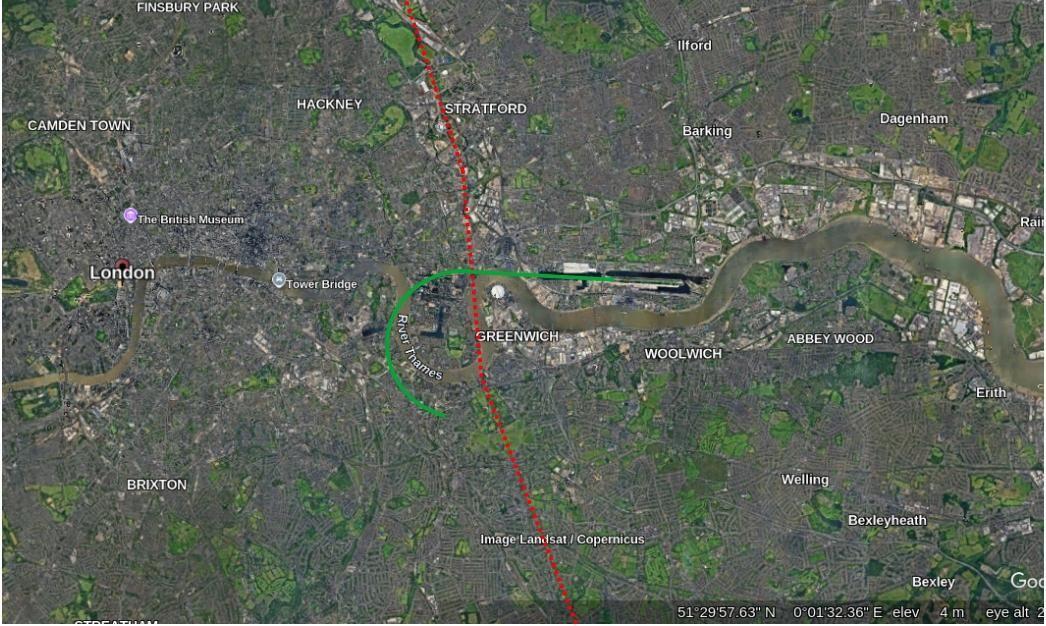
A relevant example? I used to regularly (for work) transit London S > N and N > S along the red dotted line below - at 2400ft as it kept me just out of the London TMA but as high as possible so, if it had all gone quiet on the engine front, I'd have the best chance to get the plane onto the ground with me alive and no-one else hurt. As part of the transit, I had to cross the final approach into London City (green line). So, say heading N, I'd chat to Thames Radar while over South London and would ask for a London City crossing. They'd chat to City ATC to co-ordinate and take me to the Thames before handing me to City Tower. My route over the Approach has aircraft at 1200 ft descending on the ILS and so I would have crossed anything landing at 1200 ft above that. So, while on first glance, it was fine I never, ever got that clearance with an aircraft landing - and for very good reasons. If the aircraft on the ILS had had to do a go-around, life could have become interesting very quickly. I was always held until the landing aircraft was well clear (ie ATC could see it was almost at the airfield) before they cleared me across. Indeed, legally, they could have given me a "You see the landing? Pass behind that"! But, no - always positive clearances. Got my vote ....... + gave me chance to enjoy the views of Greenwich and the City of London and "delayed" me a couple of minutes. OK, a bit unfair as LCY is "sleepy hollow" compared to DCA but, despite that, they were very friendly ..... but very strict!!!!!
So, when you are discussing (I think!!!) whether ATC elected to give PAT25 a "You visual? Pass behind" or whether it was "ordered" from on-high as it was deemed safe to do, ultimately, it is the ATCOs call on the day. Now, before I get flamed, do I blame the ATCO ? No! Well, why not? After all, he gave PAT permission! And yes, it was a "legal" clearance. But was it a wise clearance? When unpacking that little lot you have to look at a raft of Human Factors which influenced that ATCO on that night. He was on his own so, probably, the only way he could cope with all he had on his plate was to try and shift some responsibility onto PAT25 - one less thing for him to juggle. But even then, he needed to be monitoring which he clearly was - but while very busy with other approaches and departures so he just picked up a concern too late as the audio shows - "Are you sure you see the jet?". Another factor - was the strategy to use Route 4 while 33 was active something ATCers at DCA, over time, started in an effort to cut down radio traffic and speed things up? If so, had it been assessed and then monitored for adverse safety? While anecdotally, it seemed people were aware of "close calls", had any analysis taken place looking at the Databases? In the UK certainly, all the Airport Operator responsibility.
To the final "accountability" part re payments to families, the thing we have here is (and, folks, correct me if I've got this wrong) the FAA set the rules and the operate the Rules. Here, the CAA sets the rules and the Airfield Operator operates the rules. That is important - for eg, huge argument here in the UK about just how independent the UK's Military Flight Safety organisation is ..... as it is part of the Military. IMHO, what we have here are valid generic rules, some of which were simply not suitable in this specific location - just like crossing London City with an aircraft on approach - legal ...... but very unwise. As to who carries the can, well, as you said WR 6-3 , the legal beagles will get to the bottom of that ..... but it will take some time. I'll leave that side to you!!! My main question out of all of this is, why were not these issues flagged up by airport management for further investigation given it was something of an open "secret"? And where else (around the world) is this happening?

And, on that cheerful note...........! H 'n' H
Subjects
ATC
ATCO
Accountability/Liability
Close Calls
DCA
FAA
PAT25
Pass Behind
Pass Behind (All)
Radar
Route 4
Links are to this post in the relevant subject page so that this post can be seen in context.
Reply to this quoting this original post. You need to be logged in. Not available on closed threads.
March 22, 2025, 05:51:00 GMT
permalink Post: 11851870
The local controller had an Assistant ATC and a Supervisor to coordinate, monitor and regulate the traffic.
Class B airspace "ATC Clearances and Separation. An ATC clearance is required to enter and operate within Class B airspace. VFR pilots are provided sequencing and separation from other aircraft while operating within Class B airspace." source FAA Class B
One way to determine how the application of sequencing and separation to VFR pilots in this airspace was being applied would be to listen to the audio and watch radar replays over the weeks and months prior.
Subjects
ATC
Close Calls
DCA
FAA
PAT25
Radar
Route 4
Separation (ALL)
VFR
Links are to this post in the relevant subject page so that this post can be seen in context.
Reply to this quoting this original post. You need to be logged in. Not available on closed threads.
March 23, 2025, 18:20:00 GMT
permalink Post: 11852858
My closing thoughts. It seems ATC were simply trying to run a routing system, the layout of which was handed to them, to the best of their ability. As moosepileit said at Post #1176, "These charted routes are Pre 9/11/01. ATC workload and growth of route, ahem, users, too. How do you boil a frog? Just like this. One degree at a time. This is the B-17/P63 crash - dumb orchestration, no one spoke up." . The ATCO involved seems to be a victim of this - a process of "normalisation" over time and pushing rules to, or beyond, their sensible limits - something I said a few Posts back. Similarly, the helo crew were as much victims - again, possibly a process of "normalisation" over time meant they were a bit too happy to say that they had an a/c in sight which they genuinely thought was 5342 but wasn't - "normalised complacency" if such a term exists - I guess it does now!
My own concerns relate more to the "human factors" involved (as per my Safety Engineering experience) and why someone, somewhere, didn't call "Time-out, Folks! We seem to be having a lot of near-misses here! Time to revisit the Safety Case!" - if there was ever one in the first place....... Interestingly, I've already mentioned the Airport Management team in this context - but how come the airlines, where some of their pilots are calling DCA, what was it, "the most dangerous airport in the USA" (it's somewhere back in this Thread!), didn't call a halt? They also have a responsibility to conduct safe operations. OK, they have less exposure to the rate of TCAS warnings at DCA but someone, somewhere would review all TCAS incidents involving their aircraft, where it was and, importantly, why it occurred........
To close - I was involved in one "incident" (actually, it was a complete "non-incident" as you will see!) when crossing the overhead of Luton at 3000ft S - N one day. A jet on the runway went tech so the next aircraft on approach, after some discussion between ATC, the stranded aircraft on the r/w and the aircraft on approach, had only one option - to go around as the runway was blocked ...... certainly for a while. Standard missed approach for LTN is (simplified) "climb to 3000ft" - exactly where I was.
But
The reason I'd been given that crossing clearance was the ATCO had clearly
pre-planned
for the eventuality of me being overhead at 3000ft
and
a possible go-around to 3000ft. His instruction was quite straight forward, immediate and totally relaxed. "Airline XYZ, go around - stop climb at 2000ft - traffic crossing in my overhead at 3000ft.". Even so, I did pay very close personal attention to the go-around a/c, checking it actually leveled off at 2000ft ...... to see that it all went according to the "Plan"! Oh, in case you wondered, the big difference between my LTN and LCY crossings was that I couldn't get high enough at LCY for ATC to safely slot just this sort of go-around in underneath me! At LCY, the London TMA limited me to 2500 ft max (well, 2400ft with 100ft to allow for height-keeping errors on my part!).
But at LTN, I did have a great view of a 737 climbing towards me, leveling off and then passing safely below! If only the outcome on that fateful night at DCA had been the same for 5342 and PAT25.........
Last edited by Hot 'n' High; 23rd March 2025 at 19:07 .
Subjects
ATC
ATCO
DCA
Findings
Normalization of Deviance
PAT25
TCAS (All)
Links are to this post in the relevant subject page so that this post can be seen in context.
Reply to this quoting this original post. You need to be logged in. Not available on closed threads.
March 26, 2025, 21:06:00 GMT
permalink Post: 11854747
Subjects
ATC
CRJ
PAT25
Preliminary Report
Route 4
Links are to this post in the relevant subject page so that this post can be seen in context.
Reply to this quoting this original post. You need to be logged in. Not available on closed threads.
March 26, 2025, 21:43:00 GMT
permalink Post: 11854783
Subjects
PAT25
Preliminary Report
Radar
Route 4
Separation (ALL)
Visual Separation
Links are to this post in the relevant subject page so that this post can be seen in context.
Reply to this quoting this original post. You need to be logged in. Not available on closed threads.
March 29, 2025, 12:08:00 GMT
permalink Post: 11856609
How would the successful transmission of ADSB Out information by the Blackhawk have changed the outcome on January 29?
After watching the US Congress \x93grill\x94 the military, FAA and NTSB how could they participate in a conspiracy of silence\x85
The NTSB will be seen as either very dumb or deceitful or both.
Now what was the number of the Q ANON Pizza shop, I feel like some truth tonight.
Send it to me via Signal. What a joke! The relatives of the crash victims were there to watch the farce.
I'm all ears, excellent point. This focus on ADSB-OUT, and ADSB-IN is really a furphy in terms of this investigation to determine the facts, the whole facts and nothing but the facts.
If 5342 had ADSB-IN then PAT25 not having or not displaying ADSB-OUT could be relevant depending on 5342's cockpit display, the training of the pilots and their scanning.
5342 didn't have ADSB-IN so move along, move along, nothing to see, these aren't the droids you're looking for.
**Caveat. If the TWR display were using ADS-B for their updates and to generate Collision Alerts then the absence of PAT25 ADSB-OUT could be relevant.
But would the TWR ATC even know (or care) whether PAT-25 was ADSB-OUT capable. TWR ATC involves looking out the windows and judging the relative positions of aircraft.
Note: ATC display systems are not referenced in the NTSB Aviation Investigation Preliminary Report. This seems to be a glaring omission. So perhaps the NTSB are either very dumb or deceitful or both.
To further illustrate the focus on ADSB. Figure 1 Google Earth image with preliminary ADS-B data for flight 5342 and radar data for PAT25.
The ADS-B plots are 1 seconds intervals, the radar data are 4 second interval (as stated during US Congress Q&A).
So the focus is on the whizz bang ADS-B kit rather than what the ATC saw on their display.
There is reference to ATC radios, and 5342 was on frequency 119.1 MHZ and PAT25 was on frequency 134.35 MHZ. The ATC could've had them on the same frequency (changed PAT25 to 119.1 MHZ) but this would be abnormal. ATC Voice Switch systems like Frequentis, SITTI and Rohde & Schwarz typically have a frequency coupling, whereby controller broadcasts on multiple frequencies (2 or more) and voice communications on one frequency are heard on the other. In this case, ATC would broadcast on 119.1 MHZ and 134.55 MHZ and 5342 would hear instructions for aircraft on 134.55 MHZ, and PAT25 would hear instructions for aircraft on 119.1 MHZ.
Dumbo Question 3
As you are no doubt aware TWR Visual Separation is a very powerful tool / method in the eyes of the controller or in the eyes of a delegated pilot. (Literally and metaphorically speaking, i.e pun intended.)
It is the very basis of ATC Aerodrome Control. Sophisticated use requires experience and excellent situational awareness.
I just wonder how many (if any) of the \x93reported\x94 near collisions in the NTSB Preliminary report going back 4 and 14 years respectfully included perfectly safe visual separation?
I just wonder how many of the January Route 4 Helicopter plots crossing RWY 33 Approach (post 1346) were the result of ATC issuing a control instruction to change the track to closer to the shoreline or further over water.
Use of Route 4 during RWY 33 Approaches or RWY 15 Departures is possible providing a clearance limit is imposed prior to assigning relevant traffic, positive control instruction(s) and in the case of 5342, advising them of the relative position of PAT25 and that PAT25 would be maintaining separation from them.
Example for Route 4 southbound would be a clearance limit of Hains Point. Helicopter would be released past this point when there is no conflict (nil traffic) or assigned separation to avoid (pass behind). If there is a in-line stream of arriving traffic then Route 4 may not be available.
Sydney KSA has something similar for one of their helicopter routes - BONDI 5 (yep, named after the beach), delays may occur when RWY 07 is in use for DEP, or RWY 25 is in use for ARR. Further, the route is not available when RWY 16 PRM approaches are being conducted. Sydney KSA helicopter routes are in text form - TRACK TO..., TRACK VIA..., EAST OF..., and the INBOUND routes to Sydney KSA have a clearance limit in the clearance. A map display is very useful however it should be based on route descriptions. Perhaps the committee of 17 knows the history of the helicopter routes in and around DCA.
Subjects
ADSB (All)
ADSB Out
ATC
Blackhawk (H-60)
DCA
FAA
Frequency 119.1
Frequency 134.35
NTSB
PAT25
Pass Behind
Pass Behind (All)
Preliminary Report
Radar
Route 4
Separation (ALL)
Situational Awareness
Visual Separation
Links are to this post in the relevant subject page so that this post can be seen in context.
Reply to this quoting this original post. You need to be logged in. Not available on closed threads.
March 29, 2025, 16:10:00 GMT
permalink Post: 11856721
There is tower-applied visual separation . That is not relevant to the DCA accident.
There is also pilot-applied visual separation . That is what PAT25 requested and the LC approved.
As for the perfectly-safe visual separation, the DCA accident might have been avoided had the LC applied all of the elements of pilot-applied visual separation; i.e.
(e) Advise the pilots if the targets appear likely to merge.
Subjects
ATC
DCA
NTSB
PAT25
Preliminary Report
Separation (ALL)
Situational Awareness
Visual Separation
Links are to this post in the relevant subject page so that this post can be seen in context.
Reply to this quoting this original post. You need to be logged in. Not available on closed threads.
March 31, 2025, 00:41:00 GMT
permalink Post: 11857626
To say so-and-so got it wrong is often obvious ........ but why did they get it wrong? That's often very complex and can involve a lot more people and a raft of other factors and that's where the really valuable lessons are to be found. That's the real reason behind any "bias" - it's so we don't simply stop at that first person (or persons) who got something wrong, but look at what led to them doing what they did and what other factors contributed to the end result . That is the real way Safety is improved. You can then look at appropriate mitigation to try and prevent that same scenario from setting up another crew to fail in the same way at a later date.
So, for example, based on the difficulty in picking out the correct aircraft from the inbound stream, one of the many questions I've been asking myself is "Why were the PAT25 crew so willing to say they had the CRJ in sight (twice they said that) in that environment?". Had that become "normalised" on the Sqdn, or were the risks of miss-IDing a/c not being adequately highlighted in Local Orders, particularly given the geometry of that specific set-up? There may be several reasons - that's for the NTSB to dig out. I used to do a lot of visual separation stuff Commercially and I was nervous as hell - and that was in wayyyyyyyy simpler scenarios in way better conditions usually involving just one other aircraft. ATC were the same - they were very pointed in making sure I'd really seen the a/c in question. Any doubts in my mind or the ATCs mind and it was either an orbit till traffic was well clear or, if busier, it was "Contact Approach ....... lets chat again when they hand you back to me on the ILS.". OK, the ILS bit is not applicable to PAT25 but you get my drift!
There is no one reason why this accident happened - there will be quite a list with each one contributing to the final outcome. Any one of those things, had they been different decisions by those involved on the night, or, for example, by those who designed and approved Route 4 way back when, would have saved the day. So correct not just the 1st issue you find, find out and correct ALL the issues! That's what we really need to do to stop similar things happening again, not just at DCA, but anywhere.
Anyway, hope the above helps with the context of the word "bias". It was not that long ago it was "Hang the crew! Erm, oh no! Someone else has done it now! Hang them too!" Rinse & repeat! Thankfully, we are much better at digging out all the issues these days. But we have to constantly remind ourselves to "Look for everything, not just the 1st thing you find!". Cheers, H 'n' H
Last edited by Hot 'n' High; 31st March 2025 at 00:55 .
Subjects
ATC
CRJ
DCA
NTSB
Night Vision Goggles (NVG)
PAT25
Route 4
See and Avoid
Separation (ALL)
Visual Separation
Links are to this post in the relevant subject page so that this post can be seen in context.
Reply to this quoting this original post. You need to be logged in. Not available on closed threads.