March 31, 2025, 06:45:00 GMT
permalink Post: 11857734
So, for example, based on the difficulty in picking out the correct aircraft from the inbound stream, one of the many questions I've been asking myself is "Why were the PAT25 crew so willing to say they had the CRJ in sight (twice they said that) in that environment?". Had that become "normalised" on the Sqdn, or were the risks of miss-IDing a/c not being adequately highlighted in Local Orders, particularly given the geometry of that specific set-up? ...
...
Subjects
ATC
CRJ
PAT25
Separation (ALL)
Visual Separation
Links are to this post in the relevant subject page so that this post can be seen in context.
Reply to this quoting this original post. You need to be logged in. Not available on closed threads.
April 09, 2025, 03:30:00 GMT
permalink Post: 11863094
From your perspective then, could you clarify :
Controlled Airspace, See and Avoid re same, duty of care re ATCre controlled Airspace, specifically short finals, etc?
May as well add split or proportional liability??
I am trying to get even a basic understanding of how a large helicopter flew in visual flight rules into a jetliner on short final, which was on an IMC approach, on slope. Both were \x93legal\x94. The helicopter busted altitude by 125 feet vertically, and just exactly enough horizontally. Que?
There are unknowns at this point about what information the Army PAT25 crew had in front of them about the altitude at which they were operating. There also are unknowns about the Army crew's visual scan (which, as a non-aviator, sounds to me like a complex subset of facts; I do work on maintaining strong visual scan plying limited access highways and even local streets and roads in my car but the instrument panel of my vehicle is, shall we say, somewhat limited in comparison). Add in the relatively fixed attributes of the physical environment, the background lights of the city and surrounding areas, the river, and so forth. Plus, NVGs, plus experience using same by the particular crew.
Then with all those factual matters still subject to fairly significant unknowns (at least as I am able to follow the developments), your question(s) turn to the acts or omissions of ATC. I am fairly strongly inclined to "stay in my lane" - meaning, there is a lot more about how ATC functions are performed that I don't know, compared to what I might actually have picked up from forum threads and other sources. It stands to reason that the visual separation set-up is subject to formal written rules and procedures, but I don't know to what extent these presumed rules and procedures reach down to very specific operational details. Beyond that, the signal-to-noise ratio of what more I might say would not be too especially good.
I'm reminded of the old saw that some one or another fairly well-versed individual has already forgotten more about a given subject than some smart-aleck will ever be able to master about such subject. I don't want to trip over that . . . altitude restriction.
One other perhaps non-trivial item I can add is that the attorney whose office has filed the preliminary claim (as required pursuant to the federal statute) is very accomplished in this field. I've met him at professional (Aviation Law) conferences. I have enough respect for other members of the bar who have amassed vastly larger public records of accomplishment - even those records which prompt lawyer-bashers to decry the profession and all who practice in it - not to try to pass off forum talk as the equivalent, or even merely reflective of, the serious legal thinking going on in that attorney's conference room. And many other law firm conference rooms. The issues in this matter aren't going to be simple, neat, or pleasant. Perhaps the air has been deflated out of the emotional shock-balloon the midair collision visited upon many folks; it is still my view that this was a catastrophe, wrenching in many respects the NAS all the way back to the skies over New York City in 1960 and the midair which ultimately gave rise to the formation of PATCO. And the strike, which led to, with respect to controller staffing . . . . .
Subjects
ATC
Accountability/Liability
Night Vision Goggles (NVG)
PAT25
See and Avoid
Separation (ALL)
Visual Separation
Links are to this post in the relevant subject page so that this post can be seen in context.
Reply to this quoting this original post. You need to be logged in. Not available on closed threads.
July 30, 2025, 19:22:00 GMT
permalink Post: 11930888
1. PAT25 PF started to turn right at Cabin John (American Legion Bridge), which would have taken them toward Great Falls; i.e., up the Potomac. IP had to tell PF to turn left, which would start track down Potomac River (helo route 1). Odd. Not the best SA by PF.
2. No discussion in the PAT25 cockpit about the called CRJ traffic.
3. PSA Captain/PF expressed to PM a preference for continuing to runway 1 but accepted runway 33. Media will make a big deal out of this. I don\x92t think it is.
Subjects
CRJ
CVR
NTSB Docket
PAT25
Situational Awareness
Links are to this post in the relevant subject page so that this post can be seen in context.
Reply to this quoting this original post. You need to be logged in. Not available on closed threads.
July 31, 2025, 22:12:00 GMT
permalink Post: 11931558
(Same is true in the Seahawk).
Subjects
Blackhawk (H-60)
PAT25
Radio Altimeter
Links are to this post in the relevant subject page so that this post can be seen in context.
Reply to this quoting this original post. You need to be logged in. Not available on closed threads.
July 31, 2025, 22:46:00 GMT
permalink Post: 11931570
Subjects
PAT25
Links are to this post in the relevant subject page so that this post can be seen in context.
Reply to this quoting this original post. You need to be logged in. Not available on closed threads.
August 01, 2025, 23:15:00 GMT
permalink Post: 11932095
Normalisation of deviance doesn\x92t even come close.
- Airspace design. The heli route stepping down to 200ft max lead some army pilots to believe it gave clearance from DCA traffic. Spoiler. It did not.
- Controller workload \x93Just make it work\x94 was a common attitude at DCA
- FAA not actively tracking TCAS RA \x93incidents\x94 as it could skew data.. maybe it was correctly applied visual separation etc. Need to look at the background etc. Yeah. But it generated an RA 🤬
- FAA refusing requests for traffic \x93hot spots\x94 on low level VFR charts as \x93hot spots\x94 are on ground charts only.
- PAT25 wanted visual separation from the CRJ. ATC was required to inform the CRJ crew another aircraft was applying visual separation to them. They didn\x92t.
Honestly from a European perspective. It\x92s quite bone chilling.
I feel this was a systemic failure. Airspace design and Risk Normalisation.
And my heartfelt condolences for the pilots, of both aircraft, and everyone else involved including the ATCOs. Not that there weren\x92t issues\x85 but in the Swiss cheese model, the FAA bought the cheese, drilled holes in it, and invited everyone to take a look inside.
Slightly surprised by some NTSB comments as well\x85 they were presented that the heli was straight ahead on the CRJ TCAS simulation presentation. But in actual fact the CRJ was circling in a left turn for runway 33. It was stable at 500ft but in a left turn to line up with the runway\x85 wings level at 300ft. It was challenged by the airline/ALPA but I would hope the NTSB would have picked up on that.
Low point of the whole hearing was Jennifer Homendy halting proceedings and moving witnesses to different seats, as one of the FAA managers elbowed a colleague while she was giving testimony - at which point she went quiet. Infernce being she was being reminded to stop talking.
Subjects
ATC
CRJ
DCA
FAA
NTSB
NTSB Chair Jennifer Homendy
Normalization of Deviance
PAT25
Separation (ALL)
TCAS (All)
TCAS RA
VFR
Visual Separation
Links are to this post in the relevant subject page so that this post can be seen in context.
Reply to this quoting this original post. You need to be logged in. Not available on closed threads.
August 06, 2025, 18:23:00 GMT
permalink Post: 11934302
Subjects
PAT25
Links are to this post in the relevant subject page so that this post can be seen in context.
Reply to this quoting this original post. You need to be logged in. Not available on closed threads.
August 06, 2025, 18:42:00 GMT
permalink Post: 11934308
Subjects
PAT25
Separation (ALL)
Traffic in Sight
Visual Separation
Links are to this post in the relevant subject page so that this post can be seen in context.
Reply to this quoting this original post. You need to be logged in. Not available on closed threads.
August 09, 2025, 17:05:00 GMT
permalink Post: 11935810
Subjects
Altimeter (All)
NTSB Docket
PAT25
Links are to this post in the relevant subject page so that this post can be seen in context.
Reply to this quoting this original post. You need to be logged in. Not available on closed threads.
August 10, 2025, 22:26:00 GMT
permalink Post: 11936398
Two interesting events noted on the recordings:
At about 20:00L, PCT calls helicopter traffic to PAT25. I count at least 12 statements between the two pilots regarding the called traffic in addition to radio transmissions to PCT regarding the traffic. Contrast this to the CRJ called traffic which generates zero discussion between the PAT25 flight crew.
At about 20:37L, there’s a traffic interaction between MUSL13 and BLJK1 (two helicopters) that generates a conflict alert. The DCA LC provides multiple traffic alerts to both aircraft, including direction, range, and altitude of the conflicting aircraft, even after visual separation is approved for BLJK1. Contrast this with the accident sequence where PAT25 is provided with a single traffic alert and the CRJ gets bupkis.
Subjects
ATC
CRJ
DCA
PAT25
Route 4
Separation (ALL)
Visual Separation
Links are to this post in the relevant subject page so that this post can be seen in context.
Reply to this quoting this original post. You need to be logged in. Not available on closed threads.
August 10, 2025, 22:35:00 GMT
permalink Post: 11936401
My understanding is that TCAS RA's are inhibited below some specified altitude, in order to reduce or minimize nuisance alerts. Is it a correct statement to say that when the CRJ received the TCAS TA's referenced by Sailvi767's comment, it already was below the altitude at which RA's were inhibited?
If that is correct, then doesn't it follow that the CRJ crew - intently focused on the approach to and landing on 33 - were following procedure that has long been acknowledged for DCA Rnwy 33 - the LC will keep helicopter traffic from becoming conflicting traffic? It is (I think, but only as a non-pilot and non-ATCO) obviously true that in this instance, there were a number of inputs (and lackof inputs) by ATC, and likewise several acts and omissions by PAT25 which led to the procedure failing badly, with the tragic result. In other words, the clearest root cause is the fact that the acknowledged procedure over a period of years was that the LC (and sometimes a helicopter position in the tower) would keep the helicopters from becoming conflicting traffic - and through normalizationi of deviance, when this procedure eventually failed, it failed all the way.
In a previous post I mentioned that one of the attorneys representing the families of accident vicitims has said that claims against the airline would be investigated and possibly included in the forthcoming lawsuits. I suppose it is not talking like a stark raving lunatic to point to the many reports filed about overly close encounters in the airspace, especially in light of information found and then released by NTSB soon after January 29 which detailed many close encounters (as a non-frivolous basis to assert claims against the airline). But wait. They are going to argue that, during the last few hundred feet on final approach to Runway 33 at night, after having been more or less directed by ATC to switch from Runway 1, running through all the steps outlined (by Capn Bloggs) to look for the possibly conflicting traffic took priority over flying the approach - especially in light of the long-acknowledged procedure at DCA? I'm admittedly shouting from down in the cheap seats but this attack by plaintiffs on the CRJ pilots, as an means to advance claims against the airline, strikes me as a legal obscenity.
Subjects
ATC
CRJ
DCA
NTSB
PAT25
TCAS (All)
TCAS RA
Links are to this post in the relevant subject page so that this post can be seen in context.
Reply to this quoting this original post. You need to be logged in. Not available on closed threads.
August 12, 2025, 00:21:00 GMT
permalink Post: 11936996
"Request visual separation" is non-standard.
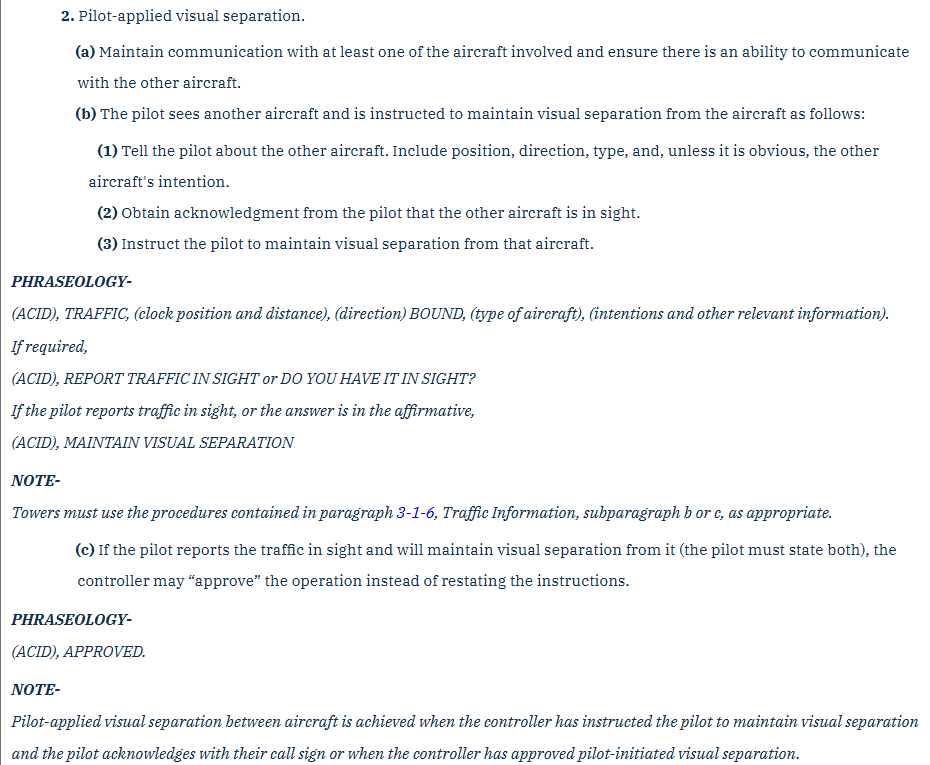
https://www.faa.gov/air_traffic/publ...section_2.html
Absolutely, it was a non-standard discourse. But however you look at what was said, PAT 25 requested the change to visual separation. Meaning PAT25 correctly believed he was under standard 1.5nm/500ft separation at the time and that he needed LC approval for Visual separation to be applied. The change in the separation standard being applied did not happen until the LC accepted PAT 25\x92s traffic visual report and authorised the change. It\x92s not an automatic change made just on the pilot\x92s say so, ie by reporting visual, which I think is what you may be implying (happy if you correct me). Both pilot and LC are necessary (and both made errors here).
Subjects
ATC
PAT25
Separation (ALL)
Traffic in Sight
Visual Separation
Links are to this post in the relevant subject page so that this post can be seen in context.
Reply to this quoting this original post. You need to be logged in. Not available on closed threads.
August 12, 2025, 01:18:00 GMT
permalink Post: 11937016
Subjects
ATC
PAT25
Separation (ALL)
Visual Separation
Links are to this post in the relevant subject page so that this post can be seen in context.
Reply to this quoting this original post. You need to be logged in. Not available on closed threads.
August 15, 2025, 06:32:00 GMT
permalink Post: 11938787
He's quite clear that he thinks that ATC alerting the CRJ about the presence of the helo (using visual flight separation) probably wouldn't have changed the outcome.
But he does pick up on the cockpit dynamics on PAT25. He says
"Now, the most important facts to emerge from the hearings this week center on the cockpit exchange between Warrant Officer Eves and Captain Robach that happened just about a minute before the midair. He says to her, " All right, kind of come left for me, ma'am. I think that's why he's asking ." And she replies, " Sure ." He says, " We're kinda.. ." And she cuts him off by saying, " Oh-kay, fine ." And he finishes his statement “… out toward the middle ”, meaning the middle of the river and west of helicopter route 4. So PAT 25 is above and west of where they should have been as the CRJ is properly on final approach for runway 33. Using maritime rules of the road terms, the CRJ was the burden vessel and the Blackhawk was the giveway vessel." He quotes someone (David Cherbonnier) posting:
"In military protocol, referring to a fellow officer as sir or ma'am is the role of a subordinate. It’s use in the cockpit indicated ‘privilege of rank’ as opposed to the typical instructor student relationship. The instructor was a Chief Warrant Officer with over 10 years service as an enlisted person prior to selection as a Chief Warrant Officer and as well as met all criteria to be a check pilot and as such was the person in charge during the entire training/examination exercise. In any other capacity, a Captain represents a person who has been recognized by Congress to have the qualifications to become an officer. In my experience, an examinee’s response in a drawn out “ oh-kay fine ” would have signaled check ride over. In this instance, deference was given to rank. Was that a contributing factor?"
Subjects
ATC
Blackhawk (H-60)
CRJ
PAT25
Route 4
Separation (ALL)
Links are to this post in the relevant subject page so that this post can be seen in context.
Reply to this quoting this original post. You need to be logged in. Not available on closed threads.
August 16, 2025, 03:15:00 GMT
permalink Post: 11939359
He's quite clear that he thinks that ATC alerting the CRJ about the presence of the helo (using visual flight separation) probably wouldn't have changed the outcome.
But he does pick up on the cockpit dynamics on PAT25. He says
"Now, the most important facts to emerge from the hearings this week center on the cockpit exchange between Warrant Officer Eves and Captain Robach that happened just about a minute before the midair. He says to her, " All right, kind of come left for me, ma'am. I think that's why he's asking ." And she replies, " Sure ." He says, " We're kinda.. ." And she cuts him off by saying, " Oh-kay, fine ." And he finishes his statement \x93\x85 out toward the middle \x94, meaning the middle of the river and west of helicopter route 4. So PAT 25 is above and west of where they should have been as the CRJ is properly on final approach for runway 33. Using maritime rules of the road terms, the CRJ was the burden vessel and the Blackhawk was the giveway vessel." He quotes someone (David Cherbonnier) posting:
Subjects
ATC
Blackhawk (H-60)
CRJ
PAT25
Route 4
Separation (ALL)
Links are to this post in the relevant subject page so that this post can be seen in context.
Reply to this quoting this original post. You need to be logged in. Not available on closed threads.
December 18, 2025, 18:05:00 GMT
permalink Post: 12007605
FAA and ATCOs. Did the Department of Justice's Answer to the Complaint throw the controller(s) "under the bus?" Yes, and no. In brief, the Answer does not state that the controllers' acts or omissions were a cause-in-fact and proximate cause of the accident.
The Complaint alleges a long list of allegedly negligent acts by the controller(s) in Paragraph 250, which starts on page 158 and runs on to 164 (in the Answer). Without having studied the pleadings for hours upon hours (as one might do in actual practice) perhaps I've missed something -- but I think the only admission made by DOJ with regard to the controllers is that a very specifically cited FAA rule or procedure of some sort was not followed: "the DCA local controller did not comply with \xb6 7-2-1(a)(2)(d) of FAA Order JO 7110.65AA, chg. 3, Air Traffic Control (Sept. 5, 2024)." This specific admission is made recurrently in the Answer, amidst many other denials of (again, unless I missed something) everything else in the massive and detailed Paragraph 250 of the Complaint.
Edit [forgot to include]: the Complaint alleges generally the following about FAA and the ATCOs.
"the Federal Aviation Administration\x92s air traffic controllers failed in their two most important priorities, namely to separate aircraft in airspace and issue Safety Alerts when aircraft are in an unsafe proximity to one another; that the air traffic controllers on duty failed to abide by numerous other policies and procedures, including that air traffic control failed to provide traffic advisories to both aircraft and air traffic control failed to resolve an aural and visual Conflict Alert that advised air traffic control that the two aircraft were on an unsafe and converging collision course; and that the air traffic controllers failed in their duties concerning the \x93tower team concept\x94 within an air traffic control facility so that all controllers assist each other to prevent, amongst other things, a mid-air collision. The Defendants\x92 [meaning, both the U.S. and the airlines] collective failures (for which they are jointly and severally liable) caused, and/or contributed to this senseless and entirely avoidable tragedy."
So, "no", because the DOJ does not admit ATC was a cause-in-fact and proximate cause (both needed for liability, if I recall 1-L) but yes, first, specifically with regard to the FAA Order, and second, for all of the reasons ATC Watcher invokes. Whether those several factors would ever be considered for inclusion in an Answer to a big tort case such as this is doubtful . . .BUT especially after the fireworks over Section 373, watch for the NTSB report to lay it all out. (And incidentally, the Complaint now includes several excerpts from NTSB hearing and docket - not sure if these were part of the original Complaint. The Answer is the first pleading in response to the Complaint and it has become the Master Complaint, as I understand it, because it is the pleading on behalf of all the plaintiffs, regardless of whether they are represented by the attorneys who filed the very first Complaint in the case. Further, according to press reports (WSJ print edition today) both the airline companies filed motions to dismiss. Thankfully, or maybe not, my Pacer account is acting up, so, no comment....)
2. The airline and its parent company. The Complaint paints a very negative picture about the acts and omissions of the airline companies and the two pilots of 5342. The Answer was filed only on behalf of the United States (FAA and Army) and so the DOJ does not address the specific allegations forming the claims against the airline - this is standard practice. Still, I found this in the Answer (re: Para. 174): "The United States admits that the AE5342 pilots failied to maintain vigilance and to see and avoid PAT25".
I am refraining from trying to summarize or comment on the many aspects of the story about the airline pilots and airline companies alleged in the Complaint. It is a very detailed story. It probably if not certainly will outrage people in the industry writ large. I've not practiced tort law, either suing or defending, but that won't stop me from saying that it seems pretty clear that the trial lawyers are gunning for the airline company deep pockets, the availability of punitive damages when those are not awardable against the Federal Government, the availability of a jury trial, and insurance policies. To state the obvious.
As for the Army, Para. 253 starts on page 168 and runs to 176; the DOJ admits some but not all of the many specifically alleged negligent acts and omissions by the Army and those pilots.
One other little item caught my attention. In paragraph 106, reference is made to "risk assessment" stuff the Army aviation unit conducted or did not conduct. "Risk Assessment", that wouldn't be the same thing as showed up in Section 373, by chance?
(For information, the case number in federal district court in D.C. is 1:25-cv-03382-ACR.)
Last edited by WillowRun 6-3; 18th December 2025 at 18:58 .
Subjects
ATC
Accountability/Liability
DCA
FAA
NTSB
NTSB Docket
PAT25
Section 373 of the FY26 NDAA
See and Avoid
Links are to this post in the relevant subject page so that this post can be seen in context.
Reply to this quoting this original post. You need to be logged in. Not available on closed threads.
January 29, 2026, 13:55:00 GMT
permalink Post: 12029155
https://www.ntsb.gov/investigations/...CA25MA108.aspx
Subjects
Altimeter (All)
Barometric Altimeter
Blackhawk (H-60)
CRJ
Findings
NTSB
PAT25
Route 4
Separation (ALL)
Traffic in Sight
Visual Separation
Links are to this post in the relevant subject page so that this post can be seen in context.
Reply to this quoting this original post. You need to be logged in. Not available on closed threads.
January 30, 2026, 09:27:00 GMT
permalink Post: 12029574
28. With several other targets located directly in front of the helicopter represented by points of light with no other features by which to identify aircraft type, and without additional position information from the controller, the instructor pilot likely identified the wrong target.
Subjects
ATC
Findings
PAT25
Separation (ALL)
Traffic in Sight
Visual Separation
Links are to this post in the relevant subject page so that this post can be seen in context.
Reply to this quoting this original post. You need to be logged in. Not available on closed threads.
February 18, 2026, 01:30:00 GMT
permalink Post: 12038924
.
[...]. The NTSB concludes that, due to additive allowable tolerances of the helicopter\x92s pitot-static/altimeter system, it is likely that the crew of PAT25 observed a barometric altimeter altitude about 100 ft lower than the helicopter\x92s true altitude, resulting in the crew erroneously believing that they were under the published maximum altitude for Route 4.
For the northern segment of Route 4, which included the area of the collision, of the 523 flights analyzed, 260 flights (49%) were identified as exceeding route altitude limitations at some point during the flight. Had the error tolerances of barometric altimeters been considered during design of the helicopter route maximum altitudes, the incompatibility of a 200-ft ceiling and barometric altimeter errors may have been identified.
Subjects
Altimeter (All)
Barometric Altimeter
Final Report
NTSB
PAT25
Route 4
Route Altitude
Links are to this post in the relevant subject page so that this post can be seen in context.
Reply to this quoting this original post. You need to be logged in. Not available on closed threads.
February 19, 2026, 14:18:00 GMT
permalink Post: 12039724
.
[...]. The NTSB concludes that, due to additive allowable tolerances of the helicopter\x92s pitot-static/altimeter system, it is likely that the crew of PAT25 observed a barometric altimeter altitude about 100 ft lower than the helicopter\x92s true altitude, resulting in the crew erroneously believing that they were under the published maximum altitude for Route 4.
For the northern segment of Route 4, which included the area of the collision, of the 523 flights analyzed, 260 flights (49%) were identified as exceeding route altitude limitations at some point during the flight. Had the error tolerances of barometric altimeters been considered during design of the helicopter route maximum altitudes, the incompatibility of a 200-ft ceiling and barometric altimeter errors may have been identified.
the PF had also shown their handling skills were not to standard earlier in the check ride (I\x92ve seen it mentioned their abandoning a manoeuvre earlier would\x92ve been a fail normally) hence monitoring their trainees parameters would\x92ve been even more taxing for the instructor
I don\x92t know how anyone can pretend these things didn\x92t at least play a part in the Swiss cheese.
if the PF had been as equally capable as the instructor and performing their scan (the CGI reenactment shows that much of the CRJ\x92s flatboats occurred within the PF\x92s side of the scan) would the outcome have been different? Possibly.
the conduct of that flight was the final hole in the Swiss cheese arguably
Subjects
Altimeter (All)
Barometric Altimeter
Blackhawk (H-60)
CVR
Final Report
NTSB
PAT25
Route 4
Route Altitude
Links are to this post in the relevant subject page so that this post can be seen in context.
Reply to this quoting this original post. You need to be logged in. Not available on closed threads.