January 31, 2025, 23:15:00 GMT
permalink Post: 11818607
Listen to the audio at 1.10 to 1.13
Controller asks PAT25 if CRJ in sight NO ANSWER
Controller asks PAT25 to pass behind. NO ANSWER
Dealt with.
Subjects
ATC
CRJ
PAT25
Pass Behind
Pass Behind (All)
Pass Behind (PAT25)
Links are to this post in the relevant subject page so that this post can be seen in context.
Reply to this quoting this original post. You need to be logged in. Not available on closed threads.
January 31, 2025, 23:21:00 GMT
permalink Post: 11818613
Subjects
ATC
CRJ
PAT25
Pass Behind
Pass Behind (All)
Pass Behind (PAT25)
Links are to this post in the relevant subject page so that this post can be seen in context.
Reply to this quoting this original post. You need to be logged in. Not available on closed threads.
January 31, 2025, 23:42:00 GMT
permalink Post: 11818626
This shows exactly the communications. The heli was told about the CRJ at 1200ft, going for 33. The heli said explicitly they had the plane in sight.
7:20 onwards.
Subjects
ATC
CRJ
PAT25
Pass Behind
Pass Behind (All)
Pass Behind (PAT25)
Links are to this post in the relevant subject page so that this post can be seen in context.
Reply to this quoting this original post. You need to be logged in. Not available on closed threads.
February 01, 2025, 00:03:00 GMT
permalink Post: 11818637
Note I say \x91through\x92 and not \x91under\x92.
I\x92m sure it is done at many airports around the World and we have a similar procedure at a large international airport in East Asia.
HOWEVER, the idea that the 200ft ceiling on the heli route is designed to provide vertical separation from the approach is ludicrous.
I suspect that limit is imposed to allow clearance from the Take-off climb surface if using the opposite direction runways. That would indeed be possible from a flight procedure design point of view (TERPS or PANS-OPS).
The only safe way is to cross behind traffic on final laterally . In some ways it would be better for the heli to be at a higher altitude if on 33 but for simplicity of procedure they may have just made it a blanket 200ft regardless.
Our procedure has laterally separated holding points either side of final which is the clearance limit where the heli can orbit or delay as necessary until confirming the aircraft to pass behind is in sight. The heli is also advised where the next aircraft in the sequence is to further verify the correct aircraft is in sight and what margin they need to leave behind the one crossing behind. Again, being higher is better as they can avoid wake turbulence by remaining well an above the glide path and pass closer behind, well ahead of the following.
There is no doubt night time makes this a far more critical operation and requires full attention. In our operation the heli is also on the same frequency as the approach aircraft, so having separate positions to control fixed wing and helis wouldn\x92t have any benefit.
This controller was hugely busy however, handling departures as well. I can\x92t believe the speed of his transmissions - even as a controller for over 30 years I have trouble with all the abbreviated phrases- of course local pilots would be used to it and expecting clipped frequencies etc\x85
The trouble with a lot of these types of procedures is a lot is carried out as a box ticking exercise - heli calls requesting to cross the final ✅, LC provides the position of the aircraft to pass behind ✅, heli reports sighting and requests own visual separation ✅, approved ✅.
LC is no doubt expected to monitor compliance visually although hugely busy with other traffic on the runway. It does sound like he was doing so, especially when the CA goes off in the background audio and puts doubt in his mind the heli is passing clear of the CRJ. He asks again immediately.
The heli confirms, so difficult to further challenge the pilot.
In my view a poorly designed procedure which was guaranteed to place the 2 aircraft in the same position if an error was made.
Subjects
ATC
CRJ
Pass Behind
Pass Behind (All)
Separation (ALL)
Vertical Separation
Visual Separation
Links are to this post in the relevant subject page so that this post can be seen in context.
Reply to this quoting this original post. You need to be logged in. Not available on closed threads.
February 01, 2025, 00:18:00 GMT
permalink Post: 11818645
The two traffic items probably didn't hear each other.
Subjects
ATC
CRJ
Frequency 119.1
Frequency 134.35
PAT25
Pass Behind
Pass Behind (All)
Pass Behind (PAT25)
Links are to this post in the relevant subject page so that this post can be seen in context.
Reply to this quoting this original post. You need to be logged in. Not available on closed threads.
February 02, 2025, 00:07:00 GMT
permalink Post: 11819398
If they had held the Helo short of the runway approach until enough radar separation to cross the approach path was available the Helo would have been orbiting for hours. When the helicopter crew confirmed they had the aircraft in sight they accepted responsibility they had identified the correct aircraft and could remain visual with it as they they crossed the approach path. If they had any doubt to this they should have stated so.
ATC intended for the helicopter to pass behind that CRJ not below it.
Actually ATC asked the Helicopter twice if they had the CRJ visual about 40 seconds apart, both times the helicopter replied yes, and the helicopter crew, not ATC, asked to maintain visual separation.
Yes, the CRJ could have not accepted ATC's request to divert to 33. They would have then been set to go around to set up again for Runway 1, the usual runway.
ATC put the CRJ on an intersecting runway, which added complexity to the pattern picture. The helo would have only had to hold for a short time to wait for the CRJ that was diverted to a runway not normally used for commercial air carriers.
Knowing that, they asked the helo to maintain visual separation, placing everything on that crew to see and avoid the CRJ. I have read that they didn't even tell them where to actually look to see the traffic, no bearing, no altitude. The helo likely saw traffic, just not where they were supposed to look. There were plenty incoming and departing Runway 1, which is why the CRJ was asked to divert. Add to that, both aircraft were low and operating over an urban area at night where it is difficult to see other aircraft. Worse even if the helo crew was using NVG.
ATC should have held the helo short, waiting for an unusual approach to a runway not used normally, so to let the CRJ pass. The CRJ crew was already saturated in tasks at the time I have not hear ATC asking them to look out for the helo.
IMO, ATC created a "single point of failure" relying on the helo to see and avoid the CRJ. Had they held the helo, and helos can hover, for even a minute, this doesn't happen. ATC's main purpose is to keep aircraft from occupying the same place at the same time. In this case, they didn't.
I am sure that the helo pilots made]mistakes. But, this appears to be a massive failure of ATC.
Last edited by Denflnt; 2nd February 2025 at 00:46 .
Subjects
ATC
CRJ
Hover
Night Vision Goggles (NVG)
Pass Behind
Pass Behind (All)
Radar
See and Avoid
Separation (ALL)
Visual Separation
Links are to this post in the relevant subject page so that this post can be seen in context.
Reply to this quoting this original post. You need to be logged in. Not available on closed threads.
February 02, 2025, 02:56:00 GMT
permalink Post: 11819470
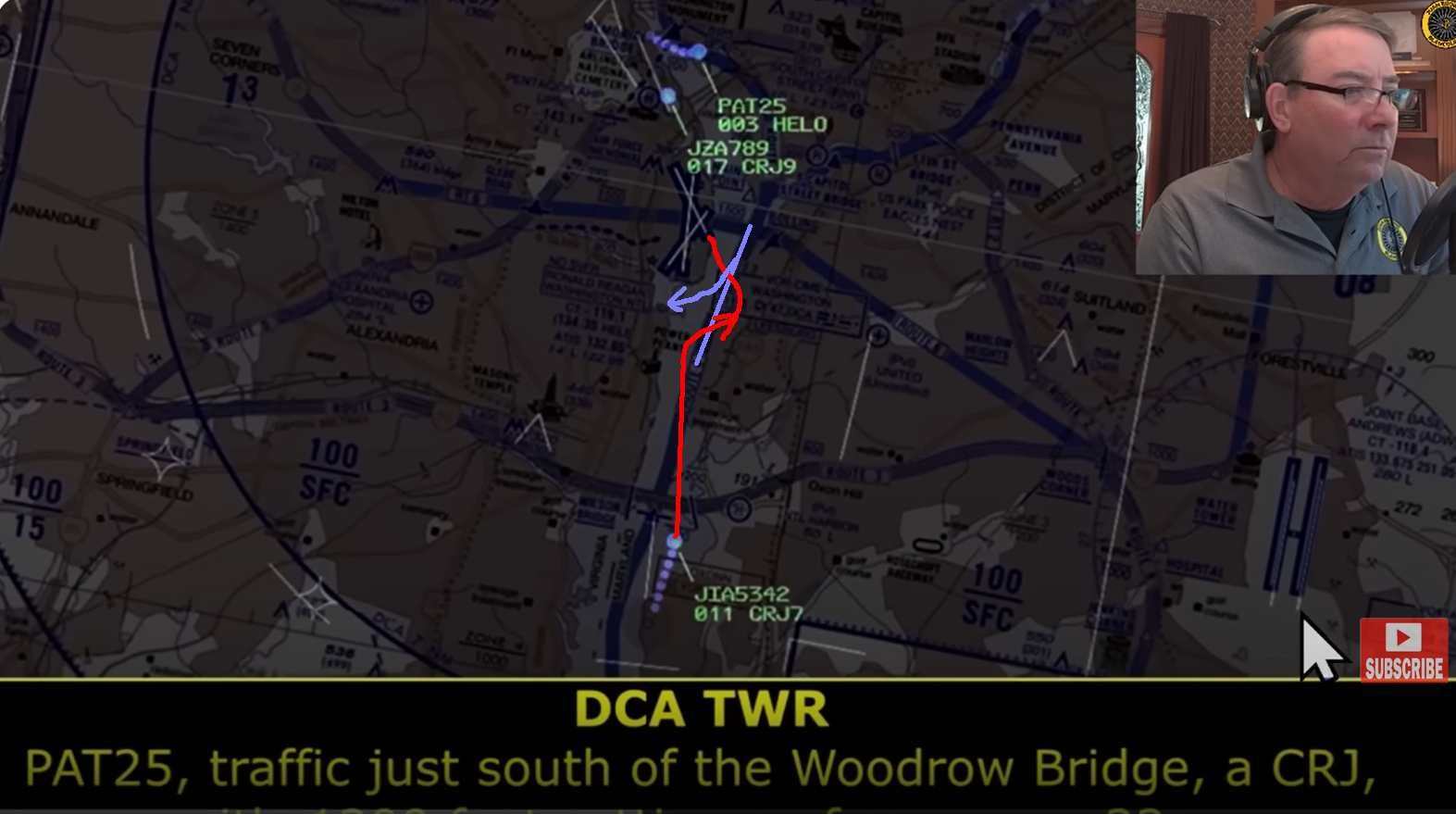
I suspect the helicopter's gradual turn to the right was a result of the pilots fixating on AAL3130 and instinctively flying to pass just behind it, without realising how far away it was.
Edit: this is the reconstruction which shows the similarity in elevation. Captain Steve and Juan Browne have put forward the same theory on their channels but without quite the same compelling graphics.
Last edited by Easy Street; 2nd February 2025 at 03:09 .
Subjects
CRJ
Night Vision Goggles (NVG)
Pass Behind
Pass Behind (All)
Radar
Links are to this post in the relevant subject page so that this post can be seen in context.
Reply to this quoting this original post. You need to be logged in. Not available on closed threads.
February 02, 2025, 03:23:00 GMT
permalink Post: 11819488
The procedures allowed the controller to hand responsibility for separation to the helo pilot, once the helo was instructed to pass behind an aircraft which the helo said it had identified (twice I think?). However, it seems that the helo identified the wrong aircraft. That's hardly surprising when it's night, there's lots of stationary and moving lights around, and one of the apparently stationary lights is in fact bolted to an aircraft with which you're on a collision course.
Subjects
ATC
CRJ
NTSB
Pass Behind
Pass Behind (All)
Separation (ALL)
Links are to this post in the relevant subject page so that this post can be seen in context.
Reply to this quoting this original post. You need to be logged in. Not available on closed threads.
February 02, 2025, 06:15:00 GMT
permalink Post: 11819534
As a system ' - at night - I think it's crazy. But that's the system.
Subjects
ATC
Blackhawk (H-60)
Pass Behind
Pass Behind (All)
Separation (ALL)
Vertical Separation
Links are to this post in the relevant subject page so that this post can be seen in context.
Reply to this quoting this original post. You need to be logged in. Not available on closed threads.
February 02, 2025, 07:39:00 GMT
permalink Post: 11819561
As a system ' - at night - I think it's crazy. But that's the system.
Subjects
ATC
Blackhawk (H-60)
Pass Behind
Pass Behind (All)
Separation (ALL)
Vertical Separation
Links are to this post in the relevant subject page so that this post can be seen in context.
Reply to this quoting this original post. You need to be logged in. Not available on closed threads.
February 02, 2025, 16:21:00 GMT
permalink Post: 11819897
Subjects
ATC
Blackhawk (H-60)
Pass Behind
Pass Behind (All)
Separation (ALL)
Vertical Separation
Links are to this post in the relevant subject page so that this post can be seen in context.
Reply to this quoting this original post. You need to be logged in. Not available on closed threads.
February 03, 2025, 14:07:00 GMT
permalink Post: 11820561
This was discussed earlier, with several posts being based on listening to an incomplete ATC recording which failed to pick up the (UHF) frequency on which the helicopter crew were responding.
As far as I can see, the helicopter crew when asked twice if they had the CRJ in sight responded in the affirmative both times. I think it's a tad unfair to criticise the controller for not being able to divine that they were actually looking at a different aircraft in the approach sequence.
Subjects
ATC
CRJ
Close Calls
Pass Behind
Pass Behind (All)
Radar
Links are to this post in the relevant subject page so that this post can be seen in context.
Reply to this quoting this original post. You need to be logged in. Not available on closed threads.
February 03, 2025, 14:45:00 GMT
permalink Post: 11820598
But the controller doesn\x92t know they have the wrong plane. Guess: he\x92s just checking they didn\x92t think they\x92d passed it already.
Either way, the controller does not have enough information to use a heading \x97 neither to know one is needed nor what it should be . The radar & display is just not as accurate as a Mark I eyeball in one cockpit seeing the other plane out the window.
When would he? \x93Tower, PAT25 has lost that traffic\x94. Until then a vector might bring them *into* a collision.
Subjects
ATC
CRJ
Close Calls
PAT25
Pass Behind
Pass Behind (All)
Radar
Links are to this post in the relevant subject page so that this post can be seen in context.
Reply to this quoting this original post. You need to be logged in. Not available on closed threads.
February 03, 2025, 15:50:00 GMT
permalink Post: 11820651
On the general subject of the 2nd Twr call to PAT25 and issuing avoidance instructions from BS5342, my take would be that maybe Twr saw it so late and simply didn't have an accurate mental picture of the precise trajectories of the helo and the CRJ to actually formulate a plan to deconflict safely. The only hope was that the helo crew "still" had the aircraft in sight (as they had already stated they had) and were still going to pass behind the CRJ............. Sadly, by then, that was just wishful thinking. At that late stage, all ATC probably knew was that ordering an evasion maneuver was just as likely to turn a near-miss into an accident as it was to turn an accident into a near-miss. A "Rock and a hard place springs" to mind....... One can only feel for the ATCO ...............
Subjects
ATC
ATCO
CRJ
DCA
PAT25
Pass Behind
Pass Behind (All)
Links are to this post in the relevant subject page so that this post can be seen in context.
Reply to this quoting this original post. You need to be logged in. Not available on closed threads.
February 03, 2025, 16:21:00 GMT
permalink Post: 11820674
If the guess that PAT25 saw the traffic for 01 (further south,who was #2 for landing, with the CRJ being #1) and not the traffic for 33, they were still advised by ATC to pass behind their traffic .
As you look at the various diagrams of the final geometry, with their initial southerly heading, any right turn would have them pass in front of the traffic approaching 01 (and yes, also it would cause them to cross in front of landing traffic for 33 if they saw that, though it appears that they didn't.).
Why the right turn rather than simply following the east bank (of the declared route) until the traffic that they did see (apparently the aircraft approaching 01) was passing their right side?
It makes no sense to me.
It appears that poster 51bravo has made a similar observation, worded differently.
If what you suggest is true, that neither pilot in the cockpit was familiar with the runway lay out of National(Reagan) Airport, that's an enormous hole in a slice or three of the cheese. I expect that subtle details like this may, or may not, eventually come out as the investigation progresses.
For patrickal:
While I appreciate the effort your put into that extended analysis, you are quite wrong about what a training mission is, the least of which is why one needs to do actual flying in an area to be competent in a given operations area, and why you have to do them in daylight and at night since your mission will call on your unit to undertake that mission, VIP transport, day or night.
The airspace in and around DC, writ large, is one of that unit's required operations area.
Your point 11 has so many things wrong about it that I won't waste further time on it.
In terms you might understand: no sale.
Last edited by Lonewolf_50; 3rd February 2025 at 16:45 .
Subjects
ATC
CRJ
DCA
Night Vision Goggles (NVG)
PAT25
Pass Behind
Pass Behind (All)
Links are to this post in the relevant subject page so that this post can be seen in context.
Reply to this quoting this original post. You need to be logged in. Not available on closed threads.
February 03, 2025, 20:31:00 GMT
permalink Post: 11820870
Subjects
ATC
CRJ
PAT25
Pass Behind
Pass Behind (All)
Links are to this post in the relevant subject page so that this post can be seen in context.
Reply to this quoting this original post. You need to be logged in. Not available on closed threads.
February 03, 2025, 20:38:00 GMT
permalink Post: 11820877
Subjects
CRJ
Pass Behind
Pass Behind (All)
Links are to this post in the relevant subject page so that this post can be seen in context.
Reply to this quoting this original post. You need to be logged in. Not available on closed threads.
February 03, 2025, 21:26:00 GMT
permalink Post: 11820910
Last edited by spornrad; 3rd February 2025 at 23:06 .
Subjects
CRJ
Circle to Land (Deviate to RWY 33)
Pass Behind
Pass Behind (All)
Links are to this post in the relevant subject page so that this post can be seen in context.
Reply to this quoting this original post. You need to be logged in. Not available on closed threads.
February 03, 2025, 22:46:00 GMT
permalink Post: 11820975
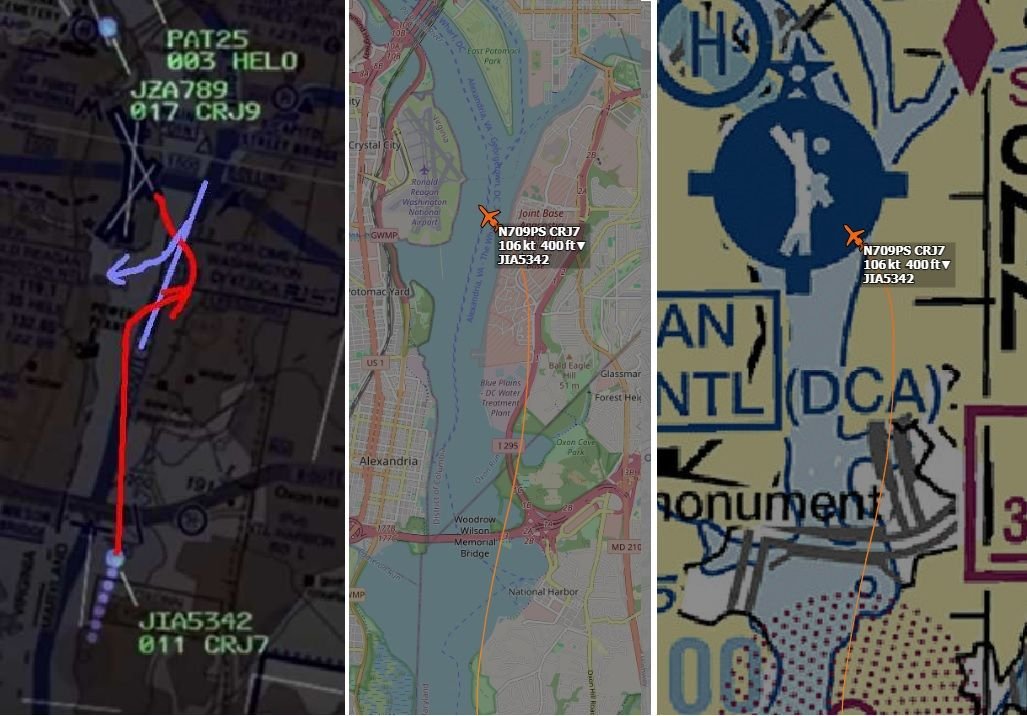
No crossing of 'Route 4' prior to ...
Subjects
CRJ
Circle to Land (Deviate to RWY 33)
Pass Behind
Pass Behind (All)
Route 4
Links are to this post in the relevant subject page so that this post can be seen in context.
Reply to this quoting this original post. You need to be logged in. Not available on closed threads.
February 05, 2025, 18:28:00 GMT
permalink Post: 11822429
They were flying Night VFR, not Day VFR.
If I am flying at night over a river at 200' yes, I want to fly smoothly, particularly if my
Maybe, Mech, if you don't know what you are talking about, you keep a sock in it rather than saying something stupid like this:
2. I was sharing (IME means In My Experience) my experience with flying that family of helicopters.
The core problem seems to have been that they never saw the CRJ. Had they seen it, my guess ~ this is speculation ~ is that they'd have turned left and done a 360 degree turn for spacing, particularly since towers instruction was "pass behind" ... and doing that would have, accomplished that. But that isn't how it turned out.
=======
Edited to account for the technical point John Dixson made.
Last edited by Lonewolf_50; 6th February 2025 at 13:10 .
Subjects
CRJ
Pass Behind
Pass Behind (All)
VFR
Links are to this post in the relevant subject page so that this post can be seen in context.
Reply to this quoting this original post. You need to be logged in. Not available on closed threads.