February 15, 2025, 10:55:00 GMT
permalink Post: 11828510
I sincerely hope the NTSB can avoid being distracted by the distractions of altimetry and the missing ATC words on the Blackhawk CVR.
Upthread, Luca Lion calculated the 3 degree PAPI approach path as crossing the eastern riverbank at 270ft. If that's correct, then the CRJ's 313ft radar height 2 seconds before collision puts it at least 43ft above the approach path, so the Blackhawk's radio height deviation of 78ft would have contributed only about 35ft to the erosion of any intended "procedural separation" (*) between the aircraft. Or, to put it another way, the same outcome would have resulted if the Blackhawk had been at 235ft radio and the CRJ on the glide. Height keeping of plus or minus 35ft can only be achieved by instrument flying, which is obviously not compatible with visual separation (or indeed VFR) so cannot be reasonably cited as part of a safety case for the procedure. And of course a landing aircraft could easily be below the glide. Altimetry and height keeping are not the cause of this accident.
Missing the word "circling" wouldn't have influenced the helo crew getting visual with the CRJ at the time of the trasnmission. At best, it would have given them an extra nudge that "runway 33" (which was audible) meant the CRJ would be taking an easterly flight path. Missing "pass behind" with only a few seconds to collision was irrelevant if, as seems likely, the helo crew did not see the CRJ at that point.
(*) The quotes around "procedural separation" are intended to convey a tone of disgust and sarcasm.
Following "5*why", keep asking...
Why did the did miss part of the message
Why was the incomplete read back missed
Why does missing a few words lead to this disaster within seconds.
Does this lead an answer like: helicopter in a very busy airspace, busy controllers (insufficient time to be fully focused on full read backs) being by default too close to (and even needing to cross) the glideslope.
Subjects
ATC
Blackhawk (H-60)
CRJ
CVR
NTSB
Pass Behind
Pass Behind (All)
Radar
Separation (ALL)
VFR
Visual Separation
Links are to this post in the relevant subject page so that this post can be seen in context.
Reply to this quoting this original post. You need to be logged in. Not available on closed threads.
February 16, 2025, 18:49:00 GMT
permalink Post: 11829389
Altimetry and height keeping would be important matters for investigators if the collision had occurred due to a breakdown in vertical separation, which as a minimum would involve 500 feet (and more often 1000 feet) of planned spacing to account for instrument and height keeping errors. FAA instrument rating standards require pilots to be able to maintain altitude plus or minus 100 feet. This helicopter was being flown VFR at very low height, which means that looking outside takes primacy over monitoring instruments. I'm sure helo pilots could fly along at 175ft plus or minus 25ft if they really tried, but you can be certain they wouldn't be looking out for traffic (as required when taking visual separation).
However, as there was no vertical separation built into this procedure, all of this is at best a distraction. The more important questions are why procedural barriers were not in place to stop the route being used during landings on runway 33, and whether visual separation at night is an adequate barrier to collision when airliners and their human cargo are involved.
N123, do you see the closest plane lined up, pass right below and behind him and never mind all the other planes right behind. Ah......NO.
There is night visual and there is night nutty visual. The first example leaves a lot of room for error and time for ATC to see if it is going wrong.
Subjects
ATC
CRJ
FAA
PAT25
Pass Behind
Pass Behind (All)
Separation (ALL)
VFR
Vertical Separation
Visual Separation
Links are to this post in the relevant subject page so that this post can be seen in context.
Reply to this quoting this original post. You need to be logged in. Not available on closed threads.
February 16, 2025, 22:11:00 GMT
permalink Post: 11829492
Subjects
CVR
PAT25
Pass Behind
Pass Behind (All)
Separation (ALL)
Visual Separation
Links are to this post in the relevant subject page so that this post can be seen in context.
Reply to this quoting this original post. You need to be logged in. Not available on closed threads.
February 16, 2025, 22:53:00 GMT
permalink Post: 11829514
Subjects
ATC
CRJ
Night Vision Goggles (NVG)
Pass Behind
Pass Behind (All)
Separation (ALL)
Links are to this post in the relevant subject page so that this post can be seen in context.
Reply to this quoting this original post. You need to be logged in. Not available on closed threads.
February 17, 2025, 01:08:00 GMT
permalink Post: 11829568
Your litany of how the holes in the cheese lined up might be missing a detail or two, but any of those holes not lining up might have avoided this tragedy.
The rad alt is right there.
At night over water at low level, the pilots I flew with did not ignore their rad alt.
It was a part of one's scan.
If I know that field elevation is 14', and my rad alt isn't at 200' or less on a route where max altitude is 200', a correction is needed now, before the error gets larger. (The separate issue of going behind, and that tower guidance apparently being stepped on, is another pair of holes in the cheese).
I am at a loss to understand the apparent magnitude of the altitude error (they were still too close laterally, yes), but as I've been out of the cockpit for a few years I am not aware of what's being taught these days.
On most airlines, they do have a barf bag, still, in the seat pocket in front of you. Suggest you vomit into that and avoid the choke hazard.
Subjects
ATC
CRJ
Night Vision Goggles (NVG)
Pass Behind
Pass Behind (All)
Radio Altimeter
Separation (ALL)
Links are to this post in the relevant subject page so that this post can be seen in context.
Reply to this quoting this original post. You need to be logged in. Not available on closed threads.
February 17, 2025, 02:01:00 GMT
permalink Post: 11829593
When the NTSB has more to share it will be interesting (to me) to see what a balanced mitigation strategy is.
Subjects
NTSB
Pass Behind
Pass Behind (All)
Links are to this post in the relevant subject page so that this post can be seen in context.
Reply to this quoting this original post. You need to be logged in. Not available on closed threads.
February 17, 2025, 06:24:00 GMT
permalink Post: 11829650
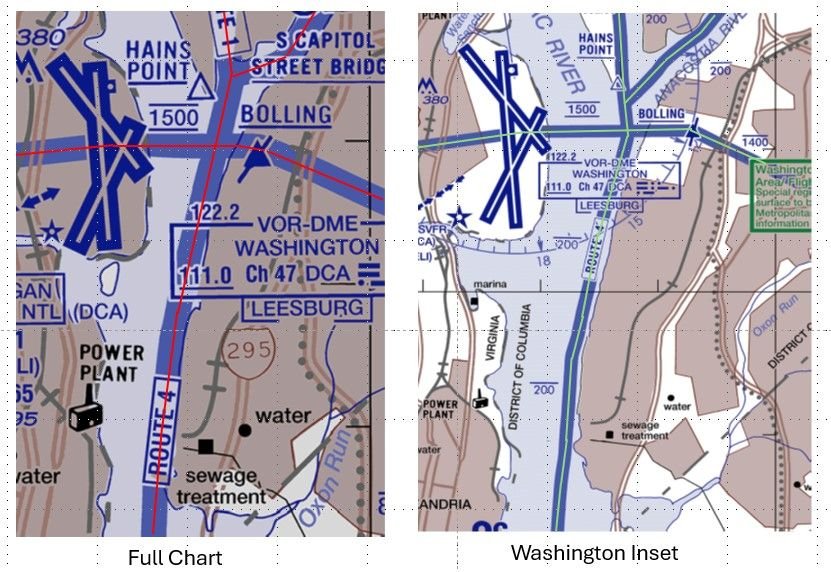
You could reasonably define the bank as the water's edge, and therefore expect crews to fly along an infinitesimally narrow path. Or as the space between the water's edge and the [edge of the flood plain | first flat area | something else], which would imply that the western boundary changes with the water level. Both imply the route is substantially above land.
Neither are useful for precise navigation, but the map and the description are probably 'close enough' if they are only needed for general route guidance and knowing that structures on the east bank need to be NOTAMed for helicopters, but probably not the west bank.
A good reminder that measurements/specifications without tolerance are often worse than useless.
If it quacks like a duck... this kind of "It can't be an X because we can't do it, so we'll call it a Y" leads to a culture that gets used to massaging the truth for convenience. Did we hear more on the Alaska door plug that was an 'opening' not a 'removal'?
Subjects
ATC
CRJ
DCA
FAA
KDCA
NTSB
Night Vision Goggles (NVG)
Pass Behind
Pass Behind (All)
Separation (ALL)
Links are to this post in the relevant subject page so that this post can be seen in context.
Reply to this quoting this original post. You need to be logged in. Not available on closed threads.
February 17, 2025, 23:42:00 GMT
permalink Post: 11830331
I would also expect helicopter pilots would avoid doing it at all. I would not recommend testing.
Last edited by Senior Pilot; 18th February 2025 at 01:12 . Reason: Leave the US Politics out of it, thanks
Subjects
Pass Behind
Pass Behind (All)
Links are to this post in the relevant subject page so that this post can be seen in context.
Reply to this quoting this original post. You need to be logged in. Not available on closed threads.
February 22, 2025, 17:10:00 GMT
permalink Post: 11833773
I am not sure the subsequent line of discussion over how Class B requires ATC (not pilots) to separate all traffic is a very productive one. Any separation instruction given by ATC relies upon the pilot executing it, for instance by maintaining the cleared altitude. Here, it relied on the pilot not colliding with the specific traffic he had confirmed visual contact with. So far as the FAA is concerned, that's a sufficient degree of control and differs from the "see and avoid" principle applicable to VFR/VFR in Class C, and VFR/Any in Class D. Again, the question is whether that's appropriate.
.
Listening to the NTSB , the only ATC instruction given : to " pass behind " was not received , and therefore not acknowledged by the crew , so we are here 100% in the good old "see and avoid" scenario I would say
Subjects
ATC
FAA
ICAO
NTSB
Pass Behind
Pass Behind (All)
See and Avoid
Separation (ALL)
Links are to this post in the relevant subject page so that this post can be seen in context.
Reply to this quoting this original post. You need to be logged in. Not available on closed threads.
March 01, 2025, 04:11:00 GMT
permalink Post: 11838291
I think the LC saw what was unfolding and said that because he had concerns that the chopper didn't actually have the CRJ. He was right.
Subjects
Blackhawk (H-60)
CRJ
Pass Behind
Pass Behind (All)
Links are to this post in the relevant subject page so that this post can be seen in context.
Reply to this quoting this original post. You need to be logged in. Not available on closed threads.
March 01, 2025, 09:36:00 GMT
permalink Post: 11838415
I think the LC saw what was unfolding and said that because he had concerns that the chopper didn't actually have the CRJ. He was right.
PAT25 says (for the second time), “Traffic visual, request visual separation”,
which is not true, evidently they were not visual at all because they crashed into the CRJ.
LC responds, “Visual separation approved, [pass behind the] CRJ,”
which clearance was issued on the false premise that PAT25 was visual. But PAT 25 only hears, “Visual separation approved…[pause]…CRJ,” because they briefly stepped on the LC’s transmission themselves. No read back is forthcoming; the LC should be expecting one but he fails to chase it up, because he’s too busy.
If PAT 25 realised he’s stepped on the middle part of the LC’s transmission to himself (which likely could have included an instruction) then he ought to be professional enough to say, “Stepped on, say again,” etc and make absolutely sure he knows what the clearance may have been. That was standard practice a long time ago, but no longer, it seems.
My original point was that in the Mover/Gonky video (post #1228) it was suggested that it’s perfectly OK to second guess what ATC might have said to you, reply to that, and then if no correction is forthcoming you can comply with your guess. As others have pointed out implicitly, that works if there’s only one error involved, but here there were three: an untrue statement, leading to a wrongly issued clearance, and a missing read back.
System broken.
Last edited by Stagformation; 2nd March 2025 at 23:42 .
Subjects
ATC
CRJ
PAT25
Pass Behind
Pass Behind (All)
Separation (ALL)
Links are to this post in the relevant subject page so that this post can be seen in context.
Reply to this quoting this original post. You need to be logged in. Not available on closed threads.
March 05, 2025, 02:07:00 GMT
permalink Post: 11841017
PAT25 says (for the second time), “Traffic visual, request visual separation”,
which is not true, evidently they were not visual at all because they crashed into the CRJ.
LC responds, “Visual separation approved, [pass behind the] CRJ,”
which clearance was issued on the false premise that PAT25 was visual. But PAT 25 only hears, “Visual separation approved…[pause]…CRJ,” because they briefly stepped on the LC’s transmission themselves. No read back is forthcoming; the LC should be expecting one but he fails to chase it up, because he’s too busy.
If PAT 25 realised he’s stepped on the middle part of the LC’s transmission to himself (which likely could have included an instruction) then he ought to be professional enough to say, “Stepped on, say again,” etc and make absolutely sure he knows what the clearance may have been. That was standard practice a long time ago, but no longer, it seems.
My original point was that in the Mover/Gonky video (post #1228) it was suggested that it’s perfectly OK to second guess what ATC might have said to you, reply to that, and then if no correction is forthcoming you can comply with your guess. As others have pointed out implicitly, that works if there’s only one error involved, but here there were three: an untrue statement, leading to a wrongly issued clearance, and a missing read back.
System broken.
Good points, especially the first, Keep in mind that no readback was required, and that type of instruction doesn't require a readback and according to the AIM is not even a type that "should" be read back, so the controller wouldn't be surprised if he didn't get one. Agree with Capn Bloggs;even if PAT25 didn't get the particular "pass behind" transmission, visual separation, which came up twice, carries the implicit instruction "Don't hit the other aircraft" ( no sarcasm intended), regardless of the method employed.
Last edited by Commando Cody; 5th March 2025 at 02:45 . Reason: Add reference to another post
Subjects
ATC
CRJ
PAT25
Pass Behind
Pass Behind (All)
Separation (ALL)
Visual Separation
Links are to this post in the relevant subject page so that this post can be seen in context.
Reply to this quoting this original post. You need to be logged in. Not available on closed threads.
March 05, 2025, 11:58:00 GMT
permalink Post: 11841230
Now if the controller had said "you look to be tracking very close to the CRJ are you sure you can pass behind?" or similar, then maybe the helo crew would have got excited. A call like that might have even triggered a "holy sh1t" moment about the TCAS "Traffic". But as far as they were concerned, they knew they had the traffic in sight and could do the visual sep thing and even if they had heard "pass behind" they would have said/thought "well, obviously". Except they had the wrong aircraft. ATC had an idea they had the wrong aircraft but didn't get the message across.
As for the reference, same thing. The helo crew could have read-back "pass behind" but it wouldn't have achieved anything.
Subjects
ATC
CRJ
Pass Behind
Pass Behind (All)
Separation (ALL)
TCAS (All)
Traffic in Sight
Visual Separation
Links are to this post in the relevant subject page so that this post can be seen in context.
Reply to this quoting this original post. You need to be logged in. Not available on closed threads.
March 05, 2025, 15:33:00 GMT
permalink Post: 11841346
Subjects
Pass Behind
Pass Behind (All)
Links are to this post in the relevant subject page so that this post can be seen in context.
Reply to this quoting this original post. You need to be logged in. Not available on closed threads.
March 05, 2025, 19:00:00 GMT
permalink Post: 11841477
Now if the controller had said "you look to be tracking very close to the CRJ are you sure you can pass behind?" or similar, then maybe the helo crew would have got excited. A call like that might have even triggered a "holy sh1t" moment about the TCAS "Traffic". But as far as they were concerned, they knew they had the traffic in sight and could do the visual sep thing and even if they had heard "pass behind" they would have said/thought "well, obviously". Except they had the wrong aircraft. ATC had an idea they had the wrong aircraft but didn't get the message across.
As for the reference, same thing. The helo crew could have read-back "pass behind" but it wouldn't have achieved anything.
Subjects
ATC
CRJ
Pass Behind
Pass Behind (All)
Separation (ALL)
TCAS (All)
Traffic in Sight
Visual Separation
Links are to this post in the relevant subject page so that this post can be seen in context.
Reply to this quoting this original post. You need to be logged in. Not available on closed threads.
March 06, 2025, 08:54:00 GMT
permalink Post: 11841781
Because without that information, they could IMHO quite happily look at the A319 approaching runway 1, intend to pass behind it to head south down-river until the A319 was no longer over the river, and loiter around the runway 33 approach until that happens.
Shift the times by ten seconds and the same accident could have still occurred.
Visual simply doesn't work at the required level of safety if there are multiple aircraft to be visual with.
Subjects
Pass Behind
Pass Behind (All)
Links are to this post in the relevant subject page so that this post can be seen in context.
Reply to this quoting this original post. You need to be logged in. Not available on closed threads.
March 06, 2025, 13:29:00 GMT
permalink Post: 11841979
Because without that information, they could IMHO quite happily look at the A319 approaching runway 1, intend to pass behind it to head south down-river until the A319 was no longer over the river, and loiter around the runway 33 approach until that happens.
Shift the times by ten seconds and the same accident could have still occurred.
Visual simply doesn't work at the required level of safety if there are multiple aircraft to be visual with.
Reading this thread since the night of the accident, many have noted the "wrong-thinking" (for lack of a better term) underpinning the way traffic was managed by FAA and ATC.
I'm not enthused about the litigation that almost certainly will be intense once it commences. But reading the thread I've started to wonder.....
What would a chronological reconstruction of each incremental decision by FAA about the operation of DCA look like, a chronology that would (of course) include each Congressional enactment requiring or allowing further intensity of operations? The airport did not go from a nominal operational environment, with typically safe procedures and airspace usage rules very similar to or the same as any other major urban airport in the country, to the situation which obtained on January 29, overnight - or so it would seem.
(Yes, reconstructing the facts to build such a chronology would involve quite a lot of discovery activities in the presumably forthcoming lawsuits, but I'm not veering off into any further comment about why that would matter or which party or parties it would help or hurt..... other than to say, very often, cases are won and lost in discovery.)
Some years ago, on a trip to Capitol Hill hoping to find gainful employment on a Congressional staff somewhere, on the return flight from what then was Washington National, the aircraft's cockpit door was open as the boarding process was being completed (it was 1987). I recall being seated close enough to the flight deck - leaning a little into the aisle (a Midway Airlines DC-9 iirc) - to be able to see the pilot in the LHS and part of the D.C. skyline through the cockpit's front windows. Maybe that is why my mind somehow can't quite comprehend the recollections from kidhood of reading about the midair collision over New York City which is featured prominently in the book Collision Course , together with the events of the night of January 29.
Added: Wall Street Journal, March 6: "Air-Traffic Staff Rules Tightened After Crash." Also reports previous "close call" incident. Highly recommended reading (and I didn't see anything to contradict the above post, WR 6-3).
Last edited by WillowRun 6-3; 6th March 2025 at 13:46 .
Subjects
ATC
Circle to Land (Deviate to RWY 33)
Close Calls
DCA
FAA
Pass Behind
Pass Behind (All)
Separation (ALL)
Visual Separation
Wall Street Journal
Links are to this post in the relevant subject page so that this post can be seen in context.
Reply to this quoting this original post. You need to be logged in. Not available on closed threads.
March 06, 2025, 14:07:00 GMT
permalink Post: 11842005
Because without that information, they could IMHO quite happily look at the A319 approaching runway 1, intend to pass behind it to head south down-river until the A319 was no longer over the river, and loiter around the runway 33 approach until that happens.
(Not sure why this little hamster wheel is still spinning, but this is PPRuNe).
Subjects
NTSB
Pass Behind
Pass Behind (All)
Links are to this post in the relevant subject page so that this post can be seen in context.
Reply to this quoting this original post. You need to be logged in. Not available on closed threads.
March 21, 2025, 11:20:00 GMT
permalink Post: 11851281
 I always read you input as, while the detailed legal nitty-gritty is generally way beyond me, you always provide a refreshing viewpoint which is good to read! The aim of my Post, based on my interpretation of the above quote, was just to emphasise the existence of ASIAS is just as a tool or, rather, a set of tools but which has no real "proactive function" in itself. Yes, it represents a very small part of the Flight Safety chain - but as a resource in the main. As you say, there were loads of examples of what happened at DCA and my post was an explanation as to who, I believe, should have been looking at it. Maybe they did - and just ignored it? No idea!
In the UK, the airport operator is totally responsible for the safety of operations on or above their field out to 4000 ft on approach and departure - about 12 miles. The CAA who regulates aviation here, along with the Dept of Transport, but in conjunction with other stakeholders such as NATS (our en-route ATC organsiation), airlines and airfield operators etc, designs the airspace and sets the generic rules for it's use. As you said, the main rule is "Don't crash anything into anything else!". However, at the airfield, it is the airport operator who needs to ensure that the generic rules work in their environment. If a particular rule is legal but, if applied in their location, is unsafe, they can't apply that rule! That's what the Safety Case should say.
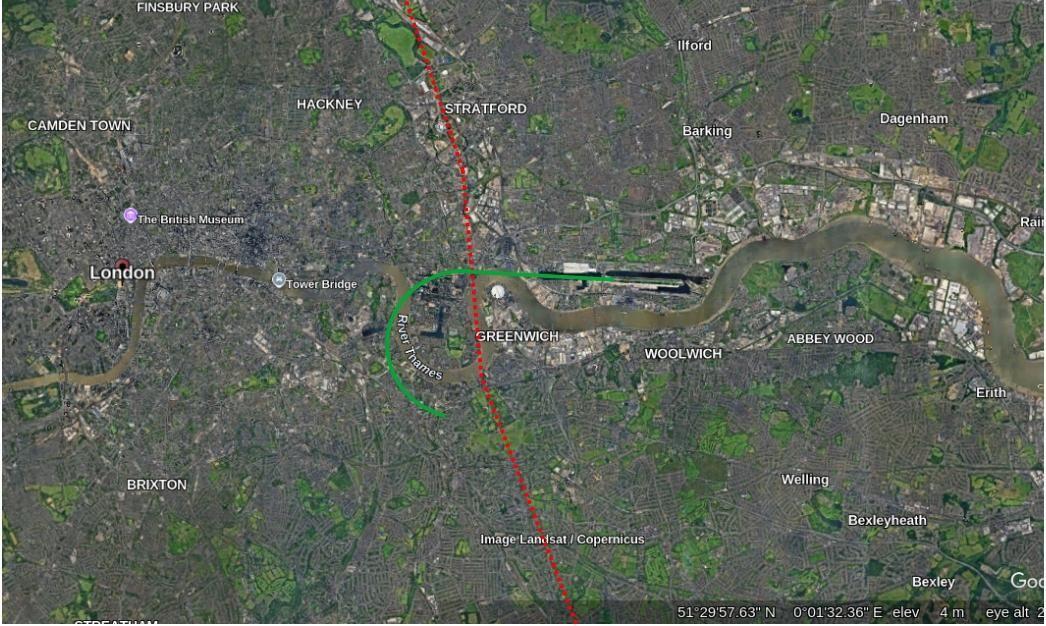
A relevant example? I used to regularly (for work) transit London S > N and N > S along the red dotted line below - at 2400ft as it kept me just out of the London TMA but as high as possible so, if it had all gone quiet on the engine front, I'd have the best chance to get the plane onto the ground with me alive and no-one else hurt. As part of the transit, I had to cross the final approach into London City (green line). So, say heading N, I'd chat to Thames Radar while over South London and would ask for a London City crossing. They'd chat to City ATC to co-ordinate and take me to the Thames before handing me to City Tower. My route over the Approach has aircraft at 1200 ft descending on the ILS and so I would have crossed anything landing at 1200 ft above that. So, while on first glance, it was fine I never, ever got that clearance with an aircraft landing - and for very good reasons. If the aircraft on the ILS had had to do a go-around, life could have become interesting very quickly. I was always held until the landing aircraft was well clear (ie ATC could see it was almost at the airfield) before they cleared me across. Indeed, legally, they could have given me a "You see the landing? Pass behind that"! But, no - always positive clearances. Got my vote ....... + gave me chance to enjoy the views of Greenwich and the City of London and "delayed" me a couple of minutes. OK, a bit unfair as LCY is "sleepy hollow" compared to DCA but, despite that, they were very friendly ..... but very strict!!!!!
So, when you are discussing (I think!!!) whether ATC elected to give PAT25 a "You visual? Pass behind" or whether it was "ordered" from on-high as it was deemed safe to do, ultimately, it is the ATCOs call on the day. Now, before I get flamed, do I blame the ATCO ? No! Well, why not? After all, he gave PAT permission! And yes, it was a "legal" clearance. But was it a wise clearance? When unpacking that little lot you have to look at a raft of Human Factors which influenced that ATCO on that night. He was on his own so, probably, the only way he could cope with all he had on his plate was to try and shift some responsibility onto PAT25 - one less thing for him to juggle. But even then, he needed to be monitoring which he clearly was - but while very busy with other approaches and departures so he just picked up a concern too late as the audio shows - "Are you sure you see the jet?". Another factor - was the strategy to use Route 4 while 33 was active something ATCers at DCA, over time, started in an effort to cut down radio traffic and speed things up? If so, had it been assessed and then monitored for adverse safety? While anecdotally, it seemed people were aware of "close calls", had any analysis taken place looking at the Databases? In the UK certainly, all the Airport Operator responsibility.
To the final "accountability" part re payments to families, the thing we have here is (and, folks, correct me if I've got this wrong) the FAA set the rules and the operate the Rules. Here, the CAA sets the rules and the Airfield Operator operates the rules. That is important - for eg, huge argument here in the UK about just how independent the UK's Military Flight Safety organisation is ..... as it is part of the Military. IMHO, what we have here are valid generic rules, some of which were simply not suitable in this specific location - just like crossing London City with an aircraft on approach - legal ...... but very unwise. As to who carries the can, well, as you said WR 6-3 , the legal beagles will get to the bottom of that ..... but it will take some time. I'll leave that side to you!!! My main question out of all of this is, why were not these issues flagged up by airport management for further investigation given it was something of an open "secret"? And where else (around the world) is this happening?

And, on that cheerful note...........! H 'n' H
Subjects
ATC
ATCO
Accountability/Liability
Close Calls
DCA
FAA
PAT25
Pass Behind
Pass Behind (All)
Radar
Route 4
Links are to this post in the relevant subject page so that this post can be seen in context.
Reply to this quoting this original post. You need to be logged in. Not available on closed threads.
March 25, 2025, 16:48:00 GMT
permalink Post: 11854025
You are spot on in that there was no way for ATC or the helo crew to verify that the one the helo crew were watching (a/c B) actually wasn't the one that ATC thought they were watching (a/c A). That, as you say, was a very significant weakness. So they were on course to avoid the one they were watching. But that wasn't the one ATC had asked them to watch.
You are dead right in how difficult "see and avoid" is. I'm lucky as I only flew between small UK Regionals and, particularly when in my home patch, I often got from Twr "Visual with a/c A on Final? Join Final as #2 to a/c A!" type stuff. Worked OK when it was only me and a/c A. Any more and usually Approach sequenced me if I'd arrived SVFR by placing me under Radar Control for a short while before then handing me off to Twr to join the cct visually once faster traffic was well ahead of me. That's if they didn't forget me completely .... which happened once ...... but that's another story - they were most apologetic when I reminded them I was still on the last vector they'd given me!!!! "Sorry about that, I'd completely forgotten about you!"! Charming!
Subjects
ATC
Pass Behind
Pass Behind (All)
Radar
See and Avoid
Links are to this post in the relevant subject page so that this post can be seen in context.
Reply to this quoting this original post. You need to be logged in. Not available on closed threads.