February 01, 2025, 18:07:00 GMT
permalink Post: 11819203
My thoughts:
I continue to see this as:
- a failure of imagination by command;
- a system failure by command to monitor performance against expected system behaviour;
- an information system failure, the evidence has been in front of those that are charged with having safe systems such as the govt, regulator, DOD, airlines;
- The crew and the the ATC controller, and certainly the passengers are not high in the systemic failures that occur here, I would contend that the crew and the ATC officer are victims of the systemic failures.
Criss-Crossing Routes in D.C. Airspace Leave Little Room for Error
By Elena Shao , Leanne Abraham , Eli Murray and Lazaro GamioThe pictures are out of order, the tracks are for "1-Week" of data. The latest NOTAM is a good start, the helo fleet operators may want to revisit the concept of the flyways.
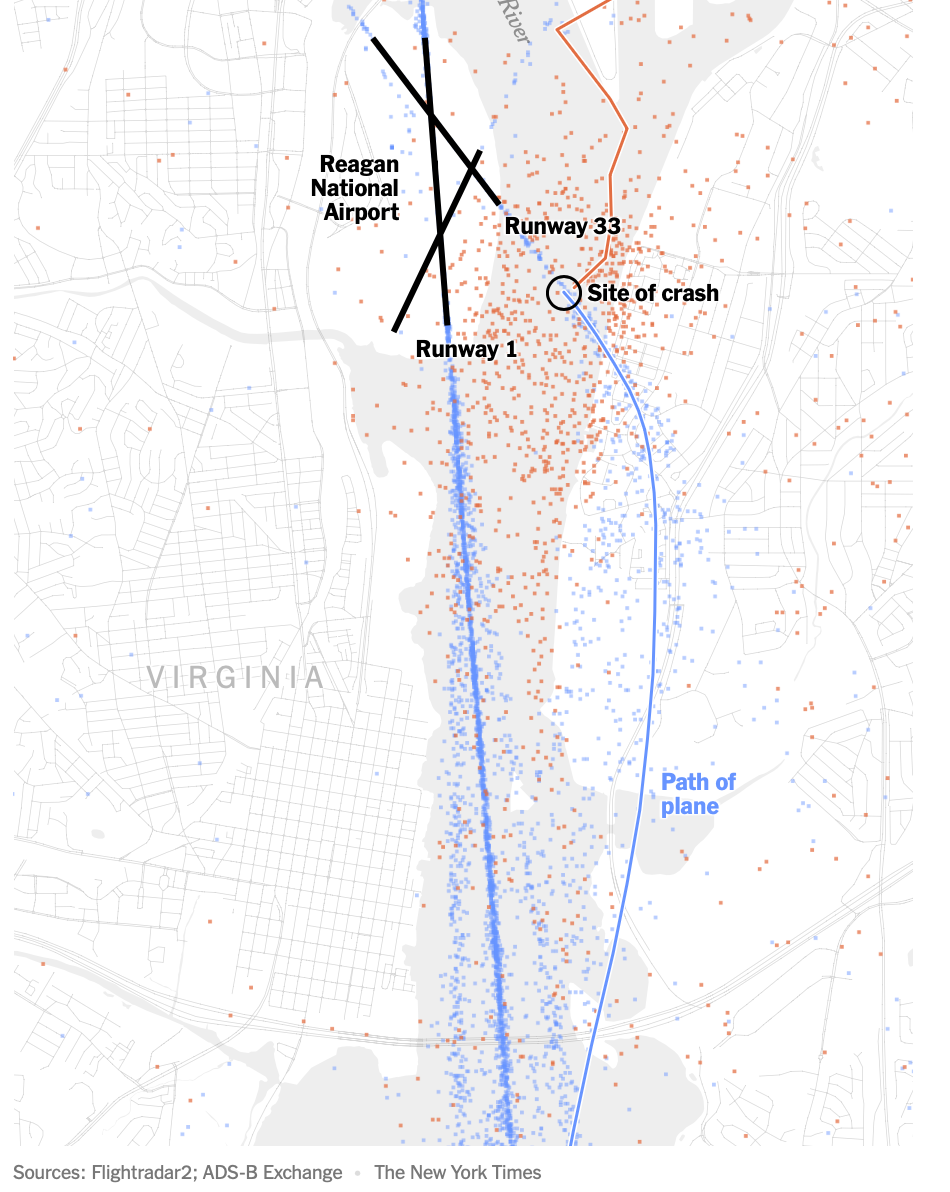
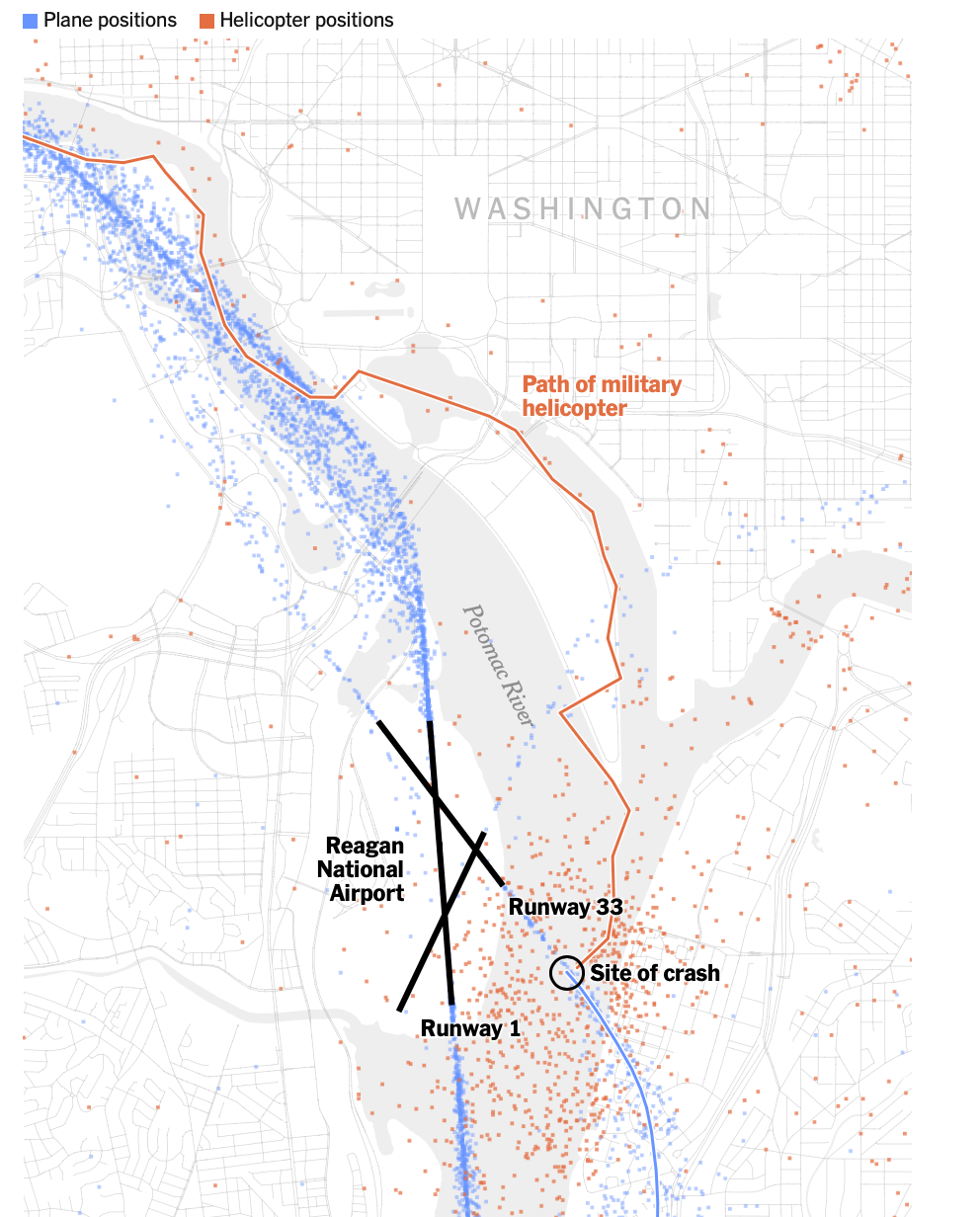
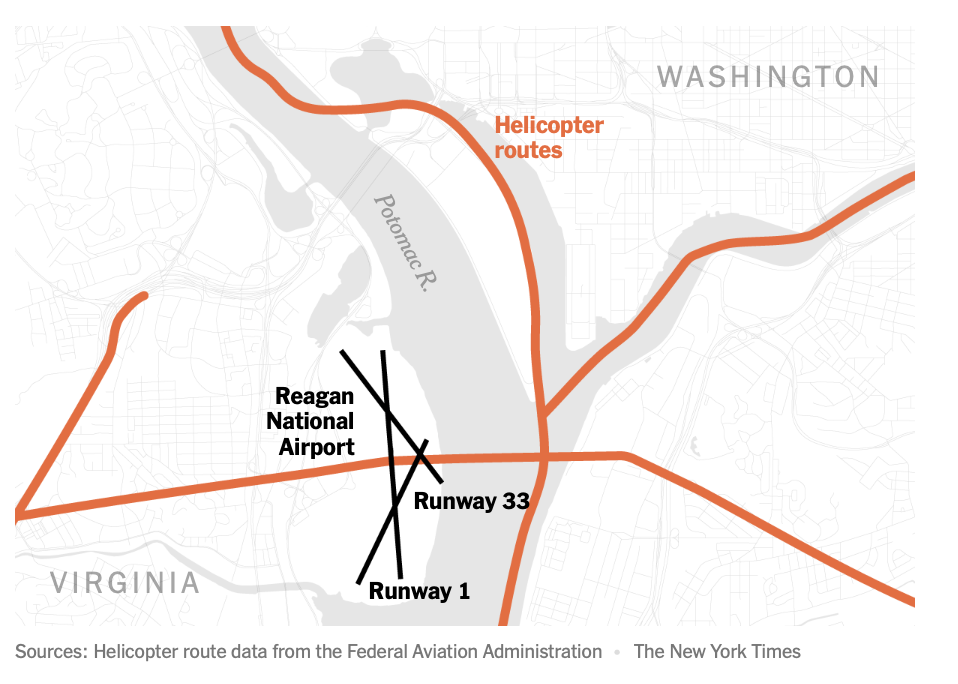
A deadly midair collision between an American Airlines passenger jet and a U.S. Army helicopter near Ronald Reagan National Airport in Washington highlights the complexity of navigating an airspace with many civilian and military aircraft.
The airport has three runways that intersect, but only one is used for nearly all of its hundreds of daily flights. With the routes of aircraft routinely criss-crossing one another, there is little room for error as planes descend onto the runways. To stay out of the way of commercial jets, helicopters in this area are supposed to fly along a route designated by the Federal Aviation Administration at an altitude no higher than 200 feet.
Air traffic data from the past week shows that helicopters flying along the Potomac River must navigate amid the takeoffs and landings of hundreds of planes daily. While they are advised by the F.A.A. to stick to a tight air corridor above the eastern bank of the river, data shows that in reality, helicopters can be spotted across the width of the river.
One week of air traffic at Reagan National
Dots show positions of planes during their takeoffs and landings at Reagan National Airport, as well as the positions of helicopters as they traversed the area from Jan. 23 to Jan. 30.The American Airlines flight was cleared to land on Runway 1 before being instructed by an air traffic controller shortly before the collision to pivot its landing route to the intersecting Runway 33.
The last-minute request to switch runways at Reagan National is “very common,” said Shawn Pruchnicki, a former airline pilot and an assistant professor at the Center for Aviation Studies at Ohio State University, who said he has piloted aircraft into the airport more than a hundred times.
Skies were clear on Wednesday night when the two aircraft collided. But, in case of low visibility, like in poor weather, the F.A.A. has designed “instrument approaches,” or descents that involve a series of steps pilots must follow to maneuver down to the runway safely.
The instrument approach for Runway 1 calls for a descending plane to cross over the helicopter corridor while the plane is at a much higher altitude, somewhere from 620 to 1,700 feet and more than a minute from landing. The approach for Runway 33, however, calls for a plane to cross over the helicopter corridor at a much lower altitude, because a plane is seconds from landing. The clearance between a helicopter in the corridor and a descending plane may be from 100 to 300 feet, which can result in close calls if there are severe fluctuations in the altitude of either aircraft.
Sources: Helicopter route and instrument approach data from the Federal Aviation Administration
Note: An instrument approach is a descent that involves a series of scripted flight maneuvers, with pilots using navigation aids and instruments to reach the runway safely when visibility is low, such as in poor weather.
The [failing] New York Times
Given the clear nighttime weather, the plane’s pilots would not have been expected to initiate an instrument approach to aid their landing, Mr. Pruchnicki said, and instead could have used their vision to guide their descent to the runway. Data on the aircraft’s positions indicates that the pilots’ route was very similar to the one outlined in an instrument approach. For example, the plane maintained roughly the recommended altitude when it made a leftward turn toward Runway 33.
In this case, the Army Black Hawk requested permission to use the route designated for helicopters, meaning that it would keep to the eastern bank of the Potomac and stay under 200 feet in altitude. But the helicopter was at least a half-mile off of the approved route when it collided with the jet, according to four people briefed on the matter but not authorized to speak publicly. The helicopter was also flying above 300 feet, not below 200, the people said.
The crash also renewed questions about the safety of intersecting runways, which the F.A.A. has sought to eliminate or close in recent years in places like Chicago and Dallas because of concerns over congestion on the ground. The setup can increase the workload of the air traffic controller, especially if the two runways are getting used simultaneously for takeoff and landing, said Cyriel Kronenburg, a former air traffic controller and pilot.
An internal preliminary report from the F.A.A., which was reviewed by The New York Times , said that a supervisor allowed an air traffic controller to leave early, sometime before the crash. This left one air traffic controller to manage the dual roles of handling helicopters in the airport’s vicinity and also instructing planes that were landing and departing from runways, according to a person briefed on the matter. While it is within the supervisor’s discretion to combine the duties, that staffing configuration “was not normal for the time of day and volume of traffic,” the F.A.A. report said.
A Times investigation in 2023 found that the nation’s air traffic control facilities are chronically understaffed , contributing to an alarming number of close calls in the skies and on the runways across the country. Before the plane crash on Wednesday night, there were at least 10 close calls at Reagan National in the last three years that were documented in government records reviewed by The Times.
Additional research by Riley Mellen.
See more on: Federal Aviation Administration (F.A.A.)
https://www.nytimes.com/interactive/...smid=url-share
Subjects
ATC
Blackhawk (H-60)
Close Calls
FAA
Preliminary Report
Links are to this post in the relevant subject page so that this post can be seen in context.
Reply to this quoting this original post. You need to be logged in. Not available on closed threads.
February 12, 2025, 16:42:00 GMT
permalink Post: 11826805
I am sorry you see a witch hunt in my post. It was supposed to be an idea for a future improvement, rather than a criticism of the very hard worked man who was on the job. On the flying end, there is quite a rigid procedure to follow if a TCAS RA goes off. From posts since I see, that there seems to be one for for STCA triggers too. It seems to me that the gravity of the situation is brought faster to a pilot's attention if the Conflict warning is announced on the RT.
That is just one factor in this sad affair of course. Both TCAS and STCA are last ditch saviours but only if full attention can be paid to them.
Now on the Conflict alert on the BRITE display . I have no first hand info on the SOPs in DCA on how a TWR controller uses the BRITE and if STCA are even displayed . `, but if they are, seen the charts and the routes , I guess STCA alerts are very common .especially when you delegate separation and you then play with a couple of hundred feet, vertical separation Too many unnecessary alerts equals normalization of deviance, . Look at the Haneda preliminary report , same ..
Finally since you mention TCAS RAs , there is a major difference with STCA , it is not the same as a TCAS RA . With an RA , as a pilot you have to react and follow , it is mandatory , for a controller a STCA is just an alert , just like a TCAS TA , if in your judgement it will pass you will not do anything , and if you have already issued a correcting instruction ( heading, level , etc,,) or here delegate visual separation , the STCA just becomes a nuisance. .
I sincerely hope the DC Controller will not be made the scapegoat of this accident . Not so sure it will not.
Subjects
ATC
DCA
FAA
NTSB
Normalization of Deviance
Preliminary Report
Separation (ALL)
TCAS (All)
TCAS RA
Vertical Separation
Visual Separation
Links are to this post in the relevant subject page so that this post can be seen in context.
Reply to this quoting this original post. You need to be logged in. Not available on closed threads.
February 12, 2025, 19:46:00 GMT
permalink Post: 11826918
Now on the Conflict alert on the BRITE display . I have no first hand info on the SOPs in DCA on how a TWR controller uses the BRITE and if STCA are even displayed . `, but if they are, seen the charts and the routes , I guess STCA alerts are very common .especially when you delegate separation and you then play with a couple of hundred feet, vertical separation Too many unnecessary alerts equals normalization of deviance, . Look at the Haneda preliminary report , same ..
Finally since you mention TCAS RAs , there is a major difference with STCA , it is not the same as a TCAS RA . With an RA , as a pilot you have to react and follow , it is mandatory , for a controller a STCA is just an alert , just like a TCAS TA , if in your judgement it will pass you will not do anything , and if you have already issued a correcting instruction ( heading, level , etc,,) or here delegate visual separation , the STCA just becomes a nuisance. .
I sincerely hope the DC Controller will not be made the scapegoat of this accident . Not so sure it will not.
Rarely does the "bad apple" theory of accident causation survive the scrutiny of a robust, honest investigation.
Last edited by Senior Pilot; 12th February 2025 at 23:14 . Reason: Quote was unreadable
Subjects
ATC
DCA
FAA
NTSB
Normalization of Deviance
Preliminary Report
Separation (ALL)
TCAS (All)
TCAS RA
Vertical Separation
Visual Separation
Links are to this post in the relevant subject page so that this post can be seen in context.
Reply to this quoting this original post. You need to be logged in. Not available on closed threads.
February 13, 2025, 00:47:00 GMT
permalink Post: 11827075
__________
Federal air-safety officials want to permanently keep helicopters away from commercial jets taking off and landing at a busy Washington, D.C., airport after the deadliest U.S. aviation accident in more than two decades.
The move, under consideration by senior Federal Aviation Administration officials, would be part of a long-term plan to improve safety at Ronald Reagan Washington National Airport, according to people familiar with the discussions.
Helicopters have been temporarily barred from flying in a corridor used by the U.S. Army Black Hawk that collided on Jan. 29 with an American Airlines regional jet, killing 67 people. The chopper routes have been used to ferry senior military officials around the region and to train for a \x93continuity of government\x94 mission in the event American political leaders need rapid evacuation from Washington. Other government agencies have also used the routes.
Federal officials have said they would revisit the helicopter restrictions once the National Transportation Safety Board issues a preliminary report on the accident in the coming weeks. Preliminary indications from the probe point to multiple factors potentially contributing to the crash, including the design of the airspace, as well as actions by the helicopter pilot and air-traffic controller, according to people familiar with the investigation.
The NTSB said it would examine how far apart planes and helicopters are supposed to be while flying in the airspace.
Transportation Secretary Sean Duffy has criticized the Pentagon\x92s operation of helicopters near the airport. \x93If we have generals who are flying in helicopters for convenience through this airspace, that\x92s unacceptable,\x94 he said last week. \x93Get in a damn Suburban and drive. You don\x92t need to take a helicopter.\x94
The Army said it would continue to comply with FAA requirements and restrictions to enhance flight safety. The service said it was reassessing its aircraft operations near the airport and that it gave priority to the safety of the public and military personnel. The current restrictions allow certain critical flights.
Duffy also suggested certain military missions can be done at a different time of night. The Jan. 29 crash occurred around 9 p.m. Eastern time.
Defense officials have assumed that the helicopter routes would be closed in the coming months amid several ongoing investigations, but have privately said that the routes should be reopened. Adjustments under consideration if routes are reopened include limiting hours for training and test missions.
Reagan\x92s convenient location, a few miles from Capitol Hill, has made the nearly 84-year-old airport a favorite among politicians, business executives and tourists.
Space is tight at the airport. Reagan\x92s longest runway, Runway 1, is the nation\x92s busiest, airport officials have said, and it has two smaller runways. Routes into and out of the airport are constrained by no-fly zones around sensitive government buildings.
The FAA has said it is also reviewing airspace around airports aside from Reagan that also have high volumes of helicopter and airplane traffic.
Discussions about Reagan airport have also focused on a small runway known as Runway 33, people familiar with the matter said. The American Airlines regional jet was attempting to land there when it collided with the Army helicopter. Some government and industry aviation officials believe that there isn\x92t a problem with planes using the runway if helicopters aren\x92t near the traffic lanes.
Warning signs existed for years about risks facing commercial passengers, with planes sharing the skies closely with helicopters zipping up and down the Potomac River.
The path the American Airlines regional jet took toward Runway 33 required it to turn toward the right and then bank left to line up for its landing. That route crosses over a lane for helicopters at a relatively low altitude.
There have been at least 35 events involving conflicts between helicopters and flights into and out of the airport that have been flagged since the 1980s, according to a Wall Street Journal analysis of anonymous reports to a system overseen by the National Aeronautics and Space Administration.
In one instance, in July 2018, a helicopter and small plane came within roughly 580 feet of each other while the plane was approaching Runway 33. The helicopter pilot had to maneuver to avoid the plane and questioned the air-traffic controller about it after, according to an internal FAA report on the incident viewed by the Journal.
Neither aircraft had received traffic advisories or safety alerts, the report said. The helicopter pilot reported the incident as a near midair collision. \x93I\x92m sorry for the confusion,\x94 the controller told the helicopter pilot, according to an audio recording of air-traffic-control communications following the incident.
Nearly two weeks after the deadly crash over the Potomac, the FAA has lifted some of the constraints put on Reagan airport in the wake of the accident.
The FAA on Tuesday boosted the airport\x92s arrival rate from 26 to 28 aircraft an hour, after temporarily reducing it to ease the strain on controllers still dealing with the aftermath of the crash, according to an email viewed by the Journal and earlier reported by other news outlets. The current rate is still lower than the airport\x92s typical maximum of 32 arrivals an hour.
Reagan\x92s two smaller runways, which had been closed due to search and recovery efforts, have been reopened.
________
Subjects
ATC
Blackhawk (H-60)
DCA
FAA
NTSB
Preliminary Report
Wall Street Journal
Links are to this post in the relevant subject page so that this post can be seen in context.
Reply to this quoting this original post. You need to be logged in. Not available on closed threads.
February 16, 2025, 04:57:00 GMT
permalink Post: 11828979
Now on the Conflict alert on the BRITE display . I have no first hand info on the SOPs in DCA on how a TWR controller uses the BRITE and if STCA are even displayed . `, but if they are, seen the charts and the routes , I guess STCA alerts are very common .especially when you delegate separation and you then play with a couple of hundred feet, vertical separation Too many unnecessary alerts equals normalization of deviance, . Look at the Haneda preliminary report , same ..
Finally since you mention TCAS RAs , there is a major difference with STCA , it is not the same as a TCAS RA . With an RA , as a pilot you have to react and follow , it is mandatory , for a controller a STCA is just an alert , just like a TCAS TA , if in your judgement it will pass you will not do anything , and if you have already issued a correcting instruction ( heading, level , etc,,) or here delegate visual separation , the STCA just becomes a nuisance. .
I sincerely hope the DC Controller will not be made the scapegoat of this accident . Not so sure it will not.
In the US, physicians who work for "Health Maintenance Organizations" are asked to practice medicine, at times, in a "basically unsafe" manner...to keep patients moving. On occasion, such practices will bite a patient (and sometimes the physician). As a whole, HMO physicians do not enjoy the best reputation.
From my perspective, there is practically no difference between the plight of an American air traffic controller and an American HMO physician. Both are expected to "squeeze one more in." Both fields are staffed by above-average capable individuals who thrive on challenges. Both are managed in such a manner that they cannot say "no" and also keep their job. In this regard, at least physicians have job portability.
But the take home point is that one cannot admit to knowing a practice is fundamentally unsafe, yet do it anyway. The public, rightfully, should not accept this. I have no solution except more staff and/or more airports (and not some next-gen whizzbang computer system).
Subjects
ATC
DCA
FAA
NTSB
Normalization of Deviance
Preliminary Report
Separation (ALL)
TCAS (All)
TCAS RA
Vertical Separation
Visual Separation
Links are to this post in the relevant subject page so that this post can be seen in context.
Reply to this quoting this original post. You need to be logged in. Not available on closed threads.
March 11, 2025, 20:21:00 GMT
permalink Post: 11845619
Subjects
NTSB
PAT25
Preliminary Report
Links are to this post in the relevant subject page so that this post can be seen in context.
Reply to this quoting this original post. You need to be logged in. Not available on closed threads.
March 11, 2025, 20:35:00 GMT
permalink Post: 11845640
"Near Midair Collision Events at DCA
Review of information gathered from voluntary safety reporting programs along with FAA data regarding encounters between helicopters and commercial aircraft near DCA from 2011 through 2024 indicated that a vast majority of the reported events occurred on approach to landing. Initial analysis found that at least one TCAS resolution advisory (RA) was triggered per month due to proximity to a helicopter. In over half of these instances, the helicopter may have been above the route altitude restriction. Two-thirds of the events occurred at night.
A review of commercial operations (instrument flight rules departures or arrivals) at DCA between October 2021 and December 2024 indicated a total of 944,179 operations. During that time, there were 15,214 occurrences between commercial airplanes and helicopters in which there was a lateral separation distance of less than 1 nm and vertical separation of less than 400 ft. There were 85 recorded events that involved a lateral separation less than 1,500 ft and vertical separation less than 200 ft."


What is seen - reported; and what is dismissed … diminishes the value of reporting.
A system broken: a broken safety management system at the national level.
Subjects
DCA
FAA
NTSB
PAT25
Preliminary Report
Route Altitude
Separation (ALL)
TCAS (All)
Vertical Separation
Links are to this post in the relevant subject page so that this post can be seen in context.
Reply to this quoting this original post. You need to be logged in. Not available on closed threads.
March 11, 2025, 21:07:00 GMT
permalink Post: 11845660
Subjects
Preliminary Report
Links are to this post in the relevant subject page so that this post can be seen in context.
Reply to this quoting this original post. You need to be logged in. Not available on closed threads.
March 26, 2025, 21:06:00 GMT
permalink Post: 11854747
Subjects
ATC
CRJ
PAT25
Preliminary Report
Route 4
Links are to this post in the relevant subject page so that this post can be seen in context.
Reply to this quoting this original post. You need to be logged in. Not available on closed threads.
March 26, 2025, 21:43:00 GMT
permalink Post: 11854783
Subjects
PAT25
Preliminary Report
Radar
Route 4
Separation (ALL)
Visual Separation
Links are to this post in the relevant subject page so that this post can be seen in context.
Reply to this quoting this original post. You need to be logged in. Not available on closed threads.
March 26, 2025, 22:07:00 GMT
permalink Post: 11854815
Subjects
ATC
CRJ
NTSB
Preliminary Report
Radar
Links are to this post in the relevant subject page so that this post can be seen in context.
Reply to this quoting this original post. You need to be logged in. Not available on closed threads.
March 27, 2025, 06:20:00 GMT
permalink Post: 11854966
Subjects
NTSB
Preliminary Report
Radar
Links are to this post in the relevant subject page so that this post can be seen in context.
Reply to this quoting this original post. You need to be logged in. Not available on closed threads.
March 29, 2025, 05:28:00 GMT
permalink Post: 11856433
Dumbo Question 3
As you are no doubt aware TWR Visual Separation is a very powerful tool / method in the eyes of the controller or in the eyes of a delegated pilot. (Literally and metaphorically speaking, i.e pun intended.)
It is the very basis of ATC Aerodrome Control. Sophisticated use requires experience and excellent situational awareness.
I just wonder how many (if any) of the “reported” near collisions in the NTSB Preliminary report going back 4 and 14 years respectfully included perfectly safe visual separation?
The small elephant in the room.
Last edited by ATCDumbo; 29th March 2025 at 07:58 .
Subjects
ATC
NTSB
Preliminary Report
Separation (ALL)
Situational Awareness
Visual Separation
Links are to this post in the relevant subject page so that this post can be seen in context.
Reply to this quoting this original post. You need to be logged in. Not available on closed threads.
March 29, 2025, 12:08:00 GMT
permalink Post: 11856609
How would the successful transmission of ADSB Out information by the Blackhawk have changed the outcome on January 29?
After watching the US Congress \x93grill\x94 the military, FAA and NTSB how could they participate in a conspiracy of silence\x85
The NTSB will be seen as either very dumb or deceitful or both.
Now what was the number of the Q ANON Pizza shop, I feel like some truth tonight.
Send it to me via Signal. What a joke! The relatives of the crash victims were there to watch the farce.
I'm all ears, excellent point. This focus on ADSB-OUT, and ADSB-IN is really a furphy in terms of this investigation to determine the facts, the whole facts and nothing but the facts.
If 5342 had ADSB-IN then PAT25 not having or not displaying ADSB-OUT could be relevant depending on 5342's cockpit display, the training of the pilots and their scanning.
5342 didn't have ADSB-IN so move along, move along, nothing to see, these aren't the droids you're looking for.
**Caveat. If the TWR display were using ADS-B for their updates and to generate Collision Alerts then the absence of PAT25 ADSB-OUT could be relevant.
But would the TWR ATC even know (or care) whether PAT-25 was ADSB-OUT capable. TWR ATC involves looking out the windows and judging the relative positions of aircraft.
Note: ATC display systems are not referenced in the NTSB Aviation Investigation Preliminary Report. This seems to be a glaring omission. So perhaps the NTSB are either very dumb or deceitful or both.
To further illustrate the focus on ADSB. Figure 1 Google Earth image with preliminary ADS-B data for flight 5342 and radar data for PAT25.
The ADS-B plots are 1 seconds intervals, the radar data are 4 second interval (as stated during US Congress Q&A).
So the focus is on the whizz bang ADS-B kit rather than what the ATC saw on their display.
There is reference to ATC radios, and 5342 was on frequency 119.1 MHZ and PAT25 was on frequency 134.35 MHZ. The ATC could've had them on the same frequency (changed PAT25 to 119.1 MHZ) but this would be abnormal. ATC Voice Switch systems like Frequentis, SITTI and Rohde & Schwarz typically have a frequency coupling, whereby controller broadcasts on multiple frequencies (2 or more) and voice communications on one frequency are heard on the other. In this case, ATC would broadcast on 119.1 MHZ and 134.55 MHZ and 5342 would hear instructions for aircraft on 134.55 MHZ, and PAT25 would hear instructions for aircraft on 119.1 MHZ.
Dumbo Question 3
As you are no doubt aware TWR Visual Separation is a very powerful tool / method in the eyes of the controller or in the eyes of a delegated pilot. (Literally and metaphorically speaking, i.e pun intended.)
It is the very basis of ATC Aerodrome Control. Sophisticated use requires experience and excellent situational awareness.
I just wonder how many (if any) of the \x93reported\x94 near collisions in the NTSB Preliminary report going back 4 and 14 years respectfully included perfectly safe visual separation?
I just wonder how many of the January Route 4 Helicopter plots crossing RWY 33 Approach (post 1346) were the result of ATC issuing a control instruction to change the track to closer to the shoreline or further over water.
Use of Route 4 during RWY 33 Approaches or RWY 15 Departures is possible providing a clearance limit is imposed prior to assigning relevant traffic, positive control instruction(s) and in the case of 5342, advising them of the relative position of PAT25 and that PAT25 would be maintaining separation from them.
Example for Route 4 southbound would be a clearance limit of Hains Point. Helicopter would be released past this point when there is no conflict (nil traffic) or assigned separation to avoid (pass behind). If there is a in-line stream of arriving traffic then Route 4 may not be available.
Sydney KSA has something similar for one of their helicopter routes - BONDI 5 (yep, named after the beach), delays may occur when RWY 07 is in use for DEP, or RWY 25 is in use for ARR. Further, the route is not available when RWY 16 PRM approaches are being conducted. Sydney KSA helicopter routes are in text form - TRACK TO..., TRACK VIA..., EAST OF..., and the INBOUND routes to Sydney KSA have a clearance limit in the clearance. A map display is very useful however it should be based on route descriptions. Perhaps the committee of 17 knows the history of the helicopter routes in and around DCA.
Subjects
ADSB (All)
ADSB Out
ATC
Blackhawk (H-60)
DCA
FAA
Frequency 119.1
Frequency 134.35
NTSB
PAT25
Pass Behind
Pass Behind (All)
Preliminary Report
Radar
Route 4
Separation (ALL)
Situational Awareness
Visual Separation
Links are to this post in the relevant subject page so that this post can be seen in context.
Reply to this quoting this original post. You need to be logged in. Not available on closed threads.
March 29, 2025, 16:10:00 GMT
permalink Post: 11856721
There is tower-applied visual separation . That is not relevant to the DCA accident.
There is also pilot-applied visual separation . That is what PAT25 requested and the LC approved.
As for the perfectly-safe visual separation, the DCA accident might have been avoided had the LC applied all of the elements of pilot-applied visual separation; i.e.
(e) Advise the pilots if the targets appear likely to merge.
Subjects
ATC
DCA
NTSB
PAT25
Preliminary Report
Separation (ALL)
Situational Awareness
Visual Separation
Links are to this post in the relevant subject page so that this post can be seen in context.
Reply to this quoting this original post. You need to be logged in. Not available on closed threads.
April 01, 2025, 22:33:00 GMT
permalink Post: 11858934
The NTSB preliminary report states that about 4% of DCA\x92s arrivals use runway 33. With 25,000 monthly flights, you can do the math. 33 used more frequently than average in the winter due to the typical strong NW winds seen in the DC area. That was the case on 1/29.
While it may be a wishful narrative that pilots get sent to ATC jail if \x93unable,\x94 doubt that\x92s anywhere close to the truth. I think the reality is if a pilot states \x93unable,\x94 ATC makes the necessary adjustments, which may involve an aircraft being resequenced in the queue. Don\x92t really think ATC has the authority to deny an aircraft a landing clearance out of spite if flight planned for DCA.
And just as the collision was occurring, JIA5347 was checking in on the Mount Vernon Visual specifically requesting 33 . Luck of the draw\x85
Subjects
ATC
DCA
NTSB
Preliminary Report
Links are to this post in the relevant subject page so that this post can be seen in context.
Reply to this quoting this original post. You need to be logged in. Not available on closed threads.
April 27, 2025, 20:22:00 GMT
permalink Post: 11874540
I\x92ll make an assumption that this is the paragraph in the NYT article that you find compelling:
This is the danger of this type of sloppy media reporting.
Subjects
ATC
Blackhawk (H-60)
NTSB
New York Times
Preliminary Report
Links are to this post in the relevant subject page so that this post can be seen in context.
Reply to this quoting this original post. You need to be logged in. Not available on closed threads.
August 14, 2025, 14:00:00 GMT
permalink Post: 11938382
Yes but that is only the visual separation procedure .
When we talk about un safe " procedures" (plural) it is mostly the airspace design and the actions written and put in place which have to be performed to keep that design safe . That part : "conflicting paths used simultaneously with only 100 or 200ft separation " is the basic " unsafe " part of the procedures. For me at least .
"Visual separation" is the procedure that's supposed to make this safe, i.e. ensure that the actual separation is never that low.
Did DCA actually schedule conflicting flights without visual separation procedures?
Subjects
ATC
DCA
Preliminary Report
Separation (ALL)
Visual Separation
Links are to this post in the relevant subject page so that this post can be seen in context.
Reply to this quoting this original post. You need to be logged in. Not available on closed threads.
August 14, 2025, 14:53:00 GMT
permalink Post: 11938401
"Visual separation" is the procedure that's supposed to make this safe, i.e. ensure that the actual separation is never that low.
Did DCA actually schedule conflicting flights without visual separation procedures?
I don't know how to answer your question. FAA said that there was no "procedural separation" plan in place. Army stated that when 33/15 was in use, the protocol/procedure was for Army to automatically hold at one of two points (depending on direction of travel) to await clearance past the extended runway center-line, or to request clearance past the same. So the 75-foot topic in theory maybe is relevant if considering wake/rotor-related turbulence, but not for physical separation of aircraft.
I cannot imagine that airlines take military helo flights into account while scheduling flights. What is important is the maximum commercial operations/flight density that can be accommodated (e.g. per hour). So when FAA allows commercial traffic to really get dense, this makes conflicts with random helo traffic more likely.
Subjects
DCA
FAA
Preliminary Report
Separation (ALL)
Visual Separation
Links are to this post in the relevant subject page so that this post can be seen in context.
Reply to this quoting this original post. You need to be logged in. Not available on closed threads.
August 22, 2025, 21:32:00 GMT
permalink Post: 11942707
NTSB Aviation Investigation Preliminary Report - N879RW (RPA), UH-60 (PAT23)
Subjects
ATC
DCA
NTSB
PAT23
Preliminary Report
Links are to this post in the relevant subject page so that this post can be seen in context.
Reply to this quoting this original post. You need to be logged in. Not available on closed threads.