January 31, 2025, 16:38:00 GMT
permalink Post: 11818348
It is genuinely odd how they flew directly into this thing which must literally have been lighting up the interior of their cockpit. Also, why were they above the 200ft route ceiling?
(Still from the video referenced above by ORAC.)
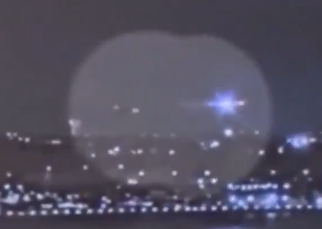
Helo on the left
Here's the more likely issue with NVG. Looking through them is often described as akin to looking through a pair of toilet roll tubes. Field of vision is radically reduced and it takes strong, conscious and fatiguing effort to conduct any kind of visual search.
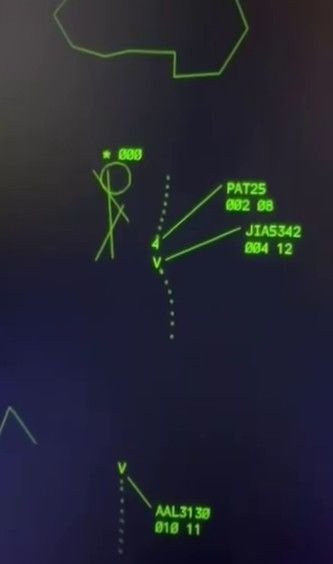
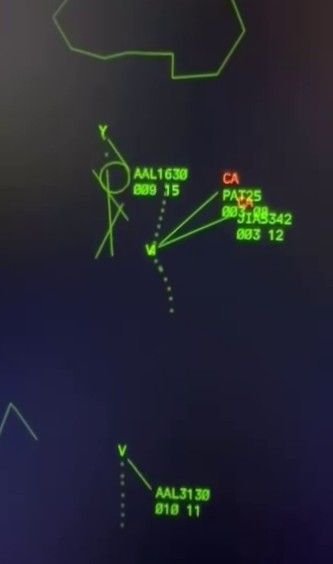
At the start of the radar recording posted to YouTube by AvHerald, AAL3130 is 10 degrees right of the CRJ from PAT25's point of view, and at a similar elevation angle. Its landing lights would be prominent in NVG and if PAT25's pilots were fixated upon it, they would not have seen the CRJ further left unless actively moving their heads to look for it. PAT25 gradually changes heading by 2 degrees right during the course of the radar clip, almost exactly following the bearing to AAL3130, and this makes it even clearer to me that PAT25 was mistakenly holding visual on it.
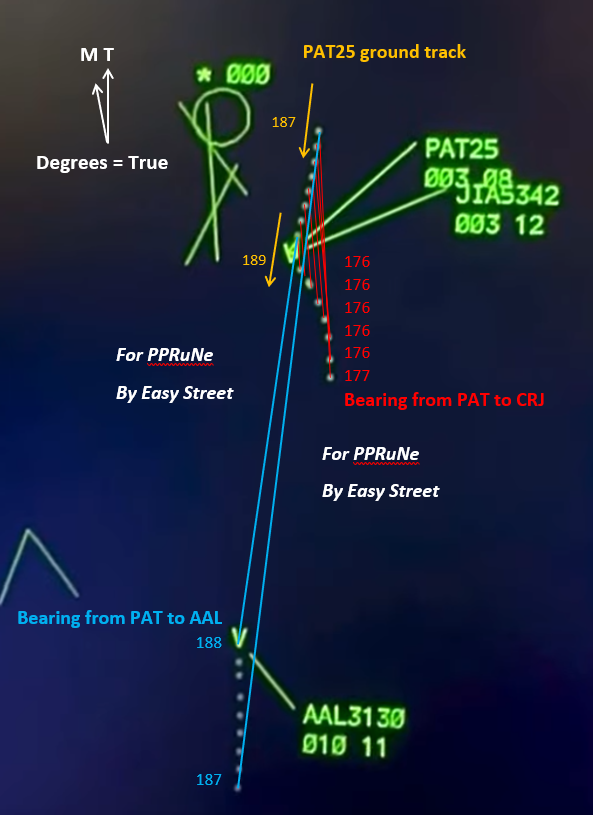
Last edited by Easy Street; 31st January 2025 at 16:50 .
Subjects
CRJ
Night Vision Goggles (NVG)
PAT25
Radar
Links are to this post in the relevant subject page so that this post can be seen in context.
Reply to this quoting this original post. You need to be logged in. Not available on closed threads.
January 31, 2025, 16:52:00 GMT
permalink Post: 11818357
Here's the more likely issue with NVG. Looking through them is often described as akin to looking through a pair of toilet roll tubes. Field of vision is radically reduced and it takes strong, conscious and fatiguing effort to conduct any kind of visual search.
At the start of the radar recording posted to YouTube by AvHerald, AAL3130 is 10 degrees right of the CRJ from PAT25's point of view, and at a similar elevation angle. Its landing lights would be prominent in NVG and if PAT25's pilots were fixated upon it, they would not have seen the CRJ further left unless actively moving their heads to look for it. PAT25 gradually changes heading by 2 degrees right during the course of the radar clip, almost exactly following the bearing to AAL3130, and this makes it even clearer to me that PAT25 was mistakenly holding visual on it.
Subjects
CRJ
Night Vision Goggles (NVG)
PAT25
Radar
Links are to this post in the relevant subject page so that this post can be seen in context.
Reply to this quoting this original post. You need to be logged in. Not available on closed threads.
January 31, 2025, 17:10:00 GMT
permalink Post: 11818375
Lets break it down based on what we know so far:
See and Avoid We have years and years and years of evidence about the limitations of see and avoid. It is not and never will be effective mitigation to a collision risk on its own. It needs to be backed up with other barriers such as ACAS etc. The human eye is particularly bad at spotting stationary objects, which would have been the case in this instance with another aircraft on a steady bearing. Those who criticise the aircrew for not keeping a good lookout are being disingenuous. The ability to judge distance at night, is difficult. Those who suggest the helicopter was looking up at the night sky, omit to recognise that the cameras on which you are basing that opinion, were at ground level. The crew of the Helo would have been at a similar altitude, looking at a background of many lights, with other aircraft barely above the horizon. The reports state that the aircrew may have been on NVG. This exacerbates the issue as they narrow your field of view, make depth perception even worse and of course, those I know of, do not display different colours, such as navigation lights. So see and avoid needs to be backed up by other measures and one can also see how VFR at night is fraught with danger.
Procedures - There is nothing inherently wrong with helicopter lanes close to aerodromes as long as the procedures that control such traffic are robust. I do not know what the local procedures state for routes 1 and 4 but I would expect them to include a limitation to ensure that you cannot use route 4/1 if an approach is being made to Rwy 33 or vice versa, an approach cannot be made to Rwy 33 if there is traffic on route 1/4. If such a procedure does no t exist then we could argue negligence. Lets assume one does exist. In that case, I would expect some process to block the route or the approach, using an aide memoire such as a flight strip or other electronic means. The recent crash at Haneda, highlights the need for such a safety barrier.
The Controller - Reports suggest that controller numbers were down to 19, which is woefully inadequate for an operation such as this and I hope the NTSB looks at what actions were taken by the airport to close in the face of staff limitations. We assume from reports, that the controller concerned was working in a combined position, with band-boxed frequencies. Looking at FR24 replays, it was quite busy at the time and we also do not know what level of fatigue the individuals were under. If the procedures above were in force, was a blocking strip forgotten? Was the controller overloaded or distracted? I hope they were not combining Radar and tower!
Phraseology - Others on here have mentioned about phraseology used. First of all, I cannot understand this machismo, that US controllers have to speak fast. Stop it! It is dangerous and you only end up having to repeat yourself. Others have mentioned about using the clock code. The Tower controller may not have the endorsement to use radar procedures and may have been forced to use geographical points. From what I have heard and yes lets wait for the report, it seems that the phraseology used was sub optimal.
Duty of Care - Some of here have spoken about the transfer of responsibility onto the helicopter operator. This is a pet hate of mine, of people hiding behind the rules to abrogate responsibility. Everyone in the system has a duty of care and Air Traffic Controllers, regardless of type of service, have an accountability to do what they can to prevent collisions. That is written into the highest levels of ICAO Annex 11
My condolences to all involved and my thoughts are also with those under investigation, who I feel may have been let down by the system.
Subjects
ATC
Accountability/Liability
ICAO
NTSB
Night Vision Goggles (NVG)
Phraseology (ATC)
Radar
See and Avoid
VFR
Links are to this post in the relevant subject page so that this post can be seen in context.
Reply to this quoting this original post. You need to be logged in. Not available on closed threads.
January 31, 2025, 17:22:00 GMT
permalink Post: 11818389
A minimal response might be to review staffing policies in the tower; if radar equipped it would help to have someone solely responsible for the heli lane situationally aware of inbound traffic to the airport. If more change is acceptable then the heli routes should be examined and probably redesigned and traffic levels at Reagan at least examined.
I can see no reason to close the airport. Yes it is constrained and has short runways but many airports are similar. around the world. London City here is examining whether it can accept Airbus 320 neo aircraft with a 4965 foot runway and steep approaches in a very built up area.
There are wider issues - why do so many controllers sound like disk jockeys in the US whereas here they do their very best to sound calm.
I do believe some changes will come - just as line up and wait was introduced I believe the current clear to land will be replaced by continue approach and then clear to land only where it means that - the runway is clear and I know of no conflict to affect your landing. With this, some clearances still need to be conditional - At KDCA clearance to and 33 might be conditional on 01 traffic. Bit overall it is just clearer - and can be accommodated by most tower controllers given what thy have to deal with AFAICS.
Finally the suitability of see and avoid to night time operations will have to be examined.
Another iootionto make it safe was suggested elsewhere. Have an either/or arrangement.
If an airliner is on approach to runway 33, Heli Route 4 is closed.
If a helicopter has had approval to fly along Route 4, the approach to Runway 33 is not available.
Simple and straightforward?
Last edited by Pilot DAR; 31st January 2025 at 17:24 . Reason: fixed typo
Subjects
KDCA
Radar
Route 4
See and Avoid
Links are to this post in the relevant subject page so that this post can be seen in context.
Reply to this quoting this original post. You need to be logged in. Not available on closed threads.
January 31, 2025, 19:54:00 GMT
permalink Post: 11818499
Subjects
ATC
CRJ
Radar
Separation (ALL)
Links are to this post in the relevant subject page so that this post can be seen in context.
Reply to this quoting this original post. You need to be logged in. Not available on closed threads.
January 31, 2025, 22:11:00 GMT
permalink Post: 11818566
Comments appreciated of course. Indeed, I was referring to the second LC comms with the helo (coinciding with CA alerts). Class B mandates ATC to ensure separation , no matter VFR (indeed twice requested and twice accepted) or IFR (on the question whether AA by/when accepting 33 canceled IFR or not). This IMO implies much more on ATC than re-requesting whether A/C in sight, in particular in case of CA alert, less than one good/bad minute apart.
VFR aircraft must be separated from VFR/IFR aircraft/ helicopter/rotorcraft that weigh more than 19,000 pounds and turbojets by no less than:
- 1 \xbd miles separation, or
- 500 feet vertical separation, or
- Visual separation, as specified in paragraph 7-2-1 , Visual Separation, paragraph 7-4-2 , Vectors for Visual Approach, and paragraph 7-6-7 , Sequencing.
The rules for pilot-applied visual separation state:
- If the aircraft are on converging courses, inform the other aircraft of the traffic and that visual separation is being applied.
- Advise the pilots if the radar targets appear likely to merge.
Subjects
ATC
IFR
Radar
Separation (ALL)
VFR
Vertical Separation
Visual Separation
Links are to this post in the relevant subject page so that this post can be seen in context.
Reply to this quoting this original post. You need to be logged in. Not available on closed threads.
January 31, 2025, 22:40:00 GMT
permalink Post: 11818585
I don't think this was done and implies controller is not absolved of responsibility even after visual separation approved.
Subjects
ATC
Radar
Separation (ALL)
Visual Separation
Links are to this post in the relevant subject page so that this post can be seen in context.
Reply to this quoting this original post. You need to be logged in. Not available on closed threads.
January 31, 2025, 23:31:00 GMT
permalink Post: 11818616
VFR aircraft must be separated from VFR/IFR aircraft/ helicopter/rotorcraft that weigh more than 19,000 pounds and turbojets by no less than:
- 1 \xbd miles separation, or
- 500 feet vertical separation, or
- Visual separation, as specified in paragraph 7-2-1 , Visual Separation, paragraph 7-4-2 , Vectors for Visual Approach, and paragraph 7-6-7 , Sequencing.
The rules for pilot-applied visual separation state:
- If the aircraft are on converging courses, inform the other aircraft of the traffic and that visual separation is being applied.
- Advise the pilots if the radar targets appear likely to merge.
- If aircraft are on converging courses, inform the other aircraft of the traffic and that visual separation is being applied.
(ACID), TRAFFIC, (clock position and distance), (direction) BOUND, (type of aircraft), HAS YOU IN SIGHT AND WILL MAINTAIN VISUAL SEPARATION.
- Advise the pilots if the targets appear likely to merge.
Issue this advisory in conjunction with the instruction to maintain visual separation, the advisory to the other aircraft of the converging course, or thereafter if the controller subsequently becomes aware that the targets are merging.\x94
Subjects
ATC
CRJ
Radar
Separation (ALL)
VFR
Vertical Separation
Visual Separation
Links are to this post in the relevant subject page so that this post can be seen in context.
Reply to this quoting this original post. You need to be logged in. Not available on closed threads.
February 01, 2025, 10:05:00 GMT
permalink Post: 11818884
The accident appears, almost certainly, to have been directly caused by the misidentification of conflicting traffic by the helo.
Fundamentally though the accident was entirely set up and enabled by critical faults in airspace usage and procedures, viz no vertical separation betwen the helo lane and glideslope at their point of intersection (to my mind simply incredible) and to a lesser extent perhaps the (again to my mind) extraordinary split frequency system. The first provides only one slice of swiss cheese - substantial vertical separation would add a second slice while the frequency thing is no cheese at all.
Despite what some commentators here and elsewhere seem to think there is never intended to be a situation when a helo passes under an aircraft on finals at 200ft. Helo traffic is held, or holds itself following a conditional clearance short of runway track before proceeding visually behind landing traffic or ahead of traffic on longer finals, exactly as is done at Heathrow. The difference is that in the event of an error at LHR there is 1000ft of vertical separation to add guartanteed separation if a helo wanders off track. Here there is next to none, it is very like a road intersection where cars on a minor road cross a big highway with conditional (orange flashing) traffic lights. Elsewhere in aviation this is just never done, there is always vertical separation too as a most basic safety precaution - ie like an overpass. The 1000ft also has the advantage that helo traffic is clearly visible on radar which is not the case when its grubbing along at 200ft.
Equally, the London helilanes too carry both mil and civ traffic, but critically both are on the same frequency (or if not the system re-broadcasts everything so it sounds as if they are) so everyone is playing the same ball. As every mil helo (surely?) has VHF nowadays why the digamma aren't procedures requiring its use when interracting in close/very close proximity with civ traffic?
Contributory factors include grossly sloppy r/t which employs open questions instead of closed ones - "do you see the CRJ on finals" when there are two unidentifiable aircraft visible on finals instead of "do you see the aircraft on 2 mile finals".
Doubtless there may be other consideration such as insufficient controllers and excessive workload too but that is not for me to say.
Bottom line is this appears to be a classic human factors accident induced by badly designed airspace, voice and control procedures.
+++++++++++
Why was the helo high? Not that I've ever done it but 200 ft or below at night over a big black hole of a river surrounded by bright city lights (800ft is my lowest) sounds pretty adventurous to me, it's very low indeed, and when a threator distraction is introduced at such low level in a helo one's instinct, even reflex is often to just squeeze back a little on the cyclic to give you a bit more space while your attention is drawn elsewhere. 100ft extra comes in a very short time and with less than 100ft of vertical separation from mis-identified traffic, that's it.
Subjects
CRJ
Radar
Separation (ALL)
Vertical Separation
Links are to this post in the relevant subject page so that this post can be seen in context.
Reply to this quoting this original post. You need to be logged in. Not available on closed threads.
February 01, 2025, 11:44:00 GMT
permalink Post: 11818956
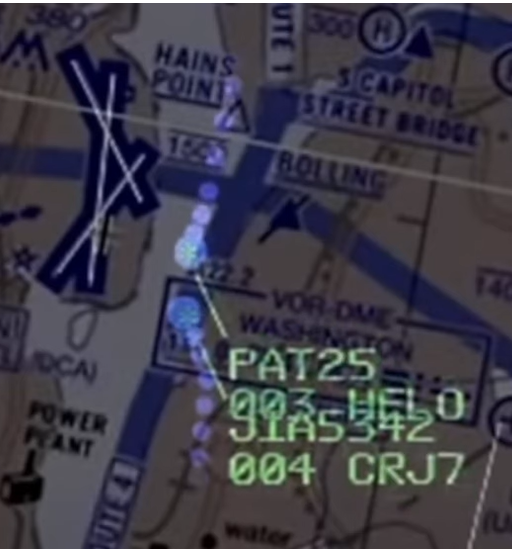
Have to ask, why the use of goggles in basically night CAVOK and a densely light city area.
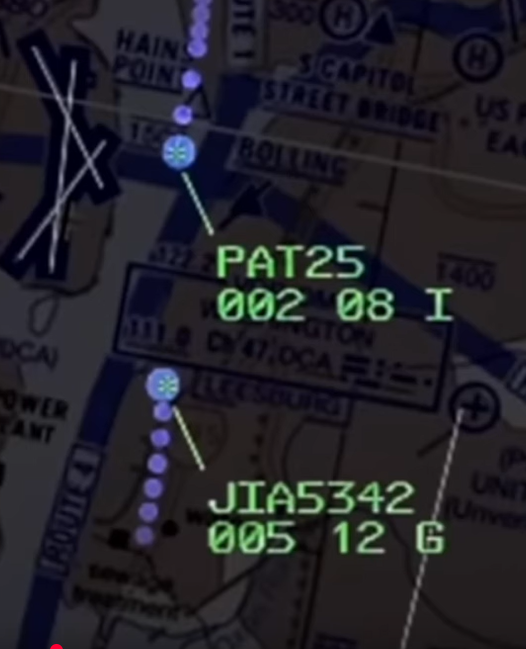
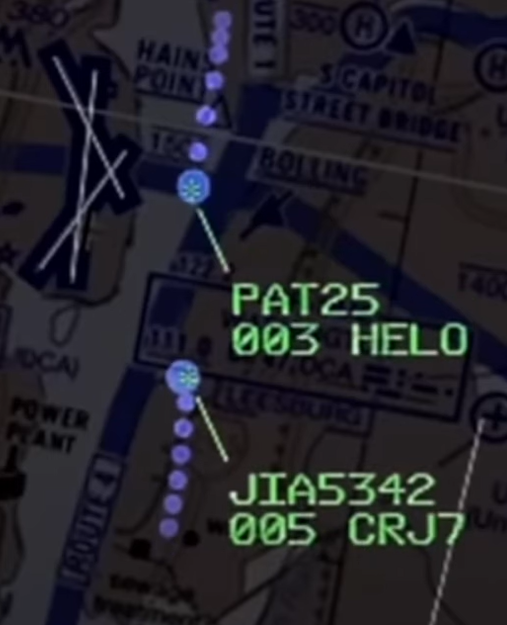
Last edited by megan; 1st February 2025 at 11:54 .
Subjects
Radar
Links are to this post in the relevant subject page so that this post can be seen in context.
Reply to this quoting this original post. You need to be logged in. Not available on closed threads.
February 01, 2025, 14:50:00 GMT
permalink Post: 11819070
Subjects
Blackhawk (H-60)
Hover
Radar
Links are to this post in the relevant subject page so that this post can be seen in context.
Reply to this quoting this original post. You need to be logged in. Not available on closed threads.
February 01, 2025, 15:43:00 GMT
permalink Post: 11819111
Sounds like that might cause a lot more accidents than it would solve.
Subjects
Radar
Links are to this post in the relevant subject page so that this post can be seen in context.
Reply to this quoting this original post. You need to be logged in. Not available on closed threads.
February 01, 2025, 16:56:00 GMT
permalink Post: 11819164
Subjects
ATC
Radar
Separation (ALL)
Vertical Separation
Links are to this post in the relevant subject page so that this post can be seen in context.
Reply to this quoting this original post. You need to be logged in. Not available on closed threads.
February 01, 2025, 18:47:00 GMT
permalink Post: 11819231
Subjects
Radar
Links are to this post in the relevant subject page so that this post can be seen in context.
Reply to this quoting this original post. You need to be logged in. Not available on closed threads.
February 01, 2025, 20:50:00 GMT
permalink Post: 11819292
- Thanks to Henra for reminding us that the ATC radar displays altitudes to the nearest 100 \xb150'
- The nytimes.com images of heli positions outside the depicted corridors posted by fdr in #578 is massive evidence of normalisation of deviance
- I am beginning to suspect that the CAs noted by the controller are a commonplace occurrence. It would be interesting to learn the frequency of DCA CAs between the helicopters and traffic on approach and departure. How much and how long has deviance been normalized?
- The CRJ crew was left out of the information loop. I have a dedicated traffic display on the top of my glider panel which shows ADS-B and Flarm traffic. A similar display would have enabled the CRJ crew to monitor traffic and get the hell out of the way when necessary.
Subjects
ADSB (All)
ATC
CRJ
DCA
Normalization of Deviance
Radar
Links are to this post in the relevant subject page so that this post can be seen in context.
Reply to this quoting this original post. You need to be logged in. Not available on closed threads.
February 02, 2025, 00:07:00 GMT
permalink Post: 11819398
If they had held the Helo short of the runway approach until enough radar separation to cross the approach path was available the Helo would have been orbiting for hours. When the helicopter crew confirmed they had the aircraft in sight they accepted responsibility they had identified the correct aircraft and could remain visual with it as they they crossed the approach path. If they had any doubt to this they should have stated so.
ATC intended for the helicopter to pass behind that CRJ not below it.
Actually ATC asked the Helicopter twice if they had the CRJ visual about 40 seconds apart, both times the helicopter replied yes, and the helicopter crew, not ATC, asked to maintain visual separation.
Yes, the CRJ could have not accepted ATC's request to divert to 33. They would have then been set to go around to set up again for Runway 1, the usual runway.
ATC put the CRJ on an intersecting runway, which added complexity to the pattern picture. The helo would have only had to hold for a short time to wait for the CRJ that was diverted to a runway not normally used for commercial air carriers.
Knowing that, they asked the helo to maintain visual separation, placing everything on that crew to see and avoid the CRJ. I have read that they didn't even tell them where to actually look to see the traffic, no bearing, no altitude. The helo likely saw traffic, just not where they were supposed to look. There were plenty incoming and departing Runway 1, which is why the CRJ was asked to divert. Add to that, both aircraft were low and operating over an urban area at night where it is difficult to see other aircraft. Worse even if the helo crew was using NVG.
ATC should have held the helo short, waiting for an unusual approach to a runway not used normally, so to let the CRJ pass. The CRJ crew was already saturated in tasks at the time I have not hear ATC asking them to look out for the helo.
IMO, ATC created a "single point of failure" relying on the helo to see and avoid the CRJ. Had they held the helo, and helos can hover, for even a minute, this doesn't happen. ATC's main purpose is to keep aircraft from occupying the same place at the same time. In this case, they didn't.
I am sure that the helo pilots made]mistakes. But, this appears to be a massive failure of ATC.
Last edited by Denflnt; 2nd February 2025 at 00:46 .
Subjects
ATC
CRJ
Hover
Night Vision Goggles (NVG)
Pass Behind
Pass Behind (All)
Radar
See and Avoid
Separation (ALL)
Visual Separation
Links are to this post in the relevant subject page so that this post can be seen in context.
Reply to this quoting this original post. You need to be logged in. Not available on closed threads.
February 02, 2025, 02:27:00 GMT
permalink Post: 11819458
Subjects
CRJ
Radar
Links are to this post in the relevant subject page so that this post can be seen in context.
Reply to this quoting this original post. You need to be logged in. Not available on closed threads.
February 02, 2025, 02:56:00 GMT
permalink Post: 11819470
I suspect the helicopter's gradual turn to the right was a result of the pilots fixating on AAL3130 and instinctively flying to pass just behind it, without realising how far away it was.
Edit: this is the reconstruction which shows the similarity in elevation. Captain Steve and Juan Browne have put forward the same theory on their channels but without quite the same compelling graphics.
Last edited by Easy Street; 2nd February 2025 at 03:09 .
Subjects
CRJ
Night Vision Goggles (NVG)
Pass Behind
Pass Behind (All)
Radar
Links are to this post in the relevant subject page so that this post can be seen in context.
Reply to this quoting this original post. You need to be logged in. Not available on closed threads.
February 02, 2025, 03:02:00 GMT
permalink Post: 11819477
Subjects
ATC
CRJ
Radar
Separation (ALL)
Links are to this post in the relevant subject page so that this post can be seen in context.
Reply to this quoting this original post. You need to be logged in. Not available on closed threads.
February 02, 2025, 15:22:00 GMT
permalink Post: 11819856
All UH-60 A and L Army aircraft incorporated the APN 209 radar altimeter. Our Sikorsky tech fellow for Avioics/electronis reports the accuracy in this area is 1-2 feet. The radar altimeter position in the instrument panel is just to the right of the attitude indicator and its top matches the top of the attitude indicator. The barometric altimeter is immediately below it.
Both pilots have the same setup.
Subjects
Altimeter (All)
Barometric Altimeter
Radar
Links are to this post in the relevant subject page so that this post can be seen in context.
Reply to this quoting this original post. You need to be logged in. Not available on closed threads.