February 04, 2025, 22:34:00 GMT
permalink Post: 11821762
"5342, helo traffic on your right 1/4 mile at 300 feet, has you in sight". The CRJ FO might just have taken a closer look out the side window with that. Or, like you, they might have opted to go around.
Subjects
ATC
CRJ
CVR
DCA
IFR
Separation (ALL)
TCAS (All)
Traffic in Sight
Visual Separation
Links are to this post in the relevant subject page so that this post can be seen in context.
Reply to this quoting this original post. You need to be logged in. Not available on closed threads.
February 05, 2025, 07:14:00 GMT
permalink Post: 11821938
As a previous poster has said, they are using third world procedures at what is a very busy and high-density traffic area. I doubt if this collision would have occurred in many other countries as positive separation and/or significant restrictions are provided to ALL aircraft, be they IFR or VFR, and certainly not at night.
I suspect however that the DoD would not be too happy with not being able to operate VFR. Whatever the outcome, an independent risk analysis would need to tick all the boxes and the procedures changed to match.
Subjects
FAA
IFR
Separation (ALL)
VFR
Links are to this post in the relevant subject page so that this post can be seen in context.
Reply to this quoting this original post. You need to be logged in. Not available on closed threads.
February 05, 2025, 08:11:00 GMT
permalink Post: 11821971
As a previous poster has said, they are using third world procedures at what is a very busy and high-density traffic area. I doubt if this collision would have occurred in many other countries as positive separation and/or significant restrictions are provided to ALL aircraft, be they IFR or VFR, and certainly not at night.
I suspect however that the DoD would not be too happy with not being able to operate VFR. h.
Subjects
FAA
IFR
Separation (ALL)
VFR
Links are to this post in the relevant subject page so that this post can be seen in context.
Reply to this quoting this original post. You need to be logged in. Not available on closed threads.
February 05, 2025, 09:41:00 GMT
permalink Post: 11822038
Additionally, any helicopters flying in such congested airspace should have a display showing other traffic so they know where to look outside.
Subjects
ATC
IFR
Separation (ALL)
VFR
Visual Separation
Links are to this post in the relevant subject page so that this post can be seen in context.
Reply to this quoting this original post. You need to be logged in. Not available on closed threads.
February 05, 2025, 10:12:00 GMT
permalink Post: 11822066
Imho the altitude sectored restrictions were never suitable and safe to deconflict helicopter traffic from traffic to finals 01 and 33, but were meant to deconflict takeoffs from 15 and 19. Could it be that someday some clever soul thought to solve increasing traffic demands by using 33 and 01 for landing despite traffic in the helicopter routes under visual separation rules, ignoring thereby that now all layers of safety had been removed bare the eyes of an helicopter crew?
Subjects
ATC
IFR
Separation (ALL)
VFR
Visual Separation
Links are to this post in the relevant subject page so that this post can be seen in context.
Reply to this quoting this original post. You need to be logged in. Not available on closed threads.
February 05, 2025, 10:32:00 GMT
permalink Post: 11822080
Additionally, any helicopters flying in such congested airspace should have a display showing other traffic so they know where to look outside.
You cannot actively vector a helo at 200ft over the black hole of a river in the middle of an urban environment or anywhere else. You'd kill helos every month doing that. If the helo were at 100ft or so there would be no need for vectors (you never get them in London, just holding, ie orbits if necessary).
Visual acknowlewgement from the aeroplane is totally unnecessary as he is on finals to land which give total priority over all other traffic. It is up to the give-way traffic to identify and acknowlege.
500ft vertical I agree with, in which case 1,5 miles is totally unnecessary and ridiculously excessive.
This discussion is being considerably bogged down by a really surprising (to me) absence of understanding of helos and helo ops by people who clearly only fly f/w IFR and seem to have no concept of how the rest of the aviation world works. Strangely, there are other ways of aviating safely without staring exclusively at an instrument panel, following a magenta line and doing only what someone miles away in an office tells you. You simply cannot try to apply IFR airline type procedures and mindset to low level VFR traffic. It's like a train driver trying to dictate railway rules to a motorcyclist and being unaware that motorcycles just don't operate like trains... imaginingthat helos can or would come to a free air hover for separation is another example of unrealistic imagnation over reality.
Please, if you don't know anything about helicopter ops, please don't try to apply procedural IFR or Hollywood mindsets/misapprehensions to them as if there is no other waay of flying.
Last edited by meleagertoo; 5th February 2025 at 10:54 .
Subjects
ATC
CRJ
Hover
IFR
Separation (ALL)
VFR
Visual Separation
Links are to this post in the relevant subject page so that this post can be seen in context.
Reply to this quoting this original post. You need to be logged in. Not available on closed threads.
February 05, 2025, 10:45:00 GMT
permalink Post: 11822093
Perhaps you mean that DoD would not be too happy with not being able to take visual separation, at night, using NVG? I think they might have to suck that up - especially the second and third aspects.
Subjects
IFR
Night Vision Goggles (NVG)
Separation (ALL)
VFR
Visual Separation
Links are to this post in the relevant subject page so that this post can be seen in context.
Reply to this quoting this original post. You need to be logged in. Not available on closed threads.
February 05, 2025, 11:01:00 GMT
permalink Post: 11822109
I think I indicated either having 500 ft vertical OR 1.5 nm horizontal, not both (which would indeed be excessive). Visual acknowledgment is only required within that hockey puck like area and I doubt whether it is acceptable to allow that option at night.
I do think the landing aircraft should be made aware of other traffic if it gets within the safe area, either by having that traffic on the same frequency, or by actively informing them. Situational awareness is everything and in any case this prepares them for a probable 'traffic' warning.
Subjects
Separation (ALL)
Situational Awareness
Visual Separation
Links are to this post in the relevant subject page so that this post can be seen in context.
Reply to this quoting this original post. You need to be logged in. Not available on closed threads.
February 05, 2025, 11:21:00 GMT
permalink Post: 11822123
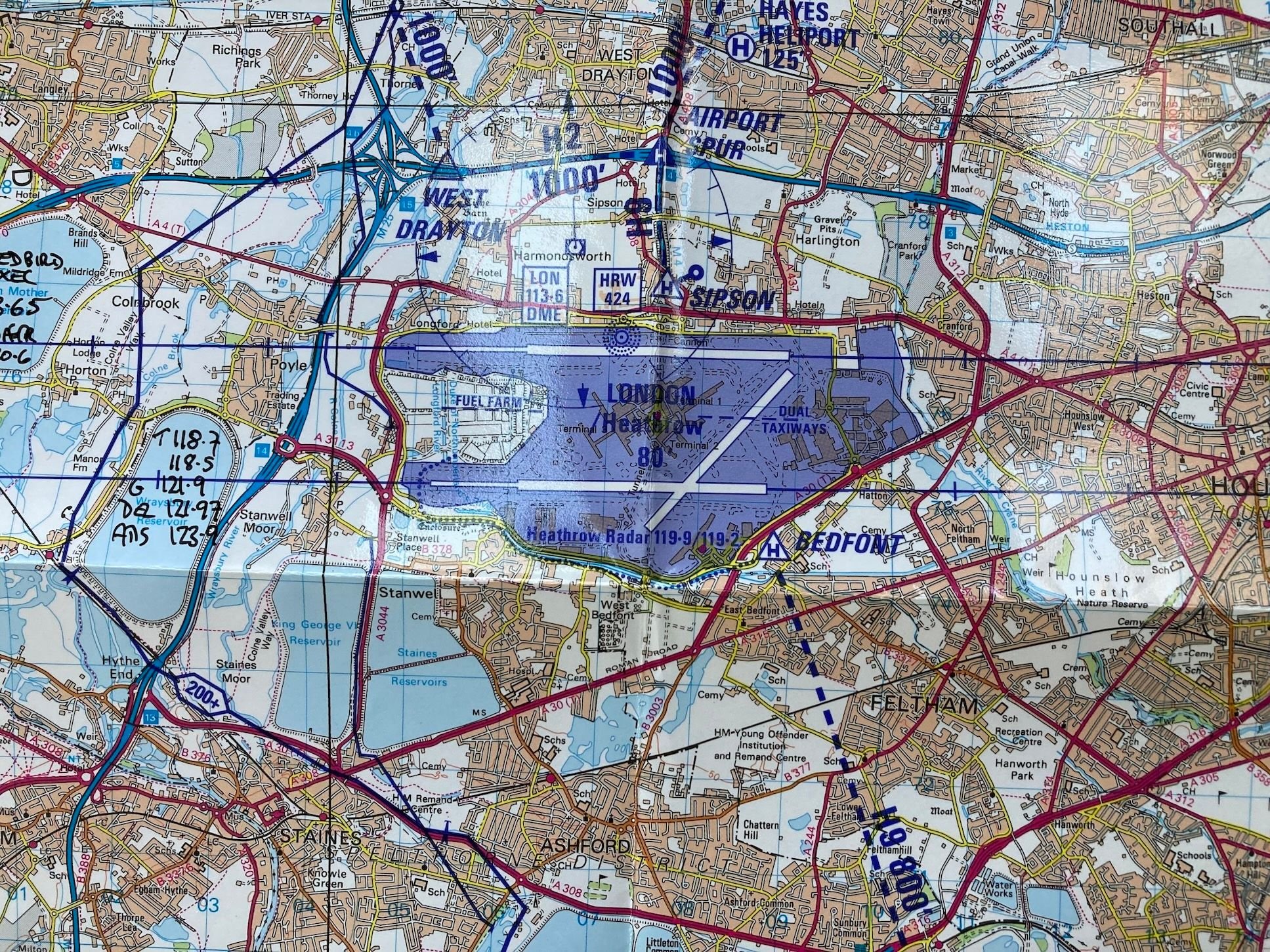
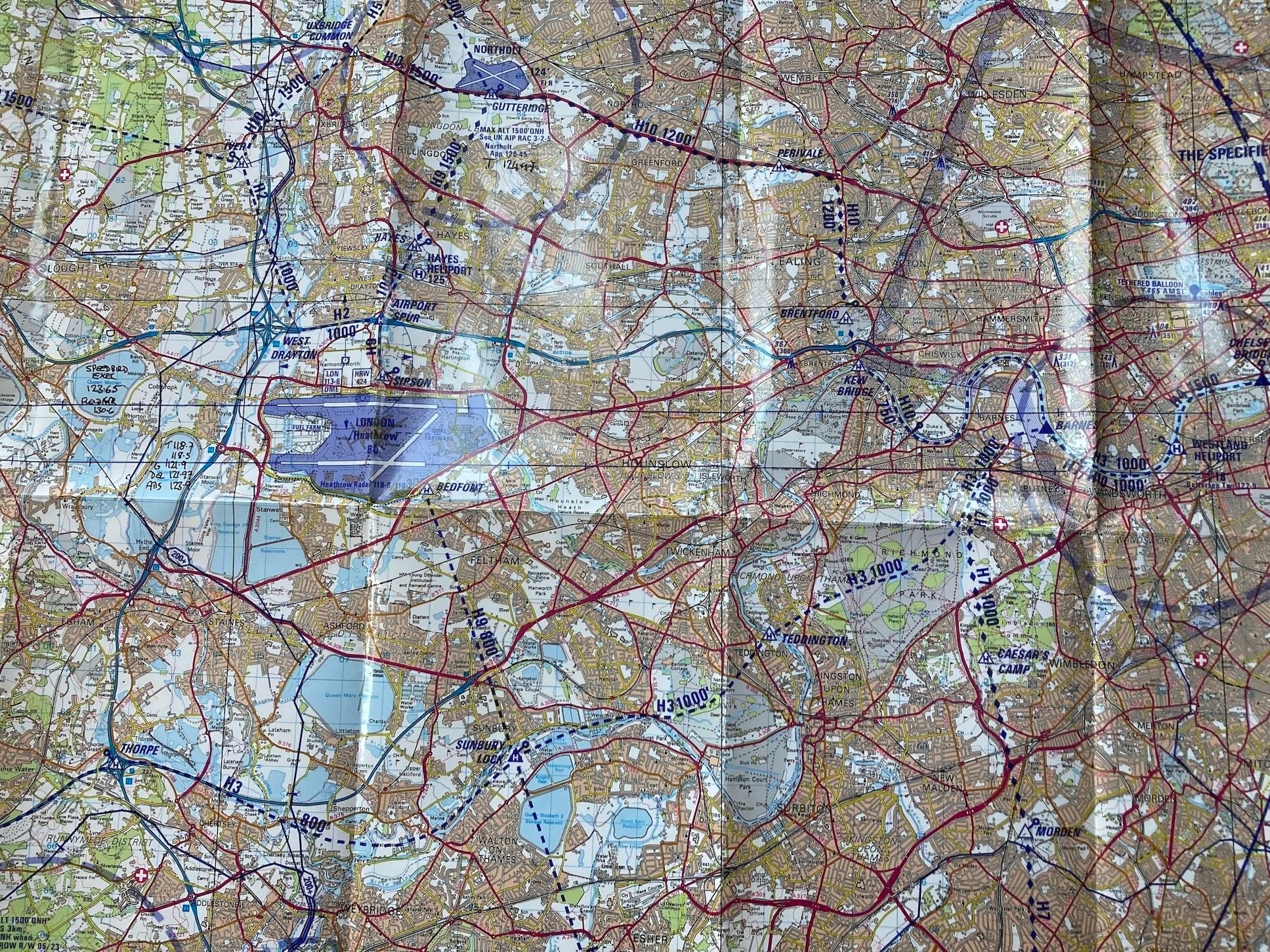
Usually, only if crossing LHR you'd be cleared to enter via requested route with limit Bedfont/Sipson, sometimes Airport Spur to hold (orbit) and change from Heathrow Special to Tower for the crossing itself. There's a further hold at Twin Taxiways between the runways. Altitudes are shown. Note there is usually unrestricted passage on routes H3 and H10 along the river directly under the approach. This system works seamlessly and with - to date - total safety.
Accepted the aairport we are discussing has more varied runway directions than Heathrow so the situation would be a bit more complex but I can't see why a similar system couldn't be devised - with defined clearance limits, sensible vertical separation and, critically, coherent and specific controller voice procedure.
There's no reason not to make landing traffic aware of helos holding close in if appropriate and indeed that happens, but no way is their visual contact required.
The entire system operates on visual 'separation'. Helos cross visually behind traffic as cleared, but with vertical separation. It's as safe as the system can be made. How else could it work? It requires no controller vectoring and the time and space margins that would be required if radar separation was used would render the slick, efficient visual system cumbrous, unacceptably high end unnecessary workload and probably unworkable.
Please, once again let's stop applying this insular f/w procedural IFR mindset to VFR helo traffic. There seems to be a procedural IFR mental blockage that can't see that 'visual separation' occurs in three dimensions, not just two. Helos are perfectly capable of ensuring visual separation as long as the traffic has been correctly identified and with vertical separation as here even if a mistake is made there is 800ft clear vertically. Also, VFR does NOT mean, as many seem to imagine, blundering about randomly at will, it is often every bit as disciplined and controlled as IFR as Shackman reiterates below, these routes are rigidly enforced to within a hundred metres or so and woe betide the transgressor.
The elephant in the room here is a combintion of a ridiculously hazardous two-dimensional crossing procedure combined with culpably sloppy & imprecise r/t which offers no second slice of cheese, not matters of visual separation. I'm well aware that our transatlantic cousins are sensitive to criticism of their relaxed, easygoing and informal ways in the air but in this case they self-evidently were the direct cause of 70 odd deaths. While they may regard European style as excessively pedantic there's no doubt whatsoever that had European standards applied here this event would have resulted in nothing more serious than a MOR and an Airmiss report.
For those unfamiliar the light grid squares are 1Km so the Sipson and Bedfont reporting/holding points is ony about 500m from the runways.
Last edited by meleagertoo; 5th February 2025 at 12:23 .
Subjects
ATC
IFR
Radar
Separation (ALL)
VFR
Vertical Separation
Visual Separation
Links are to this post in the relevant subject page so that this post can be seen in context.
Reply to this quoting this original post. You need to be logged in. Not available on closed threads.
February 05, 2025, 12:57:00 GMT
permalink Post: 11822202
...change from Heathrow Special to Tower for the crossing itself. There's a further hold at Twin Taxiways between the runways. Altitudes are shown. Note there is usually unrestricted passage on routes H3 and H10 along the river directly under the approach...
...defined clearance limits, sensible vertical separation and, critically, coherent and specific controller voice procedure.
I agree with your underlying point that blanket application of IFR separation criteria would be inappropriate. But there are modes of separation besides the false binary of 'visual' and 'IFR' which can be applied to VFR traffic.
Last edited by Easy Street; 5th February 2025 at 14:01 .
Subjects
ATC
IFR
Radar
Separation (ALL)
VFR
Vertical Separation
Visual Separation
Links are to this post in the relevant subject page so that this post can be seen in context.
Reply to this quoting this original post. You need to be logged in. Not available on closed threads.
February 05, 2025, 13:39:00 GMT
permalink Post: 11822224
I can imagine a scenario where a helicopter crew, who are regular on this route, report the airliner in sight on first call, knowing that by doing so, they avoid an orbit and subsequent delay.
With regard to other posts asking why the tower controller didn\x92t pass traffic information to the CRJ crew. Bear in mind that this guy was working flat out, working two positions with pretty constant RT. There may well have been additional tasks such as phone coordination going on in the background which we are not aware of. Again I see a scenario of tower using the absolute minimum RT in an attempt to keep on top of the workload. In his mind, the helicopter has reported the inbound in sight and has stated responsibility to pass behind\x85\x85.job done, onto the next task.
I\x92m sure that the investigation will be focusing on why the sectors were combined under these traffic conditions. In my 30+ years of ATC, I have investigated numerous incidents where a significant factor was an overworked controller working combined positions. This can be caused by staff shortages, late reactions to rapidly changing traffic conditions, unit culture or simply a \x93macho\x94 controller who thinks that they can handle everything\x85.until subsequently they find that they cannot!
Subjects
ATC
CRJ
DCA
Separation (ALL)
Vertical Separation
Links are to this post in the relevant subject page so that this post can be seen in context.
Reply to this quoting this original post. You need to be logged in. Not available on closed threads.
February 05, 2025, 19:26:00 GMT
permalink Post: 11822473
Subjects
CRJ
NTSB
Radio Altimeter
Separation (ALL)
Vertical Separation
Links are to this post in the relevant subject page so that this post can be seen in context.
Reply to this quoting this original post. You need to be logged in. Not available on closed threads.
February 05, 2025, 20:20:00 GMT
permalink Post: 11822517
Just thinking: they are coming up on the extended centerline of 33, and keep going? Were there any tower or CRJ transmits that indicated the CRJ was on short final?
Subjects
ATC
CRJ
PAT25
Separation (ALL)
Traffic in Sight
Visual Separation
Links are to this post in the relevant subject page so that this post can be seen in context.
Reply to this quoting this original post. You need to be logged in. Not available on closed threads.
February 06, 2025, 10:57:00 GMT
permalink Post: 11822897
Controller instructed very firmly: "PAT25, pass behind the CRJ"
There was no such readback, instead:
PAT25: "PAT25 has CRJ in sight, request visual separation"
Controller: "vis sep approved"
Does the "request visual separation" undo the "pass behind"?
(just trying to refresh my phraseology understanding, its long time passed, my PPL is not current a long time since)
Subjects
ATC
CRJ
PAT25
Pass Behind
Pass Behind (All)
Pass Behind (PAT25)
Phraseology (ATC)
Separation (ALL)
Traffic in Sight
Visual Separation
Links are to this post in the relevant subject page so that this post can be seen in context.
Reply to this quoting this original post. You need to be logged in. Not available on closed threads.
February 06, 2025, 11:28:00 GMT
permalink Post: 11822911
Subjects
ATC
CRJ
PAT25
Separation (ALL)
Traffic in Sight
Visual Separation
Links are to this post in the relevant subject page so that this post can be seen in context.
Reply to this quoting this original post. You need to be logged in. Not available on closed threads.
February 06, 2025, 11:35:00 GMT
permalink Post: 11822919
PAT25: "PAT25 has the traffic in sight, request visual separation"
Tower: "Visual separation approved"
0:26 here:
Subjects
CRJ
PAT25
Separation (ALL)
Traffic in Sight
Visual Separation
Links are to this post in the relevant subject page so that this post can be seen in context.
Reply to this quoting this original post. You need to be logged in. Not available on closed threads.
February 06, 2025, 11:55:00 GMT
permalink Post: 11822926
PAT25: "PAT25 has the traffic in sight, request visual separation"
Tower: "Visual separation approved"
0:26 here:
https://youtu.be/r90Xw3tQC0I?feature=shared
Perhaps, and this is big perhaps, it's a pavlovian response to whenever PAT is advised of other traffic. I listened to the TCAS RA missed approach from the previous day, and once again the response from PAT is "request visual separation". It's highly likely that the pilot requests for visual separation is the only way that this Class B airspace can operate with the mix of IFR vs VFR, and aerodrome traffic vs transits.
I fail to understand why PAT is using UHF, surely this is another slice of cheese.
The use of RWY 33 for arrival makes it easier for the ATC and the aircrew with one less runway crossing after they have landed. To emphasis the point, the following PSA actually requests RWY 33.
Subjects
ATC
CRJ
IFR
PAT25
Separation (ALL)
TCAS (All)
TCAS RA
Traffic in Sight
VFR
Visual Separation
Links are to this post in the relevant subject page so that this post can be seen in context.
Reply to this quoting this original post. You need to be logged in. Not available on closed threads.
February 06, 2025, 12:07:00 GMT
permalink Post: 11822935
Using visual separation as the only line of defence at night (and even during daylight) is utter madness. As is having aircraft circle to multiple runways, mixing high density military and civilian traffic, and a multitude of other issues.
Had full IFR separation been applied this accident wouldn\x92t have happened.
Subjects
IFR
Separation (ALL)
Visual Separation
Links are to this post in the relevant subject page so that this post can be seen in context.
Reply to this quoting this original post. You need to be logged in. Not available on closed threads.
February 06, 2025, 14:28:00 GMT
permalink Post: 11823014
The accident aircraft was making a sidestep curving manoeuvre, a late change from a straight in to 01. The only message passed about this was it was landing on 33. No comment that it was going to break off the 01 approach. No questioning that the heli crew even understood how an aircraft now approached 33, making this unusual and last-minute change, nor that it would compromise them routing along the river.
.
Subjects
CRJ
Circle to Land (Deviate to RWY 33)
PAT25
Separation (ALL)
Traffic in Sight
Visual Separation
Links are to this post in the relevant subject page so that this post can be seen in context.
Reply to this quoting this original post. You need to be logged in. Not available on closed threads.
February 06, 2025, 14:35:00 GMT
permalink Post: 11823020
The accident aircraft was making a sidestep curving manoeuvre, a late change from a straight in to 01. The only message passed about this was it was landing on 33. No comment that it was going to break off the 01 approach. No questioning that the heli crew even understood how an aircraft now approached 33, making this unusual and last-minute change, nor that it would compromise them routing along the river.
.
Subjects
CRJ
Circle to Land (Deviate to RWY 33)
DCA
Separation (ALL)
Visual Separation
Links are to this post in the relevant subject page so that this post can be seen in context.
Reply to this quoting this original post. You need to be logged in. Not available on closed threads.