February 07, 2025, 19:13:00 GMT
permalink Post: 11823870
Subjects
ATC
FAA
Separation (ALL)
Visual Separation
Links are to this post in the relevant subject page so that this post can be seen in context.
Reply to this quoting this original post. You need to be logged in. Not available on closed threads.
February 07, 2025, 21:23:00 GMT
permalink Post: 11823937
https://www.faa.gov/documentLibrary/...5-24_READY.pdf
As mentioned upthread, if not visually separated then either 500ft or 1.5mi applies.
Correct if this is all wrong, but in the accident sequence if the helo had responded ‘not visual yet, looking’ or words to that effect, then presumably a controller could allow the two to get a bit closer and then advise the conflicting traffic info to the helo again, say at 2.5mi. If helo visual, great —maintain visual separation, responsibly passes to helo.
This is what happened, although the very busy controller failed to re-state the position of the CRJ to direct the eyes of the helo crew onto the CRJ in order that they could actually see and avoid it.
However if not visual at say 2.5mi, well it’s a bit late, but the controller does still retain responsibility for separation and must apply the 500ft/1.5mi standard. Presumably instant vectors away while simultaneously climb to min vectoring altitude. Or the CRJ has to go around. Can of worms in busy airspace— helos and /or jets being dispersed all over the sky.
Much better to do a rules based system and mutually exclude intersecting IFR app/deps and Helo Visual Routes.
Last edited by Stagformation; 7th February 2025 at 22:06 .
Subjects
ATC
CRJ
FAA
IFR
See and Avoid
Separation (ALL)
Visual Separation
Links are to this post in the relevant subject page so that this post can be seen in context.
Reply to this quoting this original post. You need to be logged in. Not available on closed threads.
February 07, 2025, 21:37:00 GMT
permalink Post: 11823944
This is following on from #960-964, discussing what would happen if the PAT flight(s) refused visual separation. It seems like it would throw a spanner in ATC's arrivals and they would probably get a response similar to that Lufthansa A380: Buzz off somewhere else.
Subjects
ATC
FAA
Radar
Separation (ALL)
Visual Separation
Links are to this post in the relevant subject page so that this post can be seen in context.
Reply to this quoting this original post. You need to be logged in. Not available on closed threads.
February 07, 2025, 22:59:00 GMT
permalink Post: 11824002
https://www.faa.gov/documentLibrary/...5-24_READY.pdf
As mentioned upthread, if not visually separated then either 500ft or 1.5mi applies.
Correct if this is all wrong, but in the accident sequence if the helo had responded \x91not visual yet, looking\x92 or words to that effect, then presumably a controller could allow the two to get a bit closer and then advise the conflicting traffic info to the helo again, say at 2.5mi. If helo visual, great \x97maintain visual separation, responsibly passes to helo.
This is what happened, although the very busy controller failed to re-state the position of the CRJ to direct the eyes of the helo crew onto the CRJ in order that they could actually see and avoid it.
However if not visual at say 2.5mi, well it\x92s a bit late, but the controller does still retain responsibility for separation and must apply the 500ft/1.5mi standard. Presumably instant vectors away while simultaneously climb to min vectoring altitude. Or the CRJ has to go around. Can of worms in busy airspace\x97 helos and /or jets being dispersed all over the sky.
Much better to do a rules based system and mutually exclude intersecting IFR app/deps and Helo Visual Routes.
Subjects
ATC
CRJ
IFR
Radar
See and Avoid
Separation (ALL)
Visual Separation
Links are to this post in the relevant subject page so that this post can be seen in context.
Reply to this quoting this original post. You need to be logged in. Not available on closed threads.
February 08, 2025, 01:43:00 GMT
permalink Post: 11824068
The river is 4000 feet wide just south of that designated point. I imagine there is a procedure otherwise what would be the point?
The other option is that they would have to have the landing traffic go around.
Subjects
ATC
PAT25
Separation (ALL)
Visual Separation
Links are to this post in the relevant subject page so that this post can be seen in context.
Reply to this quoting this original post. You need to be logged in. Not available on closed threads.
February 08, 2025, 06:22:00 GMT
permalink Post: 11824114
https://www.faa.gov/documentLibrary/...5-24_READY.pdf
As mentioned upthread, if not visually separated then either 500ft or 1.5mi applies.
Correct if this is all wrong, but in the accident sequence if the helo had responded \x91not visual yet, looking\x92 or words to that effect, then presumably a controller could allow the two to get a bit closer and then advise the conflicting traffic info to the helo again, say at 2.5mi. If helo visual, great \x97maintain visual separation, responsibly passes to helo.
This is what happened, although the very busy controller failed to re-state the position of the CRJ to direct the eyes of the helo crew onto the CRJ in order that they could actually see and avoid it.
However if not visual at say 2.5mi, well it\x92s a bit late, but the controller does still retain responsibility for separation and must apply the 500ft/1.5mi standard. Presumably instant vectors away while simultaneously climb to min vectoring altitude. Or the CRJ has to go around. Can of worms in busy airspace\x97 helos and /or jets being dispersed all over the sky.
Much better to do a rules based system and mutually exclude intersecting IFR app/deps and Helo Visual Routes.
He is not radar qualified- so no headings or radar measurment distances applicable.
Where is prescribed what point is 1,5 Nm away from visual app for rwy 33? ( Note : Atco must achive required separation before that point)
or
At what point should be givem climb instruction for He to be 500' above arriving a/c before compromising 1,5Nm. If rate of climb is 1000 ft/min Helicopet need to climb for 40-50 seconds with the speed 180km/h it is 2 Nm or so - it means that instruction to climb should be given no latter than 4Nm from crossing point.
What is possibikity to spot particular aircraft for visual separation at distances more than 4Nm from crosssing points, duting the night and in bussy traffic enviroment?
Yes , I know it is Burund....
Subjects
ATC
ATCO
CRJ
IFR
Radar
See and Avoid
Separation (ALL)
Visual Separation
Links are to this post in the relevant subject page so that this post can be seen in context.
Reply to this quoting this original post. You need to be logged in. Not available on closed threads.
February 08, 2025, 11:52:00 GMT
permalink Post: 11824286
In this case though the aircraft lights were rapidly converging, the radar repeater was flashing \x91CA\x92 but the helo has already requested and been given responsibility for collision responsibility. Crazy tragic situation.
Subjects
ATC
Radar
Separation (ALL)
Visual Separation
Links are to this post in the relevant subject page so that this post can be seen in context.
Reply to this quoting this original post. You need to be logged in. Not available on closed threads.
February 08, 2025, 14:30:00 GMT
permalink Post: 11824387
I would love to see it tried - obviously it would have to be over the desert in aircraft with no pax aboard! How would it work - do you just yell " Bloggs, left a bit " over the RT if all looks a bit close?
Subjects
ATC
Radar
Separation (ALL)
Visual Separation
Links are to this post in the relevant subject page so that this post can be seen in context.
Reply to this quoting this original post. You need to be logged in. Not available on closed threads.
February 08, 2025, 16:20:00 GMT
permalink Post: 11824433
He is not radar qualified- so no headings or radar measurment distances applicable.
Where is prescribed what point is 1,5 Nm away from visual app for rwy 33? ( Note : Atco must achive required separation before that point)
or
At what point should be givem climb instruction for He to be 500' above arriving a/c before compromising 1,5Nm. If rate of climb is 1000 ft/min Helicopet need to climb for 40-50 seconds with the speed 180km/h it is 2 Nm or so - it means that instruction to climb should be given no latter than 4Nm from crossing point.
What is possibikity to spot particular aircraft for visual separation at distances more than 4Nm from crosssing points, duting the night and in bussy traffic enviroment?
Yes , I know it is Burund....
Subjects
ATC
ATCO
Radar
Separation (ALL)
Visual Separation
Links are to this post in the relevant subject page so that this post can be seen in context.
Reply to this quoting this original post. You need to be logged in. Not available on closed threads.
February 08, 2025, 16:47:00 GMT
permalink Post: 11824451
https://www.avweb.com/flight-safety/tower-brites/
This explains the different phraseology between a tower using a BRITE to help out vs. the phraseology of tower certified and equipped for full radar separation. It also explains LOAs for airspace. Where I learned to fly at KMLB the tower only owned up to about 1800 feet IIRC and approach had above that. In those pre-BRITE days it helped a lot for handling IFR traffic.
( I sometimes flew a Bell 47 helicopter there and the tower managed to organize it such that I never came close to any airplanes)
Subjects
IFR
Phraseology (ATC)
Radar
Separation (ALL)
Links are to this post in the relevant subject page so that this post can be seen in context.
Reply to this quoting this original post. You need to be logged in. Not available on closed threads.
February 09, 2025, 17:01:00 GMT
permalink Post: 11825026
To discuss what he could or should have done is just playing " Captain hindsight "
The procedure was wrong , the safety case botched , and as I understand, the " book " allowing all this was followed by both the controller and the helicopter pilot .
Let's discuss the procedures and visual separation delegation at night in busy airports instead on focusing on what the controller should have done , implying indirectly some form of responsibility in this accident..
Subjects
ATC
Pass Behind
Pass Behind (All)
Radar
Separation (ALL)
Visual Separation
Links are to this post in the relevant subject page so that this post can be seen in context.
Reply to this quoting this original post. You need to be logged in. Not available on closed threads.
February 09, 2025, 17:11:00 GMT
permalink Post: 11825027
Let's discuss the procedures and visual separation delegation at night in busy airports instead on focusing on what the controller should have done , implying indirectly some form of responsibility in this accident..
Subjects
ATC
Separation (ALL)
Visual Separation
Links are to this post in the relevant subject page so that this post can be seen in context.
Reply to this quoting this original post. You need to be logged in. Not available on closed threads.
February 09, 2025, 18:15:00 GMT
permalink Post: 11825063
To discuss what he could or should have done is just playing " Captain hindsight "
The procedure was wrong , the safety case botched , and as I understand, the " book " allowing all this was followed by both the controller and the helicopter pilot .
Let's discuss the procedures and visual separation delegation at night in busy airports instead on focusing on what the controller should have done , implying indirectly some form of responsibility in this accident..
cf FAA Order JO 7110.65AA 7.2.1.a.2 Pilot-applied visual separation
(e)Advise the pilots if the radar targets appear likely to merge.
Last edited by deltafox44; 9th February 2025 at 19:04 . Reason: adding source
Subjects
ATC
FAA
Pass Behind
Pass Behind (All)
Radar
Separation (ALL)
Visual Separation
Links are to this post in the relevant subject page so that this post can be seen in context.
Reply to this quoting this original post. You need to be logged in. Not available on closed threads.
February 09, 2025, 19:15:00 GMT
permalink Post: 11825080
To discuss what he could or should have done is just playing " Captain hindsight "
The procedure was wrong , the safety case botched , and as I understand, the " book " allowing all this was followed by both the controller and the helicopter pilot .
Let's discuss the procedures and visual separation delegation at night in busy airports instead on focusing on what the controller should have done , implying indirectly some form of responsibility in this accident..
The specific one only applies to DCA, so unless you fly there for your job or want to fill out 1001 forms to get your own airplane in there, no worries, no one else does crazy stuff like that with helos.
The general one for me so far is how easy it is to see the wrong traffic at night and the next "do you see X" I get at night I am going to be triple-redundant sure and then some before saying I do.
Subjects
ATC
DCA
Pass Behind
Pass Behind (All)
Radar
Separation (ALL)
Visual Separation
Links are to this post in the relevant subject page so that this post can be seen in context.
Reply to this quoting this original post. You need to be logged in. Not available on closed threads.
February 09, 2025, 20:32:00 GMT
permalink Post: 11825106
To discuss what he could or should have done is just playing " Captain hindsight "
The procedure was wrong , the safety case botched , and as I understand, the " book " allowing all this was followed by both the controller and the helicopter pilot .
Let's discuss the procedures and visual separation delegation at night in busy airports instead on focusing on what the controller should have done , implying indirectly some form of responsibility in this accident..
A second controller -might- have had more time to observe the conflict. They -might- have twigged and second guessed the helo's separation. But they very well might not have. The spacing might have been close enough to the every day occurances that the controller might not have been able to tell.
Having the helicopters on a separate frequency from the fixed wing would certainly not have helped anyone's situational awareness.
Subjects
ATC
Pass Behind
Pass Behind (All)
Radar
Separation (ALL)
Situational Awareness
Visual Separation
Links are to this post in the relevant subject page so that this post can be seen in context.
Reply to this quoting this original post. You need to be logged in. Not available on closed threads.
February 09, 2025, 21:03:00 GMT
permalink Post: 11825124
cf FAA Order JO 7110.65AA 7.2.1.a.2 Pilot-applied visual separation
Subjects
ATC
FAA
Separation (ALL)
Situational Awareness
Visual Separation
Links are to this post in the relevant subject page so that this post can be seen in context.
Reply to this quoting this original post. You need to be logged in. Not available on closed threads.
February 10, 2025, 13:56:00 GMT
permalink Post: 11825521
https://www.avweb.com/flight-safety/tower-brites/
This explains the different phraseology between a tower using a BRITE to help out vs. the phraseology of tower certified and equipped for full radar separation. It also explains LOAs for airspace. Where I learned to fly at KMLB the tower only owned up to about 1800 feet IIRC and approach had above that. In those pre-BRITE days it helped a lot for handling IFR traffic.
( I sometimes flew a Bell 47 helicopter there and the tower managed to organize it such that I never came close to any airplanes)
Subjects
IFR
Phraseology (ATC)
Radar
Separation (ALL)
Links are to this post in the relevant subject page so that this post can be seen in context.
Reply to this quoting this original post. You need to be logged in. Not available on closed threads.
February 10, 2025, 18:56:00 GMT
permalink Post: 11825666
I think many pilots would have made a mistake indentifying : seen from the helo, there are 3 aircraft in final, plus 1 on take-off, at the same bearing, how can you tell for sure which is the one "just south of Wilson Bridge" ?
They could only later identify the correct light spot by following its trajectory according to their mental image of the approach to 33.

At the same time the accident aircraft peels off to the right to swing around and line up to 33, thus taking his (smaller) lights out of the helicopter's direct line of vision and leaving 3130's (brighter) lights still heading to 01 to decoy the pilot. The reflexive nature of the helicopter's responses suggest to me that the full implication of 'circling to 33' in the tower's first call was missed, and also sort of implies that the helicopter could not conceive that following (nearly) the published heliroute could lead him into conflict with an aircraft on final. Me neither.
Last edited by Senior Pilot; 10th February 2025 at 21:22 . Reason: Quote
Subjects
Blackhawk (H-60)
CRJ
DCA
New York Times
PAT25
Separation (ALL)
Visual Separation
Links are to this post in the relevant subject page so that this post can be seen in context.
Reply to this quoting this original post. You need to be logged in. Not available on closed threads.
February 10, 2025, 20:51:00 GMT
permalink Post: 11825711
I'm more familiar with the London Heliroutes (see earlier posts on this thread) where the only time you'd be asked to accept visual separation is from opposite direction helicopter traffic also on the routes. You simply wouldn't get a clearance to start on any route unless all helicopters involved had already accepted visual separation. A helicopter would never need or ask for visual separation from fixed wing traffic, because the routes are designed and operated to achieve procedural separation.
Subjects
Separation (ALL)
Visual Separation
Links are to this post in the relevant subject page so that this post can be seen in context.
Reply to this quoting this original post. You need to be logged in. Not available on closed threads.
February 11, 2025, 09:56:00 GMT
permalink Post: 11825962
Speculation : The helicopter crews know that if they don't report traffic in sight as soon as it's called, they'll be slowed down and deprioritised by ATC and eventually held back until they either do report the traffic, or there's a substantial gap in arrivals - see the LH A380. That makes them unpopular with their passengers and/or superiors, so they are very flexible with what 'in sight' means.
ATC likewise knows that if they push helicopter crews too hard on altitude busts, report anything involving a helicopter, or hold up either kind of traffic, they might get people breathing down their neck and certainly nothing good comes of it.
Calling traffic immediately and not enforcing separation too strictly allows both parties to 'get on with their jobs' while looking more-or-less by-the-book - until an incident like this happens.
I'm hopeful I'm wrong, but given there seems to be a long history of near misses and altitude busts this seems like the obvious conclusion. No-one high-up wanted to hear about it or change anything , because no-one had died yet.
On a slightly different note, I'm curious whether anyone is familiar with the Hierarchy of Controls by NIOSH? It doesn't map 1:1 to aviation, but it codifies some things that are 'obvious' in hindsight:
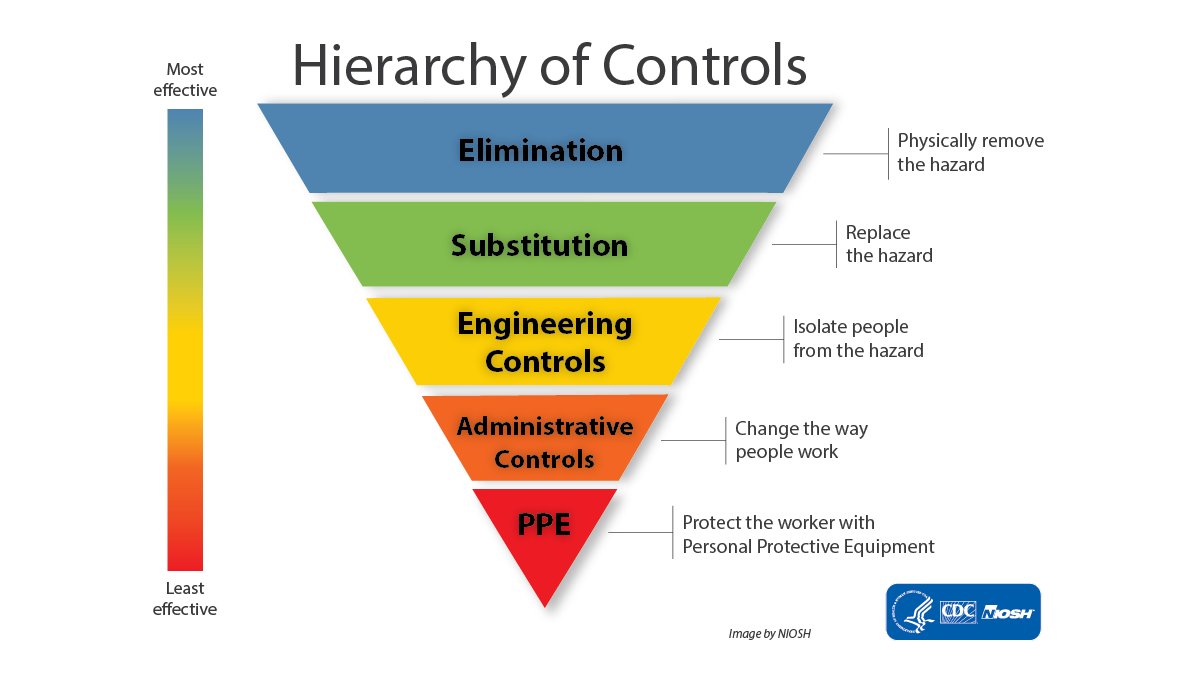
Broadly speaking, some controls are more effective than others. Wherever possible, you should attempt to use more effective controls in place of less effective ones. More effective means not just that it reduces the risk the most, but also the most reliable over time and most resistant to having rules bent, being left broken, being ignored due to alarm fatigue, or 'normalisation of deviation'. Procedures that assume everything is working perfectly and everyone is 100% competent will fail; see MCAS and a great number of other accidents.
Elimination is rarely possible but substitution (radar vs visual) and isolation (separate helicopters from other traffic) amongst other engineering controls are potentially more feasible, and much higher up the hierarchy than a glorified instruction not to crash (the very bottom of administrative). Engineering a problem out of existence is far superior to having a procedure to fix it in the QRH.
I list things like TCAS, GPWS, RSAs, and crash-proof seating as broadly being under PPE: they're nice to have and certainly worth pursuing, but unless there is no other alternative, they should never be your primary protection. Something has gone wrong if they get used.
Subjects
ATC
Close Calls
Normalization of Deviance
Radar
Separation (ALL)
TCAS (All)
Traffic in Sight
Links are to this post in the relevant subject page so that this post can be seen in context.
Reply to this quoting this original post. You need to be logged in. Not available on closed threads.