February 16, 2025, 22:06:00 GMT
permalink Post: 11829489
"However, as there was no vertical separation built into this procedure, all of this is at best a distraction. The more important questions are why procedural barriers were not in place to stop the route being used during landings on runway 33, and whether visual separation at night is an adequate barrier to collision when airliners and their human cargo are involved."
Aircraft accidents bring lawsuits - like it or not.
I'm not a member now, nor have I been a member, of the part of the profession which specializes in suing usually anybody plausible as a defendant. That doesn't mean, as an attorney first and SLF second, I don't see big problems looming ahead. (A prior post on legal factors was junked by the mods, but that was then, this is. . . .)
The FAA and the U.S. Army are privileged with sovereign immunity, as a general rule. A federal statute - the Federal Tort Claims Act - enacted a waiver of sovereign immunity BUT with an important exception. If the allegedly negligent act (or omission) was taken (or failed to be taken) as part of a "discretionary function", immunity still exists. The basic explanation is that discretionary functions involve policy judgments which, in the view of Congress, cannot be "second-guessed" in lawsuits over alleged federal agency negligence. The other half of the equation is that immunity is waived for "ministerial" actions, sort of (to over-simplify) plug-and-chug activities.
Is the construction and operation of the airspace around DCA a matter of policy judgment? I can almost hear the lawyers planning to file suit arguing that airspace rules which make simple, obvious sense are not derived from policy judgments. I can almost hear them issuing subpoenas (through the necessary international process) of Network Manager or MUAC senior managers to gain testimony that in European airspace, as others have observed about Heathrow, the airspace rules are more like "plug-and-chug" than the sometimes esoteric, and usually vague and/or ambiguous, factors which inform the choices made in - offensive phrase coming - "the policy world."
And will our fine feathered legal eagles sue American too, just to go after the deep pocket, and try to force the airline to take a position on the federal immunity questions?
It's too bad so much attention is focused on the dumb shows and noise currently meant to entertain the grandstands (if you get my meaning). There should be a way to compensate the families of the people who perished in this awful, tragic, and ultimately senseless midair collision. Is the United States civil justice system really going back to 1960 and pretending that what we are dealing with is the December 16 1960 DC-8 - L-1049 Super Constellation midair?
As another poster way, way upthread said, I feel rage.
Subjects
DCA
FAA
Separation (ALL)
Vertical Separation
Visual Separation
Links are to this post in the relevant subject page so that this post can be seen in context.
Reply to this quoting this original post. You need to be logged in. Not available on closed threads.
February 16, 2025, 22:11:00 GMT
permalink Post: 11829492
Subjects
CVR
PAT25
Pass Behind
Pass Behind (All)
Separation (ALL)
Visual Separation
Links are to this post in the relevant subject page so that this post can be seen in context.
Reply to this quoting this original post. You need to be logged in. Not available on closed threads.
February 16, 2025, 22:52:00 GMT
permalink Post: 11829513
Is the construction and operation of the airspace around DCA a matter of policy judgment? I can almost hear the lawyers planning to file suit arguing that airspace rules which make simple, obvious sense are not derived from policy judgments. I can almost hear them issuing subpoenas (through the necessary international process) of Network Manager or MUAC senior managers to gain testimony that in European airspace, as others have observed about Heathrow, the airspace rules are more like "plug-and-chug" than the sometimes esoteric, and usually vague and/or ambiguous, factors which inform the choices made in - offensive phrase coming - "the policy world."
If we took the FAA to be undertaking "plug and chug" regulatory and procedural activities, unburdened by political considerations and at risk of having EASA or UK CAA regulations and procedures held up as comparators in negligence cases against it, then I think it is highly unlikely that FAA regulations would be as permissive as they are in respect of visual separation and runway occupancy (the two most obvious and frequently cited points of difference, at least where airline operations are concerned), or that DCA\x92s helicopter routes would have existed. So why such a difference in approach? Economic factors are usually held up as the reason, and I fear this takes us away from "plug and chug" regulation into policy territory where immunity would seemingly apply.
I very much doubt that any politician, corporate lobbyist or general would explicitly advance the argument that occasional accidents are a tolerable price for the traffic capacity enhancements enabled by visual separation. It'll be interesting to see whether the NTSB forces that argument into the open, or enables it to be avoided by distracting itself with altimetry and other such matters.
Last edited by Easy Street; 16th February 2025 at 23:35 .
Subjects
DCA
FAA
NTSB
Separation (ALL)
Visual Separation
Links are to this post in the relevant subject page so that this post can be seen in context.
Reply to this quoting this original post. You need to be logged in. Not available on closed threads.
February 16, 2025, 22:53:00 GMT
permalink Post: 11829514
Subjects
ATC
CRJ
Night Vision Goggles (NVG)
Pass Behind
Pass Behind (All)
Separation (ALL)
Links are to this post in the relevant subject page so that this post can be seen in context.
Reply to this quoting this original post. You need to be logged in. Not available on closed threads.
February 17, 2025, 00:49:00 GMT
permalink Post: 11829561
"However, as there was no vertical separation built into this procedure, all of this is at best a distraction. The more important questions are why procedural barriers were not in place to stop the route being used during landings on runway 33, and whether visual separation at night is an adequate barrier to collision when airliners and their human cargo are involved."
Aircraft accidents bring lawsuits - like it or not.
I'm not a member now, nor have I been a member, of the part of the profession which specializes in suing usually anybody plausible as a defendant. That doesn't mean, as an attorney first and SLF second, I don't see big problems looming ahead. (A prior post on legal factors was junked by the mods, but that was then, this is. . . .)
The FAA and the U.S. Army are privileged with sovereign immunity, as a general rule. A federal statute - the Federal Tort Claims Act - enacted a waiver of sovereign immunity BUT with an important exception. If the allegedly negligent act (or omission) was taken (or failed to be taken) as part of a "discretionary function", immunity still exists. The basic explanation is that discretionary functions involve policy judgments which, in the view of Congress, cannot be "second-guessed" in lawsuits over alleged federal agency negligence. The other half of the equation is that immunity is waived for "ministerial" actions, sort of (to over-simplify) plug-and-chug activities.
Is the construction and operation of the airspace around DCA a matter of policy judgment? I can almost hear the lawyers planning to file suit arguing that airspace rules which make simple, obvious sense are not derived from policy judgments. I can almost hear them issuing subpoenas (through the necessary international process) of Network Manager or MUAC senior managers to gain testimony that in European airspace, as others have observed about Heathrow, the airspace rules are more like "plug-and-chug" than the sometimes esoteric, and usually vague and/or ambiguous, factors which inform the choices made in - offensive phrase coming - "the policy world."
And will our fine feathered legal eagles sue American too, just to go after the deep pocket, and try to force the airline to take a position on the federal immunity questions?
It's too bad so much attention is focused on the dumb shows and noise currently meant to entertain the grandstands (if you get my meaning). There should be a way to compensate the families of the people who perished in this awful, tragic, and ultimately senseless midair collision. Is the United States civil justice system really going back to 1960 and pretending that what we are dealing with is the December 16 1960 DC-8 - L-1049 Super Constellation midair?
As another poster way, way upthread said, I feel rage.
Subjects
DCA
FAA
Separation (ALL)
Vertical Separation
Visual Separation
Links are to this post in the relevant subject page so that this post can be seen in context.
Reply to this quoting this original post. You need to be logged in. Not available on closed threads.
February 17, 2025, 01:08:00 GMT
permalink Post: 11829568
Your litany of how the holes in the cheese lined up might be missing a detail or two, but any of those holes not lining up might have avoided this tragedy.
The rad alt is right there.
At night over water at low level, the pilots I flew with did not ignore their rad alt.
It was a part of one's scan.
If I know that field elevation is 14', and my rad alt isn't at 200' or less on a route where max altitude is 200', a correction is needed now, before the error gets larger. (The separate issue of going behind, and that tower guidance apparently being stepped on, is another pair of holes in the cheese).
I am at a loss to understand the apparent magnitude of the altitude error (they were still too close laterally, yes), but as I've been out of the cockpit for a few years I am not aware of what's being taught these days.
On most airlines, they do have a barf bag, still, in the seat pocket in front of you. Suggest you vomit into that and avoid the choke hazard.
Subjects
ATC
CRJ
Night Vision Goggles (NVG)
Pass Behind
Pass Behind (All)
Radio Altimeter
Separation (ALL)
Links are to this post in the relevant subject page so that this post can be seen in context.
Reply to this quoting this original post. You need to be logged in. Not available on closed threads.
February 17, 2025, 02:39:00 GMT
permalink Post: 11829597
So if the Blackhawk pilots either flew this low altitude route regularly, or it was an operational norm for that pilot group/operation, pilots would begin to relax with it - it's "normal" I opine that it is never normal to fly at 200 feet AGL in a built up area, nor close to the approach path for a busy airport. So if the training and operational norms of this routing lead pilots to think it is normal, they treat it that way, and vigilance goes down. This was an accident waiting to happen, because of normalization of deviance form established norms of flying.
I've learned the hard way that when ATC asks if you have X aircraft in sight, once you think you do, mentally map the path of that aircraft, then start looking for the one you have not seen yet - particularly with two pilots! You get a clearance to pass at 200 AGL under the approach path of a busy airport at night - that's unusual, and spidy senses should be tingling lots! This hyper awareness should be being trained into the operation - a preflight briefing from the lead "On this flight, we could expect this routing and clearance. This will be unusual, and we're going to be extra aware by doing the following....".
So it's easy to blame the Blackhawk pilots, and yes, they wear some of this, but the military let the pilots down by not categorizing this flight as "high risk", and ATC let the pilots down by clearing a routing which had the potential to provide only a hundreds of feet vertical separation, rather than insisting on both vertical, lateral, and projected path separation, and thereafter, telling the Blackhawk pilots all of the airplanes they should be seeing, not just the one, which seems to have been misunderstood.
I have been instructed to orbit to allow for a passing aircraft to clear in front of me, why not this time? Maybe that low altitude air route is too small for a normal orbit? Another red lag about that route not being a good idea!
Subjects
ATC
Accident Waiting to Happen
Blackhawk (H-60)
Normalization of Deviance
Separation (ALL)
VFR
Vertical Separation
Links are to this post in the relevant subject page so that this post can be seen in context.
Reply to this quoting this original post. You need to be logged in. Not available on closed threads.
February 17, 2025, 06:24:00 GMT
permalink Post: 11829650
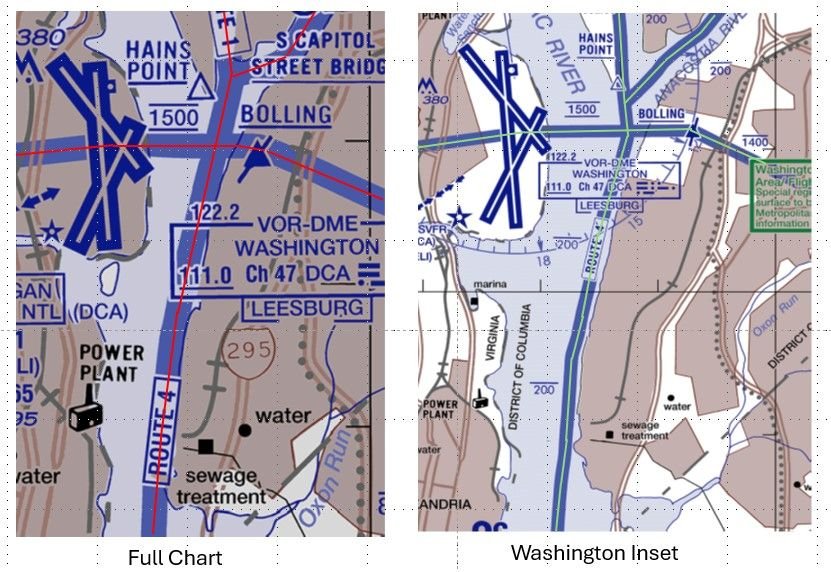
You could reasonably define the bank as the water's edge, and therefore expect crews to fly along an infinitesimally narrow path. Or as the space between the water's edge and the [edge of the flood plain | first flat area | something else], which would imply that the western boundary changes with the water level. Both imply the route is substantially above land.
Neither are useful for precise navigation, but the map and the description are probably 'close enough' if they are only needed for general route guidance and knowing that structures on the east bank need to be NOTAMed for helicopters, but probably not the west bank.
A good reminder that measurements/specifications without tolerance are often worse than useless.
If it quacks like a duck... this kind of "It can't be an X because we can't do it, so we'll call it a Y" leads to a culture that gets used to massaging the truth for convenience. Did we hear more on the Alaska door plug that was an 'opening' not a 'removal'?
Subjects
ATC
CRJ
DCA
FAA
KDCA
NTSB
Night Vision Goggles (NVG)
Pass Behind
Pass Behind (All)
Separation (ALL)
Links are to this post in the relevant subject page so that this post can be seen in context.
Reply to this quoting this original post. You need to be logged in. Not available on closed threads.
February 17, 2025, 08:38:00 GMT
permalink Post: 11829705
As many and I said before, discussion about Altimeters or width of VFR routes are just distractions to deflect from the real cause , which for me can be resumed into the lack of a safety assessment and safety case of existing procedures. We all had to do this when SMS was widely introduced in the late 90s It was not that easy , but we discovered a few holes that were closed.
Here in DCA we see a couple of procedures that would not have passed a safety case : e.g Route 4, Circling to RWY 33 with that route active, visual separation at night , use of NVG on that route ..etc,,
Flying in itself always bares a risk,, our job is to minimize the risk , not to eliminate it , but here the Regulatory ( i.e FAA) failed to minimize the risks.
As in the US the FAA is both the service provider and the Regulator , and is in addition dependent of political will and pressure for its funding , the willingness to implement unpopular measures, may be limited. A Judge might look into this differently but for those part of the discussion I hand over the floor to .Willow run 6-3 .
Subjects
DCA
FAA
Night Vision Goggles (NVG)
Route 4
Separation (ALL)
VFR
Visual Separation
Links are to this post in the relevant subject page so that this post can be seen in context.
Reply to this quoting this original post. You need to be logged in. Not available on closed threads.
February 17, 2025, 13:12:00 GMT
permalink Post: 11829888
Subjects
ATC
Separation (ALL)
VFR
Visual Separation
Links are to this post in the relevant subject page so that this post can be seen in context.
Reply to this quoting this original post. You need to be logged in. Not available on closed threads.
February 17, 2025, 15:50:00 GMT
permalink Post: 11829979
As many and I said before, discussion about Altimeters or width of VFR routes are just distractions to deflect from the real cause , which for me can be resumed into the lack of a safety assessment and safety case of existing procedures. We all had to do this when SMS was widely introduced in the late 90s It was not that easy , but we discovered a few holes that were closed.
Here in DCA we see a couple of procedures that would not have passed a safety case : e.g Route 4, Circling to RWY 33 with that route active, visual separation at night , use of NVG on that route ..etc,,
Flying in itself always bares a risk,, our job is to minimize the risk , not to eliminate it , but here the Regulatory ( i.e FAA) failed to minimize the risks.
As in the US the FAA is both the service provider and the Regulator , and is in addition dependent of political will and pressure for its funding , the willingness to implement unpopular measures, may be limited. A Judge might look into this differently but for those part of the discussion I hand over the floor to .Willow run 6-3 .
This is an excerpt from a website of an actually well-known, very accomplished, and respected group of lawyers who specialize in (among other things) aviation matters. I'm not using their name and I don't have any approval, express or implied, to use information from their website - but if justice is to be sought for the victims' families, public discussion is - or should be - encouraged.
"A discretionary function is an action of a governmental nature exercised by a federal employee, but in order for that action to be considered a discretionary function, it must pass a two-part test:
There must be an element of judgment or choice. That is, if a federal statute or regulation prescribes a course of action for an employee to follow, there is no discretion.
That judgment or choice must be susceptible to policy analysis.
The Federal Tort Claims Act contains a discretionary function exception that says the U.S. cannot be held liable for any employee\x92s failure to exercise or perform a discretionary duty.
Within the legal field of aviation accidents, discretionary duties for which the U.S. is not liable include the following:
Aircraft \x93spot check\x94 certifications
Weather forecasting
Failure to install equipment
The FAA\x92s design of flight procedures
The types of actions that are considered not discretionary, and therefore, open the U.S. government to litigation are:
The failure to issue air traffic control manual warnings
If air traffic control fails to warn of weather dangers
The failure to maintain equipment
Relaying incorrect instructions to pilots."
END OF EXCERPT [not intended as legal advice here or on its original internet page]
So to return to ATC Watcher's point...... the more posts I read about this midair collision (plus other information such as NTSB briefings) the more I am anticipating that it will require an act of Congress to provide for compensation for the families of the victims. Isn't it the obvious fact that convenience for people who work in Washington and travel "back home" generally speaking on weekends and when Congress isn't convened, is a prime and central reason for the way DCA airspace has been constructed and managed? Is it really going to be the case that because the lawsuits will - in all likelihood - fail to overcome the "discretionary function" exception, that the 67 families will be without a remedy? Is that how it works, then?
In case anyone thinks my sense of being horrified at this accident is clouding reason or logic, consider this - the book Collision Course discusses the PATCO union's genesis, the strike, and so on. PATCO's earliest stirrings resulted in large part from the 1960 midair over New York. Is the United States aviation sector willing to accept an outcome of this accident that in effect travels back over six decades? The point is, given the long-term shortage of ATCOs in this country . . . I don't think a court is capable of ruling that the situation, allowed and in fact enabled by Congress and successive White House presidential administrations, is subject to "negligence" analysis in the currently applicable legal sense. All this being said, this is how I arrive at thinking that in the interests of justice, some other means of providing for the loved ones of 67 souls who were on board needs to be determined and implemented.
Last edited by WillowRun 6-3; 17th February 2025 at 19:11 .
Subjects
ATC
DCA
FAA
NTSB
Night Vision Goggles (NVG)
Route 4
Separation (ALL)
VFR
Visual Separation
Links are to this post in the relevant subject page so that this post can be seen in context.
Reply to this quoting this original post. You need to be logged in. Not available on closed threads.
February 17, 2025, 20:56:00 GMT
permalink Post: 11830154
For a landing aircraft on Rwy33, and assuming:
(1) correct QNH dialed in
(2) perfect centerline following
(3) perfect 3deg PAPI following
baro altitude would be 278 ft exactly above the east bank. And 200 baro altitude would come appr. 1.175 ft from the east bank and over the water.
Very hard to believe that aircrafts were routinely allowed to cross simultaneously this crossing. Statistically, the accident would have happened long ago, or at, the least, have reports filed (even from passengers) and brown underwear.
And btw, even top VIP seems that are considered much more expendable than we originally thought.
Think of it like a road with a traffic light (ATC) but you can merge on red if you can see it\x92s clear (helicopter). No rotary pilot I know would knowingly pass that close under/behind a jet transport as the wake could literally be the end of you at 200\x92AGL.
Subjects
ATC
QNH
Radar
Separation (ALL)
Links are to this post in the relevant subject page so that this post can be seen in context.
Reply to this quoting this original post. You need to be logged in. Not available on closed threads.
February 17, 2025, 21:32:00 GMT
permalink Post: 11830196
Here if you want to learn or just refresh your memory ; https://www.latimes.com/archives/la-...%20government.
As an aside , the NTSB conclusions of that collision are interesting compared to our DCA accident : ( exactly 40 years ago !)
Subjects
ATC
DCA
FAA
NTSB
Probable Cause
Route 4
See and Avoid
Separation (ALL)
Links are to this post in the relevant subject page so that this post can be seen in context.
Reply to this quoting this original post. You need to be logged in. Not available on closed threads.
February 18, 2025, 08:00:00 GMT
permalink Post: 11830516
I wouldn't put it past the FAA to pull a stunt like that, read Mary Schiavo's (ex IG of the Dept. of Transportation) book if you want to know how wily they can be. And Jennifer gave them the perfect lay up in the last briefing.
It's way to easy to blame the pilots, over the years there have been incidents due to incorrect QNH settings, were both pilots and ATC have failed to catch the error, in a busy airspace with overworked ATC, late change of runway for airlines, and military helicopters using Night Vision Goggles, altimeter equipment failure/error.
Even the Max 200 ft altitude under the approach to a major US airport is an accident waiting to happen, and whoever approved this to be used during normal operations should be investigated. The CRJ was at around 325 ft on a visual/circling approach when it crashed, does anyone really think it's great airmanship to have a Black Hawk helicopter at 200 ft passing under you?
That's what made the Swiss Cheese model line up perfectly, a planned approved separation of 125 ft was the "best case" scenario.
Subjects
ATC
Accident Waiting to Happen
Altimeter (All)
Blackhawk (H-60)
CRJ
FAA
QNH
Separation (ALL)
Links are to this post in the relevant subject page so that this post can be seen in context.
Reply to this quoting this original post. You need to be logged in. Not available on closed threads.
February 18, 2025, 12:39:00 GMT
permalink Post: 11830705
I've asked a question over on Rotorheads to see if anyone knows the actual clearance and service given to helicopters entering the DCA Class Bravo on the 'routes', and I'm happy to repeat it here. In London it's Radar Control ie. separation provided by ATC supported by radar. That's one part of the picture. The other is this startling revelation from Jennifer Homendy that there are no lateral limits to the 'routes', so in one sense they are not really 'routes' at all just guidelines with defined altitude limits. I can't find even altitude limits on the NY and Boston charts.
In other words, the way the 'routes' are used is quite possibly defined locally by custom and practice rather than designed with safety baked in by the authority, and that may be the way the authority intended things to be. In the UK every towered field has its own safety management system, as does the CAA. If these exist here at DCA and the FAA it would be instructive to have those examined as part of the investigation, because either they are not being used, or they're being ignored. Nobody could maintain that the risks on this 'route' were As Low As Reasonably Practicable (ALARP).
Last edited by Wide Mouth Frog; 18th February 2025 at 13:16 .
Subjects
ATC
DCA
FAA
NTSB Chair Jennifer Homendy
Radar
Separation (ALL)
Links are to this post in the relevant subject page so that this post can be seen in context.
Reply to this quoting this original post. You need to be logged in. Not available on closed threads.
February 19, 2025, 18:09:00 GMT
permalink Post: 11831631
It may sound harsh, but after years of struggle for non-punitive environment, some have deduced this as non-punitive environment for any kind of incident (or even accident).
Back to case in DCA - to expect self separation of night VFR and IFR conducting visual approach agreed hasty and under pressure in the area where none of them is capable of sudden change of trajectory is just pouring gasoline to the fire already raging.
Subjects
ATCO
DCA
IFR
Separation (ALL)
VFR
Links are to this post in the relevant subject page so that this post can be seen in context.
Reply to this quoting this original post. You need to be logged in. Not available on closed threads.
February 20, 2025, 08:54:00 GMT
permalink Post: 11832026
A published glideslope (usually nowadays defined by ILS or GPS) is predicated on HEIGHT above the touchdown point , ie it is a physically fixed plane referenced to the ground. How the altimeter is set is completely irrelevant to an aircraft on the glideslope from that point of view. But this aeroplane was on a visual aproach so altimetry is also irrelevant as it is not constrained by a rigidly defined instrumented glideslope.
While the helilane limit is, technically, predicated on an altitude that's really just semantics in this case as it is over water that is at sea level and as any PPL should know that gives height above sea level with QNH set. Thus to all practical intents and purposes the heli routes are flown at heights, and as the rad alt is an order of magnitide more accutate than a bar-alt pilots will likely set its bug at 200ft and and such a low level as this where bar-alt inaccuracy is very significant will (or should) fly that, despite having set QNH because that's the requirement. That way both aircraft are on the same plane of reference, ie vs. the ground = height.
The graphic above is surprising illustration of how a lateral error of just 200m puts a helo firmly into the acceptable glideslope parameters and surely demonstrates more clearly than anything else we've seen the insanity, even irresponsibility of the design of this piece of airspace. Mind, get 200m off track in the vicinity of Heathrow, let alone crossing it and you'll be ordered out of the system the way you came in with a telephone number to call...
Still no word on why this route couldn't have been designed with a sensible vertical separation above the f/w flightpath, someone must know.
Subjects
Altimeter (All)
QNH
Radio Altimeter
Separation (ALL)
Vertical Separation
Links are to this post in the relevant subject page so that this post can be seen in context.
Reply to this quoting this original post. You need to be logged in. Not available on closed threads.
February 21, 2025, 01:51:00 GMT
permalink Post: 11832665
Also, I suspect the military requirement for the routes means they have to be as weather-proof as possible, meaning as low as possible. The route heights are given as maximum heights to be flown when the ceiling permits, and can be underflown when required for weather unless stated.
Subjects
Separation (ALL)
Vertical Separation
Links are to this post in the relevant subject page so that this post can be seen in context.
Reply to this quoting this original post. You need to be logged in. Not available on closed threads.
February 21, 2025, 23:22:00 GMT
permalink Post: 11833322
If two aircraft are converging on the same runway or look like they are going to occupy it simultaneously, then one of them has to give way. Why should it be any different for a small volume of sky?
Subjects
DCA
IFR
Separation (ALL)
Links are to this post in the relevant subject page so that this post can be seen in context.
Reply to this quoting this original post. You need to be logged in. Not available on closed threads.
February 22, 2025, 01:15:00 GMT
permalink Post: 11833379
If two aircraft are converging on the same runway or look like they are going to occupy it simultaneously, then one of them has to give way. Why should it be any different for a small volume of sky?
Subjects
DCA
IFR
Separation (ALL)
Visual Separation
Links are to this post in the relevant subject page so that this post can be seen in context.
Reply to this quoting this original post. You need to be logged in. Not available on closed threads.