March 06, 2025, 13:29:00 GMT
permalink Post: 11841979
Because without that information, they could IMHO quite happily look at the A319 approaching runway 1, intend to pass behind it to head south down-river until the A319 was no longer over the river, and loiter around the runway 33 approach until that happens.
Shift the times by ten seconds and the same accident could have still occurred.
Visual simply doesn't work at the required level of safety if there are multiple aircraft to be visual with.
Reading this thread since the night of the accident, many have noted the "wrong-thinking" (for lack of a better term) underpinning the way traffic was managed by FAA and ATC.
I'm not enthused about the litigation that almost certainly will be intense once it commences. But reading the thread I've started to wonder.....
What would a chronological reconstruction of each incremental decision by FAA about the operation of DCA look like, a chronology that would (of course) include each Congressional enactment requiring or allowing further intensity of operations? The airport did not go from a nominal operational environment, with typically safe procedures and airspace usage rules very similar to or the same as any other major urban airport in the country, to the situation which obtained on January 29, overnight - or so it would seem.
(Yes, reconstructing the facts to build such a chronology would involve quite a lot of discovery activities in the presumably forthcoming lawsuits, but I'm not veering off into any further comment about why that would matter or which party or parties it would help or hurt..... other than to say, very often, cases are won and lost in discovery.)
Some years ago, on a trip to Capitol Hill hoping to find gainful employment on a Congressional staff somewhere, on the return flight from what then was Washington National, the aircraft's cockpit door was open as the boarding process was being completed (it was 1987). I recall being seated close enough to the flight deck - leaning a little into the aisle (a Midway Airlines DC-9 iirc) - to be able to see the pilot in the LHS and part of the D.C. skyline through the cockpit's front windows. Maybe that is why my mind somehow can't quite comprehend the recollections from kidhood of reading about the midair collision over New York City which is featured prominently in the book Collision Course , together with the events of the night of January 29.
Added: Wall Street Journal, March 6: "Air-Traffic Staff Rules Tightened After Crash." Also reports previous "close call" incident. Highly recommended reading (and I didn't see anything to contradict the above post, WR 6-3).
Last edited by WillowRun 6-3; 6th March 2025 at 13:46 .
Subjects
ATC
Circle to Land (Deviate to RWY 33)
Close Calls
DCA
FAA
Pass Behind
Pass Behind (All)
Separation (ALL)
Visual Separation
Wall Street Journal
Links are to this post in the relevant subject page so that this post can be seen in context.
Reply to this quoting this original post. You need to be logged in. Not available on closed threads.
March 11, 2025, 03:45:00 GMT
permalink Post: 11845055
Not sure what you mean by this comment. CW3 Roth interview explained the training requirement for Route 1/4 ops. Question is whether these training flights can be conducted safely. I think they can as long as ATC doesn\x92t delegate their primary responsibility for Class B separation. It is politically untenable to resume Route 1/4 PAT training flights at present. I suspect 12th AB and DCA ATC are reviewing their previous policy that VFR visual separation is safe along these routes.
Subjects
ATC
DCA
Route 5
Route 9
Separation (ALL)
VFR
Visual Separation
Links are to this post in the relevant subject page so that this post can be seen in context.
Reply to this quoting this original post. You need to be logged in. Not available on closed threads.
March 11, 2025, 20:08:00 GMT
permalink Post: 11845606
Existing separation distances between helicopter traffic operating on Route 4 and aircraft landing on runway 33 are insufficient and pose an intolerable risk to aviation safety by increasing the chances of a midair collision.
When Route 4 operations are prohibited as recommended in Safety Recommendation A-25-1, it is critical for public safety helicopter operations to have an alternate route for operating in and around Washington, DC, without increasing controller workload.
To the Federal Aviation Administration:
Prohibit operations on helicopter Route 4 between Hains Point and the Wilson Bridge when runways 15 and 33 are being used for departures and arrivals, respectively, at Ronald Reagan Washington National Airport. (A-25-1) (Urgent)
Designate an alternative helicopter route that can be used to facilitate travel between Hains Point and the Wilson Bridge when that segment of Route 4 is closed. (A-25-2) (Urgent)
Subjects
ATC
Findings
KDCA
Route 4
Separation (ALL)
Links are to this post in the relevant subject page so that this post can be seen in context.
Reply to this quoting this original post. You need to be logged in. Not available on closed threads.
March 11, 2025, 20:35:00 GMT
permalink Post: 11845640
"Near Midair Collision Events at DCA
Review of information gathered from voluntary safety reporting programs along with FAA data regarding encounters between helicopters and commercial aircraft near DCA from 2011 through 2024 indicated that a vast majority of the reported events occurred on approach to landing. Initial analysis found that at least one TCAS resolution advisory (RA) was triggered per month due to proximity to a helicopter. In over half of these instances, the helicopter may have been above the route altitude restriction. Two-thirds of the events occurred at night.
A review of commercial operations (instrument flight rules departures or arrivals) at DCA between October 2021 and December 2024 indicated a total of 944,179 operations. During that time, there were 15,214 occurrences between commercial airplanes and helicopters in which there was a lateral separation distance of less than 1 nm and vertical separation of less than 400 ft. There were 85 recorded events that involved a lateral separation less than 1,500 ft and vertical separation less than 200 ft."


What is seen - reported; and what is dismissed … diminishes the value of reporting.
A system broken: a broken safety management system at the national level.
Subjects
DCA
FAA
NTSB
PAT25
Preliminary Report
Route Altitude
Separation (ALL)
TCAS (All)
Vertical Separation
Links are to this post in the relevant subject page so that this post can be seen in context.
Reply to this quoting this original post. You need to be logged in. Not available on closed threads.
March 11, 2025, 20:50:00 GMT
permalink Post: 11845648
"Near Midair Collision Events at DCA
Review of information gathered from voluntary safety reporting programs along with FAA data regarding encounters between helicopters and commercial aircraft near DCA from 2011 through 2024 indicated that a vast majority of the reported events occurred on approach to landing. Initial analysis found that at least one TCAS resolution advisory (RA) was triggered per month due to proximity to a helicopter. In over half of these instances, the helicopter may have been above the route altitude restriction. Two-thirds of the events occurred at night.
A review of commercial operations (instrument flight rules departures or arrivals) at DCA between October 2021 and December 2024 indicated a total of 944,179 operations. During that time, there were 15,214 occurrences between commercial airplanes and helicopters in which there was a lateral separation distance of less than 1 nm and vertical separation of less than 400 ft. There were 85 recorded events that involved a lateral separation less than 1,500 ft and vertical separation less than 200 ft."
What is seen - reported; and what is dismissed \x85 diminishes the value of reporting.
A system broken: a broken safety management system at the national level.
Subjects
DCA
FAA
NTSB
Normalization of Deviance
Route Altitude
Separation (ALL)
TCAS (All)
Vertical Separation
Links are to this post in the relevant subject page so that this post can be seen in context.
Reply to this quoting this original post. You need to be logged in. Not available on closed threads.
March 12, 2025, 01:22:00 GMT
permalink Post: 11845823
"Near Midair Collision Events at DCA
Review of information gathered from voluntary safety reporting programs along with FAA data regarding encounters between helicopters and commercial aircraft near DCA from 2011 through 2024 indicated that a vast majority of the reported events occurred on approach to landing. Initial analysis found that at least one TCAS resolution advisory (RA) was triggered per month due to proximity to a helicopter. In over half of these instances, the helicopter may have been above the route altitude restriction. Two-thirds of the events occurred at night.
A review of commercial operations (instrument flight rules departures or arrivals) at DCA between October 2021 and December 2024 indicated a total of 944,179 operations. During that time, there were 15,214 occurrences between commercial airplanes and helicopters in which there was a lateral separation distance of less than 1 nm and vertical separation of less than 400 ft. There were 85 recorded events that involved a lateral separation less than 1,500 ft and vertical separation less than 200 ft." ......
[safetypee's emojis and comments ommitted]
Almost invariably lawyers as well as law students and professors, when asked to comment about what is taught in law school, recite the truism that "law school teaches you how to think like a lawyer." Problem is, even quite modest experience in and with the realities and pressures of representing clients - i.e., practicing law - dulls the thinking part and intensifies the hustler mentalities, of which there are many variations. I'm noting this because law school actually trains you how to spot the issues. It sometimes is the case that the standard things lawyers think about a given set of issues are not the most relevant and meaningful things.
With that hopefully not grossly pedantic context out of the way..... in previous comments on this thread I've noted that the federal defendants would be expected to assert sovereign immunity.... more technically, that although the Federal Tort Claims Act waives sovereign immunity in general terms, the statute also contains various exceptions - in other words, the exceptions where they apply keep sovereign immunity in place. The exception relevant here is the "discretionary function" exception, which (pardon the attempt at over-simplifying it) keeps the immunity in place if the allegedly negligent act (or omission) resulted from a federal entity's policy decision or choice.
I previously viewed the discretionary function exception is likely imposing a pretty strong barrier against liability of the (probable) federal defendants. However.
However. However, as I write this somewhere in an aviation law practice a mid-level or even junior associate is pounding their computer keyboard, amassing BASED ON THE ISSUES NOW REVEALED an analysis of how the discretionary function exception has never, never ever ever, been imposed to bar liability for alleged negligence roughly and/or reasonably comparable to the record of "encounters" now documented by NTSB Prelim Report. And that record goes back several years . . . but presumably discovery in United States District Court under the Federal Rules of Civil Procedure could easily reach back to even more past years.
Of course, it will be said that ignoring these many encounters was indeed a policy choice, and so the exception does apply, a forum post like this notwithstanding. But that's just the point. The ISSUE here is that there never was a conscious policy directive which the alleged negligence stemmed from. Or stated another way, if I were in the aviation practice imagined above, I'd be running associates ragged to amass the above-mentioned analysis which establishes, among other things, that GROSS NEGLIGENCE by the FAA can never be, and is not as a matter of law, a predicate for applying the discretionary function exception. (For lawyers out there, somewhat akin to prima facie tort.)
By the way, for all the discovery sports fans out there, just think how much fun it will be to run discovery to amass the facts of what actions - meaning by the aircraft in which the RAs were annunciated - were taken as a result of all the RAs as noted by NTSB's Prelim Report.
Subjects
Accountability/Liability
DCA
FAA
NTSB
Route Altitude
Separation (ALL)
TCAS (All)
TCAS RA
Vertical Separation
Links are to this post in the relevant subject page so that this post can be seen in context.
Reply to this quoting this original post. You need to be logged in. Not available on closed threads.
March 20, 2025, 20:45:00 GMT
permalink Post: 11850879
1) The starting point for any of my thought process about the midair collision is that this accident should never have happened and would not have happened without some parts of "the system" failing to fulfill their assigned responsibilities. Midair collisions in U.S. airspace are an aberation, aren't they? I sense that many aviators and other aviation professionals don't want to say it out loud - their sense of disbelief that this actually occurred.
A few years ago, in response to a question after a guest lecture he had delivered at an ICAO event in Montreal, then-Chair of the NTSB Robert Zumwalt said, "we've already had that accident" . . . the question was about whether an accident caused by certain factors which were, in fact, present in the Colgan Air accident needed to happen, in order for certain rules to be changed. (I don't want to misstate the q&a, although my best recollection was that the question was about fatigue and rest, and commuting time before line service.) In other words, the DCA midair is not an accident the primary causes of which were factors the overall aviation system had not quite learned to do correctly. In comparison, at the time I first began "reading aviation", wind shear accidents were occuring not infrequently (that beginning was December 1974).
I have not represented anyone or anything in air crash litigation and my posting here is not intended as what most lawyers call "client development and prospecting." Despite that, I think the opening statement on behalf of the families of the victims of this accident will be quite a courtroom moment. It's against this backdrop that I've been trying to think through the federal entities' most likely defense. There is some sense, maybe only vague, that how the anticipated lawsuits play out will have some impact or bearing on how the overall aviation system responds to this tragic occurrence.
2) Not for the first time my choice of phrasing was too emphatic and also imprecise. I didn't mean to point to ASIAS as a foundational or ultimate component of decisions about safety of DCA airspace management and usage. Instead, the content of some of the incident reports pointed out by Juan Browne struck me as glaring. They struck me as strong evidence of two things; one - as noted above, this accident was the kind of occurrence caused by some part of the system not fulfilling its responsibilities, and the other, that there were pretty clear statements by "bottom-up" reporters about such responsibilities appearing to be unfulfilled at particular times and in particular situations.
So, from these two foundations, I'm trying to figure out whether the discretionary function exception applies or does not apply. If it applies, the federal court will not have jurisdiction over the claims and the federal defendants will enjoy immunity (irony intended). I apologize in advance for what follows next (it is quoted in full from Congressional Research Service Report (R45732.8, April 17, 2023) "The Federal Tort Claims Act (FTCA): A Legal Overview". I would not clutter up this respected forum with legal material were it not arguably necessary for meaningful discussion of what is likely to happen next in the aftermath of the night of January 29.
CRS:
"[T]to determine whether the discretionary function exception bars a particular plaintiff's suit under the FTCA, courts examine whether the federal employee was engaged in conduct that was (1) discretionary and (2) policy-driven. "If the challenged conduct is both discretionary and policy-driven," then the FTCA does not waive the government's sovereign immunity with respect to that conduct, and the plaintiff's FTCA claim must therefore fail. If, by contrast, an official's action either (1) "does not involve any discretion" or (2) "involves discretion," but "does not involve the kind of discretion\x97consideration of public policy\x97that the exception was designed to protect," then the discretionary function exception does not bar the plaintiff's claim.
Whether the Challenged Conduct Is Discretionary
When first evaluating whether "the conduct that is alleged to have caused the harm" to the plaintiff "can fairly be described as discretionary," a court must assess "whether the conduct at issue involves 'an element of judgment or choice' by the employee." "The conduct of federal employees is generally held to be discretionary unless 'a federal statute, regulation, or policy specifically prescribes a course of action for an employee to follow.'" If "the employee has no rightful option but to adhere to the directive" established by a federal statute, regulation, or policy, "then there is no discretion in the conduct for the discretionary function exception to protect." Put another way, the discretionary function exception does not insulate the United States from liability when its employees "act in violation of a statute or policy that specifically directs them to act otherwise."
Even where a federal statute, regulation, or policy pertaining to the challenged action exists, the action may nonetheless qualify as discretionary if the law in question "predominately uses permissive rather than mandatory language." In other words, where "a government agent's performance of an obligation requires that agent to make judgment calls, the discretionary function exception" may bar the plaintiff's claim under the FTCA. Notably, "[t]he presence of a few, isolated provisions cast in mandatory language" in a federal statute, regulation, or policy "does not transform an otherwise suggestive set of guidelines into binding" law that will defeat the discretionary function exception. "Even when some provisions of a policy are mandatory, governmental action remains discretionary if all of the challenged decisions involved 'an element of judgment or choice'".
[End CRS, all quotations in the excerpt as in original, and all footnotes omitted]
3) Which leads to this essential inquiry: which one - and the answer cannot be "both are involved" - is closer to what happened: the federal entity individuals involved at all levels acted in violation of a statute or policy that specifically directs them to act otherwise", or, the federal entity individuals' "performance of an obligation require[d] that agent to make judgment calls", and "all of the challenged decisions involved an 'element of judgment or choice.'"
On one hand, the imperative of separation of aircraft in controlled airspace is pretty absolute, as far as I have been given to understand. There isn't any discretion or choice to risk a collision at an "intolerable" level of likelihood in order to keep traffic moving, both airline and the military and other helicopter operations in question. And that was the query I was attempted to point out: the midair collision at DCA on Janaury 29 looks like the proverbial death of a thousand small cuts, such that there never was any "judgment" or "choice" as those (admittedly ambigous) terms are employed in the statute and its interpretation. I should have been clearer about only imagining that one of many hypothetical situations where - arguing for the defense - someone was looking at ASIAS and proceeded with the calculating or reasoning which presumably would qualify as "judgment" or "choice." The larger point is that taking account of all the safety information in all the system elements which have been noted and others which might not have been noted here, mark me down as quite skeptical that there ever occurred a time, at a particular place, where anyone acting on behalf of the federal government exercised judgment or discretion that - contrary to the assessment of the NTSB Chair - the risk at DCA was tolerable.
Two caveats to wrap: I don't envy the advocates for the victims' families, as it will be terribly challenging to argue the facts of this case without appearing to cast aspersions on some or all of the pilots and controllers. Nobody wants that, and I certainly don't.
The other is that I do not think that the discretionary function issue will play out in the context of the actions by the pilots of either aircraft or the controllers. Rather it will be litigated with regard to the way FAA (and its parent Cabinet department, DoT) structured, managed, and operated DCA airspace. And this could include staffing policies and procedures (but again, not individuals' actions or inactions on the night of the accident). There may be some involvemenmt of civil-military coordination also at the agency level.
On a somewhat personal note, just a few years ago I traveled by air to a major European capital where a quite substantial and important aviation industry organization has its headquarters; the purpose was to attend a conference hosted by that organization. When the flight ended, because I had not previously traveled on a 787 aircraft, I asked the cabin crew if I could please get an invitation to visit the flight deck to see it, if doing so would not unduly delay the pilots from deplaning. When I got admitted to the flight deck, the captain invited me to sit in the LHS, and then gave me his hat and offered to take my photograph (yes, really). In the snapshots this SLF/attorney looks pretty ridiculous, and I wonder, "what am I, ten years old?" I hope neither this post nor any others look like they were written by that kid.
Subjects
Accountability/Liability
DCA
FAA
ICAO
NTSB
Separation (ALL)
Links are to this post in the relevant subject page so that this post can be seen in context.
Reply to this quoting this original post. You need to be logged in. Not available on closed threads.
March 22, 2025, 05:51:00 GMT
permalink Post: 11851870
The local controller had an Assistant ATC and a Supervisor to coordinate, monitor and regulate the traffic.
Class B airspace "ATC Clearances and Separation. An ATC clearance is required to enter and operate within Class B airspace. VFR pilots are provided sequencing and separation from other aircraft while operating within Class B airspace." source FAA Class B
One way to determine how the application of sequencing and separation to VFR pilots in this airspace was being applied would be to listen to the audio and watch radar replays over the weeks and months prior.
Subjects
ATC
Close Calls
DCA
FAA
PAT25
Radar
Route 4
Separation (ALL)
VFR
Links are to this post in the relevant subject page so that this post can be seen in context.
Reply to this quoting this original post. You need to be logged in. Not available on closed threads.
March 22, 2025, 11:33:00 GMT
permalink Post: 11851982

Now, one could say, "Well, there was a fairly steady flow of (maybe) 10 aircraft landing/taking off. So, 1 extra helicopter is not much more to add in!". True ...... but ...... an example. A mainline train arrives at a major London Station and, at once, all the doors open and several 1000 people all get off together and start heading up the stairs to the ticket barriers. The flow of traffic is heavy but quite ordered as the flow is all in one direction and so, while traffic density up the stairs maybe slows it down a bit, the flow is nicely ordered. Picture now, H 'n' H , being in a rush and so being one of the first off the train arriving at the ticket barrier only to realise - Durrrr - he's left his case back on the train. Being not-too-bright, I decide the quickest way to go back is down the same stairs I came up, and hence back to the train. Of course there's only 1 of me going down and several 1000 coming up. But to an onlooker gazing down, the effect of my single trip back against the several 1000 heading up has had a significant effect. TBH, H 'n' H is causing a fair degree of chaos as he pushes past everyone fighting his way back down the stairs against the flow. A few choice comments are being made by his fellow pax! What we have is a disproportionate effect caused by 1 vs 1000's.
So, while I'm no expert in how the brain works, usually the ATCO is dealing with a steady flow S - N and is sequencing things in their mind to smoothly land and depart traffic, slotting people in and out of the queue to achieve an orderly, safe, flow. All of a sudden, their "mental flow" now has something working in the other direction which all needs a bit more thought to ensure that everything remains safe. OK, 1 helo is not much, but it requires a disproportionate amount of extra "computing" compared to, say, adding another 1 aircraft into the main flow, to ensure safe separation. Was that why the "Own visual separation" offer was taken up? Now, rather than managing the contraflow, the ATCO only has to "monitor" the singleton swimming against the tide - which they were to a degree. Just a thought.
I'm not sure how long such tapes are kept? Usually it is a defined period after which the tape is recycled into the "system". Of course, looking further back, and in a perfect world, you could assess ATC SOPs against the buildup in traffic over the years and see how that's affected things over time. Was it the case of "a death by a 1000 cuts" which
WR 3-6
cited? Sadly, I suspect we'd need a crystal ball to study that. But retired Controllers could give a fairly good insight.
I mean the Airport Operator running the airfield. So, in the UK, that could be a company who then employ the Twr controllers to run that side just as they employ or contract Baggage Handlers, Cleaners, etc, etc. The UK ANSP (NATS) generally pick up everything above 4000 ft tho the actual hand-offs vary tactically and there can be local variations to suit specific airspace. So, for example, from memory, the Channel Islands work up to a higher level before en-route takes over. Below that, its up to the Airport Operator to staff their operation and make sure it's all safe and sound.
Anyway, better dash as already late........! Before yet more chaos is caused by H 'n' H !!!!!!

Subjects
ATC
ATCO
Radar
Separation (ALL)
VFR
Visual Separation
Links are to this post in the relevant subject page so that this post can be seen in context.
Reply to this quoting this original post. You need to be logged in. Not available on closed threads.
March 22, 2025, 12:48:00 GMT
permalink Post: 11852019
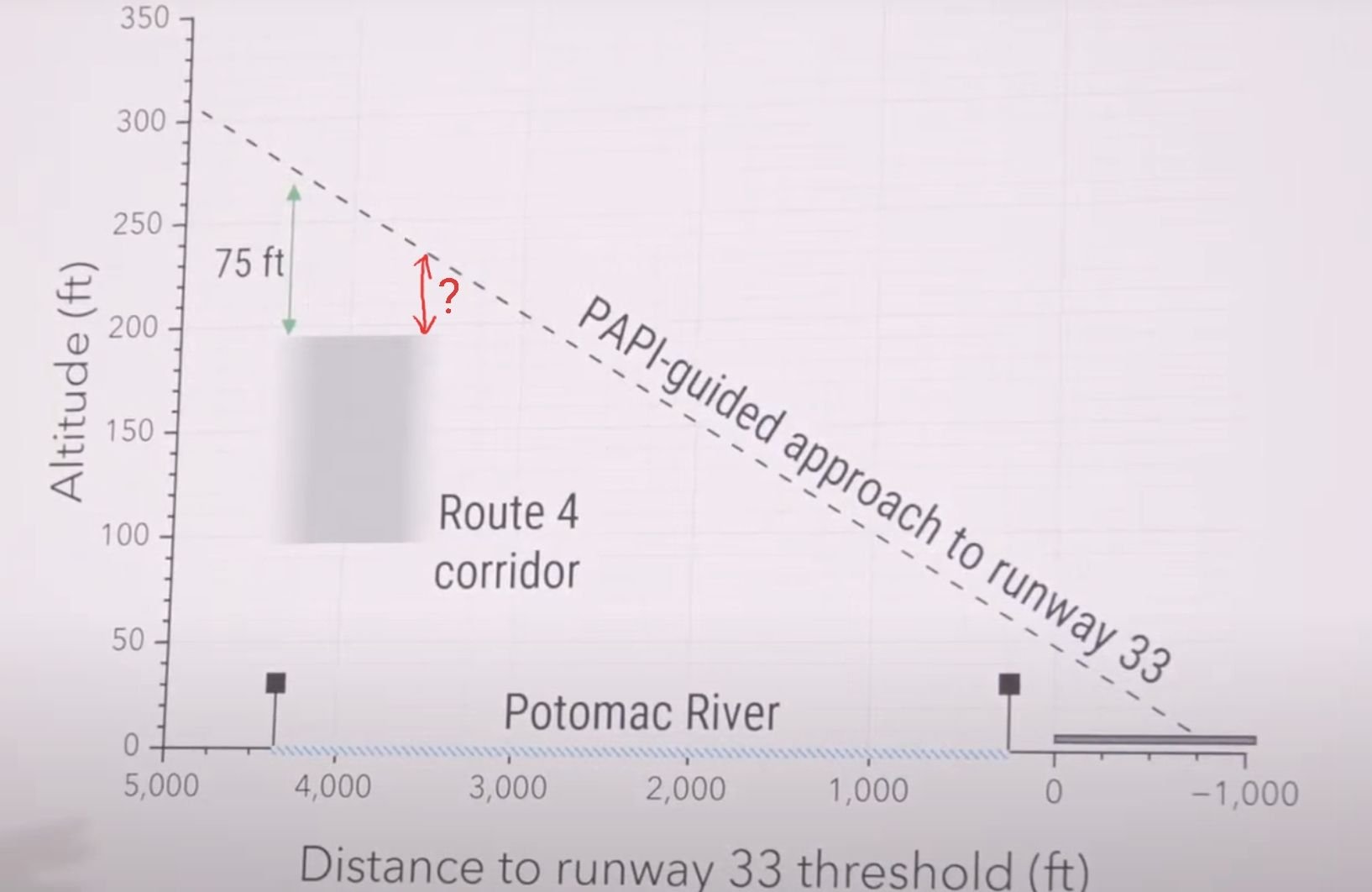
Of course in this case the thing known to degrade safety is "see and avoid", the regulator is the FAA, and the relevant parts of the user community appear to be "near as damn all of it". Focusing on the Army pilots' failure to achieve it would be a neat distraction from the much more difficult question (for everyone) of whether it is an appropriately safe means of separating from airline traffic. The nice NTSB diagram of Route 4 and the 75 feet spacing dodges the issue that neither the controller nor the Army pilots assumed that procedural separation existed; visual separation was being applied.
The permanent closure of Route 4 could be seen as acceptance that this was an unsafe basis on which to permit operations. However it still misses the point. The route was capable of being operated safely, for instance by holding helicopter traffic or avoiding use of runway 33 when needed to prevent conflictions, but that would have been tacitly to accept that visual separation was unsafe. Closing the route also only fixes the issue on one runway at one airport. Where next?
Last edited by Easy Street; 22nd March 2025 at 13:08 .
Subjects
ATC
FAA
NTSB
Route 4
See and Avoid
Separation (ALL)
Visual Separation
Links are to this post in the relevant subject page so that this post can be seen in context.
Reply to this quoting this original post. You need to be logged in. Not available on closed threads.
March 22, 2025, 22:11:00 GMT
permalink Post: 11852334
Probably five dozen lawyers have added, or will add, to their work-in-progress plans for their fact investigation and discovery activities locating, interviewing, and taking the depositions of retired ATCOs - with pertinent knowledge and appropriate credibility and experience, of course.
1. The actively used heli routes near landing traffic with merely hundreds of feet or less of "separation ".
2. The CA system being unreliable , it goes off all the time.. very high % of CA alarms in towers are useless. They do not have the effect outsiders or higher management think they do. We get so used to them going off that they don't carry the weight some wish they did. I have seen close calls where the CA goes off after the planes are a mile already past each other.
3. Visual separation with helicopters that normally use airspace, how often do they actually have traffic in sight and can maintain it? Are they just saying they do to get their job done? Should visual separation be allowed under NVGs ?
4. Many TCAS-RA problems under similar conditions, but nothing solid done about it? Where was management before? LSC? I honestly wonder if some controllers hated that operation but felt pressured into doing it to keep rate high and let the helis do their mission at the same time ?
Subjects
ATC
Close Calls
Night Vision Goggles (NVG)
Separation (ALL)
Traffic in Sight
Visual Separation
Links are to this post in the relevant subject page so that this post can be seen in context.
Reply to this quoting this original post. You need to be logged in. Not available on closed threads.
March 23, 2025, 08:32:00 GMT
permalink Post: 11852481
Last edited by lakedude; 23rd March 2025 at 08:35 . Reason: change percent to degree
Subjects
Separation (ALL)
Links are to this post in the relevant subject page so that this post can be seen in context.
Reply to this quoting this original post. You need to be logged in. Not available on closed threads.
March 23, 2025, 10:35:00 GMT
permalink Post: 11852551
As for your question on the glideslope, I did NOT properly account for the EGM96 correction. The new chart moves the glideslope up 5' to meet the height of the PAPI as measured in Google Earth (18'), which uses EGM96. Is that reasonable? I should also add a couple of feet to account for the height of the PAPI lights themselves. Does anyone know how much I should add? Thanks for the catch.
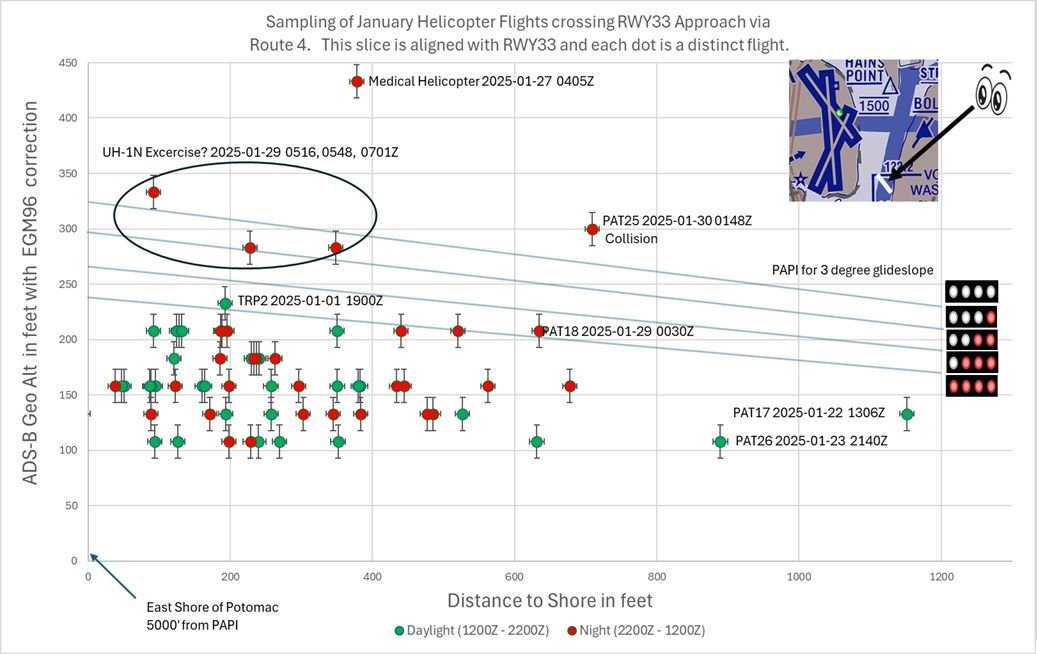
Helicopters crossing RWY 33 approach via Route 4 for January (updated)
75' is plainly inadequate vertical clearance between two aircraft and doubling/tripling that would still be unacceptably close. Separation was surely expected to be achieved horizontally but the enforcement/implementation was lacking.
Subjects
ADSB (All)
Route 4
Separation (ALL)
Links are to this post in the relevant subject page so that this post can be seen in context.
Reply to this quoting this original post. You need to be logged in. Not available on closed threads.
March 23, 2025, 11:49:00 GMT
permalink Post: 11852630
Subjects
Separation (ALL)
Links are to this post in the relevant subject page so that this post can be seen in context.
Reply to this quoting this original post. You need to be logged in. Not available on closed threads.
March 26, 2025, 21:43:00 GMT
permalink Post: 11854783
Subjects
PAT25
Preliminary Report
Radar
Route 4
Separation (ALL)
Visual Separation
Links are to this post in the relevant subject page so that this post can be seen in context.
Reply to this quoting this original post. You need to be logged in. Not available on closed threads.
March 27, 2025, 18:58:00 GMT
permalink Post: 11855392
I also watched the hearing and learned little new from the parade of platitudes and witness obfuscation. I thought far too much time was spent on ADS-B (an acronym which Maria Cantwell is incapable of uttering correctly). No discussion on use of visual separation. There were a few new points:
1. Cause of spurious DCA TCAS alerts. ME links in related thread.
2. When NTSB examined other Blackhawks of 12th AB fleet, found significant number which did not transmit ADS-B even when ADS-B switched on. One helo (accident helo?) was found to have not transmitted ADS-B for past 700+ days.
Subjects
ADSB (All)
DCA
NTSB
Separation (ALL)
TCAS (All)
Visual Separation
Links are to this post in the relevant subject page so that this post can be seen in context.
Reply to this quoting this original post. You need to be logged in. Not available on closed threads.
March 28, 2025, 22:46:00 GMT
permalink Post: 11856308
I also watched the hearing and learned little new from the parade of platitudes and witness obfuscation. I thought far too much time was spent on ADS-B (an acronym which Maria Cantwell is incapable of uttering correctly). No discussion on use of visual separation. There were a few new points:
1. Cause of spurious DCA TCAS alerts. ME links in related thread.
2. When NTSB examined other Blackhawks of 12th AB fleet, found significant number which did not transmit ADS-B even when ADS-B switched on. One helo (accident helo?) was found to have not transmitted ADS-B for past 700+ days.
The US Army, in order to meet its mission requirements, really does not want civilian pilots (commercial or otherwise) to know where its helicopters are. My evidence for this is: The eagerness of the US Army pilots to assume responsibility for seeing and avoiding commercial aircraft; The DCA tower procedures that do not allow civilian fixed wing pilots to hear the conversations between the tower and the helicopters; The Army practice of turning off ADS-B out while on missions and training flights that follow mission profiles (as explained by the USA general in the hearing); The Army's refusal to produce the memo regarding its use of ADS-B to Senator Cruz.
Should the policies adopted by the US Army be regarded as the fundamental cause of this accident?
Subjects
ADSB (All)
ADSB Out
DCA
NTSB
Separation (ALL)
TCAS (All)
Visual Separation
Links are to this post in the relevant subject page so that this post can be seen in context.
Reply to this quoting this original post. You need to be logged in. Not available on closed threads.
March 29, 2025, 04:09:00 GMT
permalink Post: 11856414
DAL2983 (A319) and DO61 had an altitude separation of about 100 ft and 0.5 nm at closest point of approach with a relative closure rate of 440 kts.
Two interactions just prior to above that may not have generated RAs: RPA4500 (E75L) passed DO61 with no lateral separation and about 1800 ft vertical separation with a relative closure of 540 kts. JIA5308 (CRJ7) passed DO61 with no lateral separation and 1200 ft separation with a relative closure of 475 kts. Unknown where DO63 was with respect to DO61.
Subjects
Separation (ALL)
TCAS RA
Vertical Separation
Links are to this post in the relevant subject page so that this post can be seen in context.
Reply to this quoting this original post. You need to be logged in. Not available on closed threads.
March 29, 2025, 05:28:00 GMT
permalink Post: 11856433
Dumbo Question 3
As you are no doubt aware TWR Visual Separation is a very powerful tool / method in the eyes of the controller or in the eyes of a delegated pilot. (Literally and metaphorically speaking, i.e pun intended.)
It is the very basis of ATC Aerodrome Control. Sophisticated use requires experience and excellent situational awareness.
I just wonder how many (if any) of the “reported” near collisions in the NTSB Preliminary report going back 4 and 14 years respectfully included perfectly safe visual separation?
The small elephant in the room.
Last edited by ATCDumbo; 29th March 2025 at 07:58 .
Subjects
ATC
NTSB
Preliminary Report
Separation (ALL)
Situational Awareness
Visual Separation
Links are to this post in the relevant subject page so that this post can be seen in context.
Reply to this quoting this original post. You need to be logged in. Not available on closed threads.
March 29, 2025, 10:29:00 GMT
permalink Post: 11856539
Subjects
Separation (ALL)
Visual Separation
Links are to this post in the relevant subject page so that this post can be seen in context.
Reply to this quoting this original post. You need to be logged in. Not available on closed threads.