July 31, 2025, 08:41:00 GMT
permalink Post: 11931111
What is likely to make a media deal is the wrongly calibrated ( or QNH setting) of the PAT altimeters which might open discussion on the real issue : the initial 100 feet procedural separation
Subjects
ATC
QNH
Separation (ALL)
Links are to this post in the relevant subject page so that this post can be seen in context.
Reply to this quoting this original post. You need to be logged in. Not available on closed threads.
July 31, 2025, 19:18:00 GMT
permalink Post: 11931506
For TF/TA radalt is the go-to instrument, but for coordinating multiple aircraft to maintain vertical separation, barometric altitude is more suitable. The problem being that barometric altimeters are subject to a lot of measurement and reporting errors.
I am sure that GPS-RTK could be used to fix the absolute altitude with great precision, but I am also sure that depending on an easily denied measurement source on a military aircraft is not going happen.
The correct solution for operating in a civilian airspace is to use ADS-B In/Out for all manned aircraft to provide appropriate and timely situational awareness. While ADS-B is also subject to denial, it offers far greater benefit in civilian airspace over GPS-RTK in that it tells the pilots where all the other aircraft are rather than simply being more precise about where their own aircraft is.
It is clear that the helicopter crew not knowing where the passenger jet was was the primary cause of the collision.
Arguments about the error in the altimeter readings are suitable to emphasize that depending on them in a crowded airspace is a fool's choice and should have been spotted a long time ago as insufficient to provide clearance.
Subjects
ADSB (All)
Altimeter (All)
Radio Altimeter
Separation (ALL)
Situational Awareness
Vertical Separation
Links are to this post in the relevant subject page so that this post can be seen in context.
Reply to this quoting this original post. You need to be logged in. Not available on closed threads.
July 31, 2025, 22:41:00 GMT
permalink Post: 11931566
Subjects
ATC
QNH
Separation (ALL)
Links are to this post in the relevant subject page so that this post can be seen in context.
Reply to this quoting this original post. You need to be logged in. Not available on closed threads.
July 31, 2025, 23:36:00 GMT
permalink Post: 11931584
EDIT: I also appreciate the arriving jet was on a geometric glide slope and that radalt under the glideslope could have been sufficient, but if one is expecting that vertical separation is sufficient then there needs to be certainty to that altitude and clearly that isn't possible on barometric altimeter and should never have been accepted by anyone.
Last edited by MechEngr; 1st August 2025 at 05:39 .
Subjects
AA5342
Altimeter (All)
Barometric Altimeter
Radio Altimeter
Separation (ALL)
Vertical Separation
Links are to this post in the relevant subject page so that this post can be seen in context.
Reply to this quoting this original post. You need to be logged in. Not available on closed threads.
August 01, 2025, 10:05:00 GMT
permalink Post: 11931748
I'm going to offer a contributing cause that I think merits consideration: there was mention made early on of there being 1, not 2, tower controllers on duty at the time when apparently 2 is the normal number.
Had there been two, the helicopter might have been handled differently, but we'll never know.
For me the key point of this accident is the 100 ft procedural separation planned between a Heli route and a non precision ( e.g visual) approach path . The rest are just more holes in the cheese.
Subjects
ATC
CRJ
Separation (ALL)
Links are to this post in the relevant subject page so that this post can be seen in context.
Reply to this quoting this original post. You need to be logged in. Not available on closed threads.
August 01, 2025, 15:56:00 GMT
permalink Post: 11931914
There's a reason for the normal 500' or 1000' separation between traffic, eg enroute cruising altitudes. Someone once worked out the tolerances and margins.
Subjects
ATC
Altimeter (All)
Separation (ALL)
Links are to this post in the relevant subject page so that this post can be seen in context.
Reply to this quoting this original post. You need to be logged in. Not available on closed threads.
August 01, 2025, 22:40:00 GMT
permalink Post: 11932083
And they acknowledged it, although in a very short reply (understandable to keep R/T's as short as possible).
But replying with " traffic circling 33 in sight " just might have improved their own SA, helping to build the mental picture that mentioned traffic was going to move slightly to their left and was at some point going to cross their route from left to right. And if they didn't have that mental picture of what "circling 33" meant for their routing, then a lot was wrong long before the impact.
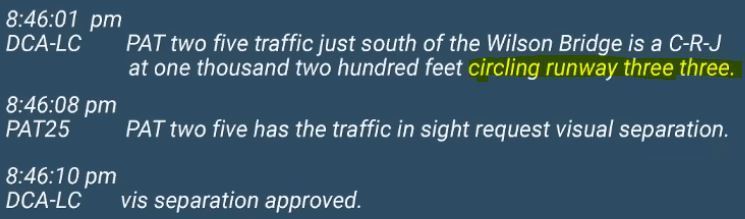
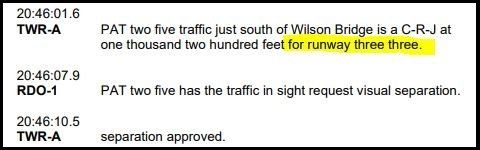
And what strikes me over and over again, is this mutual 'pavlovian' "request visual separation"-"approved" thing, as if proclaiming these words, absolves all involved from any rules/restriction that might hinder the smooth flow of things (which it does - kind of).
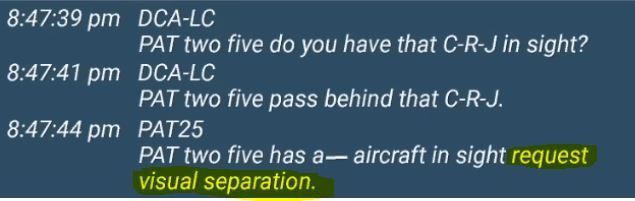
Even at the last chance of averting disaster by the controller (by clearly indicating the target), the pavlovian reaction was there again (totally meaningless as it was already requested and approved 96 second earlier)...
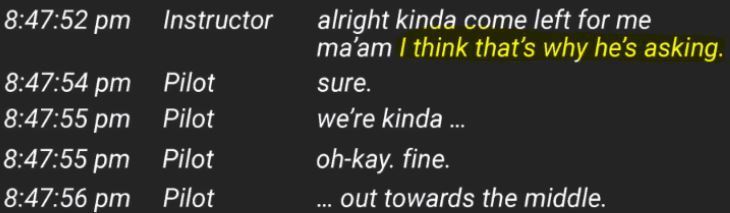
Last edited by DIBO; 2nd August 2025 at 22:03 . Reason: add extract from UH60 CVR transcript (not available/included in NTSB debrief animation)
Subjects
ATC
CVR
Night Vision Goggles (NVG)
Separation (ALL)
Situational Awareness
Visual Separation
Links are to this post in the relevant subject page so that this post can be seen in context.
Reply to this quoting this original post. You need to be logged in. Not available on closed threads.
August 01, 2025, 23:15:00 GMT
permalink Post: 11932095
Normalisation of deviance doesn\x92t even come close.
- Airspace design. The heli route stepping down to 200ft max lead some army pilots to believe it gave clearance from DCA traffic. Spoiler. It did not.
- Controller workload \x93Just make it work\x94 was a common attitude at DCA
- FAA not actively tracking TCAS RA \x93incidents\x94 as it could skew data.. maybe it was correctly applied visual separation etc. Need to look at the background etc. Yeah. But it generated an RA 🤬
- FAA refusing requests for traffic \x93hot spots\x94 on low level VFR charts as \x93hot spots\x94 are on ground charts only.
- PAT25 wanted visual separation from the CRJ. ATC was required to inform the CRJ crew another aircraft was applying visual separation to them. They didn\x92t.
Honestly from a European perspective. It\x92s quite bone chilling.
I feel this was a systemic failure. Airspace design and Risk Normalisation.
And my heartfelt condolences for the pilots, of both aircraft, and everyone else involved including the ATCOs. Not that there weren\x92t issues\x85 but in the Swiss cheese model, the FAA bought the cheese, drilled holes in it, and invited everyone to take a look inside.
Slightly surprised by some NTSB comments as well\x85 they were presented that the heli was straight ahead on the CRJ TCAS simulation presentation. But in actual fact the CRJ was circling in a left turn for runway 33. It was stable at 500ft but in a left turn to line up with the runway\x85 wings level at 300ft. It was challenged by the airline/ALPA but I would hope the NTSB would have picked up on that.
Low point of the whole hearing was Jennifer Homendy halting proceedings and moving witnesses to different seats, as one of the FAA managers elbowed a colleague while she was giving testimony - at which point she went quiet. Infernce being she was being reminded to stop talking.
Subjects
ATC
CRJ
DCA
FAA
NTSB
NTSB Chair Jennifer Homendy
Normalization of Deviance
PAT25
Separation (ALL)
TCAS (All)
TCAS RA
VFR
Visual Separation
Links are to this post in the relevant subject page so that this post can be seen in context.
Reply to this quoting this original post. You need to be logged in. Not available on closed threads.
August 03, 2025, 14:05:00 GMT
permalink Post: 11932790
Twelve billion dollars here, eighteen billion dollars additional there, pretty soon you're talking real money (with apologies to anyone who recalls the originator, Illinois Senator Everett McKinley Dirksen). With all that federal largesse provided by the American taxpayer destined to be spent on the so-called "new ATC system", I have a question. Isn't it necessary to know what conclusions the Board reaches in this investigatory process before committing to - and I'm going to use my own phrase - the "new National Airspace Architecture"?
The United States needs a new FAA organization, on two fronts at least. One, separate the ANSP from the regulator (as probably hundreds of real-life aviation industry worthies have long advocated). Second, a new organizational structure, ethos, culture, set of career pathways, and everything else that is not fit for purpose for the immient and dramatic changes dead-ahead (such as automation, Advanced Air Mobility, environmental pressures, and oh yeah, increased traffic correlated with increased demands from the traveling public for the precise kind of bag of peanuts to which they believe they're entitled). Is it not the case that FAA has failed in its fundamental mission, because under no ConOps should it have been possible for this accident to take place? (Of course, there will never be a guarantee against one or more persons conducting relevant activities with gross negligence - but if that harsh judgment is levied against the Black Hawk, nonetheless the system should have provided stronger procedural separation.)
And all this is before decisions are made about what technologies to build into the new Nat'l Airspace Arch., what vendors, what geographic arrangement, and what connectivity the entire system will have with ATM in Europe and globally (and European ATM especially is moving rapidly into the future).
But the Board final report is what, 12 months away? 18 months perhaps?
And as the new National Airspace Architecture is supposed to be undergoing definition and development, what assurance is there that the upcoming 42nd Triennial Assembly of ICAO in Montreal will not take action which will seriously impact the U.S. process? Or set ICAO on further intitiatives which would constrain U.S. plans, and not necessarily for the better? Recall that the United States has not had a designated Permanent Representative to ICAO since Capt. Sully abruptly resigned (July 2022), and while the career Foreign Service officials heading up the U.S. Mission undoubtedly are fine and excellent public servants, they are not ( afaik ) aviation industry professionals.
None of this is to say that the NTSB should speed up its process and deliberations. But at the same time, if during this Assembly the Secretary of Transportation shows up - as happened during the previous Assembly - to speak on behalf of the United States, I hope the Secretary has very, very good speechwriters because it will be hard to say anything meaningful when the state of affairs is in such disarray.
Edit:
On July 17 the White House nominated former Delta Airlines Capt. and U.S. Navy aviator Jeffrey Anderson to the position of Permanent Representative to ICAO with the rank of Ambassador. Timing of Senate confirmation hearing is presently unknown.
Last edited by WillowRun 6-3; 3rd August 2025 at 22:34 .
Subjects
ATC
Blackhawk (H-60)
FAA
Final Report
ICAO
NTSB
Separation (ALL)
Links are to this post in the relevant subject page so that this post can be seen in context.
Reply to this quoting this original post. You need to be logged in. Not available on closed threads.
August 06, 2025, 15:09:00 GMT
permalink Post: 11934187
Subjects
ATC
Route 4
Separation (ALL)
Visual Separation
Links are to this post in the relevant subject page so that this post can be seen in context.
Reply to this quoting this original post. You need to be logged in. Not available on closed threads.
August 06, 2025, 18:07:00 GMT
permalink Post: 11934290
https://data.ntsb.gov/Docket/Documen...dacted-Rel.pdf
Last edited by Stagformation; 7th August 2025 at 08:57 .
Subjects
ATC
Route 4
Separation (ALL)
Visual Separation
Links are to this post in the relevant subject page so that this post can be seen in context.
Reply to this quoting this original post. You need to be logged in. Not available on closed threads.
August 06, 2025, 18:42:00 GMT
permalink Post: 11934308
Subjects
PAT25
Separation (ALL)
Traffic in Sight
Visual Separation
Links are to this post in the relevant subject page so that this post can be seen in context.
Reply to this quoting this original post. You need to be logged in. Not available on closed threads.
August 06, 2025, 19:35:00 GMT
permalink Post: 11934332
Subjects
ATC
Normalization of Deviance
Separation (ALL)
Traffic in Sight
Visual Separation
Links are to this post in the relevant subject page so that this post can be seen in context.
Reply to this quoting this original post. You need to be logged in. Not available on closed threads.
August 08, 2025, 10:02:00 GMT
permalink Post: 11935129
What I learned:
Interestingly the Local controller involved was also a CPL pilot
Pressure to use 33 for landing during high departure rates was there to avoid the queue blocking the taxi ways for arriving aircraft : ( my comment : when you get to that situation traffic should be reduced by departure slots , that what we do in Europe with the Network manager CTOTs..)
No reaction to Conflict alert because visual acquisition was prioritized , i.e if you saw the helicopter passing behind you disregarded the CA. and this was almost always the case so CA with helicopters became disregarded
Advanced training was poor or non existent ( e.g Threat/Error management training).
On the PAT pilots interviews the most flagrant normalization of deviance is requesting visual separation with an aircraft you do not see ( yet) I realize that was declared by pilots other that the one operating that flight , but gives a good indication of the local " best practices " in that area.
Finally on the TCAS issue, one of the screenshots shows other traffic, and we can see that there were 2 TAs one in front -2 and one behind +6 , that could ( emphasis on could) have been one of the reason the CRJ crew missed the urgency of the -2 , but also probably were more focusing on the PAPI so both looking outside instead of at the display .
And to reply to a question earlier by DIBO on the discussion about ADS-B out not avail on the RAT, and its relevance for TCAS, well it would have influenced the degree of accuracy of the Tau calculation ( with Alt returns every 25 ft instead of 100 feet) and could ( again emphasis on could) have changed the alert logic/timing of the TA. Non installation of ADS-B and flying 70 ft too high are probably one of the points the lawyers are going to get into to prove negligence from the military to get more money for their clients , possibly shadowing the real causes. ; which for me are still the design of the procedure and routes, and the failure of the Regulator to act on the alerts. . Love to hear Willow-Run 6-3 comment on this .
.
Subjects
ADSB (All)
ADSB Out
ATC
CRJ
DCA
Normalization of Deviance
Separation (ALL)
TCAS (All)
Visual Separation
Links are to this post in the relevant subject page so that this post can be seen in context.
Reply to this quoting this original post. You need to be logged in. Not available on closed threads.
August 08, 2025, 10:54:00 GMT
permalink Post: 11935166
Subjects
ATC
Normalization of Deviance
Separation (ALL)
Visual Separation
Links are to this post in the relevant subject page so that this post can be seen in context.
Reply to this quoting this original post. You need to be logged in. Not available on closed threads.
August 08, 2025, 15:59:00 GMT
permalink Post: 11935283
Otherwise, if you watched the hearing, you'll remember that on day 1 the Army pilots and the medivac helo operator stated that they do not underfly aircraft.
Subjects
NTSB
Separation (ALL)
Links are to this post in the relevant subject page so that this post can be seen in context.
Reply to this quoting this original post. You need to be logged in. Not available on closed threads.
August 08, 2025, 16:19:00 GMT
permalink Post: 11935293
And to reply to a question earlier by DIBO on the discussion about ADS-B out not avail on the [P]AT, and its relevance for TCAS, well it would have influenced the degree of accuracy of the Tau calculation ( with Alt returns every 25 ft instead of 100 feet) and could ( again emphasis on could) have changed the alert logic/timing of the TA. Non installation of ADS-B and flying 70 ft too high are probably one of the points the lawyers are going to get into to prove negligence from the military to get more money for their clients , possibly shadowing the real causes. ; which for me are still the design of the procedure and routes, and the failure of the Regulator to act on the alerts. . Love to hear Willow-Run 6-3 comment on this .
.
As for the airline, to fault the pilots when they were on short finals and expected to concentrate on flying - as others have expressed here numerous times - seems very ill-founded. Whether the airline company could be alleged to have responsibility for not having spoken up more effectively to cause the airspace design and procedure to be redone also strikes me as far too oblivious to the actual operation of the NAS, and the FAA and Congressional processes, to have any validity as an approach to liability. The airline and even Sikorski could still be named as defendants but, to reiterate, this would be just for leverage and not because there is any real pathway to liability for either one.
That having been set as background, the first context ignores the existence of sovereign immunity issues and looks just at what happened and who was responsible. As a rubric for this, "normalization of deviance" seems very accurate. This includes the fact that over time, ignoring Conflict Alerts came to be routine. It includes the practice of confirming "traffic in sight" or related proper terminology, for visual separation even though no traffic had been sighted yet - because it had become routine that the traffic would come into view and be properly identified as the traffic ATC had called out. The testimony about "just make it work", as I heard it, similarly was very concerning; iirc an overall very credible FAA witness acknowledged that the "just make it work" attitude also resulted in decreased safety margins. As did the medical helicopter operator who also had Army helicopter service background. Add in the lack of advanced training, and though I have not practiced law as legal counsel for accident victims' families, the liability theories here appear strong.
Then factor in the use of 3-3 to allievate congestion from high departure rates, rather than slowing or reducing departure slots. Part of the pressure to use 3-3 (as I understood the testimony) was that the Potomac Tracon wanted to increase in-trail separation but DCA instead increased use of 3-3. This was consistent with the attitude, "just make it work".
As to ADS-B on the helicopters, my understanding is that given the roles and missions of the helicopter operations, ADS-B is not equippage the military and its civilian control (in the sense of oversight) could have approved consistent with those roles and missions generally, and especially the continuing-of-government function.
Putting all the causal factors together into a "theory of the case" is perhaps better left to advocates for the accident victims' families (just as defense theories better left to defense counsel in this matter). But since you've impliedly asked, I would not - in this first context - parse out three of the four factors you noted, the lack of ADS-B being the one left out. That leaves the helicopter operating approximately 70 feet too high, the airspace design and procedures including the helicopter routes, and the inaction following the several safety alerts in databases and other reporting functions prior to the occurence of the accident. And including the forced enlistment of DCA for handling more traffic than the widely accepted airspace utilization and safe operation rules and procedures would allow - but they "just made it work." In other words, all of these three factors combine into the most likely theory of liability.
There is a second context, however. Federal government defendants are protected, despite the broad removal (waiver) of sovereign immunity by federal statute, from liability if the alleged negligence resulted from the exercise of discretion. If the actions or omissions being challenged resulted from decisions in which the federal entity weighed economic, social, political and other factors against each other in a form of "policy" decision-making, sovereign immunity remains in place. You can see where this is leading, of course. At what point does the over-use of DCA move out of the protection of "discretionary functions and decision-making" and into the realm of ... just plain negiligence which needs to be addressed in a court action. And likewise, at what point does the Army's set of decisions about how the routes are flown, and how visual separation and traffic sightings are handled, move out of the protection given by discretionary decisions and into the realm of significant negligence not deserving of such protection? Same question for FAA - surely the presence of safety concerns in databases and reporting systems - as unorganized as they may be and as lacking in systematic review as they may be - are matters within the FAA's discretionary functions and decision-making . . . until they're not. (And not equipping PAT helicopters or other D.C.-based Very Important air transport operations by helicopter with ADS-B would have no chance of being ruled not resulting from a discretionary function and decision - it's not even arguable imo.)
I almost included with this (already lengthy) post the "syllabus" of the U.S. Supreme Court's decision in the United States v. Varig Airlines case, which I think is the most pertinent aviation case in which the discretionary function rule is fundamentally involved....but this isn't a legal forum. Still, the U.S. S. Ct. opinion (467 U.S. 797 1984) gives me uncertainty about how any court of competent jurisdiction will draw the line between what would in a case against a not-federal defendant definitely appear to be negligence, and the actions and omissions of the federal defendants here. (My personal view is that the federal defendants acted with such severe negligence that the discretionary function protection has been lost - but that is a gut reaction to the "this accident never should have happened" idea and not legal analysis.)
Finally and last for a reason, I am not commenting about the motives of legal counsel who are representing or advising clients involved in this matter. I have not practiced law a single day, or a single billable hour, or otherwise, on behalf of the families or representatives of aviation accident victims, or the defendants in such matters. As a result, in participation as a guest on this forum I think it's much wiser to let the members of the bar who do have clients and who do practice in this area let their conduct in their professional capacities speak for itself.
Subjects
ADSB (All)
ADSB Out
ATC
Accountability/Liability
DCA
FAA
Normalization of Deviance
Separation (ALL)
TCAS (All)
Traffic in Sight
Visual Separation
Links are to this post in the relevant subject page so that this post can be seen in context.
Reply to this quoting this original post. You need to be logged in. Not available on closed threads.
August 10, 2025, 05:00:00 GMT
permalink Post: 11936009
I strikes me that, from my layman’s point of view, that this is the primary and gaping hole (among numerous others) in the Swiss cheese here.
At the same time, I get the sense that no controller was ever going to intentionally permit a helicopter to pass directly under an approaching aircraft and challenge that limited clearance.
My question is, should this have been (or was it?) formalized as an ATC procedure? Because if this had been proceduralized, I find it hard to believe that just nighttime VFR separation would have been found acceptable in that environment. Rather I would think that lateral separation should have been actively managed by ATC.
For one thing, with the CRJ (or whatever aircraft) pilots making a late switch to 33, turning to line up with the runway, etc., they may not have had the bandwidth to scan for a possibly conflicting helicopter, if they could even have seen it from their cockpit. (IIRC from the inquiry, the NTSB will be investigating that last point.)
I don’t know how difficult it may have been for the helicopter to see the CRJ, but the simple fact is that they did not.
On another subject, one thing that struck me from the inquiry was that the helicopter pilot apparently had very limited recent flight time, yet was assigned a challenging check ride.
This contrasted with the testimony of the leader (?) of one of the local Medivac groups, who discussed how much more experience he and his pilots had flying in that challenging environment (and often single-pilot ops at that).
Is the Army not providing adequate training and flight time to ensure their pilots can operate safely in those conditions?
Last edited by andihce; 10th August 2025 at 06:44 . Reason: clarification
Subjects
ATC
Altimeter (All)
CRJ
NTSB
Route 4
Separation (ALL)
VFR
Vertical Separation
Links are to this post in the relevant subject page so that this post can be seen in context.
Reply to this quoting this original post. You need to be logged in. Not available on closed threads.
August 10, 2025, 06:10:00 GMT
permalink Post: 11936017
I strikes me that, from my layman\x92s point of view, that this is the primary and gaping hole (among numerous others) in the Swiss cheese here.
At the same time, I get the sense that no controller was ever going to allow a helicopter to pass directly under an approaching aircraft and challenge that limited clearance.
My question is, should this have been (or was it?) formalized as an ATC procedure? Because if this had been proceduralized, I find it hard to believe that just nighttime VFR separation would have been found acceptable in that environment. Rather I would think that lateral separation should have been actively managed by ATC.
For one thing, with the CRJ (or whatever aircraft) pilots making a late switch to 33, turning to line up with the runway, etc., they may not have had the bandwidth to scan for a possibly conflicting helicopter, if they could even have seen it from their cockpit. (IIRC from the inquiry, the NTSB will be investigating that last point.)
I don\x92t know how difficult it may have been for the helicopter to see the CRJ, but the simple fact is that they did not.
And to stick with motoring analogies, some of us are used to considering that at a junction another vehicle can be partly obscured by a pillar for one eye, and in the blind spot of our other eye, so we might move our head sideways to help check better. Some aircraft have more windscreen pillars (this helicopter has four) so the aircraft in a constant relative position - which is the one that is the collision risk - may stay behind a pillar unless we move our head.
Subjects
ATC
Altimeter (All)
CRJ
NTSB
Route 4
Separation (ALL)
VFR
Vertical Separation
Links are to this post in the relevant subject page so that this post can be seen in context.
Reply to this quoting this original post. You need to be logged in. Not available on closed threads.
August 10, 2025, 06:48:00 GMT
permalink Post: 11936029
I strikes me that, from my layman\x92s point of view, that this is the primary and gaping hole (among numerous others) in the Swiss cheese here.
At the same time, I get the sense that no controller was ever going to allow a helicopter to pass directly under an approaching aircraft and challenge that limited clearance.
My question is, should this have been (or was it?) formalized as an ATC procedure? Because if this had been proceduralized, I find it hard to believe that just nighttime VFR separation would have been found acceptable in that environment. Rather I would think that lateral separation should have been actively managed by ATC.
Subjects
ATC
Altimeter (All)
Blackhawk (H-60)
CRJ
IFR
NTSB
Route 4
Separation (ALL)
Traffic in Sight
VFR
Vertical Separation
Visual Separation
Links are to this post in the relevant subject page so that this post can be seen in context.
Reply to this quoting this original post. You need to be logged in. Not available on closed threads.