February 01, 2025, 14:16:00 GMT
permalink Post: 11819056
That’s why using their recordings leads to comments on pprune that the controller was cut off or didn’t say something or the aircraft didn’t acknowledge. It can be just the scanner not picking it up, because it focuses on one transmission at a time.
That’s not to comment on whether they had VHF or not.
The tower was transmitting on both frequencies - I believe - simultaneously.
So the CRJ would have heard only the tower's transmissions to the helo ('visual separation approved' x 2) and not the helo's transmissions.
Subjects
ATC
CRJ
Separation (ALL)
Visual Separation
Links are to this post in the relevant subject page so that this post can be seen in context.
Reply to this quoting this original post. You need to be logged in. Not available on closed threads.
February 01, 2025, 14:34:00 GMT
permalink Post: 11819060
Subjects
IFR
Separation (ALL)
Vertical Separation
Links are to this post in the relevant subject page so that this post can be seen in context.
Reply to this quoting this original post. You need to be logged in. Not available on closed threads.
February 01, 2025, 14:37:00 GMT
permalink Post: 11819062
Blaming the airspace design is also a non starter. Are we really going to say that just because the airspace is poorly designed then I'm just going to fly in to that regional jet over there?
First rule of airmanship anyone? Keep a good lookout. Seems like the helicopter crew failed to do so having been given their requested visual separation. Should have had eyes on stalks.
No the airspace does not take the blame. Apparently the hello pilots missed the lookout. And the controller could have been clearer, instead of \x93still in sight?\x94 perhaps \x93the RJ is now 1/2 mile 10 o\x92clock, confirm you have him?\x94.
(not criticizing him, guessing that he saw them closer than expected, was concerned, and made a very quick call)
But the airspace & procedure seems to not tolerate mistakes. There ought to be some safety margin. While not the primary fault, it could be improved.
Subjects
ATC
CRJ
Separation (ALL)
Visual Separation
Links are to this post in the relevant subject page so that this post can be seen in context.
Reply to this quoting this original post. You need to be logged in. Not available on closed threads.
February 01, 2025, 14:46:00 GMT
permalink Post: 11819066
This airspace literally has an intersection with crossing traffic designed into it. You can't hit something you're not close to.
Subjects
Separation (ALL)
TCAS (All)
Links are to this post in the relevant subject page so that this post can be seen in context.
Reply to this quoting this original post. You need to be logged in. Not available on closed threads.
February 01, 2025, 14:56:00 GMT
permalink Post: 11819074
The tower was transmitting on both frequencies - I believe - simultaneously.
So the CRJ would have heard only the tower's transmissions to the helo ('visual separation approved' x 2) and not the helo's transmissions.
It is not always understood on pprune (and again not you, mostly casual posters) that liveatc.net is just hobbyist / enthusiast stuff. It\x92s not reliable. The antenna placement is often poor, so some transmission sounds bad.
Same with using ads-b data from various sources and plotting tracks. Sometimes it is meaningful and sometimes the position is way too undersampled.
And don\x92t get me started on taking derivatives / differences on noisy undersampled signals to get things like wow look at that vertical speed here.
Subjects
CRJ
Separation (ALL)
Visual Separation
Links are to this post in the relevant subject page so that this post can be seen in context.
Reply to this quoting this original post. You need to be logged in. Not available on closed threads.
February 01, 2025, 15:17:00 GMT
permalink Post: 11819090
500' is also the VFR and IFR vertical offset standard. If unable to achieve, should not be allowed. 200' leg must be to be 500' below south flow DCA departures, so North flow arrivals need a better gate.
Subjects
DCA
IFR
Separation (ALL)
TCAS (All)
TCAS RA
VFR
Links are to this post in the relevant subject page so that this post can be seen in context.
Reply to this quoting this original post. You need to be logged in. Not available on closed threads.
February 01, 2025, 16:48:00 GMT
permalink Post: 11819158
The helicopter crew is said to have had NVG's but at this point no information has been provided re their use of NVG's.
The height issue is not the primary issue as the intent of the procedures and ATC instructions was to separate the two aircraft.
Had that separation effort worked there would have been no conflict thus no collision.
It is the failure of the separation and the meeting over the river the two aircraft in the same bit of air that height mattered.
No where in the standard procedure was it intended to have helicopter traffic fly below landing aircraft on RWY 33.
Poll the Pilots here folks....ask them if they would routinely fly 100-200 feet below a crossing aircraft? What do you think the answer would be?
I thank 212 Man for his input reminding me why he was the Teacher's Pet. I depend upon his ability to get into the books to keep me straight.
Now a test question for him.....were you flying the incident airplane doing a Visual Approach to RWY33....would you have tuned up the IAP for that RWY as an additional reference for your approach?
SOP's usually instruct Crews to use ILS data when doing Visual Approaches to runways with that kind of IAP so would that kind of thinking apply in this incident? Would that have been of any benefit considering the existing weather and terrain? Or, would that have been a distraction?
This was not a "Circling Approach" but it was very similar.
Subjects
ATC
Circle to Land (Deviate to RWY 33)
DCA
Night Vision Goggles (NVG)
Separation (ALL)
Links are to this post in the relevant subject page so that this post can be seen in context.
Reply to this quoting this original post. You need to be logged in. Not available on closed threads.
February 01, 2025, 16:56:00 GMT
permalink Post: 11819164
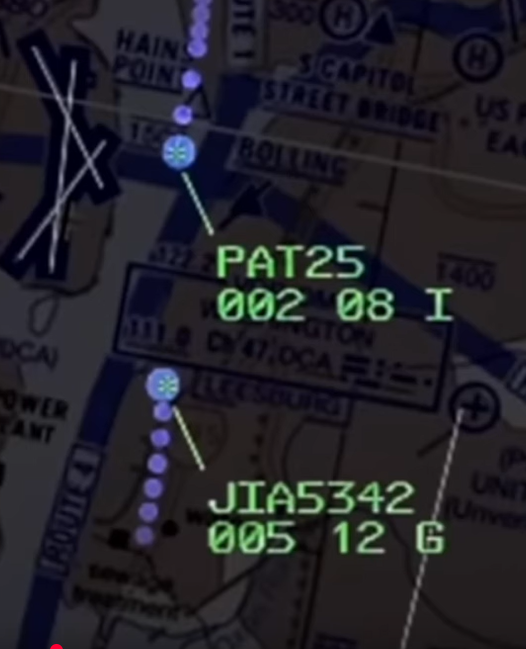
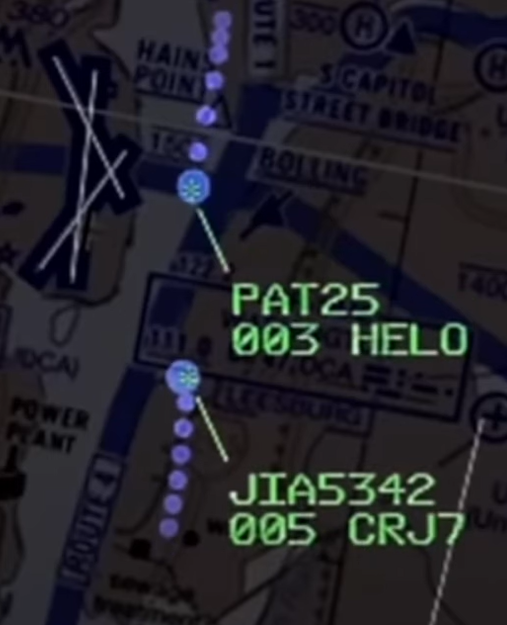
Subjects
ATC
Radar
Separation (ALL)
Vertical Separation
Links are to this post in the relevant subject page so that this post can be seen in context.
Reply to this quoting this original post. You need to be logged in. Not available on closed threads.
February 01, 2025, 17:18:00 GMT
permalink Post: 11819178
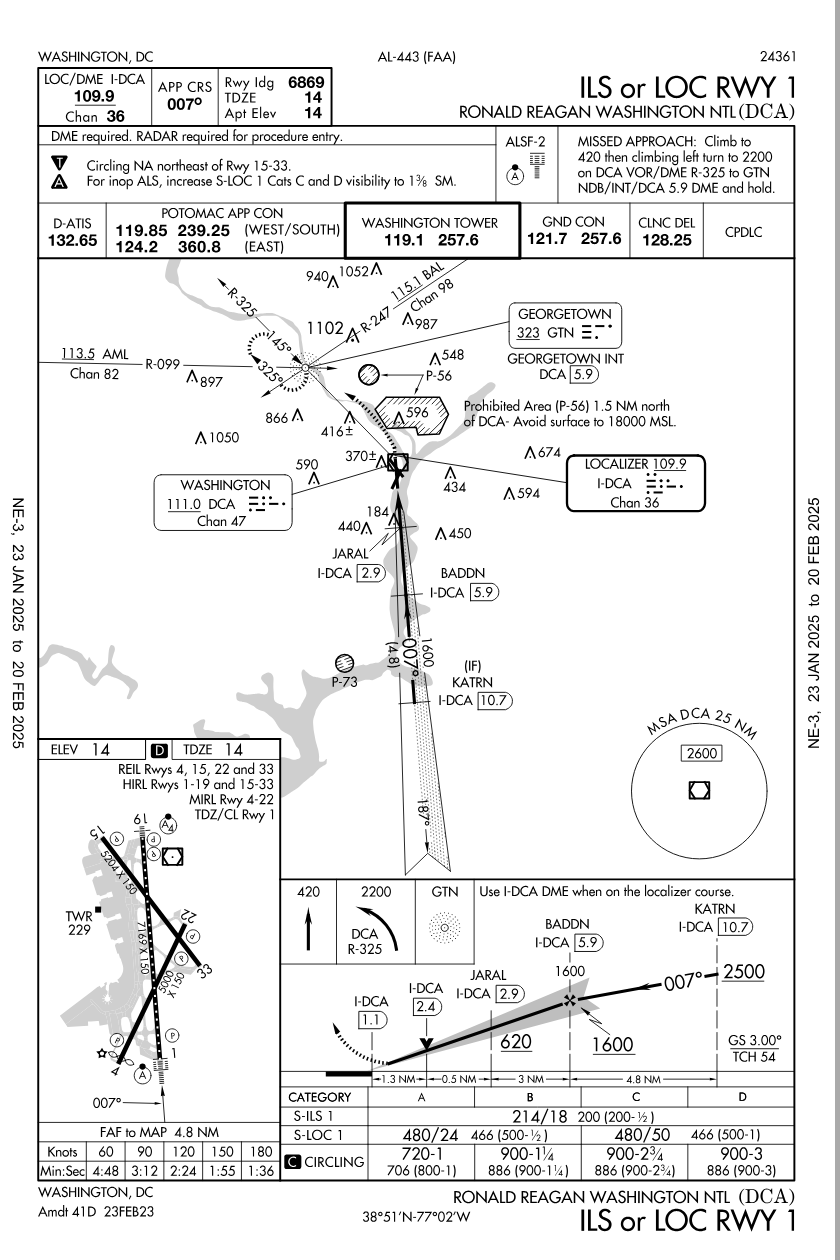
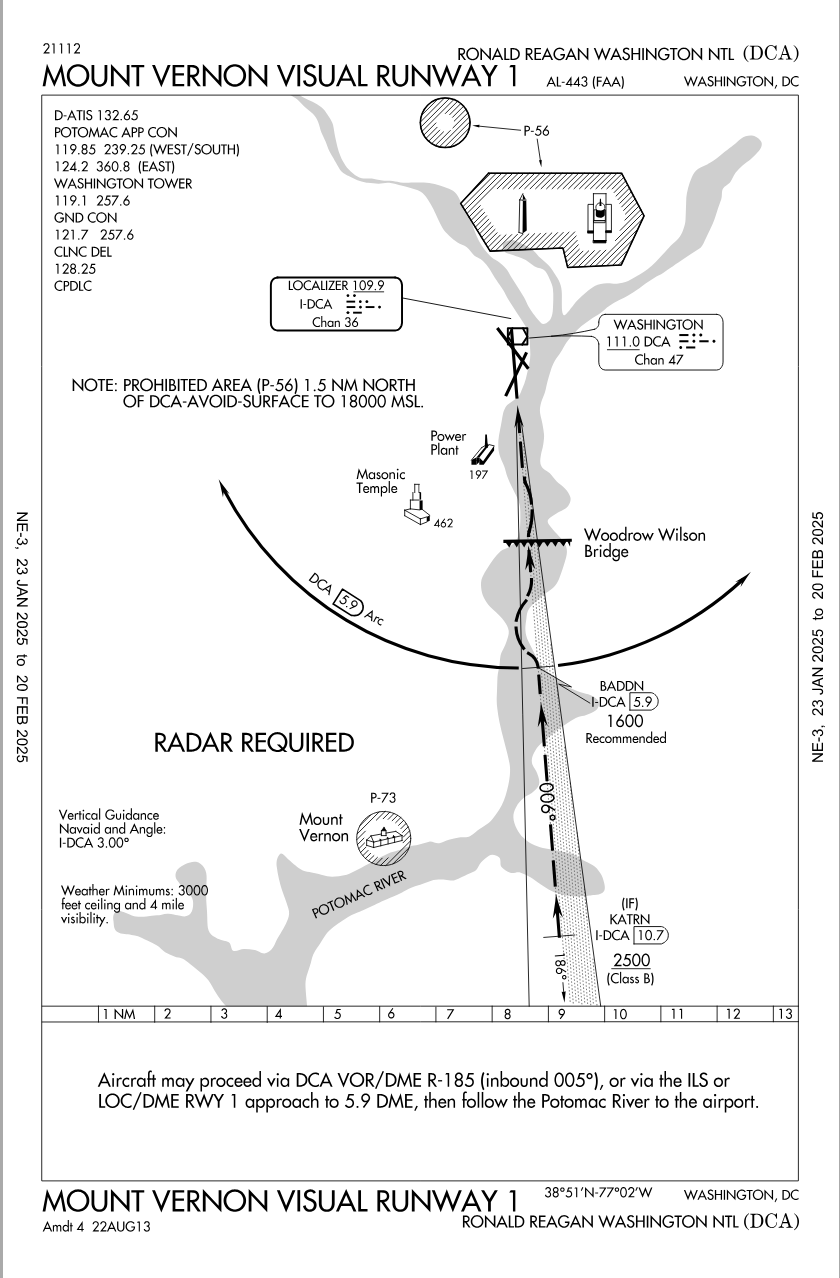
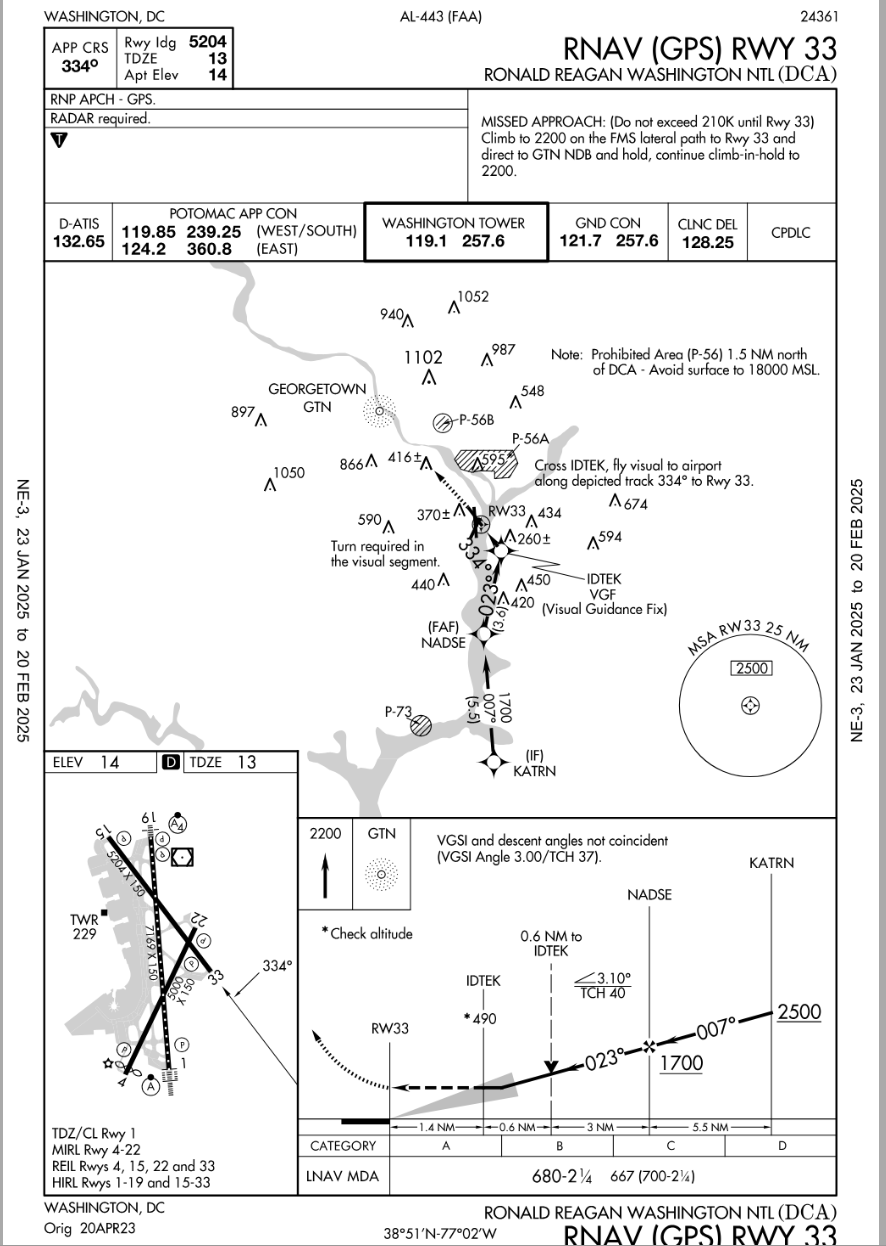
There is a curving RNAV approach, that is not in line with the runway until 490 feet/1.4nm, where one makes the last-minute ~50\xb0 left turn for visual runway alignment.
In light of that fact, maybe you can reframe your question.
AirNav: KDCA - Ronald Reagan Washington National Airport
https://aeronav.faa.gov/d-tpp/2501/00443R33.PDF
Now a test question for him.... . were you flying the incident airplane doing a Visual Approach to RWY33....would you have tuned up the IAP for that RWY as an additional reference for your approach ?
SOP's usually instruct Crews to use ILS data when doing Visual Approaches to runways with that kind of IAP so would that kind of thinking apply in this incident? Would that have been of any benefit considering the existing weather and terrain? Or, would that have been a distraction?
Pattern, perhaps you might review your comment.
It really is not a difficult concept or question.
Seems easy enough to understand if the post is actually read for comprehension sakes.
About 80% of all IATA operators would be discomforted by such changes, outside of the USA visual approaches at night have a litany of requirements to adhere to for the purposes of terrain separation, vs Texas big sky rules that do work in the US. In the end, taht didn't cause the accident, it is one of those things that goes with the freedom of flight in the USA.
...
Subjects
ATC
CRJ
KDCA
Separation (ALL)
Links are to this post in the relevant subject page so that this post can be seen in context.
Reply to this quoting this original post. You need to be logged in. Not available on closed threads.
February 01, 2025, 19:07:00 GMT
permalink Post: 11819244
The tower was transmitting on both frequencies - I believe - simultaneously.
So the CRJ would have heard only the tower's transmissions to the helo ('visual separation approved' x 2) and not the helo's transmissions.
Subjects
CRJ
Separation (ALL)
Visual Separation
Links are to this post in the relevant subject page so that this post can be seen in context.
Reply to this quoting this original post. You need to be logged in. Not available on closed threads.
February 01, 2025, 21:58:00 GMT
permalink Post: 11819334
Also depending on the range selected on the TCAS or ND display you might get a load of garbled nonesense.
Also, with any kind of warning system, they lose effectiveness with the more that they go off. A full-blooded TCAS RA is, thankfully, pretty rare on an individual basis (I\x92ve had 3 over 30 years, two in the USA) and is trained and practiced regularly. The CA/STCA that ATC received might have been the 27th of the day in that airspace for all we know, given the traffic levels and the routings in and out of DCA and criss-crossing the area, plus they did have confirmation of visual acquisition which was now the sole means of separation.
Subjects
ATC
DCA
Separation (ALL)
TCAS (All)
TCAS RA
Links are to this post in the relevant subject page so that this post can be seen in context.
Reply to this quoting this original post. You need to be logged in. Not available on closed threads.
February 01, 2025, 22:34:00 GMT
permalink Post: 11819350
Urgent information needs salience in displays and suitable attention-getters, but in that regard, proximate traffic near an airport could be given greater prominence, then to be lost in learned noise. TCAS is not the answer to this collision. I’m increasingly reminded of the term, ‘defensive controlling’. Yes, you expect to have vertical separation if the climber stops at its cleared level, but why not give it a five degree heading change, not to achieve any kind of separation, but just to make sure they don’t hit if it busts….
The transfer of responsibility to the helo crew here was entirely legitimate, but also created the single point of failure which led to a collision, and that was foreseeable.
Subjects
Separation (ALL)
TCAS (All)
Vertical Separation
Links are to this post in the relevant subject page so that this post can be seen in context.
Reply to this quoting this original post. You need to be logged in. Not available on closed threads.
February 01, 2025, 22:36:00 GMT
permalink Post: 11819353
No the airspace does not take the blame. Apparently the hello pilots missed the lookout. And the controller could have been clearer, instead of “still in sight?” perhaps “the RJ is now 1/2 mile 10 o’clock, confirm you have him?”.
(not criticizing him, guessing that he saw them closer than expected, was concerned, and made a very quick call)
But the airspace & procedure seems to not tolerate mistakes. There ought to be some safety margin. While not the primary fault, it could be improved.
The difficulties of identifying a specific aircraft, at night, in a background of stationary and moving lights, when moving objects on a collision course will always appear stationary to each other, are well known, as are the probabilities of mis-identification. The airspace design 'squeezes' inbound aircraft and transiting helicopters to practicality the same altitude, when instrument and other tolerances are taken into consideration.
I'm guessing that those focusing on the helo pilot's lookout and aircraft identification responsibilities haven't done much flying, at night, over a busy city. Maybe the procedure and airspace designers haven't either, though I get the distinct whiff of political and bureaucratic expediency in the helicopter lane design. I'm also guessing that earlier near misses in similar circumstances will be identified, where the ball on the Roulette Wheel fortunately didn't land on 00.
Last edited by Lead Balloon; 1st February 2025 at 23:06 .
Subjects
ATC
Close Calls
Separation (ALL)
Links are to this post in the relevant subject page so that this post can be seen in context.
Reply to this quoting this original post. You need to be logged in. Not available on closed threads.
February 02, 2025, 00:07:00 GMT
permalink Post: 11819397
Not just from a collision perspective, but a wake turbulance issue.
And maybe more importantly, what should have been the horizontal separation? Surely it should have been at least 500 feet after the passing CRJ (not based on air law, just common sense). Clearly there was no horizontal or vertical separation in the end, but just how far off minimums was the helicopter? Seems nearly impossible to be that far off the expected flight path.
Subjects
CRJ
Separation (ALL)
Vertical Separation
Links are to this post in the relevant subject page so that this post can be seen in context.
Reply to this quoting this original post. You need to be logged in. Not available on closed threads.
February 02, 2025, 00:07:00 GMT
permalink Post: 11819398
If they had held the Helo short of the runway approach until enough radar separation to cross the approach path was available the Helo would have been orbiting for hours. When the helicopter crew confirmed they had the aircraft in sight they accepted responsibility they had identified the correct aircraft and could remain visual with it as they they crossed the approach path. If they had any doubt to this they should have stated so.
ATC intended for the helicopter to pass behind that CRJ not below it.
Actually ATC asked the Helicopter twice if they had the CRJ visual about 40 seconds apart, both times the helicopter replied yes, and the helicopter crew, not ATC, asked to maintain visual separation.
Yes, the CRJ could have not accepted ATC's request to divert to 33. They would have then been set to go around to set up again for Runway 1, the usual runway.
ATC put the CRJ on an intersecting runway, which added complexity to the pattern picture. The helo would have only had to hold for a short time to wait for the CRJ that was diverted to a runway not normally used for commercial air carriers.
Knowing that, they asked the helo to maintain visual separation, placing everything on that crew to see and avoid the CRJ. I have read that they didn't even tell them where to actually look to see the traffic, no bearing, no altitude. The helo likely saw traffic, just not where they were supposed to look. There were plenty incoming and departing Runway 1, which is why the CRJ was asked to divert. Add to that, both aircraft were low and operating over an urban area at night where it is difficult to see other aircraft. Worse even if the helo crew was using NVG.
ATC should have held the helo short, waiting for an unusual approach to a runway not used normally, so to let the CRJ pass. The CRJ crew was already saturated in tasks at the time I have not hear ATC asking them to look out for the helo.
IMO, ATC created a "single point of failure" relying on the helo to see and avoid the CRJ. Had they held the helo, and helos can hover, for even a minute, this doesn't happen. ATC's main purpose is to keep aircraft from occupying the same place at the same time. In this case, they didn't.
I am sure that the helo pilots made]mistakes. But, this appears to be a massive failure of ATC.
Last edited by Denflnt; 2nd February 2025 at 00:46 .
Subjects
ATC
CRJ
Hover
Night Vision Goggles (NVG)
Pass Behind
Pass Behind (All)
Radar
See and Avoid
Separation (ALL)
Visual Separation
Links are to this post in the relevant subject page so that this post can be seen in context.
Reply to this quoting this original post. You need to be logged in. Not available on closed threads.
February 02, 2025, 00:13:00 GMT
permalink Post: 11819402
There is a reason for redundancy.
Have we learned nothing since PSA Flight 182? And that was in daylight.
Subjects
Separation (ALL)
Visual Separation
Links are to this post in the relevant subject page so that this post can be seen in context.
Reply to this quoting this original post. You need to be logged in. Not available on closed threads.
February 02, 2025, 00:21:00 GMT
permalink Post: 11819407
Assuming the CRJ was at an expected/typical altitude at that point in it's approach, if the helicopter was at 200 feet, or lets say for their benefit 175 feet, then they would have avoided collision by a mere 150 feet of vertical separation if everything else about the position of the two aircraft remained the same.
Is 125 feet of vertical separation (with no horizontal separation) considered acceptable?
If the CRJ movement is controlled by ATC, and the helicopter is responsible for avoiding all other aircraft, then there is no question the helicopter was at fault here as the primary cause, and ATC as the secondary.
Given the collision course these aircraft were clearly on, why wouldn't ATC have diverted one of them prior to impact? Does ATC have any reason to believe that the helicopter sees everything with the same degree of detail and accuracy as ATC? This is not a sarcastic question. I'm genuinely curious. Would ATC, hearing the helicopter twice affirming visual separation, have had any plausible reason to doubt that the helicopter was unaware of the impending collision?
What's the point of having Air Traffic "Control"...if they're not actually in control?
Subjects
ATC
CRJ
NTSB
Separation (ALL)
Vertical Separation
Visual Separation
Links are to this post in the relevant subject page so that this post can be seen in context.
Reply to this quoting this original post. You need to be logged in. Not available on closed threads.
February 02, 2025, 00:48:00 GMT
permalink Post: 11819416
Assuming the CRJ was at an expected/typical altitude at that point in it's approach, if the helicopter was at 200 feet, or lets say for their benefit 175 feet, then they would have avoided collision by a mere 150 feet of vertical separation if everything else about the position of the two aircraft remained the same.
Is 125 feet of vertical separation (with no horizontal separation) considered acceptable?
If the CRJ movement is controlled by ATC, and the helicopter is responsible for avoiding all other aircraft, then there is no question the helicopter was at fault here as the primary cause, and ATC as the secondary.
Given the collision course these aircraft were clearly on, why wouldn't ATC have diverted one of them prior to impact? Does ATC have any reason to believe that the helicopter sees everything with the same degree of detail and accuracy as ATC? This is not a sarcastic question. I'm genuinely curious. Would ATC, hearing the helicopter twice affirming visual separation, have had any plausible reason to doubt that the helicopter was unaware of the impending collision?
What's the point of having Air Traffic "Control"...if they're not actually in control?
The helo should have been told to hold some half mile away and wait for crossing traffic to clear.
The NTSB is going to have a field day with the FAA on this.
Subjects
ATC
CRJ
FAA
NTSB
Separation (ALL)
Vertical Separation
Visual Separation
Links are to this post in the relevant subject page so that this post can be seen in context.
Reply to this quoting this original post. You need to be logged in. Not available on closed threads.
February 02, 2025, 00:50:00 GMT
permalink Post: 11819419
Subjects
ATC
Altimeter (All)
CRJ
IFR
NTSB
Separation (ALL)
Links are to this post in the relevant subject page so that this post can be seen in context.
Reply to this quoting this original post. You need to be logged in. Not available on closed threads.
February 02, 2025, 01:32:00 GMT
permalink Post: 11819434
Is 125 feet of vertical separation (with no horizontal separation) considered acceptable?
If two aircraft passed that close in some other part of controlled airspace, and they'd seen each other, would one or both have filed an air miss report?
Subjects
CRJ
Separation (ALL)
Vertical Separation
Links are to this post in the relevant subject page so that this post can be seen in context.
Reply to this quoting this original post. You need to be logged in. Not available on closed threads.